
Welcome to Day 3 Compact Masterclass Understanding team











- Slides: 33
Welcome to Day 3 Compact Masterclass – Understanding team theory, archetypes and dynamics
AIM OF DAY Reflect on your team – identify the strengths and limitations in each Evaluate ways to optimise your team Critically analyse your role as a leader in developing your team
But first…. Take a minute to see if you can come up with a simple definition of a team. We’ll compare your thoughts with those of theorists in a moment…
The dynamics of teams From the literature – ideal team working consists of: Group of people with distinct roles Overall shared purpose Working in way that involves free communication and mutual adaptation in achieving that purpose Fostering Creative participation
Good teams, bad teams. . ?
Exercise Read: Introduction to Team Development (NHS Leadership Academy) Characteristics of good team development P 4 How does NHSLA define a good team? Do you agree? What is the reality (experience)?
Exercise…drawing your team What are the boundaries of your team?
Team archetypes. . . “archetype” from archein, which means “original or old”; and typos, which means “pattern, model or type”. The combined meaning is an “original pattern” of which all other similar persons, objects, or concepts are derived, copied, modeled, or emulated.
Team archetypes. . .
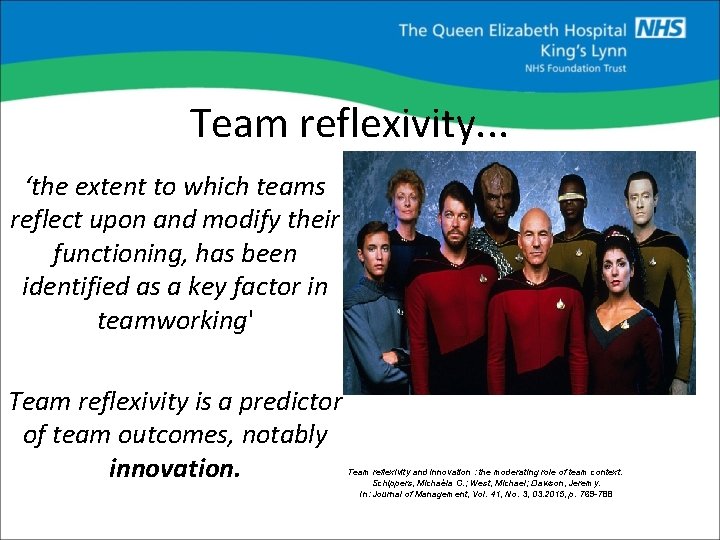
Team reflexivity. . . ‘the extent to which teams reflect upon and modify their functioning, has been identified as a key factor in teamworking' Team reflexivity is a predictor of team outcomes, notably innovation. Team reflexivity and innovation : the moderating role of team context. Schippers, Michaéla C. ; West, Michael; Dawson, Jeremy. In: Journal of Management, Vol. 41, No. 3, 03. 2015, p. 769 -788
Reflexivity therefore. . . 'as an act of self-reference where examination or action "bends back on", refers to, and affects the entity instigating the action or examination' Bryant, C. G. A. (2002). 'George Soros's theory f reflexivity: a comparison with theories of Giddens and Beck and a consideration of its practical value', Economy and Society, 31 (1), pp. 112– 131.
Hold on a moment. . “Norms, purpose, values, objectives? ? ? ” What do these mean to you as • a team • Registrant • An organisation Is there harmony or conflict?
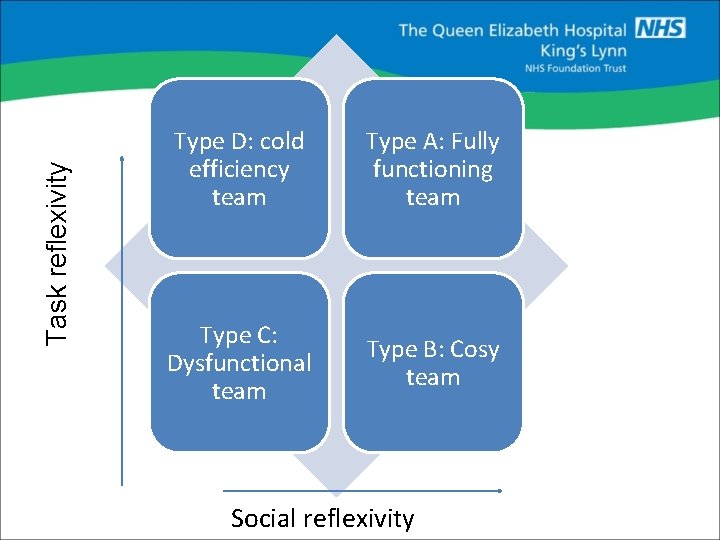
Task reflexivity Type D: cold efficiency team Type A: Fully functioning team Type C: Dysfunctional team Type B: Cosy team Social reflexivity
TYPES OF TEAM • The type A ‘fully functioning team represents a team which reflects on and modifies its objectives, processes, tasks and social support strategies appropriately in changing circumstances. ’
TYPES OF TEAM The type B ‘cosy team “has a good deal of warmth, support and cohesion amongst team members … the organisation’s satisfaction with team members is low … staying in a poorly functioning team will corrode job satisfaction”
The type C ‘dysfunctional team • … have low viability since team members are dissatisfied with both interpersonal relationships and with the sense of achievement and quality of work. ’
The type D ‘cold efficiency team • … task performance is generally good, but poor social functioning damages team viability and the mental health of members. ’ • (West, 2004)
SWOT Team! Do your team SWOT assessment What three things would you change to optimise it? Take a look at the NHS Leadership Academy paper ‘engaging teams’. Reflect and feedback: how do you influence your team?
Reflection Are boundaries important in a team? Identify 3 examples Which boundaries are important to you? What happens to the team without boundaries?
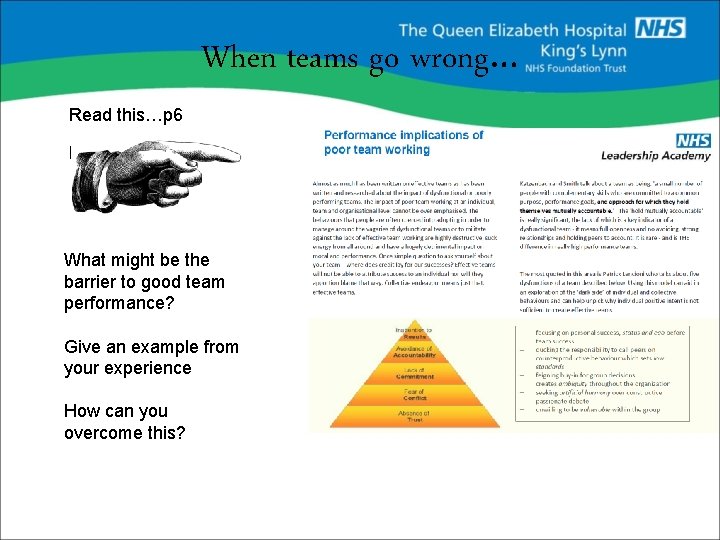
When teams go wrong… Read this…p 6 Read this… What might be the barrier to good team performance? Give an example from your experience How can you overcome this?
When teams go wronger… Watch the Carolyn Ginns (IQUIP/ CQC) interview and reflect on what the quality indicators for teams are.
Head in the clouds. . . 2 minute word clouds Finally, in groups, think about the key words and terms from this session which relate to you, your team and your learning. Reflect on why you've chosen these. Submit your list to the facilitator for conversion to a word cloud for your clinical area!
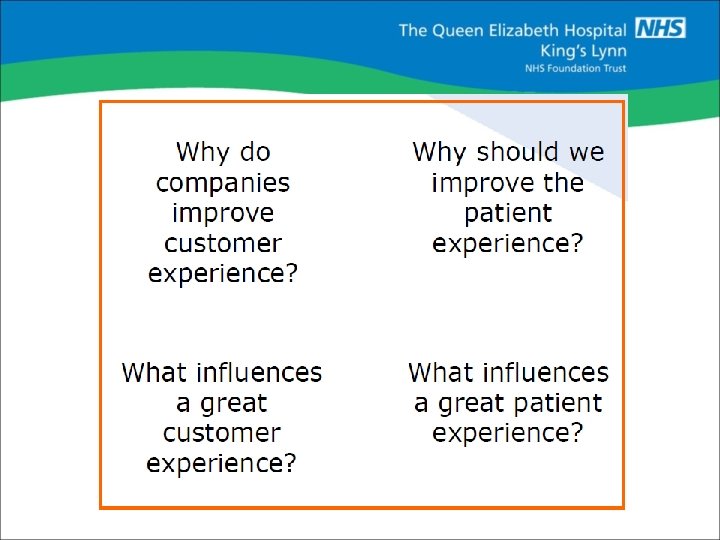
Patient experience Why do we need to improve it?
Service Safari is a method used by many top organisations and adapted by the NHS Institute for healthcare settings. It enables a team to observe a range of service experiences in a short space of time and is a fantastic source of ideas. Planning Choose a clinical area preferably one with which you are not familiar. Before the safari starts make everyone aware of the aims, which are: q to use observation skills q to walk in the shoes of a service user q to identify signals of good or poor service experience - what do you see, hear and feel? q Generate ideas for how the practice can improve patient experience
The safari has three phases – before, during and after: 1. Before is about defining purpose and capturing individual expectations 2. During is about exploring, observing, taking notes and photographs, recording feelings. 3. After is about going back to the original purpose. Before the safari starts have a discussion about some of the things to observe in each experience, e. g. : • staff behaviours • managers • environment • service users • processes
For next time: www. humanmetrics. com Identify your personality type with the Jung Typology Test™. Obtain your type description and discover which career choices and schools are the most suitable for your type.