
Welcome to Crabapple Middle School 6 th grade
Welcome to Crabapple Middle School 6 th grade Transition Rako Morrissey Principal Nancy Thweatt , Cheryl Stephenson, & George Weathers Assistant Principals Hina Patel and Amy Levin 6 th Grade counselors 107 o 0 Crabapple Road Roswell, GA 30075 Phone: (470) 254‐ 4520 and Fax: (470) 254‐ 4524 http: //school. fultonschools. org/ms/crabapple/Pages/default. aspx
Overview of Crabapple MS Principal: Dr. Rako Morrissey 6 th grade Administrator: Mrs. Cheryl Stephenson 6 th grade counselors: Mrs. Amy Levin and Mrs. Hina Patel Grades: 6 th‐ 8 th Mascot: Huskies Student Pop. : App. 970 Class Size: Usually between 24‐ 34, except in homeroom. School Hours: 8: 55 am – 4: 05 pm (2016‐ 2017)
6 th grade- A year of transition! Becoming familiar with the new building layout Adjusting to the new schedule with multiple teachers Struggling to remember homework Learning study skills Strong emotions‐ acting out, feeling hurt, defining authority by defying it Feeling uncomfortable or awkward in their own skin Needing parents but wanting freedom Dealing with pressures from peers, society, parents, and teachers
What adolescents crave… positive social interaction with adults and peers peer acceptance structure and clear limits physical activity creative expression competence and achievement meaningful participation in families, school and communities opportunities for self‐definition
PBIS At CMS, we are making a conscious decision to focus on rewarding desired behaviors rather than giving negative attention to undesired behaviors. This system is called PBIS – Positive Behavior Intervention and Support. Students get points daily for being engaged, respectful and prepared for their classes. Students work toward earning rewards with their points such as quarterly grade level celebrations (dress up days, free lunch seating). CMS also has policies for dealing with negative behaviors – they can include parent contact, silent lunch, time out, detention, office referral, etc.
th 6 Grade Curriculum Course Offerings in 6 th grade LA – LA 6, LA 6 A, LA 7 A Math – Math 6, Math 6 A, Math 7 A, Math 8 Social Studies – Social Studies 6, Social Studies 6 A Science – Earth Science 6, Earth Science 6 A Reading World Language – Spanish, French, or German Specific Curriculum information can be found at http: //www. fultonschools. org/en/divisions/acd/learnteach/Learning% 20 and%20 Teaching/FCS%20 Curriculum%20 Handbook%20 MS%20201 5‐ 2016. pdf#search=math%208%20 gse%20 standards
Personalized Instruction through technology We are personalizing instruction using 1: 1 i. Pads for project‐based learning. Each student receives a device through Fulton County paid for with SPLOST funds. -The device at CMS is an i. Pad - Continuous teacher training on personalized learning The devices are used for students to access digital content. ‐ Enhance personalized learning for each student ‐ NOT a replacement for the teacher ‐ Projects/activities as a supplement to the learning process Our goal is that students are learning with technology and using this as a productive tool of academic inquiry.
Course Placement Course placements are determined by 5 th grade teachers. If you have questions about your child’s placement for next year, contact your child’s 5 th grade teacher. Spanish, German, and French is offered to students that ‐ Grade 4 Georgia Milestones Reading Indicator On/Above. In lieu of Georgia Milestones, Grade 5 ITBS Total Reading ≥ 60%ile Waiver for Math, LA, and World Language courses only (from 10 days of the start of the school year) Every effort is made for your child to be placed in classes with fellow 6 th grade students. However, the schedules of students taking certain accelerated classes may require placement with the grade level appropriate to the content.
German is the most widely spoken language in Europe. It is one of the most important languages for international business. There are more than 400 German companies with subsidiaries right here in Georgia. Porsche and Mercedes have headquarters in Atlanta. It is also a very important language for engineering and high‐tech companies. German is the 2 nd most commonly used scientific language. Germany is known for its beauty and is one of the most popular tourist destinations for people around the world.

French VIVE LE FRANÇAIS! Did you know that… Fifty percent of current English vocabulary is derived from French? France is the world’s top tourist destination and attracts more than 84 million visitors a year? French is the international language of culture‐cooking, fashion, theatre, the visual arts, dance and architecture? More than 220 million people speak French on five continents? French is the only language, alongside English, that is taught in every country in the world?
Connections courses Connections classes are like Specials in elementary school. Some of our connections classes are Art, Drama, Engineering, Business & Computer Science, General Music, Health and PE. Any non‐year long Music students will have PE year long Music Programs – Band, Chorus and Orchestra (Year Long) Connection classes are randomly assigned, with the exception of music programs. Students dress out for every PE class. Students change in the boys’ and girls’ locker rooms before and after PE. Students may rent a locker space for safe‐keeping of personal belongings. PE Uniforms will be available for purchase during Information Day.
Homeroom Character Education ‐ Homeroom teachers facilitate character education lessons that focus on community involvement, anti‐bullying strategies, study/organizational skills, as well as team building activities DEAR time (Drop Everything And Read) ‐This is specific time set aside where students engage in reading for pleasure • Junior Achievement & 7 Habits for Highly Effective Teens • Guided work period
Grading Grades can be accessed electronically from our Home Access Center available on our website. Parents will receive a password at the start of the school year. We strongly encourage you to monitor your child’s progress via Home Access Center. Report cards are sent home each 9 weeks, with a progress report going home each 4½ weeks. Grades are cumulative for an entire semester. At the end of each semester, students are recognized for outstanding grades. Graded papers are returned to students in class. (They are not sent home directly to parents as in elementary school) Standards based reporting & letter grade (work habits/conduct grade) 90 – 100 = A 80 – 89 = B 70 – 79 = C 69 and below = F
Daily Procedures Students in middle school have to deal with lockers, class changes, bathroom breaks, and a variety of other transitional activities. The students do not need to visit their lockers after every class period. We provide times for students to use their lockers and go to the bathroom. It may be helpful for students to practice working with a locker combination over the summer. Transition time between classes is usually very short ranging between 3‐ 5 minutes. This is plenty of time as long as students do not continuously stop in the halls and engage in long conversations with friends. Your student will be assigned a homeroom teacher. 6 th graders have very little interaction with 7 th and 8 th graders Students can arrive as early as 7: 55 am and report to the Café Arrivals from 8: 25 – 8: 45, report to the gym. After 8: 45, report to homeroom. Lunch lasts 30 minutes. Money can be placed on a student’s lunch account for daily use. (No Charging)
Dress Code The administration reserves the right to assess appropriateness of dress and to intervene when necessary. Clothing must fit correctly. Clothing must not be too tight or oversized. Pants, shorts, and skirts must be worn at the waist. Pants/skirts/shorts with holes frays are not acceptable during school. Pants may not drag the floor. Undergarments must be covered by another appropriate article of clothing at all times. The leg(s) of pants may not be rolled up. T‐shirts must be in good taste (no suggestive wording or illustrations or advertisements for items which are illegal for middle school students ‐ i. e. alcohol and tobacco products, weapons, violence or of such a nature to cause disruption in the school). Hats, curlers, combs, hair picks, bandannas, sweat bands, sunglasses, pajamas, running shorts and gloves may not be worn during school. Appropriate shoes for school must be worn at all times. "Flip–flops" (shower shoes) and slippers are not permitted for safety reasons. The length of shorts, dresses and skirts should be three inches above the knee or longer. Sleeveless shirts are not allowed for boys and girls need to have at least 3 finger width fabric on each shoulder. Girls: tops must be long enough to totally cover derrieres when wearing leggings
Lockers Students will be assigned a locker during Information Day. Teachers will attempt to assign a locker relatively close to a student’s classes Rolling backpacks are not allowed 12” Locker shelves work well in lockers‐ anything smaller is not adequate Put your child’s name on everything‐ binders, book bags, PE uniforms, lunch, etc.
Communication with teachers Email is the most efficient way to contact teachers. Conferences are scheduled by teacher invitation or parent request. Conferences are almost always conducted with multiple teachers present. By having multiple teachers in attendance, we can get a better overall picture of how your child is doing. The communication protocol is: Teacher Grade‐level counselor Grade‐level administrator Principal
Homework is to give your child the extra practice they might need in a particular subject. Homework may consist of studying for a quiz or test, completing assignments, working on long term projects and practicing skills and vocabulary. Homework may be online Students should expect approximately 1‐ 1½ hours of homework per night. Even if a student does not have homework one night, they should still read over their notes
Helpful Homework Resources Teacher Websites Teachers’ Help Sessions Counselor Support Friends/classmates‐ Students should get a phone number for 1 or 2 reliable classmates Device
Homework Tips Provide a place to study and work free of distractions (soft music can be helpful) Give your student encouragement – “You can do this” Have necessary supplies in 1 place (on the desk, kitchen table, office area, etc) Establish a regular time for homework with breaks built in (20 min work, 10 min break) Study or work with other students if needed (via phone, Skype, at each others’ homes, library, etc) Your child may still need your help, but work toward independence
Some of our clubs… Academic Bowl Builders Club Chess Club CMSTV Drama Club Helen Ruffin Reading Bowl Newspaper Club/CMS Press Interact Club Drama Club Junior Beta Club French Club German Club Intramurals/Extramurals Student Council Robotics Club Young Sophisticated Divas No Place for Hate Husky Help Desk
Suggestions for Success in Middle School Complete all projects and homework ON TIME! Stay organized, record all assignments, and complete all homework. Plan and manage your time well. Create a time management chart & follow. Seek help from your teachers and counselor as soon as you need it, and don’t wait until you are overwhelmed Attend Working Lunch to work on organization, project, read, study, or work together with a student Go to your teachers’ websites Go to your teachers’ help sessions Go to your online textbook links
Organization is a challenge for many 6 th graders. With time and patience, students create a system that works for them. We recommend that 6 th grade students use 1 binder with 1 pocket divider for each class (show an example) Hole punch everything and place it in the appropriate divider section during that class Use a system to organize the papers in each section (either a portfolio table of contents with numbered papers or based on date‐ even if the teacher doesn’t provide a system, create one) Never shove paper into a book and plan to organize later‐ that’s how things get lost and how you get overwhelmed Note test dates and also on several days before to remind yourself to study Keep locker neat Break down large projects into smaller tasks
Study Tips Attend teacher help sessions Ask the teachers questions about what you don’t understand Have 1 – 2 “study buddies” in each class that you can study with/ask questions Success in school depends on how well you plan and manage your time! Some students prefer a quiet place to help them concentrate, while others find it helpful to work near an adult to ask for help when needed. Ask you teacher for a blank copy of the study guide or review activity and take it like a test then check yourself using your completed study guide Create flashcards. When you quiz yourself, make three piles “don’t know it”, “kinda know it”, “knew it right away”. Keep studying the first two piles until you can move all cards to the last pile. We like to study the stuff we know a lot because it makes us feel good to get things right but the majority of our energy needs to be on the ones we don’t know. Teach a friend, parent, sibling the material. Have them ask you questions when they don’t understand so you can see where the gaps are in your own understanding. Create your own test and answer key and have a classmate try to take it (or ask your teacher to take it!) Look for other tips on the CMS Counseling website
Top concerns of th 6 graders Getting to class on time – utilizing lunch time Finding & utilizing his/her locker – remembering locker combination Having more homework Being more responsible Having more teachers Getting through crowded hallways Remembering which class to go to next Keeping up with materials New grading procedures Getting on the right bus to go home on time Getting lost No recess, no free time The older students Making new friends, keeping old friends Bullying/Sexual Harassment Coping with adolescents changes – growing up
Support from Counselors at CMS Help students deal with and diffuse problems brought into school from home and outside the classroom Act as consultants to teachers and serve as sources of institutional knowledge for administrators Provide academic and career guidance to students, and help them meet and overcome emotional‐ and mental‐ health challenges Establish and promote supportive learning environments Develop academic and behavioral intervention programs Foster and maintain parental involvement
Tips Communicating with Middle School Counselors ‐ Give the new counselor a head’s up on potentially disruptive conflicts. Middle school counselors can help to address these concerns. Become informed about your new school by attending orientations, tours, read school guides and student handbooks and visit school web site regularly for current information. Look into clubs, area activities ‐ Peer acceptance and self –esteem issues become increasingly important. Provide opportunities for your child to develop their interests and socialize with friends, but be sure to monitor their choices. Books on transitioning/dealing with adolescent issues Talk with your child about the transition and how they feel and why they feel that way See what the school’s requirements are over the summer, i. e, Math packet, etc Involvement with PTA If you have questions or concerns don’t hesitate to call or email the school staff. Know the name of their the teachers and the school counselor for their grade.
More Tips Ask to see their assignments Organization and time management skills must be developed so students will not feel overwhelmed. Be sure to limit after –school recreational activities, provide a quiet study area and expect to see your child working regularly on homework and long‐term projects. Set rules about TV and computer use. Help your child study for tests and quizzes Monitor and support (HW, attendance, internet sites) Know the dress code for your school and check to see that your child is wearing “school friendly” attire daily. Check the calendar– know when interims and report cards go out, if there are early release days and any dates of special activities. Be sure the main office has current contact information – don’t assume your child will know or share changes in phone numbers or addresses. Help your student manage the PACING of projects. (They are never assigned the day before. )
Even More Tips Check in periodically about your child’s progress. Encourage your child to ask for extra help when needed. Insist students come to school daily Talk to your child about school and peers. Listen for comments that reflect what they are feeling and thinking. Expect your child to make mistakes and have personal struggles. Give them time to think and make decisions about how to handle their problems and deal with the consequences. Allow your child to gain a sense of independence and responsibility. DON’T forget that your child is young and there will be bumps in the road. Mistakes will be made‐‐ but it’s all a part of the learning process. Due to the rapid development, early adolescence is a time to actually increase parental involvement, not reduce it. “It is not what you do for your children, but what you have taught them to do themselves that will make them successful human beings. ” ‐‐ Ann Landers
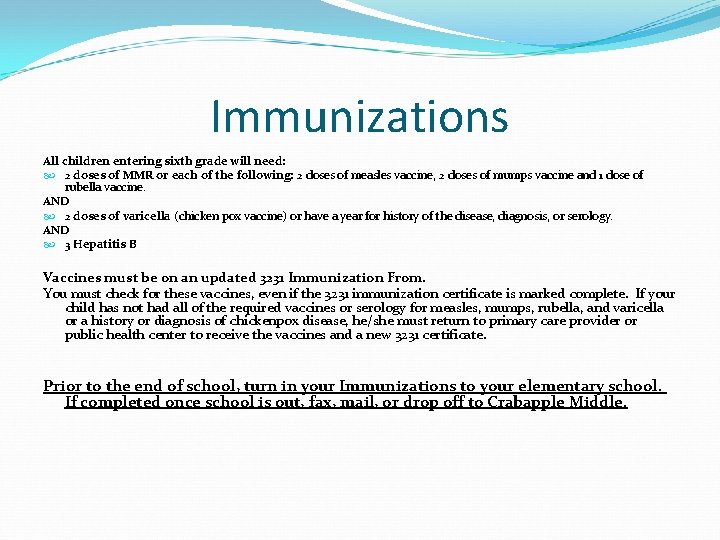
Immunizations All children entering sixth grade will need: 2 doses of MMR or each of the following: 2 doses of measles vaccine, 2 doses of mumps vaccine and 1 dose of rubella vaccine. AND 2 doses of varicella (chicken pox vaccine) or have a year for history of the disease, diagnosis, or serology. AND 3 Hepatitis B Vaccines must be on an updated 3231 Immunization From. You must check for these vaccines, even if the 3231 immunization certificate is marked complete. If your child has not had all of the required vaccines or serology for measles, mumps, rubella, and varicella or a history or diagnosis of chickenpox disease, he/she must return to primary care provider or public health center to receive the vaccines and a new 3231 certificate. Prior to the end of school, turn in your Immunizations to your elementary school. If completed once school is out, fax, mail, or drop off to Crabapple Middle.
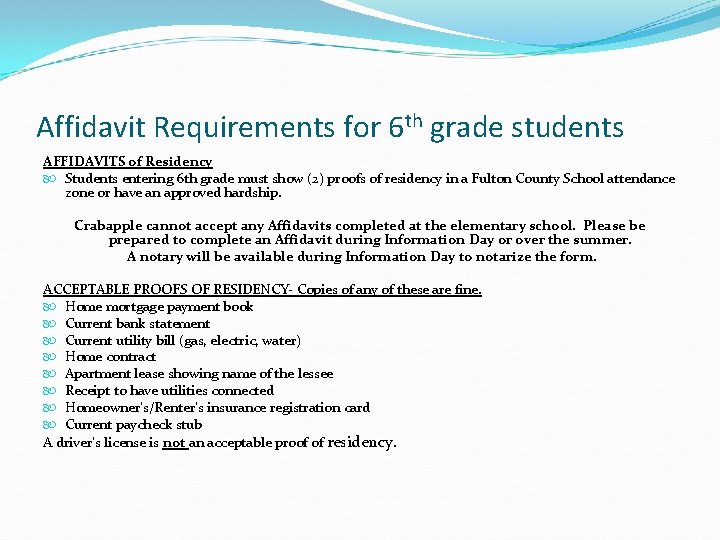
Affidavit Requirements for 6 th grade students AFFIDAVITS of Residency Students entering 6 th grade must show (2) proofs of residency in a Fulton County School attendance zone or have an approved hardship. Crabapple cannot accept any Affidavits completed at the elementary school. Please be prepared to complete an Affidavit during Information Day or over the summer. A notary will be available during Information Day to notarize the form. ACCEPTABLE PROOFS OF RESIDENCY‐ Copies of any of these are fine. Home mortgage payment book Current bank statement Current utility bill (gas, electric, water) Home contract Apartment lease showing name of the lessee Receipt to have utilities connected Homeowner’s/Renter’s insurance registration card Current paycheck stub A driver’s license is not an acceptable proof of residency.
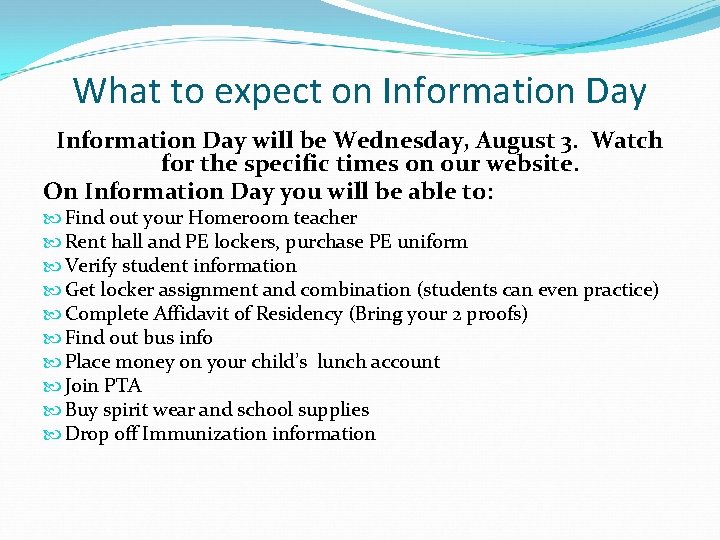
What to expect on Information Day will be Wednesday, August 3. Watch for the specific times on our website. On Information Day you will be able to: Find out your Homeroom teacher Rent hall and PE lockers, purchase PE uniform Verify student information Get locker assignment and combination (students can even practice) Complete Affidavit of Residency (Bring your 2 proofs) Find out bus info Place money on your child’s lunch account Join PTA Buy spirit wear and school supplies Drop off Immunization information
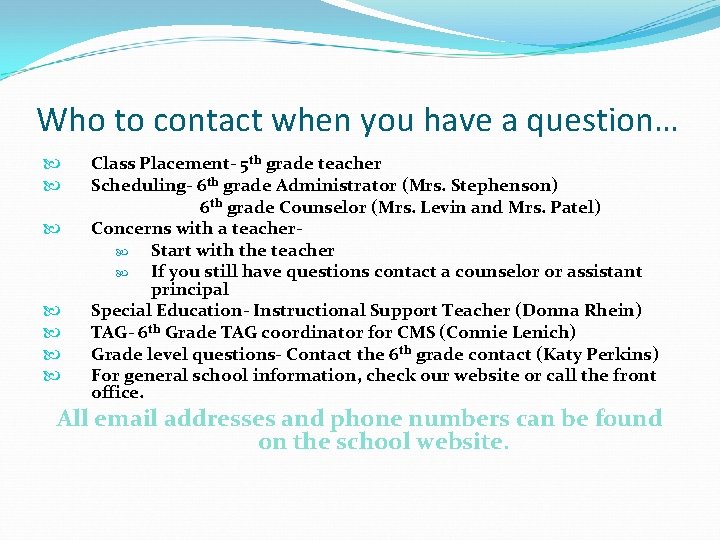
Who to contact when you have a question… Class Placement‐ 5 th grade teacher Scheduling‐ 6 th grade Administrator (Mrs. Stephenson) 6 th grade Counselor (Mrs. Levin and Mrs. Patel) Concerns with a teacher‐ Start with the teacher If you still have questions contact a counselor or assistant principal Special Education‐ Instructional Support Teacher (Donna Rhein) TAG‐ 6 th Grade TAG coordinator for CMS (Connie Lenich) Grade level questions‐ Contact the 6 th grade contact (Katy Perkins) For general school information, check our website or call the front office. All email addresses and phone numbers can be found on the school website.
Important Dates to Remember March: Monday, March 28– Wednesday, March 30, 2016 @ 9 am – 12 pm (CMS) * PTA Parent Tours of CMS April: Tuesday, April 28 @ 9 am, 2016 (RNES) *Bridges students speak with 5 th grade classrooms May: Tuesday, May 3, 2016 (CMS) *Rising 6 th grade tour: 9 – 11: 30 am (MPES: 9 – 10 am; 10 – 10: 30 am (Welcome); RNES: 10: 30 – 11: 30 am) Wednesday, May 4 @ 1 pm, 2016 (MPES) *Bridges students speak with 5 th grade classrooms
Thank you for attending. We look forward to seeing you in August. Questions about 6 th grade transition? Send an email to the CMS counselors for a response between March 4 ‐ May 27, please send an email to askcrabapplemscounselors@gmail. com
- Slides: 35