
Welcome to Computer Science II for Majors CMSC


- Slides: 14
Welcome to Computer Science II for Majors CMSC 202 Spring 2000
Course Prerequisites • CMSC 201 (grade of B or better) or equivalent • MATH 151 (grade of C or better) or equivalent
CMSC Gateway Warning! If you started college for the first time in Summer 1998 or later you are under the “CMSC Gateway” and must complete CMSC 201 and CMSC 202 with a grade of B or better. Because of the registrar’s rules regarding class sequences, students who received a C in 201 must retake CMSC 201 before taking CMSC 202. If you choose not to retake CMSC 201 you cannot graduate as a computer science major. You have been warned.
Required Skills • Fluency in C or C++. This means: – – – Basic data types (int, float, etc. ) Control structures (if, while, for, etc. ) Arrays (single and multi-dimensional) Functions Compound data types (struct) Creating working programs (writing, compiling, debugging) – Top down design (problem decomposition)
Required Skills (cont’d) – Header files – Arithmetic, relational, and logical operators – File I/O – Strings – Pointers
Enrolling in a closed section • Go to room ECS 208 and fill out the paperwork for enrolling in a closed section. After I give authorization you will need to register for the class yourself.
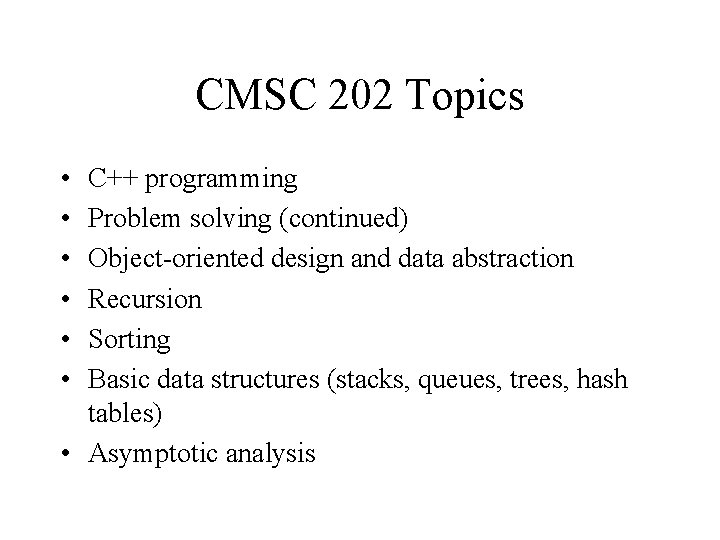
CMSC 202 Topics • • • C++ programming Problem solving (continued) Object-oriented design and data abstraction Recursion Sorting Basic data structures (stacks, queues, trees, hash tables) • Asymptotic analysis
Course Web Page All materials for this class can be found at: http: //www. csee. umbc. edu/courses/undergraduate/202 Read the syllabus for this course online immediately.
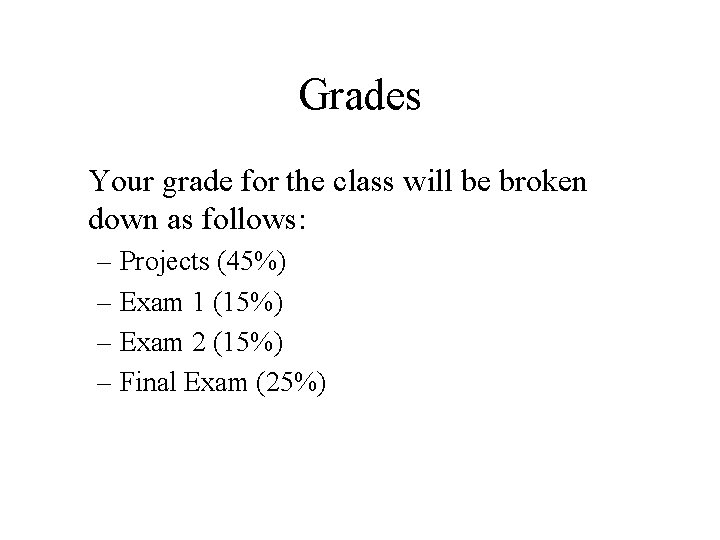
Grades Your grade for the class will be broken down as follows: – Projects (45%) – Exam 1 (15%) – Exam 2 (15%) – Final Exam (25%)
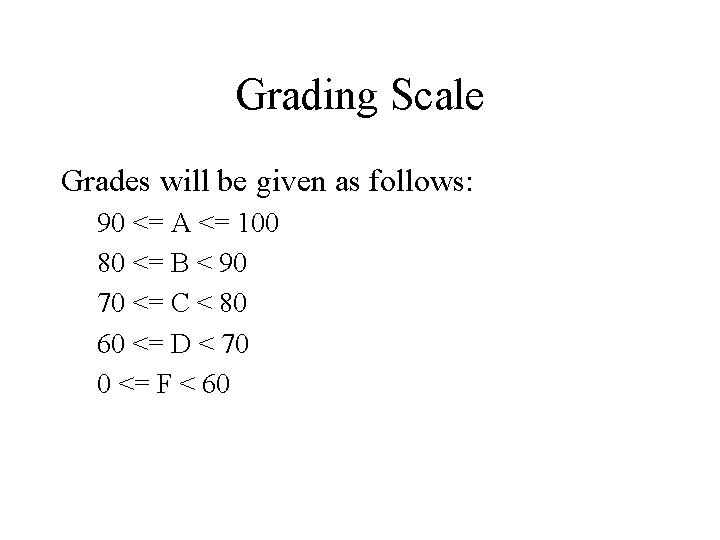
Grading Scale Grades will be given as follows: 90 <= A <= 100 80 <= B < 90 70 <= C < 80 60 <= D < 70 0 <= F < 60
Academic Dishonesty • Don’t cheat. Period. • This means don’t: – Share code (hardcopy or electronic) – Bring answers in to the test outside of your head.
Discussion Sections • Discussion is for your benefit • Discussions are supplements – Discussion should help solidify lecture material • Some new material may be covered in discussion, but you will not be responsible for it.
Programming Projects Five projects (5%, 10%, 15%) – 1 in C, 4 in C++ – Do your own work; don’t share code. – Submitted electronically. • Test this with project 0 – Accepted up to two (2) days late. -10% per day. – Use the class coding/commenting standards.
Getting Help • • • Ask questions Go to discussion Office hours (posted on the web) Email CSHC and UCS Consultants – Remember, UCS staff cannot help with project assignments.