
Welcome to Chest Imaging Jeannie Kochkodan Dr Perry



- Slides: 23
Welcome to Chest Imaging! Jeannie Kochkodan, Dr. Perry Pernicano, & Dr. Cyril Grum
Thank you! A huge thank you to Dr. Perry Pernicano for providing his time and many images to make this possible!
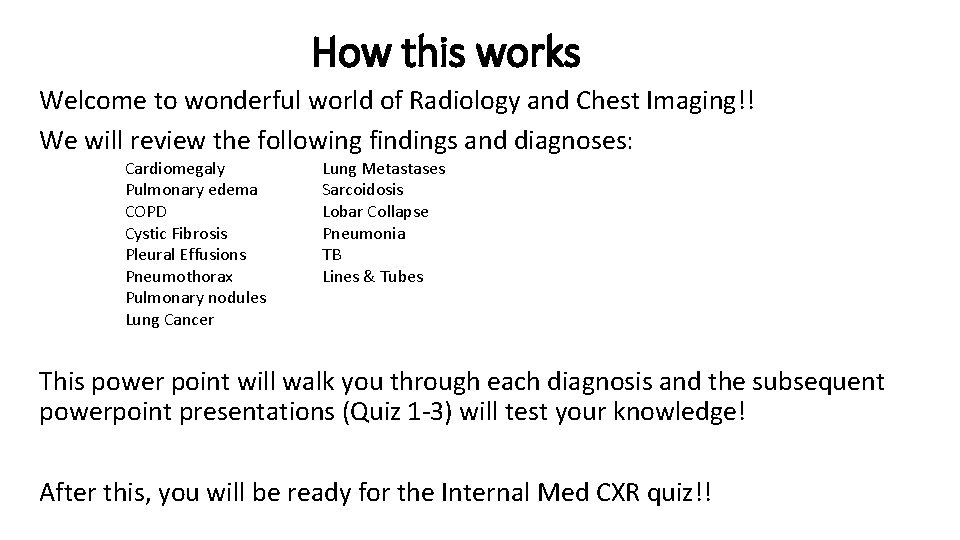
How this works Welcome to wonderful world of Radiology and Chest Imaging!! We will review the following findings and diagnoses: Cardiomegaly Pulmonary edema COPD Cystic Fibrosis Pleural Effusions Pneumothorax Pulmonary nodules Lung Cancer Lung Metastases Sarcoidosis Lobar Collapse Pneumonia TB Lines & Tubes This power point will walk you through each diagnosis and the subsequent powerpoint presentations (Quiz 1 -3) will test your knowledge! After this, you will be ready for the Internal Med CXR quiz!!
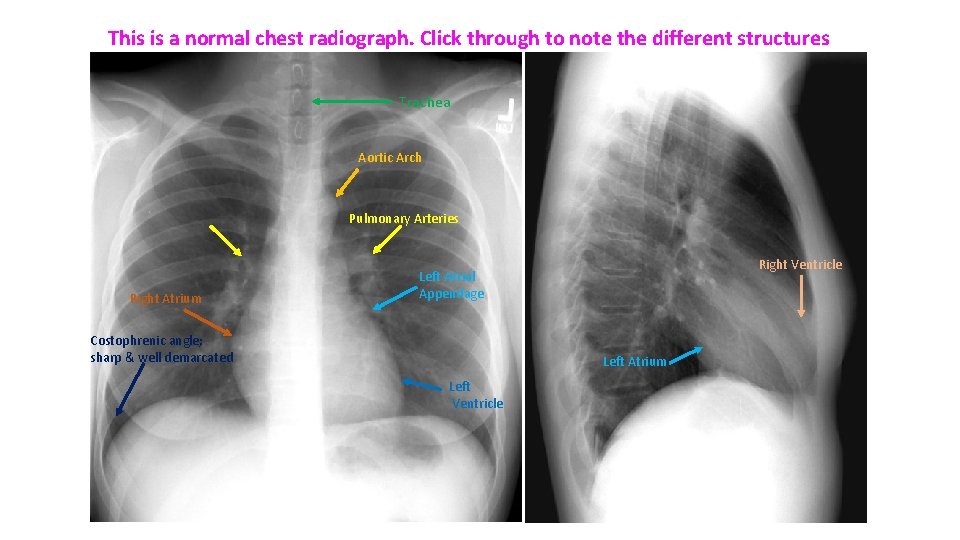
This is a normal chest radiograph. Click through to note the different structures Trachea Aortic Arch Pulmonary Arteries Right Atrium Right Ventricle Left Atrial Appendage Costophrenic angle; sharp & well demarcated Left Atrium Left Ventricle
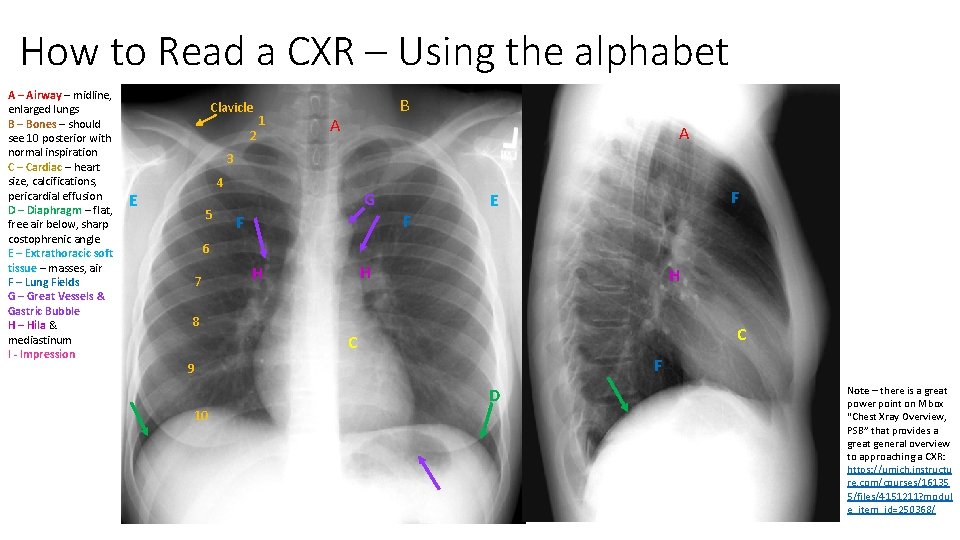
How to Read a CXR – Using the alphabet A – Airway – midline, enlarged lungs B – Bones – should see 10 posterior with normal inspiration C – Cardiac – heart size, calcifications, pericardial effusion D – Diaphragm – flat, free air below, sharp costophrenic angle E – Extrathoracic soft tissue – masses, air F – Lung Fields G – Great Vessels & Gastric Bubble H – Hila & mediastinum I - Impression Clavicle 2 1 B A A 3 4 E 5 G F F F E 6 7 H H H 8 C C F 9 D 10 Note – there is a great power point on Mbox “Chest Xray Overview, PSB” that provides a great general overview to approaching a CXR: https: //umich. instructu re. com/courses/16135 5/files/4151211? modul e_item_id=250368/
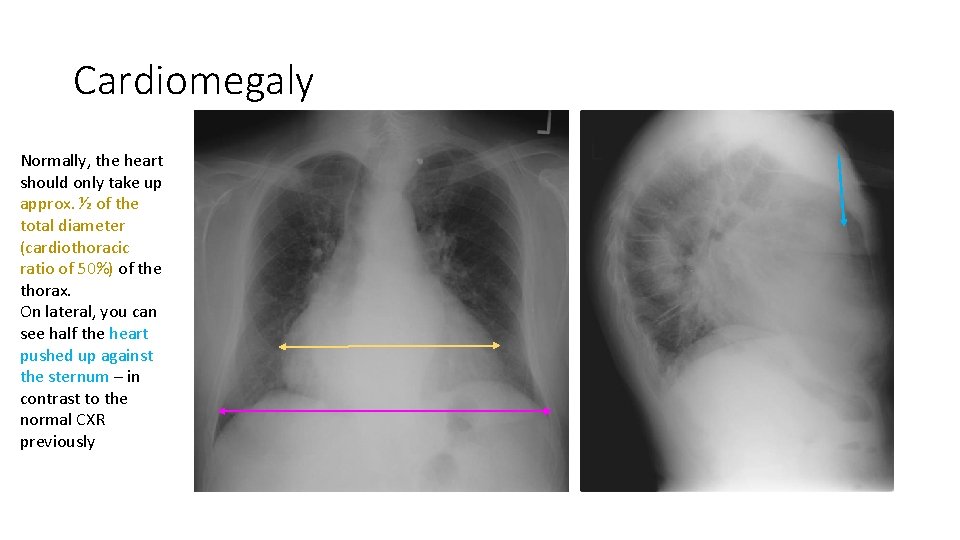
Cardiomegaly Normally, the heart should only take up approx. ½ of the total diameter (cardiothoracic ratio of 50%) of the thorax. On lateral, you can see half the heart pushed up against the sternum – in contrast to the normal CXR previously
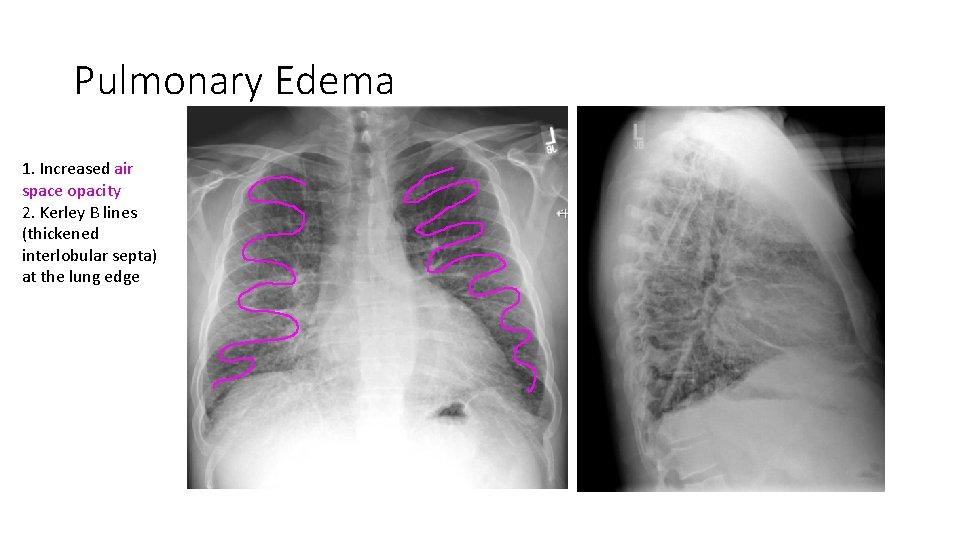
Pulmonary Edema 1. Increased air space opacity 2. Kerley B lines (thickened interlobular septa) at the lung edge
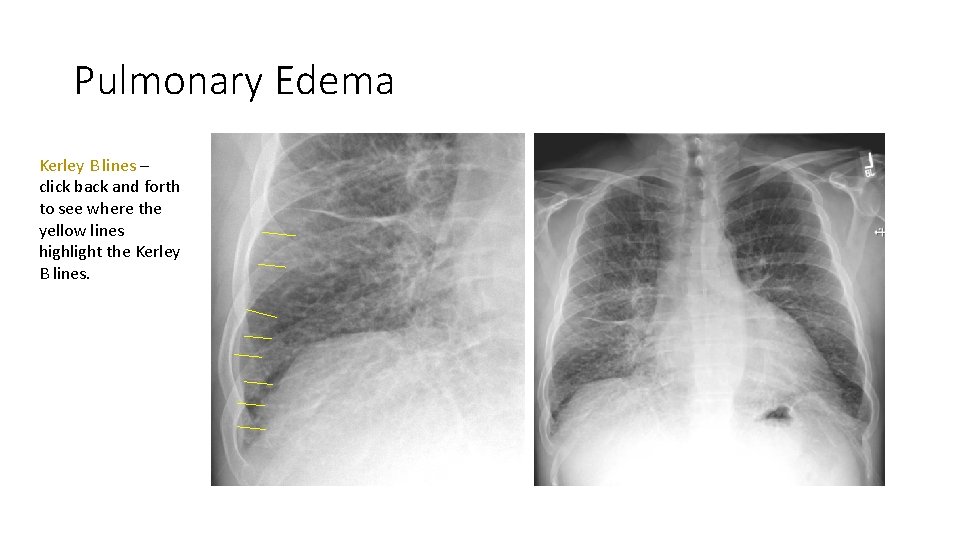
Pulmonary Edema Kerley B lines – click back and forth to see where the yellow lines highlight the Kerley B lines.
COPD 1. Hyperinflated lungs – can usually see more than the normal 10 ribs 2. Flattened diaphragm on lateral view 3. Heart can appear small 4. Increased AP diameter (Barrel Chested) on lateral view. 2 3 4 5 6 7 8 9 10 11
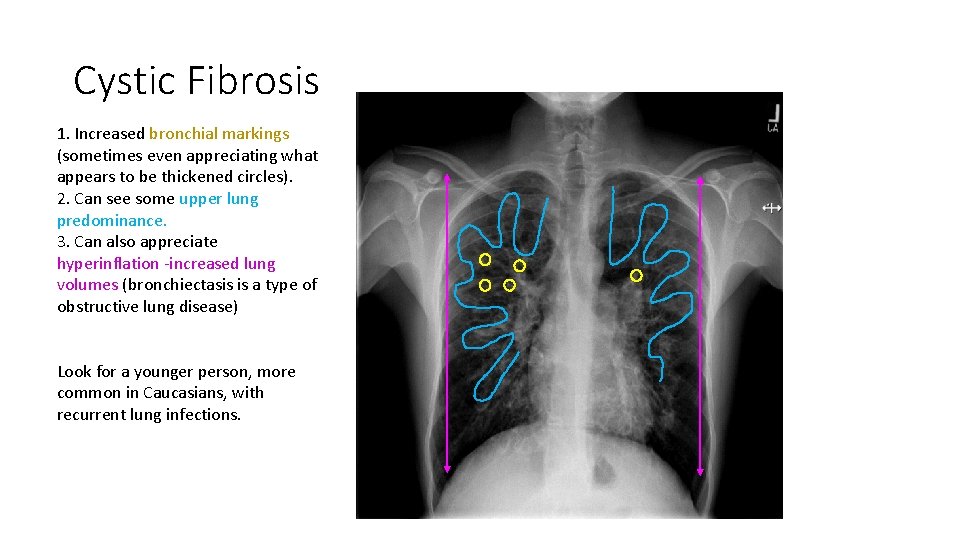
Cystic Fibrosis 1. Increased bronchial markings (sometimes even appreciating what appears to be thickened circles). 2. Can see some upper lung predominance. 3. Can also appreciate hyperinflation -increased lung volumes (bronchiectasis is a type of obstructive lung disease) Look for a younger person, more common in Caucasians, with recurrent lung infections.
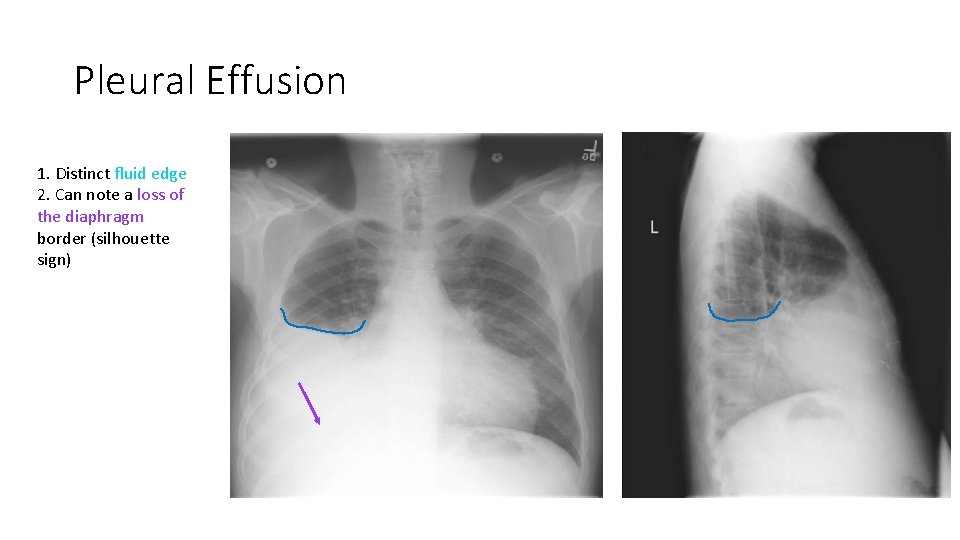
Pleural Effusion 1. Distinct fluid edge 2. Can note a loss of the diaphragm border (silhouette sign)
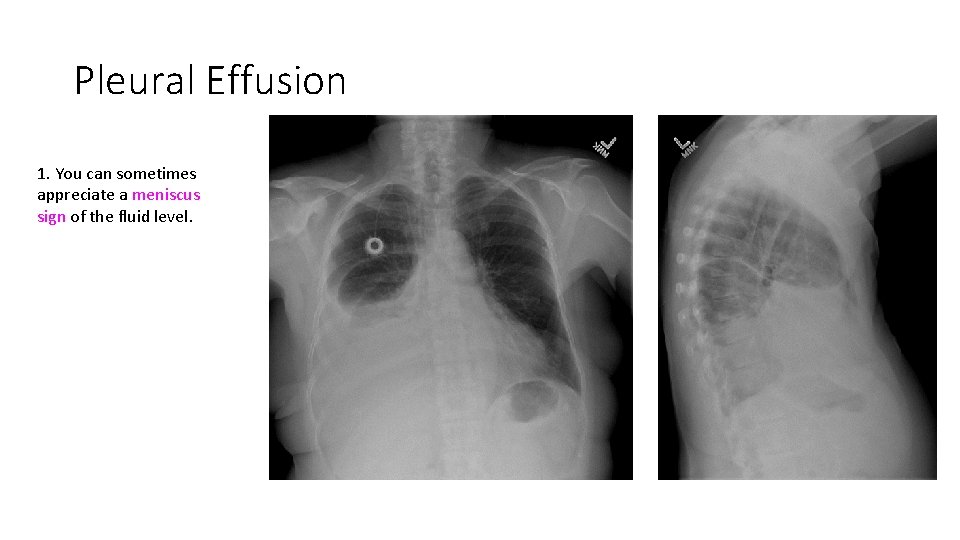
Pleural Effusion 1. You can sometimes appreciate a meniscus sign of the fluid level.
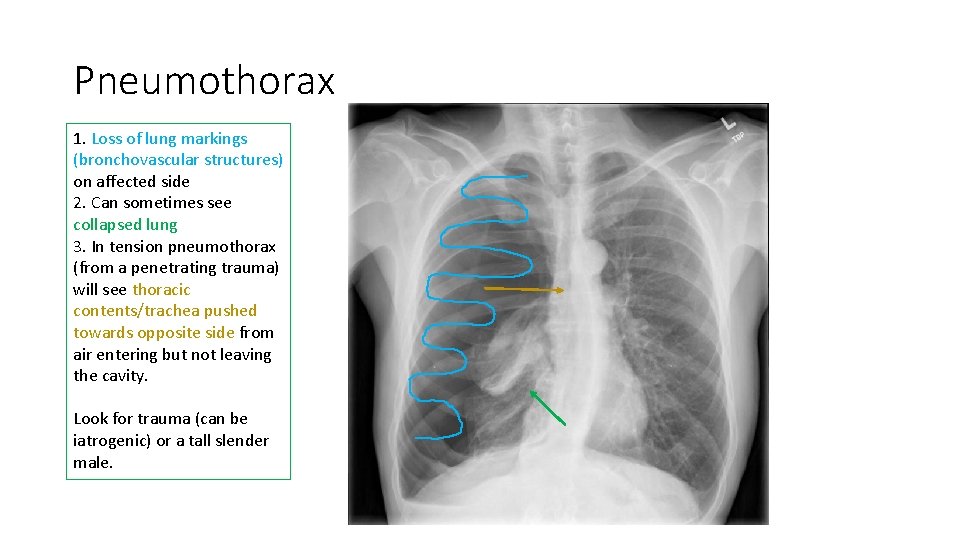
Pneumothorax 1. Loss of lung markings (bronchovascular structures) on affected side 2. Can sometimes see collapsed lung 3. In tension pneumothorax (from a penetrating trauma) will see thoracic contents/trachea pushed towards opposite side from air entering but not leaving the cavity. Look for trauma (can be iatrogenic) or a tall slender male.
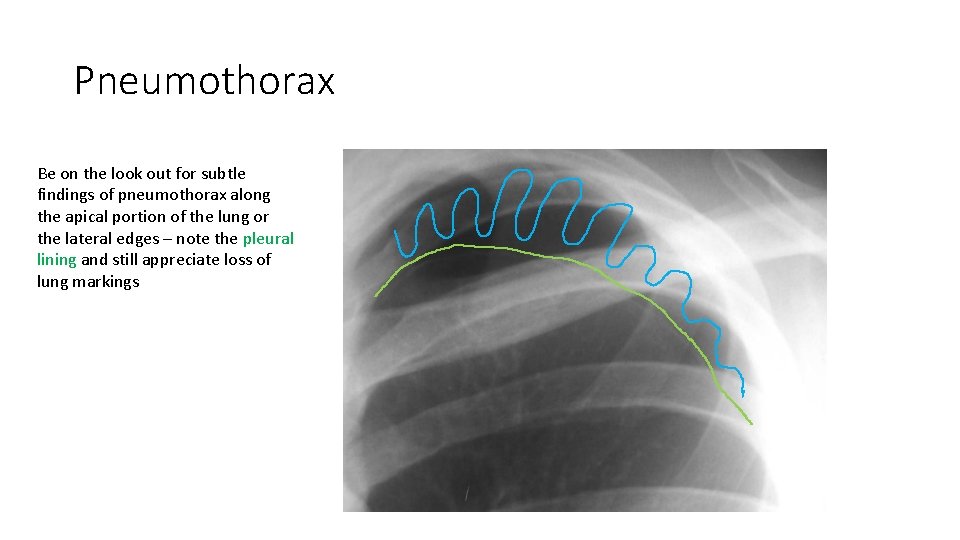
Pneumothorax Be on the look out for subtle findings of pneumothorax along the apical portion of the lung or the lateral edges – note the pleural lining and still appreciate loss of lung markings
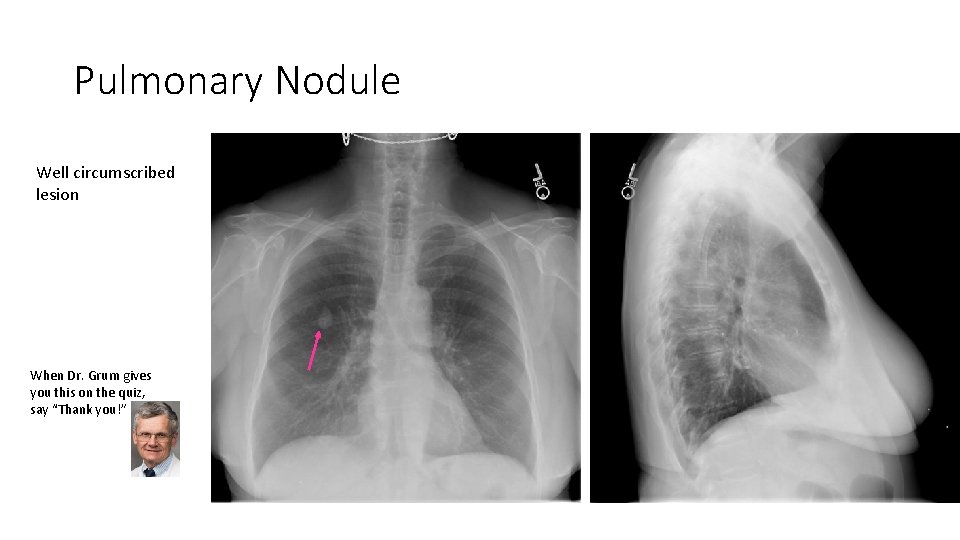
Pulmonary Nodule Well circumscribed lesion When Dr. Grum gives you this on the quiz, say “Thank you!”
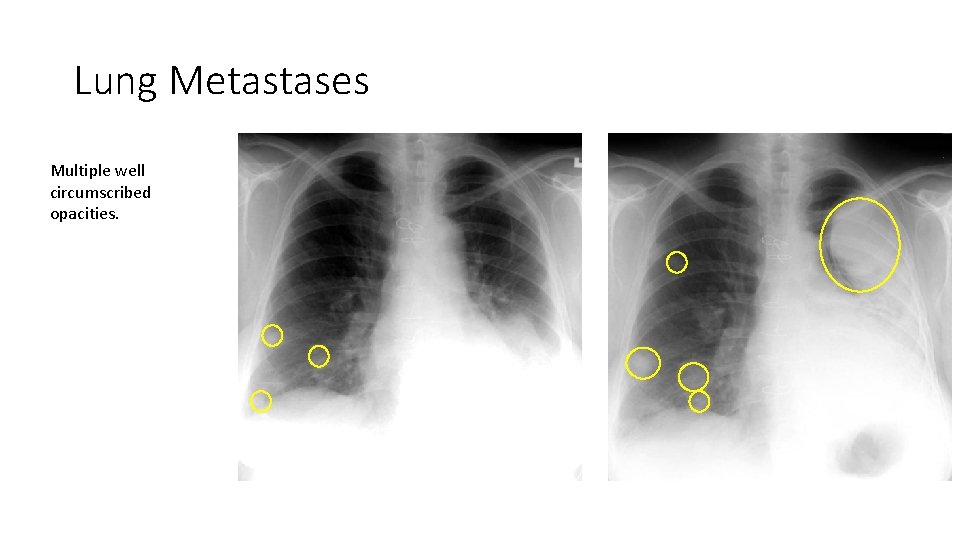
Lung Metastases Multiple well circumscribed opacities.
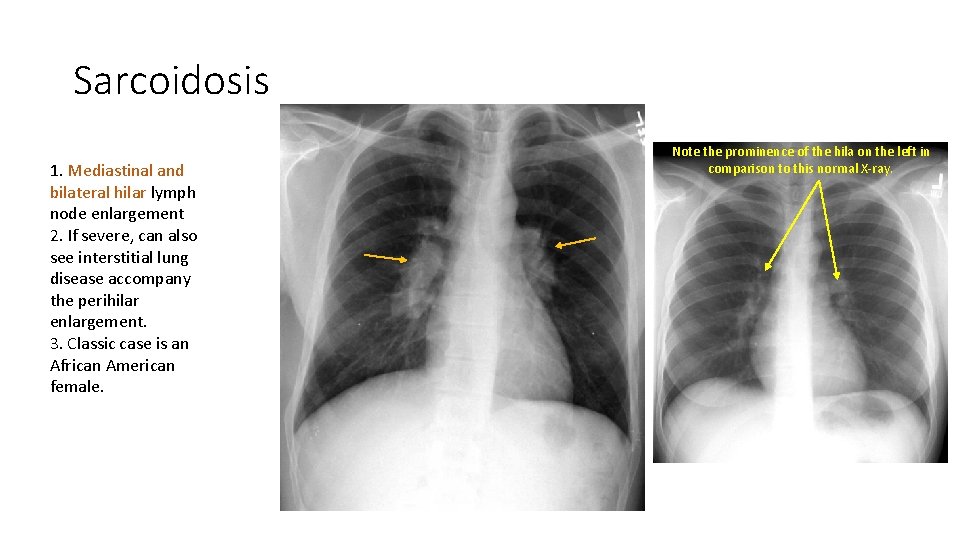
Sarcoidosis 1. Mediastinal and bilateral hilar lymph node enlargement 2. If severe, can also see interstitial lung disease accompany the perihilar enlargement. 3. Classic case is an African American female. Note the prominence of the hila on the left in comparison to this normal X-ray.
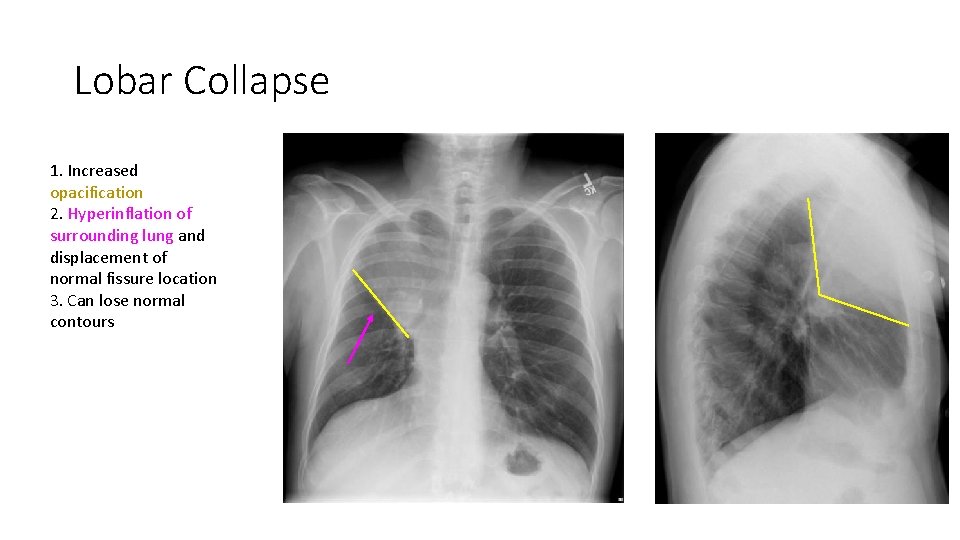
Lobar Collapse 1. Increased opacification 2. Hyperinflation of surrounding lung and displacement of normal fissure location 3. Can lose normal contours
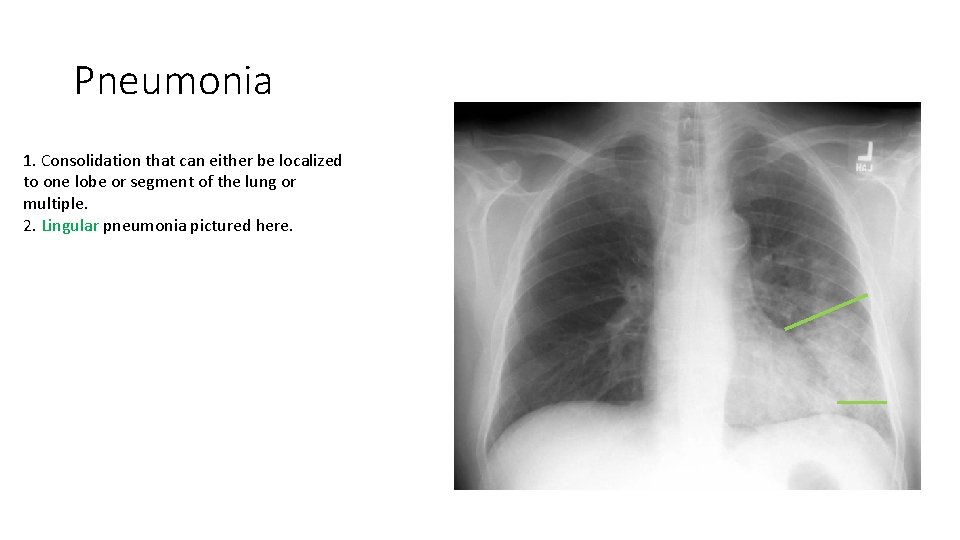
Pneumonia 1. Consolidation that can either be localized to one lobe or segment of the lung or multiple. 2. Lingular pneumonia pictured here.
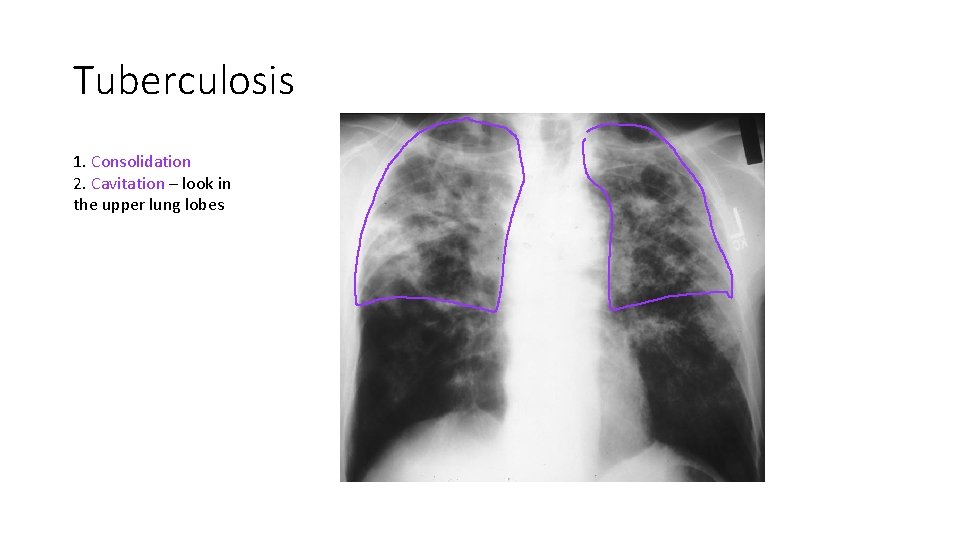
Tuberculosis 1. Consolidation 2. Cavitation – look in the upper lung lobes
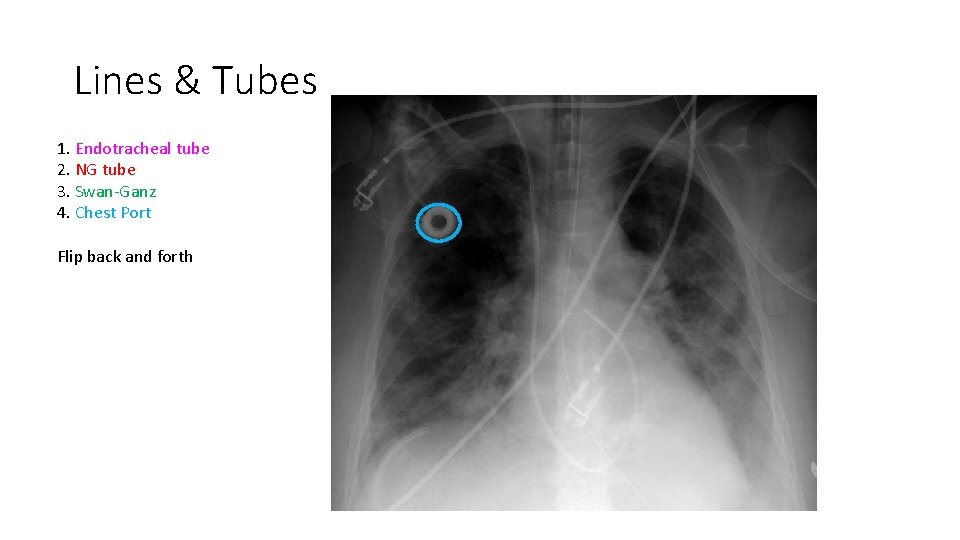
Lines & Tubes 1. Endotracheal tube 2. NG tube 3. Swan-Ganz 4. Chest Port Flip back and forth
What to do now Now that you have the basic principles down, head on over to quizzes 1 -3 to test your knowledge. - Note: for the quizzes, you will absolutely see all of the findings at least once across all of the quizzes, but each quiz may test you on the same diagnoses more than once, not at all, etc. (Trust me, it is best for the real Internal CXR quiz!)
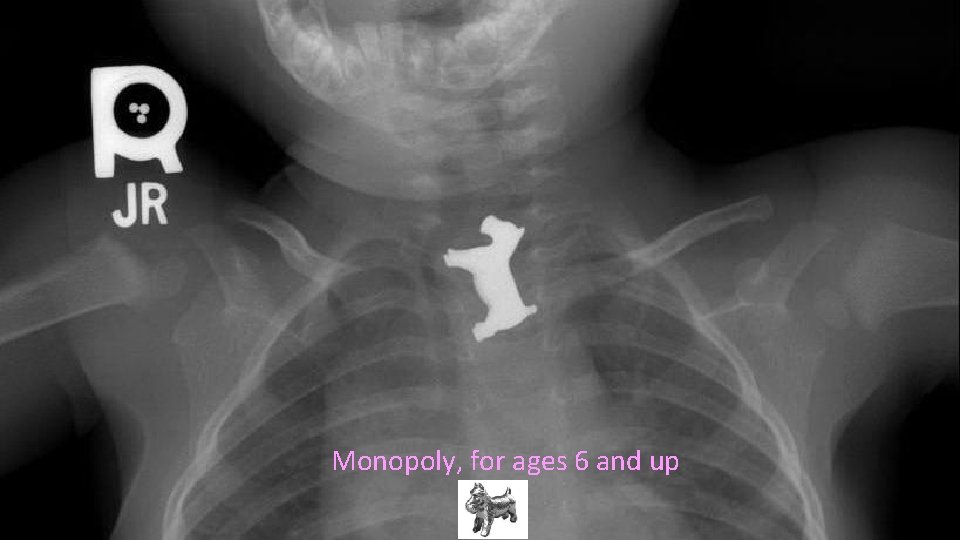
Monopoly, for ages 6 and up