
WELCOME to Ce BIT POWERHOUSEPC SHOW Alex Chow
WELCOME to Ce. BIT POWERHOUSEPC SHOW Alex Chow Sales
Catalog § Seasonic factory § Power Supply presentation § Why use seasonic? § Advantage and summarize 2008. 4 2
Factory Introduce § Company name: Sea Sonic Electronics Co. , Ltd. § Established : September 1975 § Pay-in Capital: US$18. 62 million § Major Product: Switch mode power supplies for PC, IPC, telecommunication and IT. 2008. 4 3
Our Mission Sea Sonic Electronics Co. , Ltd. is dedicated to: Products: Design the edge cutting products to lead the market; Marketing: Provide finest level of customized services Services: Maximum flexibility to meet our customers' needs Finance: company with a strong balance sheet. 2008. 4 4
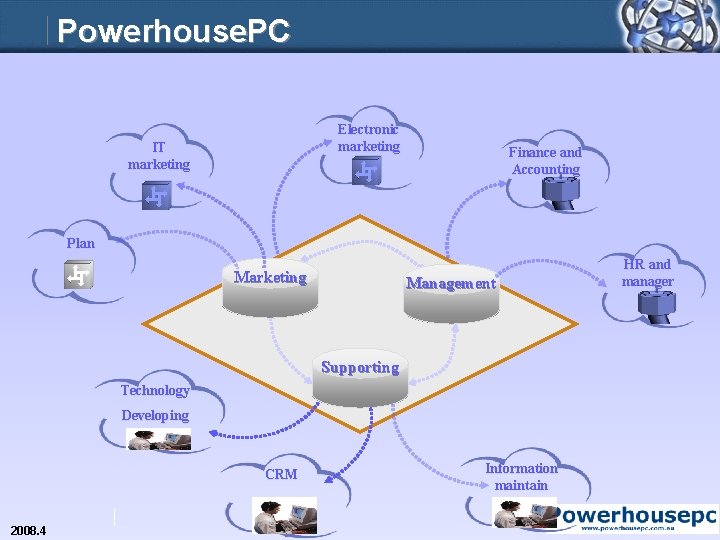
Powerhouse. PC Electronic marketing IT marketing Finance and Accounting Plan Marketing Management Supporting Technology Developing CRM 2008. 4 5 Information maintain HR and manager
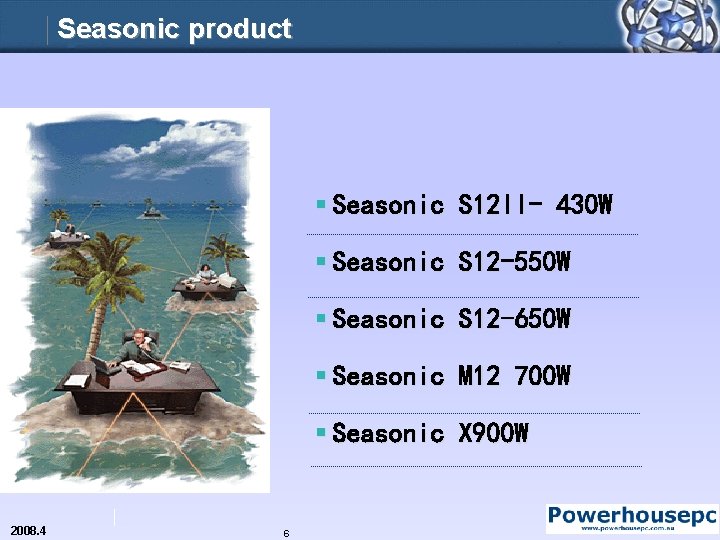
Seasonic product § Seasonic S 12 II- 430 W § Seasonic S 12 -550 W § Seasonic S 12 -650 W § Seasonic M 12 700 W § Seasonic X 900 W 2008. 4 6
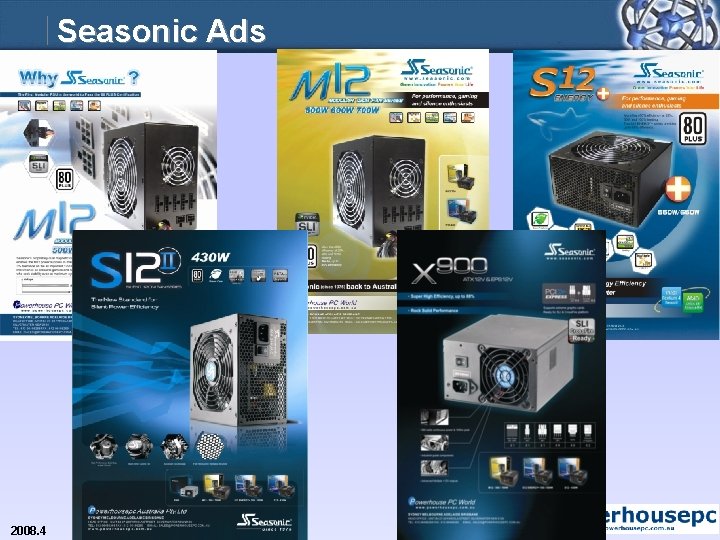
Seasonic Ads 2008. 4 7
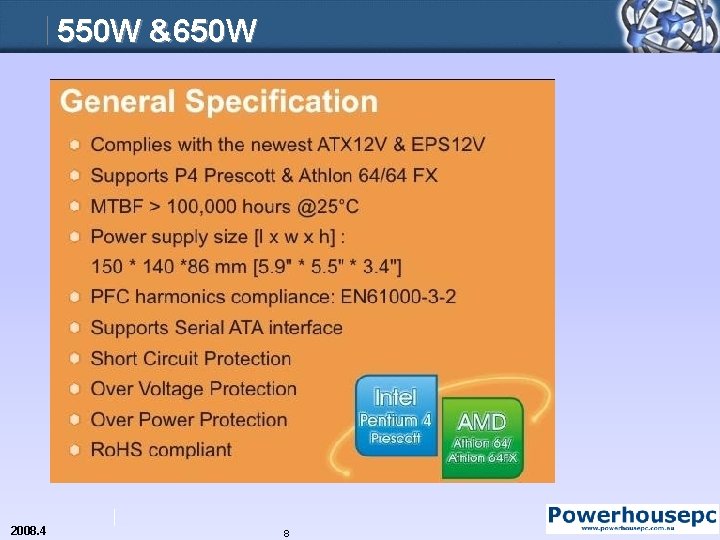
550 W &650 W 2008. 4 8
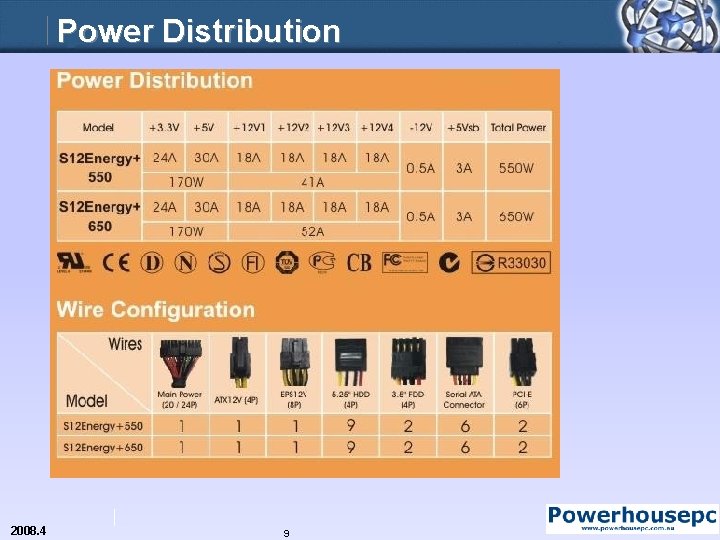
Power Distribution 2008. 4 9
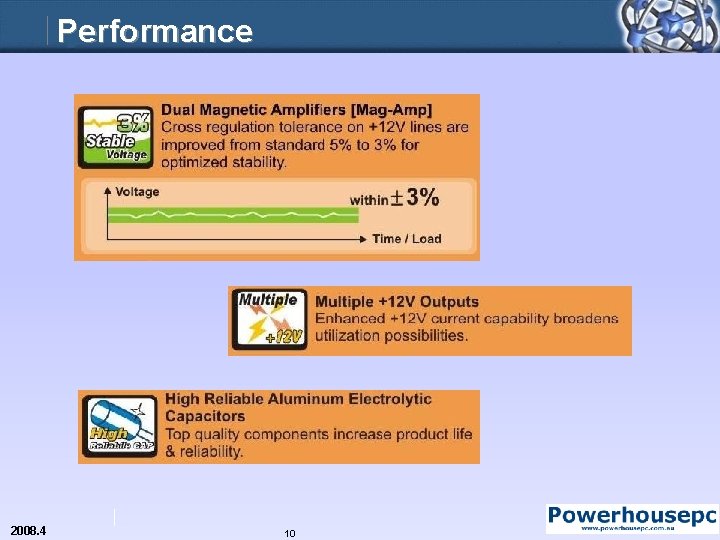
Performance 2008. 4 10
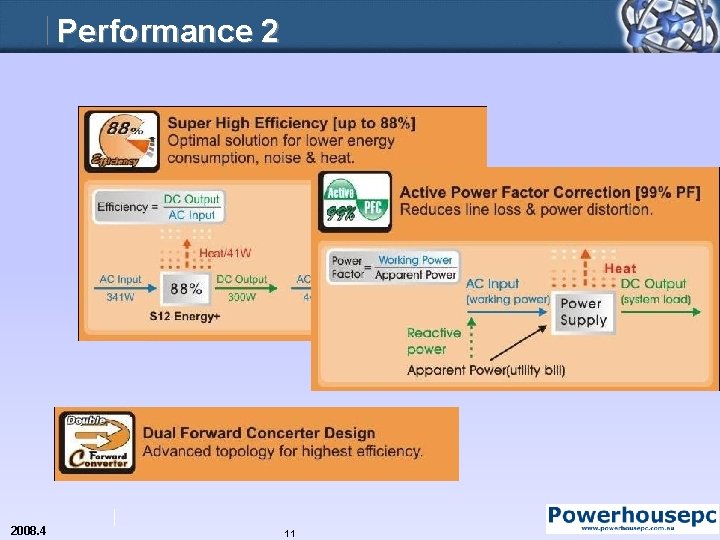
Performance 2 2008. 4 11
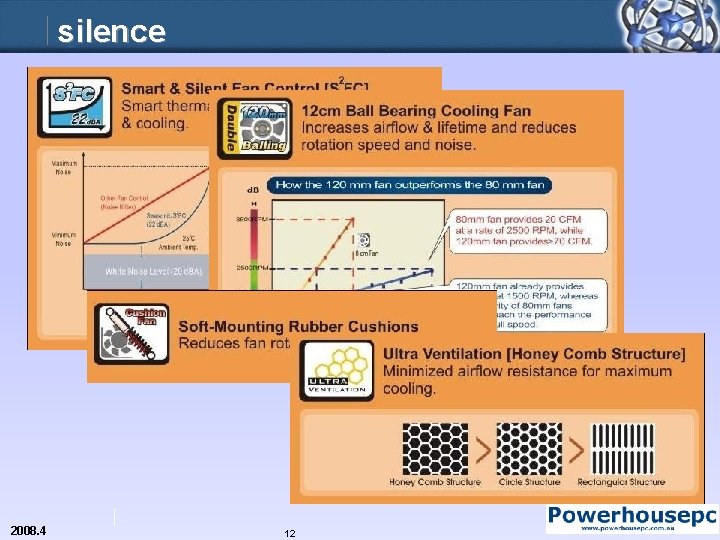
silence 2008. 4 12
Flexibility 2008. 4 13
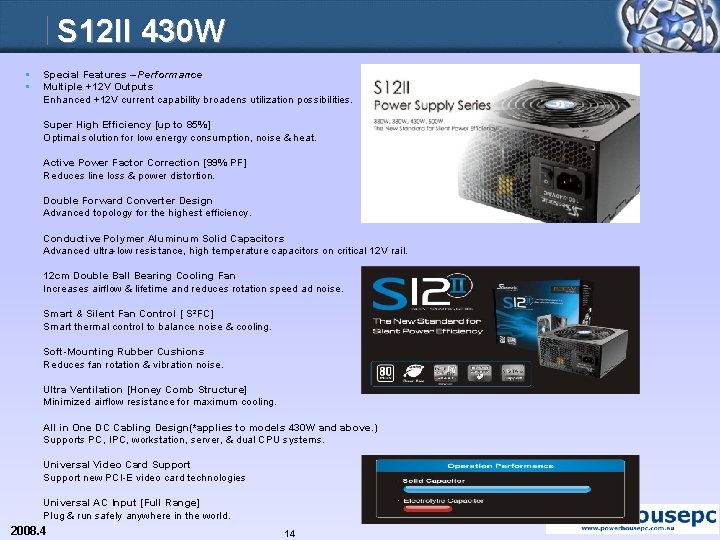
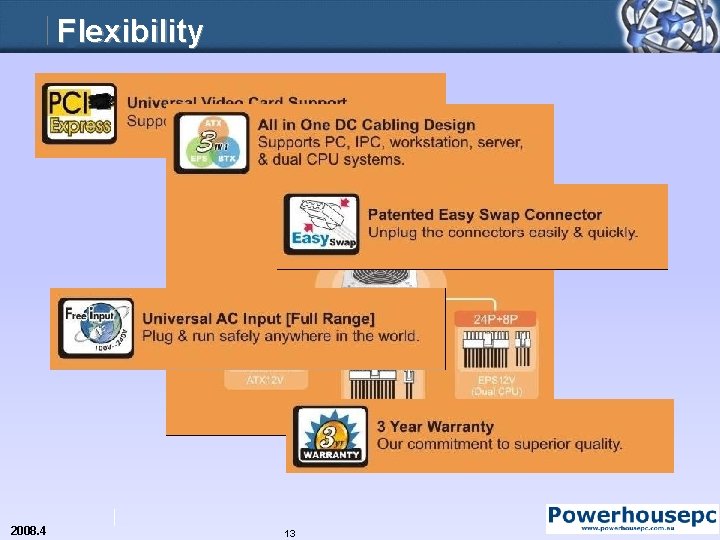
S 12 II 430 W § § Special Features – Performance Multiple +12 V Outputs Enhanced +12 V current capability broadens utilization possibilities. Super High Efficiency [up to 85%] Optimal solution for low energy consumption, noise & heat. Active Power Factor Correction [99% PF] Reduces line loss & power distortion. Double Forward Converter Design Advanced topology for the highest efficiency. Conductive Polymer Aluminum Solid Capacitors Advanced ultra-low resistance, high temperature capacitors on critical 12 V rail. 12 cm Double Ball Bearing Cooling Fan Increases airflow & lifetime and reduces rotation speed ad noise. Smart & Silent Fan Control [ S²FC] Smart thermal control to balance noise & cooling. Soft-Mounting Rubber Cushions Reduces fan rotation & vibration noise. Ultra Ventilation [Honey Comb Structure] Minimized airflow resistance for maximum cooling. All in One DC Cabling Design(*applies to models 430 W and above. ) Supports PC, IPC, workstation, server, & dual CPU systems. Universal Video Card Support new PCI-E video card technologies Universal AC Input [Full Range] Plug & run safely anywhere in the world. 2008. 4 14
Conclusions 430 W § The S 12 ii-430 takes Seasonic a small step further along the path to higher efficiency and lower noise. It is an improvement over the Super Tornado, albeit a small one for most users, but a more significant one if you have a system with hotter, more power hungry components. While the minimal noise level is about the same as in the older ST series, the new S 12 ii-430 fan controller ramps up considerably more gradually as the power load increases. This probably has to do the incremental improvement in efficiency and more efficient heatsinks that wick the heat away just a bit faster, thus keeping the PSU a bit cooler to a higher load with less airflow. We're pretty sure that the fan controller has been tweaked to take acoustic advantage of the improved thermal characteristics of this PSU. § Users of the Super Tornado 400 Rev. A 3 should not rush out to replace it with an S 12 ii-430; the gain will be marginal unless your system is pushing the fan controller to ramp up audibly. Even then, making improvements in your overall case airflow may give you more improvement with no money outlay, and the noise level of the ST may be low enough to be masked by louder components in your system anyway. § As well as the S 12 ii-430 performed, we were a bit disappointed that it did not quite reach the 80% or better efficiency at 20%, 50% and 100% loads achieved by Seasonic's Model SS-400 HT Active PFC in the 80 Plus program. § In summary, the S 12 ii-430 is the quietest fan-cooled PSU we have tested to date, by a small margin. It is also quite powerful enough for most systems, and very efficient. About the only thing more that a gamer might ask for is support for the 6 pin peripheral power connector used by power-hungry PCIe VGA cards; this feature is available in S 12 ii-430's bigger siblings, the S 12 -550 and the S 12 -650. 2008. 4 15
S 12 650 W in PCworld 2008. 4 16
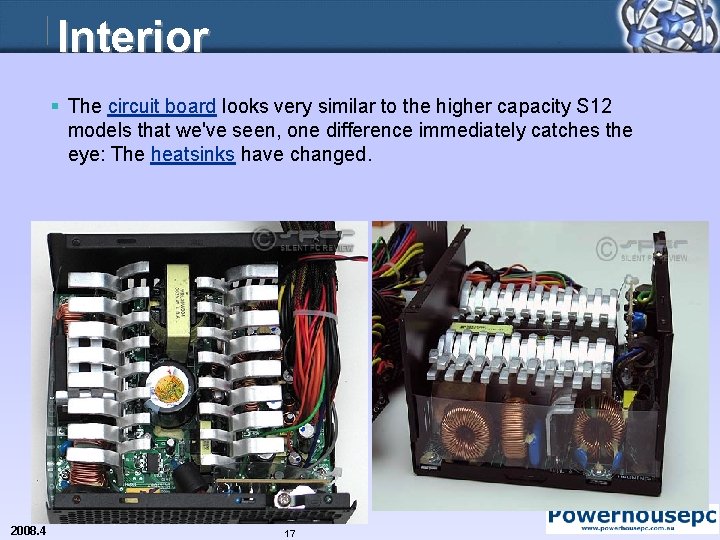
Interior § The circuit board looks very similar to the higher capacity S 12 models that we've seen, one difference immediately catches the eye: The heatsinks have changed. 2008. 4 17
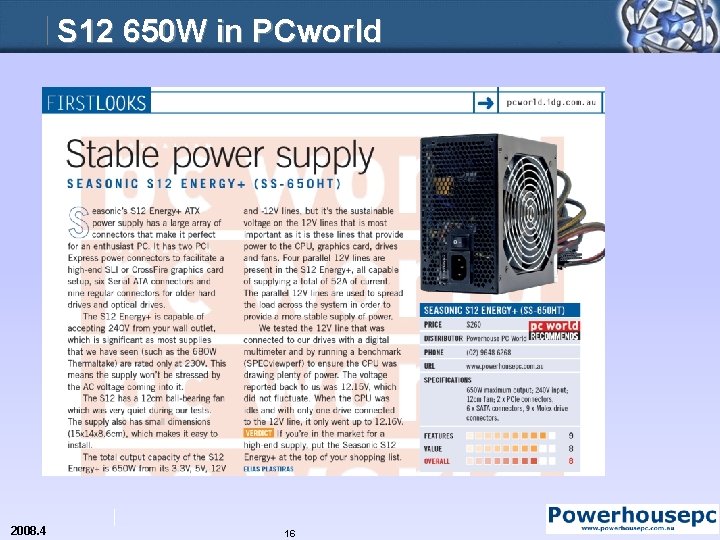
550 W and 650 W CONCLUSIONS § For a high end, blazing performance, dual-graphics, overclocked monster of a system, we know of no quieter power supply than the Energy Plus. Acoustically, the Energy Plus has surpassed our expectations of what is possible from a quiet power supply and set a new standard. With a fan that doesn't begin to increase in speed until 250 W output, it will take a concerted effort to force the Energy Plus to become noisy — a nice change from the need to put effort into preventing added noise. § As expected for an 80 Plus power supply, efficiency was top notch, and the 85% peak very close to the highest we've measured. That said, the high efficiency does need to be put into perspective. A little extra efficiency is nice to have in a powerful system, but an extra two or three percentage points doesn't work out to much of an energy saving unless the load is ridiculously high — which kind of defeats the purpose. In the range that most people will use it, the Energy Plus models are not any more efficient than Seasonic's existing models. § The biggest strike against the Energy Plus is its price. $150 for a power supply is far from pocket change, and there are plenty of cheaper alternatives that are just as quiet at lower levels. To reiterate: The Energy Plus is a power supply for connoisseurs: It's engineered beyond what most people need, but if you're looking for a special power supply for that special system, the Energy Plus fits the bill perfectly. § Nice as it is, we can't help asking where are the lower capacity models that perform like the OEM models that we've already seen from Seasonic. We know they are capable of building a power supply that is 84% efficient at 65 W. Where is the 330 W Energy Plus that can match the SS-300 SFD for low-load efficiency? Here's to hoping Seasonic brings one out for energy conscious silent PC enthusiasts. 2008. 4 18
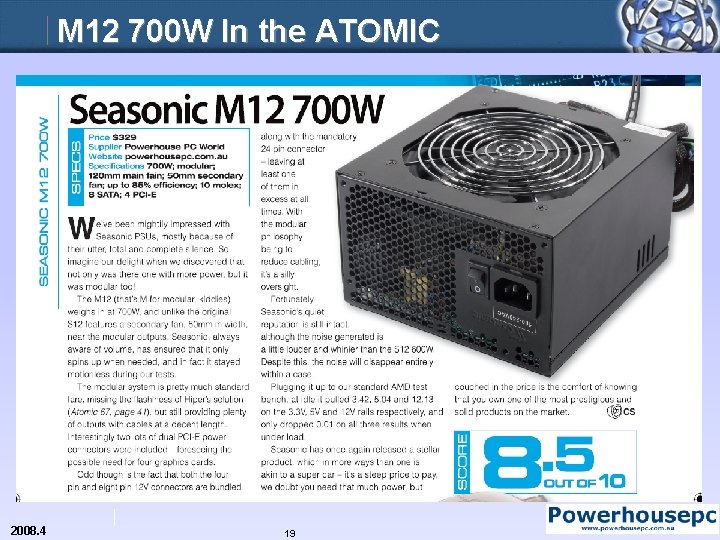
M 12 700 W In the ATOMIC 2008. 4 19
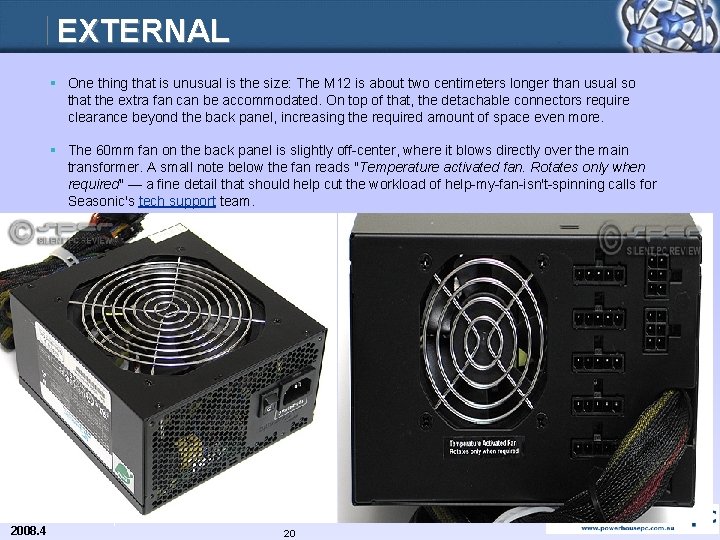
EXTERNAL § One thing that is unusual is the size: The M 12 is about two centimeters longer than usual so that the extra fan can be accommodated. On top of that, the detachable connectors require clearance beyond the back panel, increasing the required amount of space even more. § The 60 mm fan on the back panel is slightly off-center, where it blows directly over the main transformer. A small note below the fan reads "Temperature activated fan. Rotates only when required" — a fine detail that should help cut the workload of help-my-fan-isn't-spinning calls for Seasonic's tech support team. 2008. 4 20
Conclusions M 700 W § The M 12 is similar in many ways to Seasonic's recently released S 12 Energy Plus series. The two product lines are based on the same electronic design, they are both 80 Plus certified, and they both come in very high capacities. And, they now share the title of quietest power supply. Both are very quiet at idle, and will not get noisier unless pushed by a very powerful system. In fact, the main differences between the two product lines are summed up in the names themselves: The Energy Plus is slightly more efficient, while the M 12 (M for Modular) has modular cables. § If you've been dying for a quiet, modular, high power alternative to Antec's Neo HE, the M 12 can certainly deliver. The M 12 sports the best modular design that we've seen, and its powered by the high quality electronics that Seasonic is known for. § The drawbacks of the M 12 are the same ones that we saw in the S 12 Energy Plus: The high price and the huge capacities which are overkill for the vast majority of systems. The M 12 is wonderful for a high end bar-no-expense gaming rig, but more conventional systems will do better with a model that is more suitably sized. There is one other drawback: The 60 mm fan that doesn't turn off. Although it is not loud at minimum speed, it does contribute to noise, and a system that is powerful enough to cause the fan to start will need to be shut down to reset the noise level to the baseline level. The buzzing encountered with our samples can be annoying, but it's very specific to low loads, and it is not likely to be heard in any high power gaming rig, because the power demand even at idle will exceed 4 A on the 12 V lines. § There's no question that the M 12 is a high end product, with a price tag to match. It is targeted very specifically at gamers and overclockers that consider modular cables a mandatory feature — and want to take advantage of Seasonic's excellent general power delivery, efficiency and acoustics. If you fall into this market segment, the M 12 should satisfy just about perfectly. 2008. 4 21
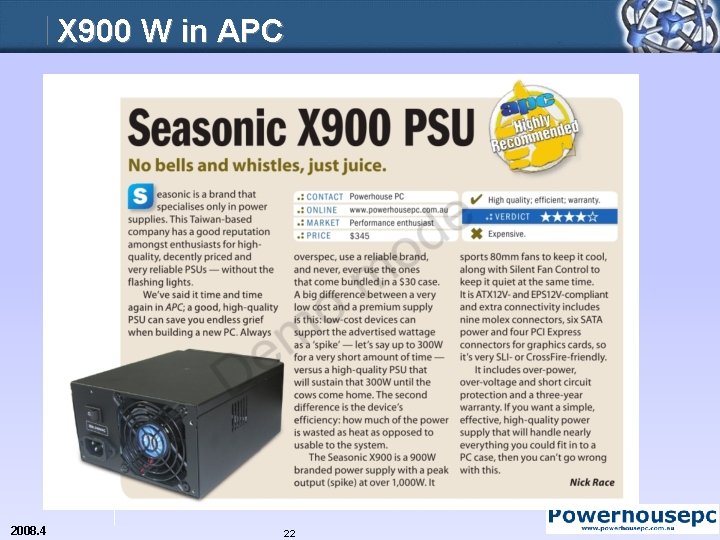
X 900 W in APC 2008. 4 22
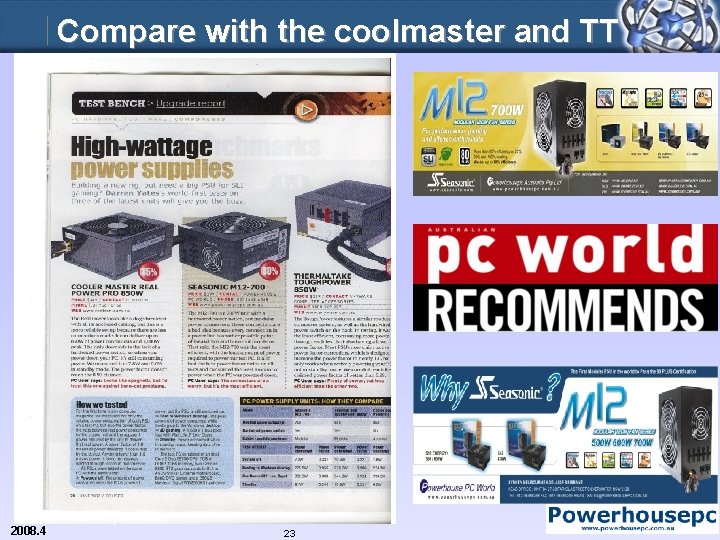
Compare with the coolmaster and TT 2008. 4 23
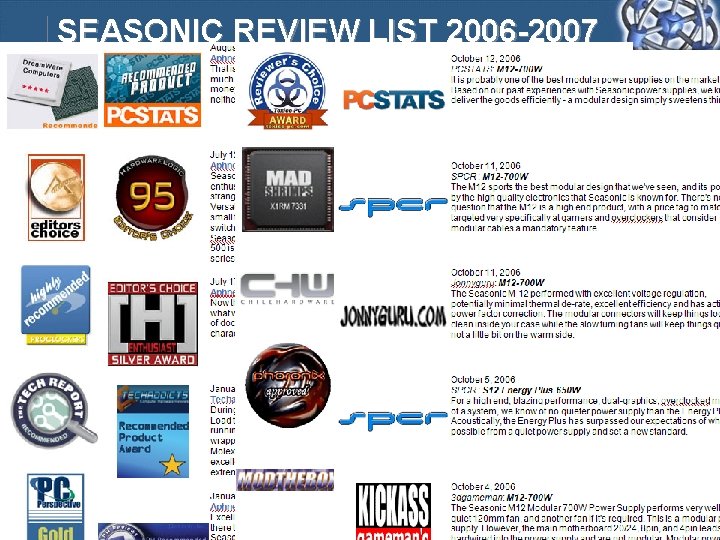
SEASONIC REVIEW LIST 2006 -2007 2008. 4 24
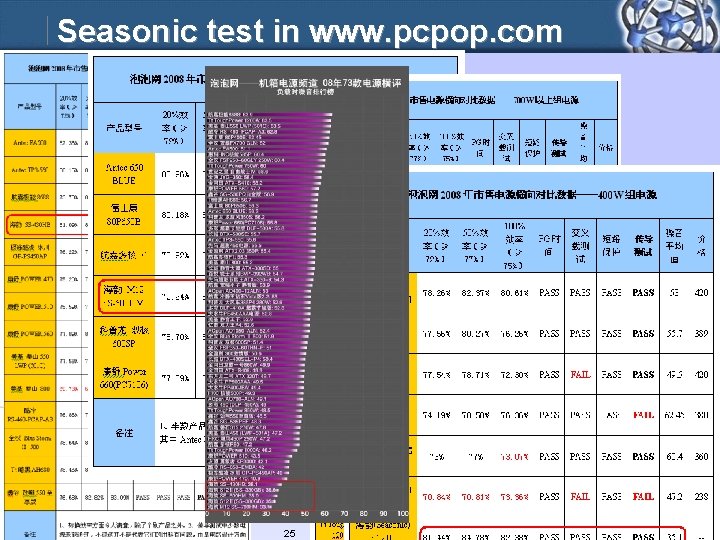
Seasonic test in www. pcpop. com 2008. 4 25
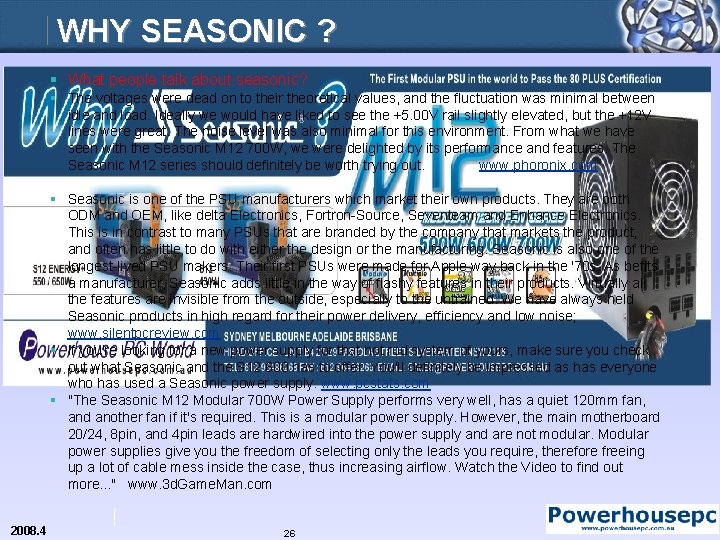
WHY SEASONIC ? § What people talk about seasonic? § The voltages were dead on to their theoretical values, and the fluctuation was minimal between idle and load. Ideally we would have liked to see the +5. 00 V rail slightly elevated, but the +12 V lines were great. The noise level was also minimal for this environment. From what we have seen with the Seasonic M 12 700 W, we were delighted by its performance and features. The Seasonic M 12 series should definitely be worth trying out. www. phoronix. com § Seasonic is one of the PSU manufacturers which market their own products. They are both ODM and OEM, like delta Electronics, Fortron-Source, Seventeam and Enhance Electronics. This is in contrast to many PSUs that are branded by the company that markets the product, and often has little to do with either the design or the manufacturing. Seasonic is also one of the longest-lived PSU makers. Their first PSUs were made for Apple way back in the '70 s. As befits a manufacturer, Seasonic adds little in the way of flashy features in their products. Virtually all the features are invisible from the outside, especially to the untrained. We have always held Seasonic products in high regard for their power delivery, efficiency and low noise; www. silentpcreview. com § If you're looking for a new power supply for that hot rod system of yours, make sure you check out what Seasonic and the S 12 600 has to offer. You'll definitely be impressed as has everyone who has used a Seasonic power supply. www. pcstats. com § "The Seasonic M 12 Modular 700 W Power Supply performs very well, has a quiet 120 mm fan, and another fan if it's required. This is a modular power supply. However, the main motherboard 20/24, 8 pin, and 4 pin leads are hardwired into the power supply and are not modular. Modular power supplies give you the freedom of selecting only the leads you require, therefore freeing up a lot of cable mess inside the case, thus increasing airflow. Watch the Video to find out more. . . " www. 3 d. Game. Man. com 2008. 4 26
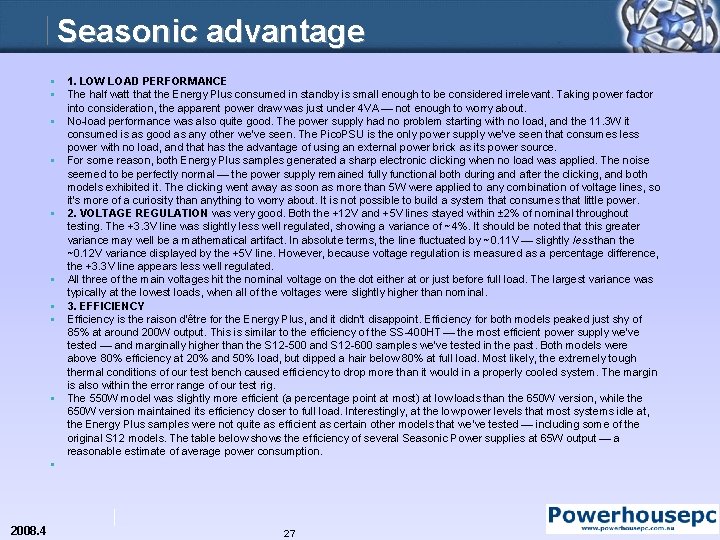
Seasonic advantage § § § § § 2008. 4 1. LOW LOAD PERFORMANCE The half watt that the Energy Plus consumed in standby is small enough to be considered irrelevant. Taking power factor into consideration, the apparent power draw was just under 4 VA — not enough to worry about. No-load performance was also quite good. The power supply had no problem starting with no load, and the 11. 3 W it consumed is as good as any other we've seen. The Pico. PSU is the only power supply we've seen that consumes less power with no load, and that has the advantage of using an external power brick as its power source. For some reason, both Energy Plus samples generated a sharp electronic clicking when no load was applied. The noise seemed to be perfectly normal — the power supply remained fully functional both during and after the clicking, and both models exhibited it. The clicking went away as soon as more than 5 W were applied to any combination of voltage lines, so it's more of a curiosity than anything to worry about. It is not possible to build a system that consumes that little power. 2. VOLTAGE REGULATION was very good. Both the +12 V and +5 V lines stayed within ± 2% of nominal throughout testing. The +3. 3 V line was slightly less well regulated, showing a variance of ~4%. It should be noted that this greater variance may well be a mathematical artifact. In absolute terms, the line fluctuated by ~0. 11 V — slightly less than the ~0. 12 V variance displayed by the +5 V line. However, because voltage regulation is measured as a percentage difference, the +3. 3 V line appears less well regulated. All three of the main voltages hit the nominal voltage on the dot either at or just before full load. The largest variance was typically at the lowest loads, when all of the voltages were slightly higher than nominal. 3. EFFICIENCY Efficiency is the raison d'être for the Energy Plus, and it didn't disappoint. Efficiency for both models peaked just shy of 85% at around 200 W output. This is similar to the efficiency of the SS-400 HT — the most efficient power supply we've tested — and marginally higher than the S 12 -500 and S 12 -600 samples we've tested in the past. Both models were above 80% efficiency at 20% and 50% load, but dipped a hair below 80% at full load. Most likely, the extremely tough thermal conditions of our test bench caused efficiency to drop more than it would in a properly cooled system. The margin is also within the error range of our test rig. The 550 W model was slightly more efficient (a percentage point at most) at low loads than the 650 W version, while the 650 W version maintained its efficiency closer to full load. Interestingly, at the low power levels that most systems idle at, the Energy Plus samples were not quite as efficient as certain other models that we've tested — including some of the original S 12 models. The table below shows the efficiency of several Seasonic Power supplies at 65 W output — a reasonable estimate of average power consumption. 27
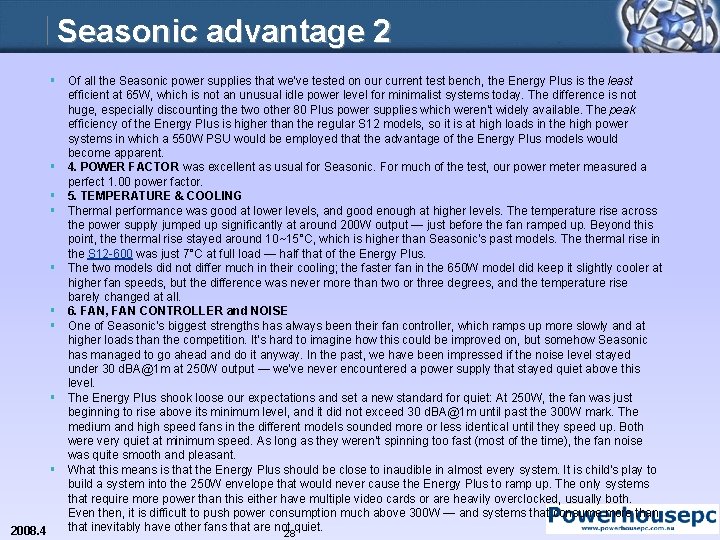
Seasonic advantage 2 § Of all the Seasonic power supplies that we've tested on our current test bench, the Energy Plus is the least efficient at 65 W, which is not an unusual idle power level for minimalist systems today. The difference is not huge, especially discounting the two other 80 Plus power supplies which weren't widely available. The peak efficiency of the Energy Plus is higher than the regular S 12 models, so it is at high loads in the high power systems in which a 550 W PSU would be employed that the advantage of the Energy Plus models would become apparent. § 4. POWER FACTOR was excellent as usual for Seasonic. For much of the test, our power meter measured a perfect 1. 00 power factor. § 5. TEMPERATURE & COOLING § Thermal performance was good at lower levels, and good enough at higher levels. The temperature rise across the power supply jumped up significantly at around 200 W output — just before the fan ramped up. Beyond this point, thermal rise stayed around 10~15°C, which is higher than Seasonic's past models. The thermal rise in the S 12 -600 was just 7°C at full load — half that of the Energy Plus. § The two models did not differ much in their cooling; the faster fan in the 650 W model did keep it slightly cooler at higher fan speeds, but the difference was never more than two or three degrees, and the temperature rise barely changed at all. § 6. FAN, FAN CONTROLLER and NOISE § One of Seasonic's biggest strengths has always been their fan controller, which ramps up more slowly and at higher loads than the competition. It's hard to imagine how this could be improved on, but somehow Seasonic has managed to go ahead and do it anyway. In the past, we have been impressed if the noise level stayed under 30 d. BA@1 m at 250 W output — we've never encountered a power supply that stayed quiet above this level. § The Energy Plus shook loose our expectations and set a new standard for quiet: At 250 W, the fan was just beginning to rise above its minimum level, and it did not exceed 30 d. BA@1 m until past the 300 W mark. The medium and high speed fans in the different models sounded more or less identical until they speed up. Both were very quiet at minimum speed. As long as they weren't spinning too fast (most of the time), the fan noise was quite smooth and pleasant. § What this means is that the Energy Plus should be close to inaudible in almost every system. It is child's play to build a system into the 250 W envelope that would never cause the Energy Plus to ramp up. The only systems that require more power than this either have multiple video cards or are heavily overclocked, usually both. Even then, it is difficult to push power consumption much above 300 W — and systems that consume more than that inevitably have other fans that are not quiet. 2008. 4 28

Thanks § If you have any questions, please feel free to contact me at any time. § Mobile: 0430 225 118 § § § Best Regards, Alex Chow Sales Powerhouse. PC Australia www. powerhousepc. com. au Unit B 4 27 -29 Fariola Street Silverwater NSW 2128 Australia § Tel: 61 -02 -9648 6268 § Fax: 61 -02 -9648 6269 2008. 4 29
- Slides: 29