
Welcome To Biology Ms C Johnson Room 707

Welcome To Biology Ms. C. Johnson Room 707 850 -617 -4700 ext. 2707 johnsonc 8@leonschools. net
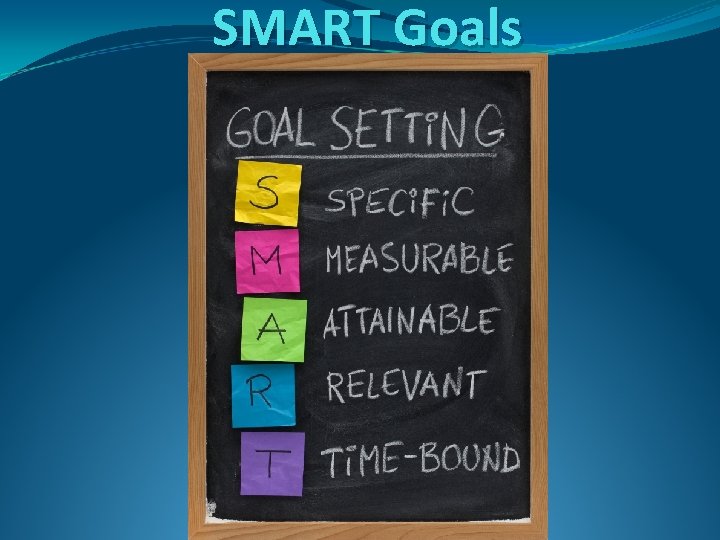
SMART Goals
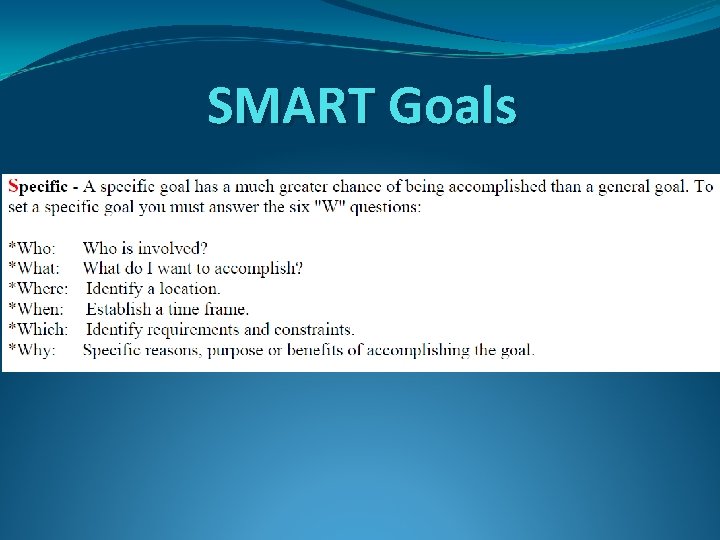
SMART Goals
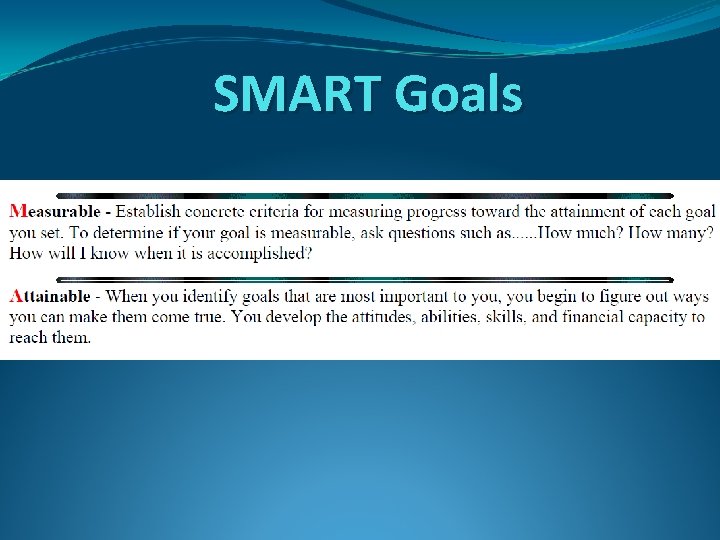
SMART Goals
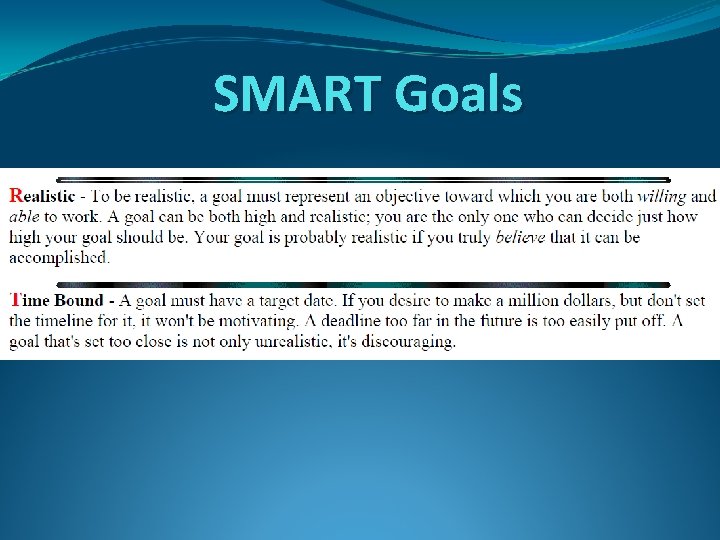
SMART Goals
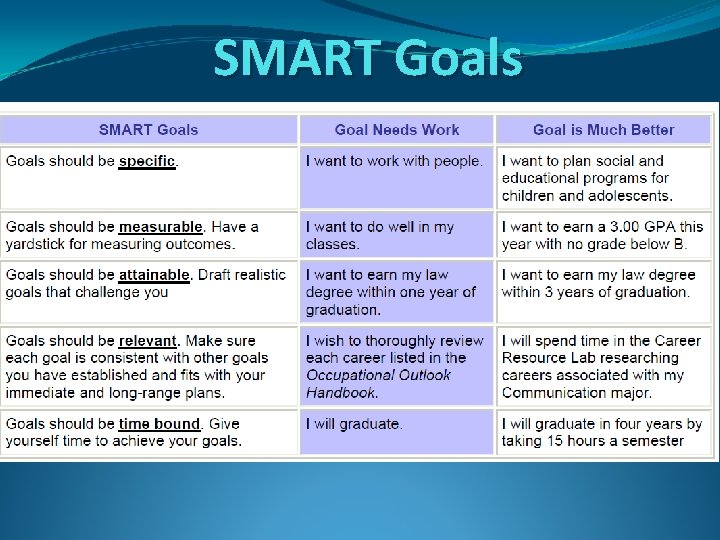
SMART Goals
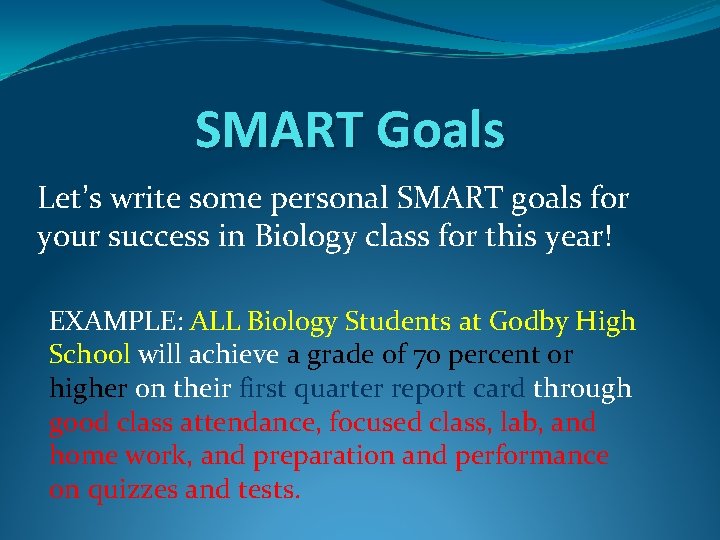
SMART Goals Let’s write some personal SMART goals for your success in Biology class for this year! EXAMPLE: ALL Biology Students at Godby High School will achieve a grade of 70 percent or higher on their first quarter report card through good class attendance, focused class, lab, and home work, and preparation and performance on quizzes and tests.
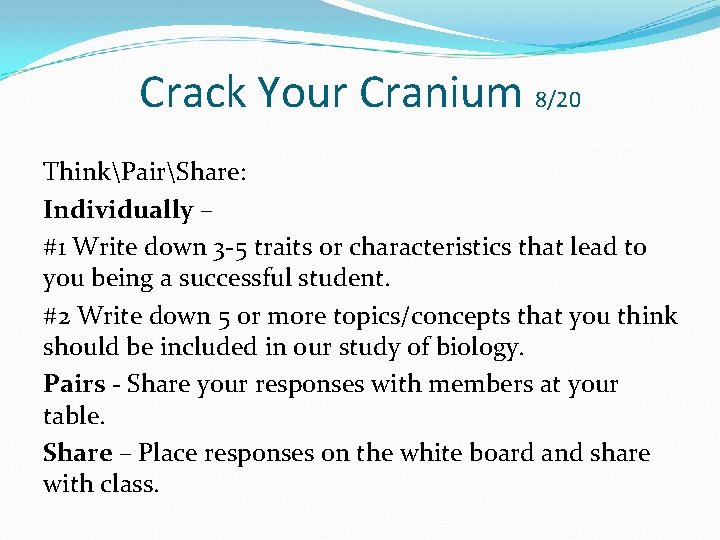
Crack Your Cranium 8/20 ThinkPairShare: Individually – #1 Write down 3 -5 traits or characteristics that lead to you being a successful student. #2 Write down 5 or more topics/concepts that you think should be included in our study of biology. Pairs - Share your responses with members at your table. Share – Place responses on the white board and share with class.
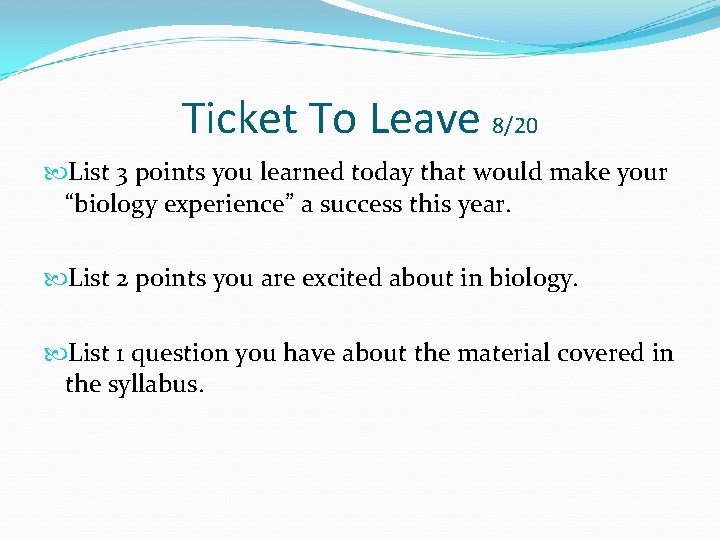
Ticket To Leave 8/20 List 3 points you learned today that would make your “biology experience” a success this year. List 2 points you are excited about in biology. List 1 question you have about the material covered in the syllabus.
Crack Your Cranium 8/21 Individually: #1 Write down your 3 top lab safety rules and explain why they are important. #2 Write down your 2 most important pieces of lab safety equipment and explain why they are important.
Lab Safety is everybody’s responsibility! Student Expectations Equipment PPE (Personal Protection Equipment) Safety Equipment Procedures if or when an emergency or accident happens in lab.
Lab Safety Expectations BE RESPONSIBLE IN THE LAB USE CHEMICALS & --Keep hands away from the GLASSWARE APPROPRIATELY face, body and mouth --Wash hands after experiments NEVER FOOL AROUND IN THE --Don’t touch anything until LAB instructed --No practical jokes, horseplay or pranks ASK QUESTIONS --If you don’t understand KEEP WORK AREAS CLEAN directions or procedure---ASK --If you don’t know how to use DRESS PROPERLY the equipment—ASK --Long hair tied back --Jewelry and loose clothing FOLLOW INSTRUCTIONS secured CAREFULLY --Closed-toe shoes only WEAR PROTECTIVE CLOTHING GEAR NO EATING IN THE LAB
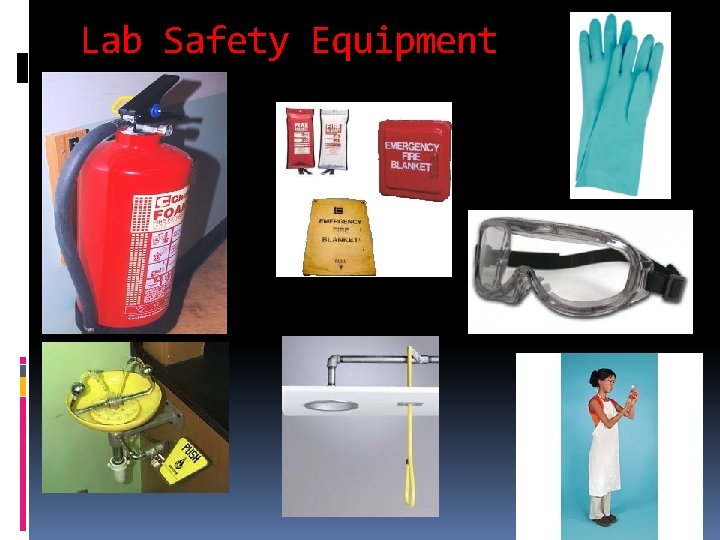
Lab Safety Equipment
Lab Safety Procedures What steps need to be taken in the event of an accident or emergency? Lab Safety Scenarios: How will you respond?
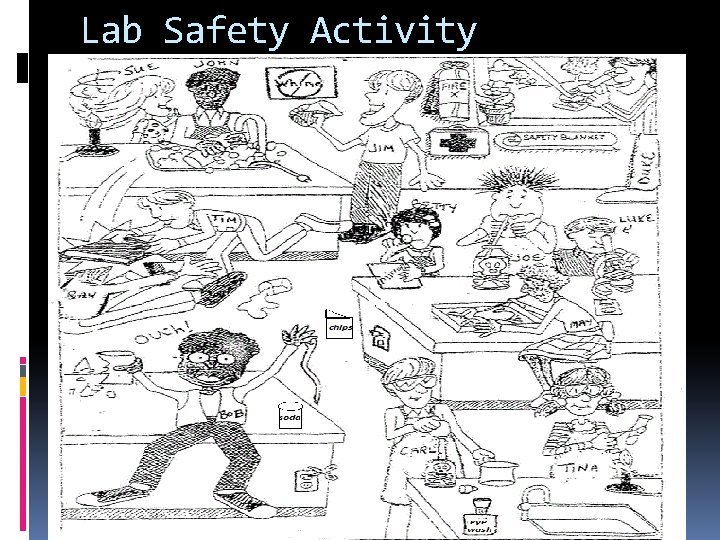
Lab Safety Activity
LAB SAFETY ACTIVITY Questions for Lab Safety Illustration: • List 3 unsafe activities shown in the illustration and explain why each is unsafe. • List 3 correct lab procedures depicted in the illustration. • What should Bob do after the accident? • What should Sue have done to avoid an accident? • Compare Luke and Duke’s lab techniques. Who is following the rules? • What are 3 things shown in the lab that should not be there? • Compare Joe and Carl’s lab techniques. Who is doing it the correct way? • What will happen to Ray and Tim when the teacher catches them? • List 3 items in the illustration that are there for the safety of the students in the lab. • What is Betty doing wrong?
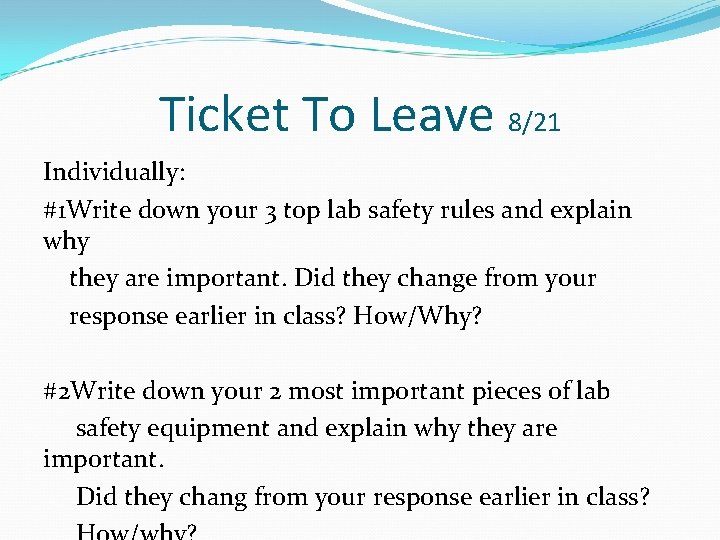
Ticket To Leave 8/21 Individually: #1 Write down your 3 top lab safety rules and explain why they are important. Did they change from your response earlier in class? How/Why? #2 Write down your 2 most important pieces of lab safety equipment and explain why they are important. Did they chang from your response earlier in class?
LAB SAFTEY’S A “RAP” Watch and Listen carefully to the following presentation. In your notebook, identify as many of the lab safety concepts as you can. http: //www. youtube. com/watch? v=x. JG 0 ir 9 n. Dtc
Bubbleology
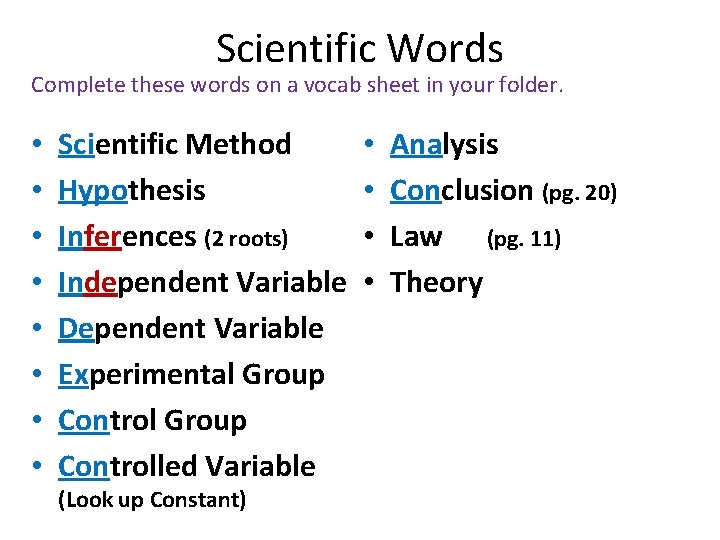
Scientific Words Complete these words on a vocab sheet in your folder. • • Scientific Method Hypothesis Inferences (2 roots) Independent Variable Dependent Variable Experimental Group Controlled Variable (Look up Constant) • • Analysis Conclusion (pg. 20) Law (pg. 11) Theory

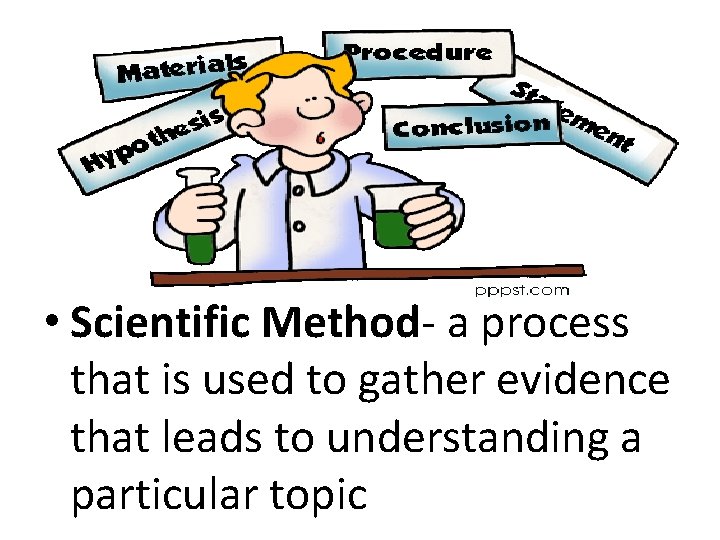
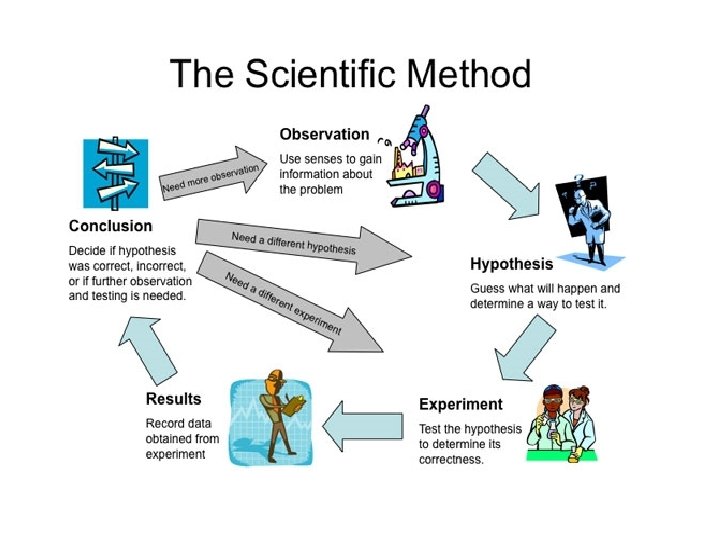
• Scientific Method- a process that is used to gather evidence that leads to understanding a particular topic
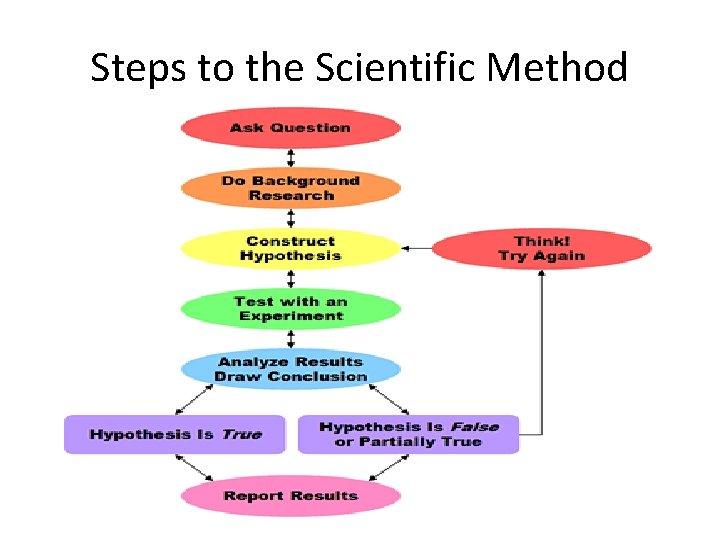
Steps to the Scientific Method
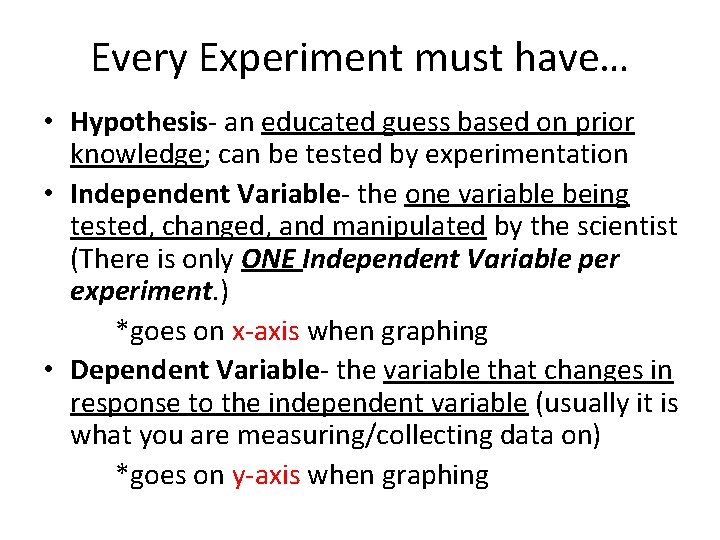
Every Experiment must have… • Hypothesis- an educated guess based on prior knowledge; can be tested by experimentation • Independent Variable- the one variable being tested, changed, and manipulated by the scientist (There is only ONE Independent Variable per experiment. ) *goes on x-axis when graphing • Dependent Variable- the variable that changes in response to the independent variable (usually it is what you are measuring/collecting data on) *goes on y-axis when graphing
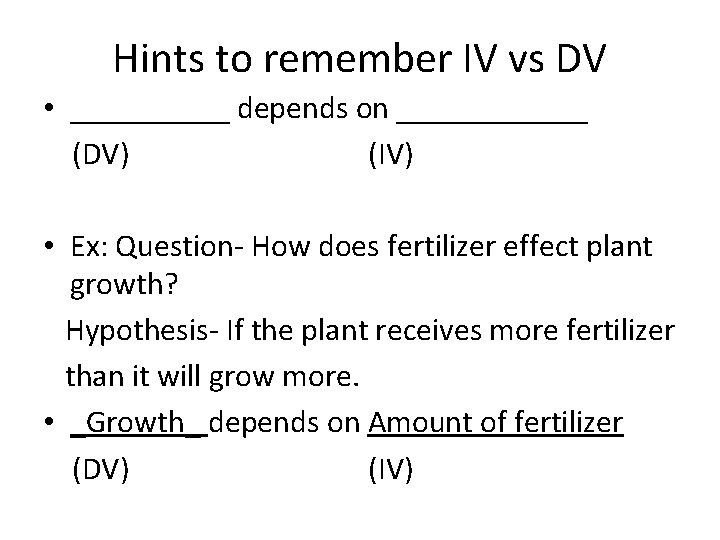
Hints to remember IV vs DV • _____ depends on ______ (DV) (IV) • Ex: Question- How does fertilizer effect plant growth? Hypothesis- If the plant receives more fertilizer than it will grow more. • _Growth_ depends on Amount of fertilizer (DV) (IV)
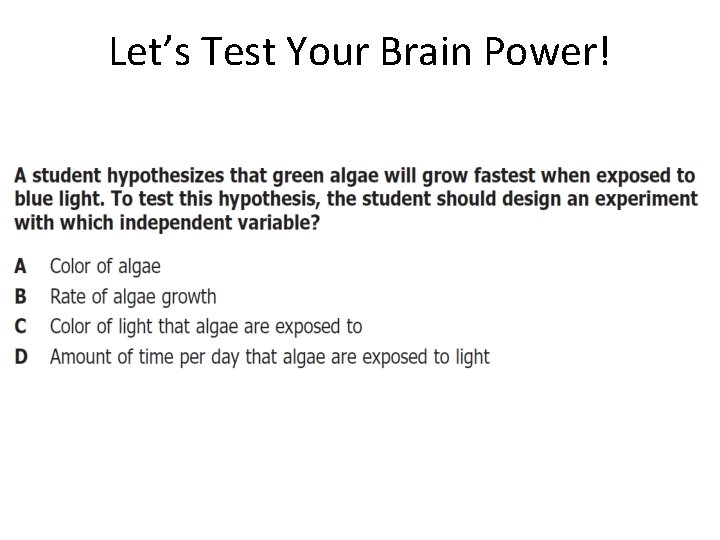
Let’s Test Your Brain Power!
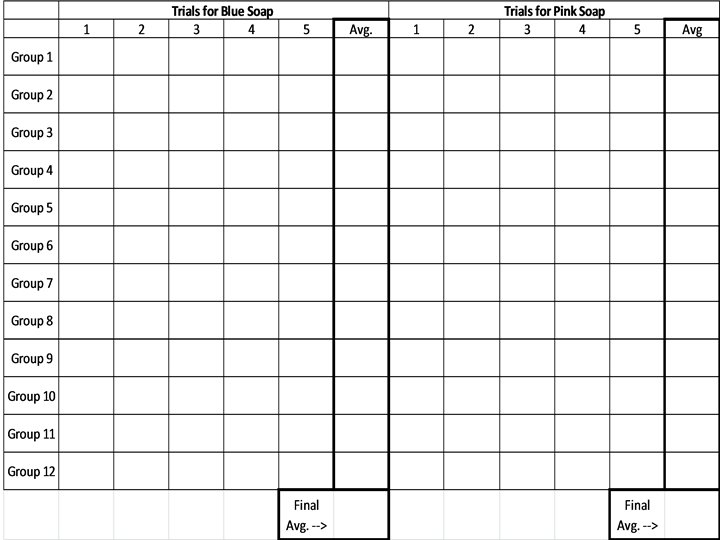
Let’s Test Your Brain Power! Using your experience with the “Bubbleology” Experiment to answer the following questions: A. Write a hypothesis that could be tested. B. What was the independent variable? C. What was the dependent variable? D. Construct the outline of a possible graph that could be used to place your data on.
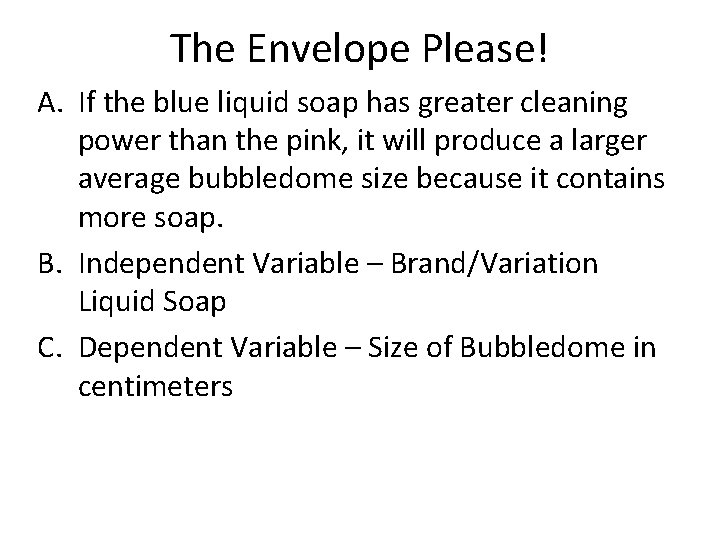
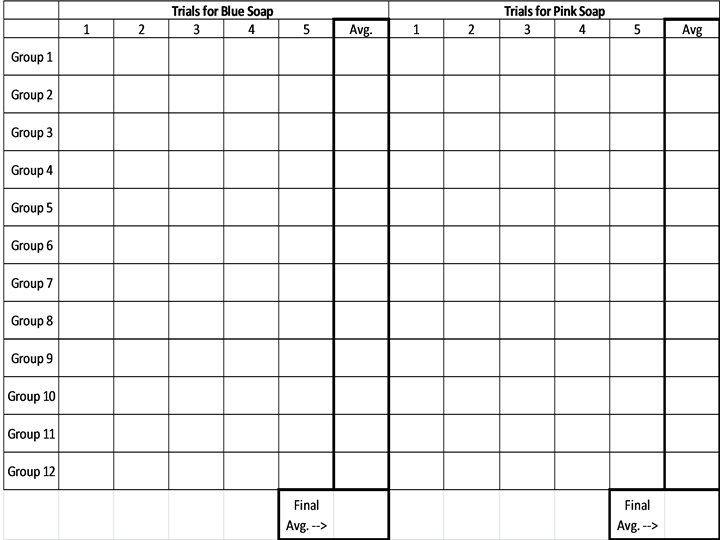
The Envelope Please! A. If the blue liquid soap has greater cleaning power than the pink, it will produce a larger average bubbledome size because it contains more soap. B. Independent Variable – Brand/Variation Liquid Soap C. Dependent Variable – Size of Bubbledome in centimeters
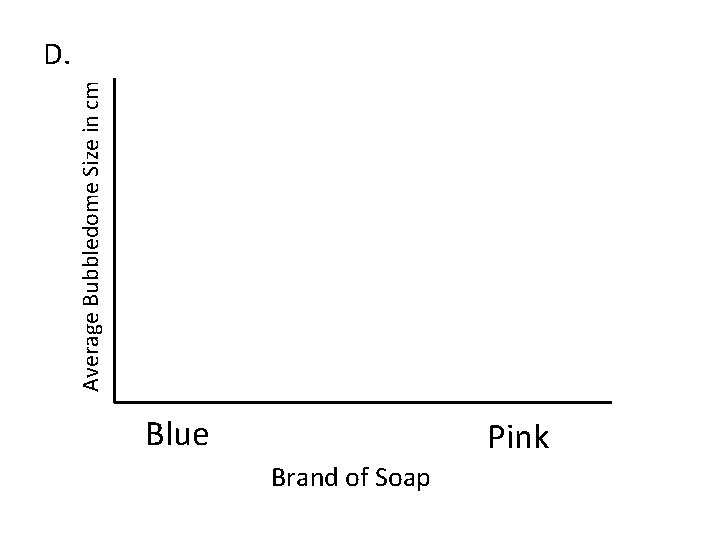
Average Bubbledome Size in cm D. Blue Pink Brand of Soap
Do Now! 9/13 • Individually, read the following scenario and answer the questions. Write in your “Do Now” section. • Identify: Homer notices that his shower is covered in a strange green slime. His friend Barney tells him that coconut juice will get rid of the green slime. Homer decides to check this out by spraying half of the shower with coconut juice. He sprays the other half of the shower with water. After 3 days of "treatment" there is no change in the appearance of the green slime on either side of the shower. 1. Independent Variable 2. Dependent Variable 3. Control Group 4. Experimental Group
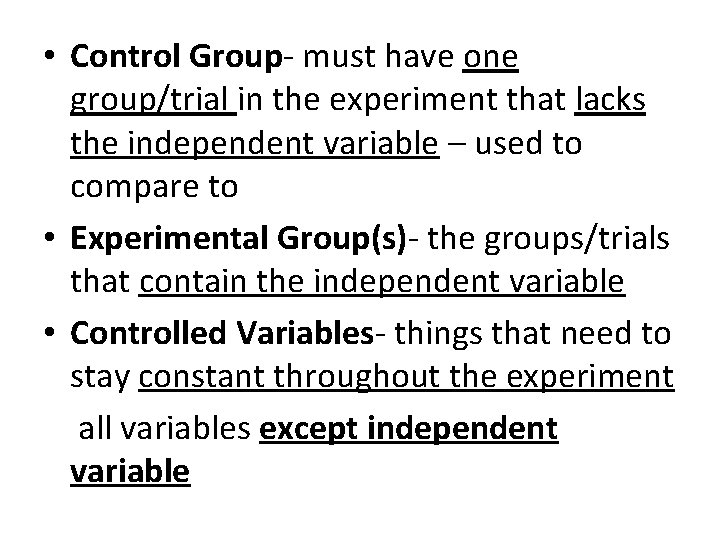
• Control Group- must have one group/trial in the experiment that lacks the independent variable – used to compare to • Experimental Group(s)- the groups/trials that contain the independent variable • Controlled Variables- things that need to stay constant throughout the experiment all variables except independent variable
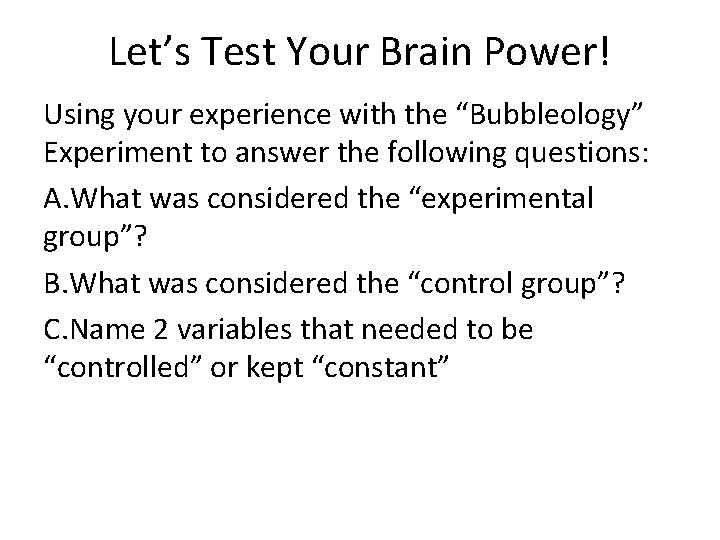
Let’s Test Your Brain Power! Using your experience with the “Bubbleology” Experiment to answer the following questions: A. What was considered the “experimental group”? B. What was considered the “control group”? C. Name 2 variables that needed to be “controlled” or kept “constant”
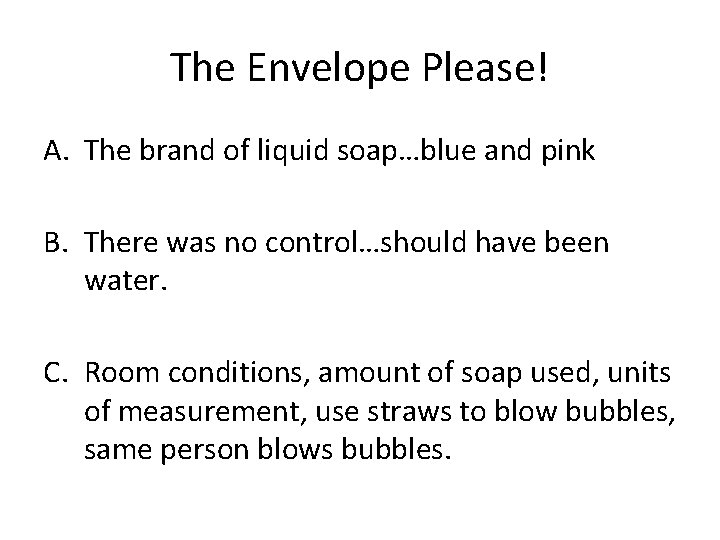
The Envelope Please! A. The brand of liquid soap…blue and pink B. There was no control…should have been water. C. Room conditions, amount of soap used, units of measurement, use straws to blow bubbles, same person blows bubbles.
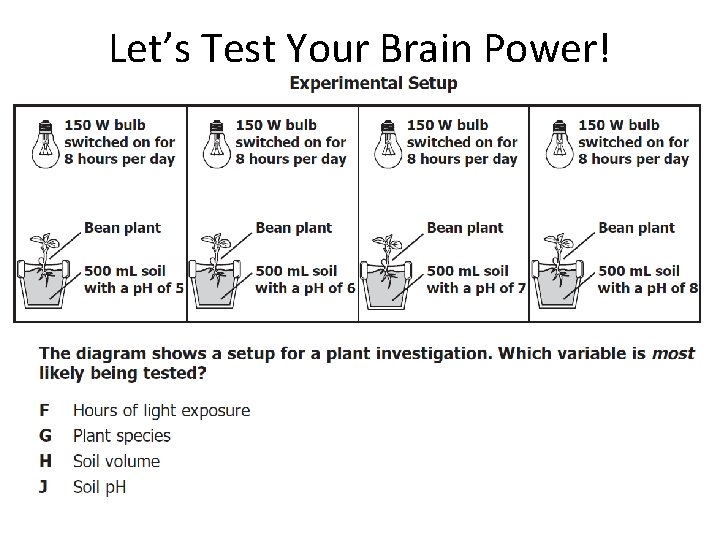
Let’s Test Your Brain Power!
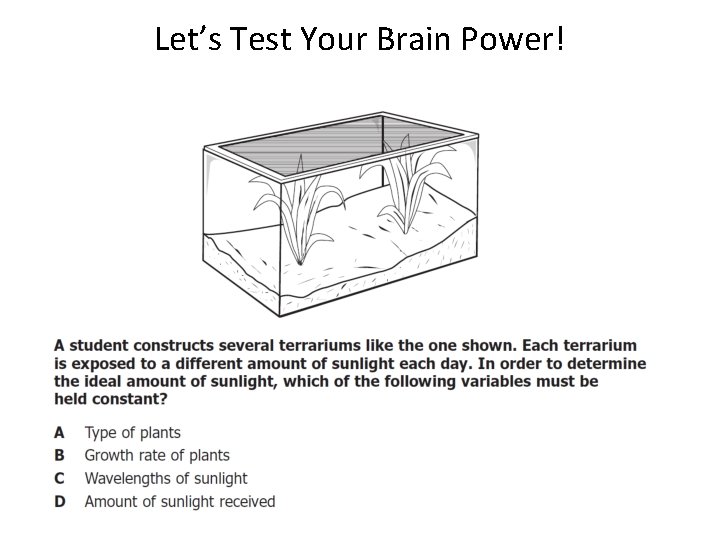
Let’s Test Your Brain Power!
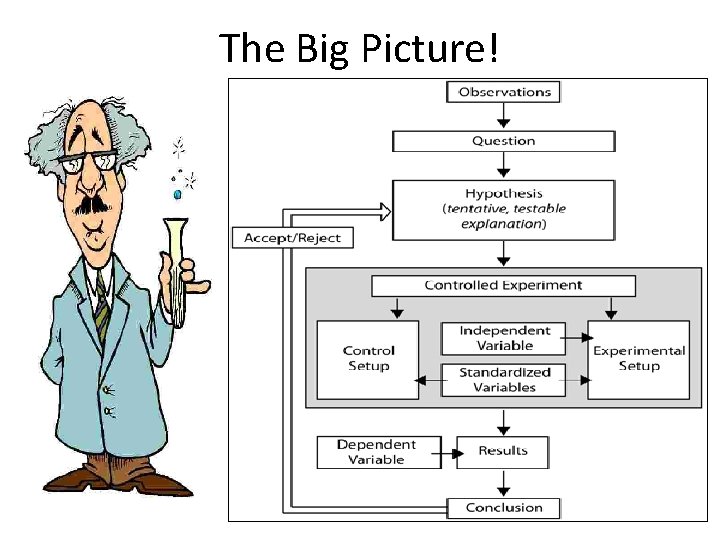
The Big Picture!
Practice Bart believes that mice exposed to radiowaves will become extra strong (maybe he's been reading too much Radioactive Man). He decides to perform this experiment by placing 10 mice near a radio for 5 hours. He compared these 10 mice to another 10 mice that had not been exposed. His test consisted of a heavy block of wood that blocked the mouse food. he found that 8 out of 10 of the radiowaved mice were able to push the block away. 7 out of 10 of the other mice were able to do the same. • Identify: 1. Independent Variable 2. Dependent Variable 3. Control Group 4. Experimental Group 5. What should Bart’s conclusion be? 6. How could Bart’s experiment be improved?
Theory vs. Law • Theory – an explanation of a natural phenomenon supported by many observations and experiments over time. Supported by evidence and enables scientist to make accurate predictions. • Law – describes relationships under certain conditions in nature. Does not explain why an event occurs, just describes the relationship.
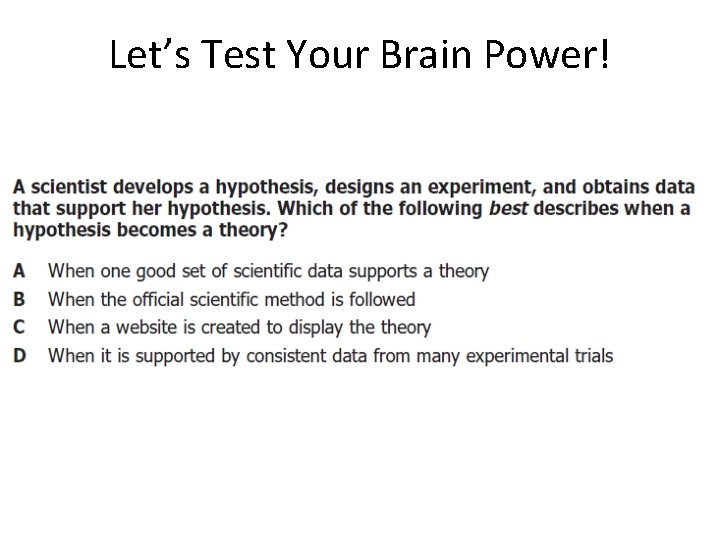
Let’s Test Your Brain Power!
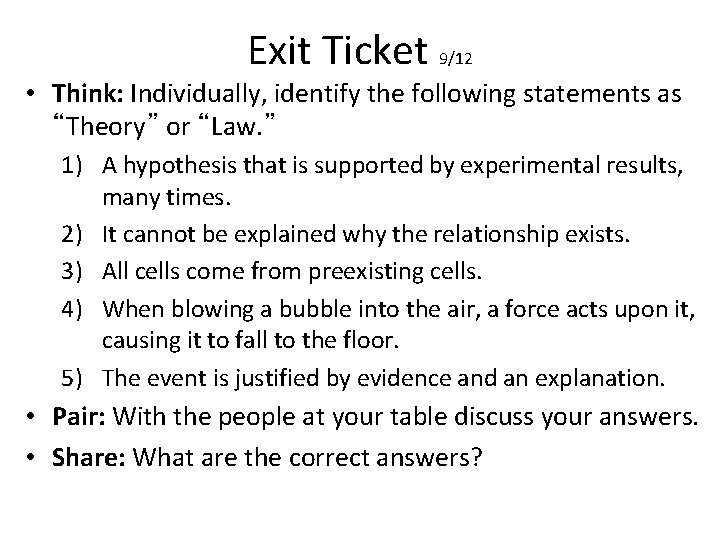
Exit Ticket 9/12 • Think: Individually, identify the following statements as “Theory” or “Law. ” 1) A hypothesis that is supported by experimental results, many times. 2) It cannot be explained why the relationship exists. 3) All cells come from preexisting cells. 4) When blowing a bubble into the air, a force acts upon it, causing it to fall to the floor. 5) The event is justified by evidence and an explanation. • Pair: With the people at your table discuss your answers. • Share: What are the correct answers?
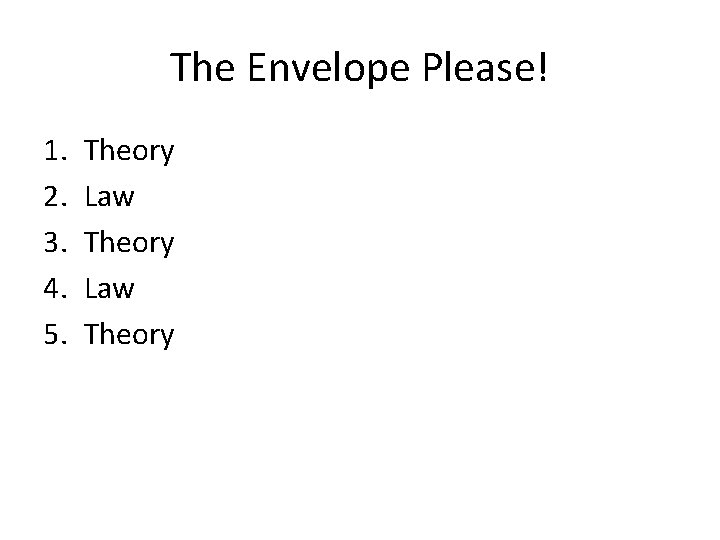
The Envelope Please! 1. 2. 3. 4. 5. Theory Law Theory
Let’s Make Some Connections
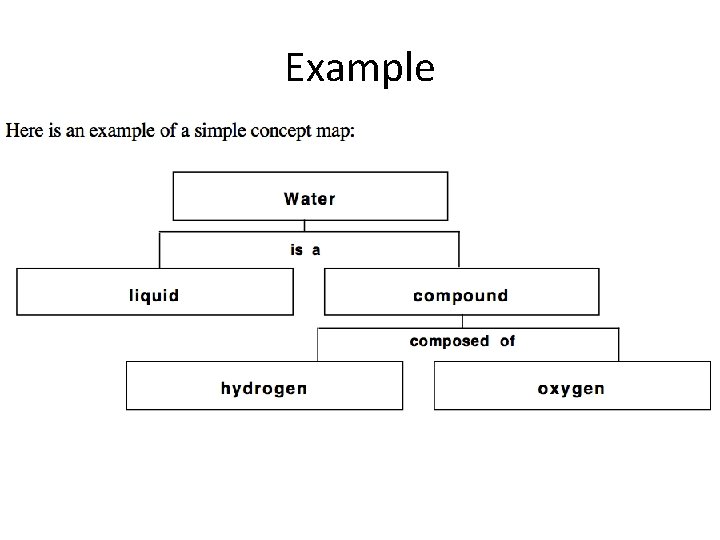
Example
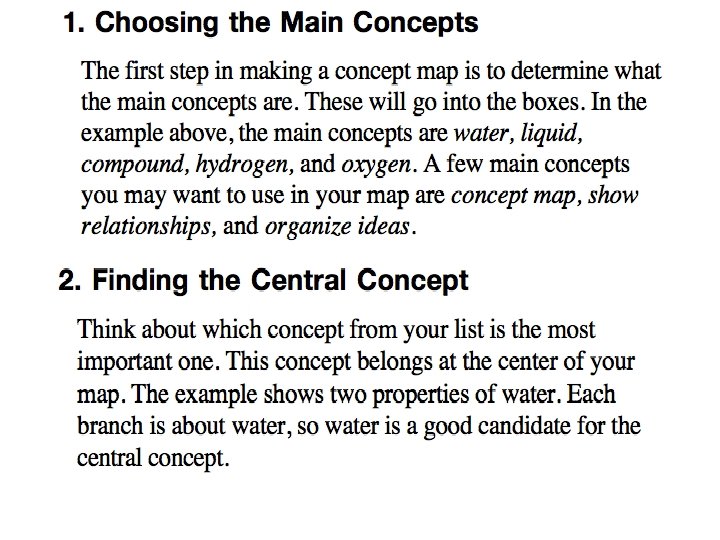
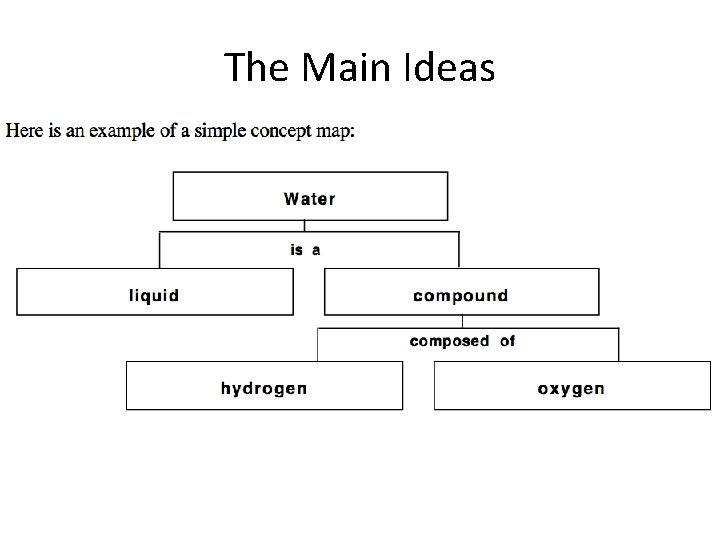
The Main Ideas
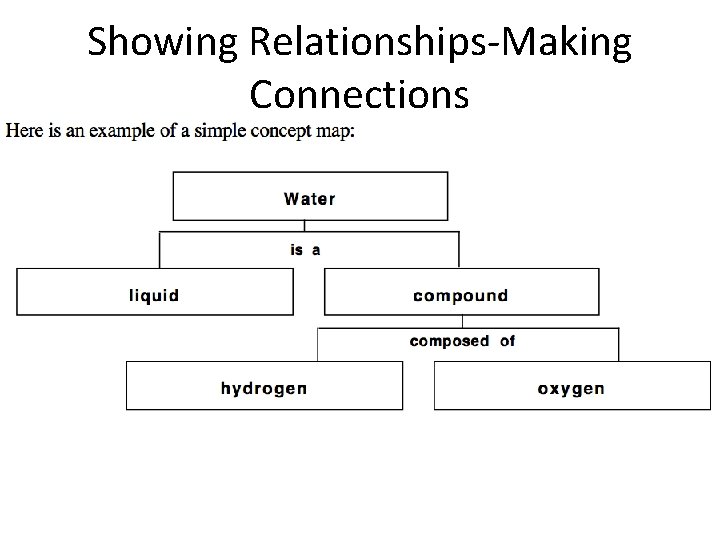
Showing Relationships-Making Connections
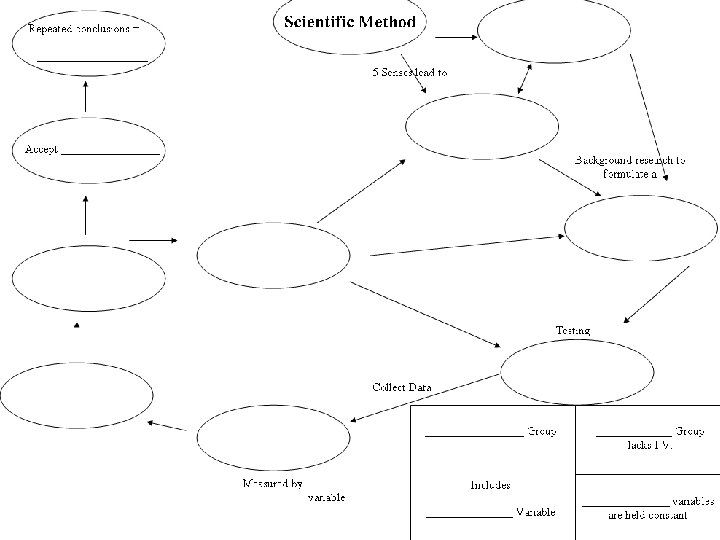
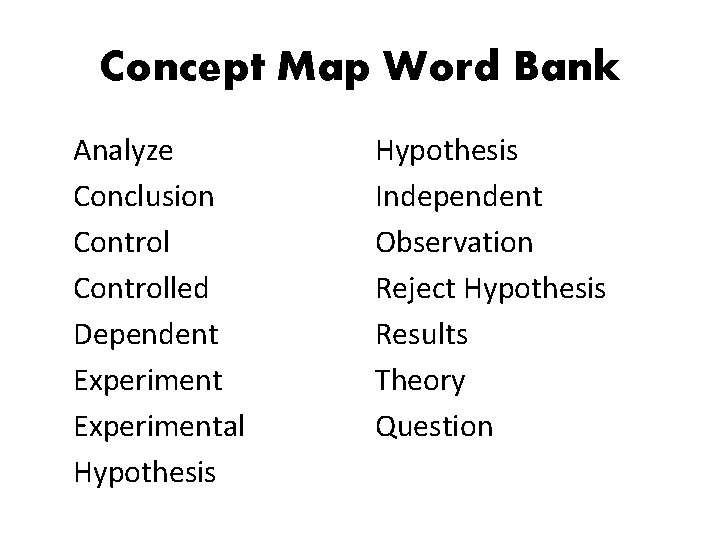
Concept Map Word Bank Analyze Conclusion Controlled Dependent Experimental Hypothesis Independent Observation Reject Hypothesis Results Theory Question
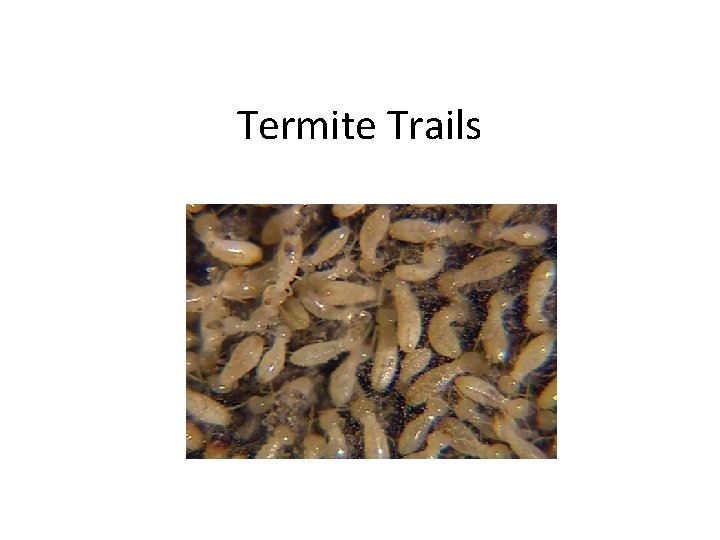
Termite Trails
Demo • What do you see?
Termites are small, soft-bodied, usually palecolored insects. They are social creatures and live in a caste system. Termites create colonies in the ground or in wood. Their food consists primarily of wood or other plant-based material. The workers are sterile and are responsible for the main work of the colony: collecting food; expanding the size of the colony; and feeding the queen, soldiers, and young.
Termites also exhibit some interesting behaviors. To illustrate, consider the following example. Take a blue felt pen and draw a figure eight. Then place several termites on the piece of paper in the middle of the figure eight and watch what happens…. . Observation…
This observation raises an interesting research question: Why do termites follow the lines?
Hypothesis • Explanation 1: Termites navigate by sight. They are attracted to certain colors such as blue. As a result, termites follow the line because it is blue. • Explanation 2: Termites are cooperative and navigate by sight. Termites leave a trail when they are looking for food so they can find their way back to the colony, so termites will follow any line they come across. • Explanation 3: Termites are cooperative and navigate by smell. The ink in the pen contains a chemical that smells the same as the pheromones that are secreted by the termites. As a result, termites follow the line because it smells like a trail left by another termite.
Materials • • • Blank sheet of Paper Blue Pen, Red pen, Blue marker, Pencil Termites Tweezers Paintbrush
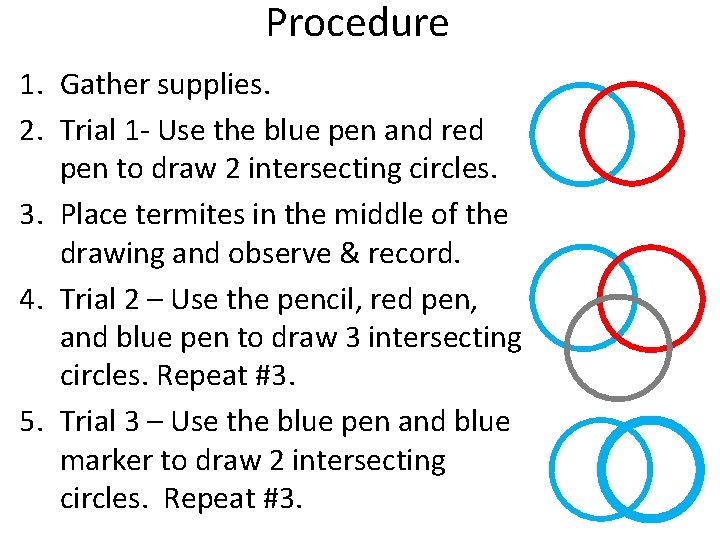
Procedure 1. Gather supplies. 2. Trial 1 - Use the blue pen and red pen to draw 2 intersecting circles. 3. Place termites in the middle of the drawing and observe & record. 4. Trial 2 – Use the pencil, red pen, and blue pen to draw 3 intersecting circles. Repeat #3. 5. Trial 3 – Use the blue pen and blue marker to draw 2 intersecting circles. Repeat #3.
Safety Precautions • WASH HANDS when you’re done.
Predicted Result if Hypothesis is True

Crack Your Cranium 9/3 1. A testable explanation of a situation is called a(n) ______. a. Experiment b. Hypothesis c. Inference d. Observation 2. What is true about scientific inquiry? a. It poses questions about astrology. b. It can be done only by one person. c. It is resistant to change and not open to criticism. d. It is testable.
Actual Results / Evidence
Claim – Which of the following represents your data? • Explanation 1: Termites navigate by sight. They are attracted to certain colors such as blue. As a result, termites follow the line because it is blue. • Explanation 2: Termites are cooperative and navigate by sight. Termites leave a trail when they are looking for food so they can find their way back to the colony, so termites will follow any line they come across. • Explanation 3: Termites are cooperative and navigate by smell. The ink in the pen contains a chemical that smells the same as the pheromones that are secreted by the termites. As a result, termites follow the line because it smells like a trail left by another termite.
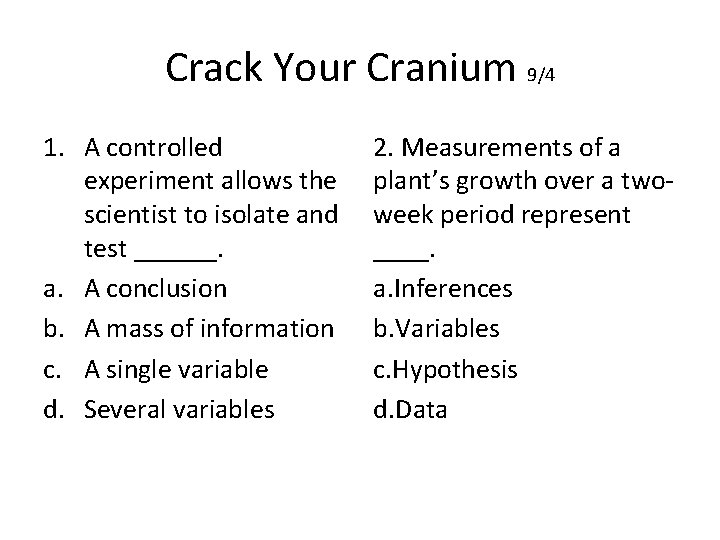
Crack Your Cranium 9/4 1. A controlled experiment allows the scientist to isolate and test ______. a. A conclusion b. A mass of information c. A single variable d. Several variables 2. Measurements of a plant’s growth over a twoweek period represent ____. a. Inferences b. Variables c. Hypothesis d. Data
The Research Question: Our Claim: Our Evidence: Our Justification of the Evidence:
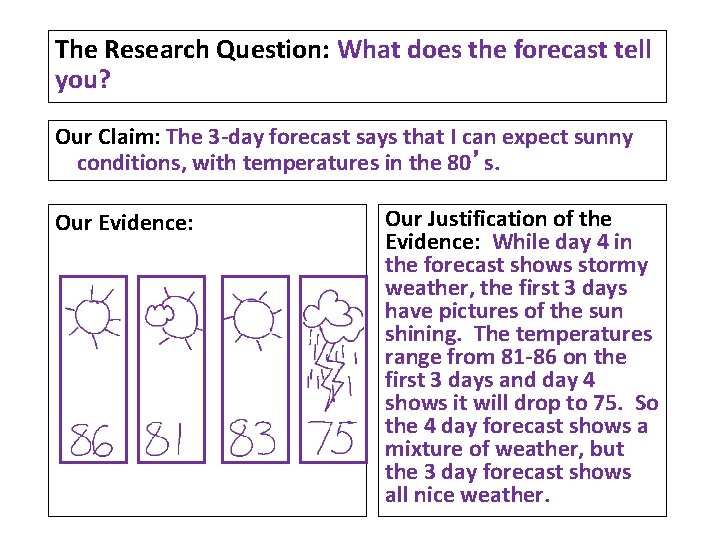
The Research Question: What does the forecast tell you? Our Claim: The 3 -day forecast says that I can expect sunny conditions, with temperatures in the 80’s. Our Evidence: Our Justification of the Evidence: While day 4 in the forecast shows stormy weather, the first 3 days have pictures of the sun shining. The temperatures range from 81 -86 on the first 3 days and day 4 shows it will drop to 75. So the 4 day forecast shows a mixture of weather, but the 3 day forecast shows all nice weather.
ADI Lab Report
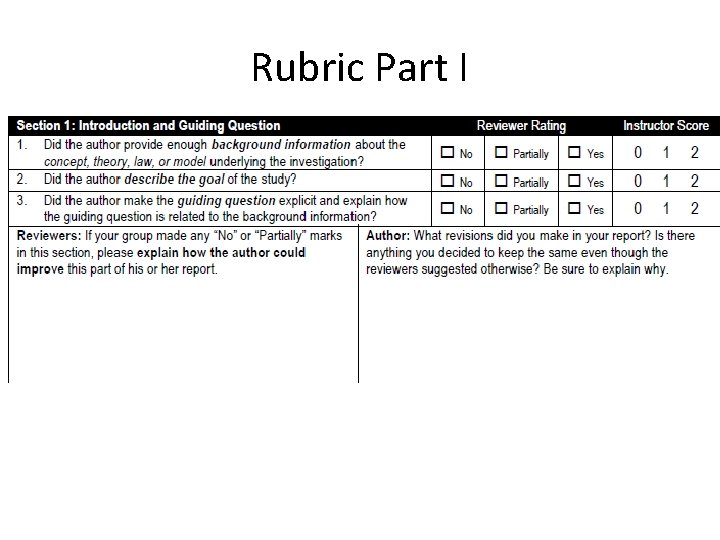
Rubric Part I
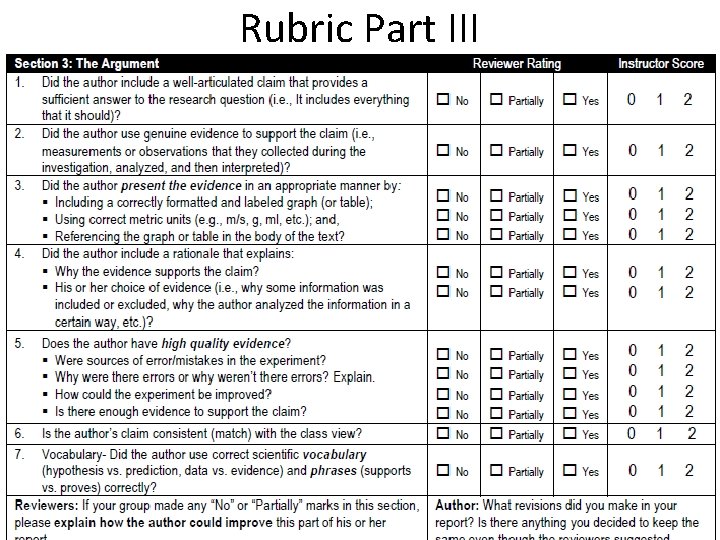
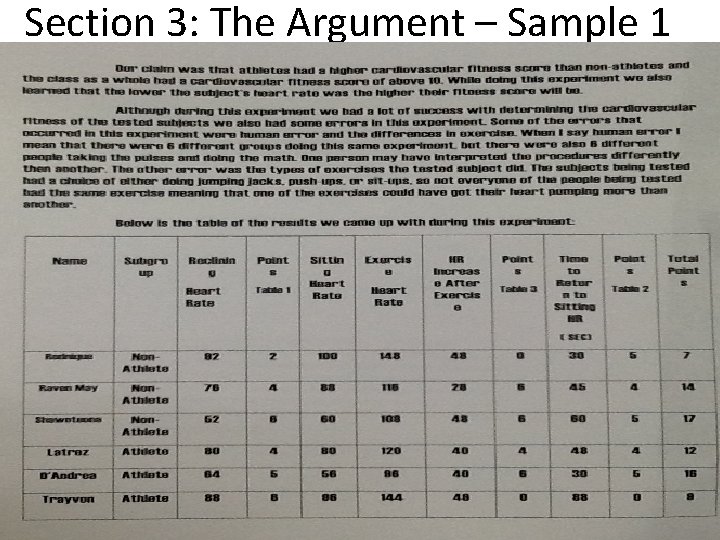
Think- Pair- Share • You will be shown 3 samples of student work • For each one: – Read and Grade using the rubric INDIVIDUALLY – Pair: Compare your grade with your partner – Discuss with class
Section 1: Introduction and Guiding Question The heart beats to pump blood around the body. This study is looking at a subgroup and a full class. The question trying to be answered is, what is the cardiovascular fitness of the athletes versus non athletes in our class?
Section 1: Introduction and Guiding Question The heart beats to pump oxygenated blood around the body because every cell needs to get this oxygen to live. The rate at which your heart pumps can be affected by many things such as, the fitness of the heart, the activity the person is doing, the size of the blood vessel, and the viscosity of the blood. The rate at which the heart beats can be measured by taking a person’s pulse. A pulse is how many beats occur in a minute. This study is looking at a subgroup and a full class. The question trying to be answered is, what is
Section 1: Introduction and Guiding Question The heart beats to pump oxygenated blood around the body because every cell needs to get this oxygen to live. The rate at which your heart pumps can be affected by many things such as, the fitness of the heart, the activity the person is doing, the size of the blood vessel, and the viscosity of the blood. The rate at which the heart beats can be measured by taking a person’s pulse. A pulse is how many beats occur in a minute. By examining a person’s pulse during a variety of activities you can determine a person’s cardiovascular fitness. This study is looking at the cardiovascular fitness of the members of our class and comparing the athletes and non-athletes. The question trying to be answered is, what is the cardiovascular fitness of the athletes versus non athletes in our class, as well as the cardiovascular fitness of the whole class?
• Now we will write Paragraph 1 as a class.
Introduction and Guiding Question Termites are small, soft bodied, usually pale colored insects. They are social creatures that live in colonies in the ground or in wood. They feed on wood or other plant based materials. In order to locate food, they need to communicate by using their senses. This study is looking at determining which sense organ do termites use to locate or follow a line to food. The question trying to be answered is “Why do termites follow lines?
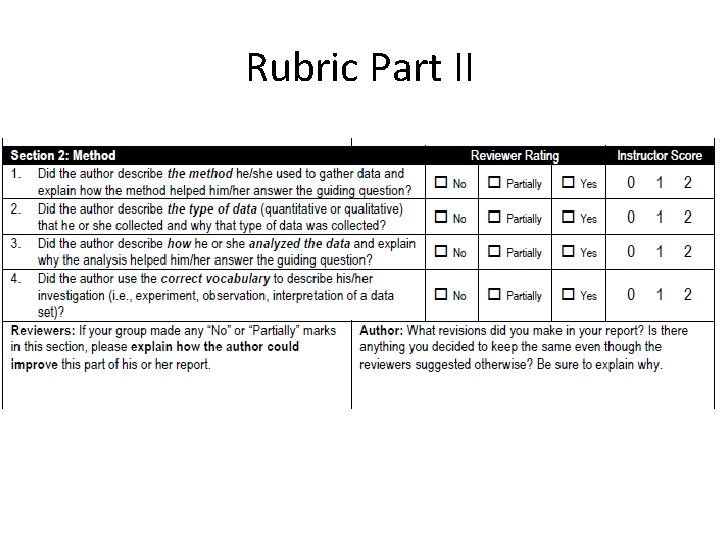
Rubric Part II
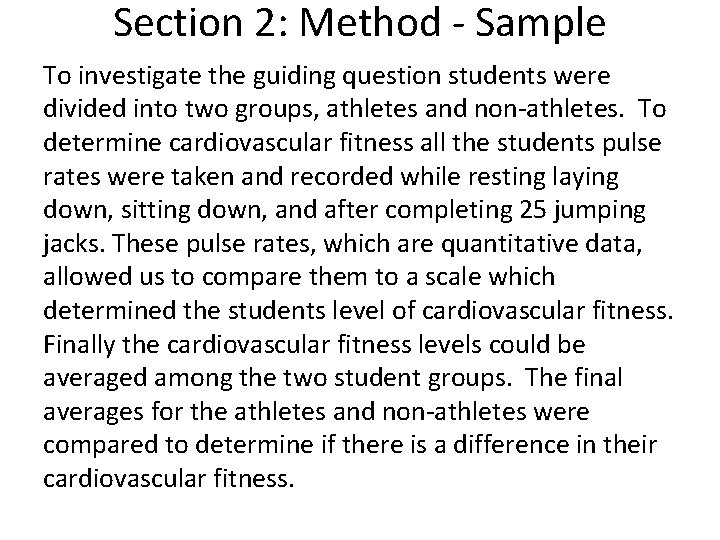
Section 2: Method - Sample To investigate the guiding question students were divided into two groups, athletes and non-athletes. To determine cardiovascular fitness all the students pulse rates were taken and recorded while resting laying down, sitting down, and after completing 25 jumping jacks. These pulse rates, which are quantitative data, allowed us to compare them to a scale which determined the students level of cardiovascular fitness. Finally the cardiovascular fitness levels could be averaged among the two student groups. The final averages for the athletes and non-athletes were compared to determine if there is a difference in their cardiovascular fitness.
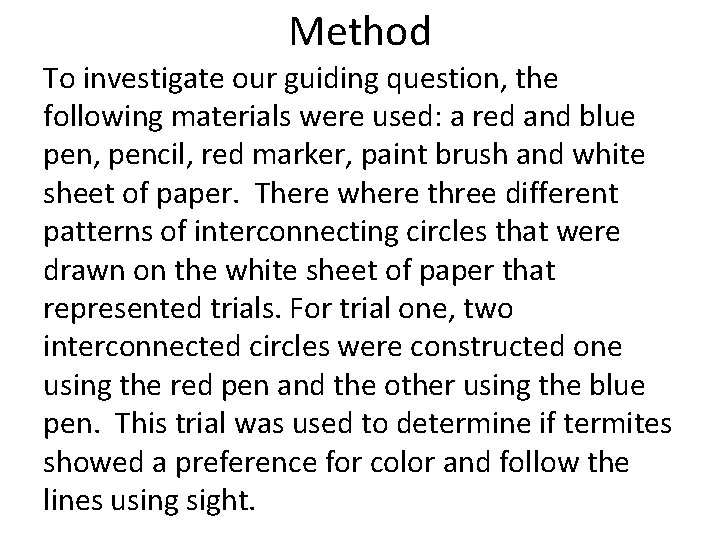
Method To investigate our guiding question, the following materials were used: a red and blue pen, pencil, red marker, paint brush and white sheet of paper. There where three different patterns of interconnecting circles that were drawn on the white sheet of paper that represented trials. For trial one, two interconnected circles were constructed one using the red pen and the other using the blue pen. This trial was used to determine if termites showed a preference for color and follow the lines using sight.
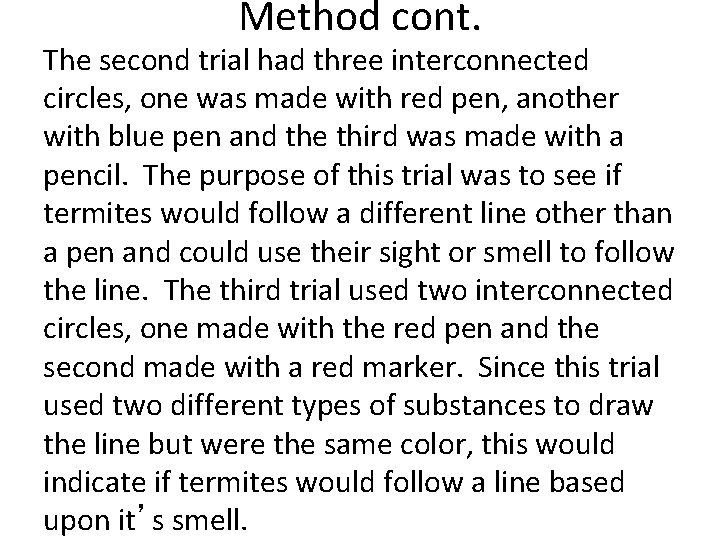
Method cont. The second trial had three interconnected circles, one was made with red pen, another with blue pen and the third was made with a pencil. The purpose of this trial was to see if termites would follow a different line other than a pen and could use their sight or smell to follow the line. The third trial used two interconnected circles, one made with the red pen and the second made with a red marker. Since this trial used two different types of substances to draw the line but were the same color, this would indicate if termites would follow a line based upon it’s smell.
Method cont. Termites were placed in the center of the circle pattern and observed for two minutes. The observations or qualitative data was placed in a table. The results from trials one, two and three were compared to determine if termites used the sense of sight or smell to follow the lines.
Rubric Part III
Section 3: The Argument
Section 3: The Argument – Sample 1
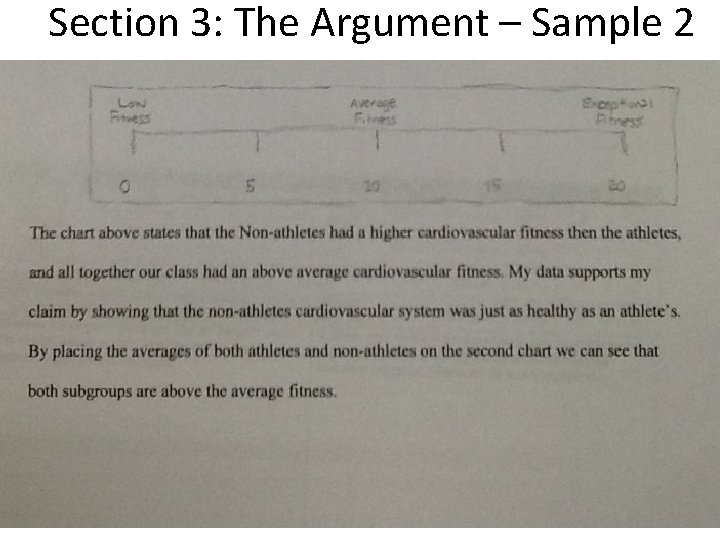
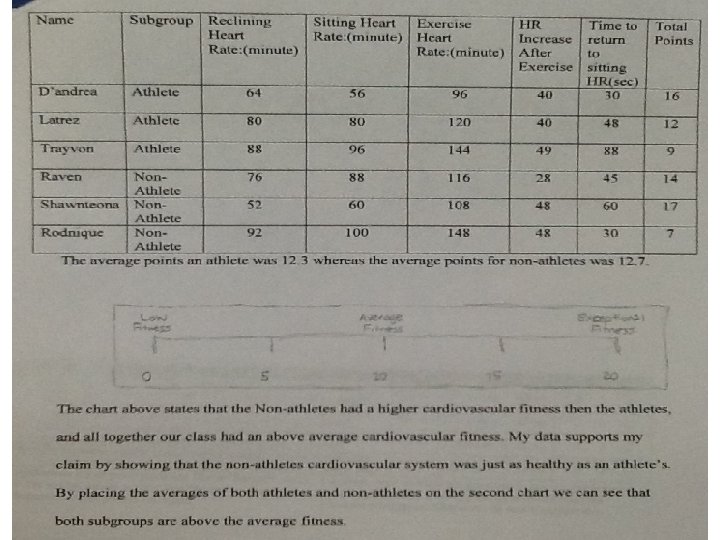
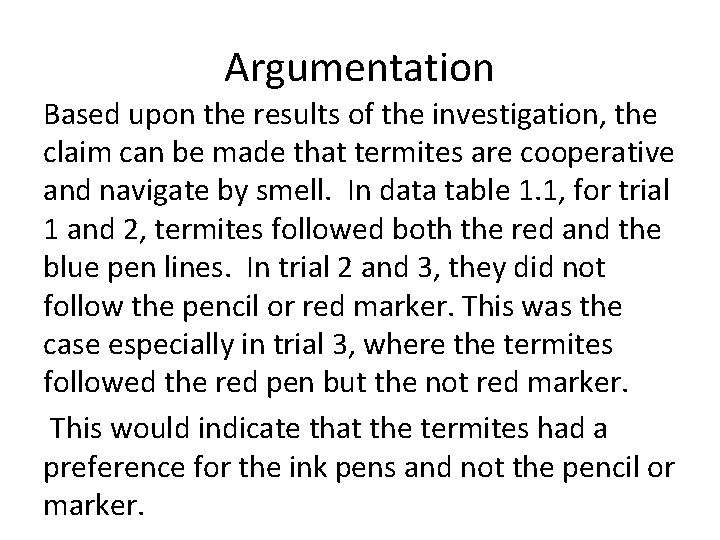
Section 3: The Argument – Sample 2
Argumentation Based upon the results of the investigation, the claim can be made that termites are cooperative and navigate by smell. In data table 1. 1, for trial 1 and 2, termites followed both the red and the blue pen lines. In trial 2 and 3, they did not follow the pencil or red marker. This was the case especially in trial 3, where the termites followed the red pen but the not red marker. This would indicate that the termites had a preference for the ink pens and not the pencil or marker.
Argumentation cont. The pencil and marker smell different than the ink in the pen The ink in the pen contains a chemical that smells the same as the pheromones that are secreted by the termites. As a result, termites follow the line because it smells like a trail left by another termite.
- Slides: 91