
Welcome to AP BIOLOGY NOTES Chapter 1 Exploring

Welcome to AP BIOLOGY!!!! NOTES: Chapter 1 Exploring Life

Exploring LIFE: ● The phenomenon we call life defies a simple, onesentence definition ● We recognize life by what living things DO

Some Properties of LIFE: ● order ● evolutionary adaptation ● response to the environment ● regulation (homeostasis) ● energy processing ● growth and development ● reproduction

(b) Evolutionary adaptation (a) Order (c) Response to the environment (d) Regulation (e) Energy processing (f) Growth and development Figure 1. 2 (g) Reproduction

Concepts / Themes in the Study of Life

► Concept 1. 1: a set of THEMES/ big ideas pervade all of biology – make connections across different areas of biology! ● THEME: new properties emerge at each level in the biological hierarchy

From the biosphere to organisms: 1 The biosphere Figure 1. 3

From cells to molecules: 9 Organelles 1 µm Cell 8 Cells Atoms 10 µm 7 Tissues 50 µm 6 Organs and organ systems Figure 1. 3 10 Molecules

Life is organized (ORDER) on many structural levels (small to large): ● Atoms ● Biological Molecules ● Organelles ● Cells ● Tissues ● Organ Systems ● Organism

Levels beyond the individual organism: ● Population ● Community ● Ecosystem ● Biomes ● Biosphere

● THEME: organisms INTERACT with other organisms and the physical environment -ex: cycling of chemical nutrients within an ecosystem

● THEME: life requires energy transfer and transformation -all organisms must perform work, which requires energy -flow of energy through an ecosystem (sunlight plants animals…)


THEME: STRUCTURE AND FUNCTION are correlated at all levels of biological organization. “Form fits function!”
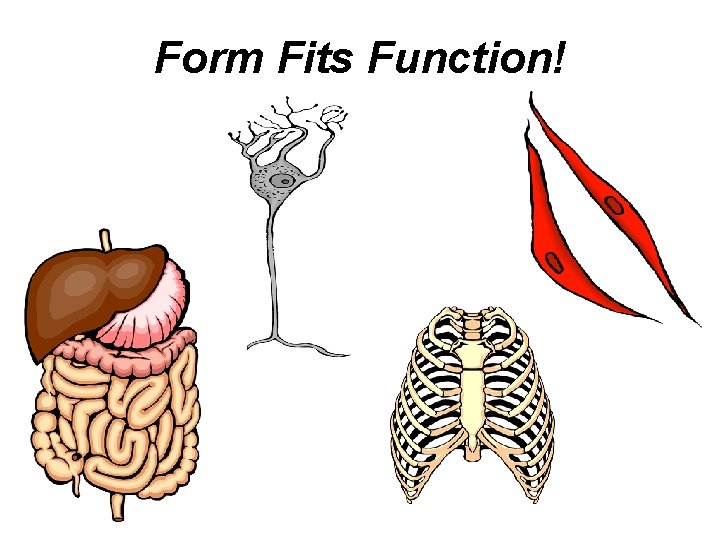
Form Fits Function!


● Biological systems are much more than the sum of their parts A system is a combination of components that form a more complex organization Outer membrane CELL Figure 1. 10 and cell surface Cytoplasm Nucleu s

THEME: the cell is an organism’s basic unit of structure and function ● The cell is the lowest level of organization that can perform all activities required for life Figure 1. 5 25 µm

The Cell’s Heritable Information: ● Cells contain chromosomes made partly of DNA, the substance of genes which program the cells’ production of proteins and transmit information from parents to offspring Sperm cell Nuclei containing DNA Egg cell Figure 1. 6 Fertilized egg with DNA from both parents Embyro’s cells with copies of inherited DNA Offspring with traits inherited from both parents

THEME: the continuity of life is based on heritable information in the form of DNA ● The molecular structure of DNA accounts for it information-rich nature

THEME: Feedback Mechanisms Regulate Biological Systems ● A kind of supply-and-demand economy applies to some of the dynamics of biological systems ● In feedback regulation the output, or product, of a process regulates that very process

In negative feedback: ● An accumulation of an end product slows the process that produces that product A Negative feedback Enzyme 1 B A Enzyme 1 B Enzyme 2 C C Enzyme 3 D D D

In positive feedback: ● The end product speeds up production W W Enzyme 4 Positive feedback X X Enzyme 5 Y Y Enzyme 6 Z Z Z Z Z

THEME: Evolution is the overarching theme of biology!

► Concept 1. 2: Evolution accounts for life’s unity and diversity ● The history of life is a saga of a changing Earth billions of years old ● The evolutionary view of life came into sharp focus in 1859 when Charles Darwin published On the Origin of Species by Natural Selection

EVOLUTION: ● The Origin of Species articulated two main points -Descent with modification -Natural selection


● The products of natural selection are often exquisite adaptations of organisms to the special circumstances of their way of life and their environment


“In Biology nothing makes sense except in the light of evolution. ” -Theodosius Dobzhansky (1900 -1975)

Diversity and unity are the dual faces of life on earth: ● TAXONOMY = branch of biology concerned with naming and classifying organisms. – This helps categorize the diversity to make it manageable. ● Unity of life is evident in: – A universal genetic code; – Similar metabolic pathways; – Similarities in cell structure.

► Classifying Life: Biologists explore life across its great diversity of species ● Diversity is a hallmark of life

Classifying life: Species Genus Family Order Class Phylum Ursus americanus (American black bear) Ursus Ursidae Carnivora Mammalia Chordata Animalia Eukarya Kingdom Domain

Life’s 3 Domains:

Unity in the Diversity of Life: ● As diverse as life is there is also evidence of remarkable unity 15 µm 1. 0 µm Cilia of Paramecium. The cilia of Paramecium propel the cell through pond water. 5 µm Cross section of cilium, as viewed with an electron microscope Cilia of windpipe cells. The cells that line the human windpipe are equipped with cilia that help keep the lungs clean by moving a film of debris-trapping mucus upward.


► Concept 1. 3: Biologists use various forms of inquiry to explore life ● At the heart of science is inquiry – A search for information and explanation, often focusing on specific questions ● Biology blends two main processes of scientific inquiry – Discovery science – Hypothesis-based science


Discovery Science: ● Describes natural structures and processes as accurately as possible through careful observation and analysis of data

“A discovery is like falling in love and reaching the top of a mountain after a hard climb all in one, an ecstasy induced not by drugs but by the revelation of a face of nature that no one has seen before. ” -Max Perutz (Pulitzer Prize: Biochemistry)

Types of DATA: ● Data -Are recorded observations -Can be quantitative or qualitative

Hypothesis-Based Science (INQUIRY): ● In science, inquiry that asks specific questions usually involves the proposing and testing of hypothetical explanations, or hypotheses ● In science, a hypothesis – Is a tentative answer to a well-framed question, an explanation on trial – Makes predictions that can be tested

Hypotheses in Scientific Inquiry: ● A scientific hypothesis must have two important qualities: -It must be testable -It must be falsifiable

A Case Study in Scientific Inquiry: Investigating Mimicry in Snake Populations ● In one type of mimicry a harmless species resembles a harmful species Flower fly (non-stinging) Honeybee (stinging)

● In this case study – Mimicry in king snakes is examined – The hypothesis predicts that predators in non–coral snake areas will attack king snakes more frequently than will predators that live where coral snakes are present


● To test this mimicry hypothesis researchers made hundreds of artificial snakes, an experimental group resembling king snakes and a control group of plain brown snakes

● After a given period of time the researchers collected data that fit a key prediction

Limitations of Science ● Science cannot address supernatural phenomena -Because hypotheses must be testable and falsifiable and experimental results must be repeatable

Theories in Science: ● A scientific theory -Is broad in scope -Generates new hypotheses -Is supported by a large body of evidence

► Concept 1. 4: Science benefits from a cooperative approach and diverse viewpoints ● Science is a social activity! – Scientists work together & share their results with the scientific community ● Building on the work of others – Results must be repeatable – Biologists approach questions at different levels – Cooperation & communication are key!


“We cannot say to ourselves, we need this or that sort of technology, therefore we should be doing this or that sort of science…Science is useful, indispensable sometimes, but whenever it moves forward it does so by producing a surprise; you cannot specify the surprise you’d like. ” -Lewis Thomas, scientist/writer

“We know very little, and yet it is astonishing that we know so much, and still more astonishing that so little knowledge can give us so much power. ” -Bertrand Russell (1872 -1970), Philosopher, mathematician
- Slides: 55