
Welcome to A Level Geography AQA Geography 7037
- Slides: 9
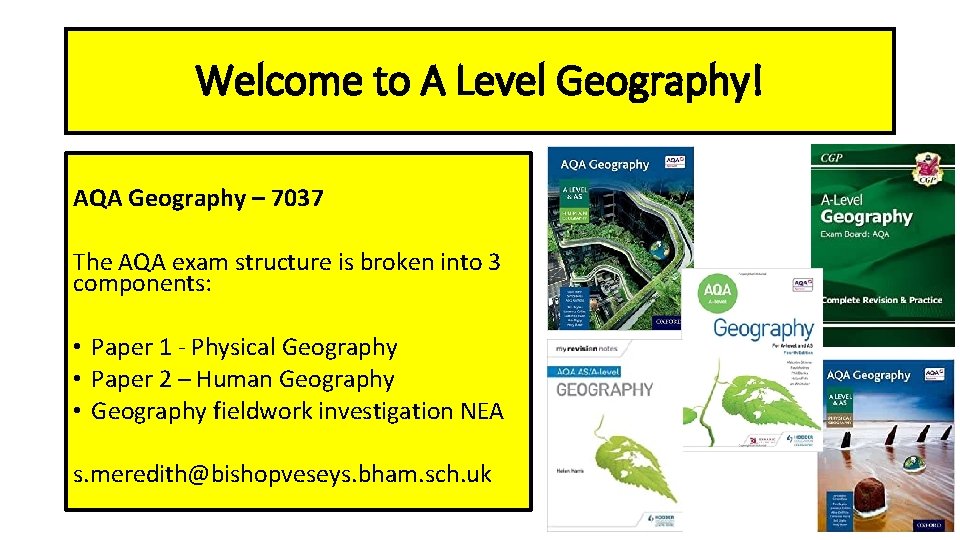
Welcome to A Level Geography! AQA Geography – 7037 The AQA exam structure is broken into 3 components: • Paper 1 - Physical Geography • Paper 2 – Human Geography • Geography fieldwork investigation NEA s. meredith@bishopveseys. bham. sch. uk
Paper 1 – Physical Geography 2 hours 30 minutes long and there are 120 marks (40% of A-Level grade) You will complete 3 sections: • Water and Carbon Cycles (36 marks) • Coastal Systems and Landscapes (36 marks) • Hazards (48 marks)
Paper 2 – Human Geography 2 hours 30 minutes long and there are 120 marks (40% of A-Level grade) You will complete 3 sections: • Global Systems and Governance (36 marks) • Changing Places (36 marks) • Contemporary Urban Environments (48 marks)
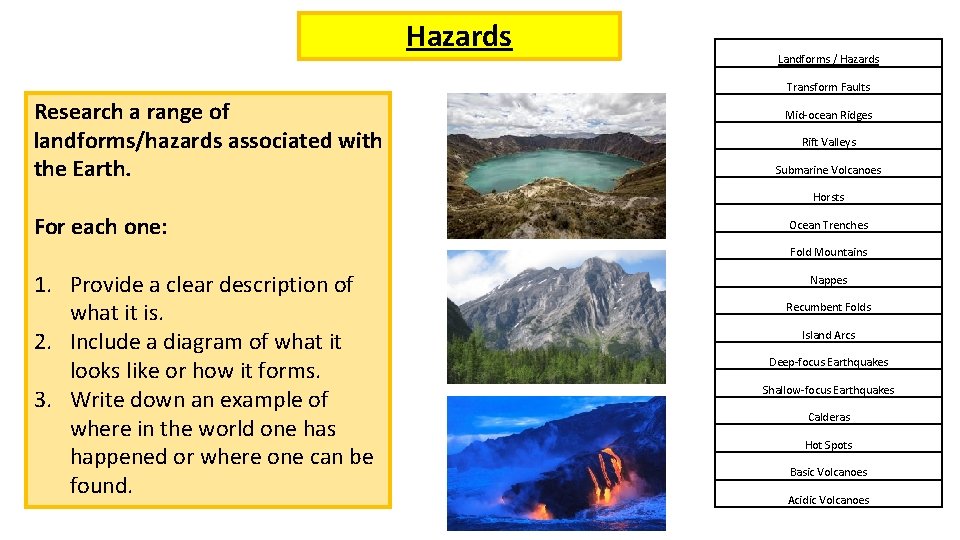
Hazards Landforms / Hazards Transform Faults Research a range of landforms/hazards associated with the Earth. Mid-ocean Ridges Rift Valleys Submarine Volcanoes Horsts For each one: Ocean Trenches Fold Mountains 1. Provide a clear description of what it is. 2. Include a diagram of what it looks like or how it forms. 3. Write down an example of where in the world one has happened or where one can be found. Nappes Recumbent Folds Island Arcs Deep-focus Earthquakes Shallow-focus Earthquakes Calderas Hot Spots Basic Volcanoes Acidic Volcanoes
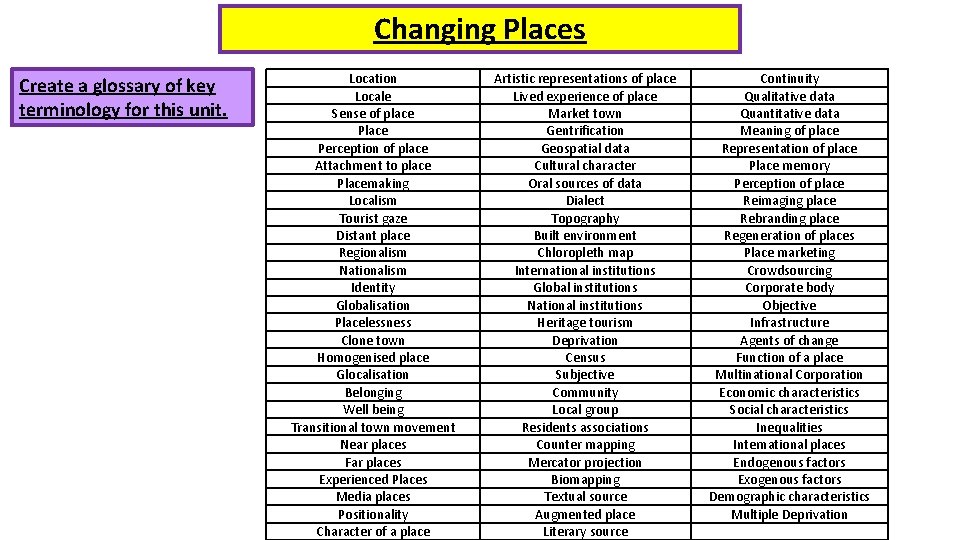
Changing Places Create a glossary of key terminology for this unit. Location Locale Sense of place Perception of place Attachment to place Placemaking Localism Tourist gaze Distant place Regionalism Nationalism Identity Globalisation Placelessness Clone town Homogenised place Glocalisation Belonging Well being Transitional town movement Near places Far places Experienced Places Media places Positionality Character of a place Artistic representations of place Lived experience of place Market town Gentrification Geospatial data Cultural character Oral sources of data Dialect Topography Built environment Chloropleth map International institutions Global institutions National institutions Heritage tourism Deprivation Census Subjective Community Local group Residents associations Counter mapping Mercator projection Biomapping Textual source Augmented place Literary source Continuity Qualitative data Quantitative data Meaning of place Representation of place Place memory Perception of place Reimaging place Rebranding place Regeneration of places Place marketing Crowdsourcing Corporate body Objective Infrastructure Agents of change Function of a place Multinational Corporation Economic characteristics Social characteristics Inequalities International places Endogenous factors Exogenous factors Demographic characteristics Multiple Deprivation
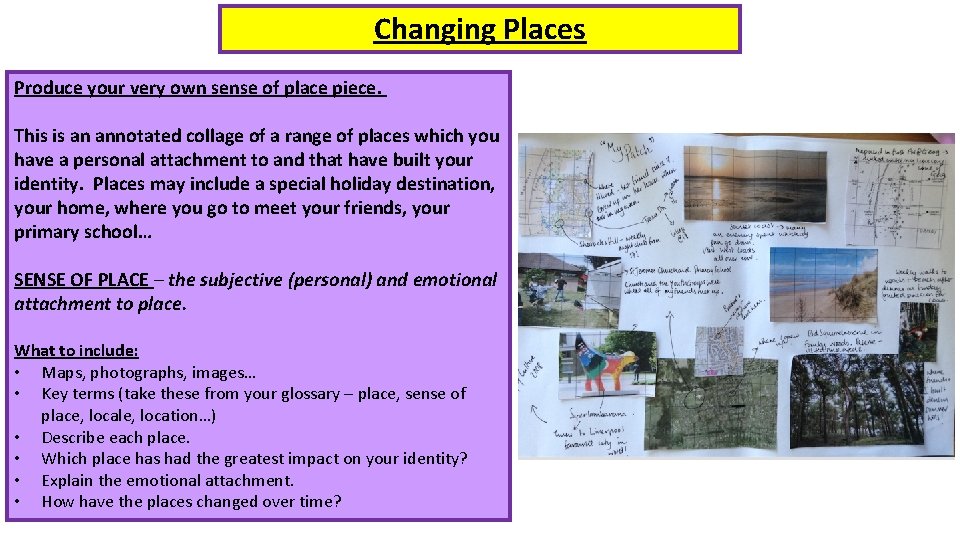
Changing Places Produce your very own sense of place piece. This is an annotated collage of a range of places which you have a personal attachment to and that have built your identity. Places may include a special holiday destination, your home, where you go to meet your friends, your primary school… SENSE OF PLACE – the subjective (personal) and emotional attachment to place. What to include: • Maps, photographs, images… • Key terms (take these from your glossary – place, sense of place, locale, location…) • Describe each place. • Which place has had the greatest impact on your identity? • Explain the emotional attachment. • How have the places changed over time?
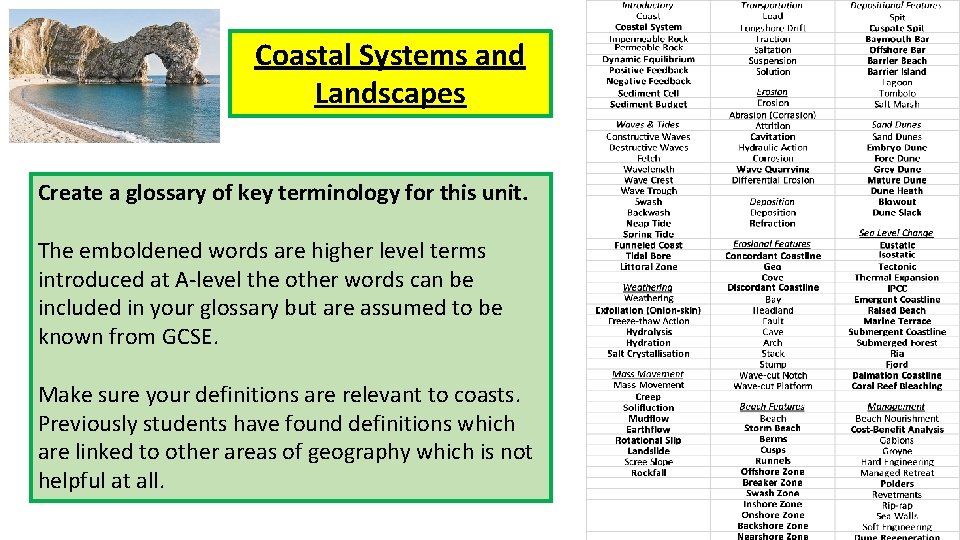
Coastal Systems and Landscapes Create a glossary of key terminology for this unit. The emboldened words are higher level terms introduced at A-level the other words can be included in your glossary but are assumed to be known from GCSE. Make sure your definitions are relevant to coasts. Previously students have found definitions which are linked to other areas of geography which is not helpful at all.
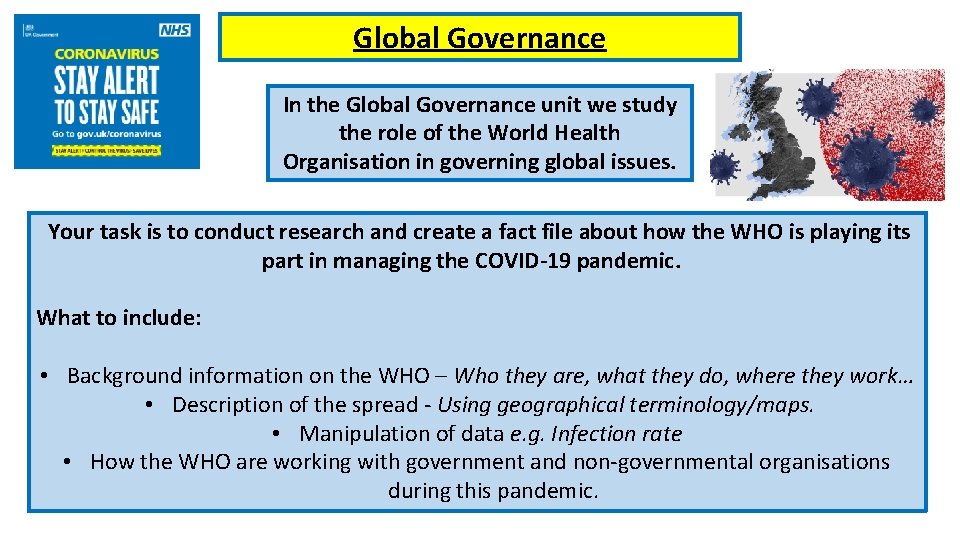
Global Governance In the Global Governance unit we study the role of the World Health Organisation in governing global issues. Your task is to conduct research and create a fact file about how the WHO is playing its part in managing the COVID-19 pandemic. What to include: • Background information on the WHO – Who they are, what they do, where they work… • Description of the spread - Using geographical terminology/maps. • Manipulation of data e. g. Infection rate • How the WHO are working with government and non-governmental organisations during this pandemic.
Extension: SENECA Learning Use the link below to join the BVGS year 11 -12 transition group on SENECA Learning https: //app. senecalearning. com/dashboard/join-class/n 1 x 5 aopn 3 r There a range of topics for you to study within the GCSE Refresher and an A Level Taster assignments. There are short answer questions which will be automatically checked. You can map your progress and reattempt any questions at any point.