
Welcome Ticket Worksheet You may work in groups

- Slides: 21
Welcome Ticket: Worksheet You may work in groups and you may use the calculators. You have about 6 minutes to do this.
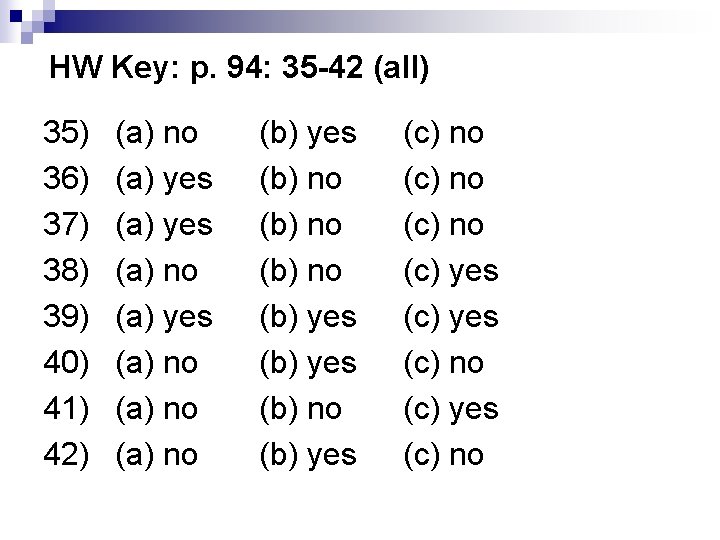
HW Key: p. 94: 35 -42 (all) 35) 36) 37) 38) 39) 40) 41) 42) (a) no (a) yes (a) no (b) yes (b) no (b) yes (b) no (b) yes (c) no (c) yes (c) no
Unit 2 2. 1 Graphs of Basic Functions & Relations – Part 2
Objectives & HW: The students will be able to: n Identify symmetry with respect to the yaxis, x-axis, or the origin. n Distinguish between odd and even functions. n HW: p. 94: 44 -52 (even), 54, 60, 68, 70
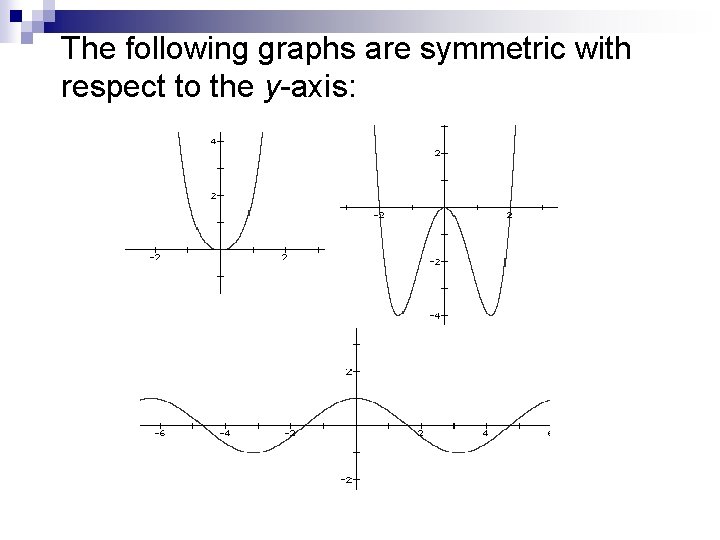
The following graphs are symmetric with respect to the y-axis:
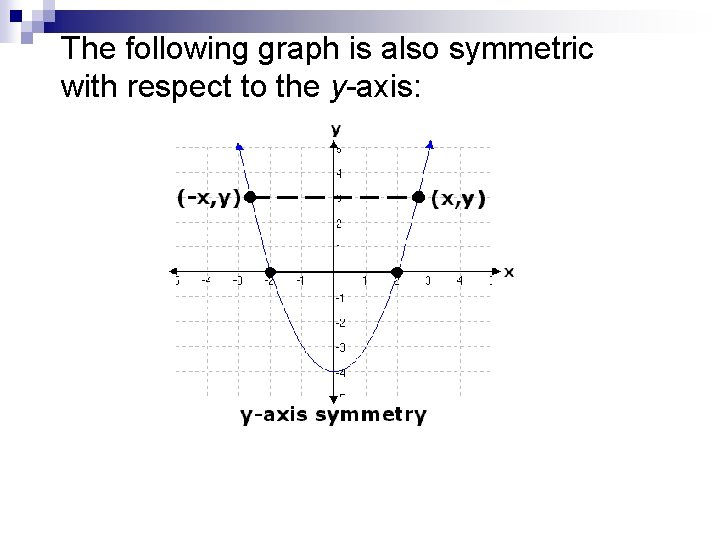
The following graph is also symmetric with respect to the y-axis:
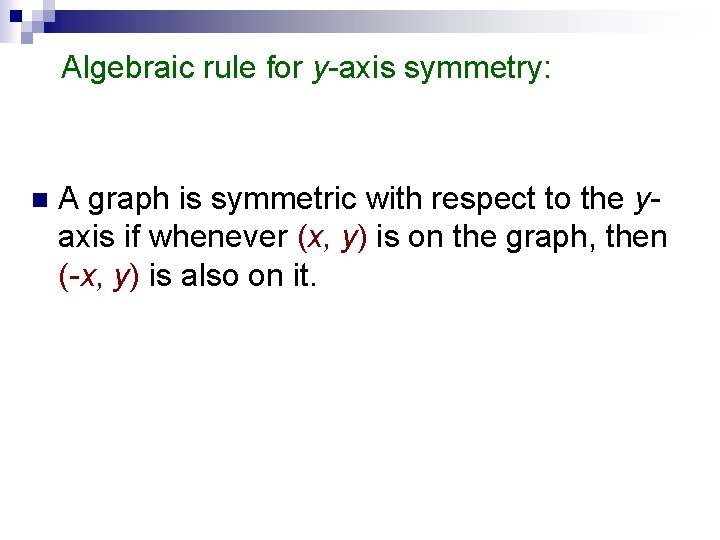
Algebraic rule for y-axis symmetry: n A graph is symmetric with respect to the yaxis if whenever (x, y) is on the graph, then (-x, y) is also on it.
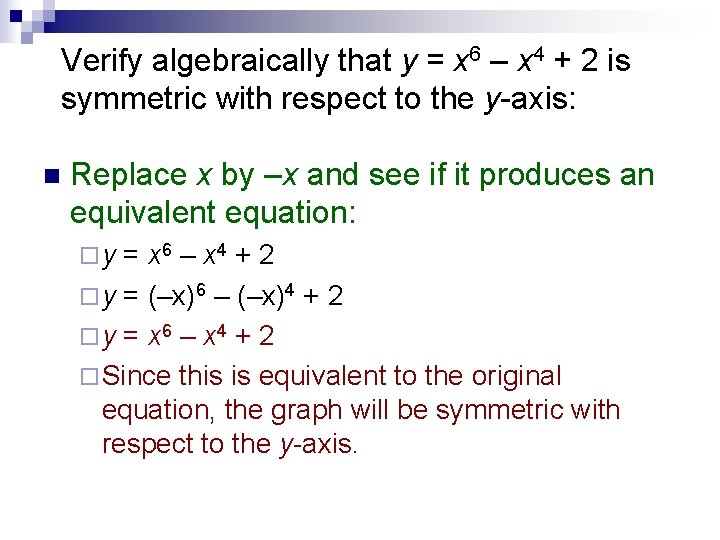
Verify algebraically that y = x 6 – x 4 + 2 is symmetric with respect to the y-axis: n Replace x by –x and see if it produces an equivalent equation: ¨y = x 6 – x 4 + 2 ¨ y = (–x)6 – (–x)4 + 2 ¨ y = x 6 – x 4 + 2 ¨ Since this is equivalent to the original equation, the graph will be symmetric with respect to the y-axis.
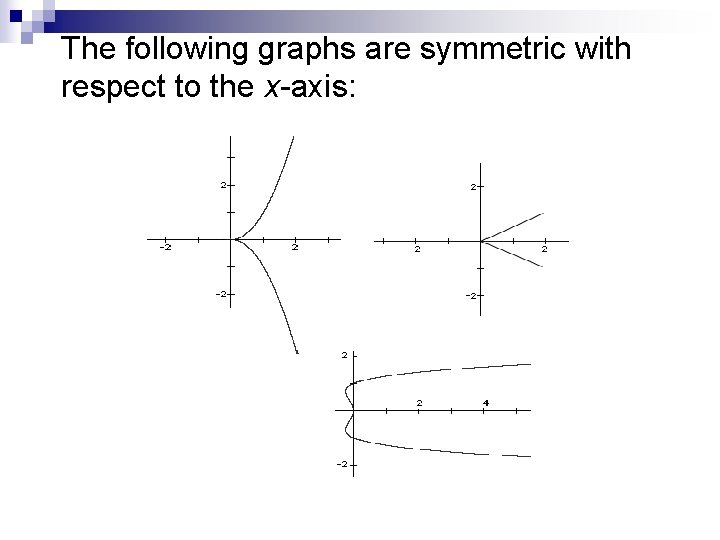
The following graphs are symmetric with respect to the x-axis:
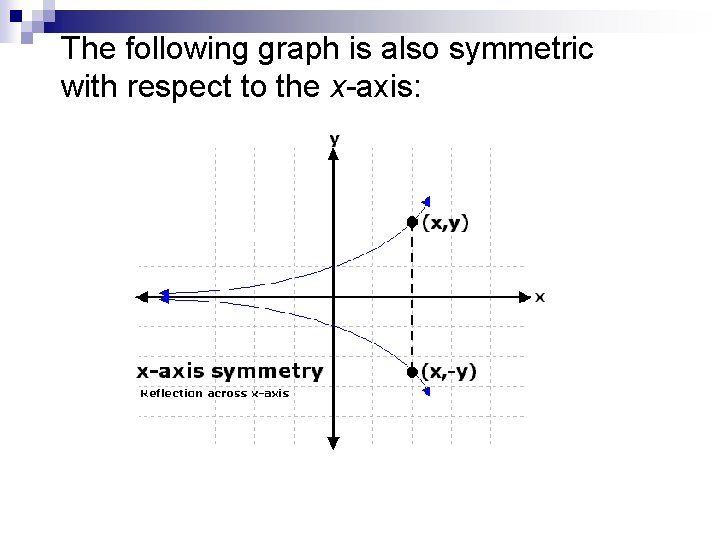
The following graph is also symmetric with respect to the x-axis:
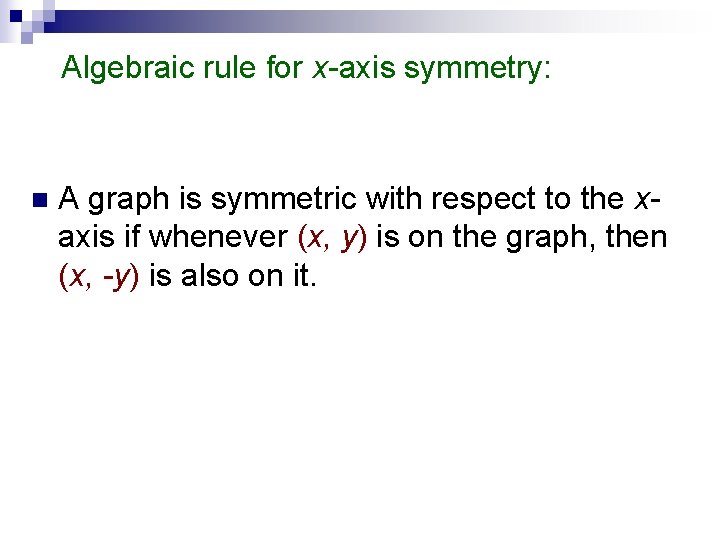
Algebraic rule for x-axis symmetry: n A graph is symmetric with respect to the xaxis if whenever (x, y) is on the graph, then (x, -y) is also on it.
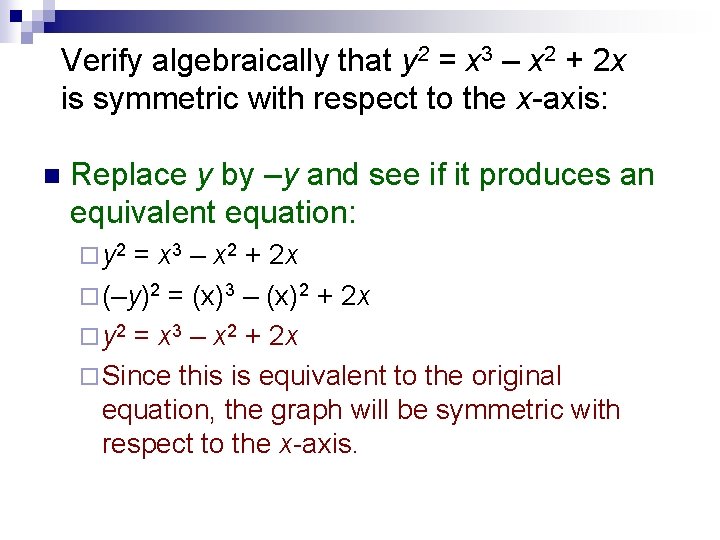
Verify algebraically that y 2 = x 3 – x 2 + 2 x is symmetric with respect to the x-axis: n Replace y by –y and see if it produces an equivalent equation: ¨ y 2 = x 3 – x 2 + 2 x ¨ (–y)2 = (x)3 – (x)2 + 2 x ¨ y 2 = x 3 – x 2 + 2 x ¨ Since this is equivalent to the original equation, the graph will be symmetric with respect to the x-axis.
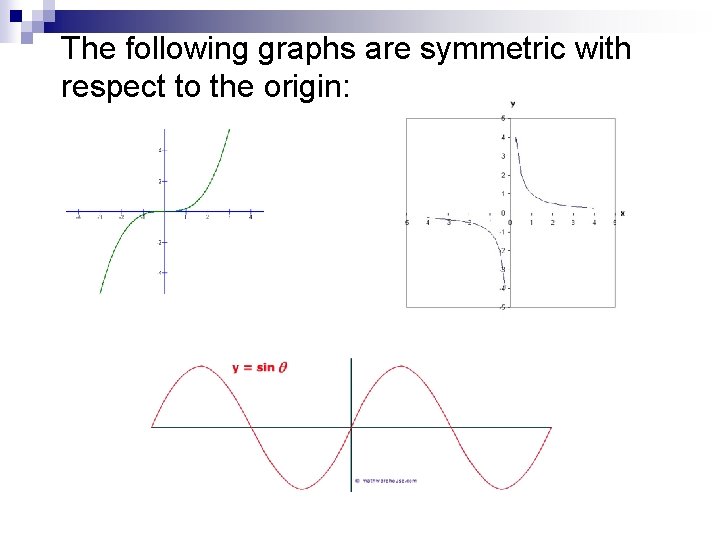
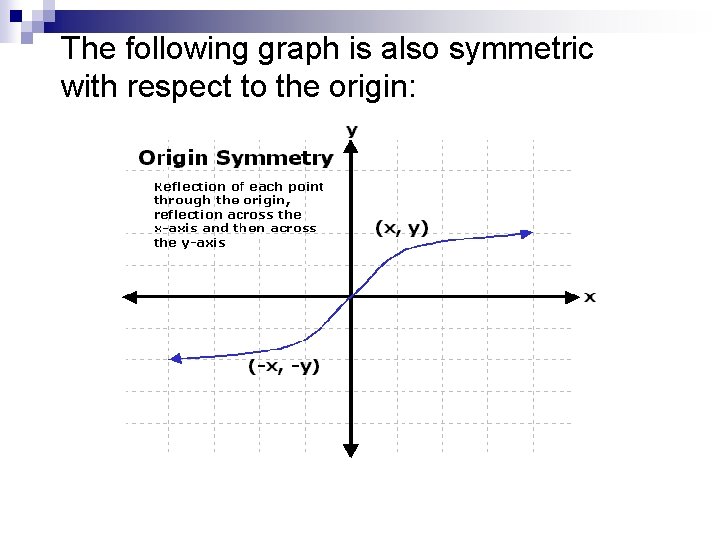
The following graphs are symmetric with respect to the origin:
The following graph is also symmetric with respect to the origin:
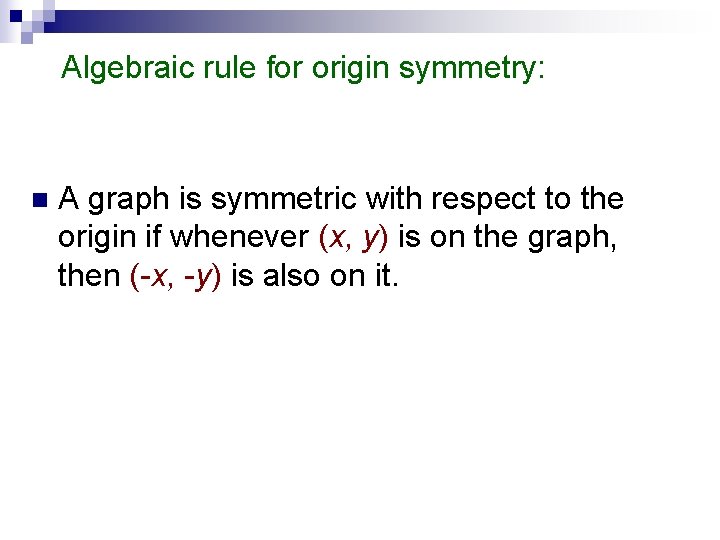
Algebraic rule for origin symmetry: n A graph is symmetric with respect to the origin if whenever (x, y) is on the graph, then (-x, -y) is also on it.
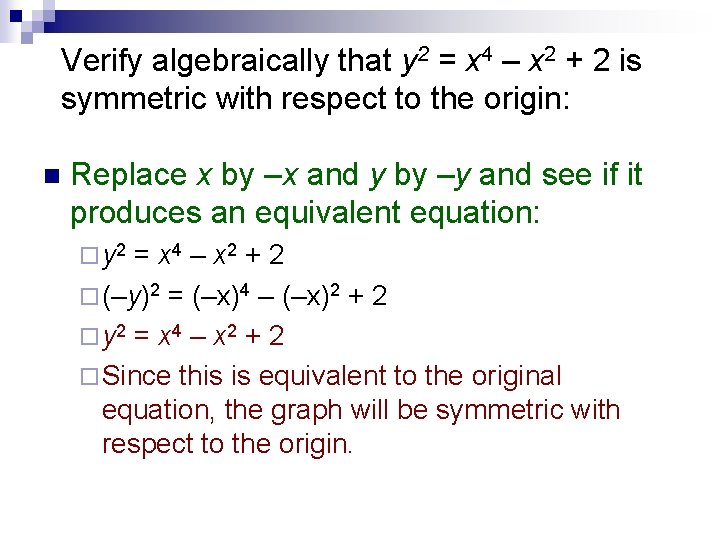
Verify algebraically that y 2 = x 4 – x 2 + 2 is symmetric with respect to the origin: n Replace x by –x and y by –y and see if it produces an equivalent equation: ¨ y 2 = x 4 – x 2 + 2 ¨ (–y)2 = (–x)4 – (–x)2 + 2 ¨ y 2 = x 4 – x 2 + 2 ¨ Since this is equivalent to the original equation, the graph will be symmetric with respect to the origin.
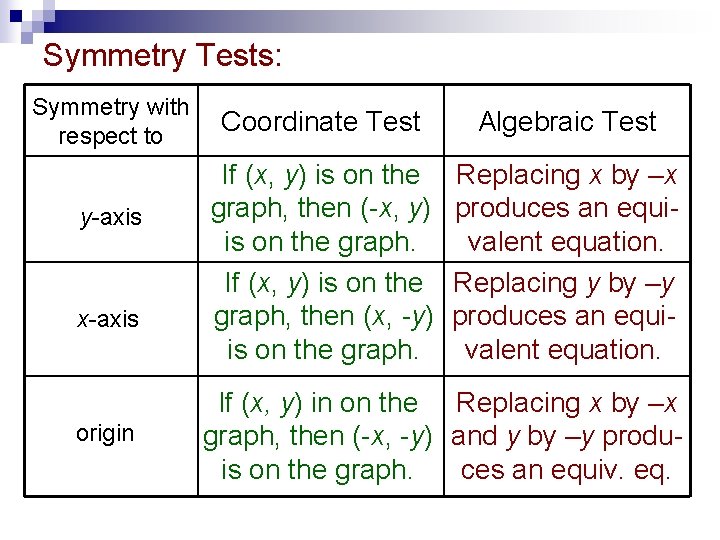
Symmetry Tests: Symmetry with respect to y-axis x-axis origin Coordinate Test Algebraic Test If (x, y) is on the graph, then (-x, y) is on the graph. If (x, y) is on the graph, then (x, -y) is on the graph. Replacing x by –x produces an equivalent equation. Replacing y by –y produces an equivalent equation. If (x, y) in on the Replacing x by –x graph, then (-x, -y) and y by –y produis on the graph. ces an equiv. eq.
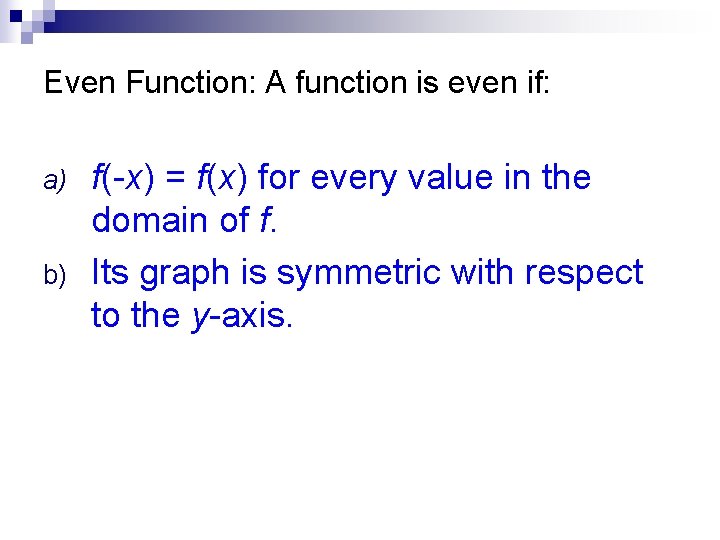
Even Function: A function is even if: a) b) f(-x) = f(x) for every value in the domain of f. Its graph is symmetric with respect to the y-axis.
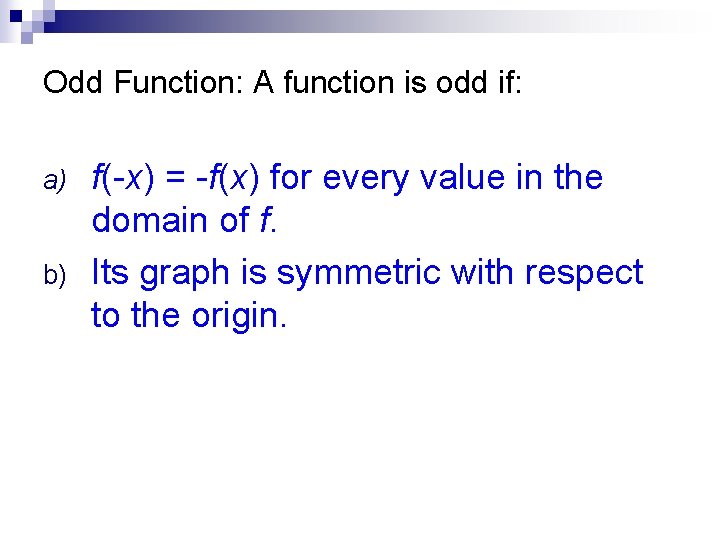
Odd Function: A function is odd if: a) b) f(-x) = -f(x) for every value in the domain of f. Its graph is symmetric with respect to the origin.
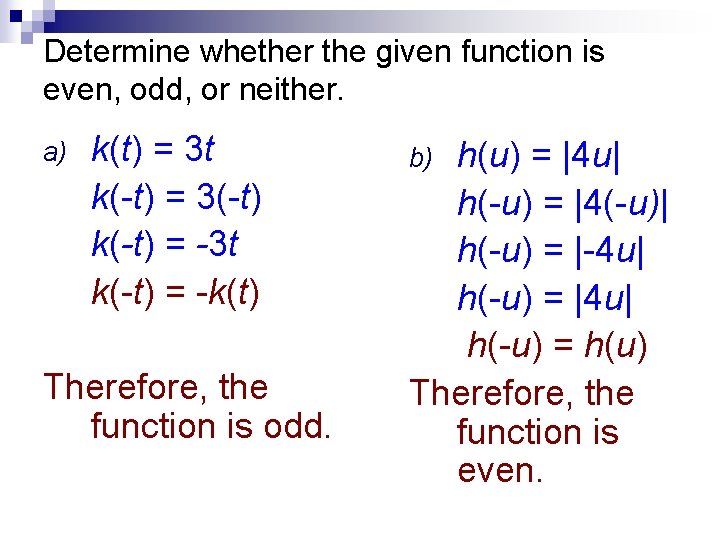
Determine whether the given function is even, odd, or neither. a) k(t) = 3 t k(-t) = 3(-t) k(-t) = -3 t k(-t) = -k(t) Therefore, the function is odd. h(u) = |4 u| h(-u) = |4(-u)| h(-u) = |-4 u| h(-u) = |4 u| h(-u) = h(u) Therefore, the function is even. b)
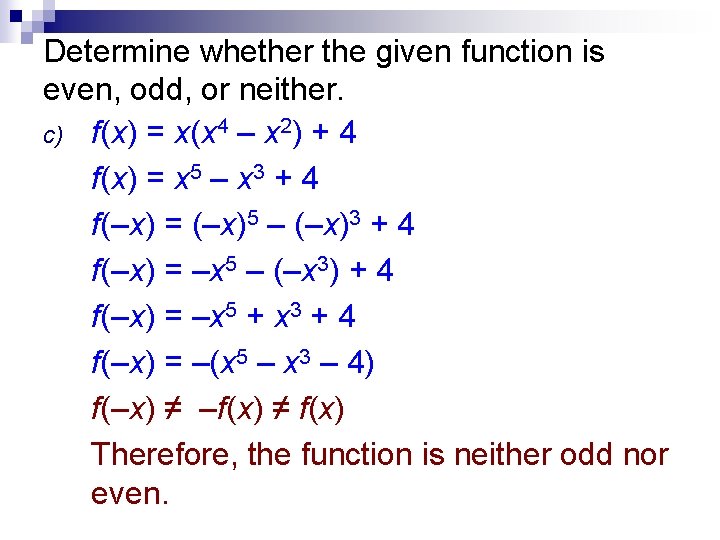
Determine whether the given function is even, odd, or neither. c) f(x) = x(x 4 – x 2) + 4 f(x) = x 5 – x 3 + 4 f(–x) = (–x)5 – (–x)3 + 4 f(–x) = –x 5 – (–x 3) + 4 f(–x) = –x 5 + x 3 + 4 f(–x) = –(x 5 – x 3 – 4) f(–x) ≠ –f(x) ≠ f(x) Therefore, the function is neither odd nor even.