
Welcome Signin Sheet check if you want CME






- Slides: 68
Welcome! Sign-in Sheet – check if you want CME / CNE Name Card (back cover, use marker) CME (Physicians & PAs) must complete: ü Credit Declaration Form handout ü Course Evaluation / Critique (in back of book) CNE (RNs and others) must complete: ü Registration form – page 1 of book ü Course Evaluation / Critique (in back of book) Pagers / Phones on silent
Team. STEPPS Team Skills Workshop <Insert your name here>
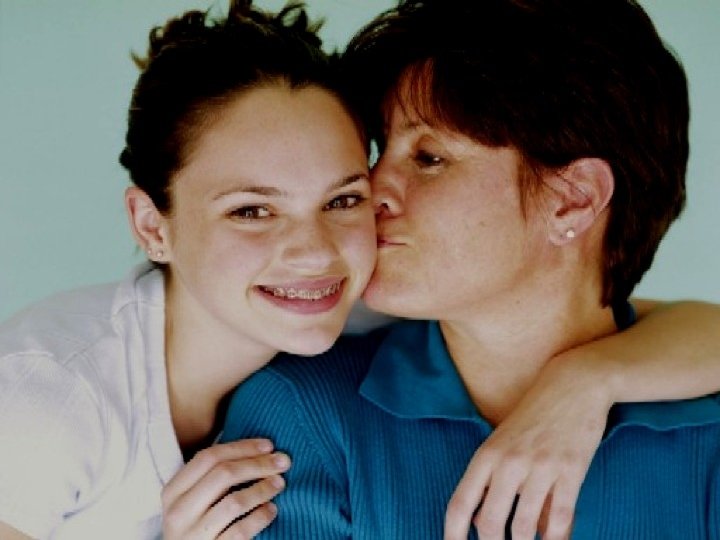
Jane and Mother
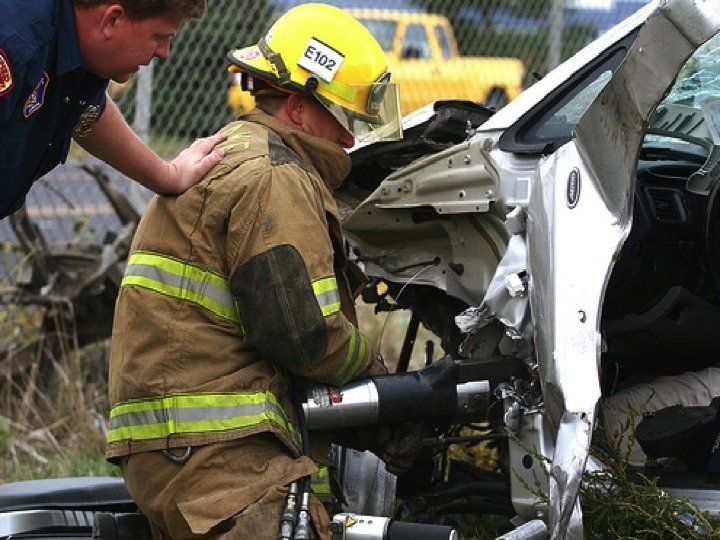
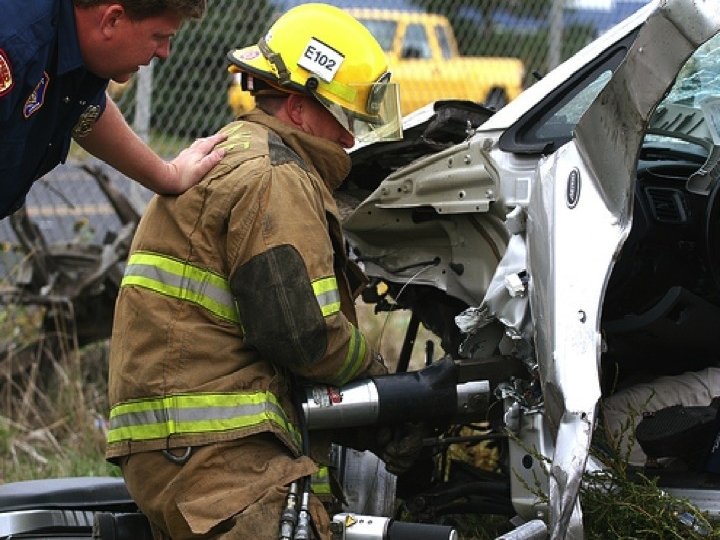
Jaws of life
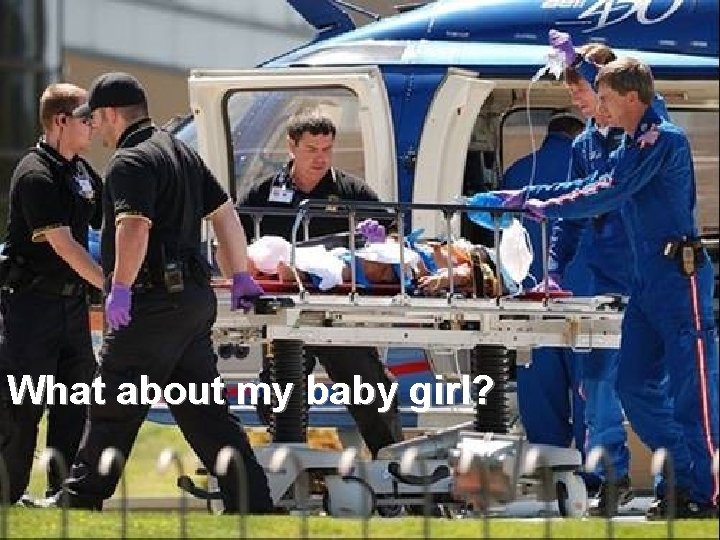
What about my baby girl?
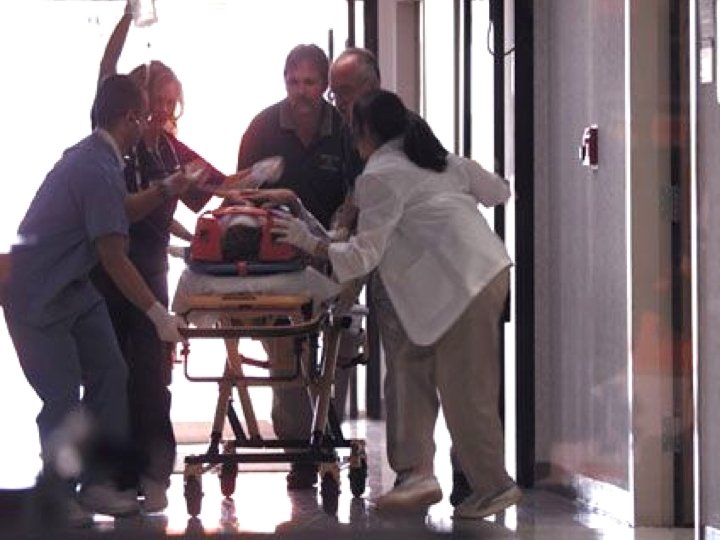
ED Arrival
Gloves
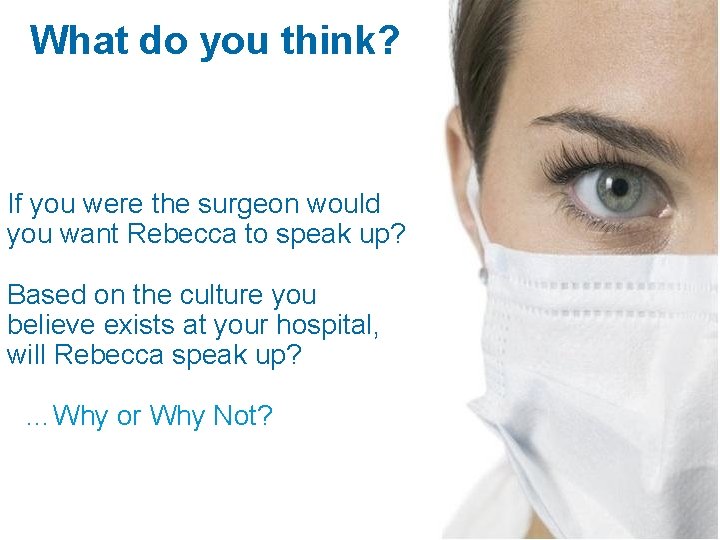
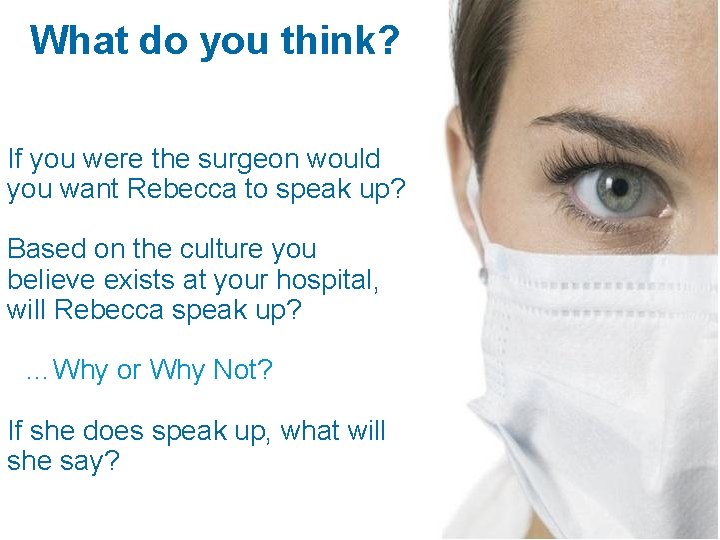
What do you think? If you were the surgeon would you want Rebecca to speak up? Based on the culture you believe exists at your hospital, will Rebecca speak up? …Why or Why Not?
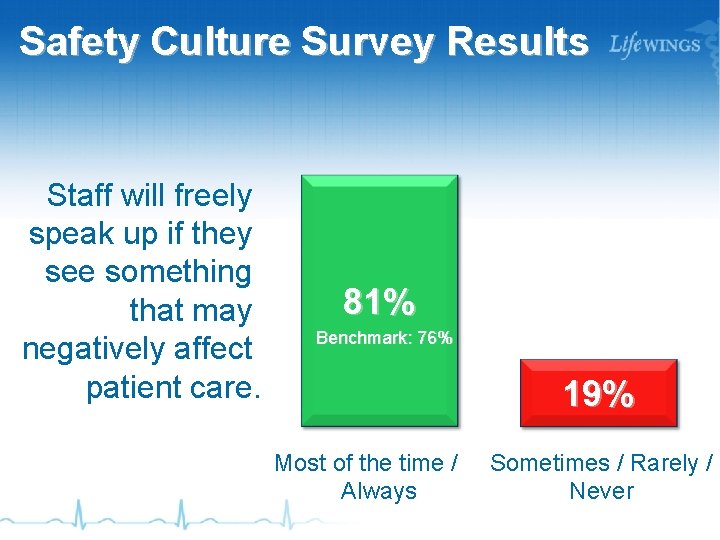
Safety Culture Survey Results Staff will freely speak up if they see something that may negatively affect patient care. 81% Benchmark: 76% 19% Most of the time / Always Sometimes / Rarely / Never
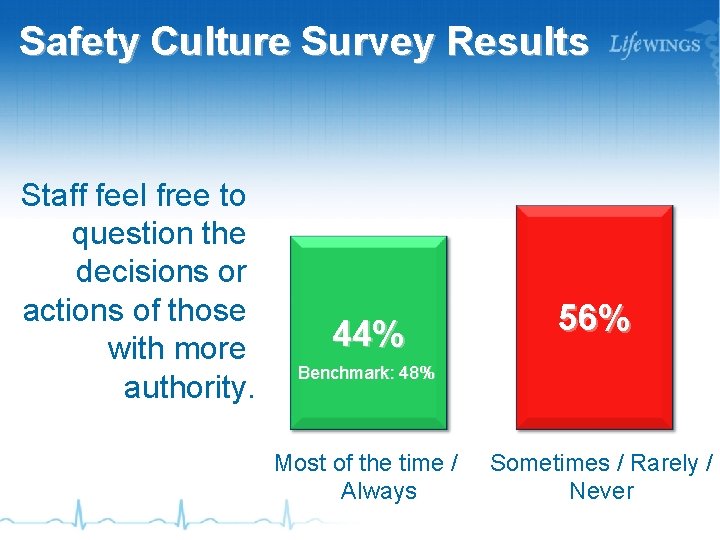
Safety Culture Survey Results Staff feel free to question the decisions or actions of those with more authority. 44% 56% Benchmark: 48% Most of the time / Always Sometimes / Rarely / Never
What do you think? If you were the surgeon would you want Rebecca to speak up? Based on the culture you believe exists at your hospital, will Rebecca speak up? …Why or Why Not? If she does speak up, what will she say?
Jaws of life
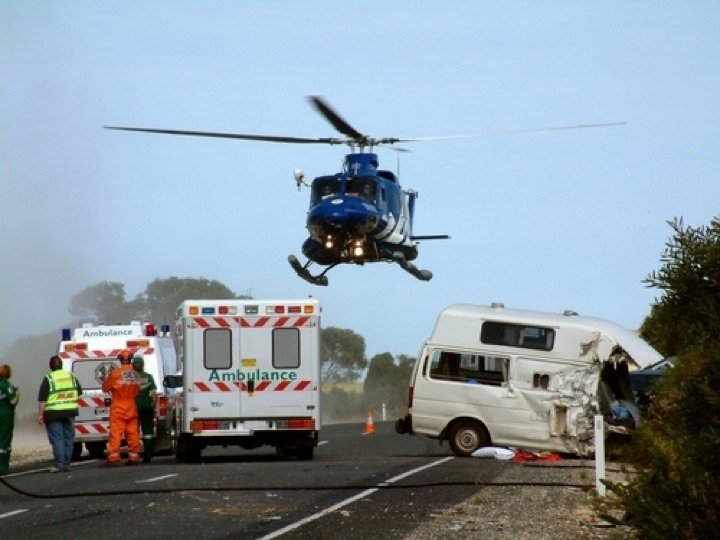
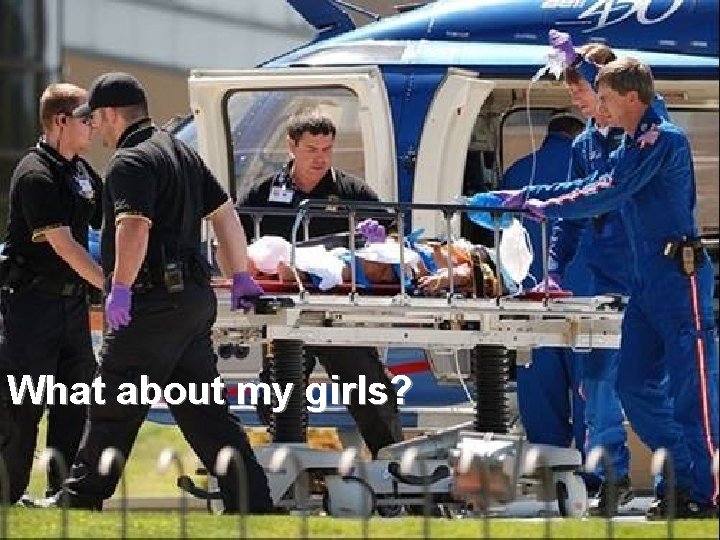
Life Flight
What about my girls?
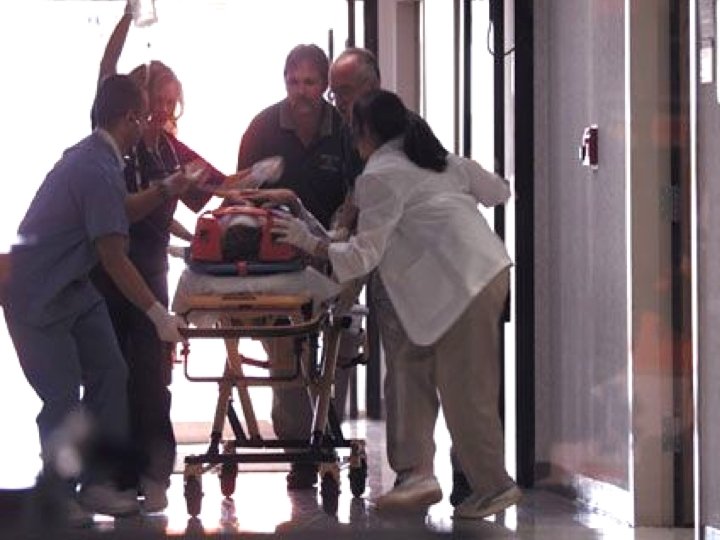
ED Arrival
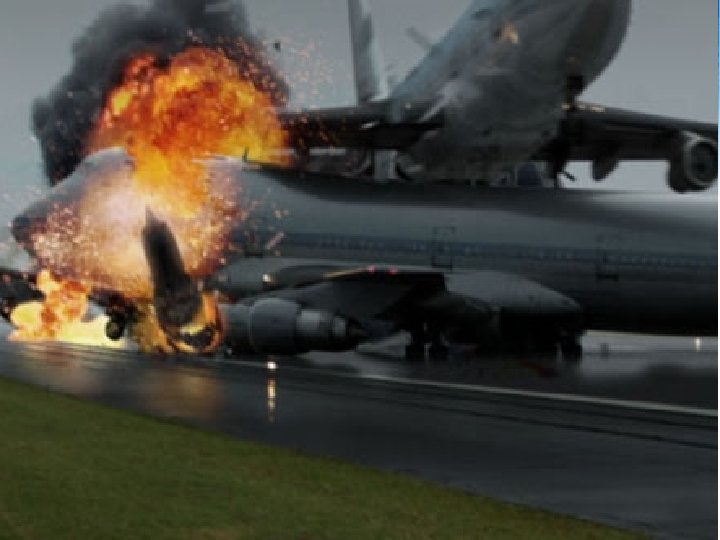
Tenerife March 1977
KLM Ad
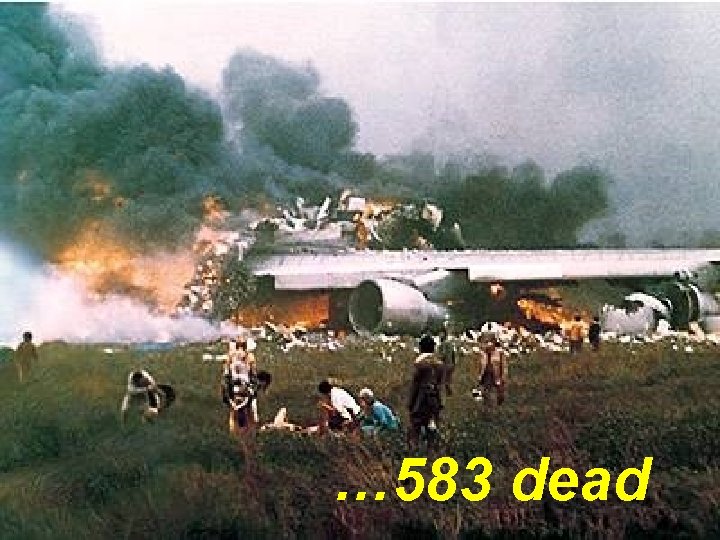
Tenerife March 1977
… 583 dead
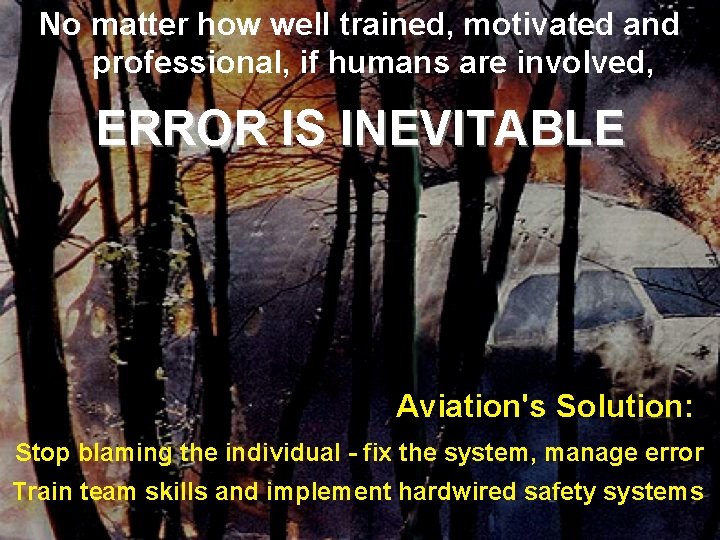
No matter how well trained, motivated and professional, if humans are involved, ERROR IS INEVITABLE Aviation's Solution: Stop blaming the individual - fix the system, manage error Train team skills and implement hardwired safety systems
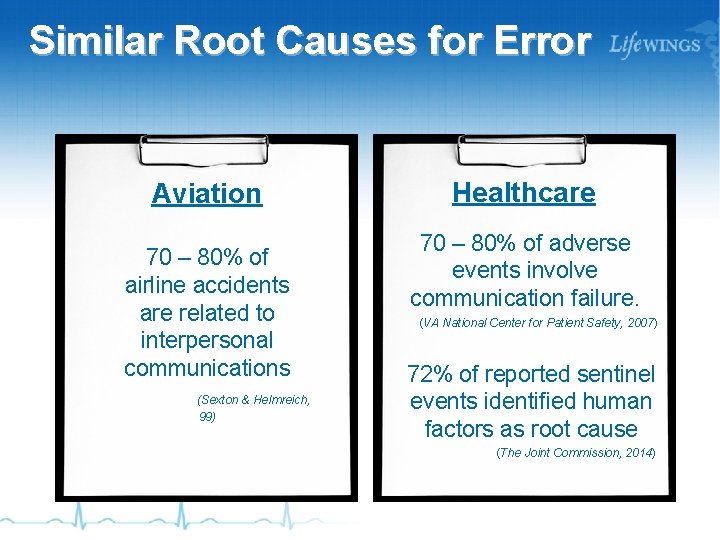
Similar Root Causes for Error Aviation 70 – 80% of airline accidents are related to interpersonal communications (Sexton & Helmreich, 99) Healthcare 70 – 80% of adverse events involve communication failure. (VA National Center for Patient Safety, 2007) 72% of reported sentinel events identified human factors as root cause (The Joint Commission, 2014)
Team Challenge
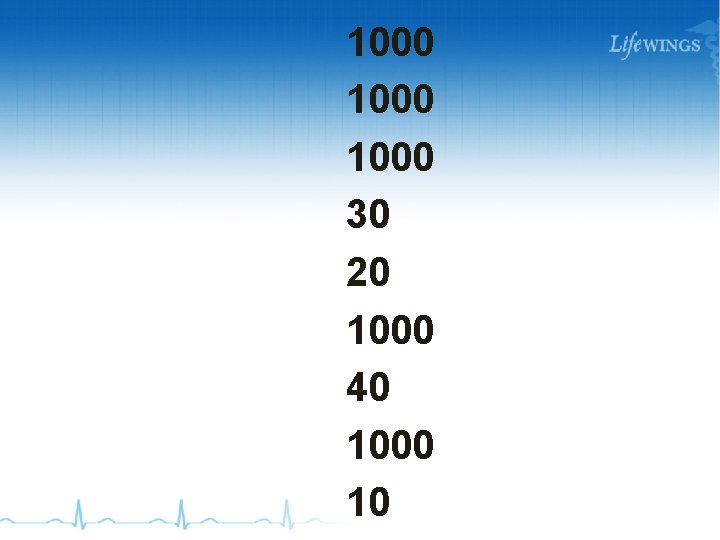
First Numbers Exercise 1000 30 20 1000 40 1000 10
What is your Team's answer?
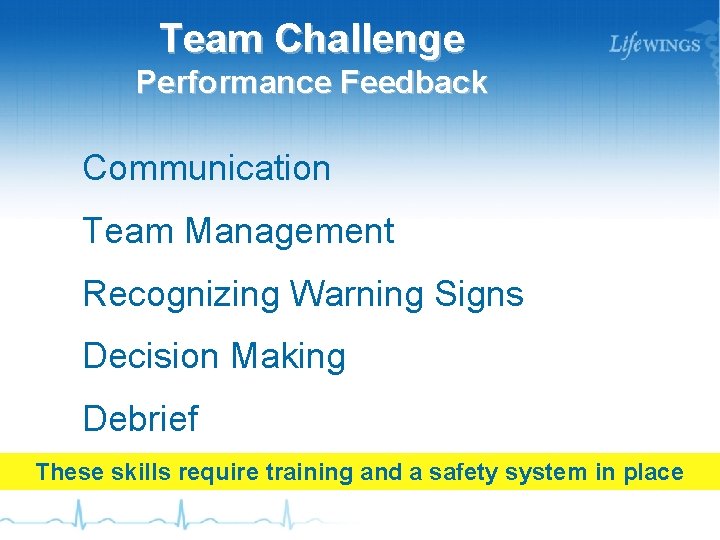
Team Challenge Performance Feedback Communication Team Management Recognizing Warning Signs Decision Making Debrief These skills require training and a safety system in place
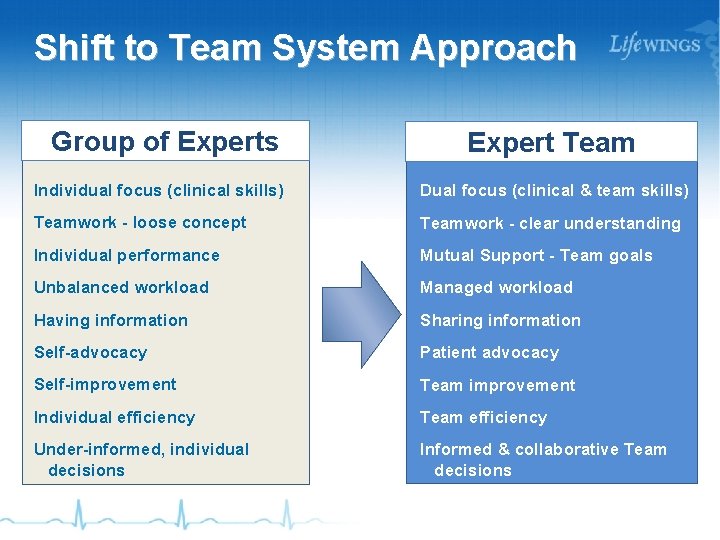
Shift to Team System Approach Group of Experts Expert Team Individual focus (clinical skills) Dual focus (clinical & team skills) Teamwork - loose concept Teamwork - clear understanding Individual performance Mutual Support - Team goals Unbalanced workload Managed workload Having information Sharing information Self-advocacy Patient advocacy Self-improvement Team improvement Individual efficiency Team efficiency Under-informed, individual decisions Informed & collaborative Team decisions
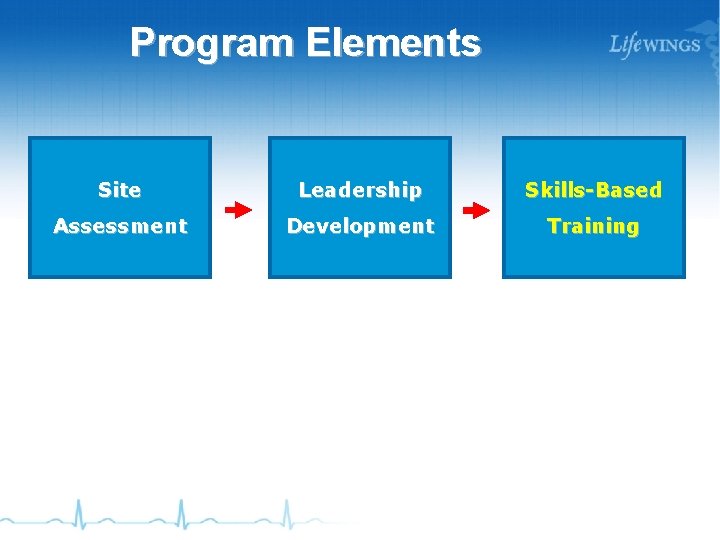
Program Elements Site Leadership Skills-Based Assessment Development Training
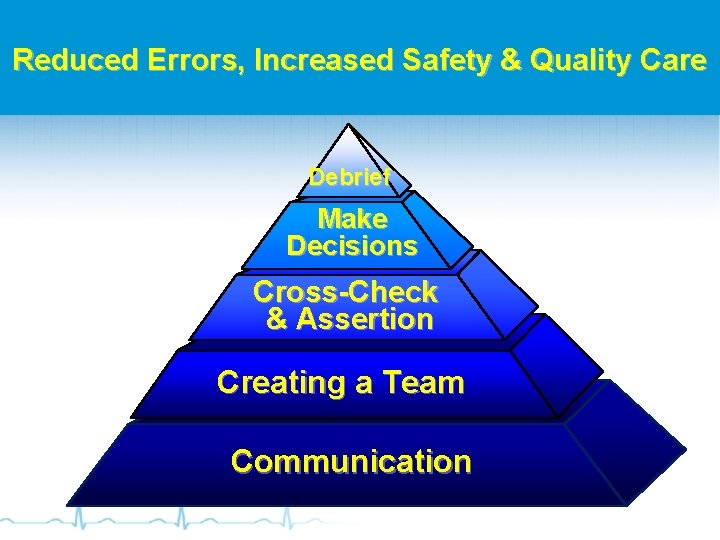
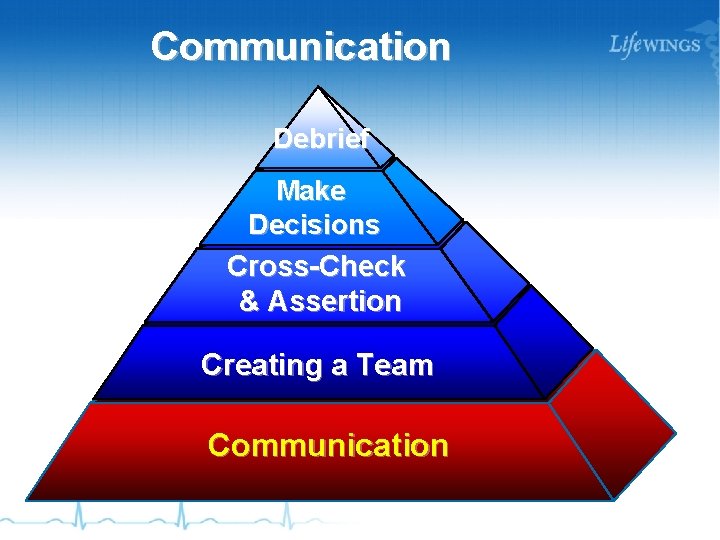
Team Skills Workshop Reduced Errors, Increased Safety & Quality Care Debrief Make Decisions Cross-Check & Assertion Creating a Team Communication
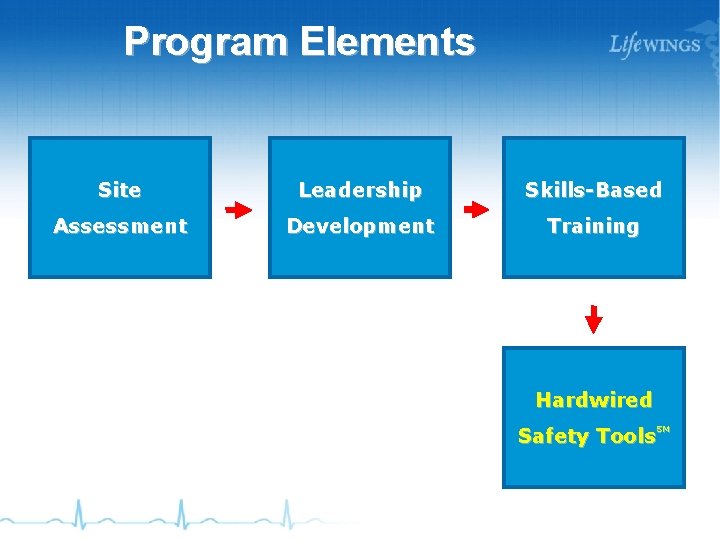
Program Elements Site Leadership Skills-Based Assessment Development Training Hardwired SM Safety Tools
Hardwired Safety Tools SM Protocols such as checklists and structured communications that “hardwire” the team skills into daily practices and processes
Key Hardwired Safety Tools Team Briefings Transfer of Care Reports Team Debriefings Concern Reports Checklists
Page 4 - Record Your Thoughts & Turn In at End of Class • Team & Communication Challenges • Patient Safety Concerns • Ideas for Tools
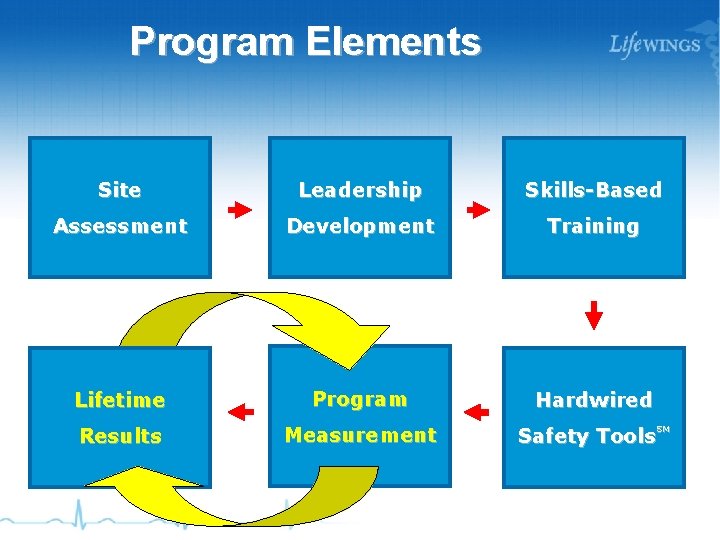
Program Elements Site Leadership Skills-Based Assessment Development Training Lifetime Program Hardwired Results Measurement SM Safety Tools
Results that matter.
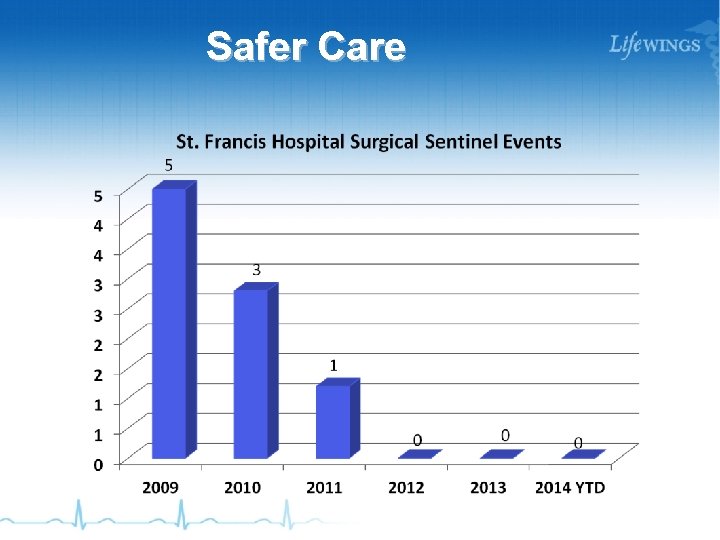
Safer Care
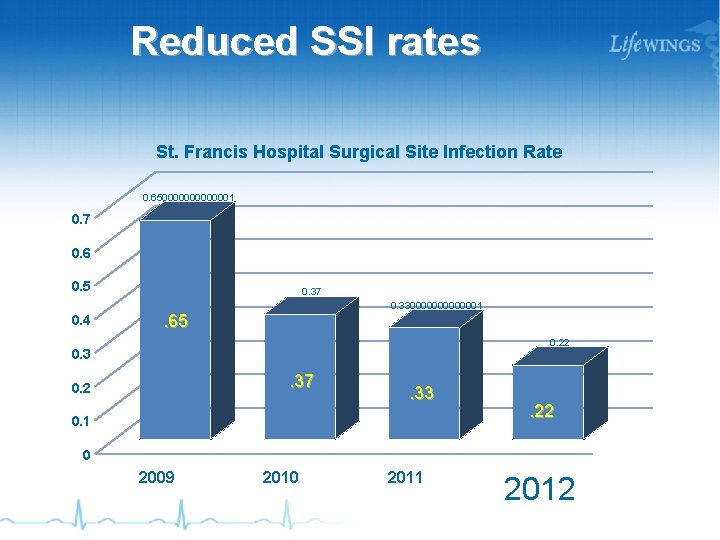
Reduced SSI rates St. Francis Hospital Surgical Site Infection Rate 0. 650000001 0. 7 0. 6 0. 5 0. 4 0. 37 0. 330000001 . 65 0. 22 0. 3 . 37 0. 2 . 33 0. 1 . 22 0 2009 2010 2011 2012 ytd 2012
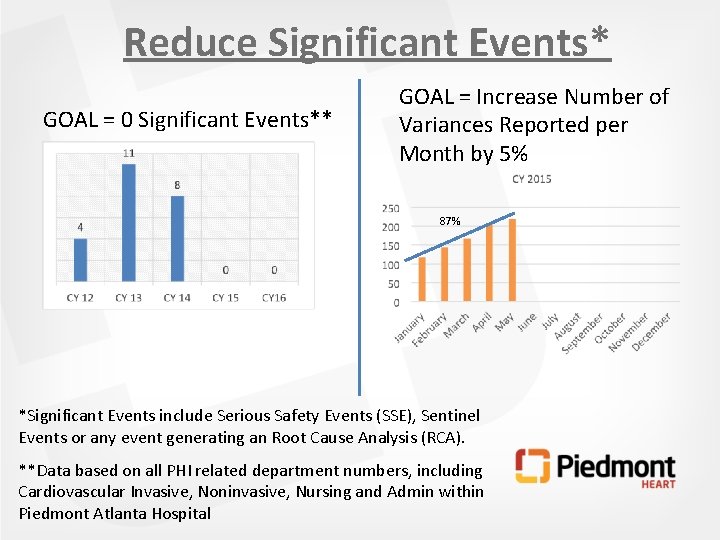
Reduce Significant Events* GOAL = 0 Significant Events** GOAL = Increase Number of Variances Reported per Month by 5% 87% *Significant Events include Serious Safety Events (SSE), Sentinel Events or any event generating an Root Cause Analysis (RCA). **Data based on all PHI related department numbers, including Cardiovascular Invasive, Noninvasive, Nursing and Admin within Piedmont Atlanta Hospital
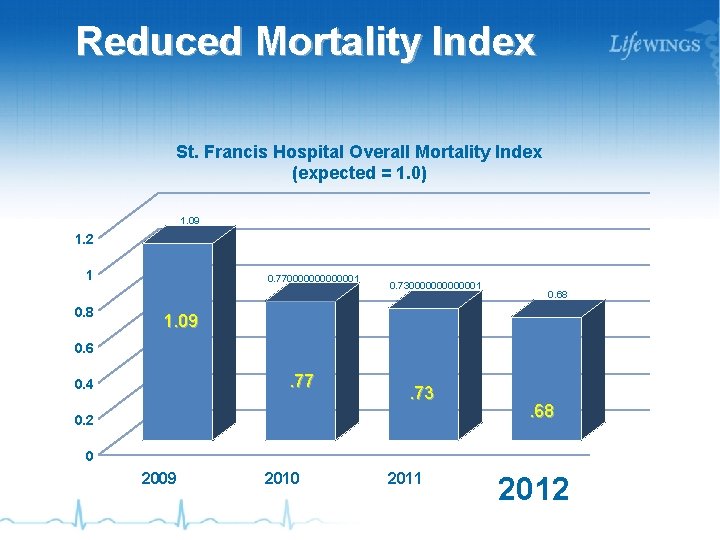
Reduced Mortality Index St. Francis Hospital Overall Mortality Index (expected = 1. 0) 1. 09 1. 2 1 0. 8 0. 770000001 0. 730000001 0. 68 1. 09 0. 6 . 77 0. 4 . 73 0. 2 . 68 0 2009 2010 2011 2012 ytd 2012
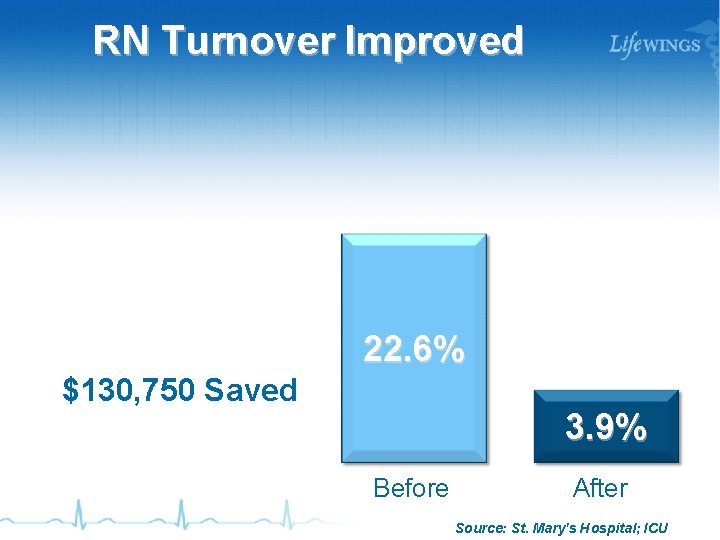
RN Turnover Improved 22. 6% $130, 750 Saved 3. 9% Before After Source: St. Mary's Hospital; ICU
What questions do you have?
Communication Debrief Make Decisions Cross-Check & Assertion Creating a Team Communication
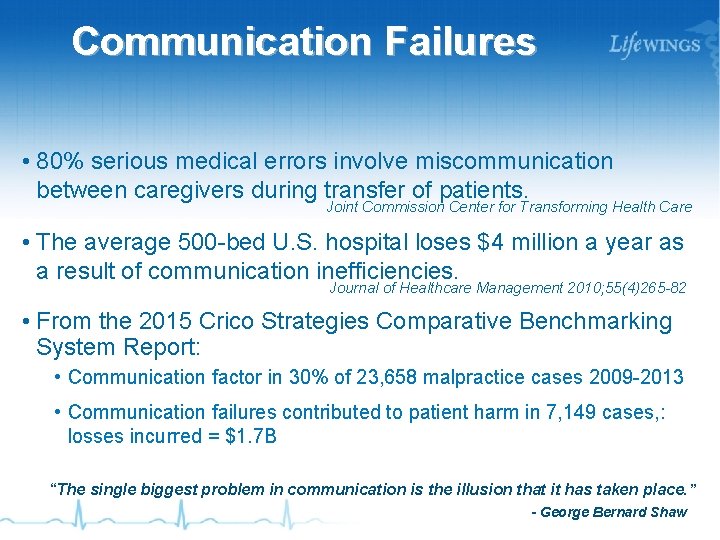
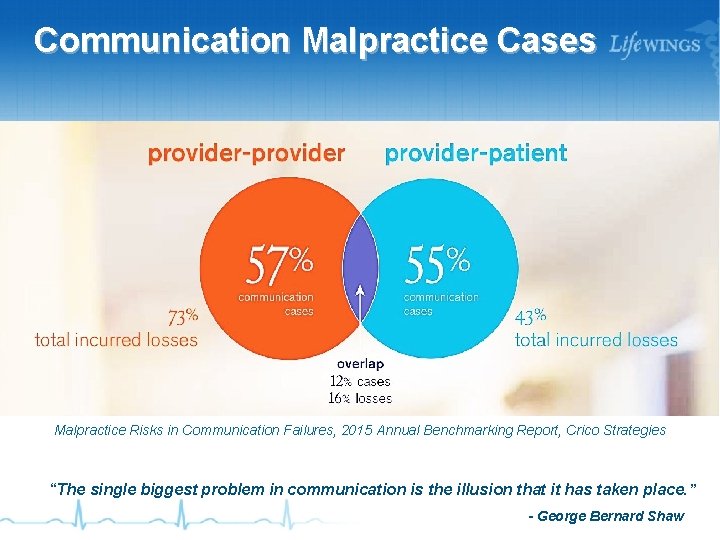
Communication Failures • 80% serious medical errors involve miscommunication between caregivers during transfer of patients. Joint Commission Center for Transforming Health Care • The average 500 -bed U. S. hospital loses $4 million a year as a result of communication inefficiencies. Journal of Healthcare Management 2010; 55(4)265 -82 • From the 2015 Crico Strategies Comparative Benchmarking System Report: • Communication factor in 30% of 23, 658 malpractice cases 2009 -2013 • Communication failures contributed to patient harm in 7, 149 cases, : losses incurred = $1. 7 B “The single biggest problem in communication is the illusion that it has taken place. ” - George Bernard Shaw
Communication Malpractice Cases Malpractice Risks in Communication Failures, 2015 Annual Benchmarking Report, Crico Strategies “The single biggest problem in communication is the illusion that it has taken place. ” - George Bernard Shaw
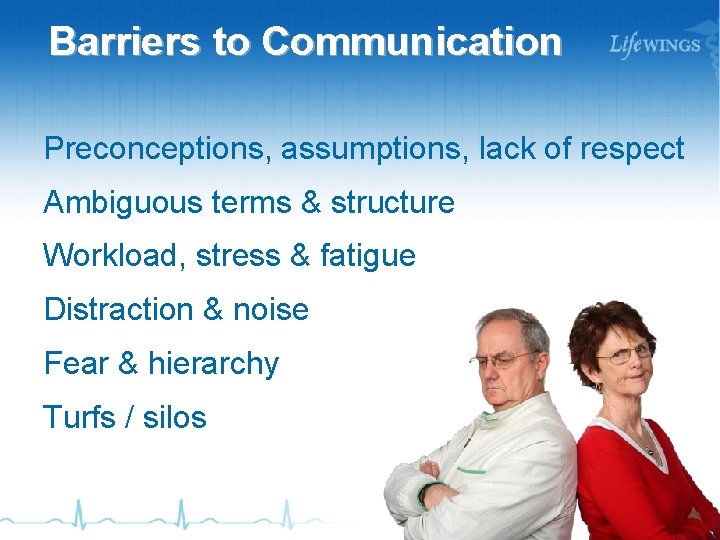
Barriers to Communication Preconceptions, assumptions, lack of respect Ambiguous terms & structure Workload, stress & fatigue Distraction & noise Fear & hierarchy Turfs / silos
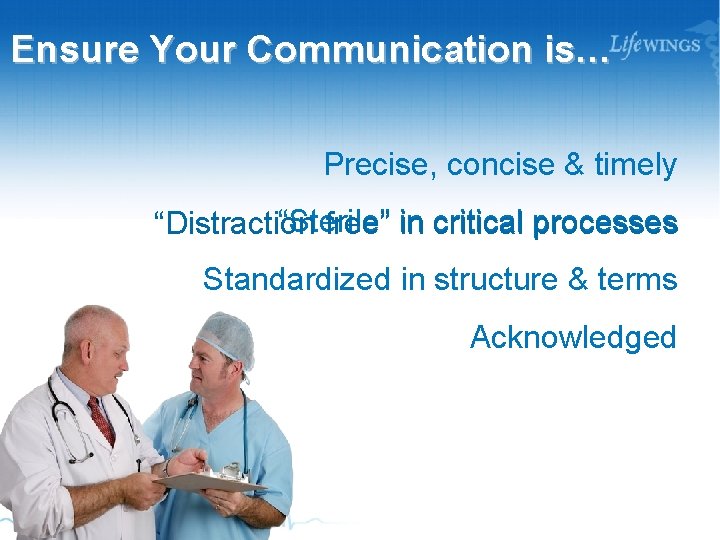
Ensure Your Communication is… Precise, concise & timely “Sterile” “Distraction free” in critical processes Standardized in structure & terms Acknowledged
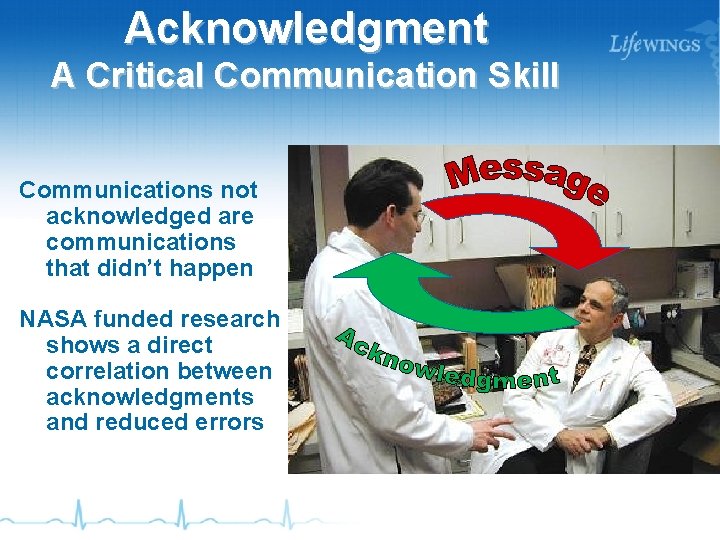
Acknowledgment A Critical Communication Skill Communications not acknowledged are communications that didn’t happen NASA funded research shows a direct correlation between acknowledgments and reduced errors
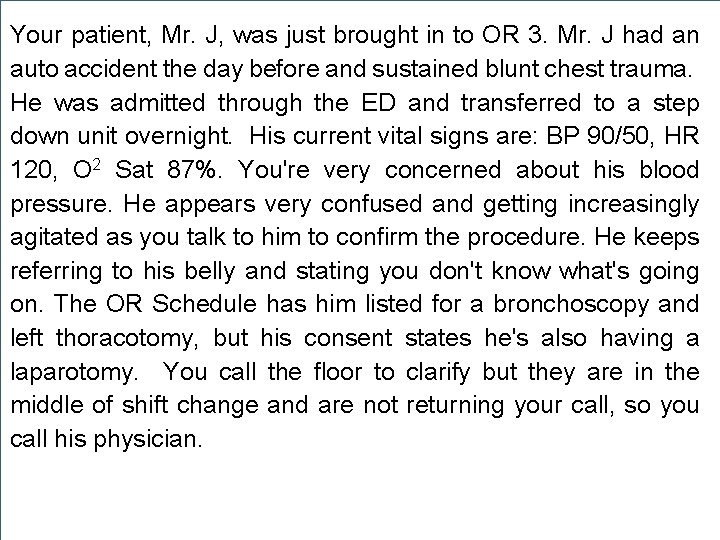
Your patient, Mr. J, was just brought in to OR 3. Mr. J had an auto accident the day before and sustained blunt chest trauma. He was admitted through the ED and transferred to a step down unit overnight. His current vital signs are: BP 90/50, HR 120, O 2 Sat 87%. You're very concerned about his blood pressure. He appears very confused and getting increasingly agitated as you talk to him to confirm the procedure. He keeps referring to his belly and stating you don't know what's going on. The OR Schedule has him listed for a bronchoscopy and left thoracotomy, but his consent states he's also having a laparotomy. You call the floor to clarify but they are in the middle of shift change and are not returning your call, so you call his physician.
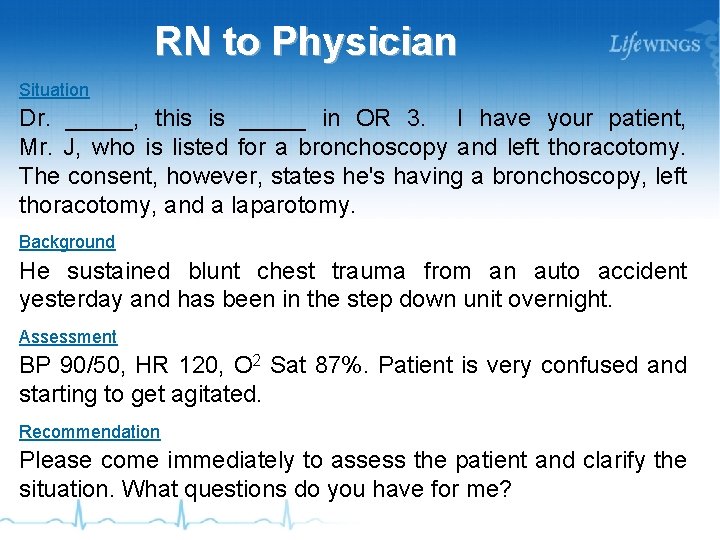
RN to Physician Situation Dr. _____, this is _____ in OR 3. I have your patient, Mr. J, who is listed for a bronchoscopy and left thoracotomy. The consent, however, states he's having a bronchoscopy, left thoracotomy, and a laparotomy. Background He sustained blunt chest trauma from an auto accident yesterday and has been in the step down unit overnight. Assessment BP 90/50, HR 120, O 2 Sat 87%. Patient is very confused and starting to get agitated. Recommendation Please come immediately to assess the patient and clarify the situation. What questions do you have for me?
Practice Your Skills Debrief the SBAR Receiver ask your partner: • What went well? • What can be improved? Page 5
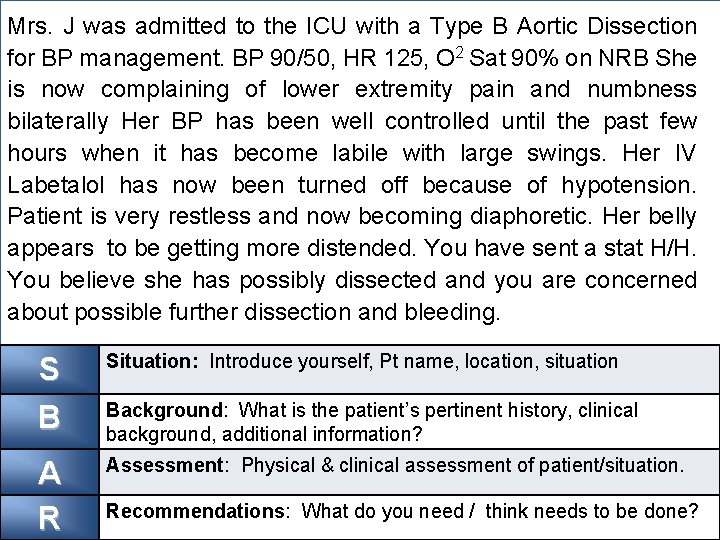
Mrs. J was admitted to the ICU with a Type B Aortic Dissection for BP management. BP 90/50, HR 125, O 2 Sat 90% on NRB She is now complaining of lower extremity pain and numbness bilaterally Her BP has been well controlled until the past few hours when it has become labile with large swings. Her IV Labetalol has now been turned off because of hypotension. Patient is very restless and now becoming diaphoretic. Her belly appears to be getting more distended. You have sent a stat H/H. You believe she has possibly dissected and you are concerned about possible further dissection and bleeding. S B Situation: Introduce yourself, Pt name, location, situation A R Assessment: Physical & clinical assessment of patient/situation. Background: What is the patient’s pertinent history, clinical background, additional information? Recommendations: What do you need / think needs to be done?
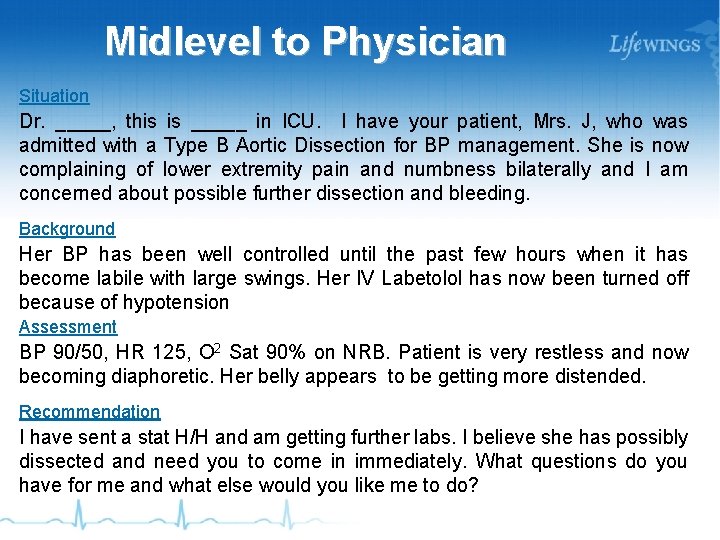
Midlevel to Physician Situation Dr. _____, this is _____ in ICU. I have your patient, Mrs. J, who was admitted with a Type B Aortic Dissection for BP management. She is now complaining of lower extremity pain and numbness bilaterally and I am concerned about possible further dissection and bleeding. Background Her BP has been well controlled until the past few hours when it has become labile with large swings. Her IV Labetolol has now been turned off because of hypotension Assessment BP 90/50, HR 125, O 2 Sat 90% on NRB. Patient is very restless and now becoming diaphoretic. Her belly appears to be getting more distended. Recommendation I have sent a stat H/H and am getting further labs. I believe she has possibly dissected and need you to come in immediately. What questions do you have for me and what else would you like me to do?
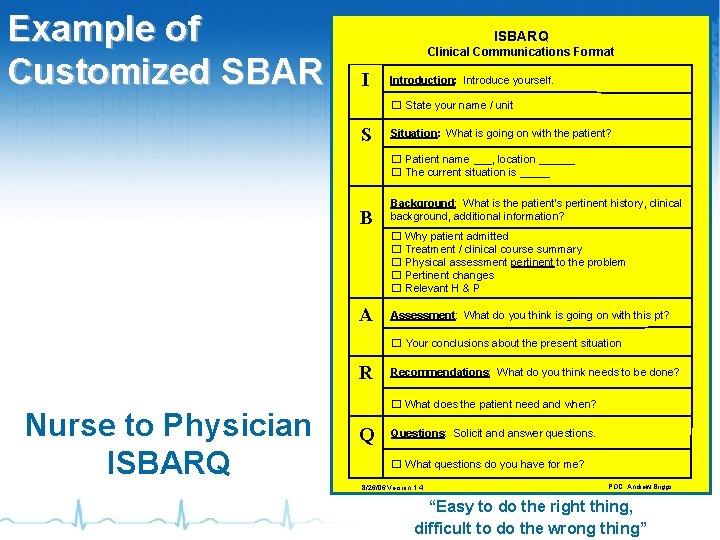
Example of Customized SBAR ISBARQ Clinical Communications Format I Introduction: Introduce yourself. � State your name / unit S Situation: What is going on with the patient? � Patient name ___, location ______ � The current situation is _____ B Background: What is the patient's pertinent history, clinical background, additional information? � � � A Why patient admitted Treatment / clinical course summary Physical assessment pertinent to the problem Pertinent changes Relevant H & P Assessment: What do you think is going on with this pt? � Your conclusions about the present situation R Nurse to Physician ISBARQ Recommendations: What do you think needs to be done? � What does the patient need and when? Q Questions: Solicit and answer questions. � What questions do you have for me? 8/26/06 Version 1. 4 POC: Andrew Briggs “Easy to do the right thing, difficult to do the wrong thing”
Let's Talk about Handoffs (Shift, Relief, Transfer of Care) Who gives good handoffs? Who gets good handoffs?
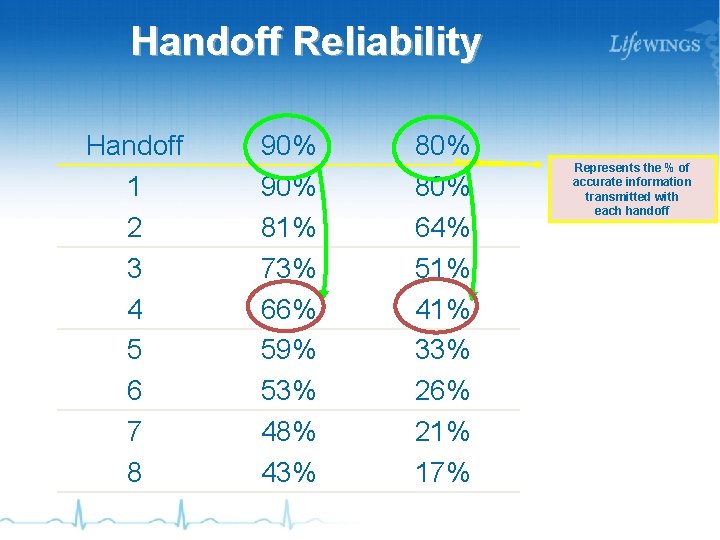
Handoff Reliability Handoff 1 2 3 4 5 6 7 8 90% 81% 73% 66% 59% 53% 48% 43% 80% 64% 51% 41% 33% 26% 21% 17% Represents the % of accurate information transmitted with each handoff
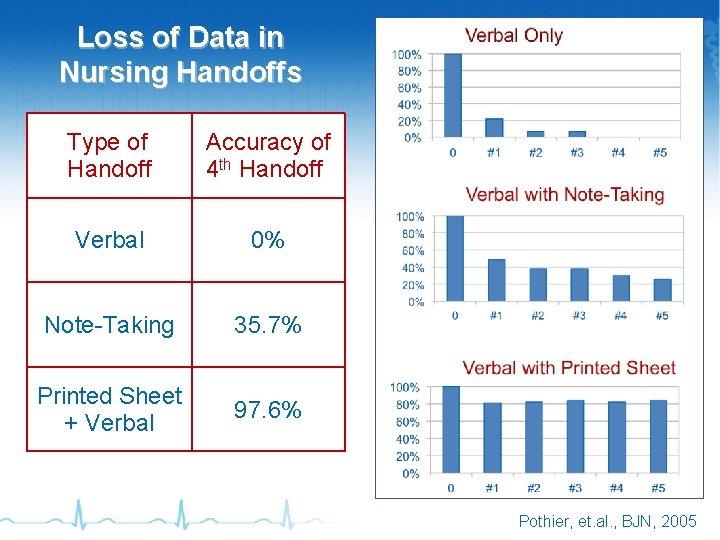
Loss of Data in Nursing Handoffs Type of Handoff Accuracy of 4 th Handoff Verbal 0% Note-Taking 35. 7% Printed Sheet + Verbal 97. 6% Pothier, et. al. , BJN, 2005
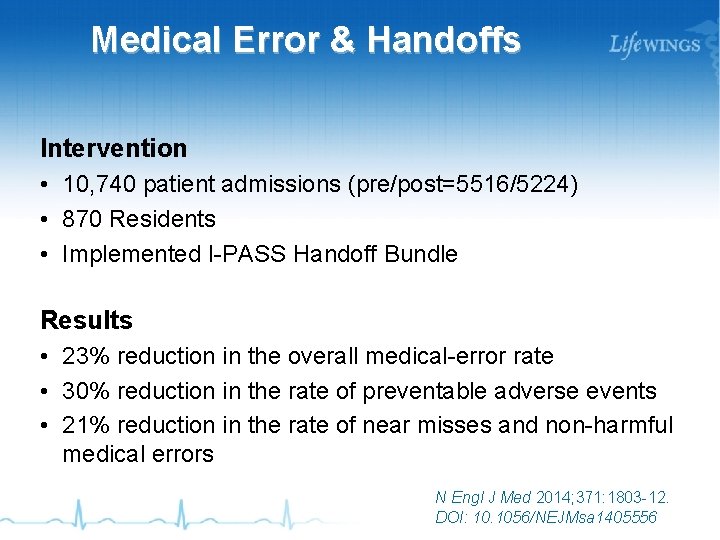
Medical Error & Handoffs Intervention • 10, 740 patient admissions (pre/post=5516/5224) • 870 Residents • Implemented I-PASS Handoff Bundle Results • 23% reduction in the overall medical-error rate • 30% reduction in the rate of preventable adverse events • 21% reduction in the rate of near misses and non-harmful medical errors N Engl J Med 2014; 371: 1803 -12. DOI: 10. 1056/NEJMsa 1405556
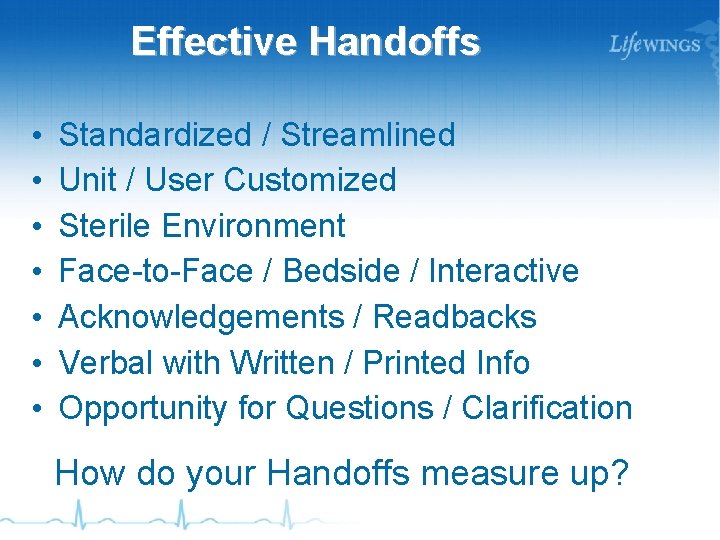
Effective Handoffs • • Standardized / Streamlined Unit / User Customized Sterile Environment Face-to-Face / Bedside / Interactive Acknowledgements / Readbacks Verbal with Written / Printed Info Opportunity for Questions / Clarification How do your Handoffs measure up?
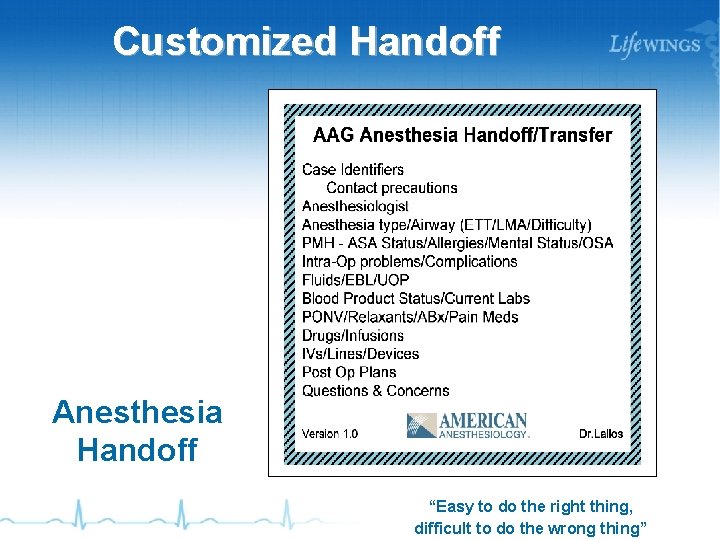
Customized Handoff Anesthesia Handoff “Easy to do the right thing, difficult to do the wrong thing”
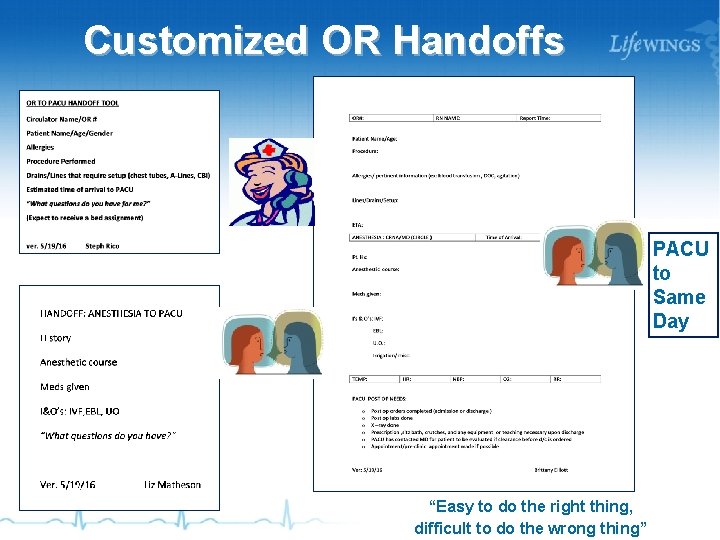
Customized OR Handoffs PACU to Same Day “Easy to do the right thing, difficult to do the wrong thing”
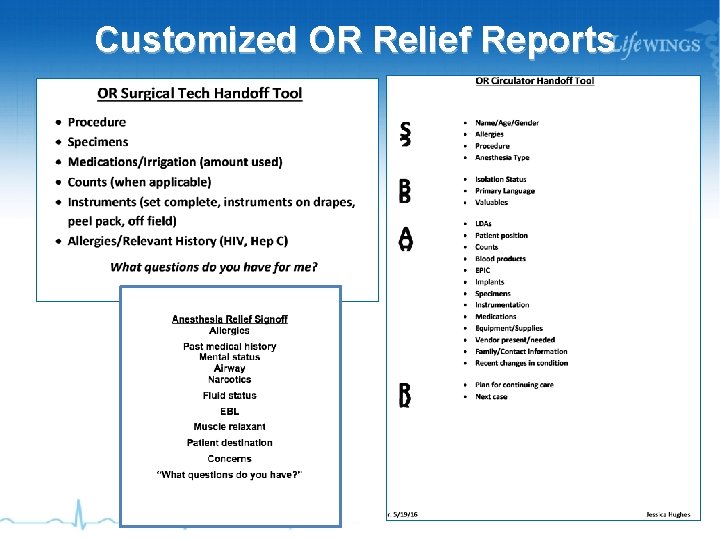
Customized OR Relief Reports
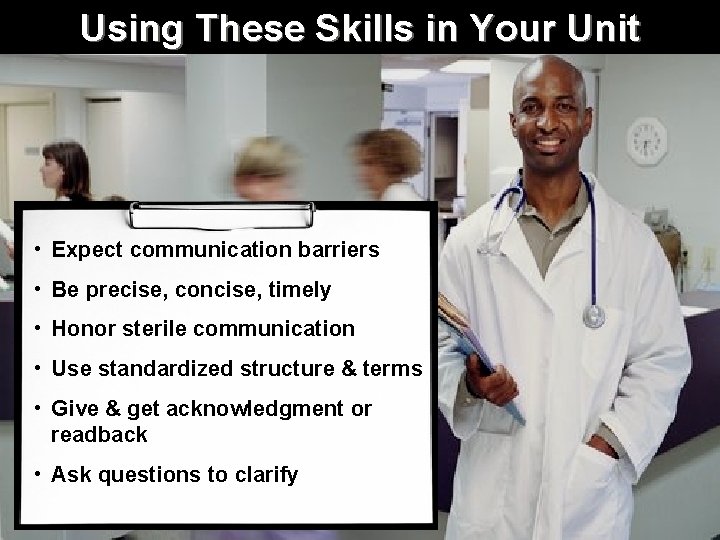
Using These Skills in Your Unit • Expect communication barriers • Be precise, concise, timely • Honor sterile communication • Use standardized structure & terms • Give & get acknowledgment or readback • Ask questions to clarify
What questions do you have about effective communication?
Administrivia Sign-in Sheet: check appropriate box if want CNE/CME – Physicians & PAs • Credit Declaration Form - Handout • Course Evaluation (last page in book) with your name at the top CNE – Nurses and anyone who wants a certificate • Registration Form (first page in book) • Course Evaluation (last page in book) with your name at the top Breaks 5 minutes
Take A Break!