
WELCOME SEQUENCE A Sequence is an ordered list




- Slides: 29
WEL-COME
SEQUENCE
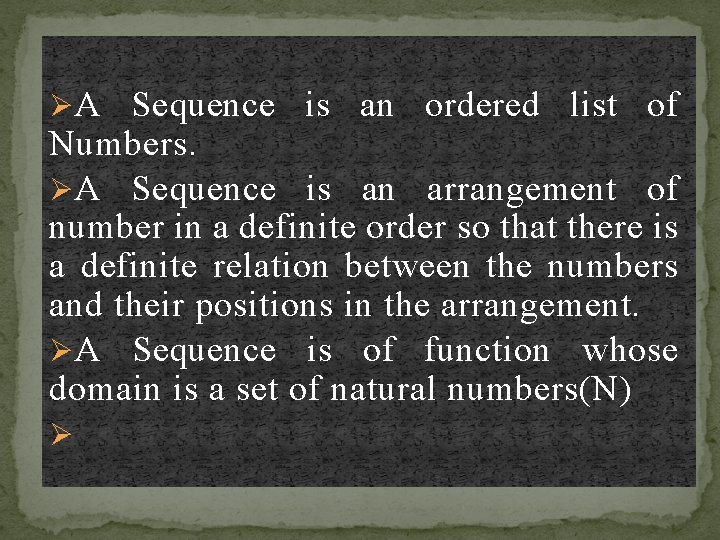
Ø A Sequence is an ordered list of Numbers. Ø A Sequence is an arrangement of number in a definite order so that there is a definite relation between the numbers and their positions in the arrangement. Ø A Sequence is of function whose domain is a set of natural numbers(N) Ø
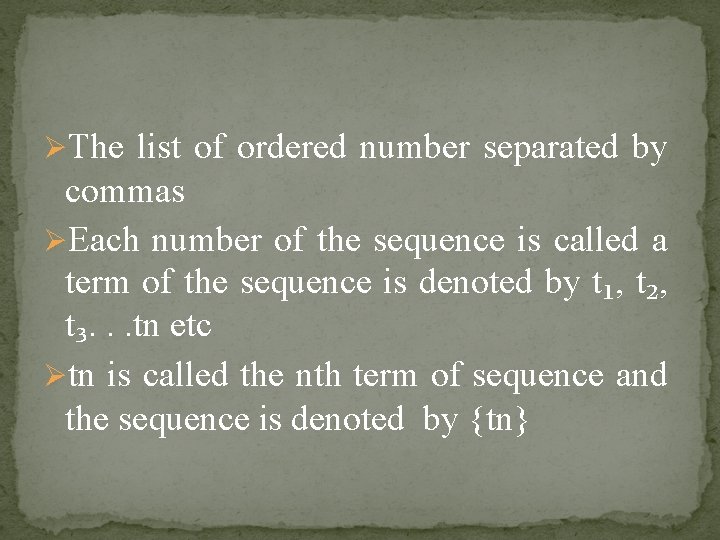
ØThe list of ordered number separated by commas ØEach number of the sequence is called a term of the sequence is denoted by t₁, t₂, t₃. . . tn etc Øtn is called the nth term of sequence and the sequence is denoted by {tn}
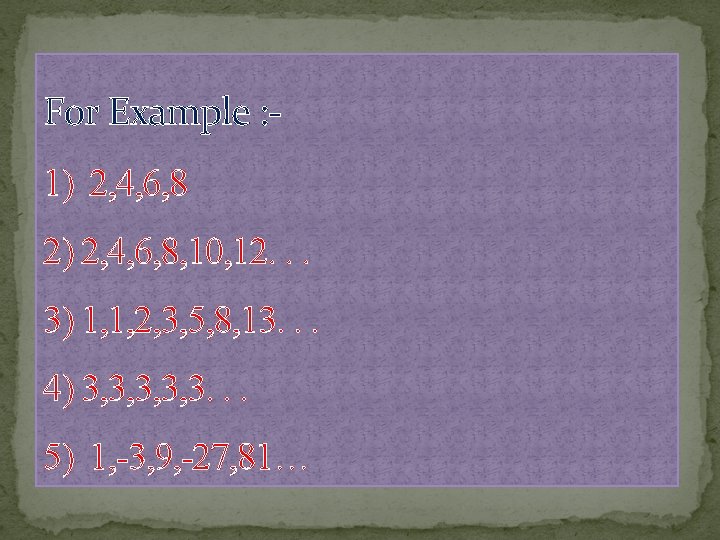
For Example : 1) 2, 4, 6, 8 2) 2, 4, 6, 8, 10, 12. . . 3) 1, 1, 2, 3, 5, 8, 13. . . 4) 3, 3, 3. . . 5) 1, -3, 9, -27, 81…
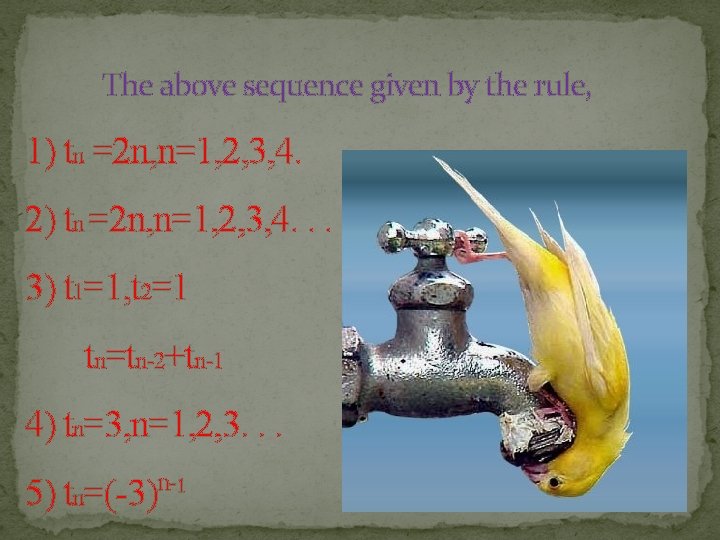
The above sequence given by the rule, 1) tn =2 n, n=1, 2, 3, 4. 2) tn =2 n, n=1, 2, 3, 4. . . 3) t 1=1, t 2=1 tn=tn-2+tn-1 4) tn=3, n=1, 2, 3. . . n-1 5) tn=(-3)
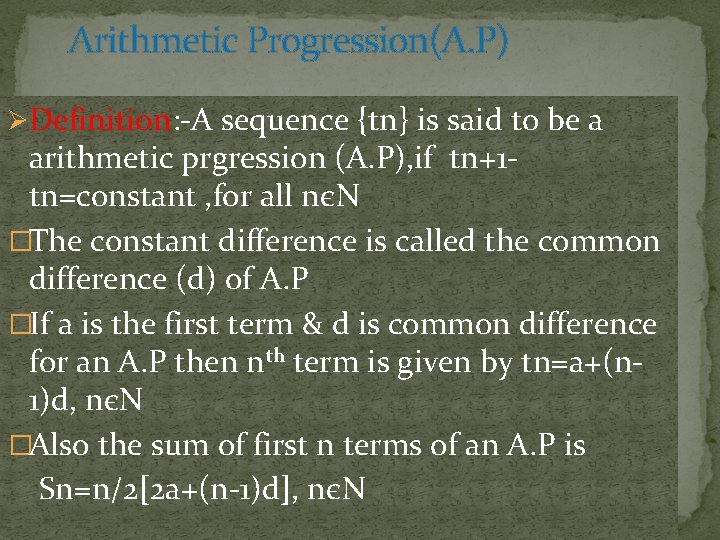
Arithmetic Progression(A. P) ØDefinition: -A sequence {tn} is said to be a arithmetic prgression (A. P), if tn+1 tn=constant , for all nєN �The constant difference is called the common difference (d) of A. P �If a is the first term & d is common difference for an A. P then nth term is given by tn=a+(n 1)d, nєN �Also the sum of first n terms of an A. P is Sn=n/2[2 a+(n-1)d], nєN
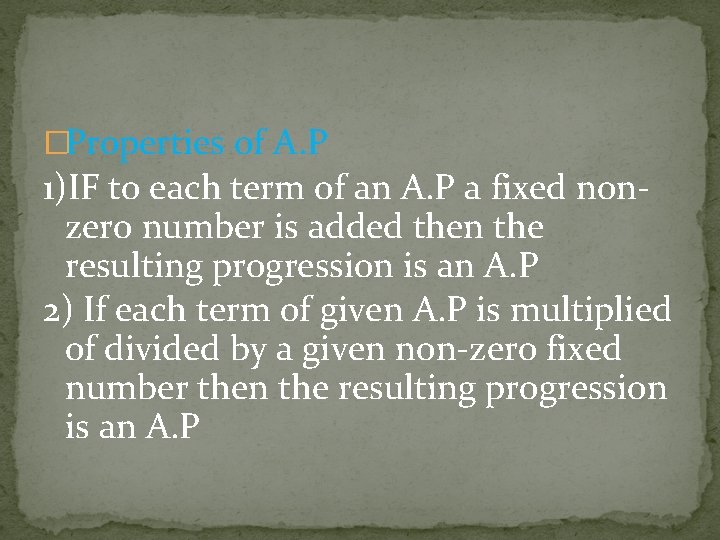
�Properties of A. P 1)IF to each term of an A. P a fixed nonzero number is added then the resulting progression is an A. P 2) If each term of given A. P is multiplied of divided by a given non-zero fixed number then the resulting progression is an A. P
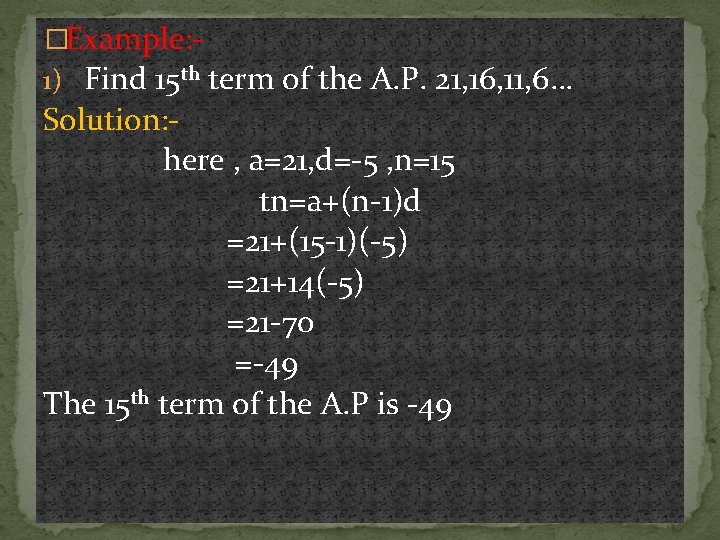
�Example: 1) Find 15 th term of the A. P. 21, 16, 11, 6… Solution: here , a=21, d=-5 , n=15 tn=a+(n-1)d =21+(15 -1)(-5) =21+14(-5) =21 -70 =-49 The 15 th term of the A. P is -49
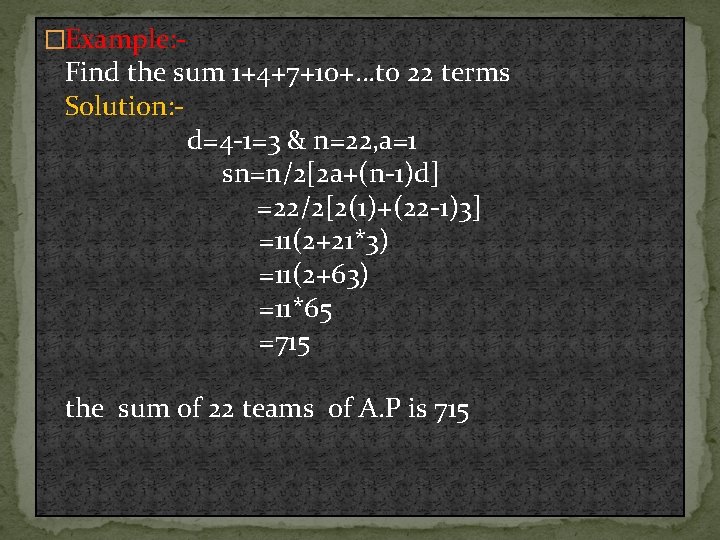
�Example: - Find the sum 1+4+7+10+…to 22 terms Solution: d=4 -1=3 & n=22, a=1 sn=n/2[2 a+(n-1)d] =22/2[2(1)+(22 -1)3] =11(2+21*3) =11(2+63) =11*65 =715 the sum of 22 teams of A. P is 715
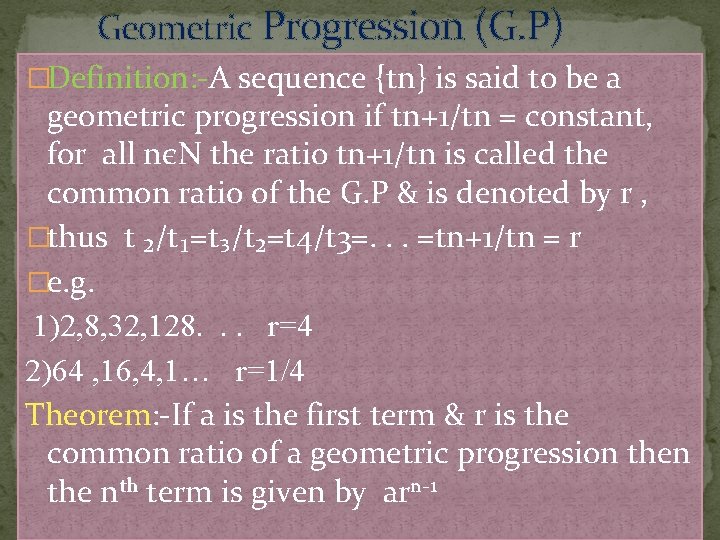
Geometric Progression (G. P) �Definition: -A sequence {tn} is said to be a geometric progression if tn+1/tn = constant, for all nєN the ratio tn+1/tn is called the common ratio of the G. P & is denoted by r , �thus t ₂/t₁=t₃/t₂=t 4/t 3=. . . =tn+1/tn = r �e. g. 1)2, 8, 32, 128. . . r=4 2)64 , 16, 4, 1… r=1/4 Theorem: -If a is the first term & r is the common ratio of a geometric progression the nth term is given by arⁿ-1
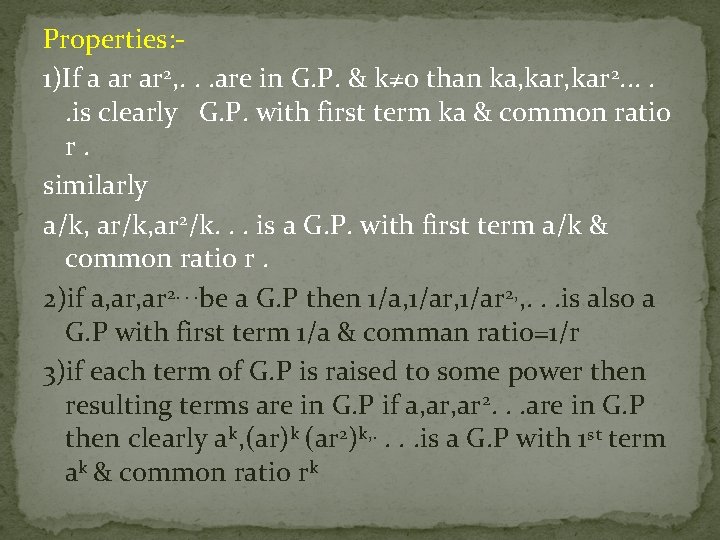
Properties: 1)If a ar ar 2, . . . are in G. P. & k≠ 0 than ka, kar 2. . . is clearly G. P. with first term ka & common ratio r. similarly a/k, ar 2/k. . . is a G. P. with first term a/k & common ratio r. 2)if a, ar 2. . . be a G. P then 1/a, 1/ar 2, , . . . is also a G. P with first term 1/a & comman ratio=1/r 3)if each term of G. P is raised to some power then resulting terms are in G. P if a, ar 2. . . are in G. P then clearly ak, (ar)k (ar 2)k, . . is a G. P with 1 st term ak & common ratio rk
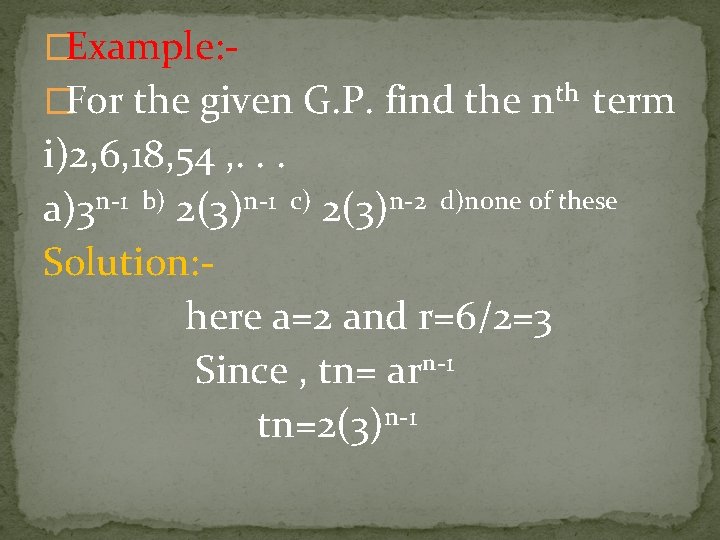
�Example: �For the given G. P. find the nth term i)2, 6, 18, 54 , . . . a)3 n-1 b) 2(3)n-1 c) 2(3)n-2 d)none of these Solution: here a=2 and r=6/2=3 Since , tn= arⁿ-1 tn=2(3)n-1
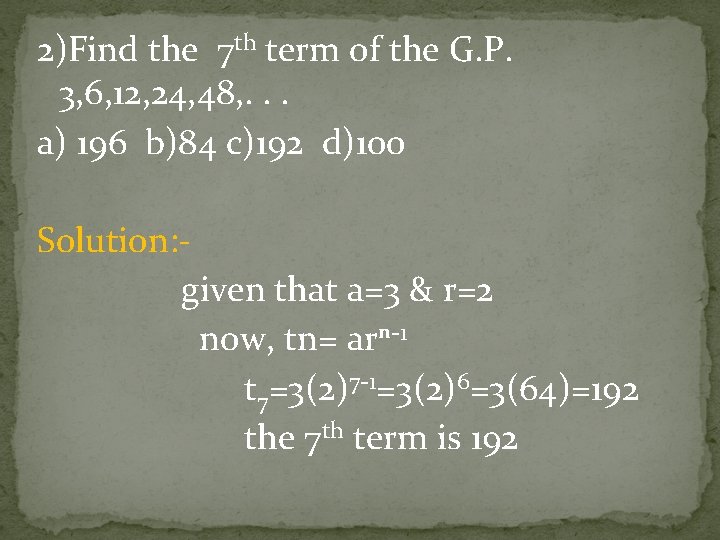
2)Find the 7 th term of the G. P. 3, 6, 12, 24, 48, . . . a) 196 b)84 c)192 d)100 Solution: given that a=3 & r=2 now, tn= arⁿ-1 t 7=3(2)7 -1=3(2)6=3(64)=192 the 7 th term is 192
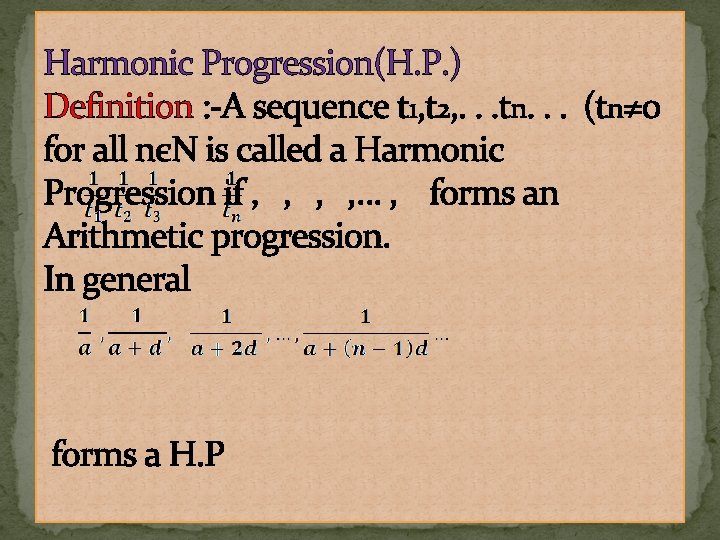
Harmonic Progression(H. P. ) Definition : -A sequence t 1, t 2, . . . tn. . . (tn≠ 0 for all nєN is called a Harmonic Progression if , , … , forms an Arithmetic progression. In general forms a H. P
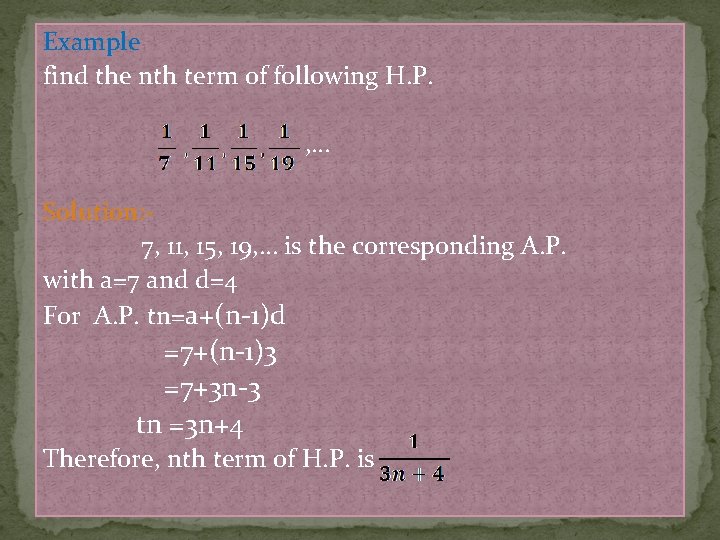
Example find the nth term of following H. P. , … Solution: 7, 11, 15, 19, … is the corresponding A. P. with a=7 and d=4 For A. P. tn=a+(n-1)d =7+(n-1)3 =7+3 n-3 tn =3 n+4 Therefore, nth term of H. P. is
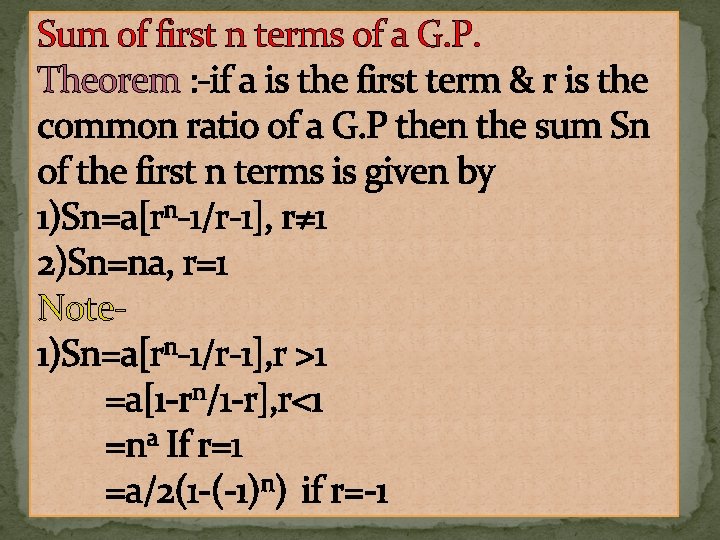
Sum of first n terms of a G. P. Theorem : -if a is the first term & r is the common ratio of a G. P then the sum Sn of the first n terms is given by 1)Sn=a[rn-1/r-1], r≠ 1 2)Sn=na, r=1 Note 1)Sn=a[rn-1/r-1], r >1 =a[1 -rn/1 -r], r<1 =na If r=1 =a/2(1 -(-1)n) if r=-1
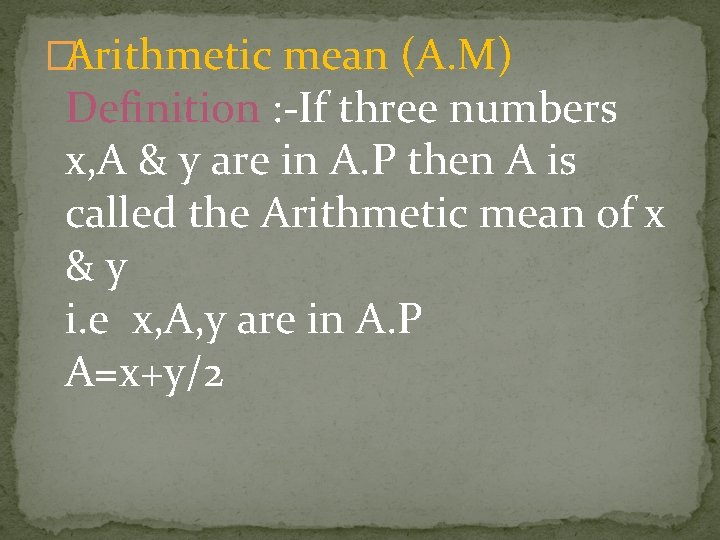
�Arithmetic mean (A. M) Definition : -If three numbers x, A & y are in A. P then A is called the Arithmetic mean of x &y i. e x, A, y are in A. P A=x+y/2
�Geometric Mean (G. M) Definition: -If three numbers x, G & y are in G. P then G is called the geometric mean of x & y. if x, G, y are in G. P. G=√xy, either x>0, y>0 or x<0, y<0
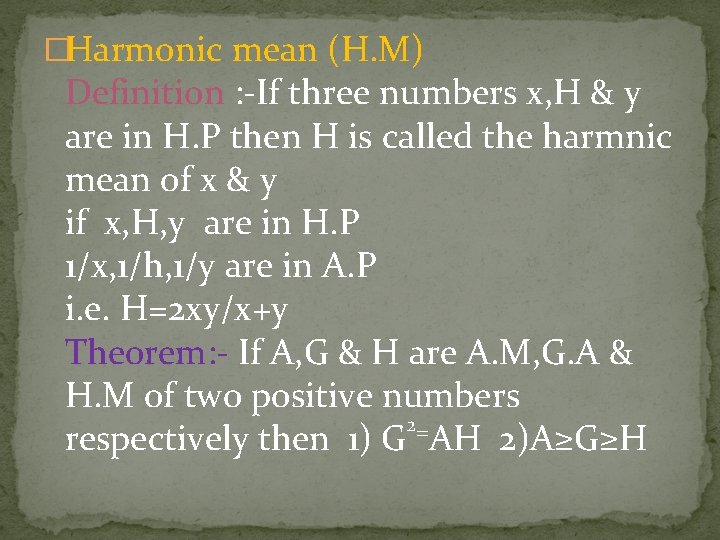
�Harmonic mean (H. M) Definition : -If three numbers x, H & y are in H. P then H is called the harmnic mean of x & y if x, H, y are in H. P 1/x, 1/h, 1/y are in A. P i. e. H=2 xy/x+y Theorem: - If A, G & H are A. M, G. A & H. M of two positive numbers respectively then 1) G²=AH 2)A≥G≥H
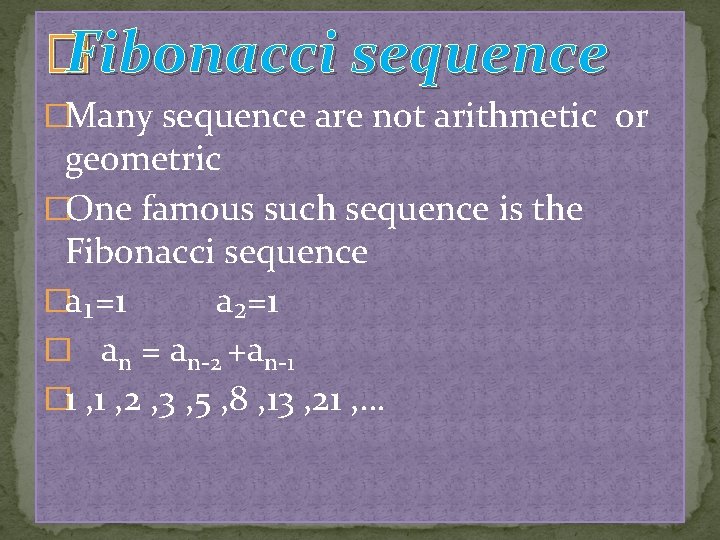
� Fibonacci sequence �Many sequence are not arithmetic or geometric �One famous such sequence is the Fibonacci sequence �a₁=1 a₂=1 � an = an-2 +an-1 � 1 , 2 , 3 , 5 , 8 , 13 , 21 , …
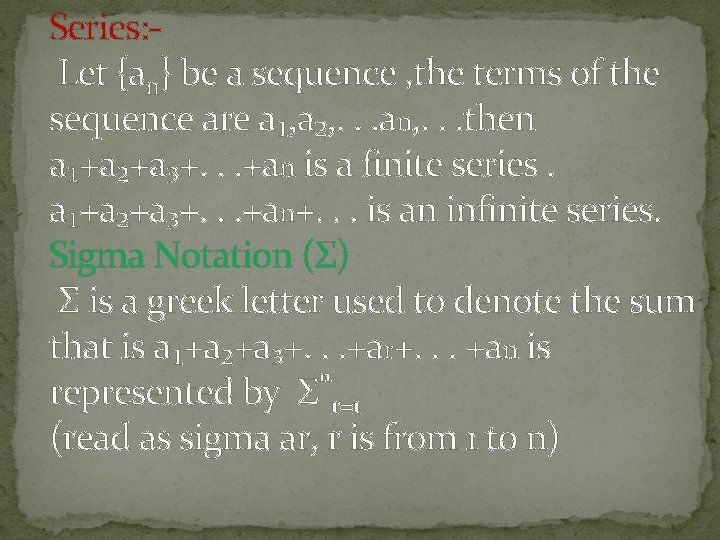
Series: Let {an} be a sequence , the terms of the sequence are a₁, a₂, . . . an, . . . then a₁+a₂+a₃+. . . +an is a finite series. a₁+a₂+a₃+. . . +an+. . . is an infinite series. Sigma Notation (Σ) Σ is a greek letter used to denote the sum that is a₁+a₂+a₃+. . . +ar+. . . +an is represented by Σⁿr=1 (read as sigma ar, r is from 1 to n)
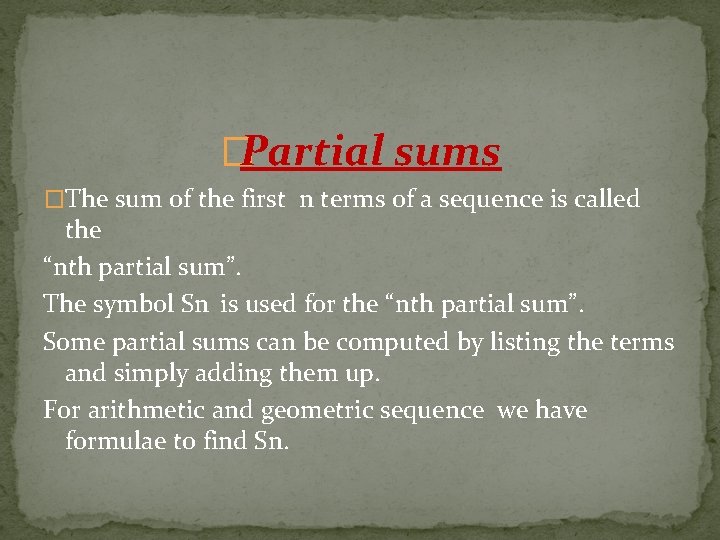
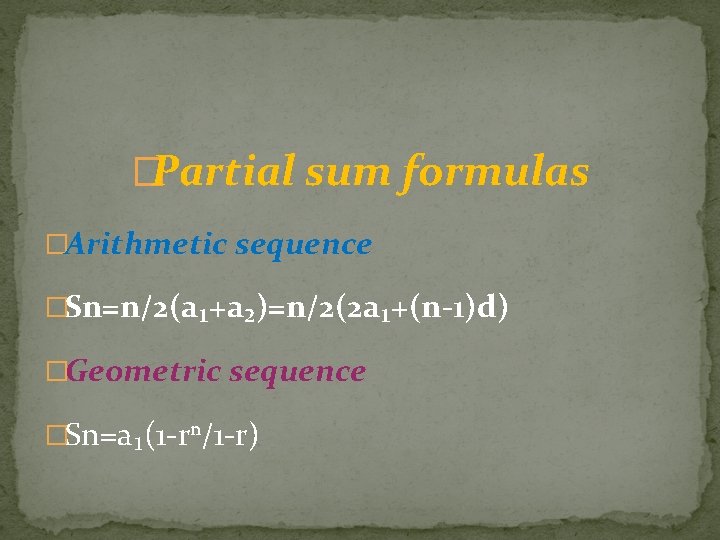
�Partial sums �The sum of the first n terms of a sequence is called the “nth partial sum”. The symbol Sn is used for the “nth partial sum”. Some partial sums can be computed by listing the terms and simply adding them up. For arithmetic and geometric sequence we have formulae to find Sn.
�Partial sum formulas �Arithmetic sequence �Sn=n/2(a₁+a₂)=n/2(2 a₁+(n-1)d) �Geometric sequence �Sn=a₁(1 -rⁿ/1 -r)
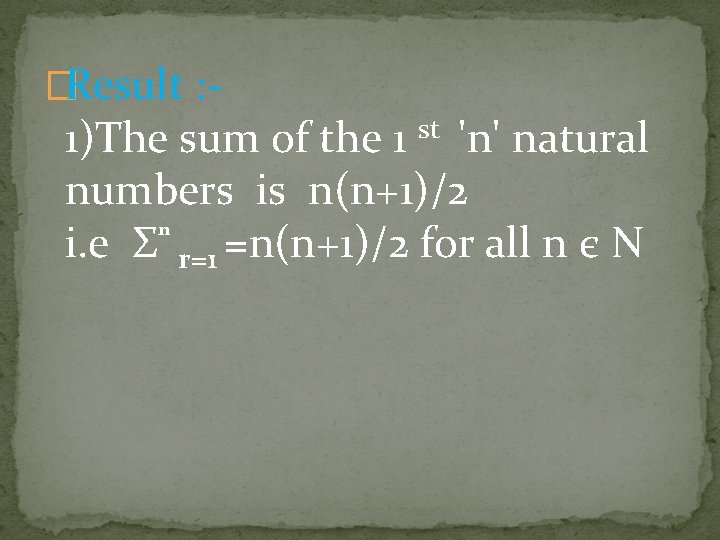
�Result : - 1)The sum of the 1 st 'n' natural numbers is n(n+1)/2 ⁿ i. e Σ r=1 =n(n+1)/2 for all n є N
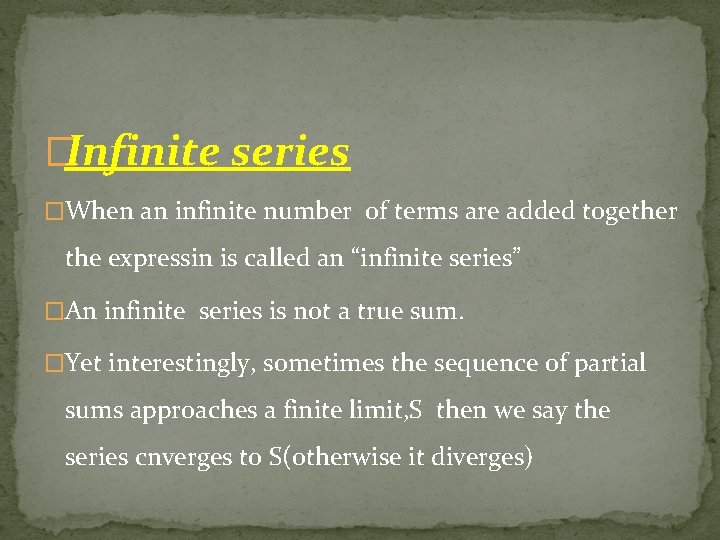
�Infinite series �When an infinite number of terms are added together the expressin is called an “infinite series” �An infinite series is not a true sum. �Yet interestingly, sometimes the sequence of partial sums approaches a finite limit, S then we say the series cnverges to S(otherwise it diverges)
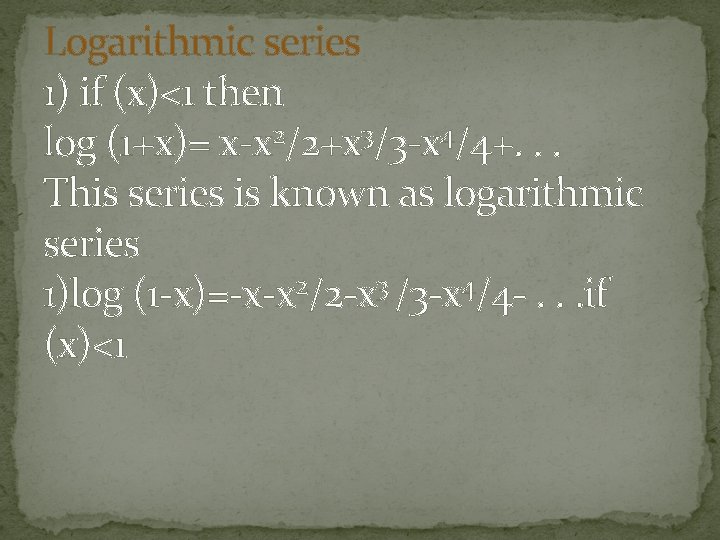
Logarithmic series 1) if (x)<1 then log (1+x)= x-x 2/2+x 3/3 -x 4/4+. . . This series is known as logarithmic series 1)log (1 -x)=-x-x 2/2 -x 3 /3 -x 4/4 -. . . if (x)<1
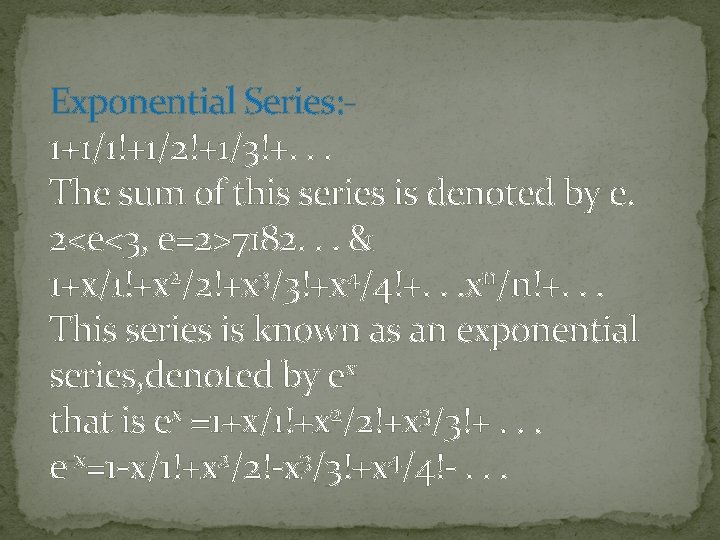
Exponential Series: 1+1/1!+1/2!+1/3!+. . . The sum of this series is denoted by e. 2<e<3, e=2>7182. . . & 1+x/1!+x 2/2!+x 3/3!+x 4/4!+. . . xn/n!+. . . This series is known as an exponential series, denoted by ex that is ex =1+x/1!+x 2/2!+x 3/3!+. . . e-x=1 -x/1!+x 2/2!-x 3/3!+x 4/4!-. . .
Thank You…