
Welcome Principles of Computer Science Comp Sci 1









- Slides: 24
Welcome! Principles of Computer Science Comp. Sci 1 French Science 2231 M, W 10: 05 -11: 20 Professor Jeff Forbes See http: //www. cs. duke. edu/courses/cps 001/spring 09 Comp. Sci 001 1. 1
Today’s topics l l l What is this course about? How are we going to learn that? Who is this guy talking to us? Where do we go from here? An overview of computer science Upcoming ä The World Wide Web and HTML ä Internet & Networks ä Information representation Comp. Sci 001 1. 2
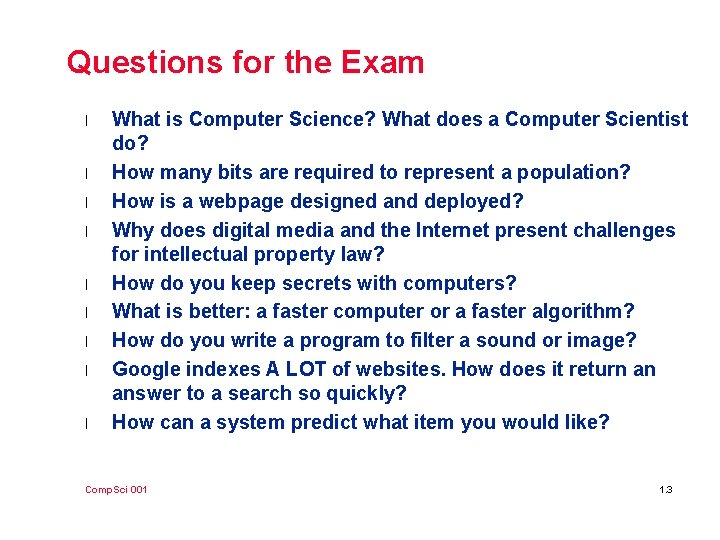
Questions for the Exam l l l l l What is Computer Science? What does a Computer Scientist do? How many bits are required to represent a population? How is a webpage designed and deployed? Why does digital media and the Internet present challenges for intellectual property law? How do you keep secrets with computers? What is better: a faster computer or a faster algorithm? How do you write a program to filter a sound or image? Google indexes A LOT of websites. How does it return an answer to a search so quickly? How can a system predict what item you would like? Comp. Sci 001 1. 3
What is Computer Science? Comp. Sci 001 l What does a computer scientist do? l What does a programmer do? l What does a systems administrator do? l What do you want to do? 1. 4
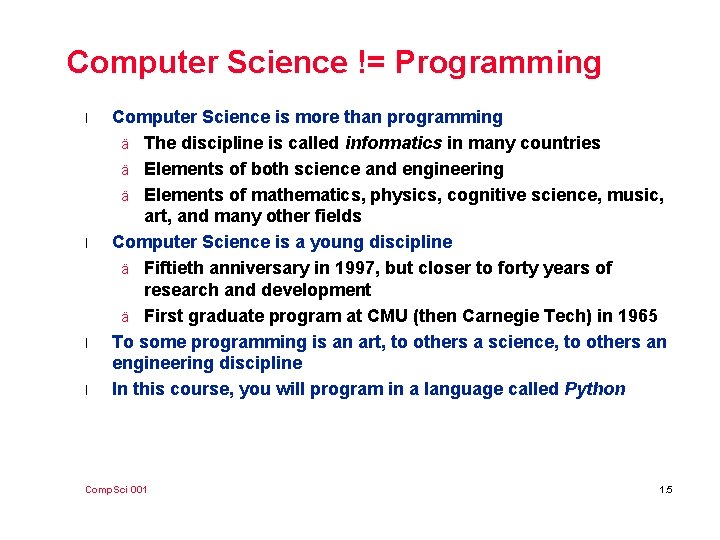
Computer Science != Programming l l Computer Science is more than programming ä The discipline is called informatics in many countries ä Elements of both science and engineering ä Elements of mathematics, physics, cognitive science, music, art, and many other fields Computer Science is a young discipline ä Fiftieth anniversary in 1997, but closer to forty years of research and development ä First graduate program at CMU (then Carnegie Tech) in 1965 To some programming is an art, to others a science, to others an engineering discipline In this course, you will program in a language called Python Comp. Sci 001 1. 5
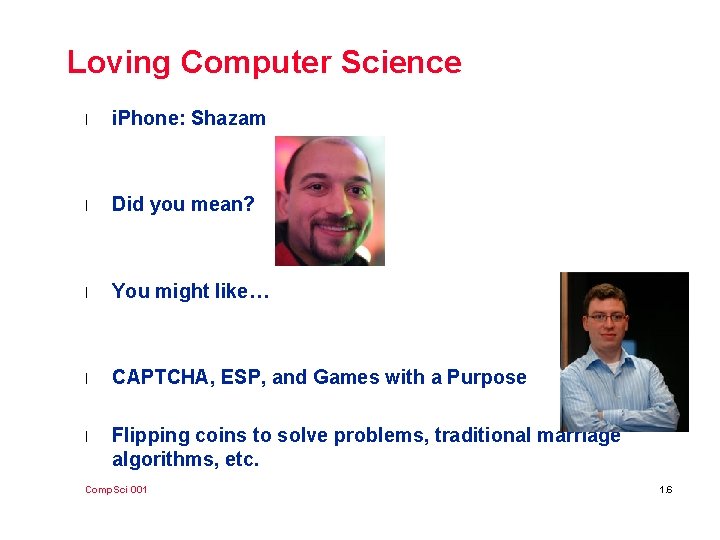
Loving Computer Science l i. Phone: Shazam l Did you mean? l You might like… l CAPTCHA, ESP, and Games with a Purpose l Flipping coins to solve problems, traditional marriage algorithms, etc. Comp. Sci 001 1. 6
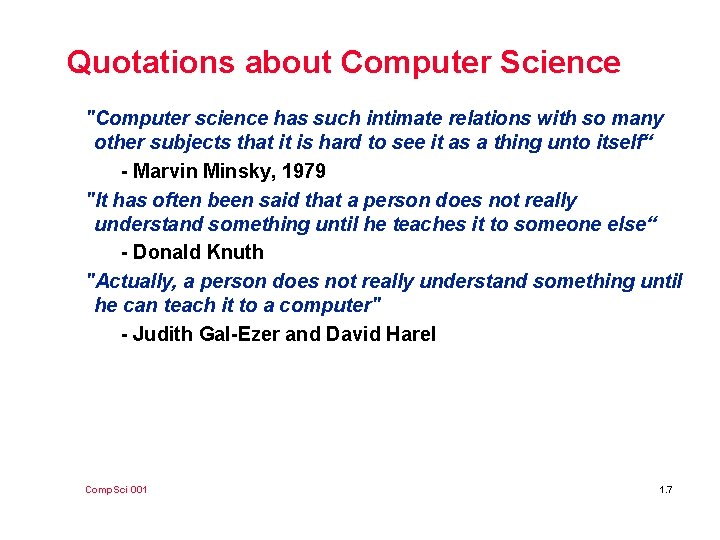
Quotations about Computer Science "Computer science has such intimate relations with so many other subjects that it is hard to see it as a thing unto itself“ - Marvin Minsky, 1979 "It has often been said that a person does not really understand something until he teaches it to someone else“ - Donald Knuth "Actually, a person does not really understand something until he can teach it to a computer" - Judith Gal-Ezer and David Harel Comp. Sci 001 1. 7
Algorithms as Cornerstone of CS Comp. Sci 001 1. 8
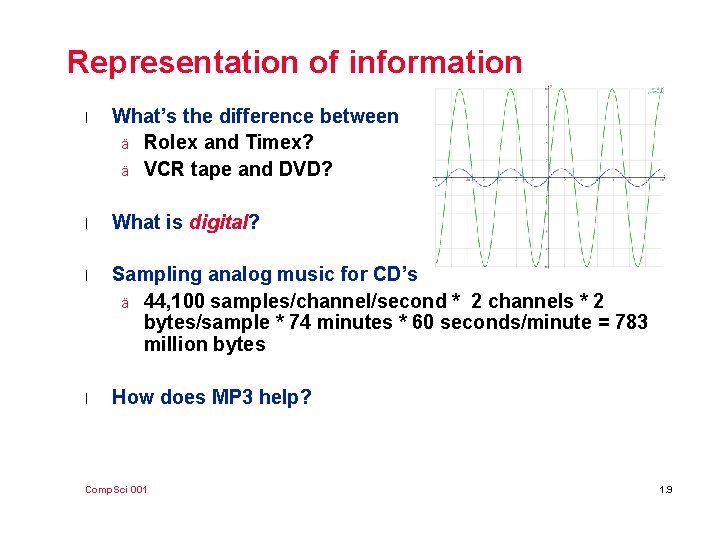
Representation of information l What’s the difference between ä Rolex and Timex? ä VCR tape and DVD? l What is digital? l Sampling analog music for CD’s ä 44, 100 samples/channel/second * 2 channels * 2 bytes/sample * 74 minutes * 60 seconds/minute = 783 million bytes l How does MP 3 help? Comp. Sci 001 1. 9
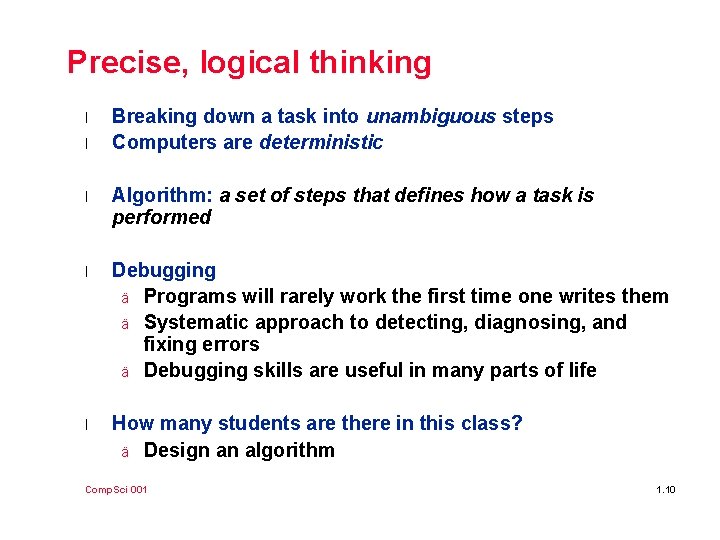
Precise, logical thinking l l Breaking down a task into unambiguous steps Computers are deterministic l Algorithm: a set of steps that defines how a task is performed l Debugging ä Programs will rarely work the first time one writes them ä Systematic approach to detecting, diagnosing, and fixing errors ä Debugging skills are useful in many parts of life l How many students are there in this class? ä Design an algorithm Comp. Sci 001 1. 10
Creating a Program l l l Specify the problem ä remove ambiguities ä identify constraints Develop algorithms, design classes, design software architecture Implement program ä revisit design ä test, code, debug ä revisit design Documentation, testing, maintenance of program A programming language is a way to describe an algorithm. Comp. Sci 001 1. 11
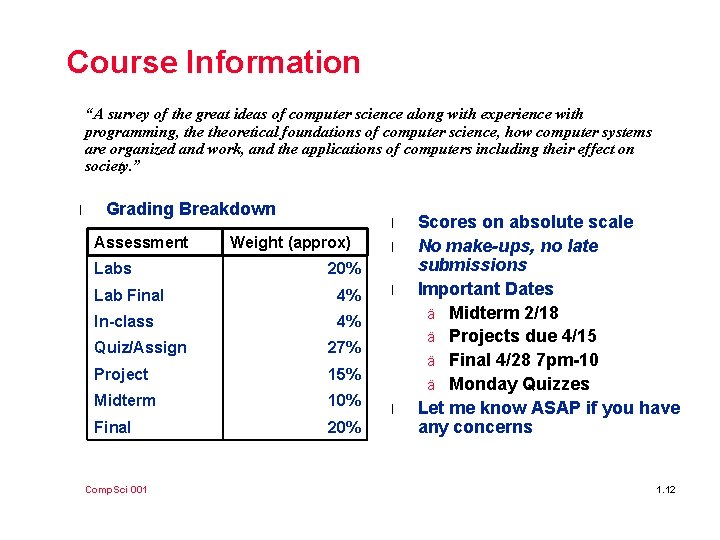
Course Information “A survey of the great ideas of computer science along with experience with programming, theoretical foundations of computer science, how computer systems are organized and work, and the applications of computers including their effect on society. ” l Grading Breakdown Assessment Labs l Weight (approx) 20% Lab Final 4% In-class 4% Quiz/Assign 27% Project 15% Midterm 10% Final 20% Comp. Sci 001 l l l Scores on absolute scale No make-ups, no late submissions Important Dates ä Midterm 2/18 ä Projects due 4/15 ä Final 4/28 7 pm-10 ä Monday Quizzes Let me know ASAP if you have any concerns 1. 12
Administrivia l Check web pages regularly ä Course web page http: //www. cs. duke. edu/courses/spring 09/cps 001/ ä Read Blackboard web page https: //courses. duke. edu ä Read discussion forums http: //www. cs. duke. edu/bb/viewforum. php? f=77 l Reading posted on Blackboard page due by next Monday class time Lab starts on Monday, Jan. 12 l Seating Chart ä Pictures of you l Collaboration policy Late policy l Comp. Sci 001 1. 13
Frequently Asked Questions l l What is the prerequisite? ä High school algebra (? ) How does this course fit into the curriculum? ä A survey, service course designed for non-majors ä CPS 4 & 6 are more programming oriented ä Satisfies QS and STS requirements Why take this course? ä Computers are interesting, useful, and ubiquitous ä Pure entertainment I'm computer-phobic. Will I be able to handle this course? ä Computers rarely bite and the ones you deal with in this course are relatively small and not very mobile Comp. Sci 001 1. 14
What does this course teach? l l Great Ideas of Computer Science ä Why does Amazon. com work? ä How do we keep information secure when using insecure media? ä How can flipping coins allow us to solve problems? ä What problems are easy, hard, or impossible? ä How can free software be incredibly sophisticated and in some cases superior to proprietary software? Why doesn’t this course teach anything practical? ä Learn how to create a web page? • Read a book ä Learn to how to create a web browser? • Programming paradigms, networking, security, operating systems and computer architecture, concurrent processing, social effects of computing, etc. Comp. Sci 001 1. 15
How does this course teach? l Active learning l Utilizing technology ä On some days, you can bring your laptop ä Concep. Test: questions that highlight an important concept gleaned from the lecture and/or reading ä It’s OK not to know! ä Peer instruction: after seeing the results, you will have confer with your neighbor and revote Just in Time Teaching ä Discuss your assignment responses in class ä Class debates Why respond? ä Counts toward inclass work score ä Effort, participation, and altruism ä Makes class better ! l l Comp. Sci 001 1. 16
Computers and Society l Moore’s Law and rapid technological innovation ä What do exponential increases in computing power bring? l Ubiquitous computing ä When computers are everywhere, what are the opportunities and implications? l Security & Privacy ä Are security and privacy concerns at odds or complementary? l Standards ä How can systems developed by disparate groups work effectively? Comp. Sci 001 1. 17
Questions you will be able to answer l l l Vendor tries to sell you a system that will check all of your systems and procedures to see if they are correct. ä A good deal? Programmer tells you that to optimize the routing of your sales personnel is beyond the power of today's computers. ä Do you believe her? Computer consultant demonstrates complicated management system with test data including a handful of employees. ä Is the performance with this small set of data a good indicator of how the system will perform with all of your company data entered? Comp. Sci 001 1. 18
Networks l l l Need to communicate. How to do it? ä Robustly, efficiently, securely Classifications ä LAN vs. WAN ä Closed (proprietary) vs. Open Topologies Comp. Sci 001 What advantages do open networks have? 1. 19
The Internet l Network of networks ä Connect networks through routers and bridges ä Internet: Started by DARPA in 1973 What is network neutrality? Comp. Sci 001 1. 20
The World Wide Web l l l Started Servers disseminate hypertext documents ä Hypertext is text with a link or reference ä Uniform resource locator (URL): unique address of data on web Hyper. Text Markup Language (HTML) is a common formatting language for the web ä Tags are non-printing formatting markers • Identified by angle brackets (i. e. <TAG> ) • Example: <TITLE>The Human Tornado</TITLE> • Come in delimiting pair l General Goals ä Platform independent Text Specification (also called a Markup Language) ä Links to other network resources l How is the Web different from the Internet? Comp. Sci 001 1. 21
What is Computer Science? l Computer science is no more about computers than astronomy is about telescopes. Edsger Dijkstra l Computer science is not as old as physics; it lags by a couple of hundred years. However, this does not mean that there is significantly less on the computer scientist's plate than on the physicist's: younger it may be, but it has had a far more intense upbringing! Richard Feynman http: //www. wordiq. com Comp. Sci 001 1. 22
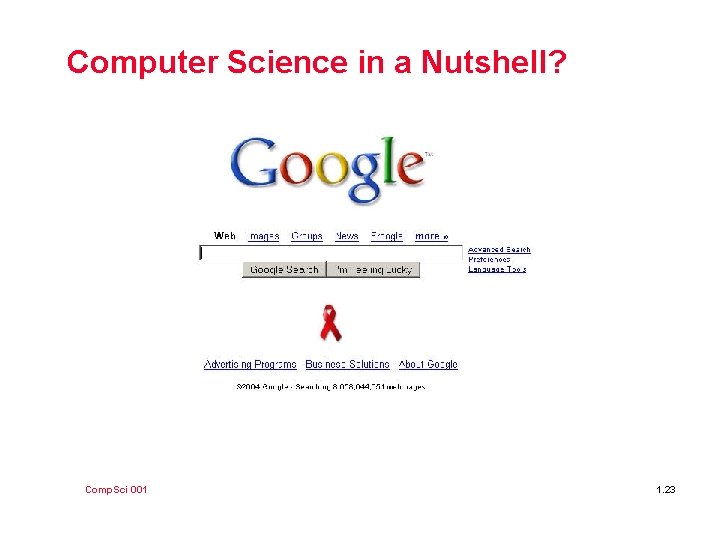
Computer Science in a Nutshell? Comp. Sci 001 1. 23
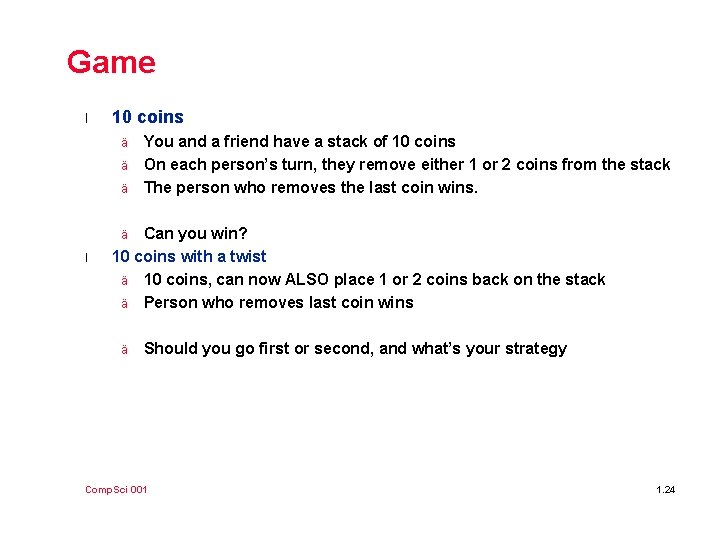
Game l 10 coins ä ä ä You and a friend have a stack of 10 coins On each person’s turn, they remove either 1 or 2 coins from the stack The person who removes the last coin wins. Can you win? 10 coins with a twist ä 10 coins, can now ALSO place 1 or 2 coins back on the stack ä Person who removes last coin wins ä l ä Should you go first or second, and what’s your strategy Comp. Sci 001 1. 24