
Welcome PLC Facilitators Training Day 2 Empowering Collaborative
Welcome! PLC Facilitator’s Training Day 2 Empowering Collaborative Teams 1
End In Mind 2
3
PLC Facilitator’s Training Learning Map Goal for this Unit: Develop and Implement PLCs to support CCSS and Professional Growth PLC Facilitator Training Day 1 PLC Facilitator Training Day 2 Introduction and Background • Pasco’s Multi-Year PLC Plan • Connections to Objectives/Priorities and Mission/Values • How PLC work integrates all district focus areas PLCs • Definition of PLCs; Key Terms • Purpose of PLC work • 5 Questions that drive PLCs • Inquiry Cycle Step 0 for PLCs PLC infrastructure planning • Organization of Teams/Meeting Structures • Norms/Roles • Climate/Culture • Scheduling/Protective Time • Establishing and Communicating Clear Expectations • Common Assessments/Assessment Mapping Effective Facilitation Techniques • Characteristics of a Professional Facilitator Review of Previous Work • Purpose of PLC work • Facilitation Techniques 4 5 questions that drive PLCs • What do we want all students to learn? (Unwrapping Standards, Creating Learning Goals and Scales) • How will we know if and when they’ve learned it? (Scales/Rubrics) • How will we teach it? (Prioritized instructional practices, Marzano Connections, Prioritized Shifts) • How will we respond if some students do not learn and how will we respond if some students have already learned? PLC Action Plan Development • Step 0 with Grade/Content/Subject Teams • 5 PLC Driving Questions with Grade/Content/Subject Teams • Facilitator Support Plan
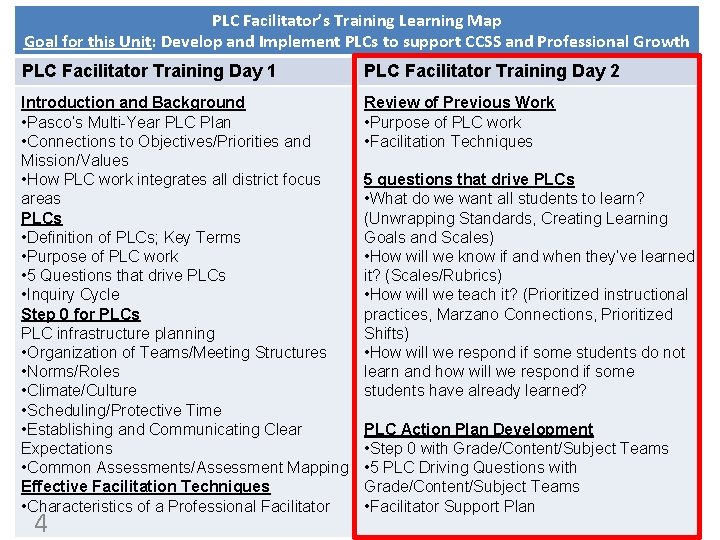
Day 2: Key Content and Activities • Review of Previous Content • 5 Driving Questions for PLC Work • PLC Action Planning Unit Learning Goal: Develop and implement PLCs to support CCSS, Professional Learning, and Professional Growth Today’s Learning Goals: Know and understand the 5 questions for PLCs and to develop PLC action plans 5 DQ #2: Identifying Critical Information
Norms for Our Work If you think it, say it Ask questions Take care of your neighbor Take care of yourself What is said here stays here; what is learned here leaves here • Be present • • • 6
Getting Ready: Materials to Bring Provided Materials • Day 1 PPT • PLC Note Taking Guide • Access to ELA and Math CCSS • PPT Handout • PLC Action Planning Handout 7
Review of Day 1 Content 8 DQ #3: Review Content
Pasco’s Integrated System: Why, What, and How As a team – 1. Why are we moving towards an integrated system? 2. What will that system look like? 3. How will this be done? 9
Review of Content: True or False 1. Professional Learning Communities are focused on learning. 1. Step “ 0” are things that we need to address before we engage in collaborative planning. 1. PLCs are time in which teams problem-solve and/or use the inquiry process and talk about at-risk students. 10
Activity: Developing a Communication Plan “The problem with communication is the illusion that is has occurred” - George Bernard Shaw Develop a communication plan for your Step 0 action plan. Include the following components: - Who are the stakeholders? - What should be communicated? - When should it be communicated? - How should it be communicated? 11
Sample Communication Format 1. 2. 3. 4. 5. 6. 7. 8. 12 Review background and compelling whys – What is your compelling why for your Step 0 work? Discuss who was involved in the work Identify required outcomes (if any) Identify desired outcomes – – Implementation of CCSS Guaranteed and Viable Curriculum Discuss key decisions that were made – Meeting structures – Schedules – Any other Step 0 Action Plans Discuss how these key decisions meet desired outcomes Discuss potential risks, and risks will be minimalized Q and A. Adapted from Trego. ED Forum
“The illiterate of the 21 st century will not be those who cannot read and write, but those who cannot learn, unlearn and relearn. ” - Alvin Toffler 13
Common Core= A New 21 st Century Learner 14
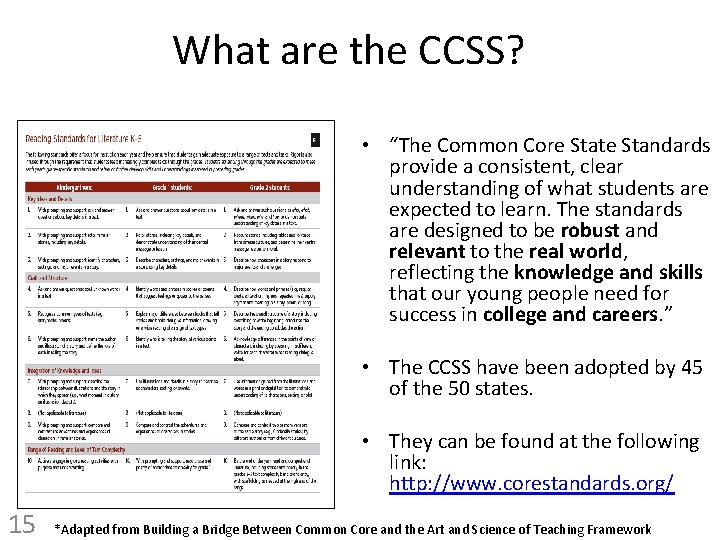
What are the CCSS? • “The Common Core State Standards provide a consistent, clear understanding of what students are expected to learn. The standards are designed to be robust and relevant to the real world, reflecting the knowledge and skills that our young people need for success in college and careers. ” • The CCSS have been adopted by 45 of the 50 states. • They can be found at the following link: http: //www. corestandards. org/ 15 *Adapted from Building a Bridge Between Common Core and the Art and Science of Teaching Framework
5 Driving Questions for Professional Learning Communities (PLC) Unit Learning Goal: Develop and implement PLCs to support CCSS, Professional Learning, and Professional Growth Mini-Lesson Goal: To understand the 5 driving questions for PLCs 16 DQ #1: Communicating Learning Goals and Feedback
“The fact that teachers collaborate will do nothing to improve a school. The purpose of collaboration can only be accomplished if the professionals engaged in collaboration are focused on the right things. ” ~Richard Du. Four What does collaboration look like with your team/at your school? What would we hear and see? What type of work is your team engaged in? 17
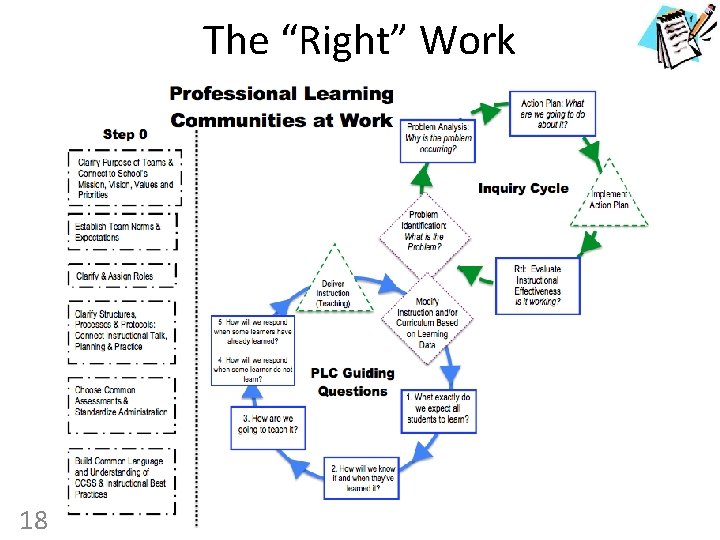
The “Right” Work 18
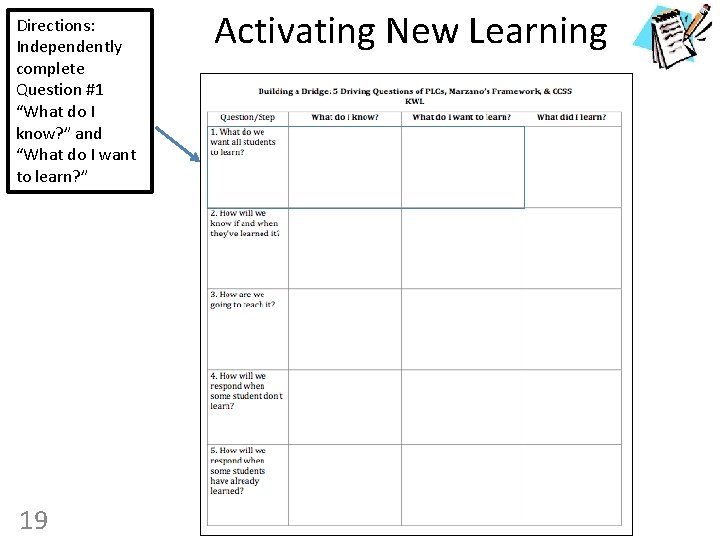
Directions: Independently complete Question #1 “What do I know? ” and “What do I want to learn? ” 19 Activating New Learning
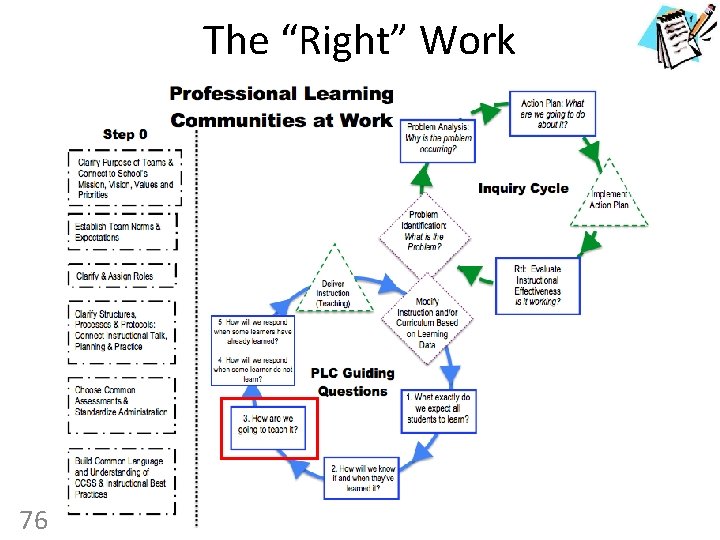
5 Driving PLC Questions 1. 2. 3. 4. 5. 20 What do we want all students to learn? – Unwrap Standards (K-U-D) – Use K-U-D to develop learning scales and goals How will we know if and when they’ve learned it? – Use learning scales and other assessments to track and monitor student progress (formative and summative assessments) How are we going to teach it? – Based upon learning scale, decide the type of lesson that will best facilitate student mastery of content (e. g. , introducing new knowledge, deepening knowledge, or generating and testing hypotheses) – Select instructional strategies that will maximize student learning (Marzano’s 41 elements) How will we respond when some students don’t learn? – Anticipate and plan for needs of at-risk students How will we respond when some students have already learned? – Anticipate and plan for needs of students who need acceleration
PLC Question 1: What do we want all students to learn? Unwrapping CCSS Creating Learning Scales 21
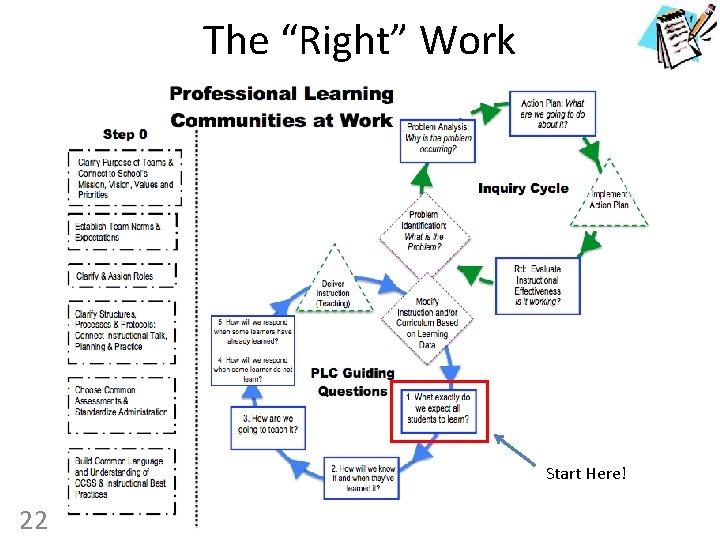
The “Right” Work Start Here! 22
Why Unwrapping the Common Core Standard within PLCs? http: //cooperativelearning. nuvvo. com/lesson/9 592 -seinfeld-teaches-history 23 DQ 2: Interacting with New Knowledge
Why do you think it is important to unwrap the common core standards as a collaborative PLC team? What are some benefits for improving teaching practices and student achievement? 24
Why Unwrap the Common Core Standards? “Guaranteed and viable curriculum gives students access to the same essential learning regardless of who is teaching the class and each member of the team will work to ensure every student acquires the knowledge and skills the team has agreed are most essential for that unit. " (Marzano, 2003) “GUARANTEED & VIABLE CURRICULUM” NUMBER ONE FACTOR that increases levels of learning -Marzano; Porter; Lezotte 25 DQ 2: Identifying Critical Information
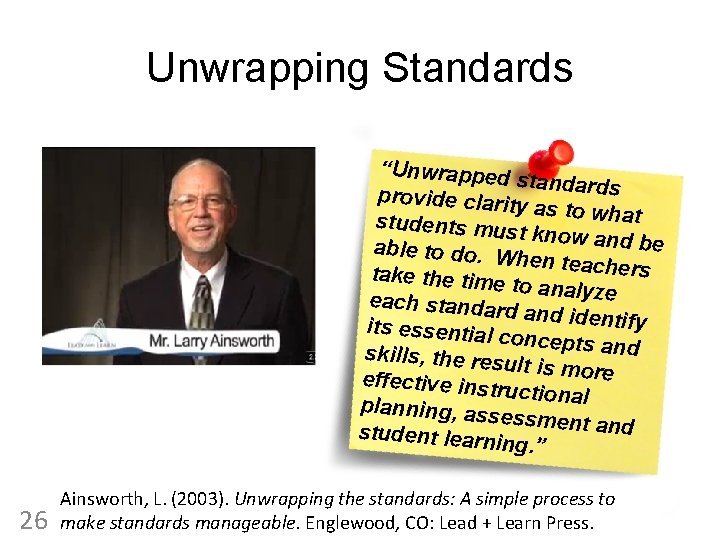
Unwrapping Standards “Unwrapped standards provide clarit y as to what students mus t know and b e able to do. W hen teachers take the time to analyze each standar d and identify its essential concepts and skills, the res ult is more effective inst ructional planning, ass essment and student learn ing. ” 26 Ainsworth, L. (2003). Unwrapping the standards: A simple process to make standards manageable. Englewood, CO: Lead + Learn Press.
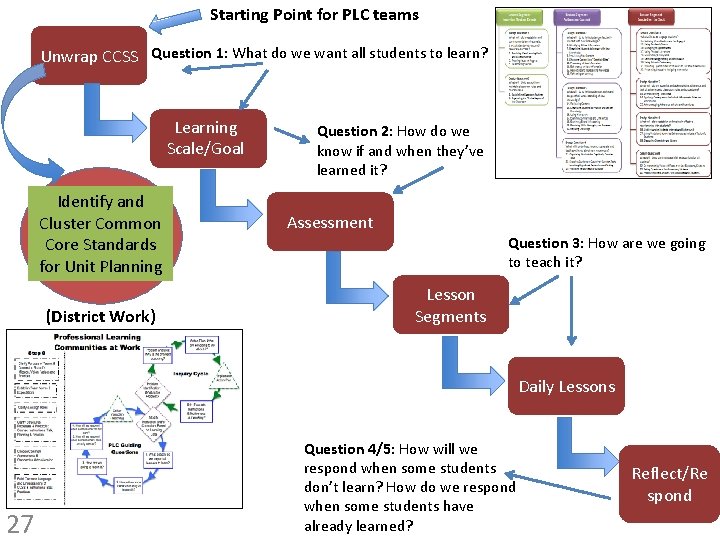
Starting Point for PLC teams Unwrap CCSS Question 1: What do we want all students to learn? Learning Scale/Goal Identify and Cluster Common Core Standards for Unit Planning (District Work) Question 2: How do we know if and when they’ve learned it? Assessment Question 3: How are we going to teach it? Lesson Segments Daily Lessons 27 Question 4/5: How will we respond when some students don’t learn? How do we respond when some students have already learned? Reflect/Re spond
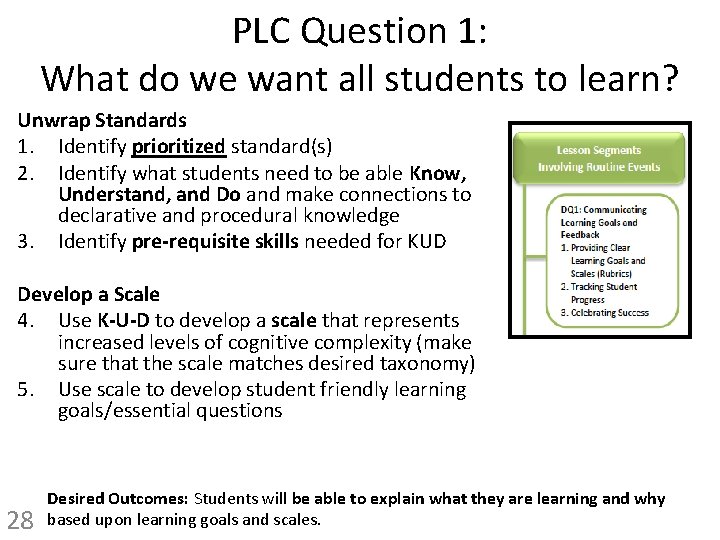
PLC Question 1: What do we want all students to learn? Unwrap Standards 1. Identify prioritized standard(s) 2. Identify what students need to be able Know, Understand, and Do and make connections to declarative and procedural knowledge 3. Identify pre-requisite skills needed for KUD Develop a Scale 4. Use K-U-D to develop a scale that represents increased levels of cognitive complexity (make sure that the scale matches desired taxonomy) 5. Use scale to develop student friendly learning goals/essential questions 28 Desired Outcomes: Students will be able to explain what they are learning and why based upon learning goals and scales.
A note about Content vs. Process • The focus of this training is on the process of PLCs • Content is also important, and will be critical for your PLC, but our goal is to teach the process • Specific content (CCSS and Marzano) will be light for illustration purposes 29
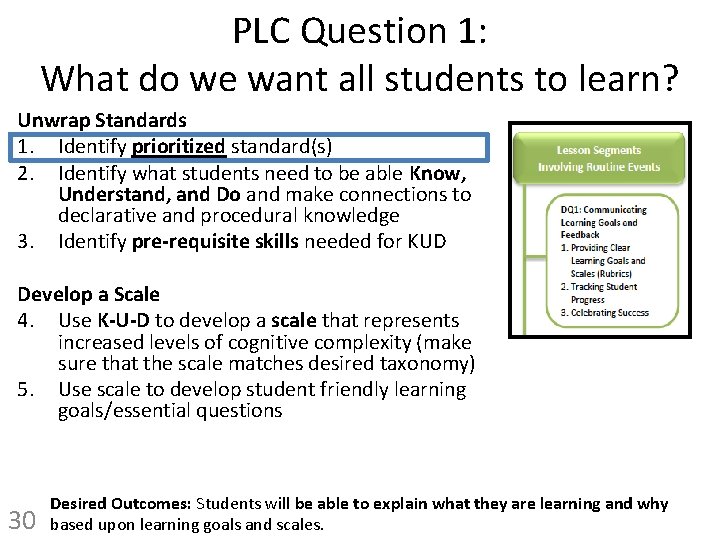
PLC Question 1: What do we want all students to learn? Unwrap Standards 1. Identify prioritized standard(s) 2. Identify what students need to be able Know, Understand, and Do and make connections to declarative and procedural knowledge 3. Identify pre-requisite skills needed for KUD Develop a Scale 4. Use K-U-D to develop a scale that represents increased levels of cognitive complexity (make sure that the scale matches desired taxonomy) 5. Use scale to develop student friendly learning goals/essential questions 30 Desired Outcomes: Students will be able to explain what they are learning and why based upon learning goals and scales.
What Tools In Our Toolbox are Available? Materials: • Common Core State Standards • Vertical Articulation of Grade Level Standards • Curriculum Maps (if available) • Test Specifications (if available) • PARCC Assessments (samples) Helpful Websites: http: //www. corestandards. org/ http: //dpi. state. nc. us/acre/standards/common core-tools/#unela http: //www. engageny. org/common-core-curriculum 31
Example Step 1: Identify prioritized standard(s) PLC. 0. 0. 2 – Participants will plan to facilitate Step 0 components with PLC teams 32
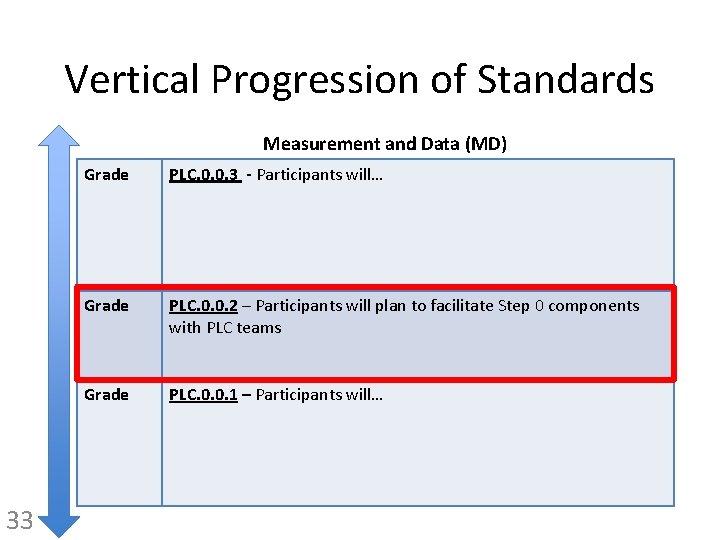
Vertical Progression of Standards Measurement and Data (MD) 33 Grade PLC. 0. 0. 3 - Participants will… Grade PLC. 0. 0. 2 – Participants will plan to facilitate Step 0 components with PLC teams Grade PLC. 0. 0. 1 – Participants will…
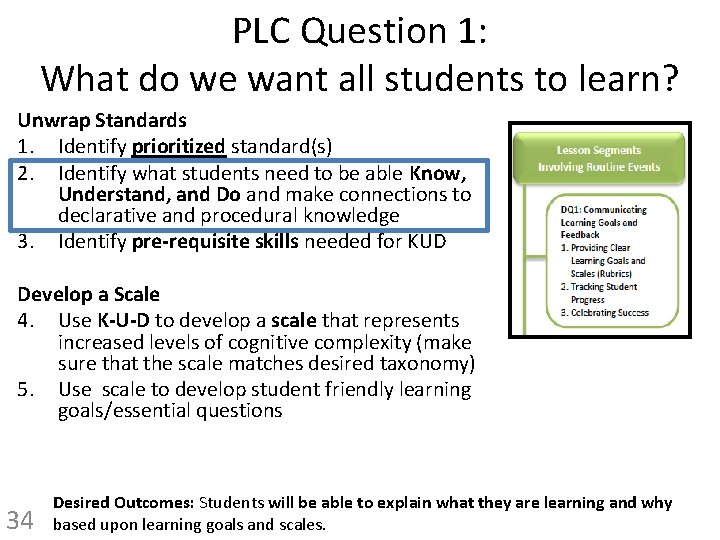
PLC Question 1: What do we want all students to learn? Unwrap Standards 1. Identify prioritized standard(s) 2. Identify what students need to be able Know, Understand, and Do and make connections to declarative and procedural knowledge 3. Identify pre-requisite skills needed for KUD Develop a Scale 4. Use K-U-D to develop a scale that represents increased levels of cognitive complexity (make sure that the scale matches desired taxonomy) 5. Use scale to develop student friendly learning goals/essential questions 34 Desired Outcomes: Students will be able to explain what they are learning and why based upon learning goals and scales.
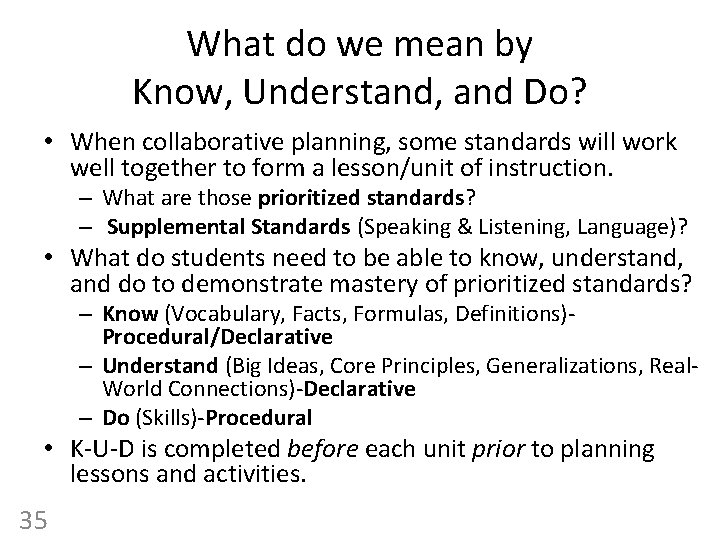
What do we mean by Know, Understand, and Do? • When collaborative planning, some standards will work well together to form a lesson/unit of instruction. – What are those prioritized standards? – Supplemental Standards (Speaking & Listening, Language)? • What do students need to be able to know, understand, and do to demonstrate mastery of prioritized standards? – Know (Vocabulary, Facts, Formulas, Definitions)Procedural/Declarative – Understand (Big Ideas, Core Principles, Generalizations, Real. World Connections)-Declarative – Do (Skills)-Procedural • K-U-D is completed before each unit prior to planning lessons and activities. 35
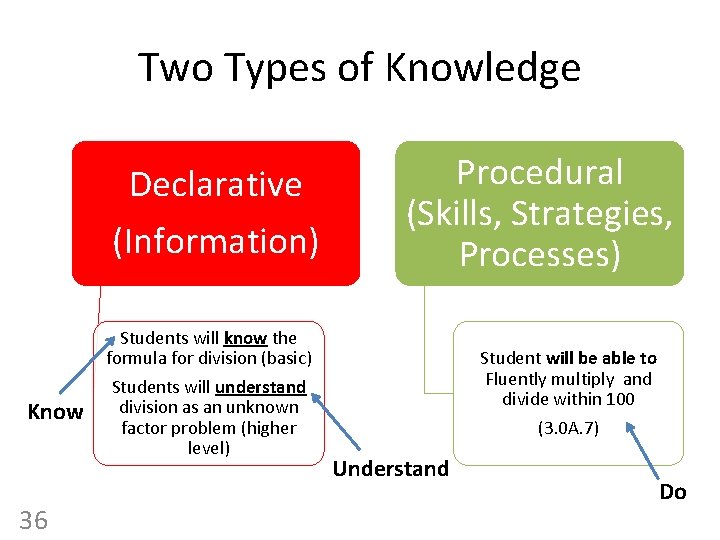
Two Types of Knowledge Declarative (Information) Procedural (Skills, Strategies, Processes) Students will know the formula for division (basic) Know 36 Students will understand division as an unknown factor problem (higher level) Student will be able to Fluently multiply and divide within 100 (3. 0 A. 7) Understand Do
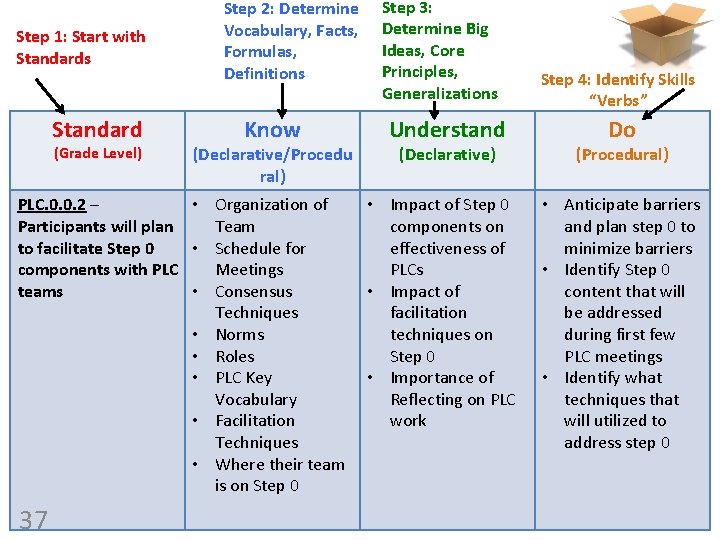
Step 1: Start with Standards Standard (Grade Level) Step 2: Determine Vocabulary, Facts, Formulas, Definitions Know (Declarative/Procedu ral) PLC. 0. 0. 2 – • Organization of Participants will plan Team to facilitate Step 0 • Schedule for components with PLC Meetings teams • Consensus Techniques • Norms • Roles • PLC Key Vocabulary • Facilitation Techniques • Where their team is on Step 0 37 Step 3: Determine Big Ideas, Core Principles, Generalizations Understand (Declarative) • Impact of Step 0 components on effectiveness of PLCs • Impact of facilitation techniques on Step 0 • Importance of Reflecting on PLC work Step 4: Identify Skills “Verbs” Do (Procedural) • Anticipate barriers and plan step 0 to minimize barriers • Identify Step 0 content that will be addressed during first few PLC meetings • Identify what techniques that will utilized to address step 0
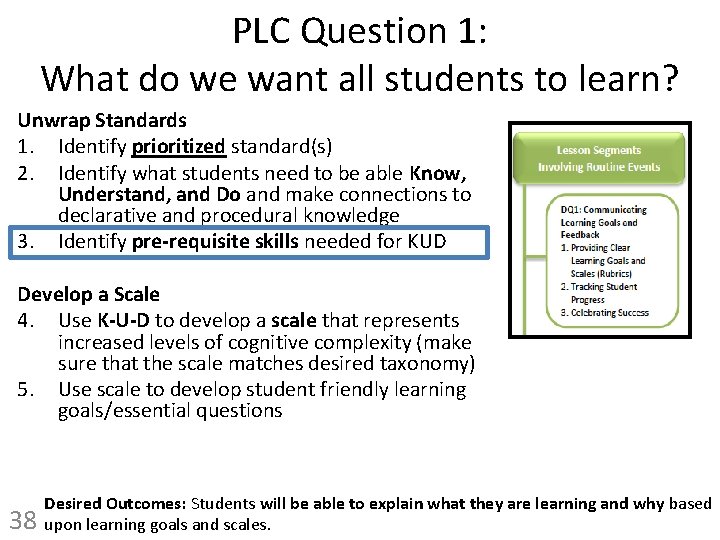
PLC Question 1: What do we want all students to learn? Unwrap Standards 1. Identify prioritized standard(s) 2. Identify what students need to be able Know, Understand, and Do and make connections to declarative and procedural knowledge 3. Identify pre-requisite skills needed for KUD Develop a Scale 4. Use K-U-D to develop a scale that represents increased levels of cognitive complexity (make sure that the scale matches desired taxonomy) 5. Use scale to develop student friendly learning goals/essential questions 38 Desired Outcomes: Students will be able to explain what they are learning and why based upon learning goals and scales.
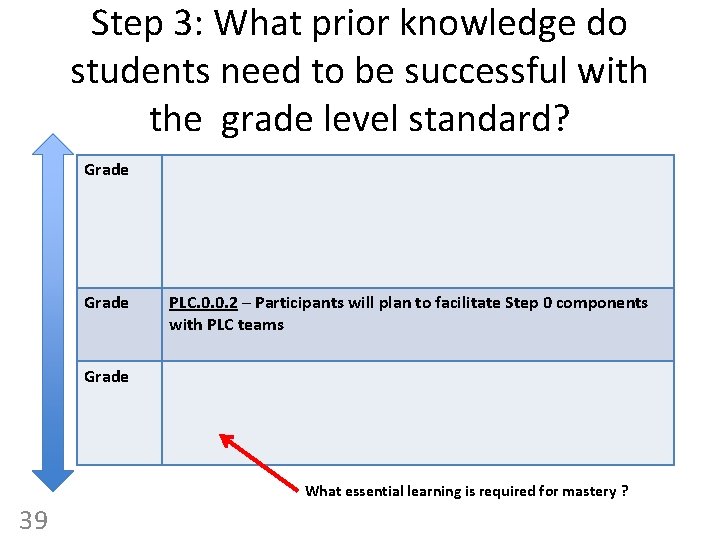
Step 3: What prior knowledge do students need to be successful with the grade level standard? Grade PLC. 0. 0. 2 – Participants will plan to facilitate Step 0 components with PLC teams Grade What essential learning is required for mastery ? 39
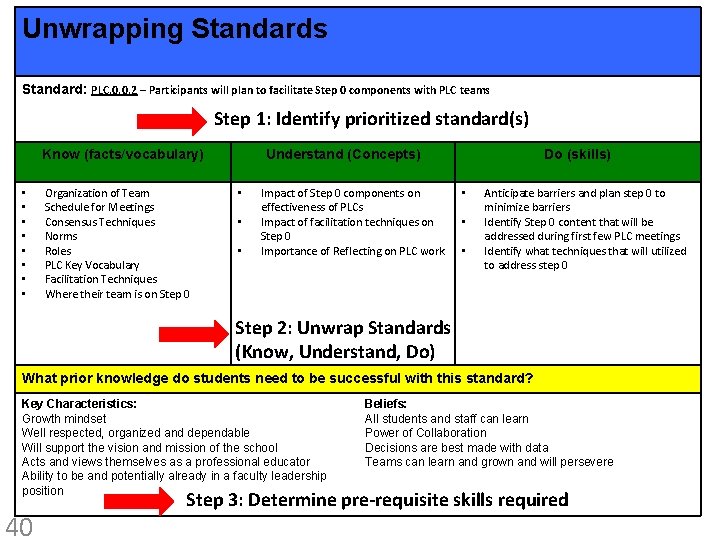
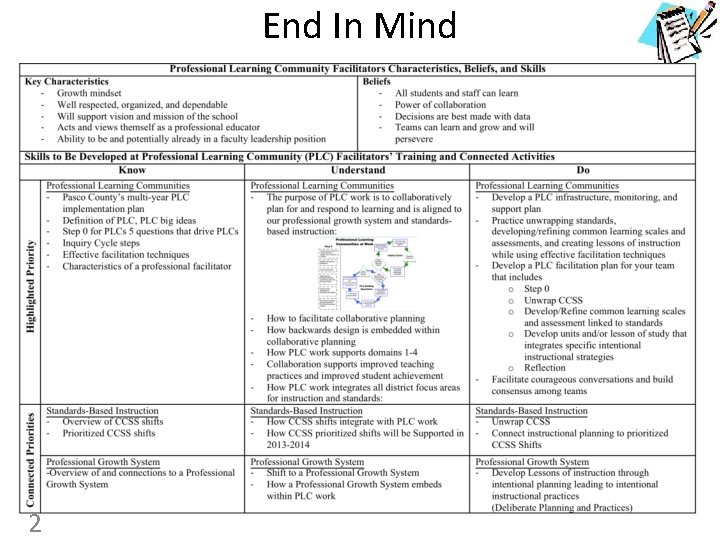
Unwrapping Standards Standard: PLC. 0. 0. 2 – Participants will plan to facilitate Step 0 components with PLC teams Step 1: Identify prioritized standard(s) Know (facts/vocabulary) • • Organization of Team Schedule for Meetings Consensus Techniques Norms Roles PLC Key Vocabulary Facilitation Techniques Where their team is on Step 0 Understand (Concepts) • • • Impact of Step 0 components on effectiveness of PLCs Impact of facilitation techniques on Step 0 Importance of Reflecting on PLC work Do (skills) • • • Anticipate barriers and plan step 0 to minimize barriers Identify Step 0 content that will be addressed during first few PLC meetings Identify what techniques that will utilized to address step 0 Step 2: Unwrap Standards (Know, Understand, Do) What prior knowledge do students need to be successful with this standard? Key Characteristics: Growth mindset Well respected, organized and dependable Will support the vision and mission of the school Acts and views themselves as a professional educator Ability to be and potentially already in a faculty leadership position 40 Beliefs: All students and staff can learn Power of Collaboration Decisions are best made with data Teams can learn and grown and will persevere Step 3: Determine pre-requisite skills required
Unwrapping Standards: Team Practice Steps 1, 2, & 3 41
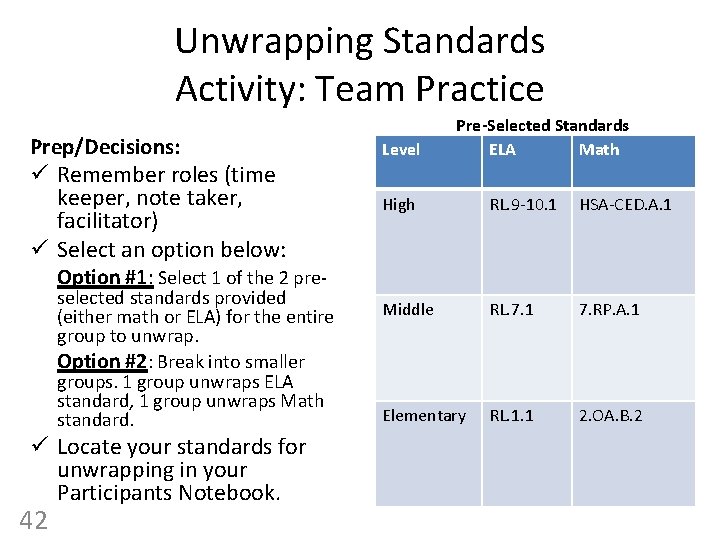
Unwrapping Standards Activity: Team Practice Prep/Decisions: ü Remember roles (time keeper, note taker, facilitator) ü Select an option below: Option #1: Select 1 of the 2 pre- selected standards provided (either math or ELA) for the entire group to unwrap. Option #2: Break into smaller groups. 1 group unwraps ELA standard, 1 group unwraps Math standard. ü Locate your standards for unwrapping in your Participants Notebook. 42 Level Pre-Selected Standards ELA Math High RL. 9 -10. 1 HSA-CED. A. 1 Middle RL. 7. 1 7. RP. A. 1 Elementary RL. 1. 1 2. OA. B. 2
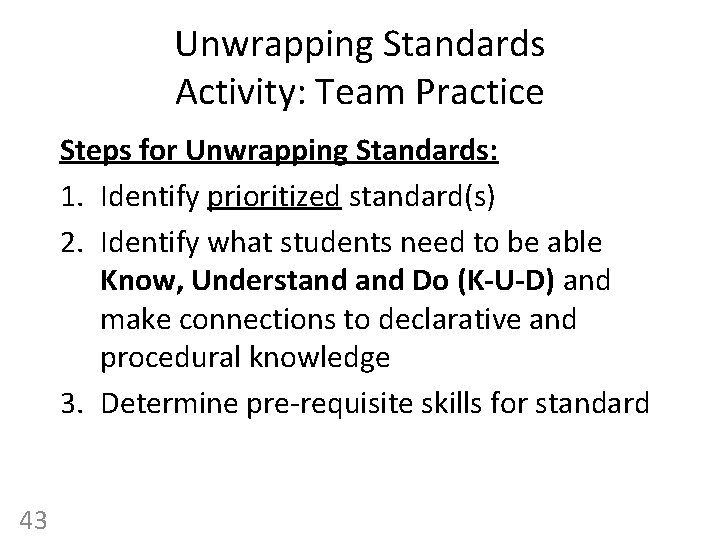
Unwrapping Standards Activity: Team Practice Steps for Unwrapping Standards: 1. Identify prioritized standard(s) 2. Identify what students need to be able Know, Understand Do (K-U-D) and make connections to declarative and procedural knowledge 3. Determine pre-requisite skills for standard 43
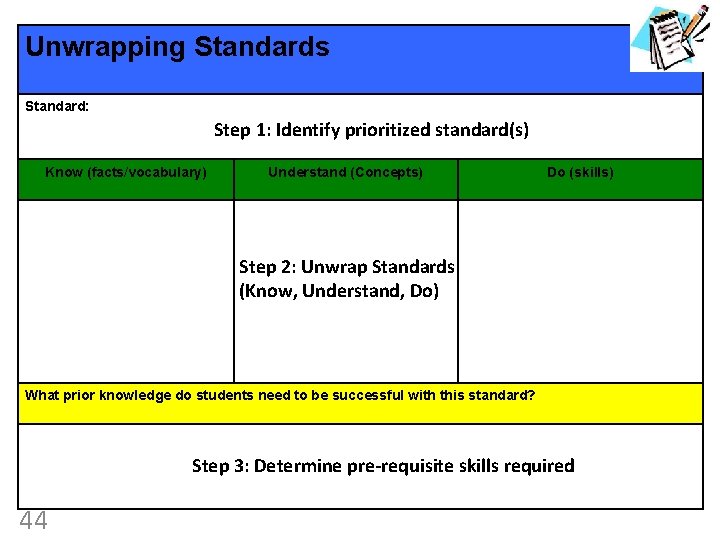
Unwrapping Standards Standard: Step 1: Identify prioritized standard(s) Know (facts/vocabulary) Understand (Concepts) Do (skills) Step 2: Unwrap Standards (Know, Understand, Do) What prior knowledge do students need to be successful with this standard? Step 3: Determine pre-requisite skills required 44
Team Reflection • How was the unwrapping standards process? – How well did your team work together while unwrapping standards? • Were your norms and roles helpful with collaboration? – What obstacles did your team overcome? What can you celebrate? – What components of this process can you begin to implement in future planning? 45
PLC Video Reflection • Step 1, 2, 3 – unwrapping Standards • There are many different ways to unwrap standards. What are some similarities and/or differences that you noticed about how this team unwrapped standards? • How does this compare to the work at your school? http: //www. youtube. com/watch? v=WXd. H 5 amla. M 4 46
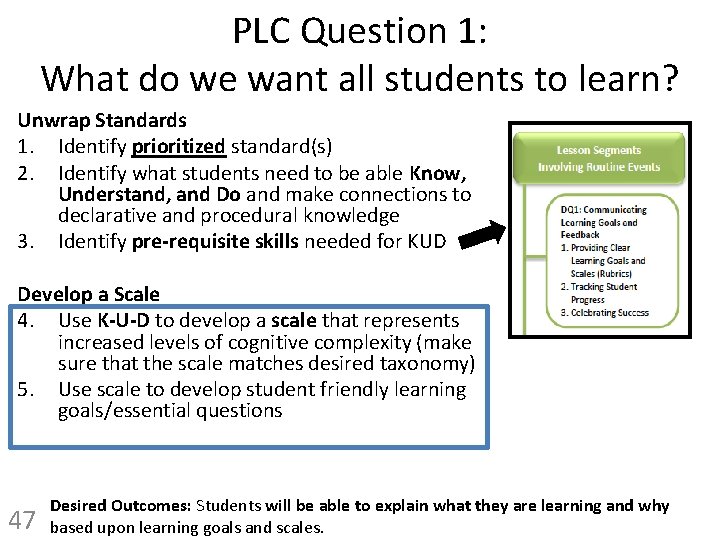
PLC Question 1: What do we want all students to learn? Unwrap Standards 1. Identify prioritized standard(s) 2. Identify what students need to be able Know, Understand, and Do and make connections to declarative and procedural knowledge 3. Identify pre-requisite skills needed for KUD Develop a Scale 4. Use K-U-D to develop a scale that represents increased levels of cognitive complexity (make sure that the scale matches desired taxonomy) 5. Use scale to develop student friendly learning goals/essential questions 47 Desired Outcomes: Students will be able to explain what they are learning and why based upon learning goals and scales.
A scale: What’s the point? A scale: • Articulates distinct levels of knowledge and skills relative to a specific topic • Provides a roadmap for designing instruction that reflects a progression of learning and authentic assessment. • Allows students to know how they are doing and how to get better-motivating! 48
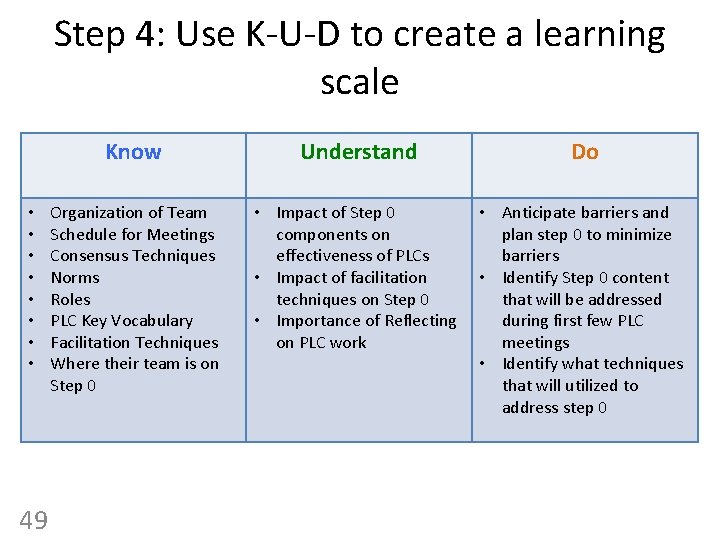
Step 4: Use K-U-D to create a learning scale • • 49 Know Understand Do Organization of Team Schedule for Meetings Consensus Techniques Norms Roles PLC Key Vocabulary Facilitation Techniques Where their team is on Step 0 • Impact of Step 0 components on effectiveness of PLCs • Impact of facilitation techniques on Step 0 • Importance of Reflecting on PLC work • Anticipate barriers and plan step 0 to minimize barriers • Identify Step 0 content that will be addressed during first few PLC meetings • Identify what techniques that will utilized to address step 0
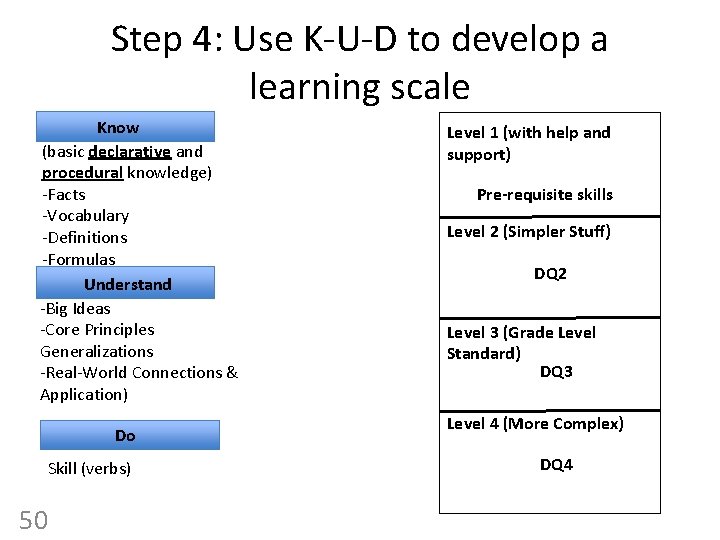
Step 4: Use K-U-D to develop a learning scale Know (basic declarative and procedural knowledge) -Facts -Vocabulary -Definitions -Formulas Understand -Big Ideas -Core Principles Generalizations -Real-World Connections & Application) Do Skill (verbs) 50 Level 1 (with help and support) Pre-requisite skills Level 2 (Simpler Stuff) DQ 2 Level 3 (Grade Level Standard) DQ 3 Level 4 (More Complex) DQ 4
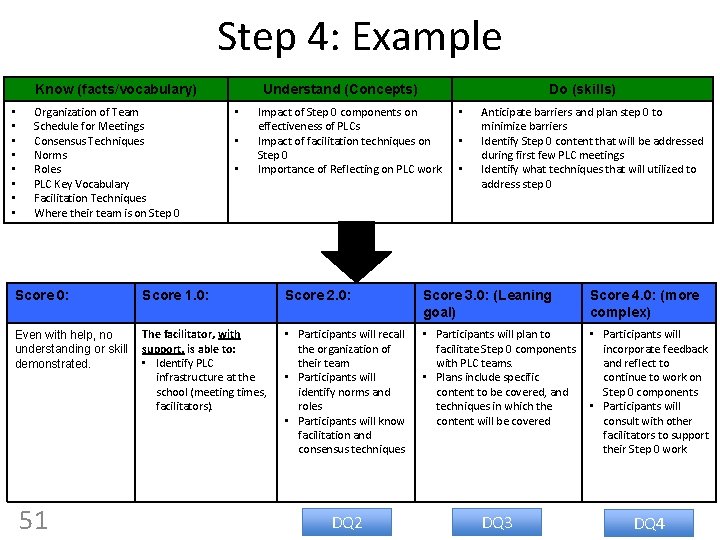
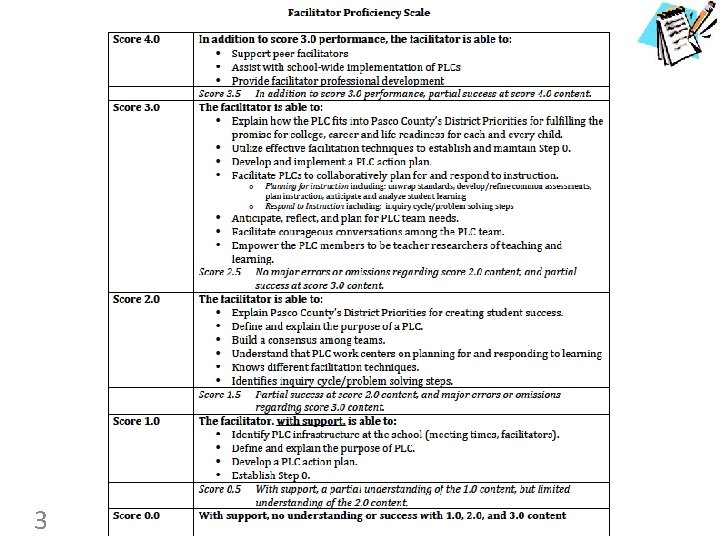
Step 4: Example Know (facts/vocabulary) • • Organization of Team Schedule for Meetings Consensus Techniques Norms Roles PLC Key Vocabulary Facilitation Techniques Where their team is on Step 0 Score 0: Understand (Concepts) • • • Impact of Step 0 components on effectiveness of PLCs Impact of facilitation techniques on Step 0 Importance of Reflecting on PLC work Score 1. 0: The facilitator, with Even with help, no understanding or skill support, is able to: • Identify PLC demonstrated. infrastructure at the school (meeting times, facilitators). 51 Do (skills) • • • Anticipate barriers and plan step 0 to minimize barriers Identify Step 0 content that will be addressed during first few PLC meetings Identify what techniques that will utilized to address step 0 Score 2. 0: Score 3. 0: (Leaning goal) Score 4. 0: (more complex) • Participants will recall the organization of their team • Participants will identify norms and roles • Participants will know facilitation and consensus techniques • Participants will plan to facilitate Step 0 components with PLC teams. • Plans include specific content to be covered, and techniques in which the content will be covered • Participants will incorporate feedback and reflect to continue to work on Step 0 components • Participants will consult with other facilitators to support their Step 0 work DQ 2 DQ 3 DQ 4
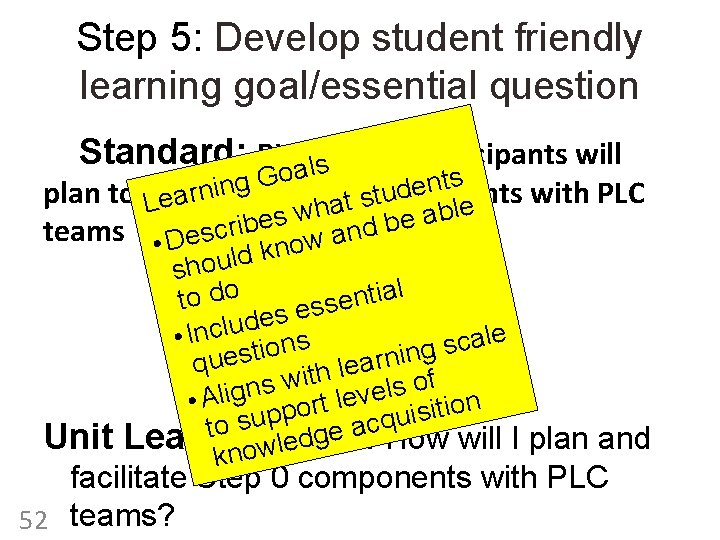
Step 5: Develop student friendly learning goal/essential question Standard: PLC. 0. 0. 2 – Participants will als o G s t g n n e i d plan to facilitate Stepha 0 t components with PLC stu ble Learn w a s e e b b i r d teams • Desc n a w o n k d l u sho to do essential es d u l c e l • In a s c n s io g t n s i e n r u a q e l h t i f w o s s n l • Alig pport leve isition u q su c o a t e : How will I plan and g d Unit Learning Goal e l know facilitate Step 0 components with PLC 52 teams?
53
Unwrapping Standards: Team Practice Steps 4 & 5 54
Activity: Team Practice • Remember roles (note taker, facilitator, time keeper) • Use K-U-D to develop learning scale • Determine taxonomy of learning scale 55
Complete Scale Score 0: Assessments for Learning Example Score 1. 0: Assessment Methods Time of Assessment Complexity/Rigor of Task Score 2. 0: Score 3. 0: (Leaning goal) Score 4. 0: (more complex)
Team Reflection • How was the scale development process (with taxonomy)? – How well did your team work together? • Were your norms and roles helpful with collaboration? – What obstacles did your team overcome? What can you celebrate? – What components of this process can you begin to implement in future planning? 57
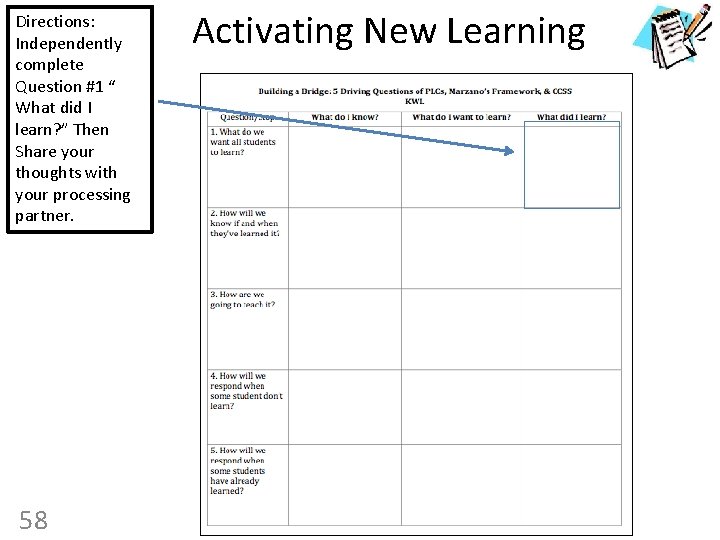
Directions: Independently complete Question #1 “ What did I learn? ” Then Share your thoughts with your processing partner. 58 Activating New Learning
PLC Question 2: How do we know if and when they’ve learned it? Align Learning Scales to Assessment of Learning Assessment for Learning 59
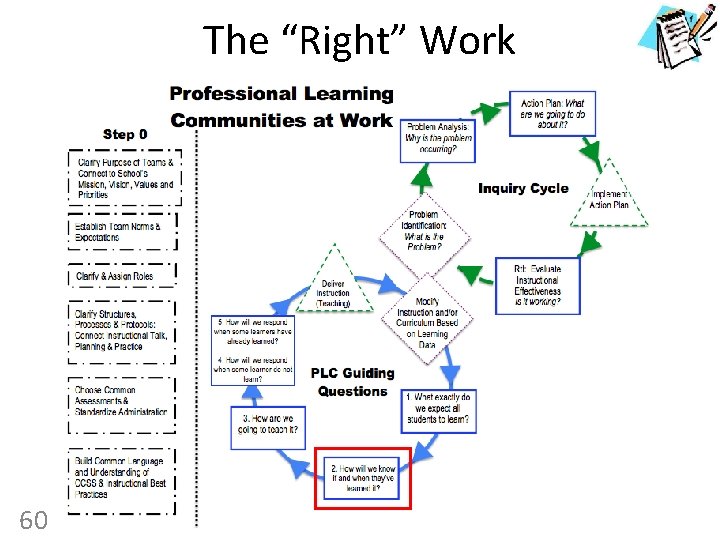
The “Right” Work 60
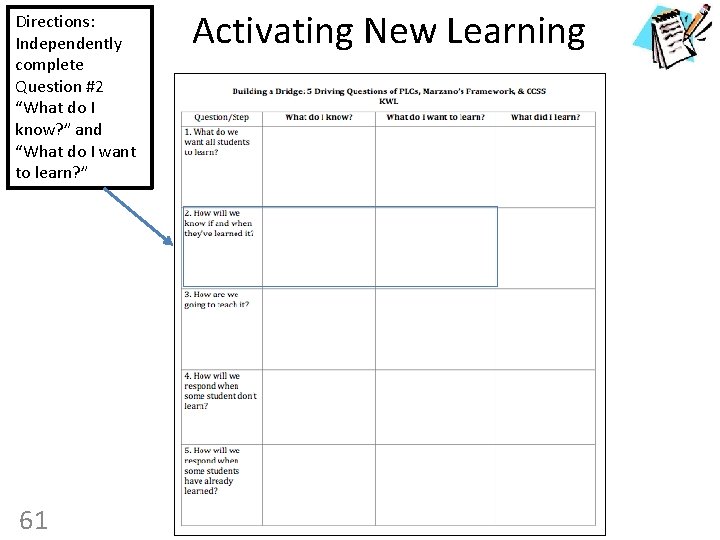
Directions: Independently complete Question #2 “What do I know? ” and “What do I want to learn? ” 61 Activating New Learning
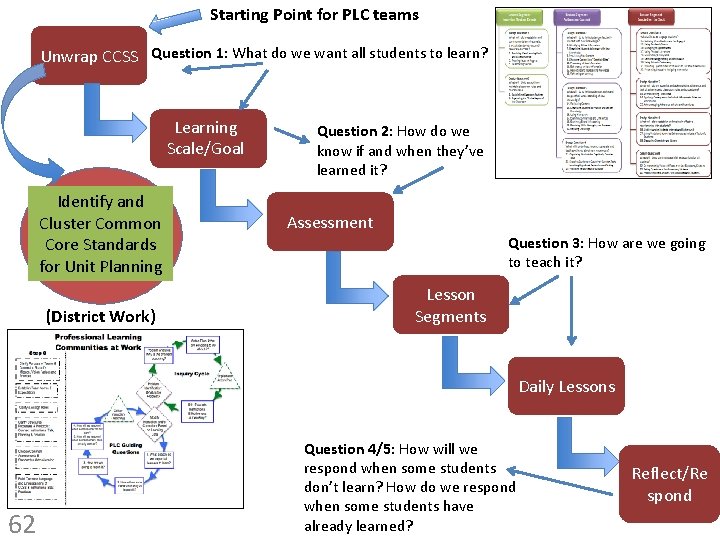
Starting Point for PLC teams Unwrap CCSS Question 1: What do we want all students to learn? Learning Scale/Goal Identify and Cluster Common Core Standards for Unit Planning (District Work) Question 2: How do we know if and when they’ve learned it? Assessment Question 3: How are we going to teach it? Lesson Segments Daily Lessons 62 Question 4/5: How will we respond when some students don’t learn? How do we respond when some students have already learned? Reflect/Re spond
Question 2: “We taught it, did they get it? ” Timing (C-I-A) • Within our lesson, when and how are we going to assess for student learning ? How are we pre-planning for this? – Ongoing and embedded in teaching (daily) – Pre and Post learning (before and after instruction) – Student Self- Assessment and Goal Setting w/ feedback – Combination • When and how are we going to reflect on the lesson/unit and student learning? What student data will you collect and bring to the meeting? 63
Question 2: “We taught it, did they get it? ” Questions to Consider • What skills do we prioritize based upon learning goals and standards taught in this lesson/unit (leverage, endurance, foundational)? • What does mastery look like in this lesson/unit based upon the learning goals? • What evidence of learning will we collect to determine mastery (student work samples)? • What formative assessment strategies are a priority within this lesson/unit (e. g. , assessment prompts, quick checks, accountable talk, summarizer, answering LEQ)? • What is the level of rigor? Depth? Quality? Timeliness of formative feedback on all student work? (Taxonomy of Assessment? ) 64
Multiple Means to Assess • • • 65 Paper and Pencil Probing discussions Demonstrations/Performance-Based Work Samples Observations Student Generated
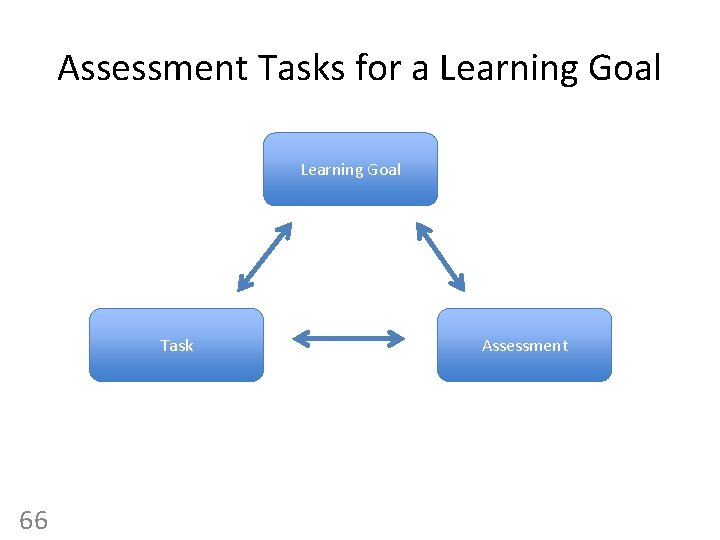
Assessment Tasks for a Learning Goal Task 66 Assessment
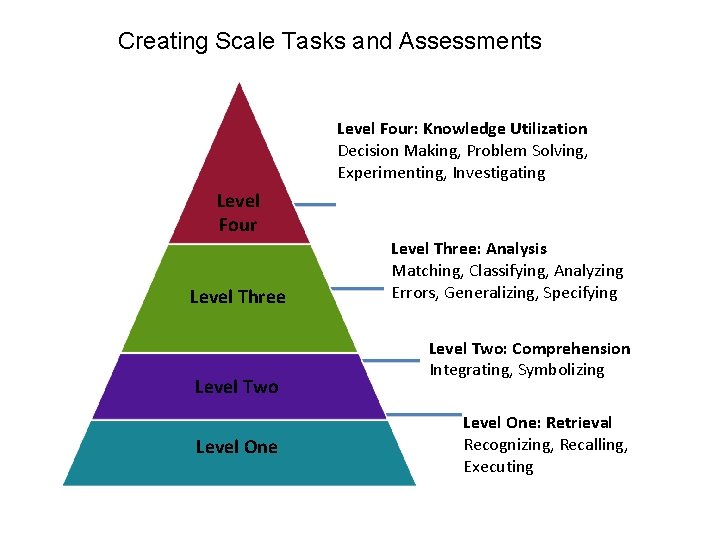
Creating Scale Tasks and Assessments Level Four: Knowledge Utilization Decision Making, Problem Solving, Experimenting, Investigating Level Four Level Three Level Two Level One Level Three: Analysis Matching, Classifying, Analyzing Errors, Generalizing, Specifying Level Two: Comprehension Integrating, Symbolizing Level One: Retrieval Recognizing, Recalling, Executing
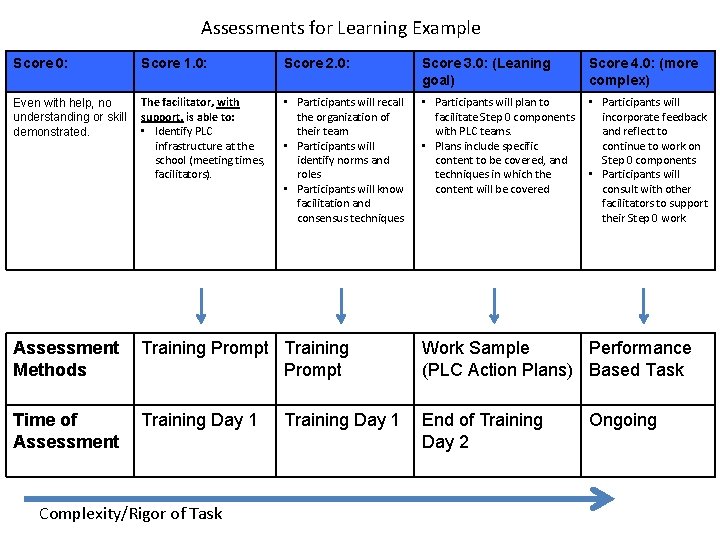
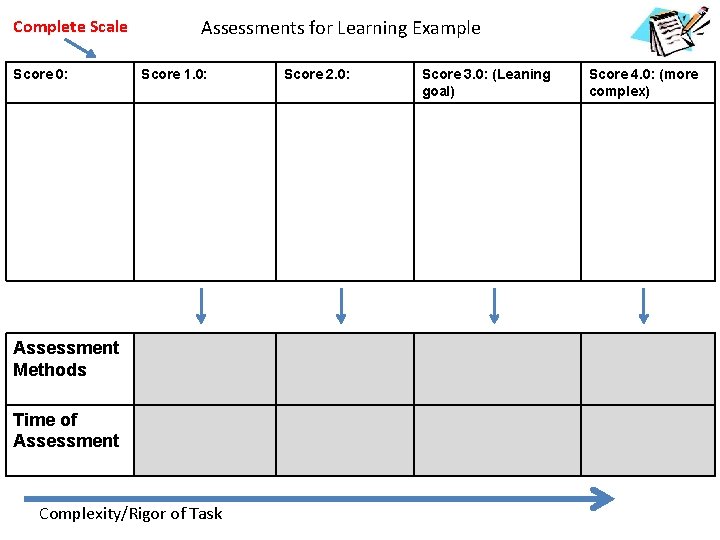
Assessments for Learning Example Score 0: Score 1. 0: The facilitator, with Even with help, no understanding or skill support, is able to: • Identify PLC demonstrated. infrastructure at the school (meeting times, facilitators). Score 2. 0: Score 3. 0: (Leaning goal) Score 4. 0: (more complex) • Participants will recall the organization of their team • Participants will identify norms and roles • Participants will know facilitation and consensus techniques • Participants will plan to facilitate Step 0 components with PLC teams. • Plans include specific content to be covered, and techniques in which the content will be covered • Participants will incorporate feedback and reflect to continue to work on Step 0 components • Participants will consult with other facilitators to support their Step 0 work Assessment Methods Training Prompt Work Sample Performance (PLC Action Plans) Based Task Time of Assessment Training Day 1 End of Training Day 2 Complexity/Rigor of Task Training Day 1 Ongoing
Activity: Team Practice • Remember your roles, norms • Use your learning scale to create an assessment plan • Be sure to consider level of rigor (cognitive complexity) 69
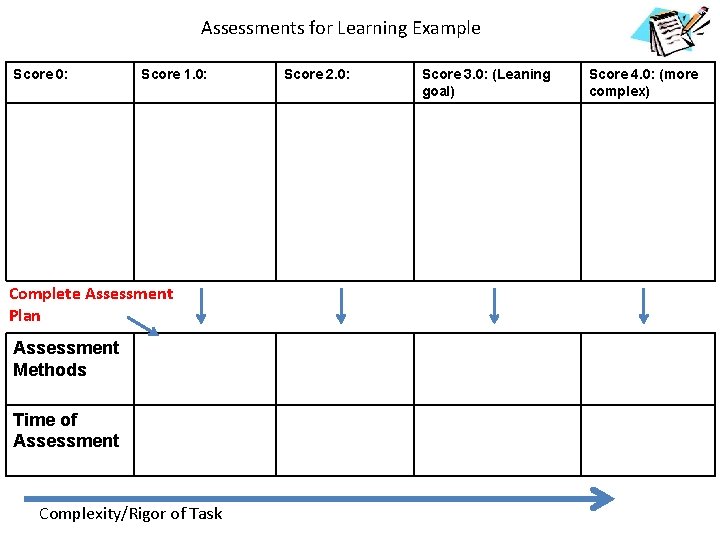
Assessments for Learning Example Score 0: Score 1. 0: Complete Assessment Plan Assessment Methods Time of Assessment Complexity/Rigor of Task Score 2. 0: Score 3. 0: (Leaning goal) Score 4. 0: (more complex)
Team Reflection • How was the assessment planning process? – How well did your team work together? • Were your norms and roles helpful with collaboration? – What obstacles did your team overcome? What can you celebrate? – What components of this process can you begin to implement in future planning? 71
PLC Video Reflection • Question #2 – Creating/Refining Common Assessments • How is the team approaching assessment of learning? • What about opportunities for assessments for learning? http: //www. youtube. com/watch? v=WXd. H 5 aml a. M 4 72
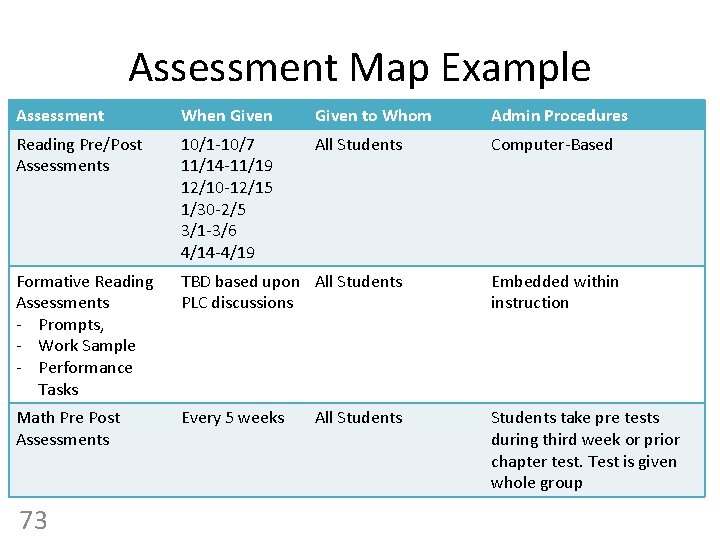
Assessment Map Example Assessment When Given to Whom Admin Procedures Reading Pre/Post Assessments 10/1 -10/7 11/14 -11/19 12/10 -12/15 1/30 -2/5 3/1 -3/6 4/14 -4/19 All Students Computer-Based Formative Reading Assessments - Prompts, - Work Sample - Performance Tasks TBD based upon All Students PLC discussions Embedded within instruction Math Pre Post Assessments Every 5 weeks Students take pre tests during third week or prior chapter test. Test is given whole group 73 All Students
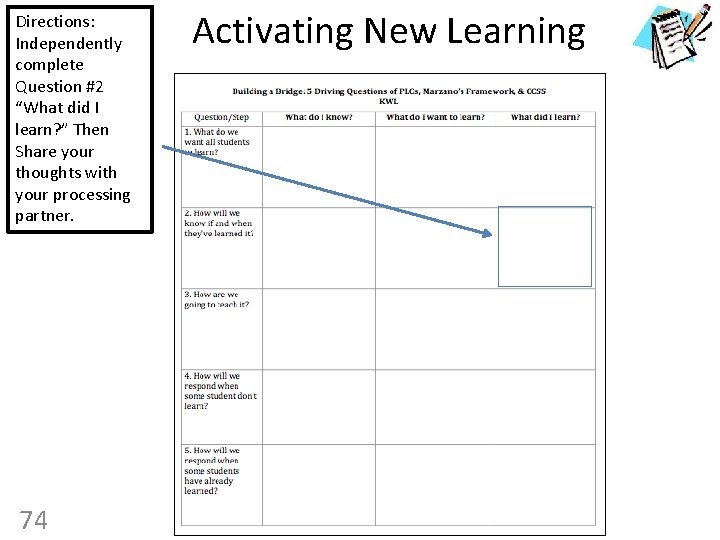
Directions: Independently complete Question #2 “What did I learn? ” Then Share your thoughts with your processing partner. 74 Activating New Learning
PLC Question 3: How are we going to teach it? Develop Instruction based upon 75
The “Right” Work 76
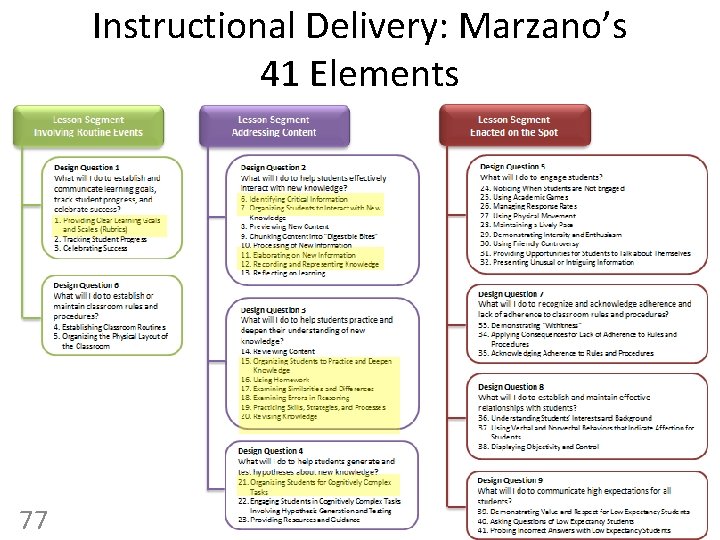
Instructional Delivery: Marzano’s 41 Elements 77
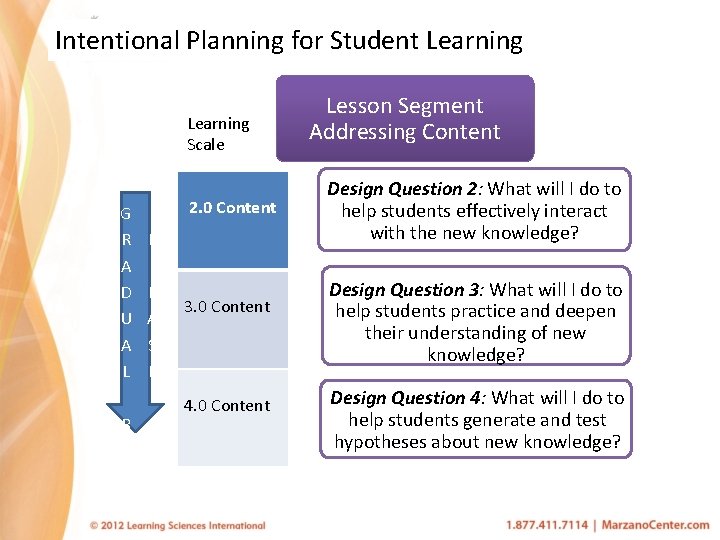
Intentional Planning for Student Learning Scale G R A D U A L R 2. 0 Content E L E A S E 3. 0 Content 4. 0 Content Lesson Segment Addressing Content Design Question 2: What will I do to help students effectively interact with the new knowledge? Design Question 3: What will I do to help students practice and deepen their understanding of new knowledge? Design Question 4: What will I do to help students generate and test hypotheses about new knowledge?
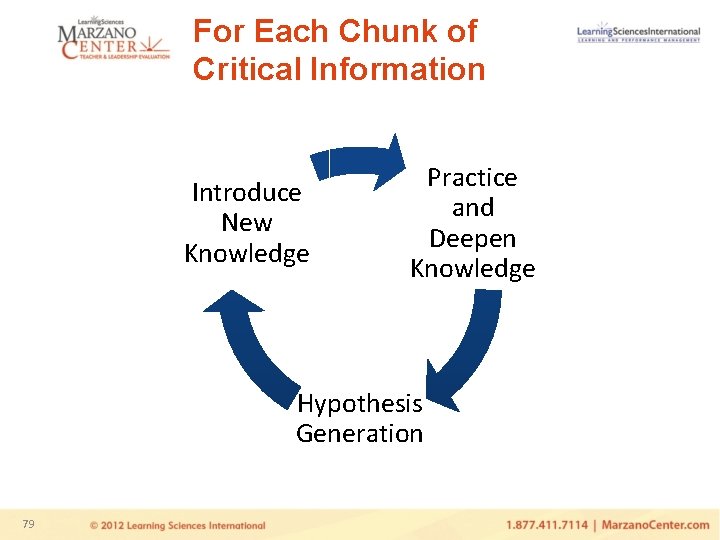
For Each Chunk of Critical Information Introduce New Knowledge Practice and Deepen Knowledge Hypothesis Generation 79
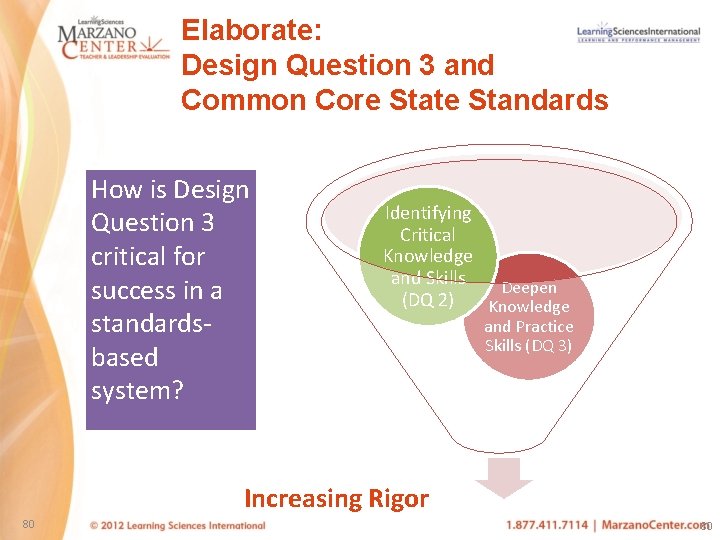
Elaborate: Design Question 3 and Common Core State Standards How is Design Question 3 critical for success in a standardsbased system? Identifying Critical Knowledge and Skills Deepen (DQ 2) Knowledge and Practice Skills (DQ 3) Increasing Rigor 80 80
PLC Questions 4 and 5: What will we do if/when some students do not learn? What will we do if/when some students have already learned? 81
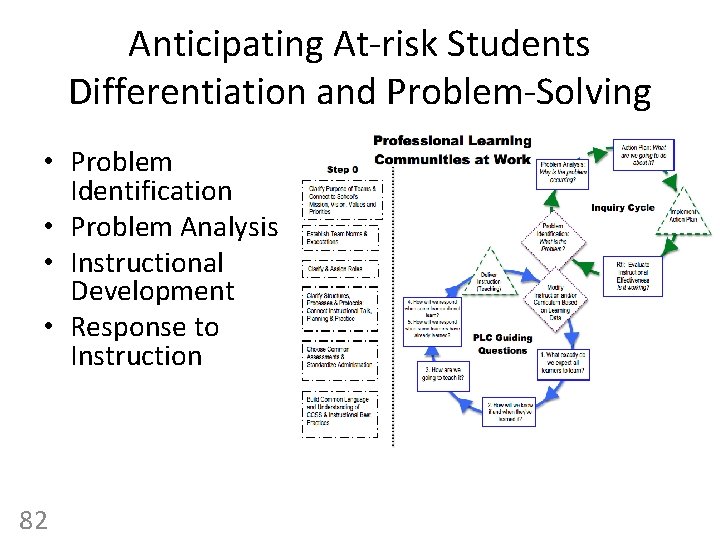
Anticipating At-risk Students Differentiation and Problem-Solving • Problem Identification • Problem Analysis • Instructional Development • Response to Instruction 82
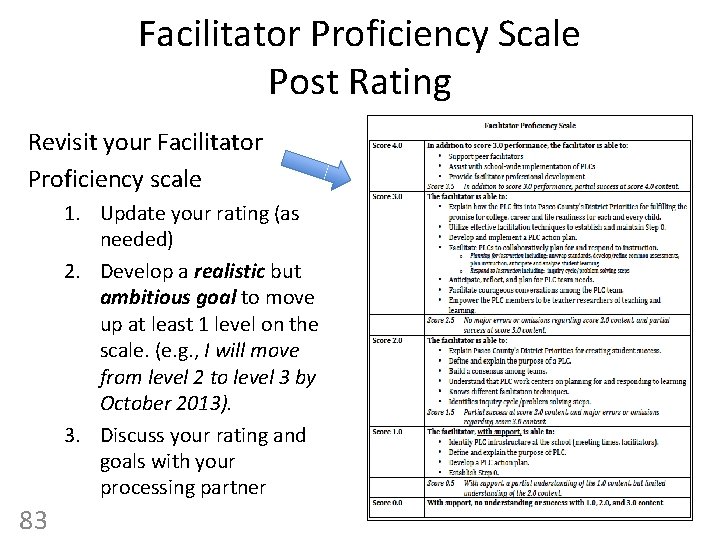
Facilitator Proficiency Scale Post Rating Revisit your Facilitator Proficiency scale 1. Update your rating (as needed) 2. Develop a realistic but ambitious goal to move up at least 1 level on the scale. (e. g. , I will move from level 2 to level 3 by October 2013). 3. Discuss your rating and goals with your processing partner 83
Professional Learning Communities Prioritizing Work 84
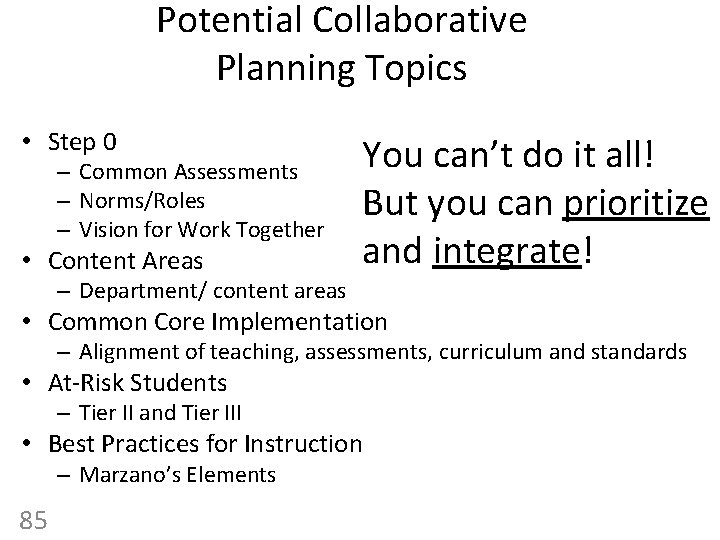
Potential Collaborative Planning Topics • Step 0 – Common Assessments – Norms/Roles – Vision for Work Together • Content Areas You can’t do it all! But you can prioritize and integrate! – Department/ content areas • Common Core Implementation – Alignment of teaching, assessments, curriculum and standards • At-Risk Students – Tier II and Tier III • Best Practices for Instruction – Marzano’s Elements 85
Guiding Questions for Prioritizing PLC Work Are we going to spend the bulk of our time backwards planning for learning? Are we going to spend the bulk of our time discussing how to respond when students do or do not learn? Or a Combination of Both? 86
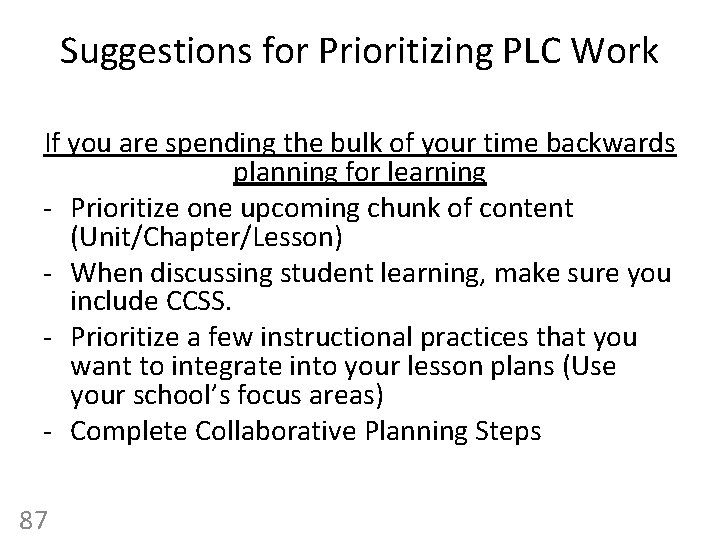
Suggestions for Prioritizing PLC Work If you are spending the bulk of your time backwards planning for learning - Prioritize one upcoming chunk of content (Unit/Chapter/Lesson) - When discussing student learning, make sure you include CCSS. - Prioritize a few instructional practices that you want to integrate into your lesson plans (Use your school’s focus areas) - Complete Collaborative Planning Steps 87
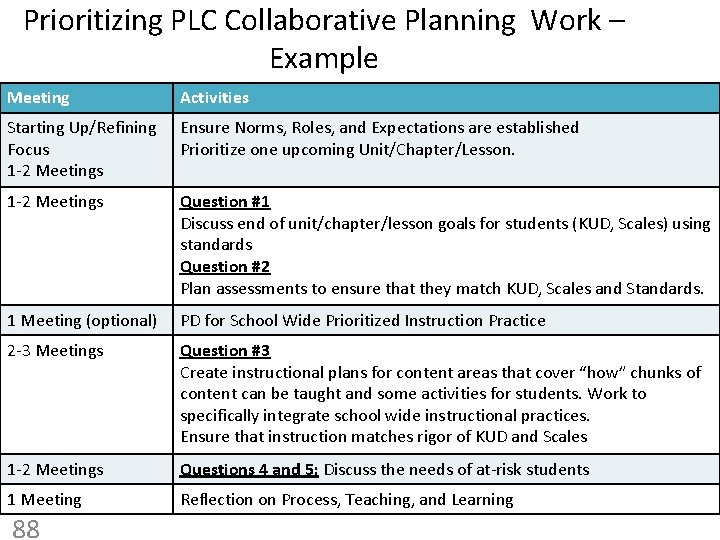
Prioritizing PLC Collaborative Planning Work – Example Meeting Activities Starting Up/Refining Focus 1 -2 Meetings Ensure Norms, Roles, and Expectations are established Prioritize one upcoming Unit/Chapter/Lesson. 1 -2 Meetings Question #1 Discuss end of unit/chapter/lesson goals for students (KUD, Scales) using standards Question #2 Plan assessments to ensure that they match KUD, Scales and Standards. 1 Meeting (optional) PD for School Wide Prioritized Instruction Practice 2 -3 Meetings Question #3 Create instructional plans for content areas that cover “how” chunks of content can be taught and some activities for students. Work to specifically integrate school wide instructional practices. Ensure that instruction matches rigor of KUD and Scales 1 -2 Meetings Questions 4 and 5: Discuss the needs of at-risk students 1 Meeting Reflection on Process, Teaching, and Learning 88
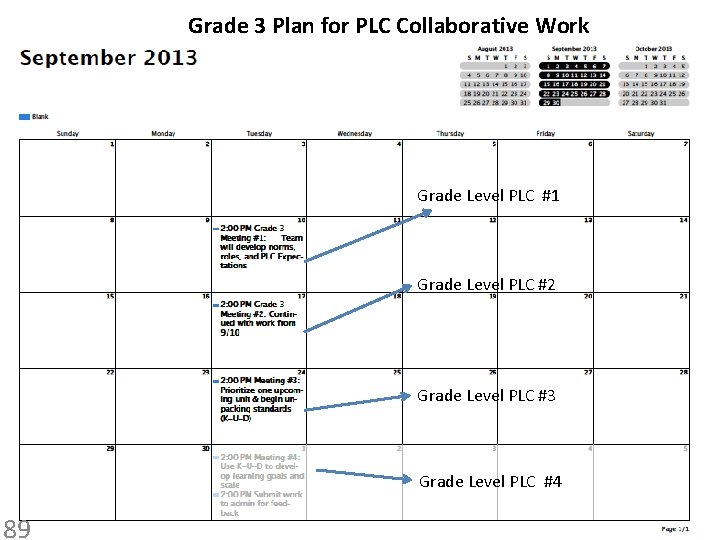
Grade 3 Plan for PLC Collaborative Work Grade Level PLC #1 Grade Level PLC #2 Grade Level PLC #3 Grade Level PLC #4 89
PLC Action Planning 90
End of Day Activity 1. Identify your next four PLC meetings 2. With your processing partner, discuss what the topics for these meetings might cover 3. Write out what topics you are going to cover 4. Write out your next meeting’s agenda (including how you’ll cover the content) 5. Use your peers for feedback 6. Email your work (PDF and/or Doc) to dsanchez@pasco. k 12. fl. us with the subject heading “PLC Action Plan” 91
- Slides: 91