
Welcome Partnerships Addressing Disadvantage July 2018 Andrew Witchard
- Slides: 22
Welcome Partnerships Addressing Disadvantage July 2018 Andrew Witchard A/Deputy Secretary, Economic Department of Treasury and Finance Corri Mc. Kenzie A/Deputy Secretary, Strategy and Planning Department of Health and Human Services
Partnerships Addressing Disadvantage Information Session July 2018 Teresa Fels Executive Director, Social Policy Department of Treasury and Finance Michael Coppola Assistant Director, System Intelligence and Analytics Department of Health and Human Services Gayle King Director, Policy Reform Department of Education and Training
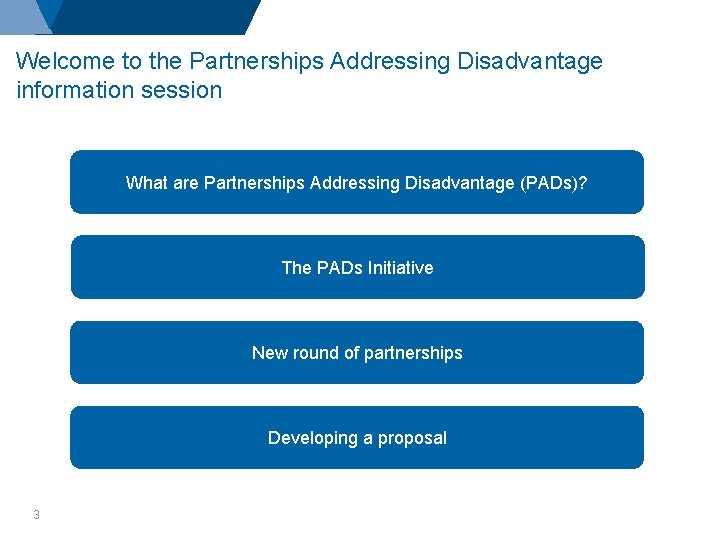
Welcome to the Partnerships Addressing Disadvantage information session What are Partnerships Addressing Disadvantage (PADs)? The PADs Initiative New round of partnerships Developing a proposal 3
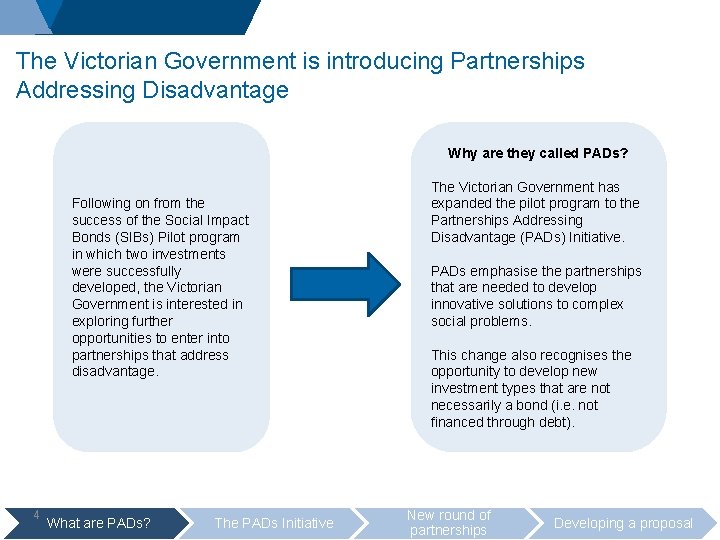
The Victorian Government is introducing Partnerships Addressing Disadvantage Why are they called PADs? Following on from the success of the Social Impact Bonds (SIBs) Pilot program in which two investments were successfully developed, the Victorian Government is interested in exploring further opportunities to enter into partnerships that address disadvantage. 4 What are PADs? The PADs Initiative The Victorian Government has expanded the pilot program to the Partnerships Addressing Disadvantage (PADs) Initiative. PADs emphasise the partnerships that are needed to develop innovative solutions to complex social problems. This change also recognises the opportunity to develop new investment types that are not necessarily a bond (i. e. not financed through debt). New round of partnerships Developing a proposal
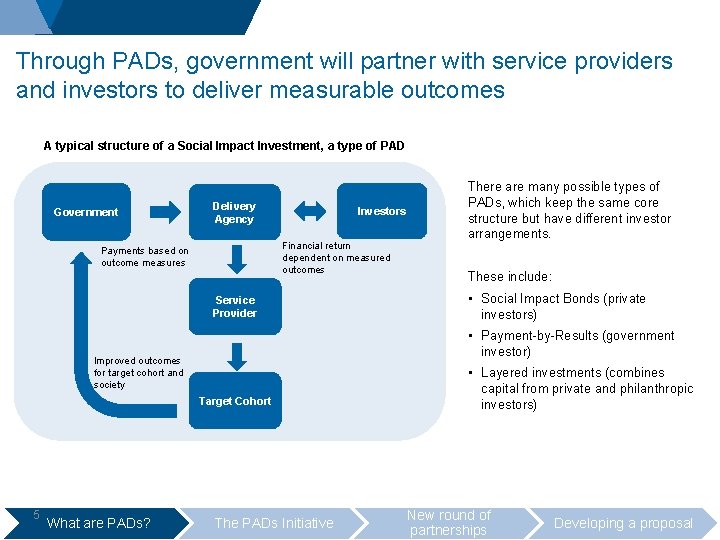
Through PADs, government will partner with service providers and investors to deliver measurable outcomes A typical structure of a Social Impact Investment, a type of PAD Government Delivery Agency Investors Financial return dependent on measured outcomes Payments based on outcome measures Service Provider Target Cohort What are PADs? These include: • Social Impact Bonds (private investors) • Payment-by-Results (government investor) Improved outcomes for target cohort and society 5 There are many possible types of PADs, which keep the same core structure but have different investor arrangements. The PADs Initiative • Layered investments (combines capital from private and philanthropic investors) New round of partnerships Developing a proposal
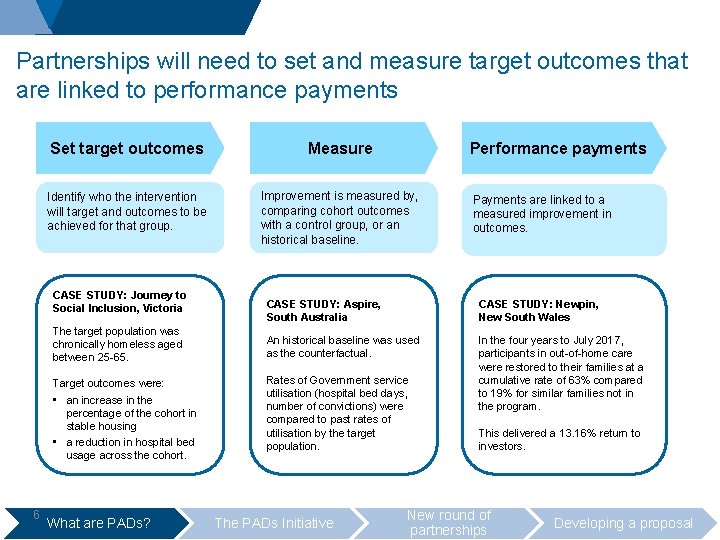
Partnerships will need to set and measure target outcomes that are linked to performance payments Measure Identify who the intervention will target and outcomes to be achieved for that group. Improvement is measured by, comparing cohort outcomes with a control group, or an historical baseline. CASE STUDY: Journey to Social Inclusion, Victoria The target population was chronically homeless aged between 25 -65. Target outcomes were: • an increase in the percentage of the cohort in stable housing • a reduction in hospital bed usage across the cohort. 6 Performance payments Set target outcomes What are PADs? Payments are linked to a measured improvement in outcomes. CASE STUDY: Aspire, South Australia CASE STUDY: Newpin, New South Wales An historical baseline was used as the counterfactual. In the four years to July 2017, participants in out-of-home care were restored to their families at a cumulative rate of 63% compared to 19% for similar families not in the program. Rates of Government service utilisation (hospital bed days, number of convictions) were compared to past rates of utilisation by the target population. The PADs Initiative This delivered a 13. 16% return to investors. New round of partnerships Developing a proposal
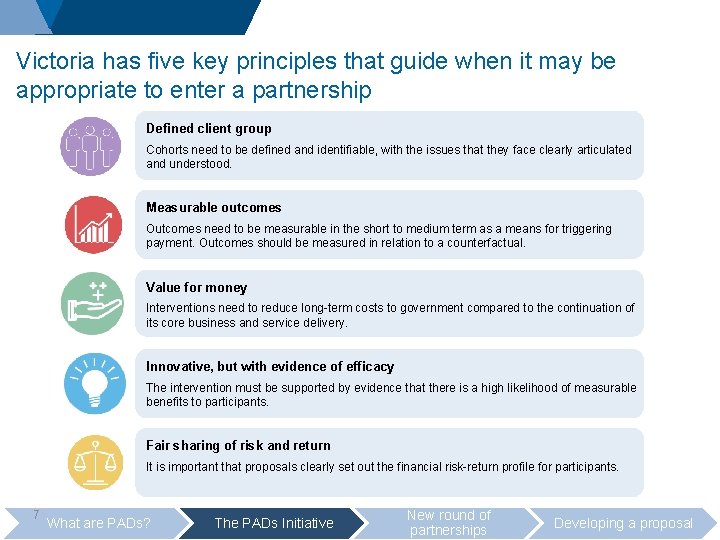
Victoria has five key principles that guide when it may be appropriate to enter a partnership Defined client group Cohorts need to be defined and identifiable, with the issues that they face clearly articulated and understood. Measurable outcomes Outcomes need to be measurable in the short to medium term as a means for triggering payment. Outcomes should be measured in relation to a counterfactual. Value for money Interventions need to reduce long-term costs to government compared to the continuation of its core business and service delivery. Innovative, but with evidence of efficacy The intervention must be supported by evidence that there is a high likelihood of measurable benefits to participants. Fair sharing of risk and return It is important that proposals clearly set out the financial risk-return profile for participants. 7 What are PADs? The PADs Initiative New round of partnerships Developing a proposal
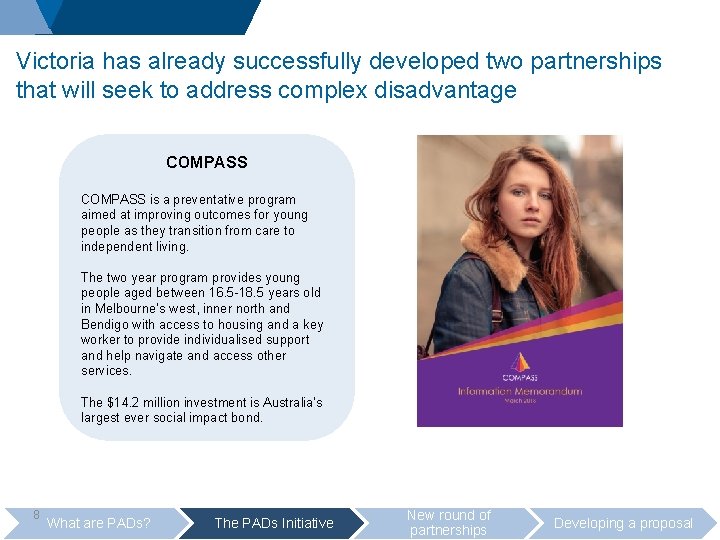
Victoria has already successfully developed two partnerships that will seek to address complex disadvantage COMPASS is a preventative program aimed at improving outcomes for young people as they transition from care to independent living. The two year program provides young people aged between 16. 5 -18. 5 years old in Melbourne’s west, inner north and Bendigo with access to housing and a key worker to provide individualised support and help navigate and access other services. The $14. 2 million investment is Australia’s largest ever social impact bond. 8 What are PADs? The PADs Initiative New round of partnerships Developing a proposal
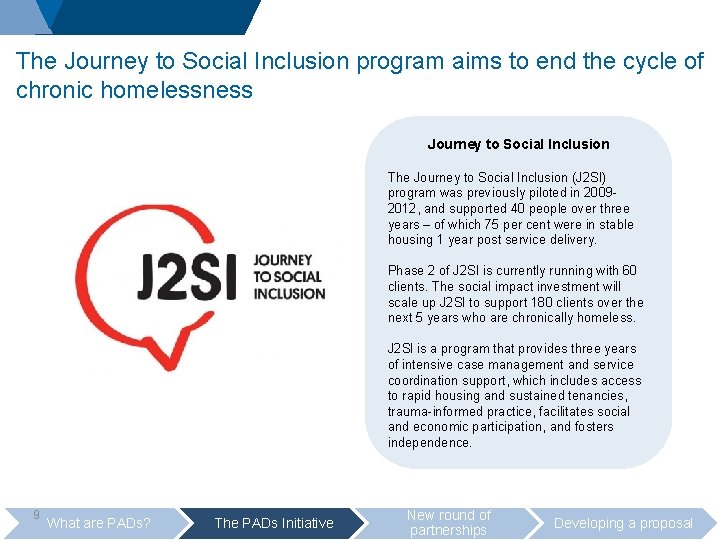
The Journey to Social Inclusion program aims to end the cycle of chronic homelessness Journey to Social Inclusion The Journey to Social Inclusion (J 2 SI) program was previously piloted in 20092012, and supported 40 people over three years – of which 75 per cent were in stable housing 1 year post service delivery. Phase 2 of J 2 SI is currently running with 60 clients. The social impact investment will scale up J 2 SI to support 180 clients over the next 5 years who are chronically homeless. J 2 SI is a program that provides three years of intensive case management and service coordination support, which includes access to rapid housing and sustained tenancies, trauma-informed practice, facilitates social and economic participation, and fosters independence. 9 What are PADs? The PADs Initiative New round of partnerships Developing a proposal
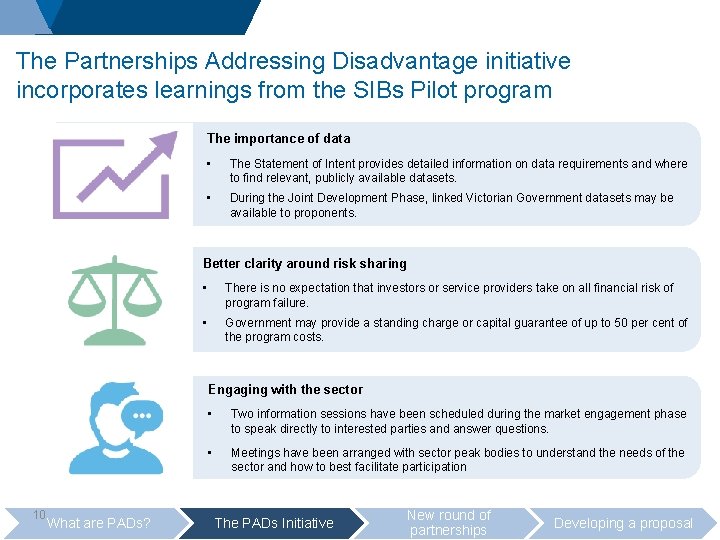
The Partnerships Addressing Disadvantage initiative incorporates learnings from the SIBs Pilot program The importance of data • The Statement of Intent provides detailed information on data requirements and where to find relevant, publicly available datasets. • During the Joint Development Phase, linked Victorian Government datasets may be available to proponents. Better clarity around risk sharing • There is no expectation that investors or service providers take on all financial risk of program failure. • Government may provide a standing charge or capital guarantee of up to 50 per cent of the program costs. Engaging with the sector 10 What are PADs? • Two information sessions have been scheduled during the market engagement phase to speak directly to interested parties and answer questions. • Meetings have been arranged with sector peak bodies to understand the needs of the sector and how to best facilitate participation The PADs Initiative New round of partnerships Developing a proposal
A Statement of Intent was published on 29 June 2018 to formally launch Partnerships Addressing Disadvantage 11 What are PADs? • The Statement of Intent (SOI) is available online at the Department of Treasury and Finance website. • The SOI outlines the Victorian Government’s intentions for PADs, including preferred policy areas and data considerations. • A formal Request for Proposals (RFP) will be released on the Tenders Vic website on 16 July 2018. • The key difference between the SOI and RFP is that the SOI does not include information about how proposals will be evaluated. • Proposals will be accepted up until 5 pm 9 September 2018. The PADs Initiative New round of partnerships Developing a proposal
The preferred policy areas for the two new partnerships seek to improve outcomes for. . . 1. Vulnerable children Children aged 5– 14 (or school years 1– 10) that face challenges and adversities that impact their learning and have failed or are likely to fail successive educational milestones. 2. Disengaged youth Youth aged 15– 24 who have left school early and are not engaged in training or the labour force, and are located in a geographic area associated with socioeconomic disadvantage. 12 What are PADs? The PADs Initiative New round of partnerships Developing a proposal
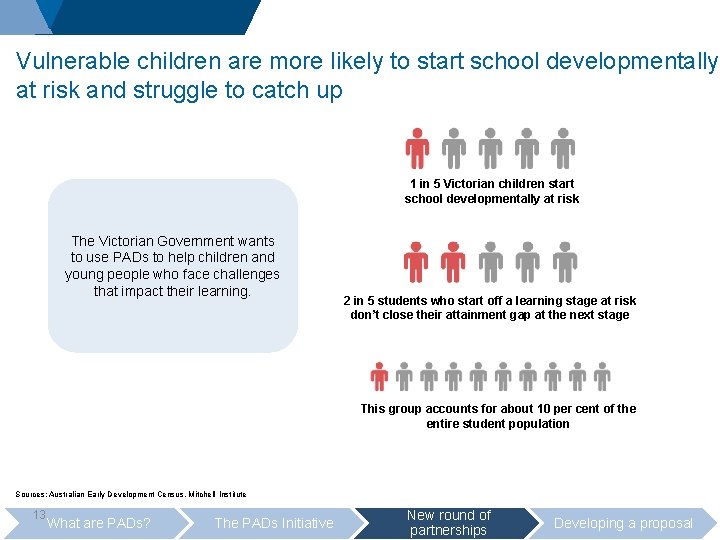
Vulnerable children are more likely to start school developmentally at risk and struggle to catch up 1 in 5 Victorian children start school developmentally at risk The Victorian Government wants to use PADs to help children and young people who face challenges that impact their learning. 2 in 5 students who start off a learning stage at risk don’t close their attainment gap at the next stage This group accounts for about 10 per cent of the entire student population Sources: Australian Early Development Census, Mitchell Institute 13 What are PADs? The PADs Initiative New round of partnerships Developing a proposal
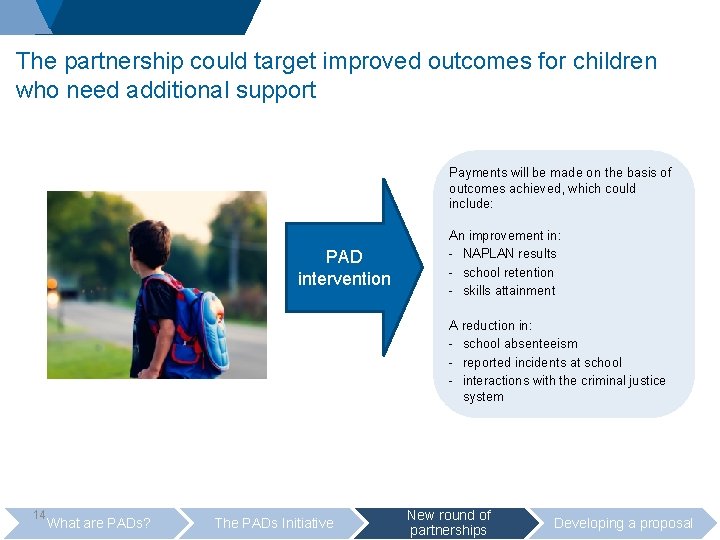
The partnership could target improved outcomes for children who need additional support Payments will be made on the basis of outcomes achieved, which could include: PAD intervention An improvement in: - NAPLAN results - school retention - skills attainment A reduction in: - school absenteeism - reported incidents at school - interactions with the criminal justice system 14 What are PADs? The PADs Initiative New round of partnerships Developing a proposal
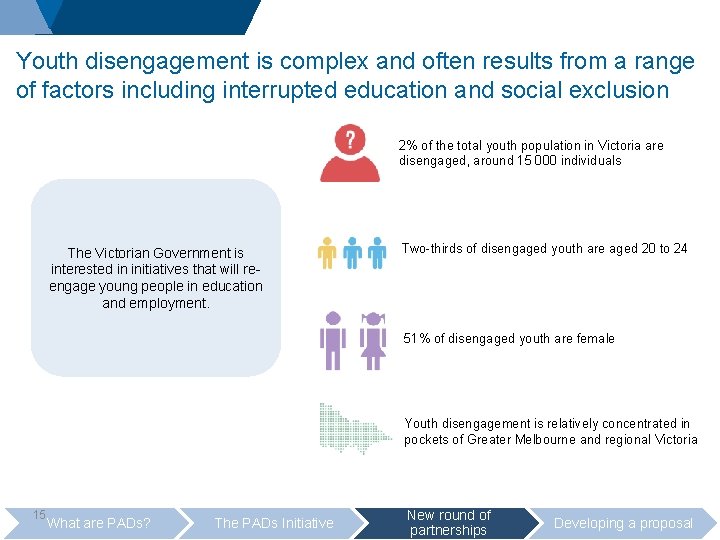
Youth disengagement is complex and often results from a range of factors including interrupted education and social exclusion 2% of the total youth population in Victoria are disengaged, around 15 000 individuals The Victorian Government is interested in initiatives that will reengage young people in education and employment. Two-thirds of disengaged youth are aged 20 to 24 51% of disengaged youth are female Youth disengagement is relatively concentrated in pockets of Greater Melbourne and regional Victoria 15 What are PADs? The PADs Initiative New round of partnerships Developing a proposal
The partnership will target early school leavers aged 15 -24 who are not in education, training or the labour force Payable outcomes for this partnership could include: An improvement in: • engagement in school PAD intervention • Year 12 completion rates • employment rates A reduction in: • interactions with the criminal justice system • homelessness • acute health service usage 16 What are PADs? The PADs Initiative New round of partnerships Developing a proposal
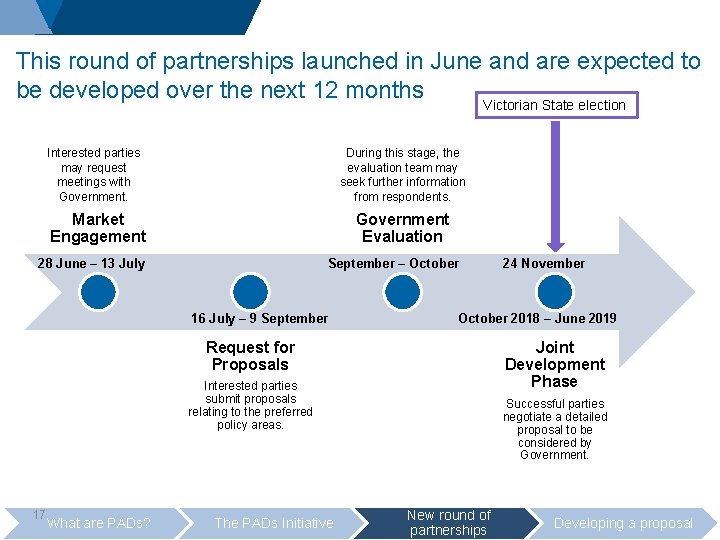
This round of partnerships launched in June and are expected to be developed over the next 12 months Victorian State election Interested parties may request meetings with Government. During this stage, the evaluation team may seek further information from respondents. Market Engagement Government Evaluation 28 June – 13 July September – October 16 July – 9 September October 2018 – June 2019 Request for Proposals Joint Development Phase Interested parties submit proposals relating to the preferred policy areas. 17 What are PADs? The PADs Initiative 24 November Successful parties negotiate a detailed proposal to be considered by Government. New round of partnerships Developing a proposal
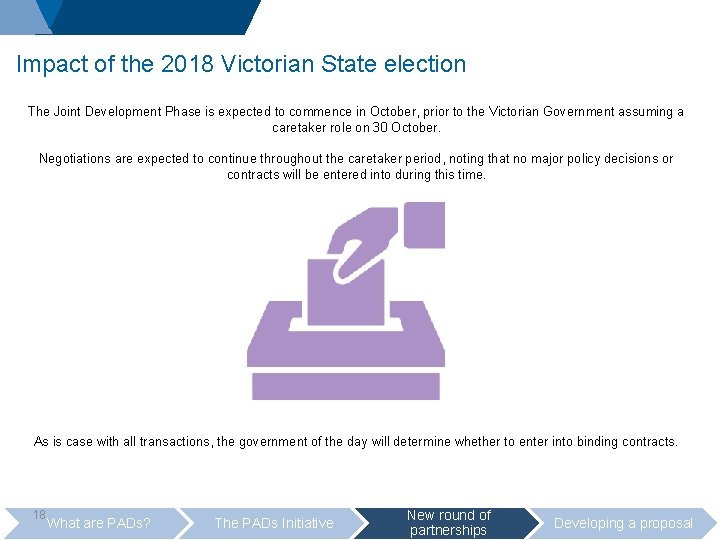
Impact of the 2018 Victorian State election The Joint Development Phase is expected to commence in October, prior to the Victorian Government assuming a caretaker role on 30 October. Negotiations are expected to continue throughout the caretaker period, noting that no major policy decisions or contracts will be entered into during this time. As is case with all transactions, the government of the day will determine whether to enter into binding contracts. 18 What are PADs? The PADs Initiative New round of partnerships Developing a proposal
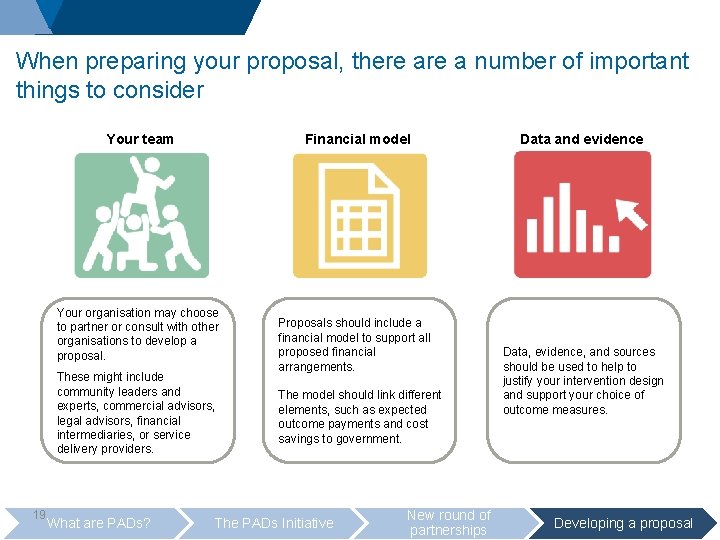
When preparing your proposal, there a number of important things to consider Your team Financial model Your organisation may choose to partner or consult with other organisations to develop a proposal. These might include community leaders and experts, commercial advisors, legal advisors, financial intermediaries, or service delivery providers. 19 What are PADs? Proposals should include a financial model to support all proposed financial arrangements. The model should link different elements, such as expected outcome payments and cost savings to government. The PADs Initiative New round of partnerships Data and evidence Data, evidence, and sources should be used to help to justify your intervention design and support your choice of outcome measures. Developing a proposal
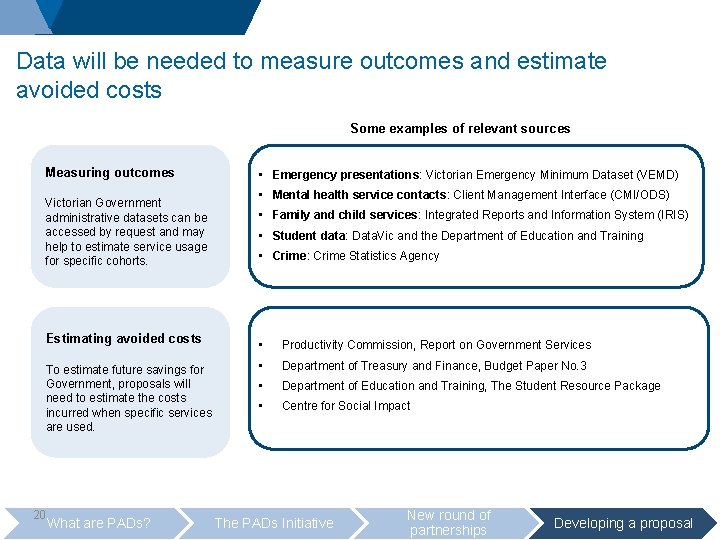
Data will be needed to measure outcomes and estimate avoided costs Some examples of relevant sources Measuring outcomes Victorian Government administrative datasets can be accessed by request and may help to estimate service usage for specific cohorts. Estimating avoided costs To estimate future savings for Government, proposals will need to estimate the costs incurred when specific services are used. 20 What are PADs? • Emergency presentations: Victorian Emergency Minimum Dataset (VEMD) • Mental health service contacts: Client Management Interface (CMI/ODS) • Family and child services: Integrated Reports and Information System (IRIS) • Student data: Data. Vic and the Department of Education and Training • Crime: Crime Statistics Agency • Productivity Commission, Report on Government Services • Department of Treasury and Finance, Budget Paper No. 3 • Department of Education and Training, The Student Resource Package • Centre for Social Impact The PADs Initiative New round of partnerships Developing a proposal
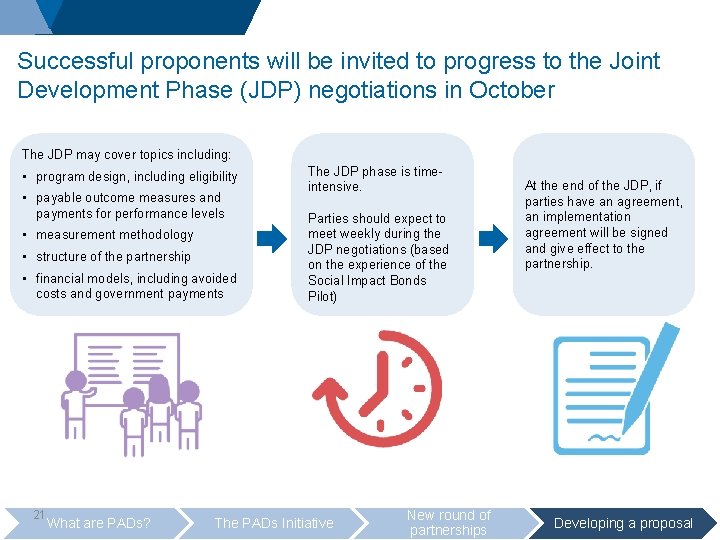
Successful proponents will be invited to progress to the Joint Development Phase (JDP) negotiations in October The JDP may cover topics including: • program design, including eligibility • payable outcome measures and payments for performance levels • measurement methodology • structure of the partnership • financial models, including avoided costs and government payments 21 What are PADs? The JDP phase is timeintensive. Parties should expect to meet weekly during the JDP negotiations (based on the experience of the Social Impact Bonds Pilot) The PADs Initiative New round of partnerships At the end of the JDP, if parties have an agreement, an implementation agreement will be signed and give effect to the partnership. Developing a proposal
To ask a follow up question or arrange a meeting with government, contact the PAD email address Requesting a meeting Email enquiries For any questions related to PADs more generally, contact pads@dtf. vic. gov. au. Before the Request for Proposal is released, questions related to schools involvement may be directed to Kim Ryan, ryan. kim. k@edumail. vic. gov. au. 22 Between 29 June and 13 July, government will be available for meetings with interested parties. To request a meeting with government, please contact pads@dtf. vic. gov. au. It may not be possible to accommodate all requests to meet. Meetings may be attended by a probity advisor to ensure no unfair advantage and ensure information provided is consistent with other publicly available information.