
WELCOME PARTICIPANTS DESIGN TYPES OF RESEARCH IN SOCIAL
![Researchable Areas in [Current Interest] Social Sciences l l l l Rural Health and](https://slidetodoc.com/presentation_image_h2/cbc6c8d1f17e5a6f2c5929a2cc05c2c4/image-27.jpg "Researchable Areas in [Current Interest] Social Sciences l l l l Rural Health and")

- Slides: 32
WELCOME PARTICIPANTS “DESIGN & TYPES OF RESEARCH IN SOCIAL SCIENCES”
DESIGN & TYPES OF RESEARCH IN SOCIAL SCIENCES Dr. D. Ilangovan, M. Com. , Ph. D. Professor, Dept. of Commerce Annamalai University, Annamalainagar- 608 002 E-mail : dil 2691@yahoo. co. in Mob: 09443738926
What is Research ? l l l A. B. C. D. E. F. Research is the systematic process of collecting and analysing information (data) in order to increase our understanding of the phenomenon with which we are concerned or interested. Research involves three main stage 1. planning 2. data collection 3. analysis The Research Process obviously involves the Following: Originates with a question or problem. Requires a clear articulation of a goal. Follows a specific plan of procedure. Usually divides the principal problems into more manageable sub-problems (hypotheses), which guide the research. Accepts certain critical assumptions. Requires collection and interpretation of data to answer original research question 06 -04 -2020 Prof D. Ilangovan HD Commerce Annamalai University 3
Meaning of Research l Research refers to “search for knowledge” l “A careful investigation or enquiry specially through search for new facts in any branch of knowledge” is the dictionary meaning of Research. l “A systematized effort to gain new knowledge” – according to Redman and Mory 06 -04 -2020 Prof D. Ilangovan HD Commerce Annamalai University 4
Meaning of Research. . Cont. . d l l l In the words of Clifford Woody, ‘research comprises of Defining and redefining problems, Formulating hypothesis or suggested solutions, Collecting, organizing and evaluating data, making deductions and reaching conclusions; and at last Carefully testing the conclusions whether they fit the formulated hypotheses’. It is totally a process of thinking about the ‘subject’ 06 -04 -2020 Prof D. Ilangovan HD Commerce Annamalai University 5
Purposes of Research in Social Sciences l l l l To study the current and burning issues To highlight the problems in depth To focus on the contributing factors to the crisis To analyze the environment for remedies if any To identify practicable, result oriented solutions To testify a few of them for generalization To recommend for proper implementation To evaluate and assess the desired results l To globalize the findings for universal application 06 -04 -2020 Prof D. Ilangovan HD Commerce Annamalai University 6
Need for Research l l l l Desire to get a research degree along with its consequential benefits, Desire to face the challenge in solving the unsolved problems Displaying our ability to ‘critical thinking / analysis’ of socio-economic / cross-cultural problems Desire to get intellectual joy of doing some creative work, Desire to be of service to society and Desire to get respectability among scholars Many more factors are behind any useful research activities – ‘benefit of mankind’ 06 -04 -2020 Prof D. Ilangovan HD Commerce Annamalai University 7
Objectives of Research l To gain familiarity with a phenomenon or to achieve new insights into it, l To portray accurately the characteristics of a particular individual, situation or group, l To determine the frequency with which something occurs or it is associated with something else and l To test a hypothesis of a casual relationship between variables. 06 -04 -2020 Prof D. Ilangovan HD Commerce Annamalai University 8
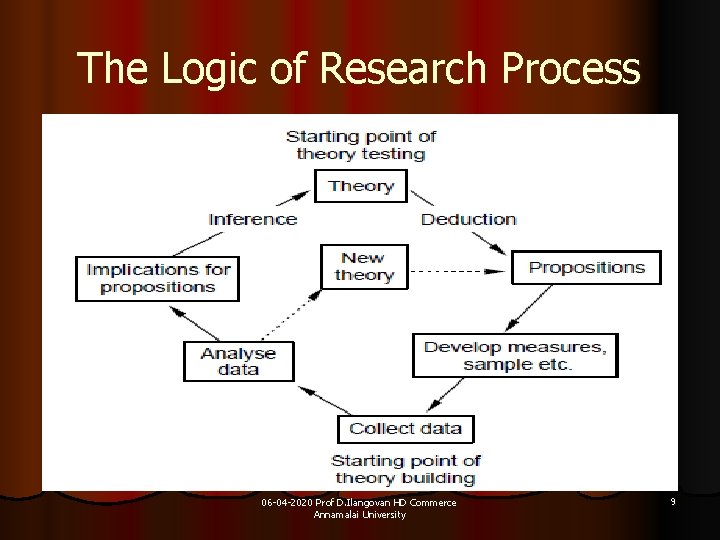
The Logic of Research Process 06 -04 -2020 Prof D. Ilangovan HD Commerce Annamalai University 9
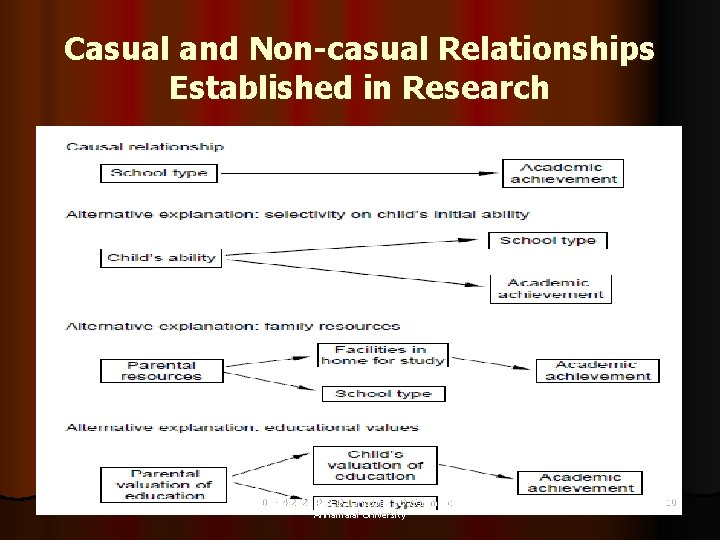
Casual and Non-casual Relationships Established in Research 06 -04 -2020 Prof D. Ilangovan HD Commerce Annamalai University 10
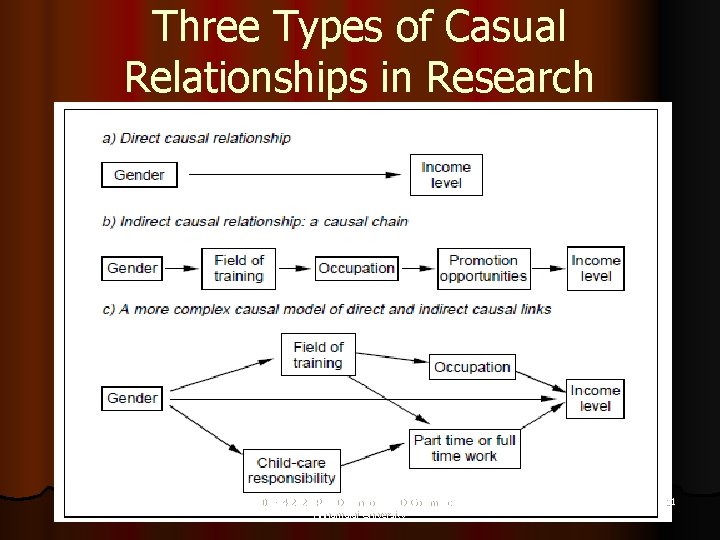
Three Types of Casual Relationships in Research 06 -04 -2020 Prof D. Ilangovan HD Commerce Annamalai University 11
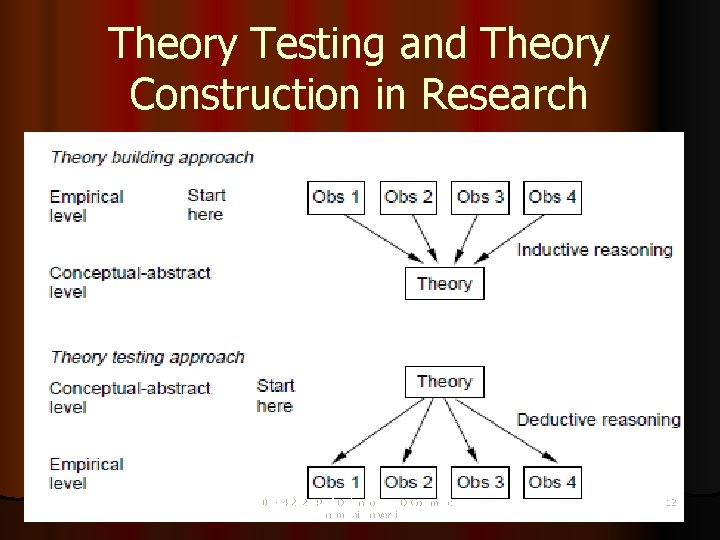
Theory Testing and Theory Construction in Research 06 -04 -2020 Prof D. Ilangovan HD Commerce Annamalai University 12
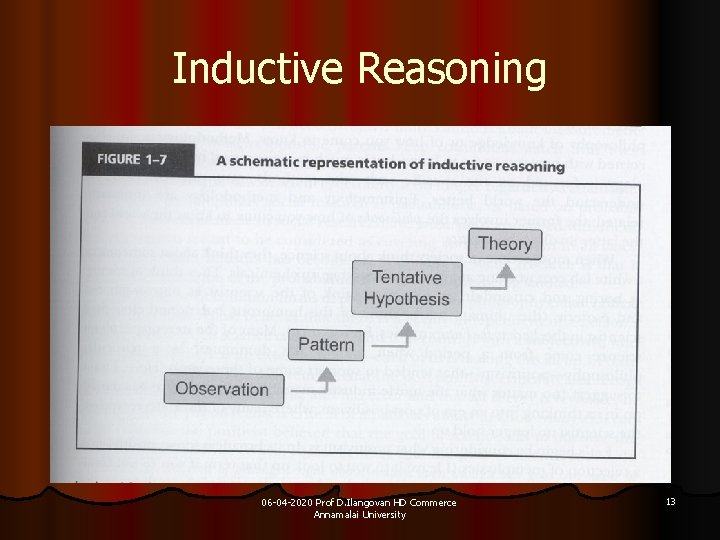
Inductive Reasoning 06 -04 -2020 Prof D. Ilangovan HD Commerce Annamalai University 13
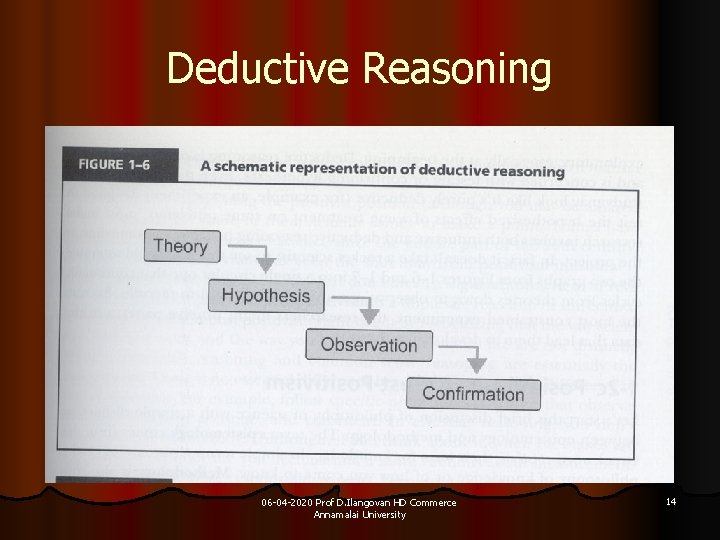
Deductive Reasoning 06 -04 -2020 Prof D. Ilangovan HD Commerce Annamalai University 14
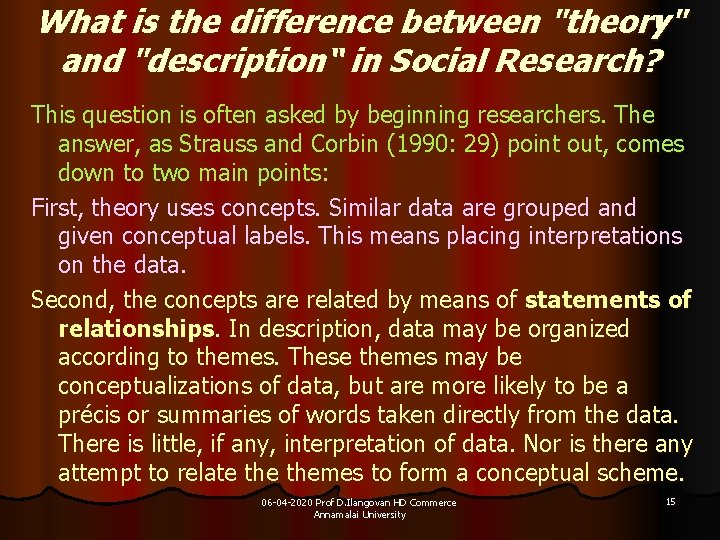
What is the difference between "theory" and "description“ in Social Research? This question is often asked by beginning researchers. The answer, as Strauss and Corbin (1990: 29) point out, comes down to two main points: First, theory uses concepts. Similar data are grouped and given conceptual labels. This means placing interpretations on the data. Second, the concepts are related by means of statements of relationships. In description, data may be organized according to themes. These themes may be conceptualizations of data, but are more likely to be a précis or summaries of words taken directly from the data. There is little, if any, interpretation of data. Nor is there any attempt to relate themes to form a conceptual scheme. 06 -04 -2020 Prof D. Ilangovan HD Commerce Annamalai University 15
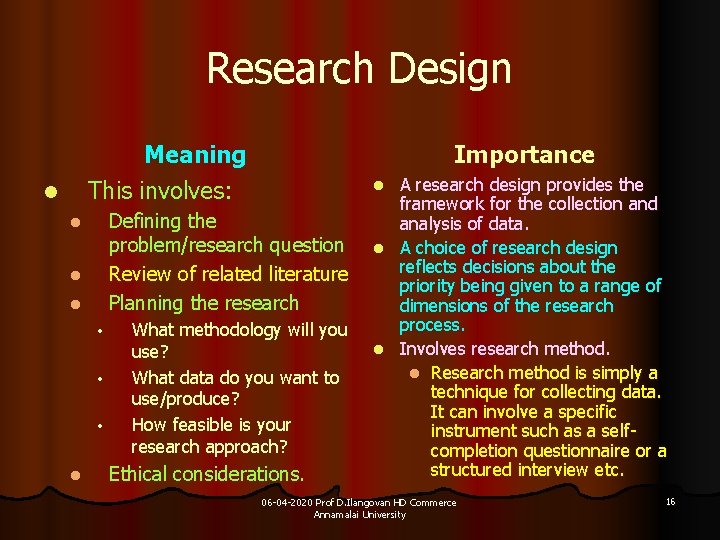
Research Design Meaning This involves: l l l • • • A research design provides the framework for the collection and analysis of data. l A choice of research design reflects decisions about the priority being given to a range of dimensions of the research process. l Involves research method. l Research method is simply a technique for collecting data. It can involve a specific instrument such as a selfcompletion questionnaire or a structured interview etc. l Defining the problem/research question Review of related literature Planning the research l l Importance What methodology will you use? What data do you want to use/produce? How feasible is your research approach? Ethical considerations. 06 -04 -2020 Prof D. Ilangovan HD Commerce Annamalai University 16
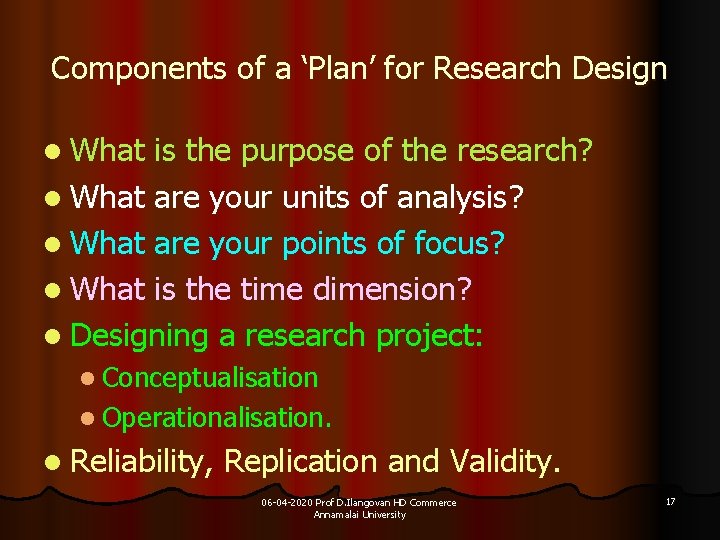
Components of a ‘Plan’ for Research Design l What is the purpose of the research? l What are your units of analysis? l What are your points of focus? l What is the time dimension? l Designing a research project: l Conceptualisation l Operationalisation. l Reliability, Replication and Validity. 06 -04 -2020 Prof D. Ilangovan HD Commerce Annamalai University 17
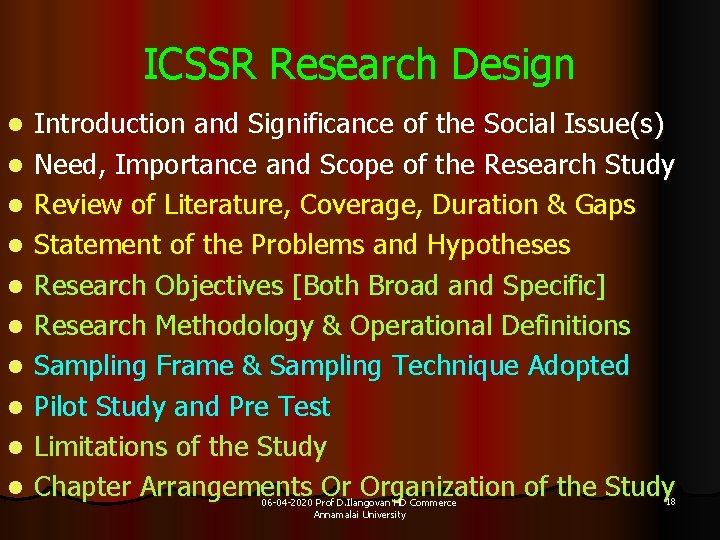
ICSSR Research Design l l l l l Introduction and Significance of the Social Issue(s) Need, Importance and Scope of the Research Study Review of Literature, Coverage, Duration & Gaps Statement of the Problems and Hypotheses Research Objectives [Both Broad and Specific] Research Methodology & Operational Definitions Sampling Frame & Sampling Technique Adopted Pilot Study and Pre Test Limitations of the Study Chapter Arrangements Or Organization of the Study 06 -04 -2020 Prof D. Ilangovan HD Commerce Annamalai University 18
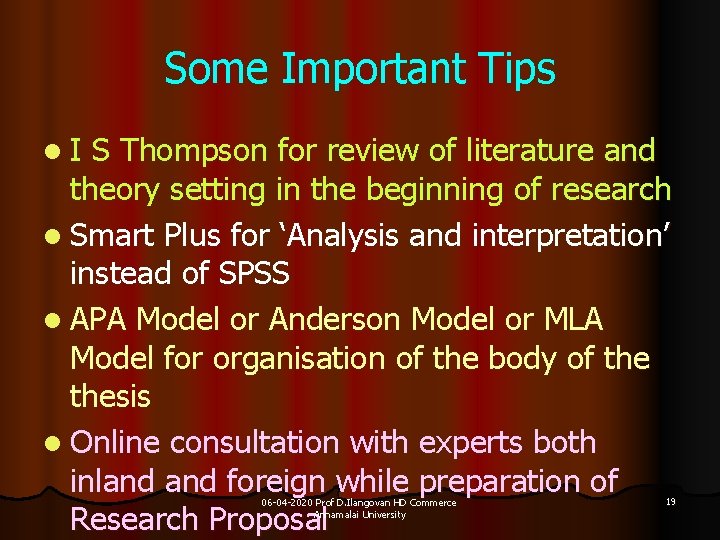
Some Important Tips l. I S Thompson for review of literature and theory setting in the beginning of research l Smart Plus for ‘Analysis and interpretation’ instead of SPSS l APA Model or Anderson Model or MLA Model for organisation of the body of thesis l Online consultation with experts both inland foreign while preparation of Research Proposal 06 -04 -2020 Prof D. Ilangovan HD Commerce Annamalai University 19
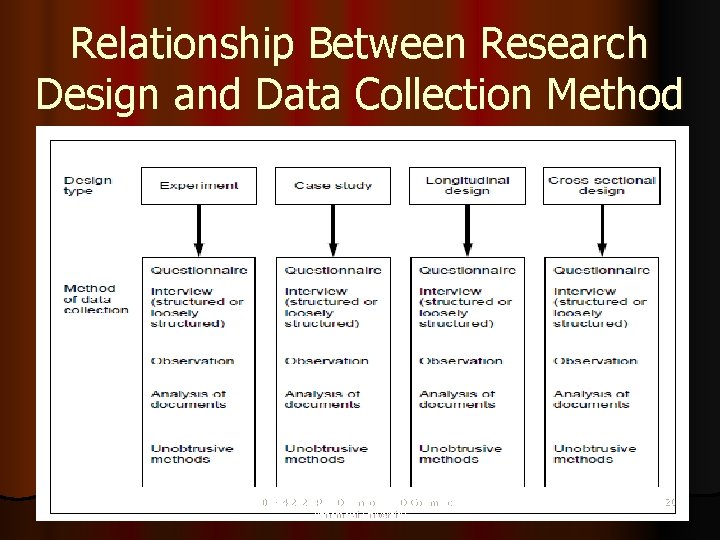
Relationship Between Research Design and Data Collection Method 06 -04 -2020 Prof D. Ilangovan HD Commerce Annamalai University 20
The Research “Problems - Objective – Chapter” Relationship l The Research Problems have Direct Bearing on the Objectives Frames l The Objectives are Analysed in specific Chapters Drafted l The Chapters Clearly indicate the Analytical Outcomes or Solutions to the Problems Identified Earlier l These three aspects have a clear Relationship in Social Science Research 06 -04 -2020 Prof D. Ilangovan HD Commerce Annamalai University 21
Publication - A Part Research Design l l l l Publication in Journals Local News Papers in vernacular Magazines for public use Research News Papers Research Journals Government Publications Seminar / Conference Publications Publication for private circulation Publication in Books /Reports l Books and Reports of International Standards l Books for College Students l Books for government Library l Reports for private organisations l Reports for local bodies l Reports for State / Central govt. l Reports for MNCs l Reports for Special Agencies 06 -04 -2020 Prof D. Ilangovan HD Commerce Annamalai University 22
TYPES OF RESEARCH IN SOCIAL SCIENCES 06 -04 -2020 Prof D. Ilangovan HD Commerce Annamalai University 23
Major Types of Research Design in Social Sciences l Research is scholarly or scientific inquiry. It ties together theory, methods and data in the thorough study of some object. People engage in research for a number of reasons: (1) to explore, (2) to describe, (3) to explain, and (4) to promote change. l 1. Basic Goal of research: To produce new knowledge including discovery of relationships; create capacity to predict, control, manipulate. l 2. Applied (policy-oriented) Goal of the research: Produce the information necessary to help a policy-maker eliminate or alleviate a social problem l 3. Evaluation (assessment-appraisal) Goal of the Research: To provide an accurate account of the impact of a treatment program applied to a social problem. l 4. Action oriented (critical) Goal of the Research: To dig beneath the surface of historically specific social structures that reproduce oppression and other problems in society. And to link knowledge and action in social transformation. 06 -04 -2020 Prof D. Ilangovan HD Commerce Annamalai University 24
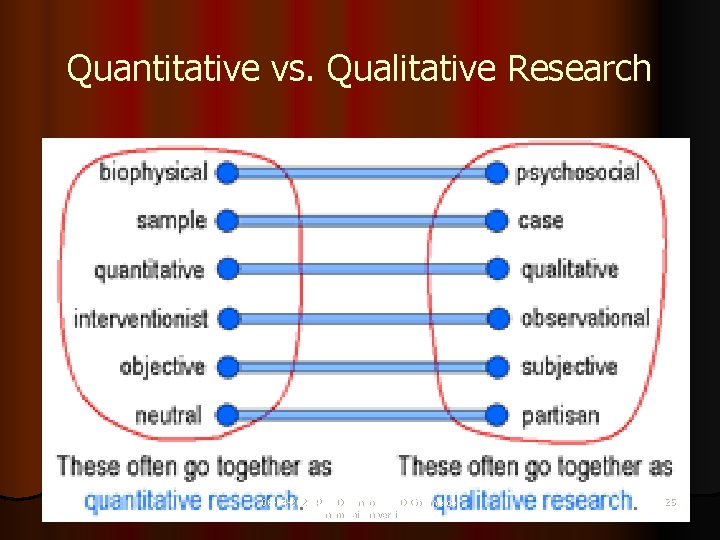
Quantitative vs. Qualitative Research 06 -04 -2020 Prof D. Ilangovan HD Commerce Annamalai University 25
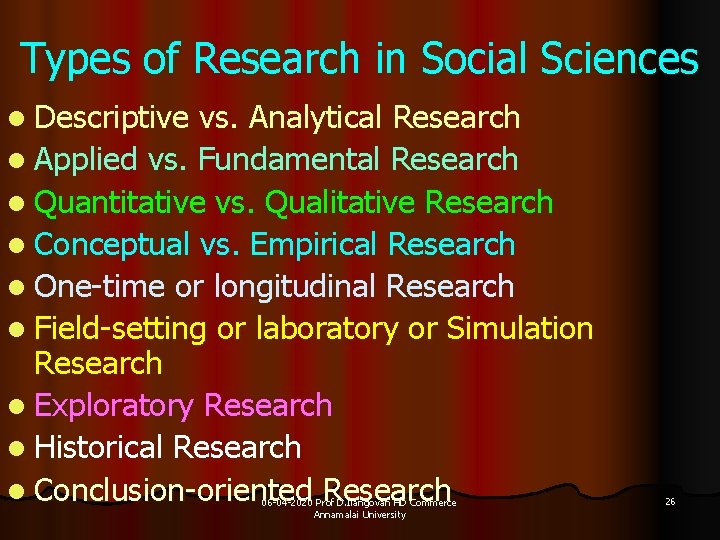
Types of Research in Social Sciences l Descriptive vs. Analytical Research l Applied vs. Fundamental Research l Quantitative vs. Qualitative Research l Conceptual vs. Empirical Research l One-time or longitudinal Research l Field-setting or laboratory or Simulation Research l Exploratory Research l Historical Research l Conclusion-oriented Research 06 -04 -2020 Prof D. Ilangovan HD Commerce Annamalai University 26
Researchable Areas in [Current Interest] Social Sciences l l l l Rural Health and Family Welfare -Bharat Nirman Women and Child Development, Governance Rural Development and Social Welfare Care for Youth, Aged and Physically Disabled Preservation of Traditional Art and Culture Programme for Further Employment Generation Calamity Relief and Assessment of Rehabilitation l Mental Health and Evaluation of Social Order l Impact of Development Programmes of Govt. 06 -04 -2020 Prof D. Ilangovan HD Commerce Annamalai University 27
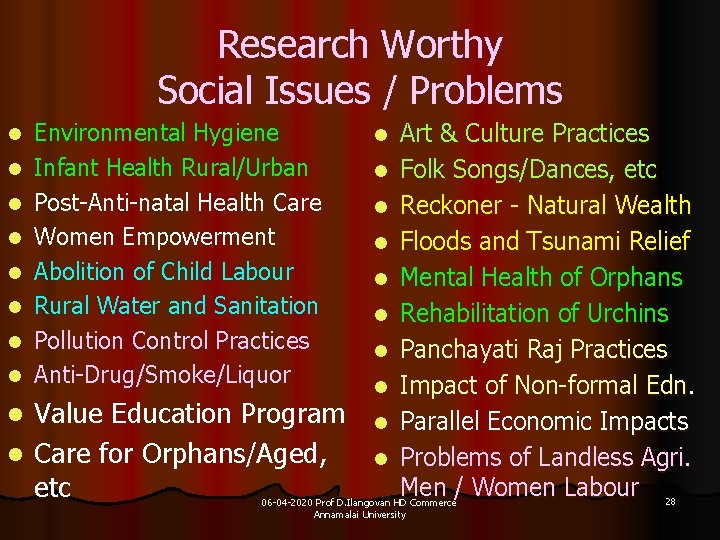
Research Worthy Social Issues / Problems l l l l Environmental Hygiene Infant Health Rural/Urban Post-Anti-natal Health Care Women Empowerment Abolition of Child Labour Rural Water and Sanitation Pollution Control Practices Anti-Drug/Smoke/Liquor Value Education Program l Care for Orphans/Aged, etc l l l Art & Culture Practices Folk Songs/Dances, etc Reckoner - Natural Wealth Floods and Tsunami Relief Mental Health of Orphans Rehabilitation of Urchins Panchayati Raj Practices Impact of Non-formal Edn. Parallel Economic Impacts Problems of Landless Agri. Men / Women Labour 06 -04 -2020 Prof D. Ilangovan HD Commerce Annamalai University 28
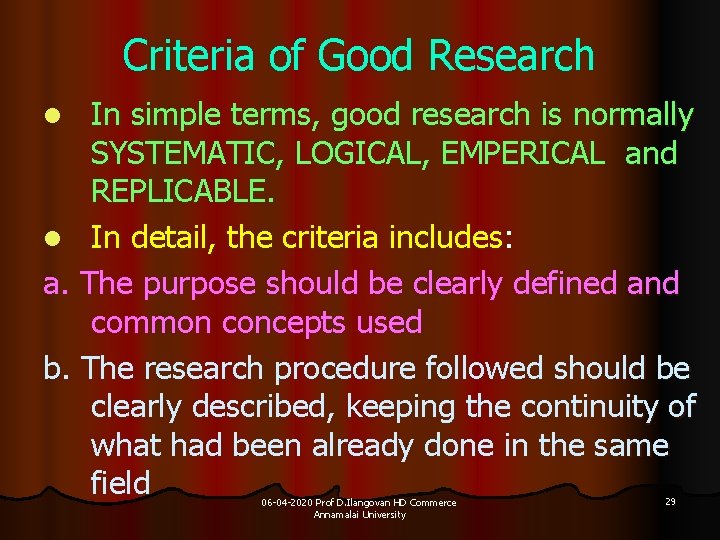
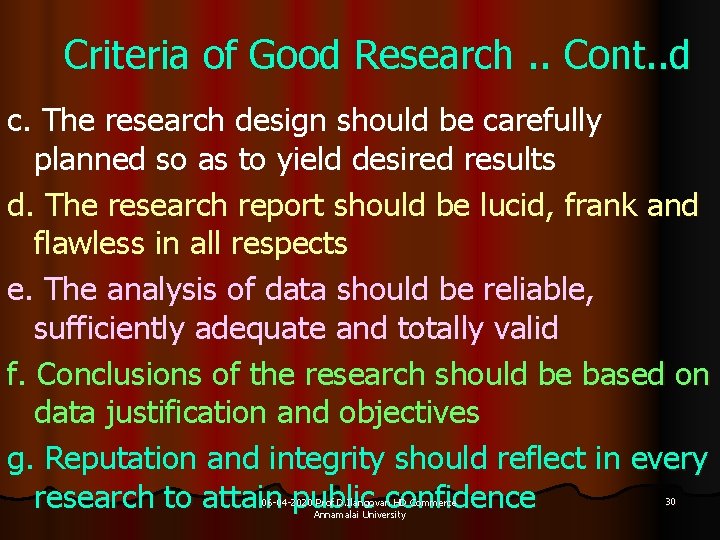
Criteria of Good Research In simple terms, good research is normally SYSTEMATIC, LOGICAL, EMPERICAL and REPLICABLE. l In detail, the criteria includes: a. The purpose should be clearly defined and common concepts used b. The research procedure followed should be clearly described, keeping the continuity of what had been already done in the same field l 06 -04 -2020 Prof D. Ilangovan HD Commerce Annamalai University 29
Criteria of Good Research. . Cont. . d c. The research design should be carefully planned so as to yield desired results d. The research report should be lucid, frank and flawless in all respects e. The analysis of data should be reliable, sufficiently adequate and totally valid f. Conclusions of the research should be based on data justification and objectives g. Reputation and integrity should reflect in every research to attain public confidence 06 -04 -2020 Prof D. Ilangovan HD Commerce Annamalai University 30
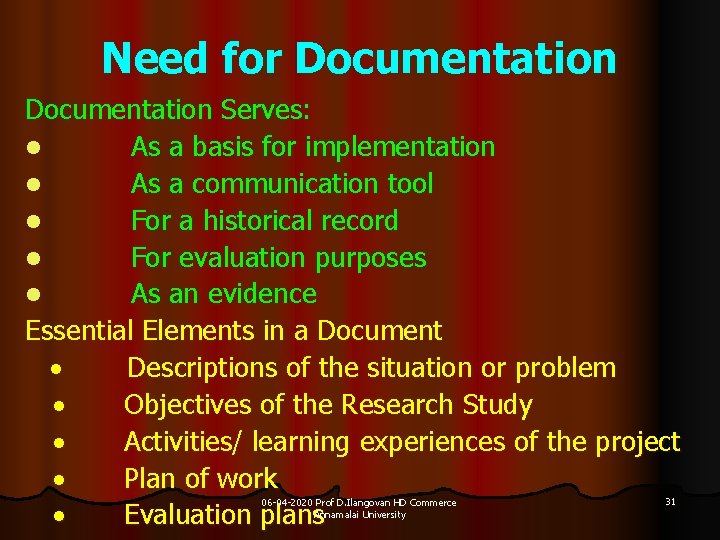
Need for Documentation Serves: l As a basis for implementation l As a communication tool l For a historical record l For evaluation purposes l As an evidence Essential Elements in a Document · Descriptions of the situation or problem · Objectives of the Research Study · Activities/ learning experiences of the project · Plan of work · Evaluation plans 06 -04 -2020 Prof D. Ilangovan HD Commerce Annamalai University 31
THANK YOU ALL 06 -04 -2020 Prof D. Ilangovan HD Commerce Annamalai University 32