
Welcome NIH Bethesda Surgery Radiology and Laboratory Medicine
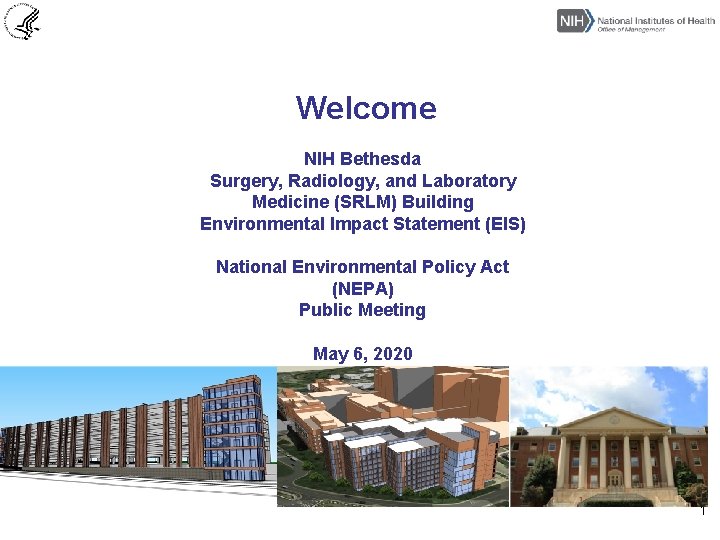
Welcome NIH Bethesda Surgery, Radiology, and Laboratory Medicine (SRLM) Building Environmental Impact Statement (EIS) National Environmental Policy Act (NEPA) Public Meeting May 6, 2020 1
NIH Representatives NEPA Management Valerie Nottingham, Deputy Director Division of Environmental Protection/ORF/NIH Mark Radtke, Environmental Protection Specialist Division of Environmental Protection/ORF/NIH Georgianna Porter, Environmental Protection Specialist Division of Environmental Protection/ORF/NIH Michelle Coley, Management Analyst Division of Environmental Protection/ORF/NIH Project Management Aaron Altman, HOK Contractor EIS Consultant Robert Dover, Senior Project Manager AECOM 2
The National Environmental Policy Act Mark Radtke, Environmental Protection Specialist Division of Environmental Protection/ORF/NIH 3
Purpose of NEPA? • NEPA is our basic national charter for protection of the environment • Establishes policy, sets goals, contains “action-forcing” provisions • Ensures that environmental information is available to public officials and citizens before decisions are made • Ensures the agency makes an informed decision on its action 4
NEPA Policy • Making the NEPA process more useful to decision makers and the public – Documents should be clear and concise – Supported by evidence that agencies have made the necessary analysis • Encourage and facilitate public involvement in decisions which effect the quality of the human environment – Public Scoping Meetings – Public Meetings after the Draft is released • Identify and assess the reasonable alternatives to proposed actions that will avoid or minimize adverse effects 5
Surgery, Radiology, and Laboratory Medicine Building Utility Vault and Parking Garage Aaron Altman, HOK 6
Proposed Surgery, Radiology and Lab Medicine Building • Critical hospital functions (Operating Rooms, MRI & CT Suites, Laboratories, etc. ) are housed in spaces that are old and outdated and the corresponding building utility systems (HVAC, Plumbing etc. ) are in poor condition and prone to regular failures, which negatively impact on-going health care operations. • A new addition to the hospital (Building 10) is proposed to address the inadequacies, and to provide state-of-the-art facilities to support leading-edge medical research to prevent, detect, diagnose, and treat disease and disability. 7
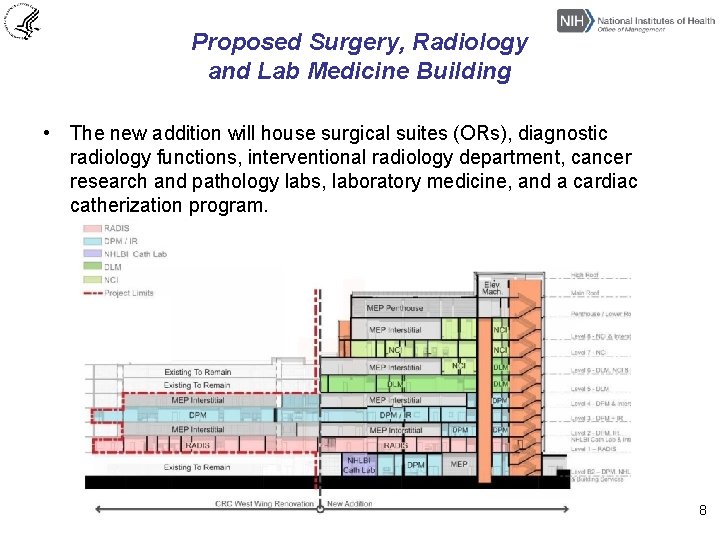
Proposed Surgery, Radiology and Lab Medicine Building • The new addition will house surgical suites (ORs), diagnostic radiology functions, interventional radiology department, cancer research and pathology labs, laboratory medicine, and a cardiac catherization program. 8
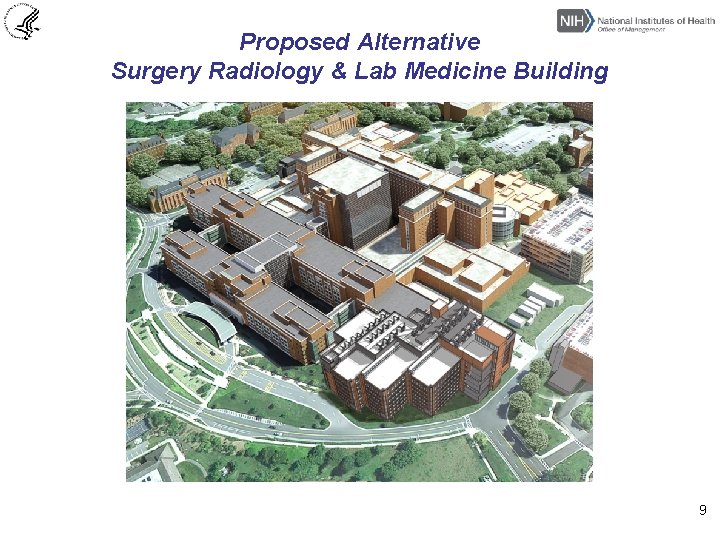
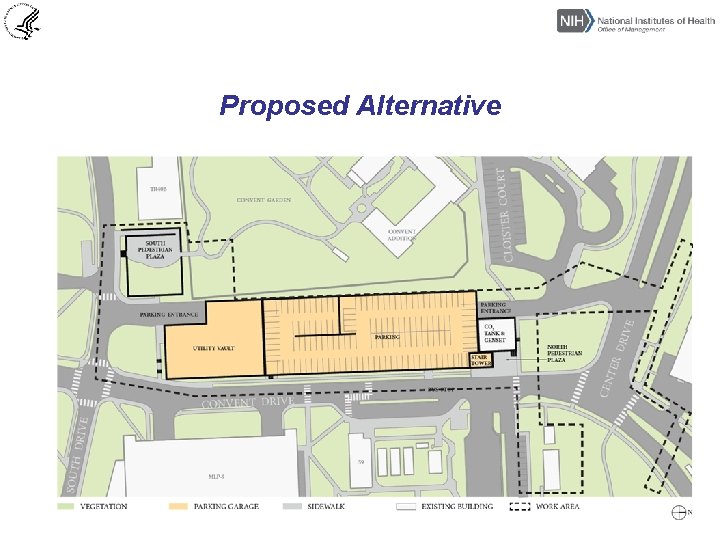
Proposed Alternative Surgery Radiology & Lab Medicine Building 9
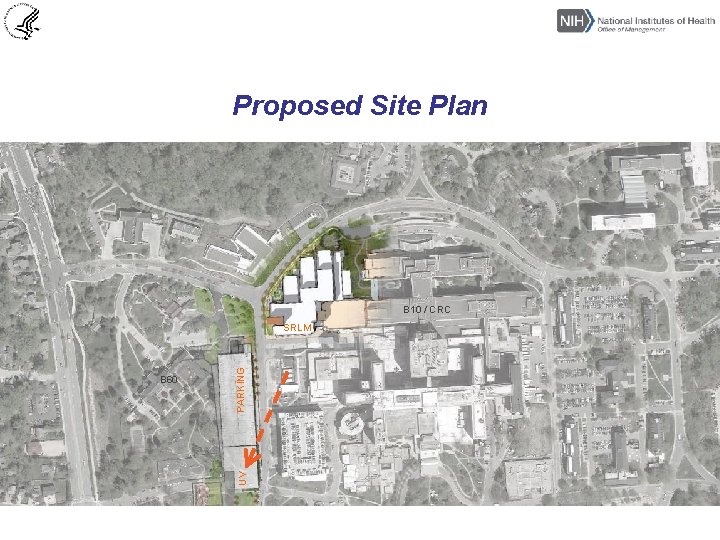
Proposed Parking Garage • An existing parking garage, located under Building 10, poses a personnel safety risk and a security threat to hospital operations. • The underground garage has serious structurally deficiencies based on corrosion of concrete, due to years of wear and tear, despite ongoing maintenance. • A new, free-standing, multi-level garage is proposed to accommodate patients, guests and hospital staff. • The new garage, in combination with other parking facilities on campus, will ultimately eliminate underground parking under Building 10. The underground space could be better used to support hospital operations. 10
Proposed Electrical Utility Vault & Equipment • Existing electrical switching station and switchgear, which supply critical normal and emergency power to hospital/Building 10 and adjacent structures, is housed in lightweight structures. The lightweight structures sits on top of deteriorating underground parking structure and poses a safety and security risk due to the location directly adjacent to a main campus roadway. • The electrical equipment (switchgear and emergency diesel generators) is aging and approaching the end of its useful life expectancy. The current equipment is inadequate to support the new hospital addition. • A structurally hardened building (Utility Vault) is proposed, to house new, right-sized electrical equipment to support new hospital addition, ensure reliability and long-term sustainability of the NIH’s premier research hospital. 11
Proposed Utility Vault & Patient Parking Garage Historic Considerations • A utility vault and patient parking garage are proposed to be colocated on a site that is currently an at-grade valet parking lot. • The site adjacent to Building 60, a deconsecrated Convent located on campus. The Convent and its corresponding grounds are eligible for listing in the National Historic Register. • The design of the proposed vault/garage structure will be sensitive to the adjacent historic properties, and any adverse effects will be mitigated/ minimized via the use of special façade treatments and additional plantings to obscure the view of the new building from the Convent and its grounds. • An existing wall around the Convent grounds would be preserved and protected before, during and after all construction activities. • NIH is in communication with the Montgomery County Historical Society and the American Indian Society of Washington, DC. A SHPO representative (Natalie Loukianoff) visited the campus in March to discuss the proposed project. 12
Proposed Alternative
Existing Site Plan
Proposed Site Plan B 10 / CRC UV B 60 PARKING SRLM
AECOM, EIS Preparer Robert Dover, Senior Project Manager 16
AECOM Corporate Background • AECOM is the world’s largest architecture and engineering (A/E) firm, with more than 10, 000 environmental professionals and 2, 500 National Environmental Policy Act (NEPA) related practitioners in the United States. • AECOM’s NEPA experience includes the following: – In the last five (5) years, AECOM has prepared more than 100 EIS/Record of Decisions (RODs) and several thousand EA/Finding of No Significant Impacts (FONSIs) for a variety of Federal agencies. – Substantial recent experience in developing EISs and Environmental Assessments (EAs) in support of building construction, demolition, and renovation on federal multi-tenant office, laboratory, and hospital campuses. – Support for all phases of the NEPA process from scoping, to environmental analysis, and public communications support • AECOM performed all NEPA analyses independently of NIH 17
AECOM’s Technical Approach to the EIS • Considered public scoping comments and worked with NIH to identify reasonable project alternatives • Performed environmental analyses – Gathered and evaluated existing resource and socioeconomic data, as well as project-specific studies and designs – Performed additional site-specific investigation and analysis – Coordinated analysis with NIH subject matter experts – Assisted NIH with permitting requirements and consultation with federal, state, and local agencies • Identified direct, indirect, and cumulative impacts of the project and alternatives • Identified and evaluated mitigation measures to avoid, minimize, or compensate for adverse impacts 18
The NIH NEPA Process Mark Radtke, Environmental Protection Specialist Division of Environmental Protection/ORF/NIH 19
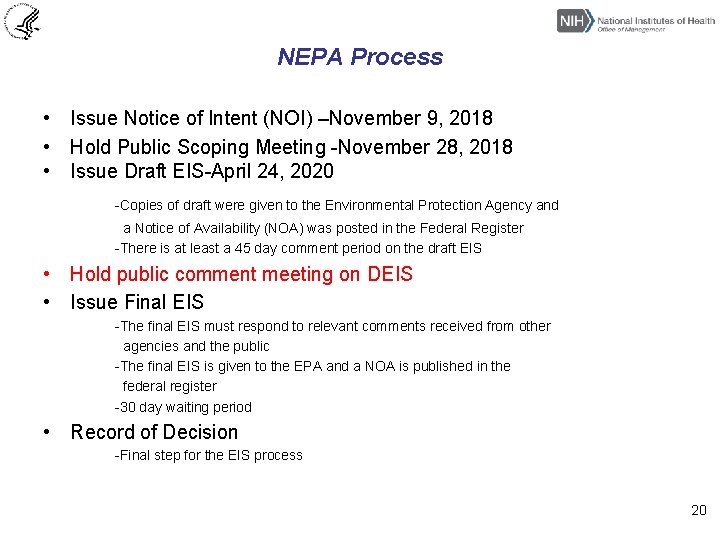
NEPA Process • Issue Notice of Intent (NOI) –November 9, 2018 • Hold Public Scoping Meeting -November 28, 2018 • Issue Draft EIS-April 24, 2020 -Copies of draft were given to the Environmental Protection Agency and a Notice of Availability (NOA) was posted in the Federal Register -There is at least a 45 day comment period on the draft EIS • Hold public comment meeting on DEIS • Issue Final EIS -The final EIS must respond to relevant comments received from other agencies and the public -The final EIS is given to the EPA and a NOA is published in the federal register -30 day waiting period • Record of Decision -Final step for the EIS process 20
Effective Public Commenting You can make a difference Comments may be the most important contribution from citizens Effective Comments: • • • Early in the NEPA process Clear, concise and relevant to the analysis Solution oriented and provide specific examples Suggest additional alternatives Suggest sources of relevant data or information for consideration 21
Open Forum For Public Comments A few key reminders • This is not a questions and answer session. This is for comments only • All personal information given in this forum is only seen by NIH • When commenting, please include your name and mailing address • Comments can be made through this forum, mail, email, or phone 22
Draft Environmental Impact Statement Online Can be found at: https: //nems. nih. gov/NEPA
How Do I Get Information on the NIH Surgery, Radiology, and Laboratory Medicine Building EIS? Public comments should be directed to: Valerie Nottingham Deputy Director Division of Environmental Protection National Institutes of Health, ORF B 13/2 S 11, MSC 5746 9000 Rockville Pike, Bethesda, Maryland 20892 telephone 301 -496 -7775 e-mail: nihnepa@mail. nih. gov 24
- Slides: 24