
Welcome March VTPBi S Regional Coordinators Meeting Agenda
Welcome! March VTPBi. S Regional Coordinators Meeting
Agenda • Welcome and Introductions – Sign-in Sheet – Activity • Topic Presentation and Discussion: – Assessments Tools Guide – Benchmarks of Quality (Bo. Q) – Universal Screening • Information, Resources and Plan for Future Meetings

Introductions and Activity • Introductions around the room: • Scavenger Hunt: – Use the handout and walk around the room to find someone you don’t know. – Ask them a question from the handout – After, find another person and ask a different question – Continue until five questions have been answered
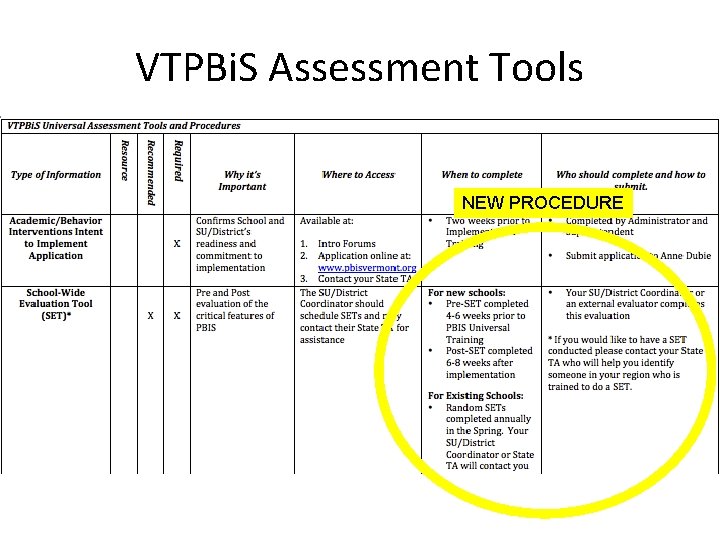
VTPBi. S Assessment Tools NEW PROCEDURE
Benchmarks of Quality (Bo. Q)
Why the Bo. Q? • State/SU/District capacity to conduct the SETs challenging • Self-assessment at the building level • Much more in depth than the SET • Easily identifies areas of strength and areas in need of development • Transfers easily to action planning around the Universal Level of PBIS • Pilots were conducted and fabulous feedback was received
What is the Benchmarks of Quality (Bo. Q)? • Self-assessment survey and action planning tool consisting of 53 questions and lists 10 Critical Elements • Lists components of PBIS implementation that address the critical elements of PBIS implementation • Completed by leadership team with School Coordinator and/or SU/District Coordinator two times per year (November and April) to assess development and implementation of school-wide (Universal) PBIS • Useful in developing action plans for following year
Two Components of the Benchmarks of Quality (Bo. Q) • Scoring Form – Completed by the leadership team with School Coordinator and/or SU/District Coordinator using the Scoring Guide • Scoring Guide – Describes procedure for completing Bo. Q – Includes a rubric for scoring each item
Bo. Q Will Provide: • Summary of team’s perceptions of PBIS implementation at the Universal Level • Objective assessment of school’s implementation based on criteria described in a rubric (107 point scale and teams implementing with fidelity achieve a score of 70% or above). • Comparison between the above factors which will encourage discussion of strengths and weaknesses and provides ideas for action planning
STEP 1 • PBIS Leadership Team with School Coordinator and/or SU/District Coordinator uses the Scoring Guide to complete: School-Wide Benchmarks of Quality: Scoring Form
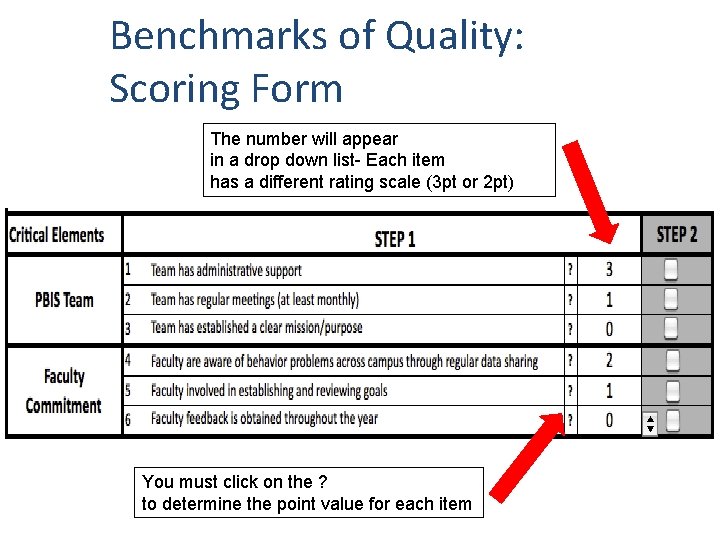
Benchmarks of Quality: Scoring Form The number will appear in a drop down list- Each item has a different rating scale (3 pt or 2 pt) You must click on the ? to determine the point value for each item
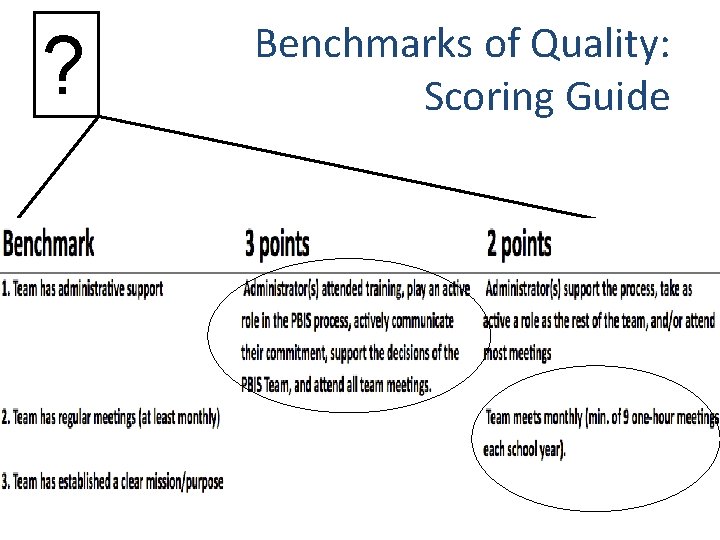
? Benchmarks of Quality: Scoring Guide
STEP 2 • PBIS Leadership Team places a next to any item that is identified as an area in need of development.
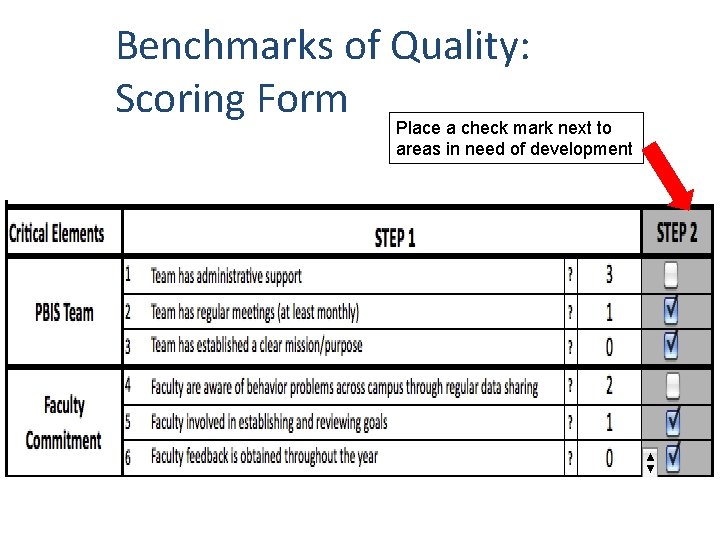
Benchmarks of Quality: Scoring Form Place a check mark next to areas in need of development
STEP 3 • Review the Bo. Q and identify strengths • Place item in need of development on the Team Summary under “Area in Need of Development. ” • If other actions items exist place them in the “other Action Items” section on the Team Summary
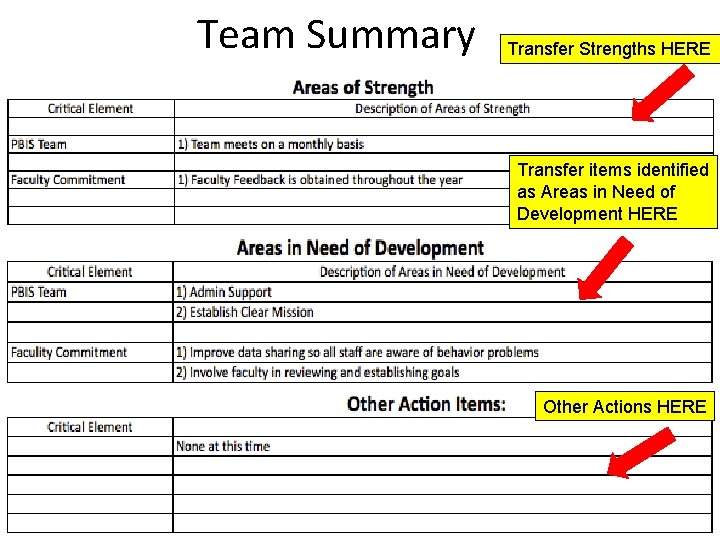
Team Summary Transfer Strengths HERE Transfer items identified as Areas in Need of Development HERE Other Actions HERE
STEP 4 • The electronic scoring sheet will automatically score your Bo. Q. Maximum score is 107 and teams implementing with fidelity achieve a score of 70% or above. • School Coordinator or SU/District Coordinator e-mails completed Bo. Q to Sabine Baldwin at sabine. baldwin@state. vt. us

QUESTIONS? ?
Universal Screening What is screening? Why would you want it? What does it look like? What’s next?
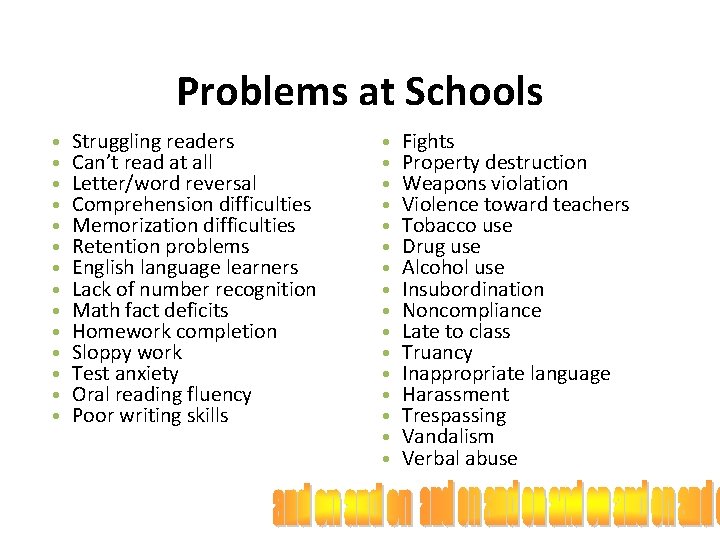
Problems at Schools • • • • Struggling readers Can’t read at all Letter/word reversal Comprehension difficulties Memorization difficulties Retention problems English language learners Lack of number recognition Math fact deficits Homework completion Sloppy work Test anxiety Oral reading fluency Poor writing skills • • • • Fights Property destruction Weapons violation Violence toward teachers Tobacco use Drug use Alcohol use Insubordination Noncompliance Late to class Truancy Inappropriate language Harassment Trespassing Vandalism Verbal abuse
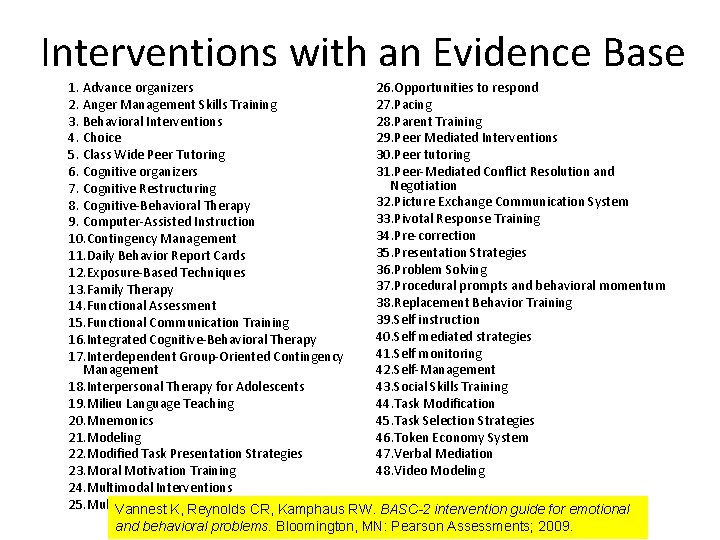
Interventions with an Evidence Base 1. Advance organizers 26. Opportunities to respond 2. Anger Management Skills Training 27. Pacing 28. Parent Training 3. Behavioral Interventions 29. Peer Mediated Interventions 4. Choice 30. Peer tutoring 5. Class Wide Peer Tutoring 31. Peer-Mediated Conflict Resolution and 6. Cognitive organizers Negotiation 7. Cognitive Restructuring 32. Picture Exchange Communication System 8. Cognitive-Behavioral Therapy 33. Pivotal Response Training 9. Computer-Assisted Instruction 34. Pre-correction 10. Contingency Management 35. Presentation Strategies 11. Daily Behavior Report Cards 36. Problem Solving 12. Exposure-Based Techniques 37. Procedural prompts and behavioral momentum 13. Family Therapy 38. Replacement Behavior Training 14. Functional Assessment 39. Self instruction 15. Functional Communication Training 40. Self mediated strategies 16. Integrated Cognitive-Behavioral Therapy 41. Self monitoring 17. Interdependent Group-Oriented Contingency 42. Self-Management 43. Social Skills Training 18. Interpersonal Therapy for Adolescents 44. Task Modification 19. Milieu Language Teaching 45. Task Selection Strategies 20. Mnemonics 46. Token Economy System 21. Modeling 47. Verbal Mediation 22. Modified Task Presentation Strategies 48. Video Modeling 23. Moral Motivation Training 24. Multimodal Interventions 25. Multi-systemic Therapy Vannest K, Reynolds CR, Kamphaus RW. BASC-2 intervention guide for emotional and behavioral problems. Bloomington, MN: Pearson Assessments; 2009.
Why Universal Screening? • To find students whose problems are not immediately obvious and to identify problems with a high degree of accuracy • Early identification leads to early intervention • Schools that implement Universal Screening select interventions based on results of rating scales on the screening tools. This is effective and efficient.
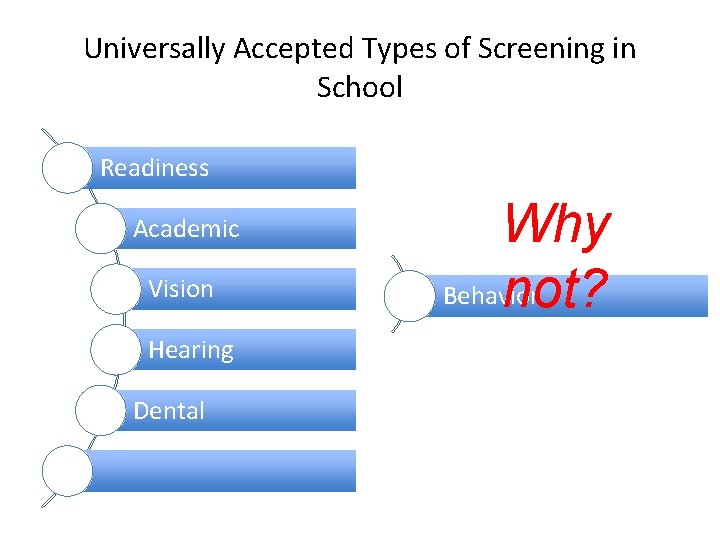
Universally Accepted Types of Screening in School Readiness Academic Vision Hearing Dental Why Behavior not?
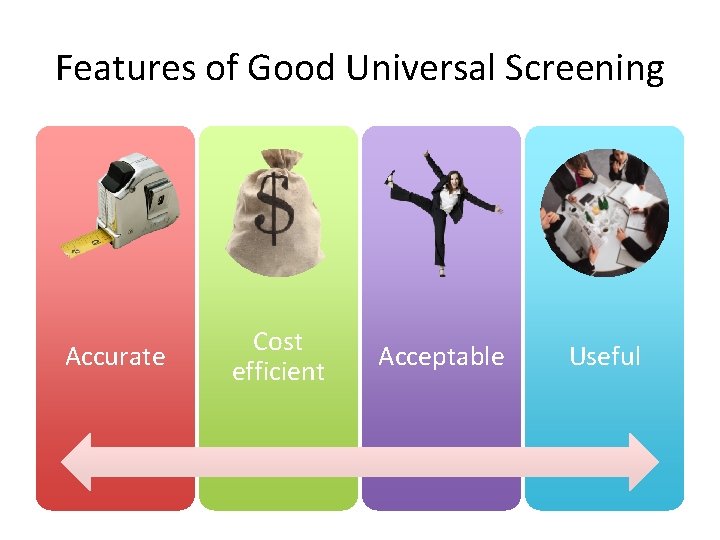
Features of Good Universal Screening Accurate Cost efficient Acceptable Useful
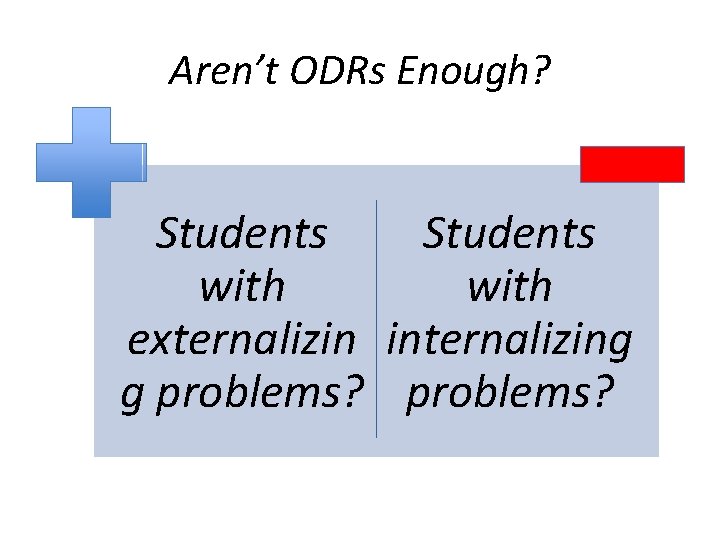
Aren’t ODRs Enough? Students with externalizin internalizing g problems?
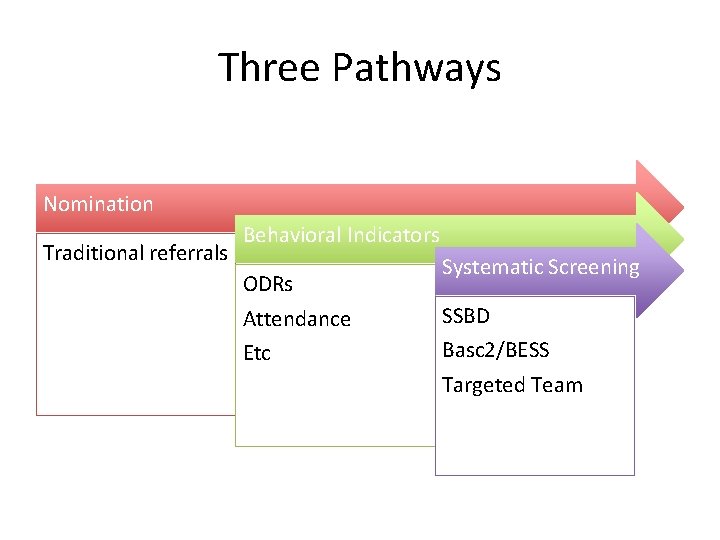
Three Pathways Nomination Traditional referrals Behavioral Indicators ODRs Attendance Etc Systematic Screening SSBD Basc 2/BESS Targeted Team
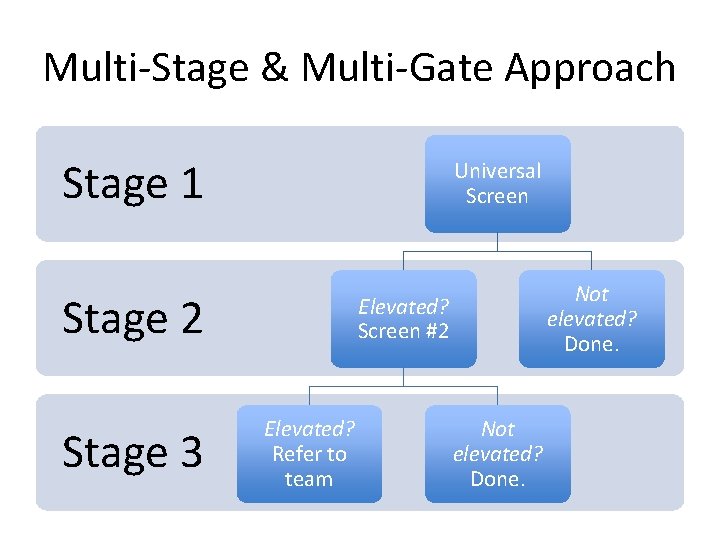
Multi-Stage & Multi-Gate Approach Stage 1 Universal Screen Stage 2 Stage 3 Not elevated? Done. Elevated? Screen #2 Elevated? Refer to team Not elevated? Done.
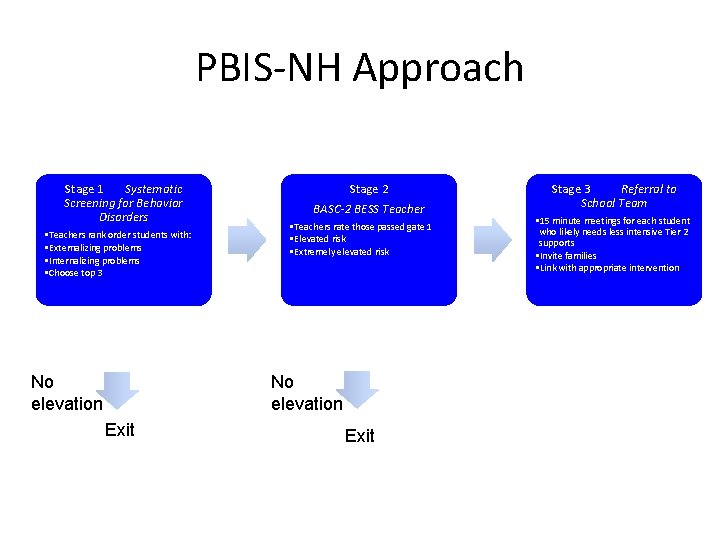
PBIS-NH Approach Stage 1 Systematic Screening for Behavior Disorders • Teachers rank order students with: • Externalizing problems • Internalizing problems • Choose top 3 No elevation Stage 2 BASC-2 BESS Teacher • Teachers rate those passed gate 1 • Elevated risk • Extremely elevated risk No elevation Exit Stage 3 Referral to School Team • 15 minute meetings for each student who likely needs less intensive Tier 2 supports • Invite families • Link with appropriate intervention
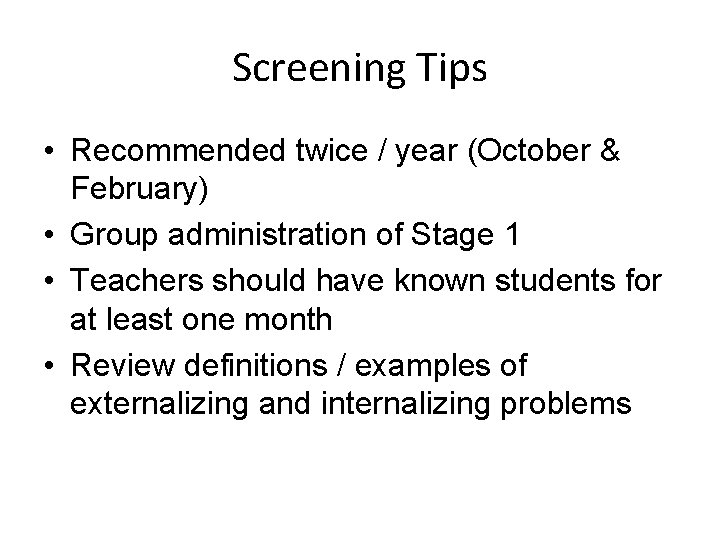
Screening Tips • Recommended twice / year (October & February) • Group administration of Stage 1 • Teachers should have known students for at least one month • Review definitions / examples of externalizing and internalizing problems
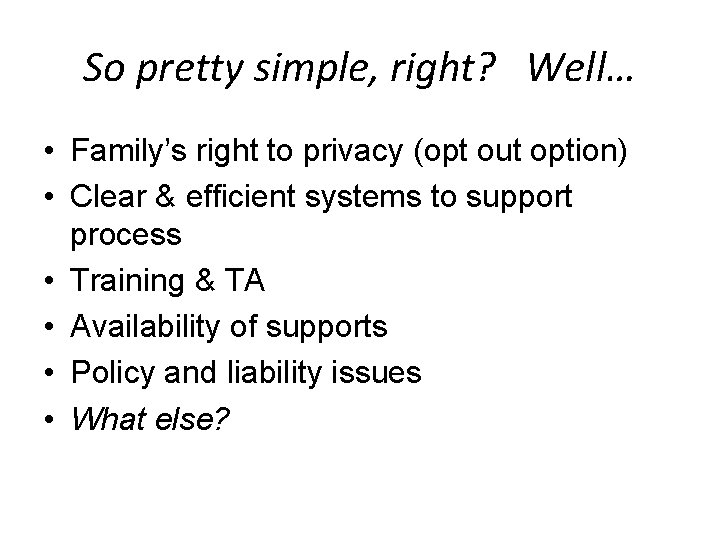
So pretty simple, right? Well… • Family’s right to privacy (opt out option) • Clear & efficient systems to support process • Training & TA • Availability of supports • Policy and liability issues • What else?
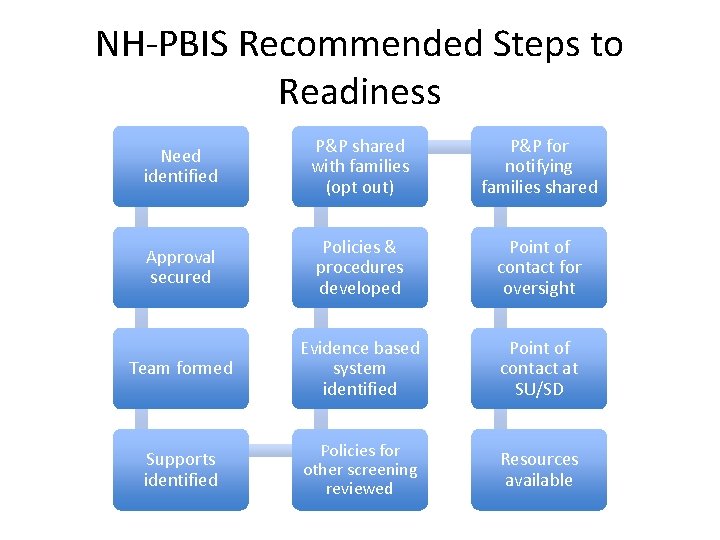
NH-PBIS Recommended Steps to Readiness Need identified P&P shared with families (opt out) P&P for notifying families shared Approval secured Policies & procedures developed Point of contact for oversight Team formed Evidence based system identified Point of contact at SU/SD Supports identified Policies for other screening reviewed Resources available
Next Steps • Discuss the merits and challenges of implementing Universal Screening at your school • Universal Screening for Behavior Workshop at the BEST Summer Institute • Future Trainings will be available next fall so stay tuned!
Wrap-up-Logistics • BEST Summer Institute- June 25 -28 Registration is Open! • May Regional Coordinators Meetings- Webinar on May 23 • CPI Training – April 3, Montpelier • Intensive Wraparound Introduction Webinar – April 4 • Intensive Wraparound Overview Day – May 11, Lake Morey • Webinar for SU/District Coordinators on facilitating data days – April 12
- Slides: 33