
WELCOME Lower Manhattan Regional Group September 29 th
WELCOME! Lower Manhattan Regional Group September 29 th, 2017 Hispanic Federation: Las Americas Conference Center
Overview & Today’s Agenda Steve Sawicki| NYSDOH – AI Jonathan Gómez | NYSDOH – AI
2017 LMRG Charge: Improved Patient Care and Outcomes in Lower Manhattan • By: • Creating new opportunities for expedited linkage to care, engagement of those lost to or never engaged in care, and increased viral load suppression at individual agencies and cross-agency collaboration • Building our skills in and use of quality improvement processes, such as Plan, Do, Study, Act Cycles, to test our ideas and evaluate their potential success • Sharing our collective experience with activities to uncover or develop breakthroughs to improve patient care & public health outcomes
Key Elements of LMRG Success • Collaboration across agencies, along with consumers and clients, setting collaborative goals, using QI to identify new ways to engage hard-to-reach, high-risk groups in HIV testing and linkage-to-care, ongoing primary care and supportive services systems in the region • Documenting and sharing the results from tests of improvement strategies at Learning Sessions • Measuring agency-level client outcomes and City and State surveillance data to understand drive improvement in linkage and retention in the Lower Manhattan Region
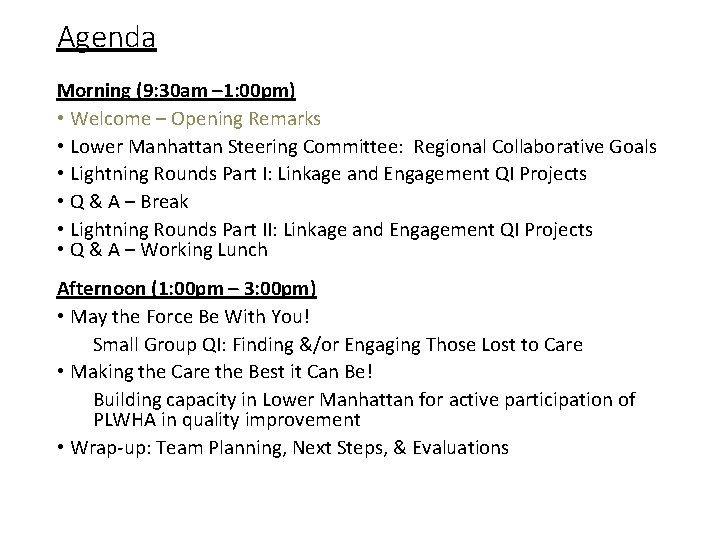
Agenda Morning (9: 30 am – 1: 00 pm) • Welcome – Opening Remarks • Lower Manhattan Steering Committee: Regional Collaborative Goals • Lightning Rounds Part I: Linkage and Engagement QI Projects • Q & A – Break • Lightning Rounds Part II: Linkage and Engagement QI Projects • Q & A – Working Lunch Afternoon (1: 00 pm – 3: 00 pm) • May the Force Be With You! Small Group QI: Finding &/or Engaging Those Lost to Care • Making the Care the Best it Can Be! Building capacity in Lower Manhattan for active participation of PLWHA in quality improvement • Wrap-up: Team Planning, Next Steps, & Evaluations
Lower Manhattan Collaborative Goals NYLinks Lower Manhattan Regional Group Steering Committee Lara Comstock | Isaac Evans-Frantz (Callen-Lorde Community Health Center) Dana Diamond (Exponents) Hannah Hirschland | Lynnette Ford (Gay Men’s Health Crisis) Alison Kliegman | Leslie Pierce (Housing Works) Toan Nguyen (Hetrick-Martin Institute) Shruti Ramachandran | Amy Newton (Mount Sinai Health System - Institute for Advanced Medicine)
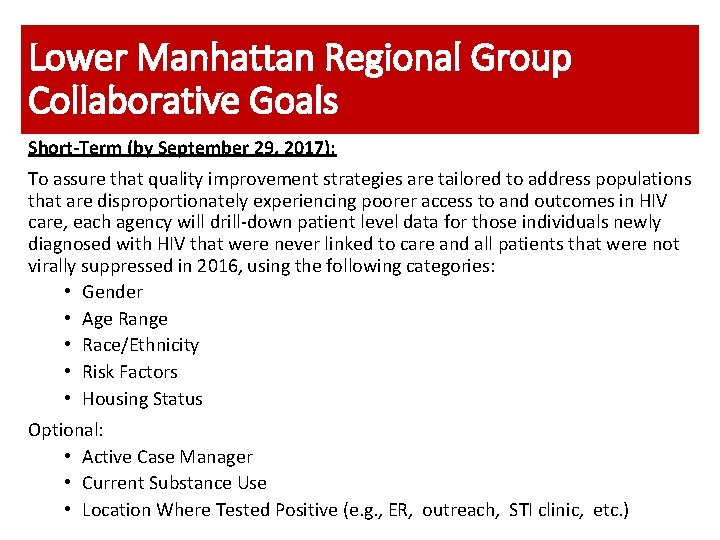
Lower Manhattan Regional Group Collaborative Goals Short-Term (by September 29, 2017): To assure that quality improvement strategies are tailored to address populations that are disproportionately experiencing poorer access to and outcomes in HIV care, each agency will drill-down patient level data for those individuals newly diagnosed with HIV that were never linked to care and all patients that were not virally suppressed in 2016, using the following categories: • Gender • Age Range • Race/Ethnicity • Risk Factors • Housing Status Optional: • Active Case Manager • Current Substance Use • Location Where Tested Positive (e. g. , ER, outreach, STI clinic, etc. )
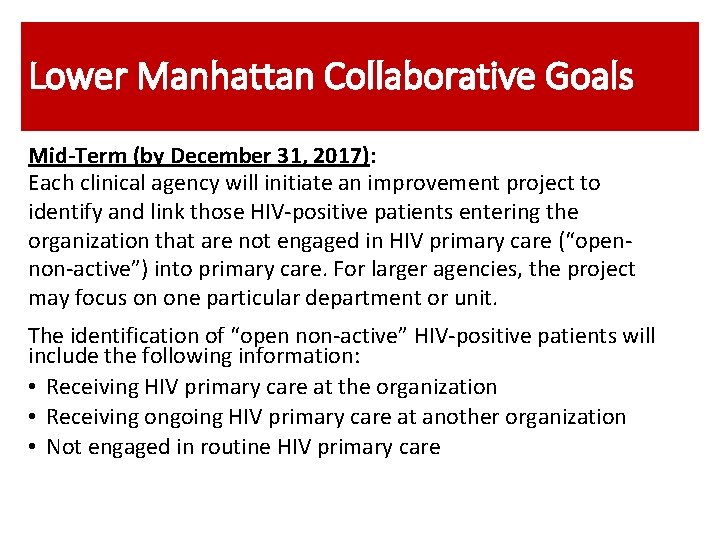
Lower Manhattan Collaborative Goals Mid-Term (by December 31, 2017): Each clinical agency will initiate an improvement project to identify and link those HIV-positive patients entering the organization that are not engaged in HIV primary care (“opennon-active”) into primary care. For larger agencies, the project may focus on one particular department or unit. The identification of “open non-active” HIV-positive patients will include the following information: • Receiving HIV primary care at the organization • Receiving ongoing HIV primary care at another organization • Not engaged in routine HIV primary care
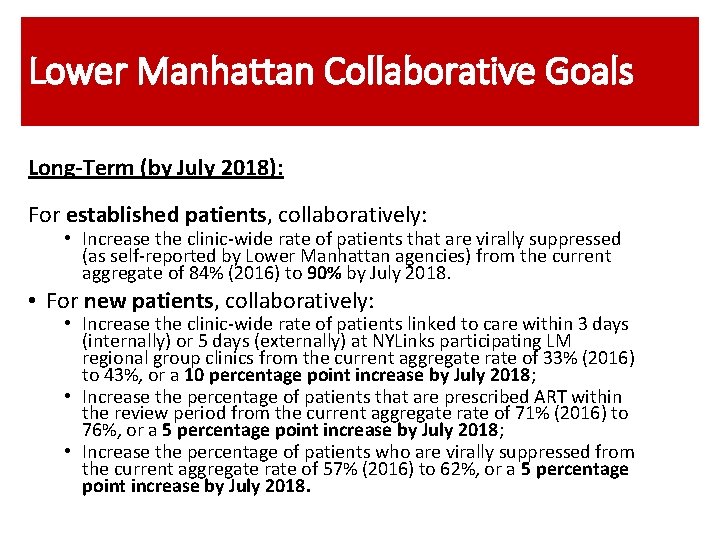
Lower Manhattan Collaborative Goals Long-Term (by July 2018): For established patients, collaboratively: • Increase the clinic-wide rate of patients that are virally suppressed (as self-reported by Lower Manhattan agencies) from the current aggregate of 84% (2016) to 90% by July 2018. • For new patients, collaboratively: • Increase the clinic-wide rate of patients linked to care within 3 days (internally) or 5 days (externally) at NYLinks participating LM regional group clinics from the current aggregate rate of 33% (2016) to 43%, or a 10 percentage point increase by July 2018; • Increase the percentage of patients that are prescribed ART within the review period from the current aggregate rate of 71% (2016) to 76%, or a 5 percentage point increase by July 2018; • Increase the percentage of patients who are virally suppressed from the current aggregate rate of 57% (2016) to 62%, or a 5 percentage point increase by July 2018.
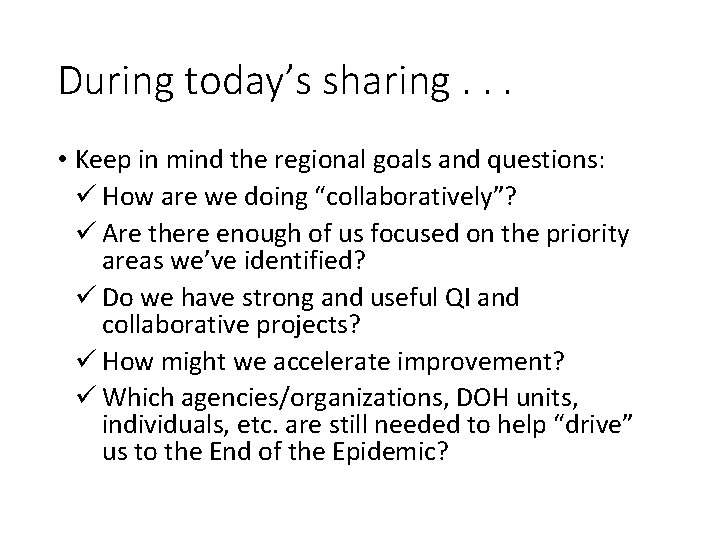
During today’s sharing. . . • Keep in mind the regional goals and questions: ü How are we doing “collaboratively”? ü Are there enough of us focused on the priority areas we’ve identified? ü Do we have strong and useful QI and collaborative projects? ü How might we accelerate improvement? ü Which agencies/organizations, DOH units, individuals, etc. are still needed to help “drive” us to the End of the Epidemic?
Lightning Rounds Part I: QI Team Progress – Linkage & Engagement Strategies
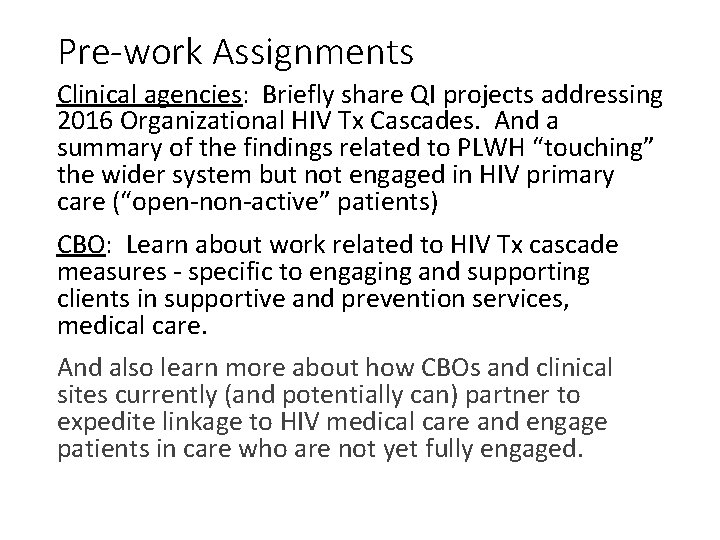
Pre-work Assignments Clinical agencies: Briefly share QI projects addressing 2016 Organizational HIV Tx Cascades. And a summary of the findings related to PLWH “touching” the wider system but not engaged in HIV primary care (“open-non-active” patients) CBO: Learn about work related to HIV Tx cascade measures - specific to engaging and supporting clients in supportive and prevention services, medical care. And also learn more about how CBOs and clinical sites currently (and potentially can) partner to expedite linkage to HIV medical care and engage patients in care who are not yet fully engaged.
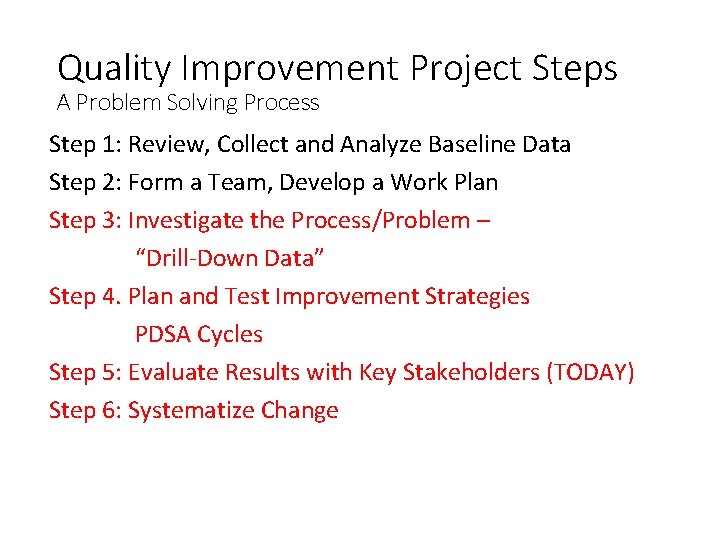
Quality Improvement Project Steps A Problem Solving Process Step 1: Review, Collect and Analyze Baseline Data Step 2: Form a Team, Develop a Work Plan Step 3: Investigate the Process/Problem – “Drill-Down Data” Step 4. Plan and Test Improvement Strategies PDSA Cycles Step 5: Evaluate Results with Key Stakeholders (TODAY) Step 6: Systematize Change
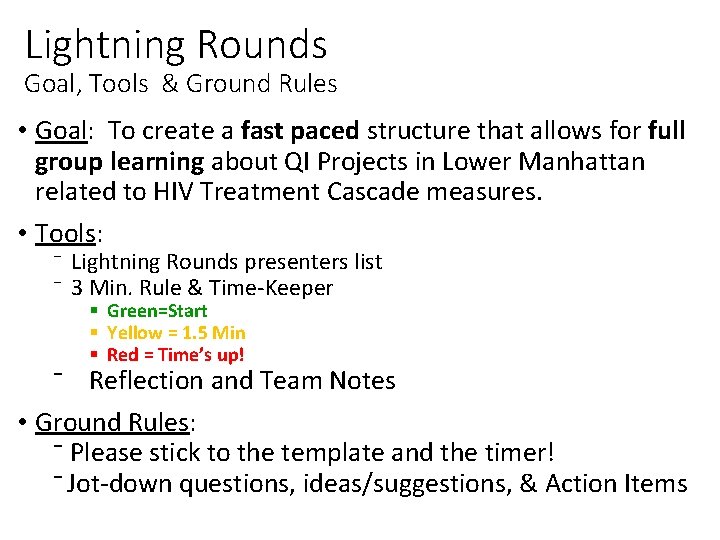
Lightning Rounds Goal, Tools & Ground Rules • Goal: To create a fast paced structure that allows for full group learning about QI Projects in Lower Manhattan related to HIV Treatment Cascade measures. • Tools: ⁻ Lightning Rounds presenters list ⁻ 3 Min. Rule & Time-Keeper § Green=Start § Yellow = 1. 5 Min § Red = Time’s up! ⁻ Reflection and Team Notes • Ground Rules: ⁻ Please stick to the template and the timer! ⁻ Jot-down questions, ideas/suggestions, & Action Items
Part 1: Community Based Organizations • GMHC • Alliance for Positive Change • Hetrick-Martin Institute • Exponents • Council for Adoptable Children
Supportive Service: GMHC Drilling-Down Data for Quality Improvement Projects September 29, 2017
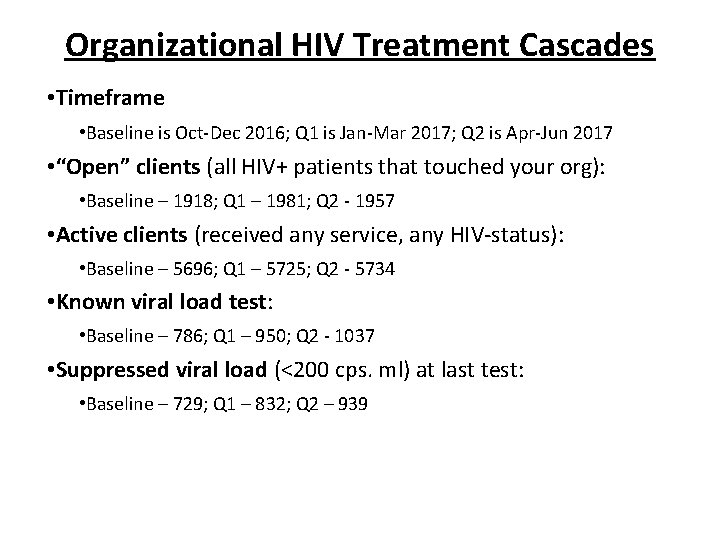
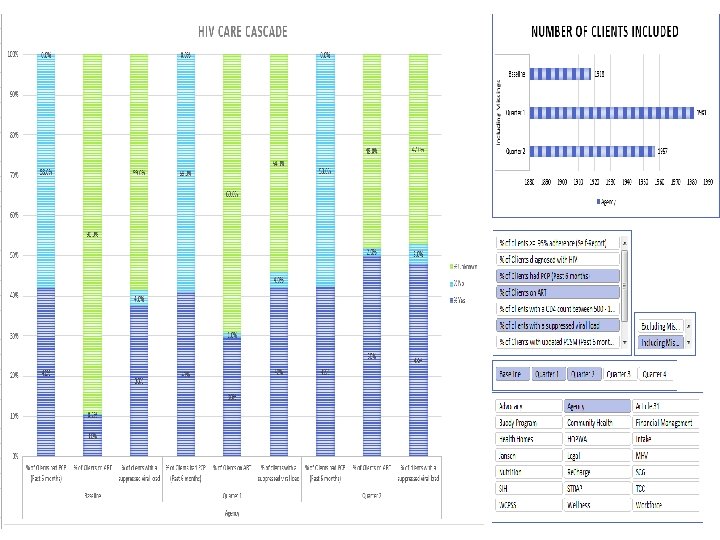
Organizational HIV Treatment Cascades • Timeframe • Baseline is Oct-Dec 2016; Q 1 is Jan-Mar 2017; Q 2 is Apr-Jun 2017 • “Open” clients (all HIV+ patients that touched your org): • Baseline – 1918; Q 1 – 1981; Q 2 - 1957 • Active clients (received any service, any HIV-status): • Baseline – 5696; Q 1 – 5725; Q 2 - 5734 • Known viral load test: • Baseline – 786; Q 1 – 950; Q 2 - 1037 • Suppressed viral load (<200 cps. ml) at last test: • Baseline – 729; Q 1 – 832; Q 2 – 939
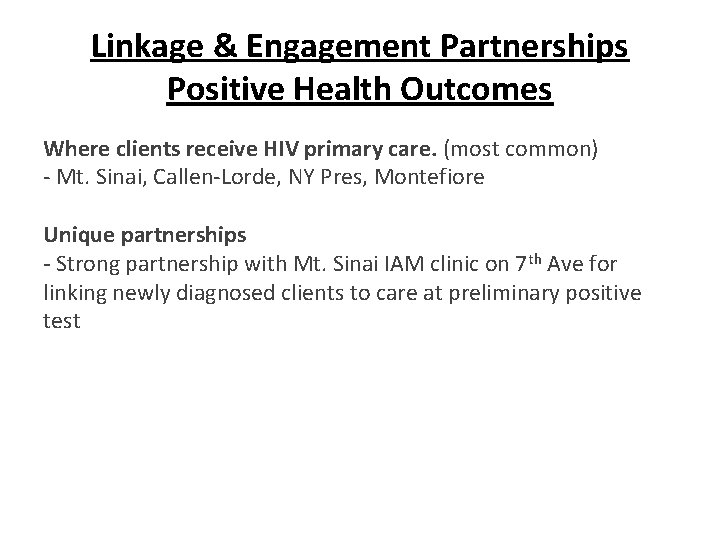
Linkage & Engagement Partnerships Positive Health Outcomes Where clients receive HIV primary care. (most common) - Mt. Sinai, Callen-Lorde, NY Pres, Montefiore Unique partnerships - Strong partnership with Mt. Sinai IAM clinic on 7 th Ave for linking newly diagnosed clients to care at preliminary positive test
Agency Name Toward an Improvement Strategy (only if applicable) ▪GMHC is testing expanding primary care status measure data collection to all clients who have had 3 encounters in a 3 -month period ¹ An Intriguing strategy is new/unique in its design/concept relative to the care processes you usually provide.
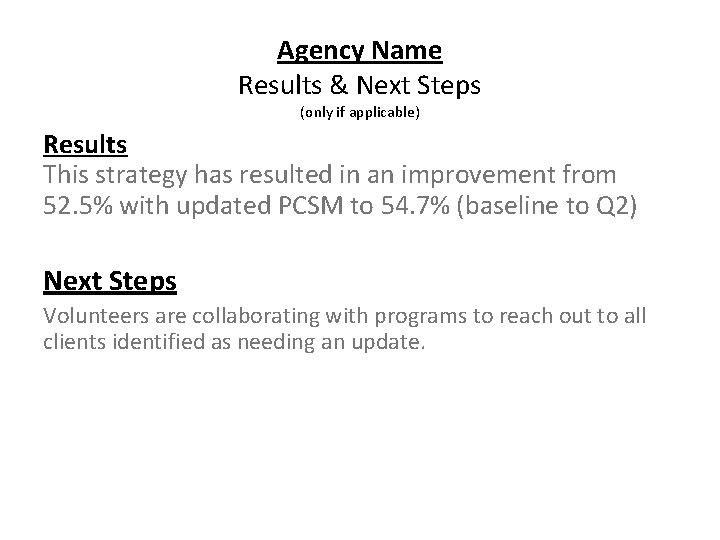
Agency Name Results & Next Steps (only if applicable) Results This strategy has resulted in an improvement from 52. 5% with updated PCSM to 54. 7% (baseline to Q 2) Next Steps Volunteers are collaborating with programs to reach out to all clients identified as needing an update.
QI Contact Information (only if applicable) Name: Hannah Hirschland Title: Managing Director, Analytics and Evaluation Email: hannahh@gmhc. org Phone: 212 -367 -1285
Supportive Service: The Alliance for Positive Change Drilling-Down Data for Quality Improvement Projects September 29, 2017
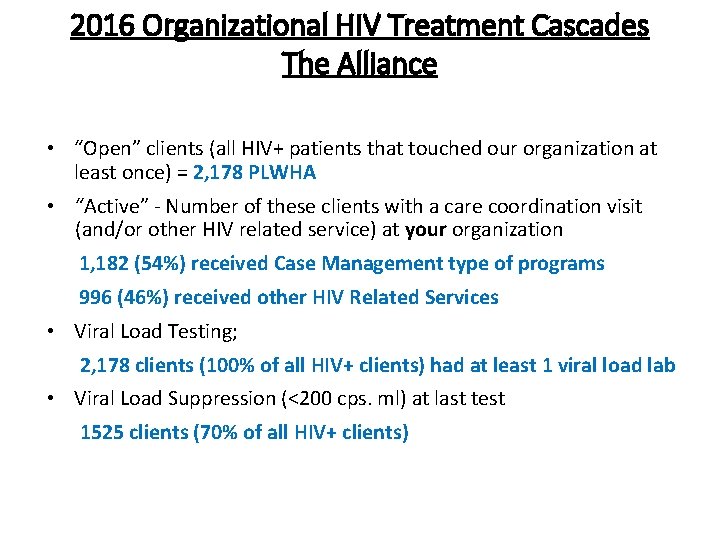
2016 Organizational HIV Treatment Cascades The Alliance • “Open” clients (all HIV+ patients that touched our organization at least once) = 2, 178 PLWHA • “Active” - Number of these clients with a care coordination visit (and/or other HIV related service) at your organization 1, 182 (54%) received Case Management type of programs 996 (46%) received other HIV Related Services • Viral Load Testing; 2, 178 clients (100% of all HIV+ clients) had at least 1 viral load lab • Viral Load Suppression (<200 cps. ml) at last test 1525 clients (70% of all HIV+ clients)
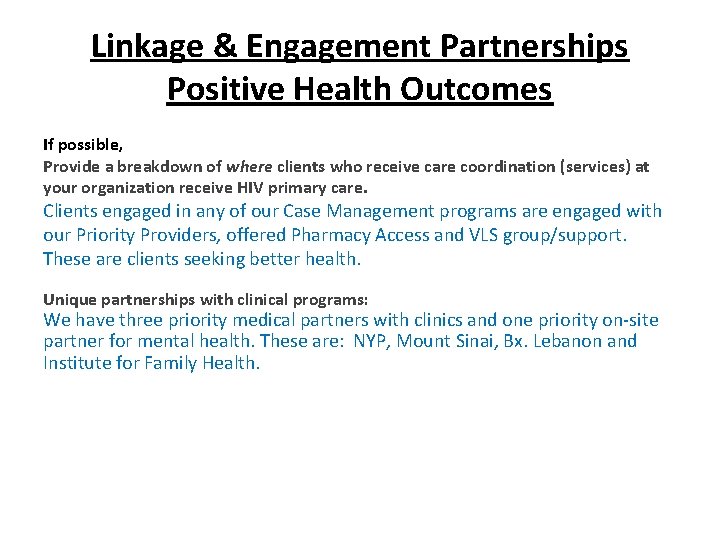
Linkage & Engagement Partnerships Positive Health Outcomes If possible, Provide a breakdown of where clients who receive care coordination (services) at your organization receive HIV primary care. Clients engaged in any of our Case Management programs are engaged with our Priority Providers, offered Pharmacy Access and VLS group/support. These are clients seeking better health. Unique partnerships with clinical programs: We have three priority medical partners with clinics and one priority on-site partner for mental health. These are: NYP, Mount Sinai, Bx. Lebanon and Institute for Family Health.
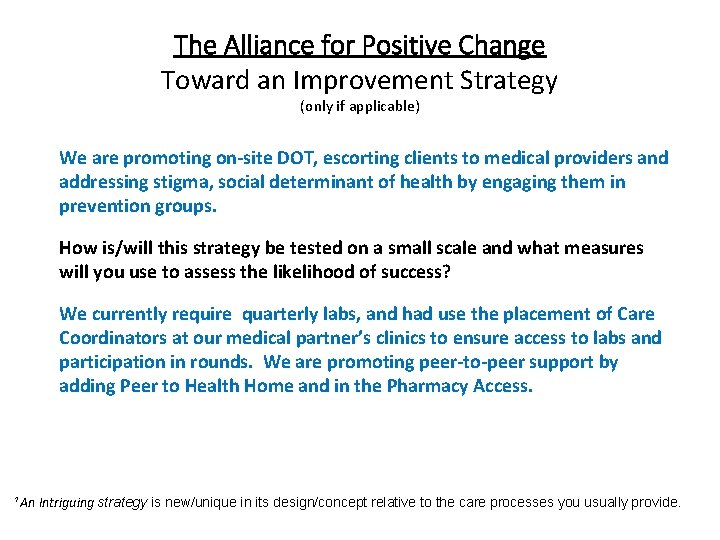
The Alliance for Positive Change Toward an Improvement Strategy (only if applicable) We are promoting on-site DOT, escorting clients to medical providers and addressing stigma, social determinant of health by engaging them in prevention groups. How is/will this strategy be tested on a small scale and what measures will you use to assess the likelihood of success? We currently require quarterly labs, and had use the placement of Care Coordinators at our medical partner’s clinics to ensure access to labs and participation in rounds. We are promoting peer-to-peer support by adding Peer to Health Home and in the Pharmacy Access. ¹ An Intriguing strategy is new/unique in its design/concept relative to the care processes you usually provide.
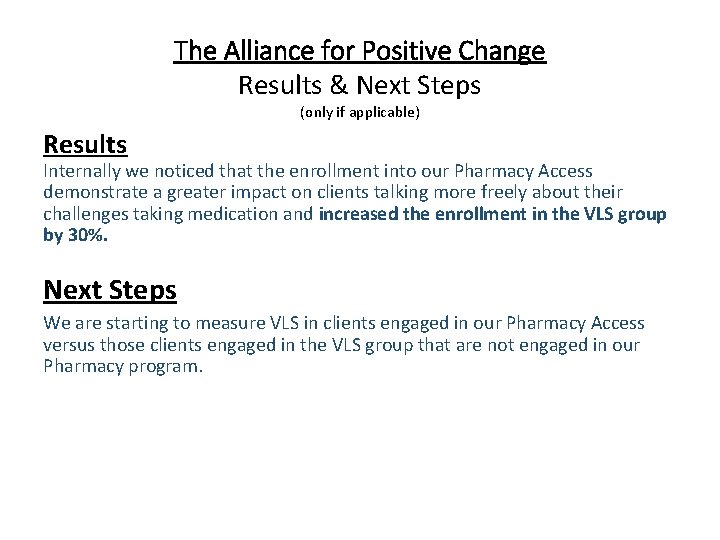
The Alliance for Positive Change Results & Next Steps (only if applicable) Results Internally we noticed that the enrollment into our Pharmacy Access demonstrate a greater impact on clients talking more freely about their challenges taking medication and increased the enrollment in the VLS group by 30%. Next Steps We are starting to measure VLS in clients engaged in our Pharmacy Access versus those clients engaged in the VLS group that are not engaged in our Pharmacy program.
QI Contact Information Name: Evelyn Lopez Title: Chief Program Officer Email: evelyn 2@alliance. nyc Phone: (212) 645 -0875 ext. 454
HMI’s Prevention Cascade Lower Manhattan NYLinks Meeting 9/29/17 Toan Nguyen Program Manager, Health and Wellness
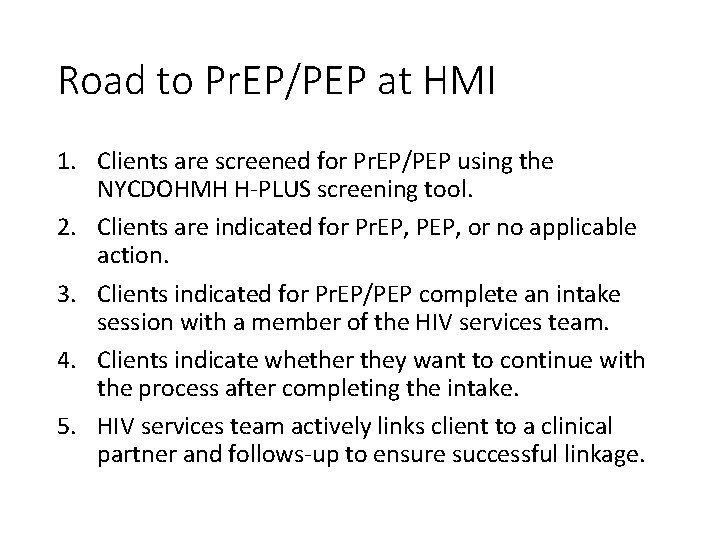
Road to Pr. EP/PEP at HMI 1. Clients are screened for Pr. EP/PEP using the NYCDOHMH H-PLUS screening tool. 2. Clients are indicated for Pr. EP, PEP, or no applicable action. 3. Clients indicated for Pr. EP/PEP complete an intake session with a member of the HIV services team. 4. Clients indicate whether they want to continue with the process after completing the intake. 5. HIV services team actively links client to a clinical partner and follows-up to ensure successful linkage.
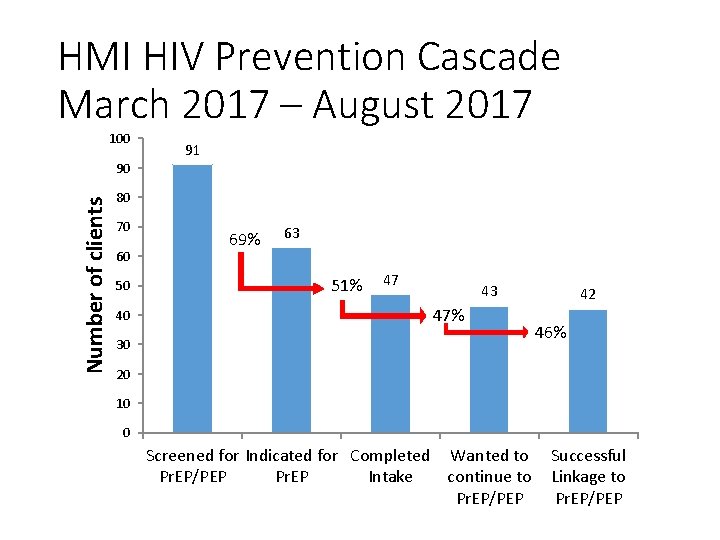
HMI HIV Prevention Cascade March 2017 – August 2017 100 Number of clients 90 91 80 70 60 50 40 69% 63 51% 47 43 47% 30 42 46% 20 10 0 Screened for Indicated for Completed Wanted to Pr. EP/PEP Pr. EP Intake continue to Pr. EP/PEP Successful Linkage to Pr. EP/PEP
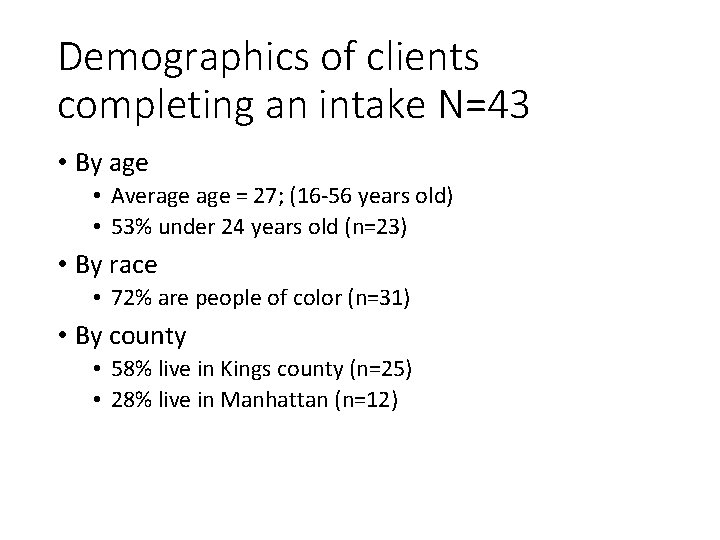
Demographics of clients completing an intake N=43 • By age • Average = 27; (16 -56 years old) • 53% under 24 years old (n=23) • By race • 72% are people of color (n=31) • By county • 58% live in Kings county (n=25) • 28% live in Manhattan (n=12)
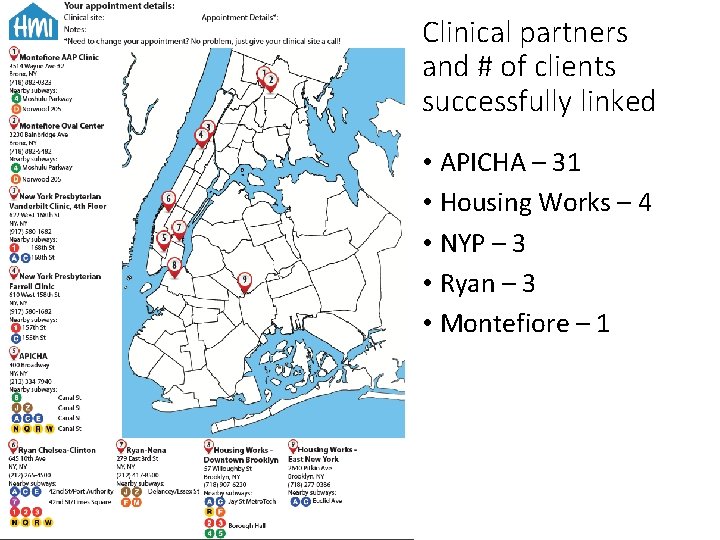
Clinical partners and # of clients successfully linked • APICHA – 31 • Housing Works – 4 • NYP – 3 • Ryan – 3 • Montefiore – 1
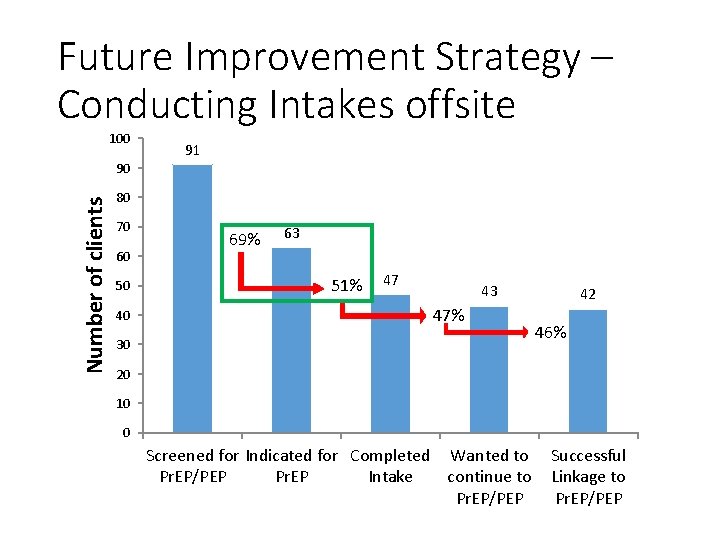
Future Improvement Strategy – Conducting Intakes offsite 100 Number of clients 90 91 80 70 60 50 40 69% 63 51% 47 43 47% 30 42 46% 20 10 0 Screened for Indicated for Completed Wanted to Pr. EP/PEP Pr. EP Intake continue to Pr. EP/PEP Successful Linkage to Pr. EP/PEP
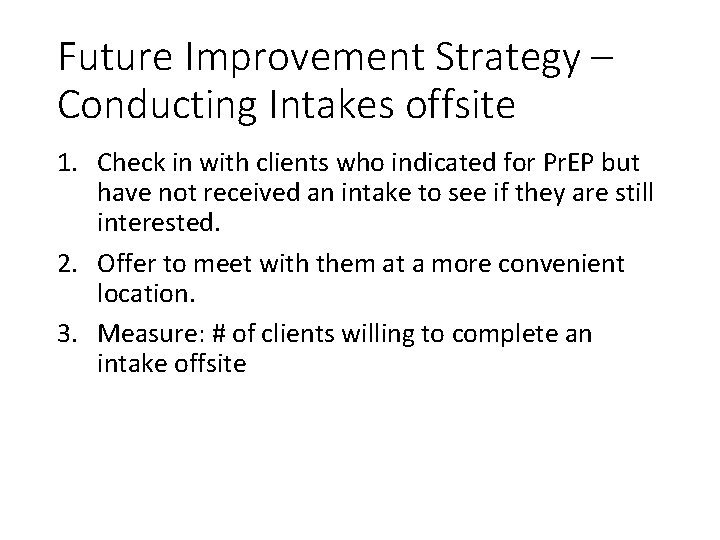
Future Improvement Strategy – Conducting Intakes offsite 1. Check in with clients who indicated for Pr. EP but have not received an intake to see if they are still interested. 2. Offer to meet with them at a more convenient location. 3. Measure: # of clients willing to complete an intake offsite
QI Contact Information Name: Toan Nguyen Title: Program Manager, Health and Wellness Email: tnguyen@hmi. org Phone: 212 -674 -2400 x 299
Questions/Answers/Ideas • Please refer to your notes: - Is there a project that stands out for you? - Strategies that you may apply to your own work? - Questions? - Suggestions to refine or build upon an existing strategy based upon your agencies experience? - Any potential partnerships to help accelerate positive change?
Lightning Rounds Part II: QI Team Progress – Linkage and Engagement QI Projects
Lightning Rounds: Reminders Goal, Tools & Ground Rules • Goal: To create a fast paced structure that allows for full group learning about QI Projects in Lower Manhattan related to HIV Treatment Cascade measures. • Tools: ⁻ Lightning Rounds presenters list ⁻ 3 Min. Rule & Time-Keeper § Green=Start § Yellow = 1. 5 Min § Red = Time’s up! ⁻ Reflection and Team Notes • Ground Rules: ⁻ Please stick to the template and the timer! ⁻ Jot-down questions, ideas/suggestions, & team notes
HIV Medical Clinics and Managed Care Plans • Callen-Lorde CHC • NYU School of Medicine/Bellevue Hospital Center Pediatric Infectious Disease Clinic • Ryan-NENA CHC • Mount Sinai Health System - Institute for Advanced Medicine • Metro. Plus Health Plan • Betances Health Center • New York-Presbyterian Hospital
Callen-Lorde Community Health Center Ending Disparities Among Our Patients Living with HIV September 29, 2017
Callen-Lorde Goal and Data Drill Down Improvement Goal: To close the disparity in viral suppression for transgender women by increasing the viral suppression rate for this community from 78% (248/356) to 86% by 6/30/18. Investigating the Problem: In 2016, of Callen-Lorde’s cisgender* patients retained in care, 92% became virally suppressed. However, of the transgender and gender non-binary women and youth retained in care, only 79% became virally suppressed. *Cisgender means a person’s gender identity aligns with their sex assigned at birth, as opposed to someone who is transgender or gender non-binary.
Callen-Lorde Improvement Strategy Our Improvement Strategy: Provide incentives to women and youth on Medicaid who enroll in case management and become virally suppressed. Testing: The incentives concept has been tested elsewhere. We are focusing on a subset of patients to start and will seek to expand incentives project if we meet our target.
Callen-Lorde Results & Next Steps Results We plan to implement this project October 1. Next Steps 1. Acquire gift cards 2. Complete staff trainings 3. Conduct outreach
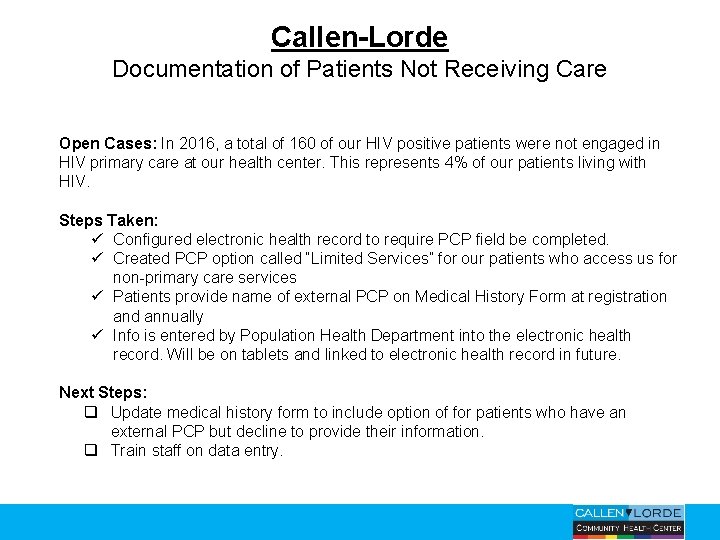
Callen-Lorde Documentation of Patients Not Receiving Care Open Cases: In 2016, a total of 160 of our HIV positive patients were not engaged in HIV primary care at our health center. This represents 4% of our patients living with HIV. Steps Taken: ü Configured electronic health record to require PCP field be completed. ü Created PCP option called “Limited Services” for our patients who access us for non-primary care services ü Patients provide name of external PCP on Medical History Form at registration and annually ü Info is entered by Population Health Department into the electronic health record. Will be on tablets and linked to electronic health record in future. Next Steps: q Update medical history form to include option of for patients who have an external PCP but decline to provide their information. q Train staff on data entry.
QI Contact Information Name: Title: Email: Phone: Lara Comstock, RN Director of Nursing lcomstock@callen-lorde. org 212 -271 -7216 Name: Title: Isaac Evans-Frantz Coordinator of Quality & Performance Improvement iefrantz@callen-lorde. org 212 -271 -7255 Email: Phone:
NYU School of Medicine/Bellevue Hospital Center Pediatric Infectious Disease Clinic Title: HIV Treatment Adherance and Viral Load Suppression Improvement Project September 29, 2017
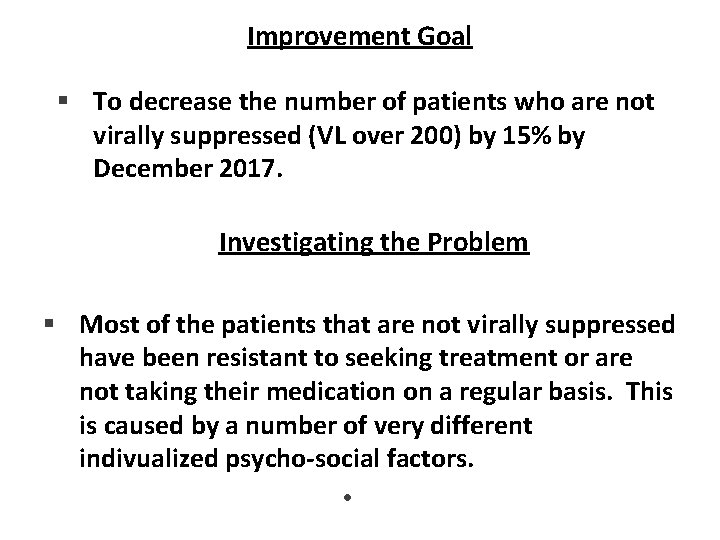
Improvement Goal § To decrease the number of patients who are not virally suppressed (VL over 200) by 15% by December 2017. Investigating the Problem § Most of the patients that are not virally suppressed have been resistant to seeking treatment or are not taking their medication on a regular basis. This is caused by a number of very different indivualized psycho-social factors. •
NYU School of Medicine/Bellevue Hospital Center Pediatric Infectious Disease Clinic Improvement Strategy § Tracking a cohort of unsuppressed individuals for the past 6 months § Conducting monthly 360⁰ case conference § Multiple individualized approaches § Tracking return to treatment and better clinical markers. § Success is minimal, as many in this cohort are not treatment adherent for multiple reasons.
NYU School of Medicine/Bellevue Hospital Center Pediatric Infectious Disease Clinic Results & Next Steps Results • We are tracking individual patient data and qualitative notes on discussions and procedures and follow-up on procedures. Next Steps • Continue to try to connect to this service resistant cohort through a variety of means to reengage in treatment. • Learn from other programs about how they work with unsuppressed “hard-core” treatment/service resistant individuals.
QI Contact Information Name: Jeff Natt Title: Program Manager Email: jeffrey. natt@nyumc. org Phone: 212 263 -1534
Ryan-NENA Community Health Center Ryan-NENA HIV Treatment Cascade Improvement Project: Improving Viral Load Suppression September 29, 2017
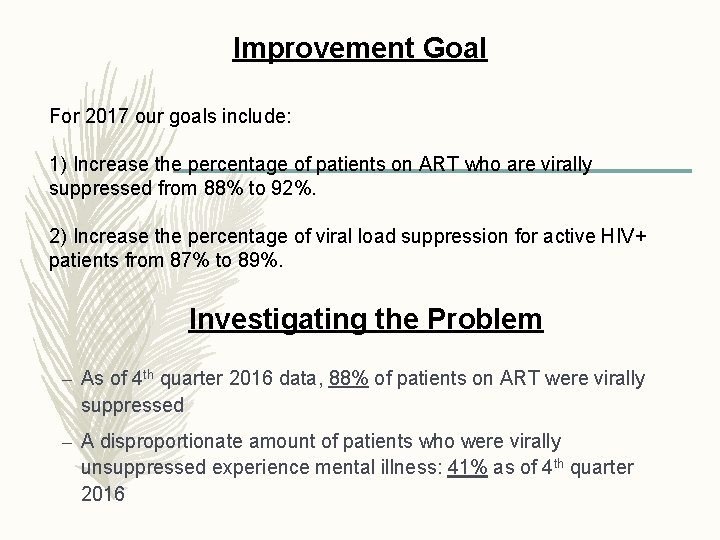
Improvement Goal For 2017 our goals include: 1) Increase the percentage of patients on ART who are virally suppressed from 88% to 92%. 2) Increase the percentage of viral load suppression for active HIV+ patients from 87% to 89%. Investigating the Problem – As of 4 th quarter 2016 data, 88% of patients on ART were virally suppressed – A disproportionate amount of patients who were virally unsuppressed experience mental illness: 41% as of 4 th quarter 2016
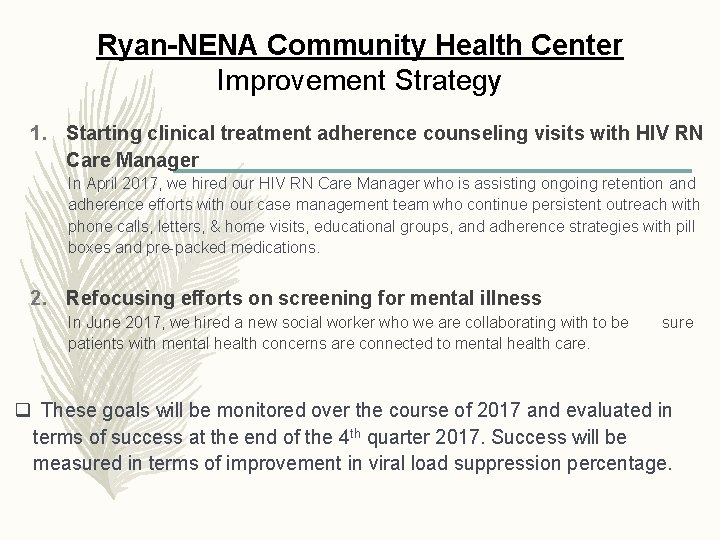
Ryan-NENA Community Health Center Improvement Strategy 1. Starting clinical treatment adherence counseling visits with HIV RN Care Manager In April 2017, we hired our HIV RN Care Manager who is assisting ongoing retention and adherence efforts with our case management team who continue persistent outreach with phone calls, letters, & home visits, educational groups, and adherence strategies with pill boxes and pre-packed medications. 2. Refocusing efforts on screening for mental illness In June 2017, we hired a new social worker who we are collaborating with to be patients with mental health concerns are connected to mental health care. sure q These goals will be monitored over the course of 2017 and evaluated in terms of success at the end of the 4 th quarter 2017. Success will be measured in terms of improvement in viral load suppression percentage.
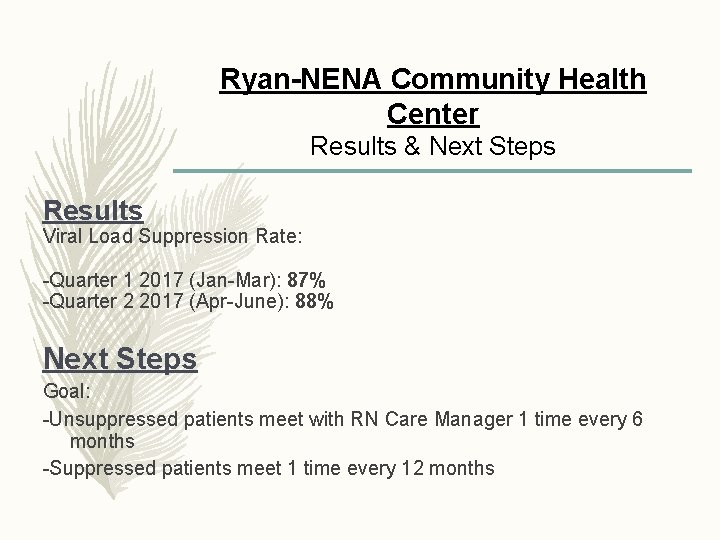
Ryan-NENA Community Health Center Results & Next Steps Results Viral Load Suppression Rate: -Quarter 1 2017 (Jan-Mar): 87% -Quarter 2 2017 (Apr-June): 88% Next Steps Goal: -Unsuppressed patients meet with RN Care Manager 1 time every 6 months -Suppressed patients meet 1 time every 12 months
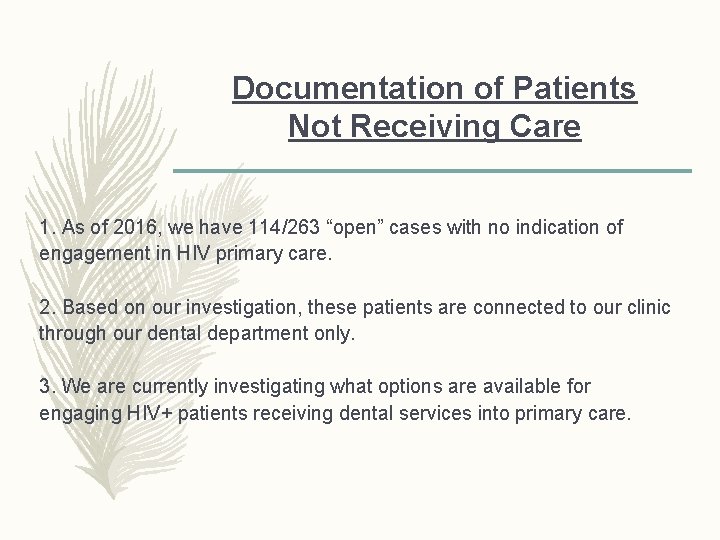
Documentation of Patients Not Receiving Care 1. As of 2016, we have 114/263 “open” cases with no indication of engagement in HIV primary care. 2. Based on our investigation, these patients are connected to our clinic through our dental department only. 3. We are currently investigating what options are available for engaging HIV+ patients receiving dental services into primary care.
QI Contact Information Name: Rebecca Wilson, DNP, FNP-BC Title: HIV Clinical Care Coordinator Email: Rebecca. Wilson@ryan-nena. org Phone: (212) 531 - 7574
Institute for Advanced Medicine, Mount Sinai Health System Viral Load Suppression Improvement Project NY LINKS Lower Manhattan Regional Group September 29, 2017
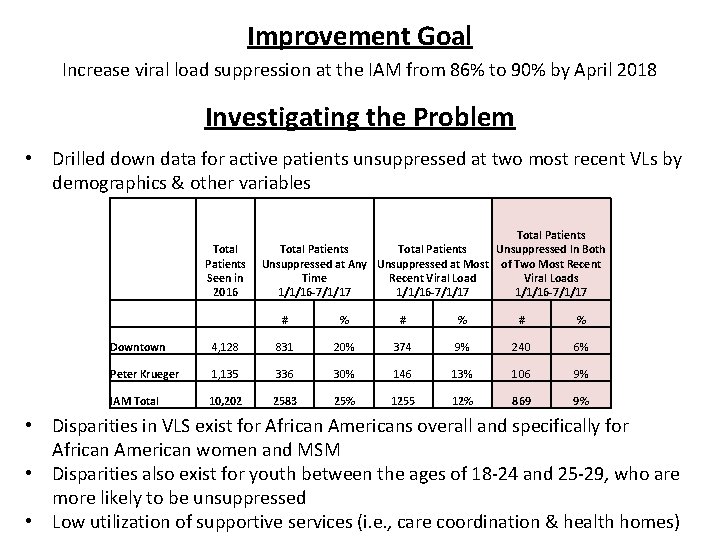
Improvement Goal Increase viral load suppression at the IAM from 86% to 90% by April 2018 Investigating the Problem • Drilled down data for active patients unsuppressed at two most recent VLs by demographics & other variables Total Patients Seen in 2016 Total Patients Unsuppressed In Both Total Patients Unsuppressed at Any Unsuppressed at Most of Two Most Recent Time Recent Viral Loads 1/1/16 -7/1/17 # % # % Downtown 4, 128 831 20% 374 9% 240 6% Peter Krueger 1, 135 336 30% 146 13% 106 9% IAM Total 10, 202 2583 25% 1255 12% 869 9% • Disparities in VLS exist for African Americans overall and specifically for African American women and MSM • Disparities also exist for youth between the ages of 18 -24 and 25 -29, who are more likely to be unsuppressed • Low utilization of supportive services (i. e. , care coordination & health homes)
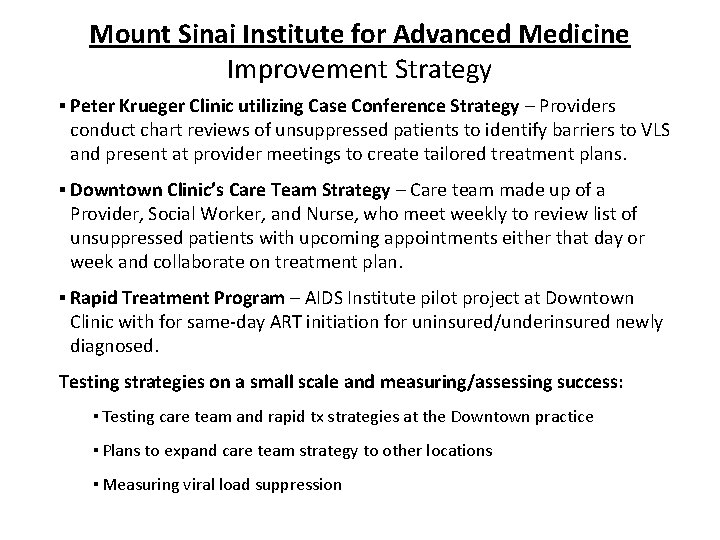
Mount Sinai Institute for Advanced Medicine Improvement Strategy ▪ Peter Krueger Clinic utilizing Case Conference Strategy – Providers conduct chart reviews of unsuppressed patients to identify barriers to VLS and present at provider meetings to create tailored treatment plans. ▪ Downtown Clinic’s Care Team Strategy – Care team made up of a Provider, Social Worker, and Nurse, who meet weekly to review list of unsuppressed patients with upcoming appointments either that day or week and collaborate on treatment plan. ▪ Rapid Treatment Program – AIDS Institute pilot project at Downtown Clinic with for same-day ART initiation for uninsured/underinsured newly diagnosed. Testing strategies on a small scale and measuring/assessing success: ▪ Testing care team and rapid tx strategies at the Downtown practice ▪ Plans to expand care team strategy to other locations ▪ Measuring viral load suppression
Mount Sinai Institute for Advanced Medicine Results & Next Steps Results - TBD Viral load suppression data will be reviewed quarterly at the end of each 4 month PDSA cycle. Next Steps • PDSA Cycle #1: September to December 2017 • Share lessons learned of provider chart review at Peter Krueger • Refine and expand care team approach at Downtown Clinic to other IAM clinics
QI Contact Information Name: Amy Newton Title: HIV QI Manager Email: Amy. Newton@mountsinai. org Phone: 212 -604 -1755 Name: Shruti Ramachandran Title: Director of Quality Management and Evaluation Email: Shruti. Ramachandran@mountsinai. org Phone: 212 -604 -1737
Metro. Plus Health Plan HIV Et. E Cascade Improvement Project September 29, 2017
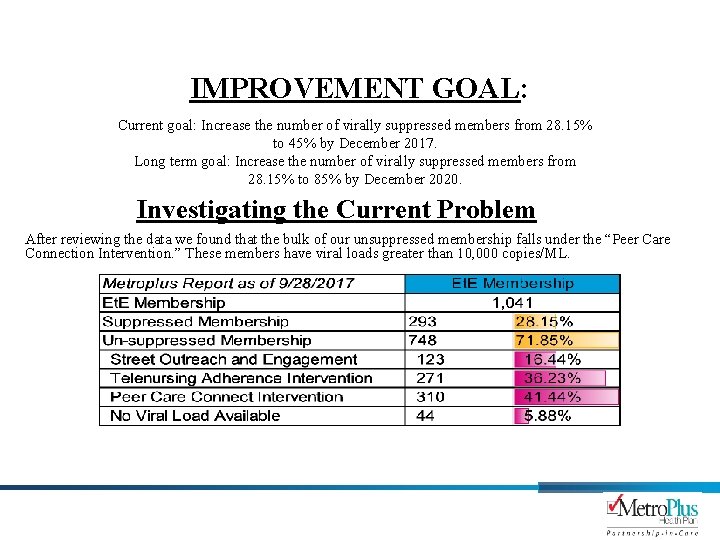
IMPROVEMENT GOAL: Current goal: Increase the number of virally suppressed members from 28. 15% to 45% by December 2017. Long term goal: Increase the number of virally suppressed members from 28. 15% to 85% by December 2020. Investigating the Current Problem After reviewing the data we found that the bulk of our unsuppressed membership falls under the “Peer Care Connection Intervention. ” These members have viral loads greater than 10, 000 copies/ML.
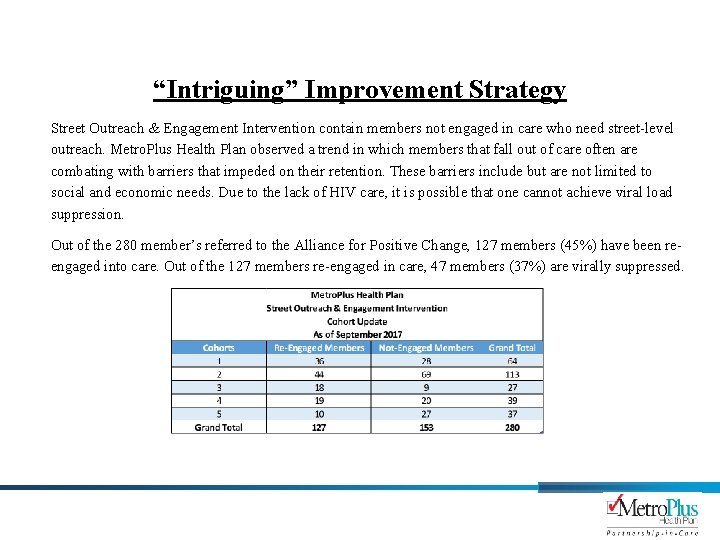
“Intriguing” Improvement Strategy Street Outreach & Engagement Intervention contain members not engaged in care who need street-level outreach. Metro. Plus Health Plan observed a trend in which members that fall out of care often are combating with barriers that impeded on their retention. These barriers include but are not limited to social and economic needs. Due to the lack of HIV care, it is possible that one cannot achieve viral load suppression. Out of the 280 member’s referred to the Alliance for Positive Change, 127 members (45%) have been reengaged into care. Out of the 127 members re-engaged in care, 47 members (37%) are virally suppressed.
Next Steps § Expand the “Adherence Technology Intervention” by hiring a Pharmacy Technician to do telephonic treatment adherence education. § Review pharmacy refill claims to analyze member adherence trends.
Addressing Our “Open” Caseload § § 44 (5. 88%) members in 2017 were “open” & had no documentation of HIV primary care. Through claims we were able to identify that 28 (63%) of our members are receiving some form of care within a non-HIV primary care site. The remaining 17 member have no contact information and Metro. Plus was unable to locate them through claims. We are partnering with the Alliance for Positive change to outreach to these members who are lost to care.
QI Contact Information Name: Title: Email: Phone: Mervin Otero Quality and Compliance Manager Oterome@metroplus. org (212) 908 -8862
Betances Health Center Title: HIV Treatment Cascade Improvement Project September 29, 2017
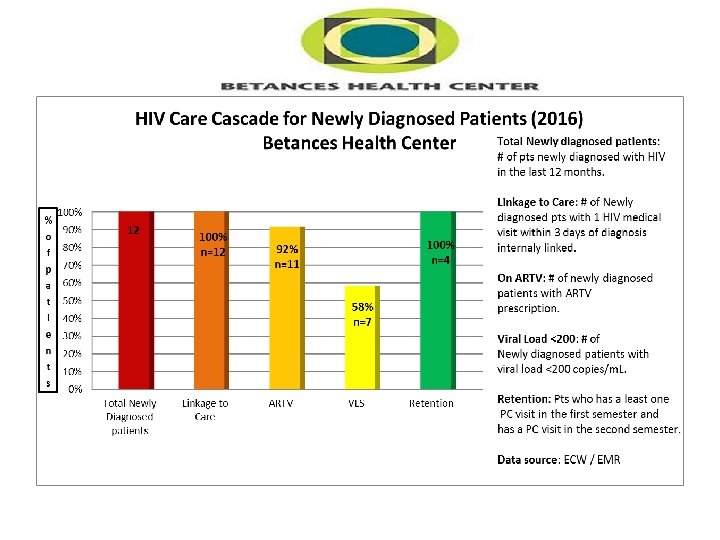
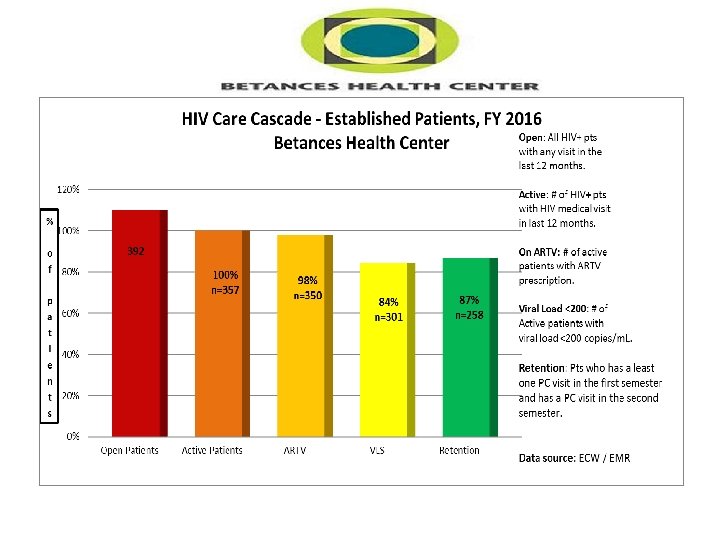
Improvement Goal To increase the number of patients with viral load suppression from 84% to 88% at the end of December 2017. Investigating the Problem • Patients with mental health problems are less likely to adhere to medication. • We only requested referral to receive ancillary care services. • We are not requesting medical information such as VL/CD 4.
Betances Health Center Improvement Strategy, Results & Next Steps Results By doing multiple interventions leading to Viral Load suppression we were able to report 90% VLS at the end of August 2017. Next Steps • Describe your next steps: We will keep doing multiple customize interventions according to the patient. We show pamphlets, graphics of disease progression to patients, health education groups leading to treatment adherence.
Documentation of Patients Not Receiving Care 1. All “open” HIV+ cases have documentation of engagement in HIV primary care. 2. We only see patients with referral from their primary care physicians. 3. What challenges remain to be addressed? Medical records with VL and CD 4 data.
QI Contact Information Name: Fidel Bu Contreras Title: Program Director Email: fcontreras@betances. org Phone: 221 -227 -8401
Clinical: New. York-Presbyterian Hospital Title: NYP Open HIV Case Project – Care Cascade September 29, 2017
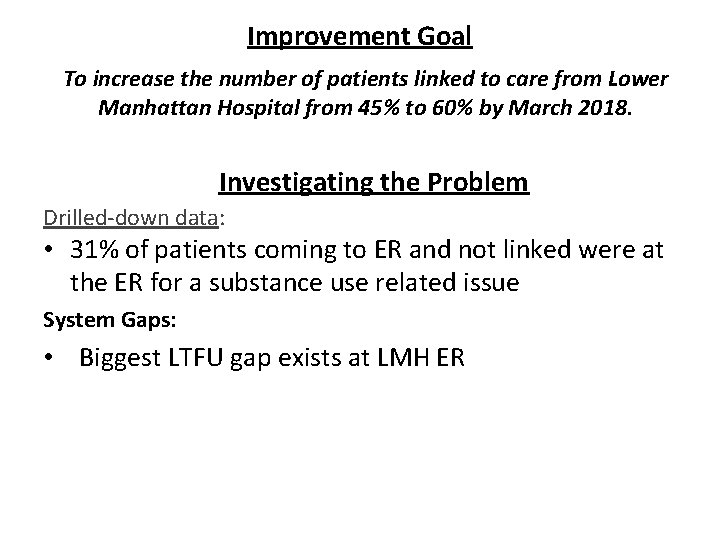
Improvement Goal To increase the number of patients linked to care from Lower Manhattan Hospital from 45% to 60% by March 2018. Investigating the Problem Drilled-down data: • 31% of patients coming to ER and not linked were at the ER for a substance use related issue System Gaps: • Biggest LTFU gap exists at LMH ER
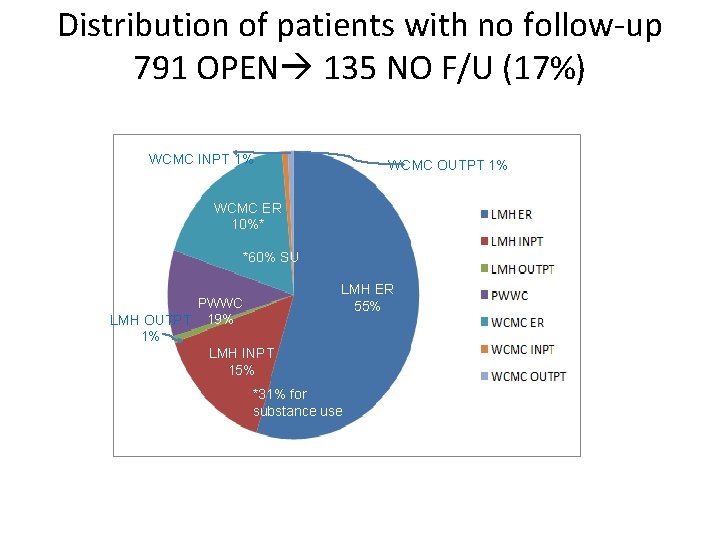
Distribution of patients with no follow-up 791 OPEN 135 NO F/U (17%) WCMC INPT 1% WCMC OUTPT 1% WCMC ER 10%* *60% SU PWWC LMH OUTPT 19% 1% LMH INPT 15% LMH ER 55% *31% for substance use
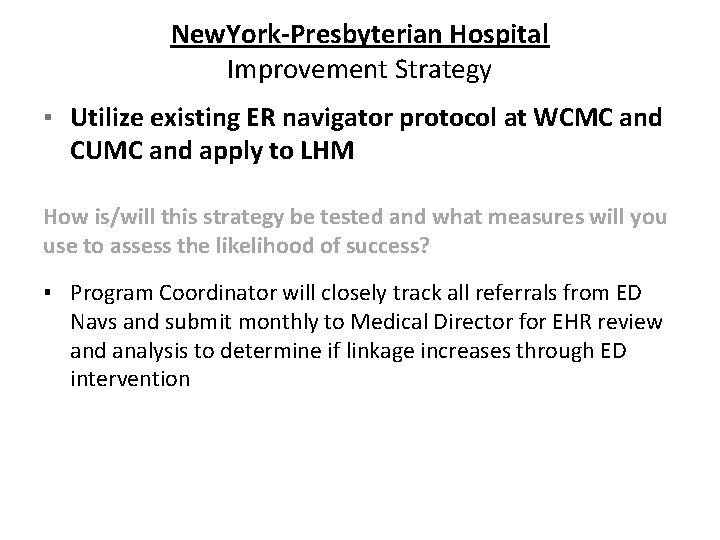
New. York-Presbyterian Hospital Improvement Strategy ▪ Utilize existing ER navigator protocol at WCMC and CUMC and apply to LHM How is/will this strategy be tested and what measures will you use to assess the likelihood of success? ▪ Program Coordinator will closely track all referrals from ED Navs and submit monthly to Medical Director for EHR review and analysis to determine if linkage increases through ED intervention
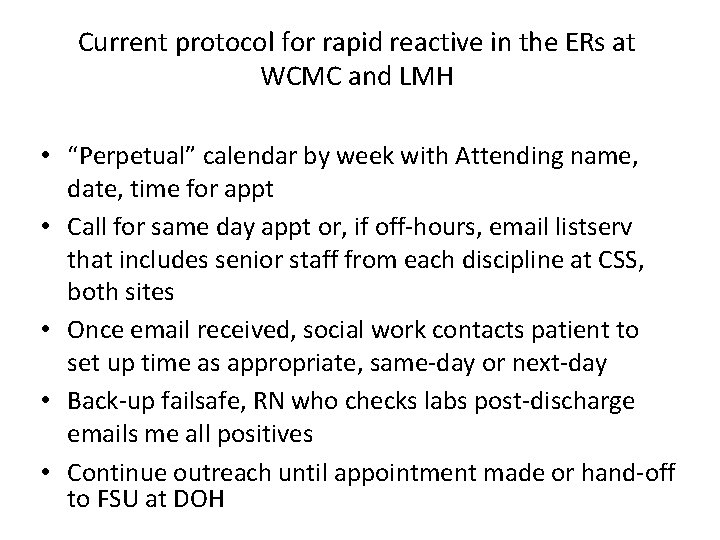
Current protocol for rapid reactive in the ERs at WCMC and LMH • “Perpetual” calendar by week with Attending name, date, time for appt • Call for same day appt or, if off-hours, email listserv that includes senior staff from each discipline at CSS, both sites • Once email received, social work contacts patient to set up time as appropriate, same-day or next-day • Back-up failsafe, RN who checks labs post-discharge emails me all positives • Continue outreach until appointment made or hand-off to FSU at DOH
Open Caseload 1. Cases with no indication of engagement in HIV primary care (nor of incarceration or death in 2016).
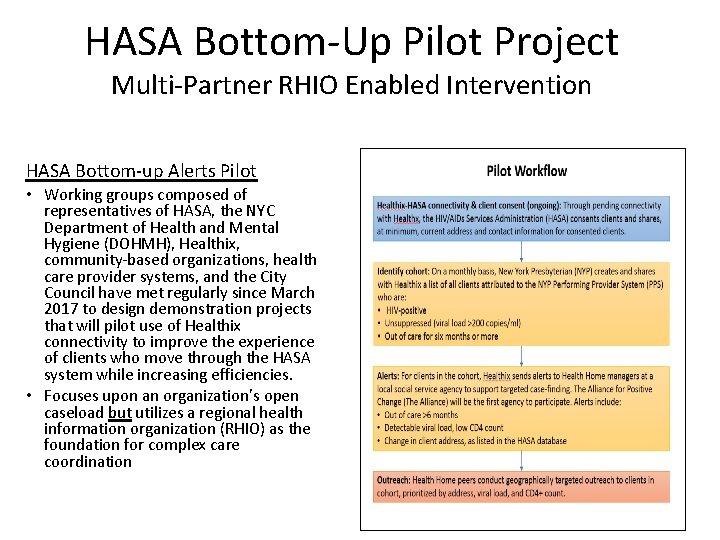
HASA Bottom-Up Pilot Project Multi-Partner RHIO Enabled Intervention HASA Bottom-up Alerts Pilot • Working groups composed of representatives of HASA, the NYC Department of Health and Mental Hygiene (DOHMH), Healthix, community-based organizations, health care provider systems, and the City Council have met regularly since March 2017 to design demonstration projects that will pilot use of Healthix connectivity to improve the experience of clients who move through the HASA system while increasing efficiencies. • Focuses upon an organization’s open caseload but utilizes a regional health information organization (RHIO) as the foundation for complex care coordination
ER system not yet good enough • Navigators unable to cover 24/7/365, and patients slip through • Need a real-time IT solution to identify patients with HIV diagnosis for chart review and follow-up during or shortly after ER visit • Ideally would then access RHIO to see where patients receive care or if they are connected to any CBOs (consent issues) • Social workers, case managers, peers can do outreach for patients who are not in care • Need to be able to access CSR without 6 -month limit for these kinds of patients if RHIO doesn’t return information or unable to reach • CSR doesn’t allow submission of patients with no labs, or who may have returned to the ER again recently but are still potentially out of care
QI Contact Information Name: Marianna da Costa Title: Practice Care Facilitator (Program Coord) Email: mrd 9188@nyp. org Phone: 212 -746 -7164
Questions/Answers/Ideas • Please refer to your notes: - Is there a project that stands out for you? - Strategies that you may apply to your own work? - Questions? - Suggestions to refine or build upon an existing strategy based upon your agencies experience? - Any potential partnerships to help accelerate positive change?
Time-Out/Team Planning • Take a moment to review your organizational HIV treatment cascade goals, along with our collaborative goals. Take notes. . . • Are these aligned? Are there ways to refine your QI work or new partnerships that you can implement to help move our region further toward the goals? • How are/will you document your improvement strategies and measure the impact to easily share success or challenges with stakeholders and the region
Finding & Engaging Those “Lost to Care” QI Tool: Force Field Analysis Nova West | NYSDOH – AI Jonathan Gómez | NYSDOH – AI
“Open Cases – No Record of Care” Current Situation • Persons living with HIV require linkage and ongoing engagement in medical care to improve clinical outcomes and reduce the risk of onward HIV transmission • 2016 Organizational HIV Treatment Cascades reveal a large number of PLWH “touching” our systems with little/no information about their engagement in HIV medical care. • Many are entering the system through ER, Urgent Care & as in patients. It’s likely that these same individuals are also accessing supportive services.
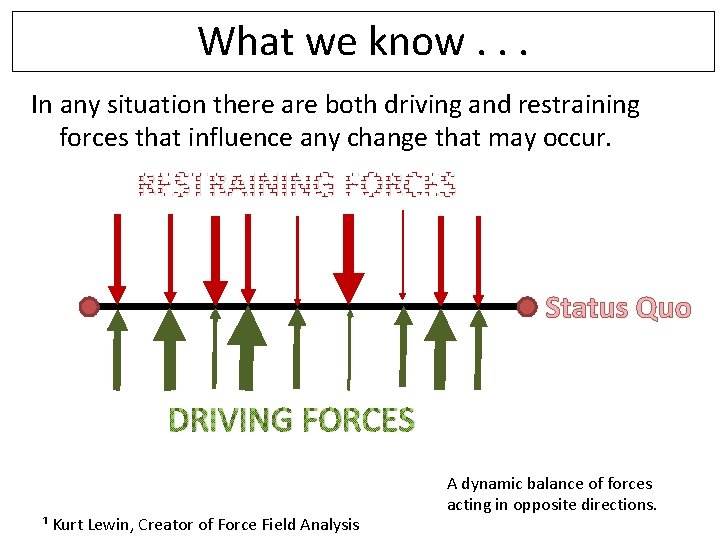
What we know. . . In any situation there are both driving and restraining forces that influence any change that may occur. RESTRAINING FORCES Status Quo DRIVING FORCES ¹ Kurt Lewin, Creator of Force Field Analysis A dynamic balance of forces acting in opposite directions.
Our Goal Pick One Identify strategies to leverage existing resources/factors, minimize hindering factors &/or identify new collaborative strategies to: 1. Expeditiously determine if these individuals (“open – non-active cases” from 2016) are engaged in HIV primary care. OR 2. Help locate and link individuals who are determined to be “out of care” into HIV primary care.
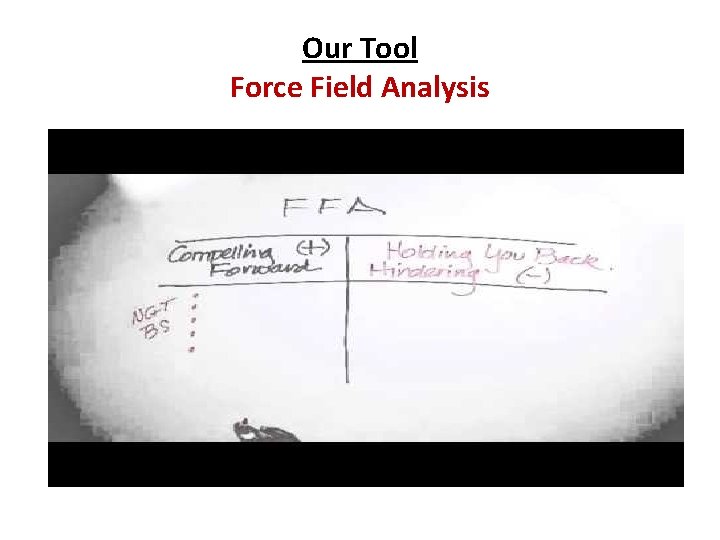
Our Tool Force Field Analysis
Group Work (50 Minutes) What’s needed – “Force Field Analysis” Instructions; large flip-chart pages; open and equal sharing; Group Work & Time: ü Select a facilitator and recorder ü As a group – complete a Force Field Analysis Part I: Develop A Force Field Diagram (20 Mins) Part II: Analyze the FF to develop strategies (20 mins) ü Report Back (10 mins) Share the most promising or collaborative strategy ü If time permits. . . Vote on Best!!
The Training of Consumers on Quality Daniel Tietz | NYSDOH – AI
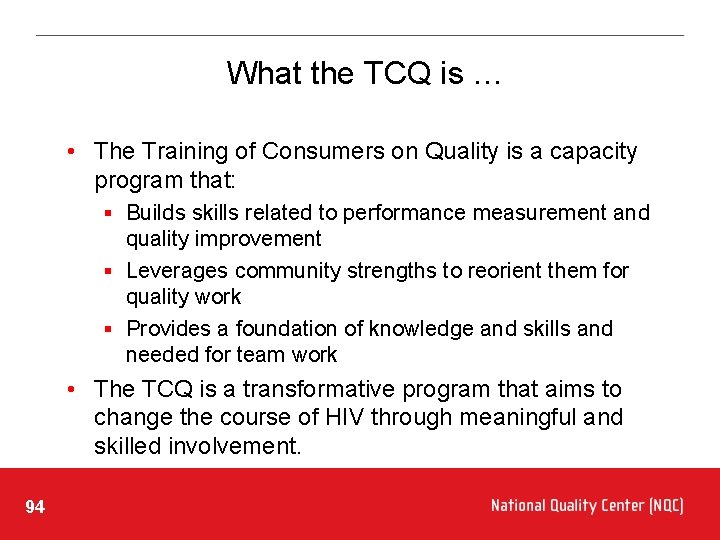
What the TCQ is … • The Training of Consumers on Quality is a capacity program that: § Builds skills related to performance measurement and quality improvement § Leverages community strengths to reorient them for quality work § Provides a foundation of knowledge and skills and needed for team work • The TCQ is a transformative program that aims to change the course of HIV through meaningful and skilled involvement. 94
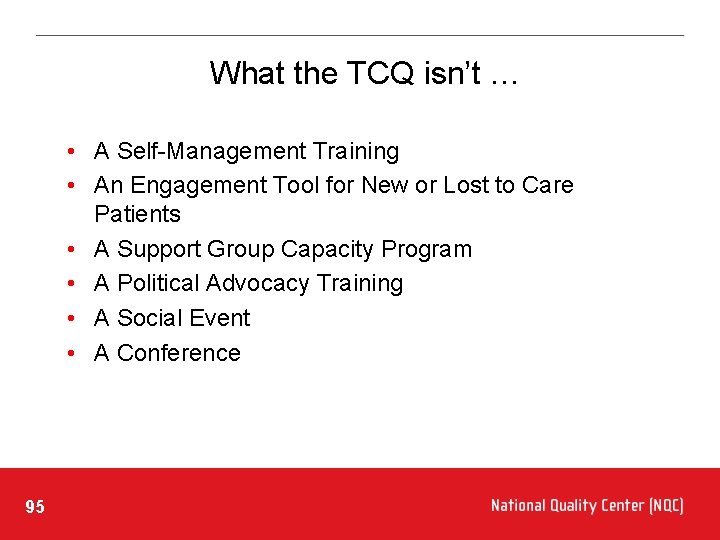
What the TCQ isn’t … • A Self-Management Training • An Engagement Tool for New or Lost to Care Patients • A Support Group Capacity Program • A Political Advocacy Training • A Social Event • A Conference 95
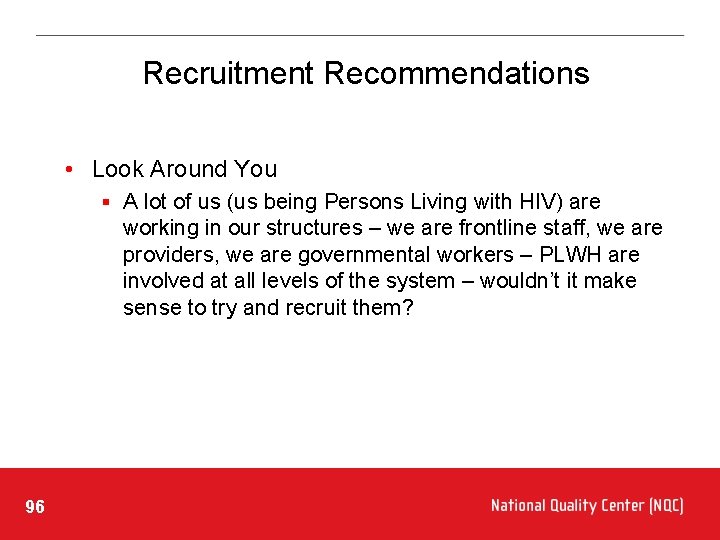
Recruitment Recommendations • Look Around You § A lot of us (us being Persons Living with HIV) are working in our structures – we are frontline staff, we are providers, we are governmental workers – PLWH are involved at all levels of the system – wouldn’t it make sense to try and recruit them? 96
Example of a TCQ Activity Becoming an Advocate for Quality Improvement When we cannot communicate, we get sick, and as our sickness increases, we suffer and spill our suffering on other people. ~ Thich Nhat Hanh
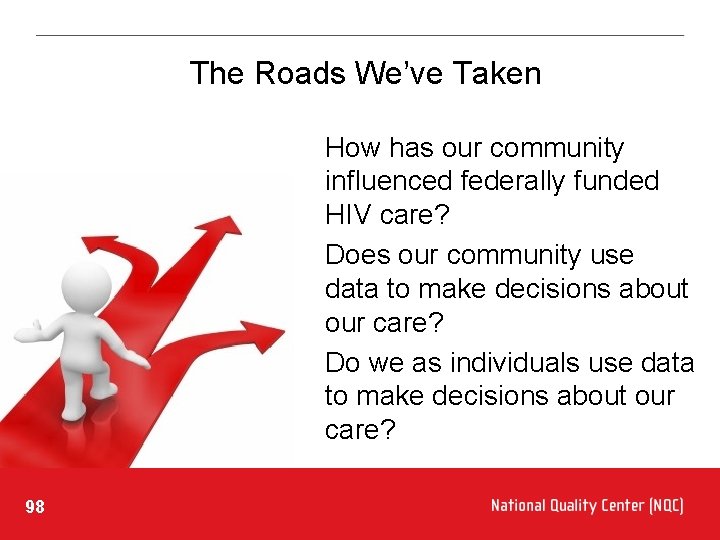
The Roads We’ve Taken How has our community influenced federally funded HIV care? Does our community use data to make decisions about our care? Do we as individuals use data to make decisions about our care? 98
History and Methods of PLWH Involvement
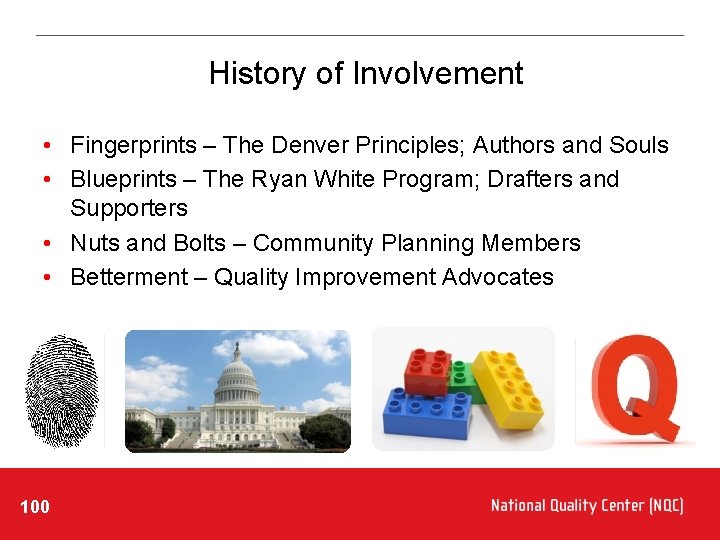
History of Involvement • Fingerprints – The Denver Principles; Authors and Souls • Blueprints – The Ryan White Program; Drafters and Supporters • Nuts and Bolts – Community Planning Members • Betterment – Quality Improvement Advocates 100
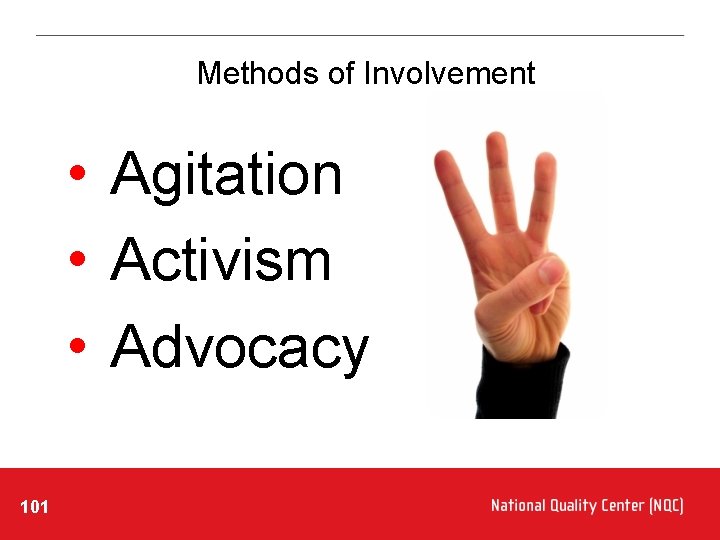
Methods of Involvement • Agitation • Activism • Advocacy 101
Definitions • Agitator – 1663 § One who stirs up public feeling on controversial issues § Synonyms: exciter, incendiary, inciter, instigator, rabble- rouser • Activism – 1915 § A doctrine or practice that emphasizes direct vigorous action especially in support of or opposition to one side of a controversial issue • Advocate – 14 th Century § One that pleads the cause of another; specifically: one that pleads the cause of another before a tribunal or judicial court § One that defends or maintains a cause or proposal § One that supports or promotes the interests of another 102
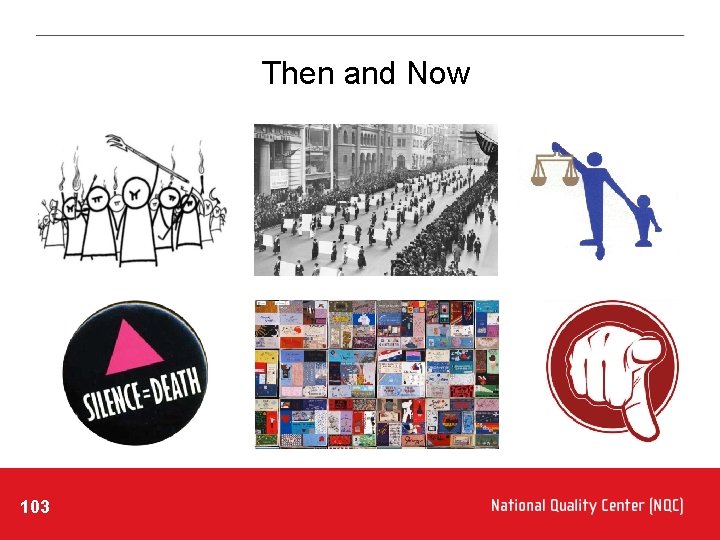
Then and Now 103
Quality Advocates are: 1. Activated Patients 2. Comfortable with data 3. Effective communicators 4. Comfortable with technology 5. Effective and supportive team members 6. Quality improvement literate 104
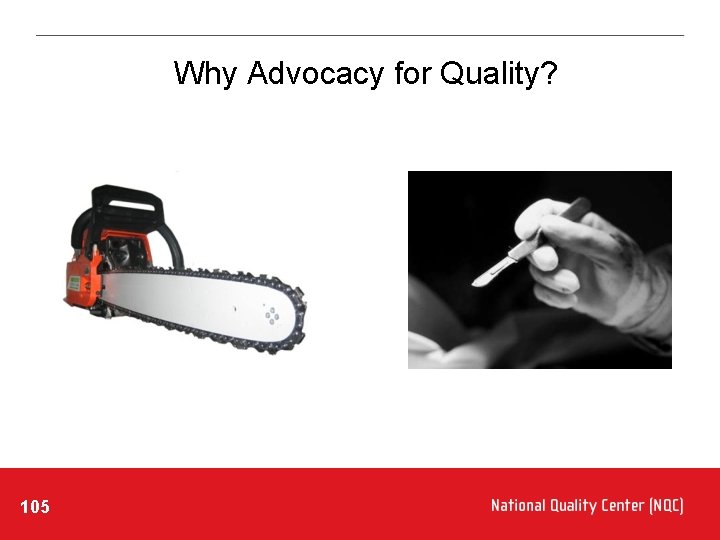
Why Advocacy for Quality? 105

THAT INTAKE FORM MUST GO! 106
Process: Selecting a Method of Involvement 1. 2. 3. 4. 5. 107 Identify problem Identify stakeholders Examine relationships Determine response Select involvement method
Discussion
Discussion • Does our HIV community use all the methods appropriately and effectively? • How might this framework change our activities in relationship to improving HIV care through partnerships with providers? • Does our community have well established and productive partnerships to meet the needs of the epidemic today? 109
Thank you and Contact Information Daniel Tietz Director, Consumer Affairs New York State Department of Health AIDS Institute National Quality Center daniel. Tietz@heatlh. ny. gov 110
Wrap Up: Team Planning, Next Steps and Evaluation Jonathan Gómez | NYSDOH – AI
Team Planning • Consider the 4 areas covered today: ⁻ HIV Treatment Cascades and QI Projects ⁻ Identifying & engaging “open non-active” PLWH in HIV medical care and services ⁻ Building partnerships with other agencies to address expedited linkage to care, engagement in treatment and/or VLS - Building capacity for consumer involvement in QI
Important Dates • October 31 st – 2 nd Submission of the Stigma Reduction Plan Due • October 31 st – 1 st Data Submission for the HIV Tobacco Cessation Improvement Campaign • December 19 th - Next Full Group Meeting • Early December - QI Project Updates for Sharing • November – Guidance for 2017 Organizational HIV Tx Cascades Stay Tuned: • Healthix Meeting vs Webinar • Training Consumers in Quality
For QI/QM Questions or Assistance Contact Jonathan Gómez 212 -417 -4757 jonathan. gomez@health. ny. gov Susan Weigl sweigl@yahoo. com

Thanks!! Lower Manhattan Steering Committee, AI Coaches, & All Participants @ Today’s meeting
- Slides: 115