
Welcome Knowledge for Healthcare Mobilising Evidence and Organisational
Welcome
Knowledge for Healthcare: Mobilising Evidence and Organisational Knowledge London April 3 2017 @NHS_Health. Ed. Eng #HEELKS
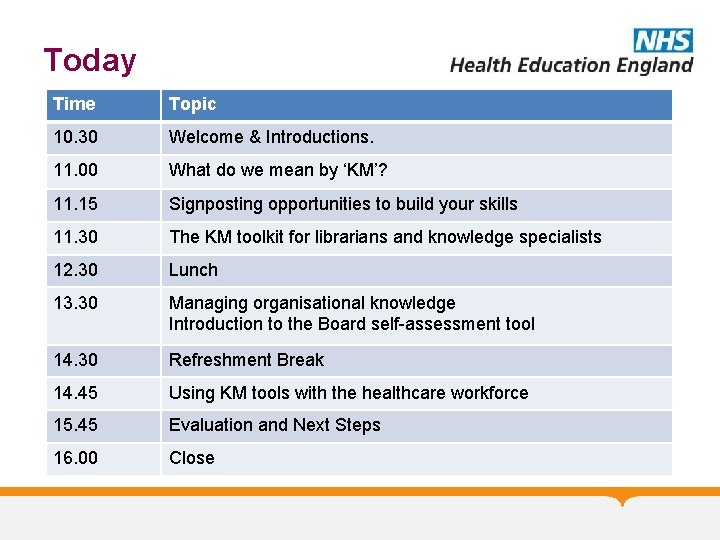
Today Time Topic 10. 30 Welcome & Introductions. 11. 00 What do we mean by ‘KM’? 11. 15 Signposting opportunities to build your skills 11. 30 The KM toolkit for librarians and knowledge specialists 12. 30 Lunch 13. 30 Managing organisational knowledge Introduction to the Board self-assessment tool 14. 30 Refreshment Break 14. 45 Using KM tools with the healthcare workforce 15. 45 Evaluation and Next Steps 16. 00 Close
Our ambition To bring Knowledge for Healthcare to all NHS funded organisations in England Why? Knowledge is a valuable asset that needs to be managed so that healthcare organisations are able to apply knowledge, build know-how and continue to learn in order to improve organisational efficiencies and patient outcomes
Purpose To enable and encourage healthcare librarians and knowledge specialists to: • Build skills and confidence in using selected tools and techniques • better manage knowledge as a routine element of our everyday work • collaborate on ‘Knowledge Management’ solutions across library services, and across internal teams • engage our colleagues - librarians, knowledge specialists and other healthcare professionals – in better mobilising the evidence and using organisational knowledge

Introductions
The sheer amount can be overwhelming; one local authority chief executive described how he receives at least 100 pieces of evidence in his inbox every week. The pace of change in local public services means that people are constantly responding to new policies and thus have little time or capacity to find out what is going on in other areas. The real challenge lies in “knowing where to go” and who to go to. Sophie Wilson et al. Local public service reform. Institute for Government, 2016
Healthcare library and knowledge services are a powerhouse for education, lifelong learning, research and evidence-based practice. Our ambition is to extend this role so that healthcare knowledge services become business-critical instruments of informed decisions making and innovation. Professor Ian Cumming - Knowledge for Healthcare Development Framework
Mobilising the evidence base “Evidence does not speak for itself but needs to be mobilised at the right time, and through the right people, to make a difference in decision making. ” National Institute for Health Research, 2013
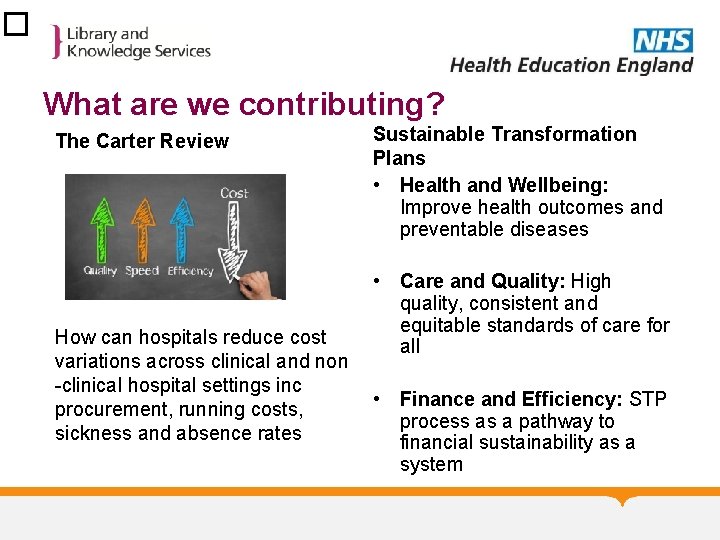
� What are we contributing? The Carter Review How can hospitals reduce cost variations across clinical and non -clinical hospital settings inc procurement, running costs, sickness and absence rates Sustainable Transformation Plans • Health and Wellbeing: Improve health outcomes and preventable diseases • Care and Quality: High quality, consistent and equitable standards of care for all • Finance and Efficiency: STP process as a pathway to financial sustainability as a system
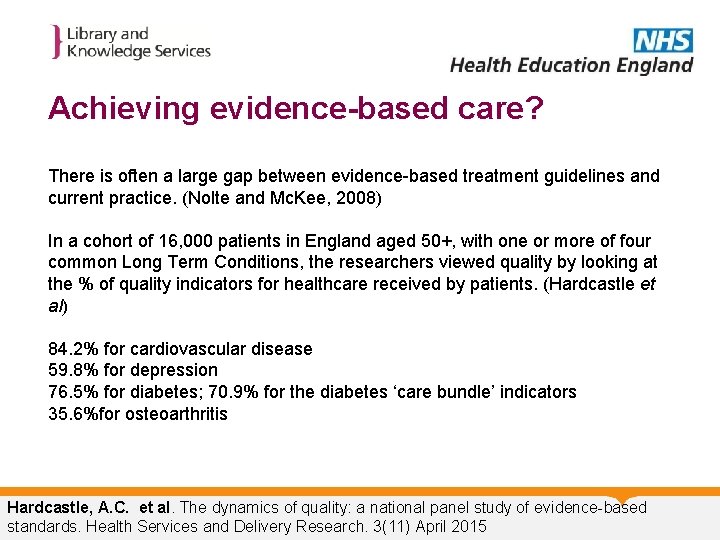
Achieving evidence-based care? There is often a large gap between evidence-based treatment guidelines and current practice. (Nolte and Mc. Kee, 2008) In a cohort of 16, 000 patients in England aged 50+, with one or more of four common Long Term Conditions, the researchers viewed quality by looking at the % of quality indicators for healthcare received by patients. (Hardcastle et al) 84. 2% for cardiovascular disease 59. 8% for depression 76. 5% for diabetes; 70. 9% for the diabetes ‘care bundle’ indicators 35. 6%for osteoarthritis Hardcastle, A. C. et al. The dynamics of quality: a national panel study of evidence-based standards. Health Services and Delivery Research. 3(11) April 2015
Business critical Healthcare Library and Knowledge Specialists can play a pivotal role in helping organisations to identify and seize opportunities to achieve productivity, realise efficiency savings and improve the quality of patient care. For example - • Increase and improve the use of evidence into practice through provision of synthesised, summarised evidence and horizon scanning products • Develop tools, processes and resources so that healthcare staff can effectively share organisational knowledge and know-how
Library and Knowledge Services Policy HEE is committed to: • Enabling all NHS workforce members to freely access library and knowledge services so that they can use the right knowledge and evidence to achieve excellent NIHR healthcare and health improvement. • Developing NHS librarians and knowledge specialists to use their expertise to mobilise evidence obtained from research and organisational knowledge to underpin decision-making in the National Health Service in England
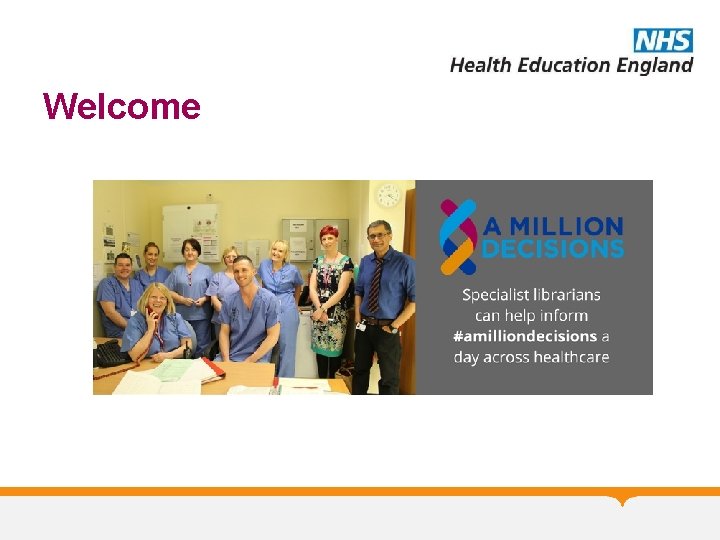
#AMillion. Decisions Joint campaign by HEE and CILIP, launched 30 th January: • #AMillion. Decisions highlights the role of librarians and knowledge specialists in delivering evidence to support more than a million decisions a day across the healthcare sector. • Raises awareness amongst health organisations that “the use in the health service of evidence obtained from research” is a legal requirement under the Health and Social Care Act 2012. • Official launch was extremely wide-reaching with over a million impressions for the #amilliondecisions hashtag
What do we mean by Knowledge Management?
Knowledge Management ". . . It's not about creating an encyclopaedia that captures everything that anybody ever knew. Rather, it's about keeping track of those who know the recipe, and nuturing the culture and the technology that will get NIHR them talking. . . " Arian Ward of Work Frontiers International
Knowledge Management The use of knowledge in your work. The use of resources and or people. Using knowledge to improve care. Knowing what we know who, where & what for critical information NIHR From staff at Maidstone and Tunbridge Wells NHS Trust
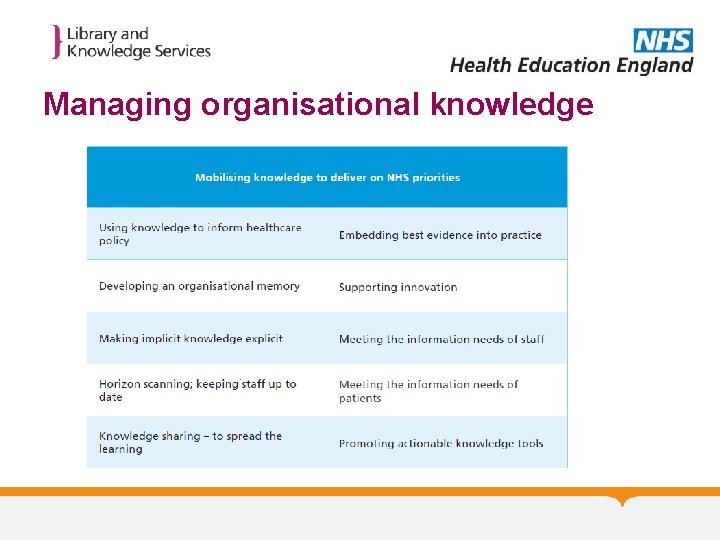
Managing organisational knowledge
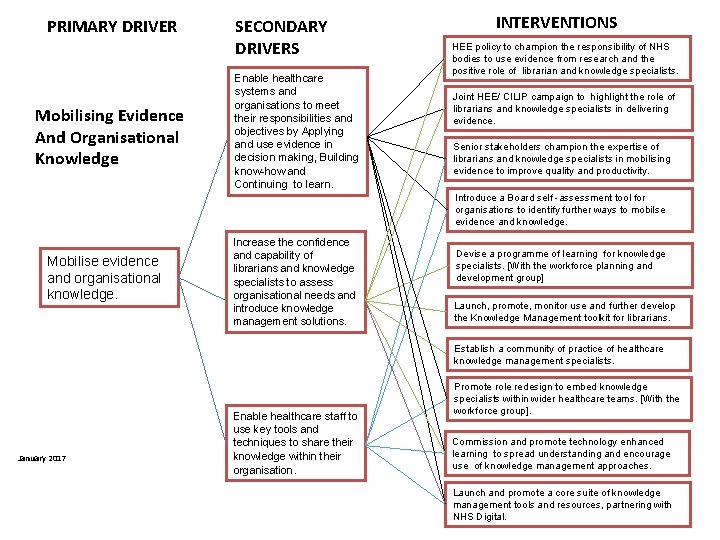
PRIMARY DRIVER Mobilising Evidence And Organisational Knowledge SECONDARY DRIVERS Enable healthcare systems and organisations to meet their responsibilities and objectives by Applying and use evidence in decision making, Building know-how and Continuing to learn. INTERVENTIONS HEE policy to champion the responsibility of NHS bodies to use evidence from research and the positive role of librarian and knowledge specialists. Joint HEE/ CILIP campaign to highlight the role of librarians and knowledge specialists in delivering evidence. Senior stakeholders champion the expertise of librarians and knowledge specialists in mobilising evidence to improve quality and productivity. Introduce a Board self -assessment tool for organisations to identify further ways to mobilse evidence and knowledge. Mobilise evidence and organisational knowledge. Increase the confidence and capability of librarians and knowledge specialists to assess organisational needs and introduce knowledge management solutions. Devise a programme of learning for knowledge specialists. [With the workforce planning and development group] Launch, promote, monitor use and further develop the Knowledge Management toolkit for librarians. Establish a community of practice of healthcare knowledge management specialists. January 2017 Enable healthcare staff to use key tools and techniques to share their knowledge within their organisation. Promote role redesign to embed knowledge specialists within wider healthcare teams. [With the workforce group]. Commission and promote technology enhanced learning to spread understanding and encourage use of knowledge management approaches. Launch and promote a core suite of knowledge management tools and resources, partnering with NHS Digital.
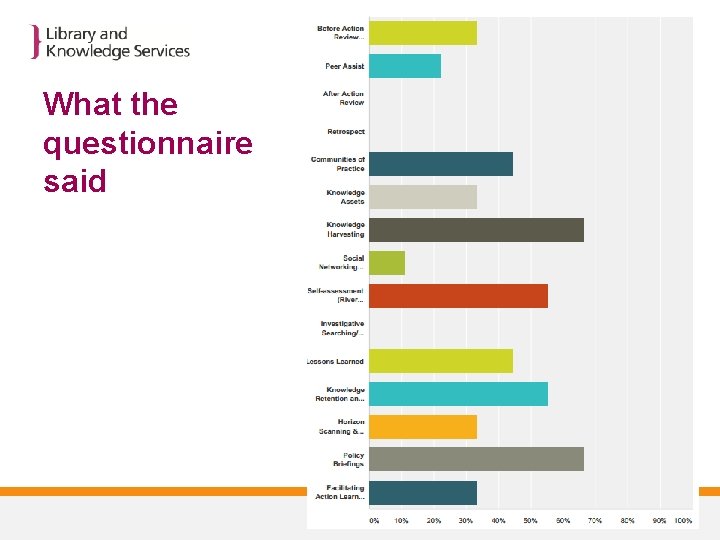
What the questionnaire said
Signposting opportunities to build your skills
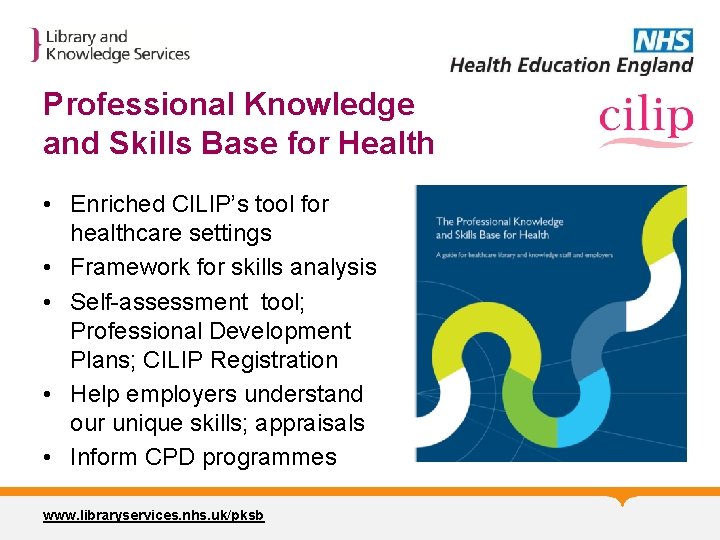
Professional Knowledge and Skills Base for Health • Enriched CILIP’s tool for healthcare settings • Framework for skills analysis • Self-assessment tool; Professional Development Plans; CILIP Registration • Help employers understand our unique skills; appraisals • Inform CPD programmes www. libraryservices. nhs. uk/pksb
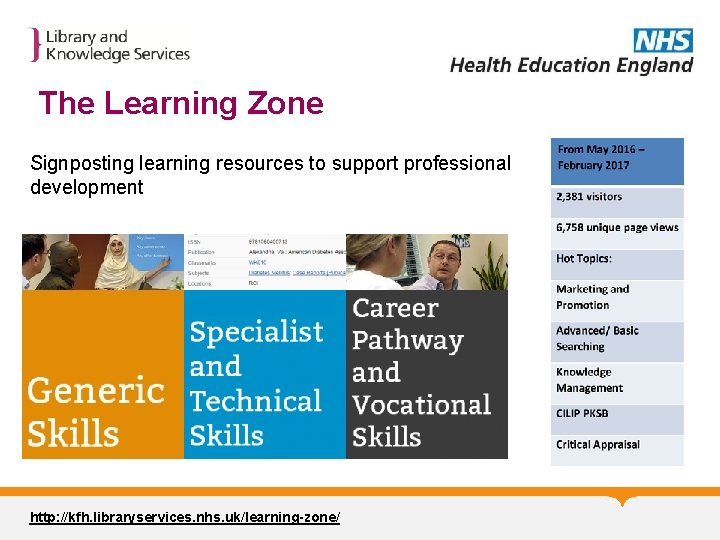
The Learning Zone Signposting learning resources to support professional development http: //kfh. libraryservices. nhs. uk/learning-zone/
Development opportunities A wealth of opportunities and learning resources have been put in place enabling individuals to progressively enhance their skills, confidence and roles in mobilising evidence and organisational knowledge • Core skills Introducing knowledge and evidence Everyday knowledge and evidence in health care settings • Expanding the core skill set Mobilising organisational knowledge in health care settings • Leadership skills Leading knowledge services • Advanced specialist skills Advanced KM: formal qualifications • Resources and Tools
A business critical workforce • Synthesising and Summarising – Tim Buckley Owen – Plus 3 follow- up packs & group sessions “It has given me confidence when writing summaries” “I now have a method to quickly evaluate the evidence prior to writing the summary” • Making LKS Business Critical – Anne Gray “This was a really useful session and introduced me to quite a few resources I hadn’t encountered before. Between the discussion of what managers want and seeing the range of documents at the end of the day, I have a much clearer idea about what is required and where I need to change my approach from that of a clinical librarian. ”
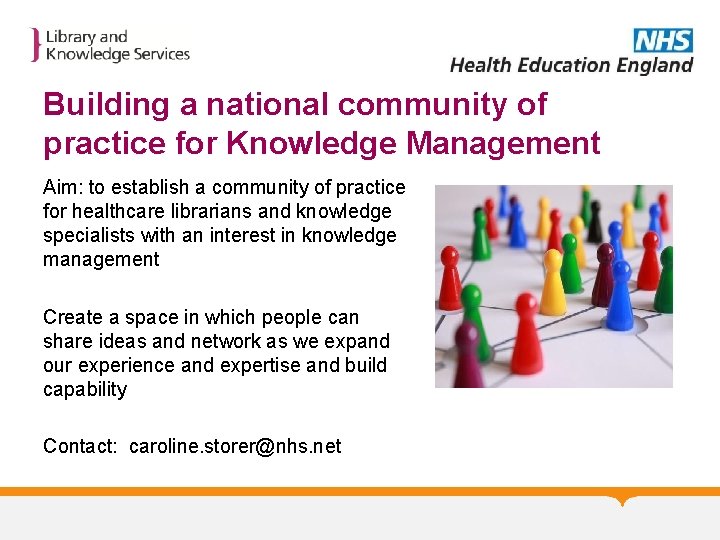
Building a national community of practice for Knowledge Management Aim: to establish a community of practice for healthcare librarians and knowledge specialists with an interest in knowledge management Create a space in which people can share ideas and network as we expand our experience and expertise and build capability Contact: caroline. storer@nhs. net
Northern KM Group • Historically Yorkshire and Humber and North West • Membership includes: o National Organisations: NHS England, Public Health England, NHS Digital, Health Education England o Acute, community and mental health trusts o Non NHS healthcare organisations o 20 members representing 12 organisations
What do you think? • What is our driver? • What value are we trying to create? • How do you want to share knowledge?
Knowledge Management Toolkit
KM Toolkit • Aim: to support LKS to fulfil the KM purpose & goals in Kf. H • Task & finish group carried out scoping for good examples • Gathered together good practice and tools • Toolkit is to share and spread good practice and how to achieve the KM goals • Not static – we still want more examples • It will develop along with KM work in LKS http: //kfh. libraryservices. nhs. uk/knowledge-management/
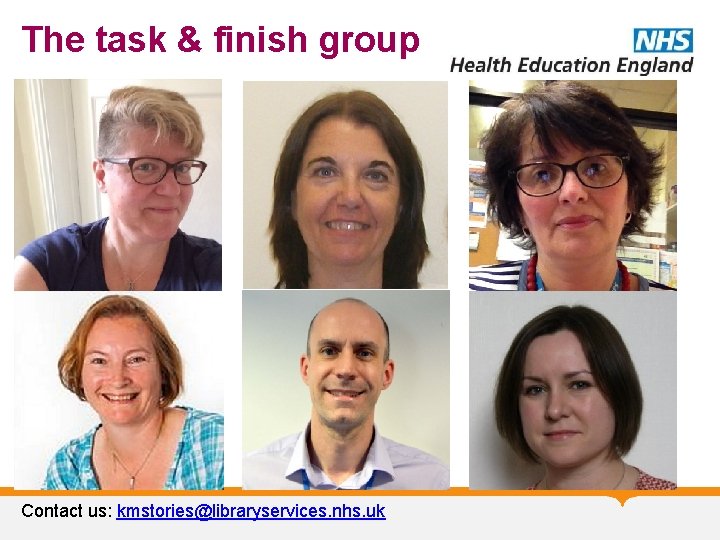
The task & finish group Contact us: kmstories@libraryservices. nhs. uk
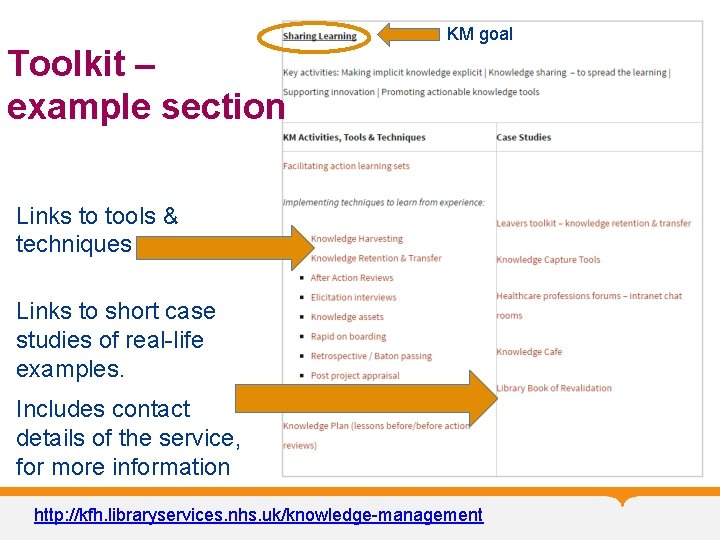
KM goal Toolkit – example section Links to tools & techniques Links to short case studies of real-life examples. Includes contact details of the service, for more information http: //kfh. libraryservices. nhs. uk/knowledge-management
The Knowledge Café • We are going to run this session as a knowledge café • After this introductory talk, we will break into small groups to discuss the overall question • We will move every 15 minutes to focus on a different tool/technique • Purpose is to share ideas about how you might use this technique or achieve a goal • Not to ‘solve’ the problem outright but to share ideas and develop a way forward for each of you
Knowledge Café (cont) • Each table has a tool/technique to discuss • Example case studies of how other services have carried it out – you may not need these if you have enough experience within the group • Supplementary questions are on the table
Things to remember • You may want to take a moment to ensure you’re all clear on the technique being discussed • Definitions/ templates are provided to help this • Think not only in terms of how you can carry out the technique, but who you might need to collaborate with, or how you can promote it
The Knowledge Café Question By using the tools and techniques from the KM toolkit, how can you strengthen your ability to optimise the use of knowledge in your organisation?
Feedback • Takeaways: what are you going to do differently/ adopt in your service? • Developing the toolkit – what else would you like to see on there? Anything to contribute? kmstories@libraryservices. nhs. uk

Peer assist – The movie With thanks to the Centre for e-Learning, University of Ottawa, Ontario
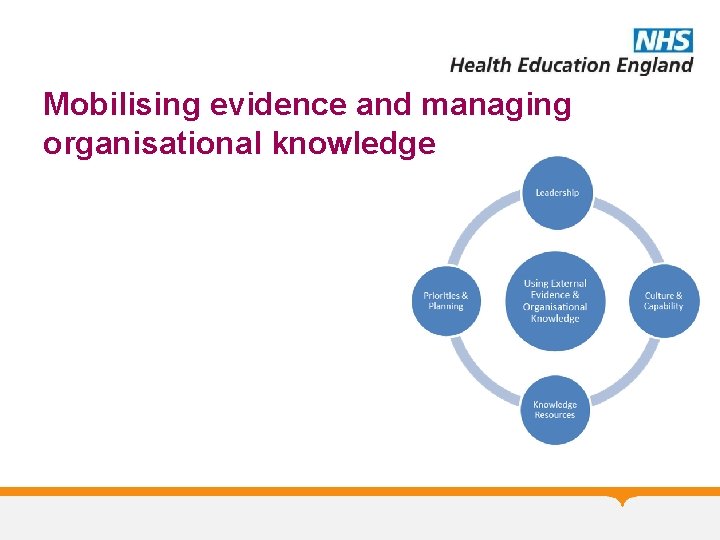
Mobilising evidence and managing organisational knowledge
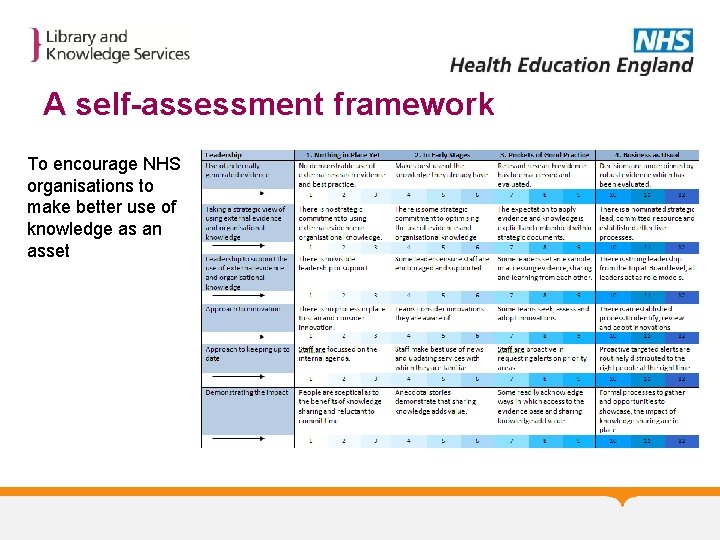
A self-assessment framework To encourage NHS organisations to make better use of knowledge as an asset
Provenance of the tool • • • Built on prior work Extensive literature review Informed by colleagues in KM task and finish group Draft tool created Draft tested and refined based on feedback from librarians, executives and senior clinicians • Tool signed off by Patrick Mitchell and Strategic Library Leads
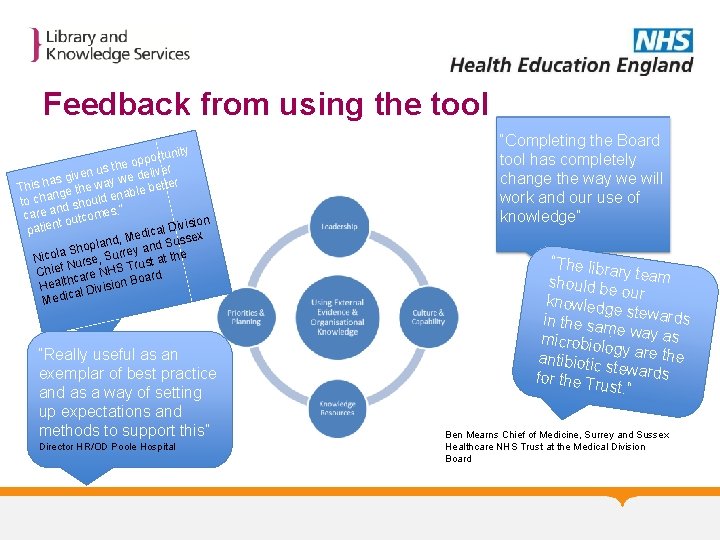
“ Feedback from using the tool ty ortuni p p o the ver en us v i g e deli er s w a y h a ew This bett nge th ld enable a h c to ou nd sh a s. ” e r a c come t u o t ision patien al Div x c i d e se , M pland y and Sus o h S e Nicola urse, Surr ust at the N Tr f Chie NHS e r a c oard h Healt l Division B a Medic “Really useful as an exemplar of best practice and as a way of setting up expectations and methods to support this” Director HR/OD Poole Hospital “Completing the Board tool has completely change the way we will work and our use of knowledge” “The libra ry t should be eam our knowledg es in the sam tewards e microbiolo way as gy are the antibiotic stewards for the Tr ust. ” Ben Mearns Chief of Medicine, Surrey and Sussex Healthcare NHS Trust at the Medical Division Board
Demonstration of the tool
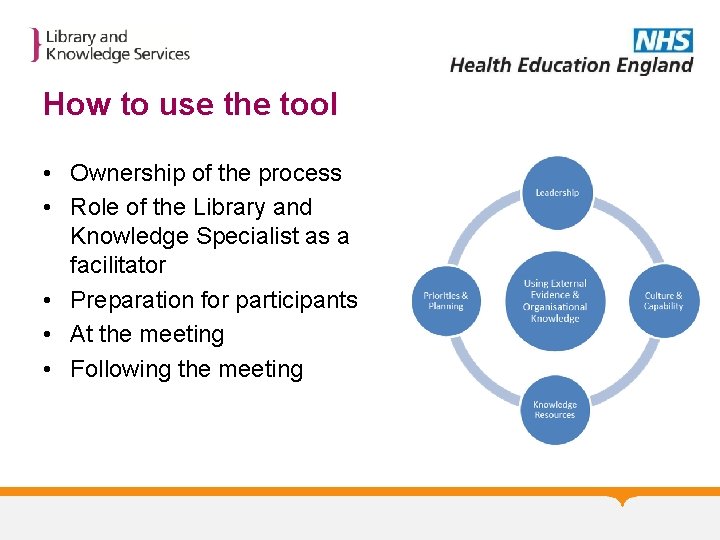
How to use the tool • Ownership of the process • Role of the Library and Knowledge Specialist as a facilitator • Preparation for participants • At the meeting • Following the meeting
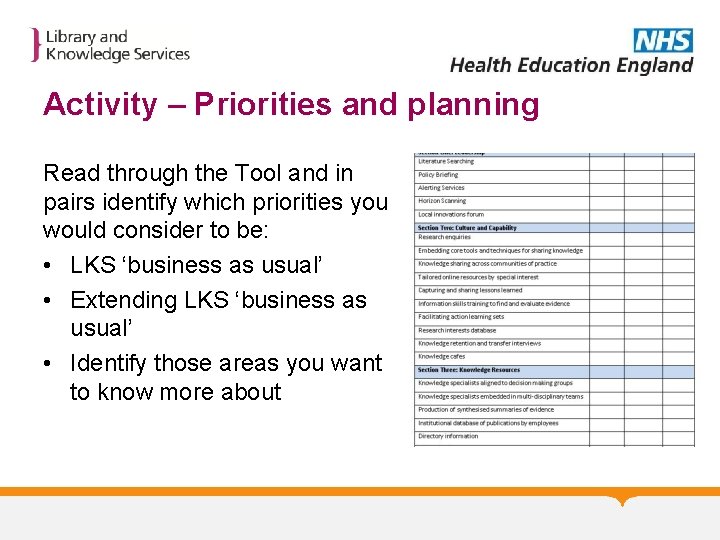
Activity – Priorities and planning Read through the Tool and in pairs identify which priorities you would consider to be: • LKS ‘business as usual’ • Extending LKS ‘business as usual’ • Identify those areas you want to know more about
Activity – Implementation Plan • Have you identified the “opportunity” areas you need to find out more about? • Who will you approach first about this in your organisation? • Who else will you use the self-assessment tool with? • When will you schedule facilitation of the self-assessment? • Who else will you contact for further help?

Mobilising the knowledge of the healthcare workforce
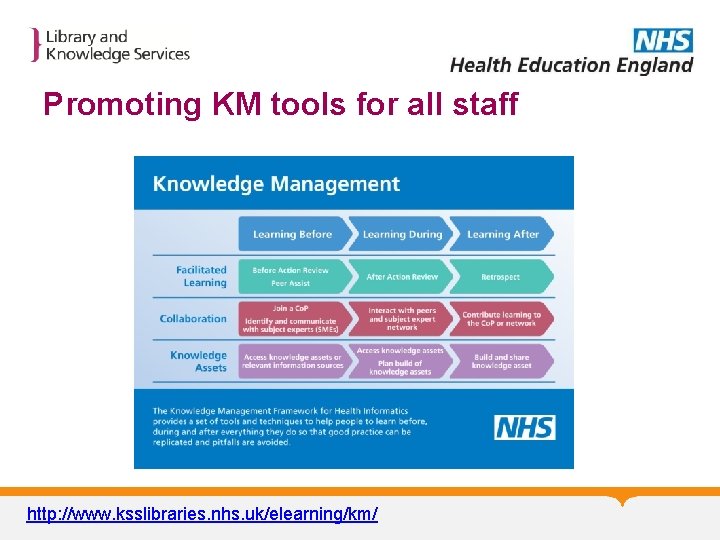
Promoting KM tools for all staff http: //www. ksslibraries. nhs. uk/elearning/km/
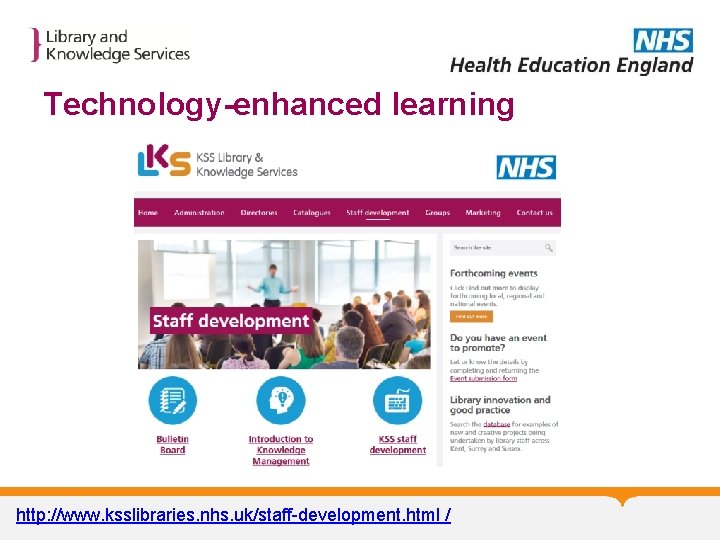
Technology-enhanced learning http: //www. ksslibraries. nhs. uk/staff-development. html /
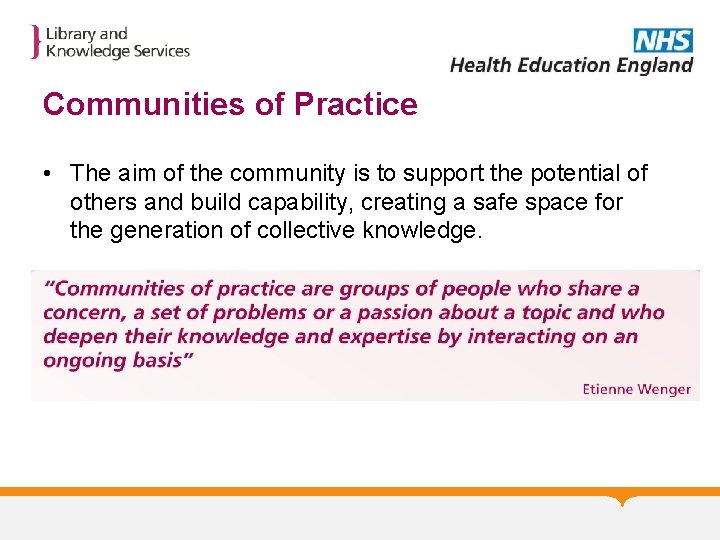
Communities of Practice • The aim of the community is to support the potential of others and build capability, creating a safe space for the generation of collective knowledge.
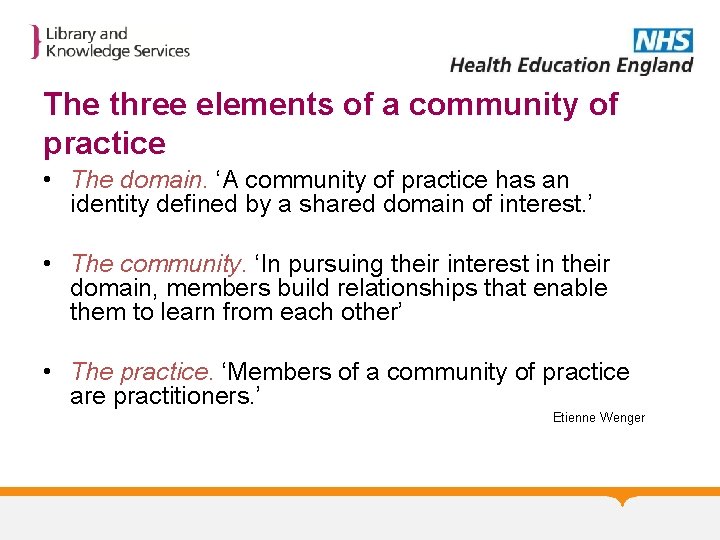
The three elements of a community of practice • The domain. ‘A community of practice has an identity defined by a shared domain of interest. ’ • The community. ‘In pursuing their interest in their domain, members build relationships that enable them to learn from each other’ • The practice. ‘Members of a community of practice are practitioners. ’ Etienne Wenger
Communities of Practice • The community needs to have a sense of belonging • The identity is important • You need a core hosting team of at least six to start a Co. P. Get support! • Think outside the box, you don’t need to stick to traditional rules!
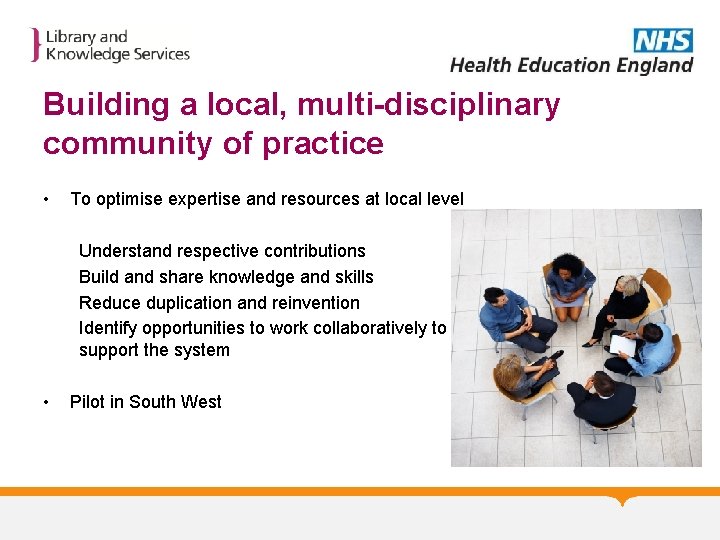
Building a local, multi-disciplinary community of practice • To optimise expertise and resources at local level Understand respective contributions Build and share knowledge and skills Reduce duplication and reinvention Identify opportunities to work collaboratively to support the system • Pilot in South West
Case Study – Pennine Care NHS Foundation Trust Healthcare professions forums – intranet chat rooms • Healthcare Professions Lead wanted input from the Knowledge Service on how to supplement the activities of the recently established Healthcare Professions networking forums • Established chat rooms for each of the professions (e. g. allied health professions, pharmacy and nursing) as well as a general chat room for multi-professional networking. • The chat rooms that are being used regularly provide a record and store way to manage knowledge and allow those participating in the forums to share good practice.
More information on communities of practice Knowledge Management Toolkit – Communities of Practice http: //kfh. libraryservices. nhs. uk/knowledge-management/km-goals-tools-andtechniques/communities-of-practice/ E-Learning – Communities of Practice http: //www. ksslibraries. nhs. uk/elearning/km/cp/ NHS Scotland Quality Improvement Hub – Communities of Practice http: //www. qihub. scot. nhs. uk/knowledge-centre/quality-improvement-tools/communitiesof-practice. aspx Knowledge Management Postcard by NHS Digital – Collaboration http: //kfh. libraryservices. nhs. uk/wp-content/uploads/2016/07/Collaboration. pdf
A little experiment
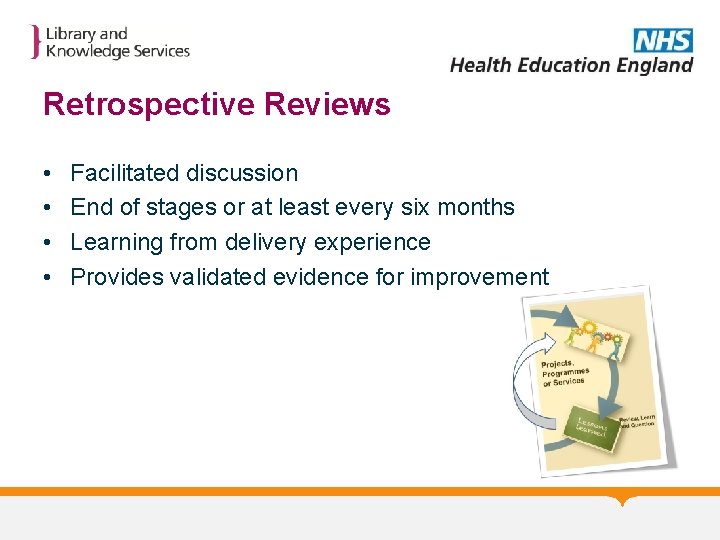
Retrospective Reviews • • Facilitated discussion End of stages or at least every six months Learning from delivery experience Provides validated evidence for improvement
What are some of the inputs into a Retrospective Review? • Lessons learned log • Risks, issues and incident logs • Experience § Team members § People impacted
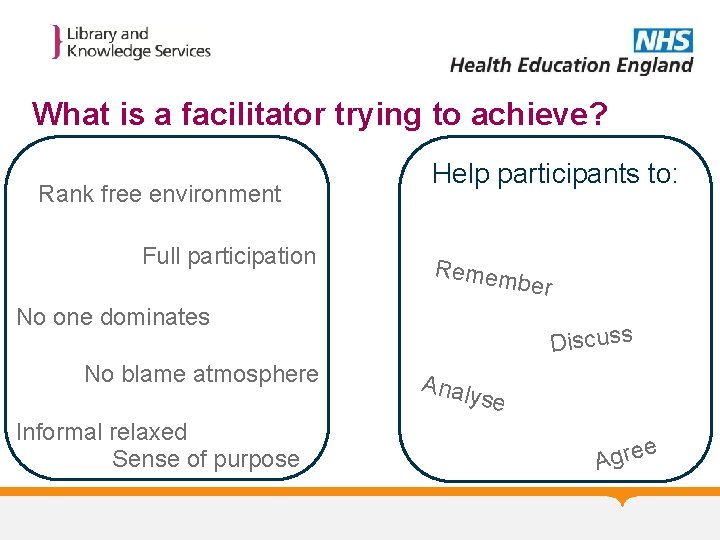
What is a facilitator trying to achieve? Rank free environment Full participation Help participants to: Remem ber No one dominates No blame atmosphere Informal relaxed Sense of purpose Discuss Analy se e e r g A
Ground Rules • • • No blame culture Leave stripes at the door Everybody's comments are valid Participative There are no stupid statements/questions Focus on your own experience/insights Realistic expectations Write legibly Spell out acronyms Audio recording for write up only
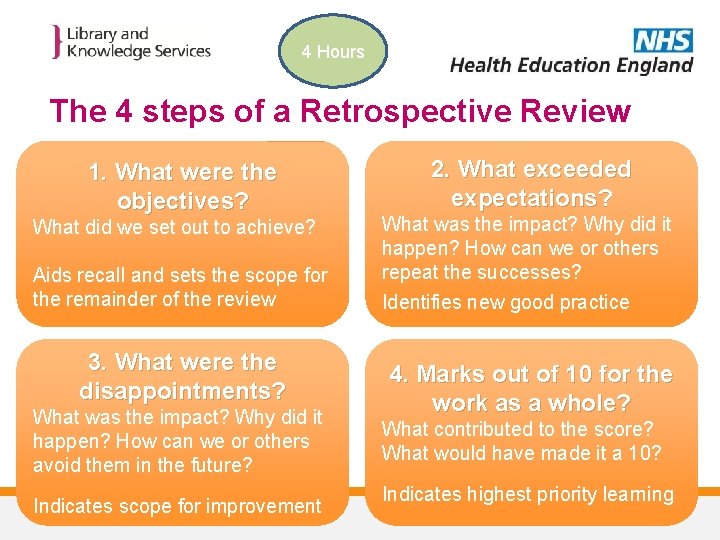
4 Hours The 4 steps of a Retrospective Review 1. What were the objectives? What did we set out to achieve? Aids recall and sets the scope for the remainder of the review 3. What were the disappointments? What was the impact? Why did it happen? How can we or others avoid them in the future? Indicates scope for improvement 2. What exceeded expectations? What was the impact? Why did it happen? How can we or others repeat the successes? Identifies new good practice 4. Marks out of 10 for the work as a whole? What contributed to the score? What would have made it a 10? Indicates highest priority learning
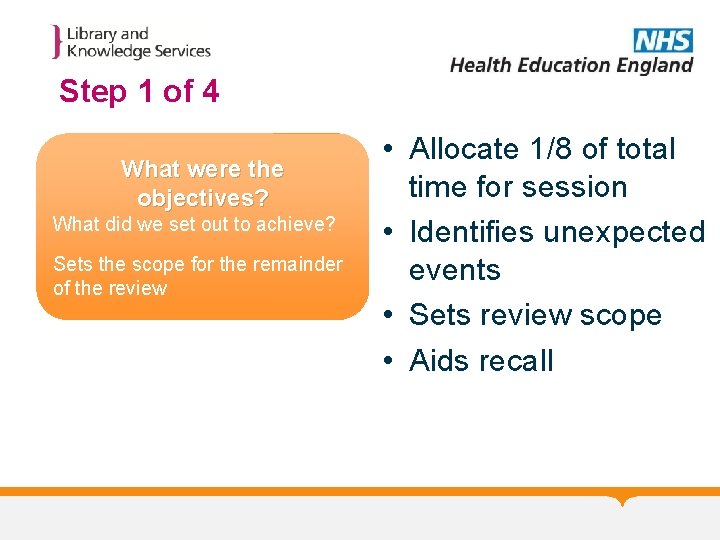
Step 1 of 4 What were the objectives? What did we set out to achieve? Sets the scope for the remainder of the review • Allocate 1/8 of total time for session • Identifies unexpected events • Sets review scope • Aids recall
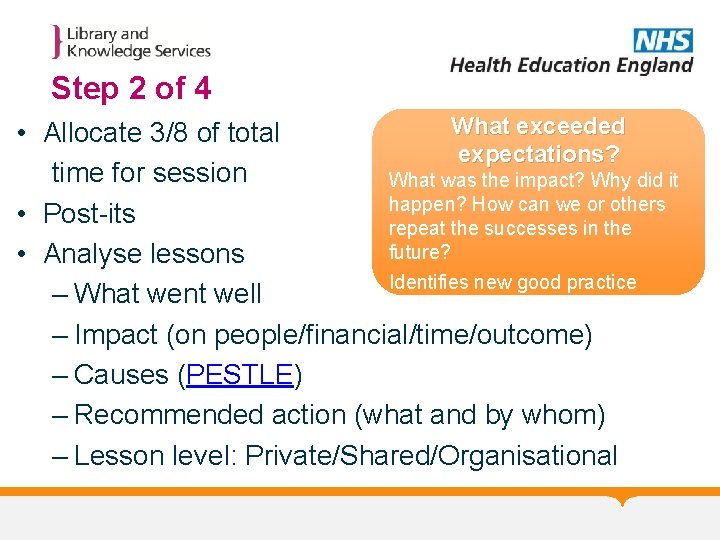
Step 2 of 4 What exceeded • Allocate 3/8 of total expectations? time for session What was the impact? Why did it happen? How can we or others • Post-its repeat the successes in the future? • Analyse lessons Identifies new good practice – What went well – Impact (on people/financial/time/outcome) – Causes (PESTLE) – Recommended action (what and by whom) – Lesson level: Private/Shared/Organisational
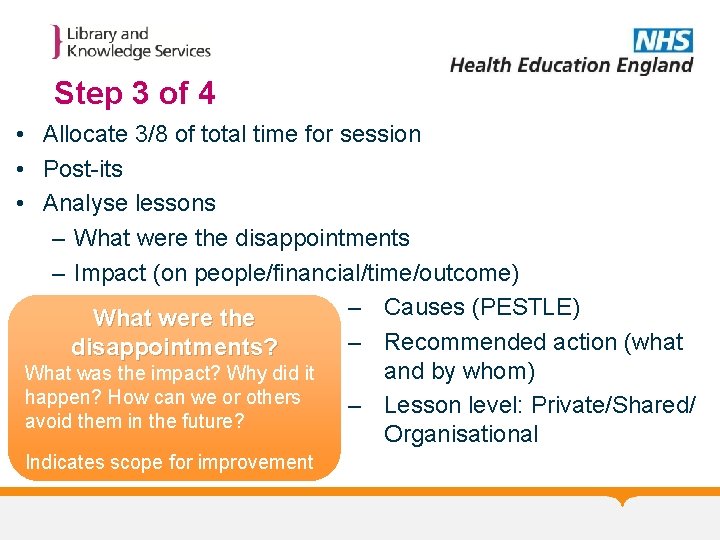
Step 3 of 4 • Allocate 3/8 of total time for session • Post-its • Analyse lessons – What were the disappointments – Impact (on people/financial/time/outcome) – Causes (PESTLE) What were the – Recommended action (what disappointments? and by whom) What was the impact? Why did it happen? How can we or others – Lesson level: Private/Shared/ avoid them in the future? Organisational Indicates scope for improvement
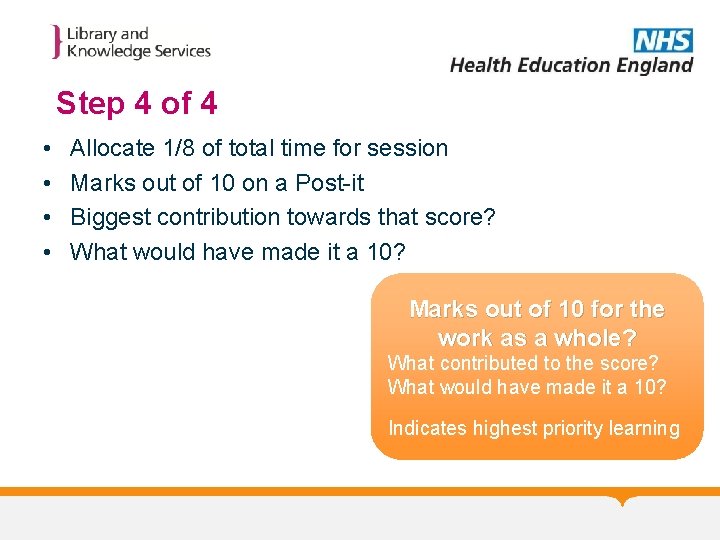
Step 4 of 4 • • Allocate 1/8 of total time for session Marks out of 10 on a Post-it Biggest contribution towards that score? What would have made it a 10? Marks out of 10 for the work as a whole? What contributed to the score? What would have made it a 10? Indicates highest priority learning
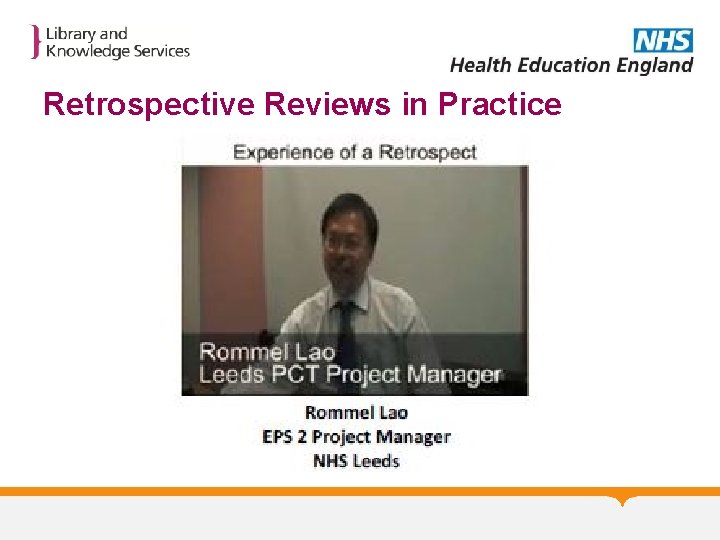
Retrospective Reviews in Practice
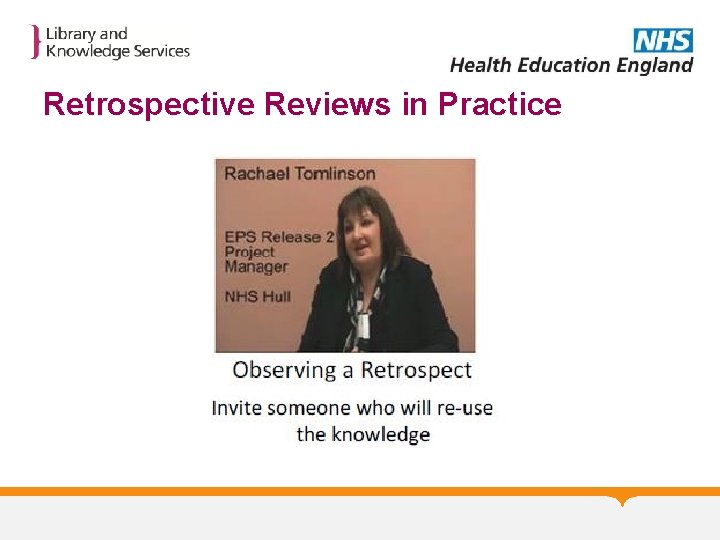
Retrospective Reviews in Practice
More Information on Retrospective Reviews Knowledge Management Toolkit – Retrospects and Baton Passing http: //kfh. libraryservices. nhs. uk/knowledge-management/km-goals-tools-andtechniques/retrospective-baton-passing/ E-Learning – Retrospects http: //www. ksslibraries. nhs. uk/elearning/km/retrospects/km_retrospects/index. htm Knowledge Management Postcard on Retrospects by NHS Digital http: //kfh. libraryservices. nhs. uk/wp-content/uploads/2016/07/Retrospect. pdf
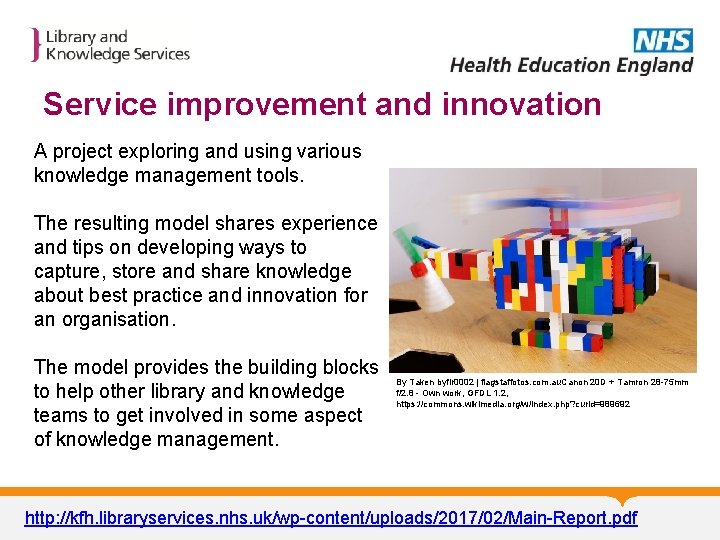
Service improvement and innovation A project exploring and using various knowledge management tools. The resulting model shares experience and tips on developing ways to capture, store and share knowledge about best practice and innovation for an organisation. The model provides the building blocks to help other library and knowledge teams to get involved in some aspect of knowledge management. By Taken byfir 0002 | flagstaffotos. com. au. Canon 20 D + Tamron 28 -75 mm f/2. 8 - Own work, GFDL 1. 2, https: //commons. wikimedia. org/w/index. php? curid=989692 http: //kfh. libraryservices. nhs. uk/wp-content/uploads/2017/02/Main-Report. pdf
Next Steps – Committing to Knowledge Management in the workplace
Mobilising Knowledge 1. How far are you managing knowledge for the organisation? 2. Where are the opportunities to mobilise knowledge to deliver on priorities? 3. What does your service need to provide? 4. How will you market your KM services? 5. How can you exploit new technologies to achieve the vision?
“There are things known and there are things unknown, and in between are the doors of perception. ” Aldous Huxley. 1894 -1963

Contact details Sue Lacey Bryant Louise Goswami Alison Day Dominic Gilroy Sue Robertson sue. lacey-bryant@hee. nhs. uk louise. goswami@nhs. net Alison. Day 12@nhs. net dominic. gilroy 1@nhs. net sue. robertson@hee. nhs. uk Blog: http: //kfh. libraryservices. nhs. uk/ @NHS_Health. Ed. Eng #HEELKS
- Slides: 77