
Welcome Hospitality in Asia Gregory Stoller gstolle 96


































- Slides: 172
Welcome!!! Hospitality in Asia Gregory Stoller gstolle 96 i@aol. com 617 -233 -5666 1
Bonjour à tous. Je m'appelle Gregory Stoller et suis professeur au département entreprenariat de Boston Université aux Etats-Unis. Cette année, j'enseigne l'entreprenariat international et la finance appliquée à la création d'entreprise. De plus, je dirige une agence immobilière depuis treize ans. Je suis marié, et habite avec ma femme et mes trois enfants à Boston. Après mon mariage, nous sommes allés en France pour notre lune de miel: Paris, le Val de Loire, Nice, les vins français. . . que de très bons souvenirs! Je ne parle pas couramment français, mais je voulais vous acceuillir dans la langue officielle de ce pays. Bienvenue à tous dans ce cours et j'espère que vous amuserez bien.
Hello everyone. My name is Gregory Stoller and I'm a professor at Boston University in the United States. There, I teach international business, entrepreneurship and finance. In addition, I have a private company in the real estate industry. I am married and with my wife, we live in Boston. In addition, we have three children. After our marriage we came to France for our honeymoon, in Paris, the Loire Valley and in Nice. It was terrific! I don't speak French very fluently but I wanted to offer my greetings in the official language of this country. Welcome to the course and I hope you enjoy it!
Session #1 • Course Introduction • International Industry Overview 4
Course Introduction
Course Overview- Part I I. Course Introduction and Business Ideas (14 h 00 – 17 h 00) 1) Course Introduction 2) International Industry Overview II. China Market Overview (9 h 00 – 12 h 00) 1) Characteristics of Chinese Market 2) Doing Business in China 6
Course Overview- Part II III. Japan Market Overview (9 h 00 – 12 h 00) 1) Characteristics of Japanese Market 2) Imperial Hotel vs. Ryokan 3) Doing Business in Japan IV. Thai Market Overview (14 h 00 – 17 h 00) 1) Characteristics of Thai Market 2) Doing Business in Thailand 3) Optional Case: Thai Textiles 7
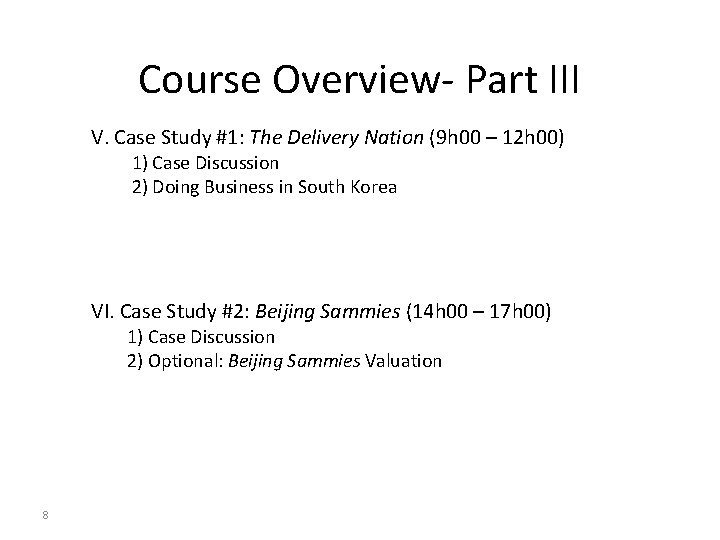
Course Overview- Part III V. Case Study #1: The Delivery Nation (9 h 00 – 12 h 00) 1) Case Discussion 2) Doing Business in South Korea VI. Case Study #2: Beijing Sammies (14 h 00 – 17 h 00) 1) Case Discussion 2) Optional: Beijing Sammies Valuation 8
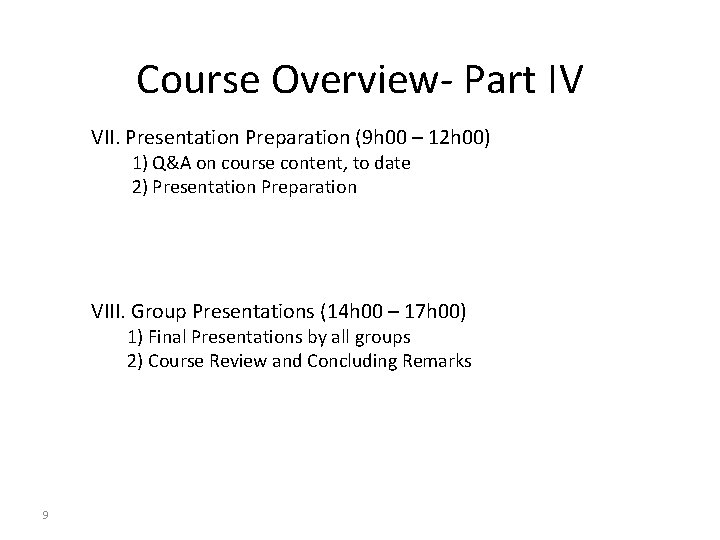
Course Overview- Part IV VII. Presentation Preparation (9 h 00 – 12 h 00) 1) Q&A on course content, to date 2) Presentation Preparation VIII. Group Presentations (14 h 00 – 17 h 00) 1) Final Presentations by all groups 2) Course Review and Concluding Remarks 9
Course Operation (before class) I. Course Pre-requisites 1) Ability to think, challenge and be challenged 2) Basic Business Sense (revenue - expenses = ? ) 3) Basic understanding of Global Strategy and International Business II. Importance of Preparation 1) Case Analysis 2) Readings 3) Discussion with classmates 4) Answers to case “study questions” (see other slide) III. Knowledge of Technology 1) Internet, Microsoft Office applications 2) E-mail 10
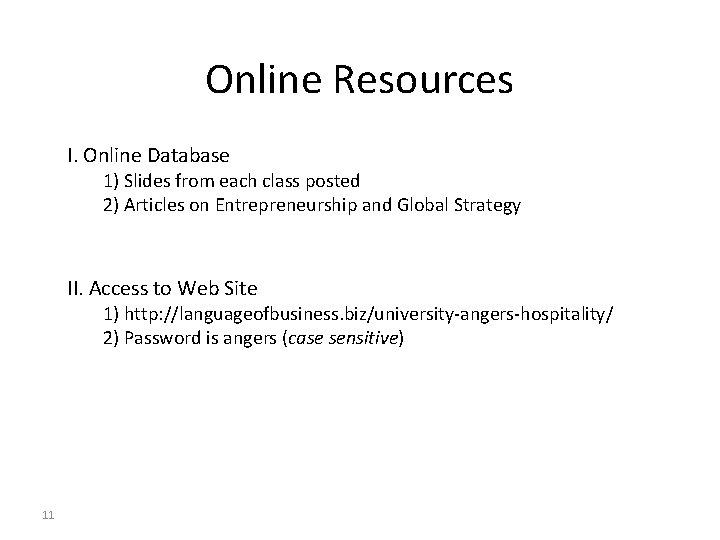
Online Resources I. Online Database 1) Slides from each class posted 2) Articles on Entrepreneurship and Global Strategy II. Access to Web Site 1) http: //languageofbusiness. biz/university-angers-hospitality/ 2) Password is angers (case sensitive) 11
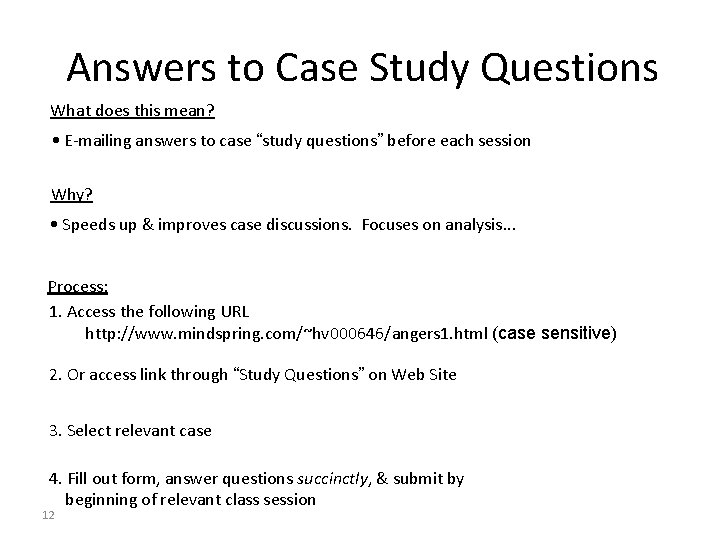
Answers to Case Study Questions What does this mean? • E-mailing answers to case “study questions” before each session Why? • Speeds up & improves case discussions. Focuses on analysis. . . Process: 1. Access the following URL http: //www. mindspring. com/~hv 000646/angers 1. html (case sensitive) 2. Or access link through “Study Questions” on Web Site 3. Select relevant case 4. Fill out form, answer questions succinctly, & submit by beginning of relevant class session 12
Course Operation (during class) I. Case Method 1) Discussion format 2) Question everything and everybody (including me!) 3) Use of “real world” examples 4) Integration of study question answers II. Class Participation 1) “Thinking on your feet” & being challenged 2) No B-S allowed-- be able to back-up your points 3) Don’t miss class 4) Seating Chart III. Academia vs. the “real world” 1) Anecdotes from Business Executives 2) Personal “War stories” and commentary 13
Course Operation (after class) I. Individual Follow-up 1) What did I learn today? Does it make sense? 2) How can I apply this in the “real world? ” 3) Where can I learn more? 4) Am I being a good team player? II. “I need help…!” 1) Ask, ask! (no B-S allowed!) 2) E-mail Communication III. “Am I having fun? ” 14
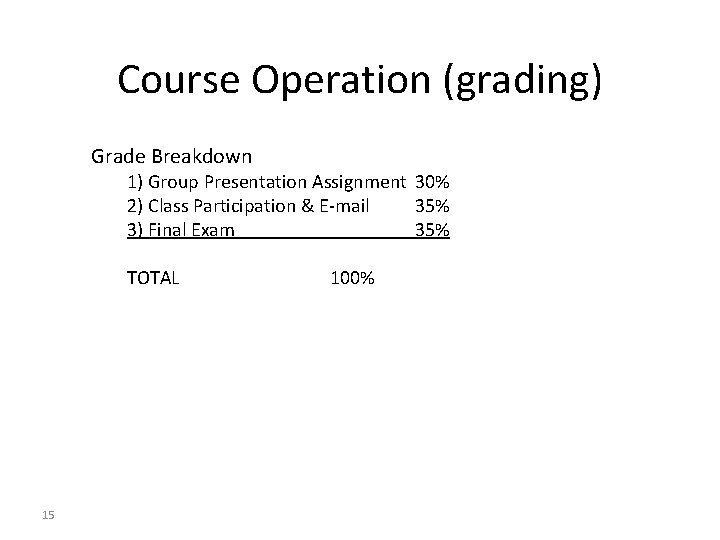
Course Operation (grading) Grade Breakdown 1) Group Presentation Assignment 30% 2) Class Participation & E-mail 35% 3) Final Exam 35% TOTAL 15 100%
Questions? I. Course II. Technology (i. e. E-mail submissions, Course web site) III. Why is your instructor so short? 16
International Industry Overview 17
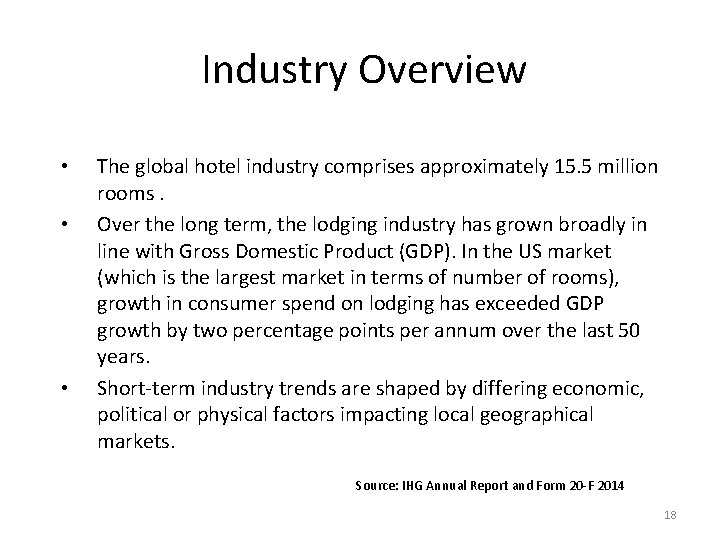
Industry Overview • • • The global hotel industry comprises approximately 15. 5 million rooms. Over the long term, the lodging industry has grown broadly in line with Gross Domestic Product (GDP). In the US market (which is the largest market in terms of number of rooms), growth in consumer spend on lodging has exceeded GDP growth by two percentage points per annum over the last 50 years. Short-term industry trends are shaped by differing economic, political or physical factors impacting local geographical markets. Source: IHG Annual Report and Form 20 -F 2014 18
What defines luxury? • • • Luxury major, luxury exclusive, and upper upscale. Luxury exclusives embraces the largest market share, accounting for 40. 5% of luxury hotels worldwide. In February, 2013, the Forbes Travel Guide Star Awards announced 76 five-star hotels and 226 four-star hotels worldwide as the award winners, a yearly increase of 33% and 28. 4%, respectively. Worldwide, in 2012 hotel performance metrics revealed that the luxury hotel market had achieved an increase in all indices, including occupancy, average daily rate, and nominal revenue per available room (Rev. PAR). Source: A review of studies on luxury hotels over the past two decades 19
Where are they located? • • • 75. 5% of the world’s luxury hotels are located in the United States, with the rest of the top five being the U. K. , Canada, Hong Kong, and France (The World Luxury Index, 2013). The global luxury travel market has recorded strong growth in 2011 - 2012, after a significant decline in 2009 and modest recovery in 2010. Apart from this consideration, consumer interest globally for luxury hotels has grown by 1. 5%. The luxury segment continues growing in the years after in spite of intermittent recessions, like the one between 1980 s and early 1990. Source: A review of studies on luxury hotels over the past two decades 20
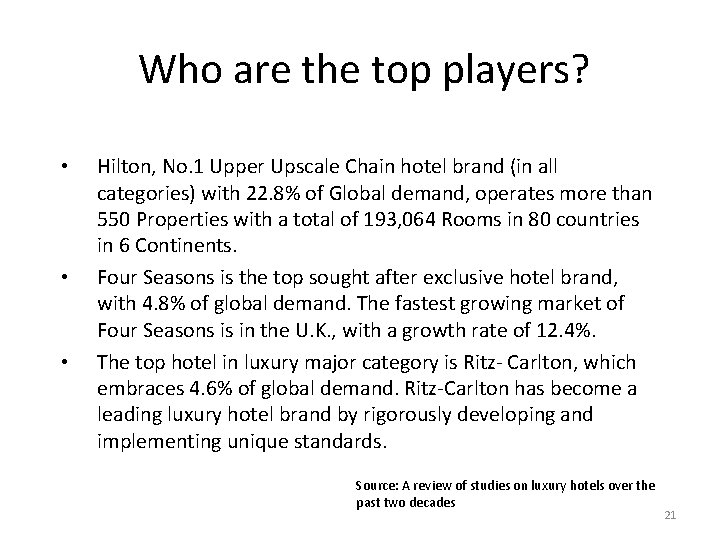
Who are the top players? • • • Hilton, No. 1 Upper Upscale Chain hotel brand (in all categories) with 22. 8% of Global demand, operates more than 550 Properties with a total of 193, 064 Rooms in 80 countries in 6 Continents. Four Seasons is the top sought after exclusive hotel brand, with 4. 8% of global demand. The fastest growing market of Four Seasons is in the U. K. , with a growth rate of 12. 4%. The top hotel in luxury major category is Ritz- Carlton, which embraces 4. 6% of global demand. Ritz-Carlton has become a leading luxury hotel brand by rigorously developing and implementing unique standards. Source: A review of studies on luxury hotels over the past two decades 21
How are they expanding? (Part 1) • • There are three basic ways that international hotel chains can expand business outside their home countries: (a) owning subsidiaries, (b) franchising, and (c) operating through management contracts. Leasing: By leasing the properties as one method of entering new foreign markets, hotel chains also assume the whole risk of properties that they manage. On the other hand, due to unfamiliarity of the new foreign market, global hotel chains often need more money and time than if they affiliated with local companies Source: Customization vs. standardization in global hotel expansion 22
How are they expanding? (Part 2) • • Franchising: One of the greatest benefits of franchising to a country’s economic development is that the franchises are rather easy to establish. . . But not in some countries: In China, strict government regulations imply that a franchisor will guarantee the quality of products and services sold by its local distributors. Nevertheless, it is impossible for hotel chains to control franchisee at all times and to convey all the knowledge they have. Thus, hotel chains are exposing their brand to the risk of getting impaired. Source: Customization vs. standardization in global hotel expansion 23
How are they expanding? (Part 3) • • • Management Contracts: This allows hotel chains to use other people’s money for the initial investment for properties overseas: Mandarin Oriental Hotel Group has recently announced that it will manage a luxury 400 -room hotel on Las Vegas Strip-- as it currently owns and operates 22 luxury hotels (with eight more currently under development) in 17 countries. But, if hotel chains cannot gain a financial and continuous support from the owners, the hotels cannot maintain their standard quality of service and are sometimes even forced to go out of business. International hotel chains often chose not to own equity or even management-contract when they enter foreign markets. Source: Customization vs. standardization in global hotel expansion 24
How are they expanding? (Part 4) • • • First two elements of a feasibility study in regards to regulations and customs of a specific market are financial and political factors. Diversification across countries is key. The main financial factors of any international market are growth potential, inflation rate, and the lending and taxation policies. Multinational hotel corporations are assessing political risk and political stability before entering a new market. Source: Customization vs. standardization in global hotel expansion 25
How are they expanding? (Part 5) • • • Staffing: Four Seasons-- The General Manager and Assistant General Manager are selected by the corporation and brought from another country but middle staff from local labor pool. Management: Hyatt-- Top executives leave their corporate offices and spread around the country and world in order to assist their employees and express their appreciation and respect to them. Reservation Systems: Hilton-- Corporate owned hotels share their systems and all the information is being transferred to corporate headquarters. Source: Customization vs. standardization in global hotel expansion 26
How are they expanding? (Part 6) • • • Staffing: Four Seasons-- The General Manager and Assistant General Manager are selected by the corporation and brought from another country but middle staff from local labor pool. Management: Hyatt-- Top executives leave their corporate offices and spread around the country and world in order to assist their employees and express their appreciation and respect to them. Reservation Systems: Hilton-- Corporate owned hotels share their systems and all the information is being transferred to corporate headquarters. Source: Customization vs. standardization in global hotel expansion 27
Customization vs. Standardization? • • • Not just branding: Ownership, Employee management, Facilities, Culture. No longer one size fits all: Marriott-- Marriott Corporation currently owns and operates, as well as franchises hotels that fall into one of 15 hotel brands, covering all five market segments. Companies must realize heterogeneous customers respond differently to different kinds of marketing– i. e. , TV ads, discounts, loyalty programs. Source: Customization vs. standardization in global hotel expansion 28
Global Investment Trends (2015) • • More lodging projects broke ground as traditional lenders eased restrictions on construction loan originations. Accelerating cross-border capital flows intensified competition among domestic and international investor groups for hotel assets. In select secondary markets, investors evaluated higher-yield opportunities outside of gateway cities, reflecting renewed interest in the sector. Evolving guest preferences propelled an influx of new hotel brands. Source: Global hospitality insights Top thoughts for 2015 (EY) 29
Global Investment Trends #2 (2015) • • Real estate fundamentals continue to improve, and debt and equity capital are abundant, providing a solid foundation for an uptick in transaction volume and overall competition. Global hotel investment continues to steadily increase, with 2014’s totals expected to exceed US$54. 5 billion compared to US$52 billion in 2013. Global hospitality and leisure transactions increased 8% yearover-year through Q 3 2014, showing that the industry continues to gain momentum even in the face of accelerating geopolitical instability, health and terrorism concerns. A wave of new hotels will open in 2015, and a robust global development pipeline of approximately 1. 3 million guestrooms is in place. Source: Global hospitality insights Top thoughts for 2015 (EY) 30
Asian Outbound Trends • • • Overseas capital accounted for 41. 2% of 2014’s global hotel investments through October, compared to 34. 7% in 2013, 29. 9% in 2012 and only 25. 9% in 2011. Asian investors (primarily dominated by China, Hong Kong, Japan and Singapore) represented 43. 2% of the cross-border hotel transactions during the 12 months ending October 2014, followed by North American and Middle Eastern investors. Investment Targets: North America, Europe and Australia inbound investment is anticipated to keep rising. Source: Global hospitality insights Top thoughts for 2015 (EY) 31
International Tax Trends • • • During 2015, significant cross-border capital flows will continue to draw focus from a tax standpoint. The strategic use of REIT structures to hold lodging assets across the globe will continue to gain investor attention in 2015. Trend: The separation of operations and property ownership, commonly known as Opco/ Propco structures. Opco/Propco structures involve the separation of the real estate into one company and operating assets into another company. Source: Global hospitality insights Top thoughts for 2015 (EY) 32
Academic Research • • • A research boom on luxury hotel topics appeared starting from 2005, especially during 2006, 2008, and 2009, which may imply that luxury hotels may continue to be a prevailing research topic in future years. Among the nine research themes identified, marketing was the most popular research theme throughout the review period. The study of the countries of origin identified 18 countries, among which U. S. , China, Australia and South Korea have the most number of luxury hotel articles that focused on these countries. Source: A review of studies on luxury hotels over the past two decades 33
Session #2 The China Market 34
China Hotel Market Outlook • • Number of outbound Mainland Chinese tourists will double from an estimated 100 million in 2013 to 200 million by 2020. China domestic market is also gaining momentum amongst local Chinese travellers re: Golden Week 49. 2% of properties surveyed were state-owned, 39. 4% privately owned and 11. 4% were held under other ownership structures, such as joint ventures and foreign-owned enterprises. 66. 3% were owner-operated and managed, 23. 0% running under a third party management agreement, 6. 5% franchised and 4. 4% leased or operated under a different management model. Source: China Hotel Market Overview 2014 35
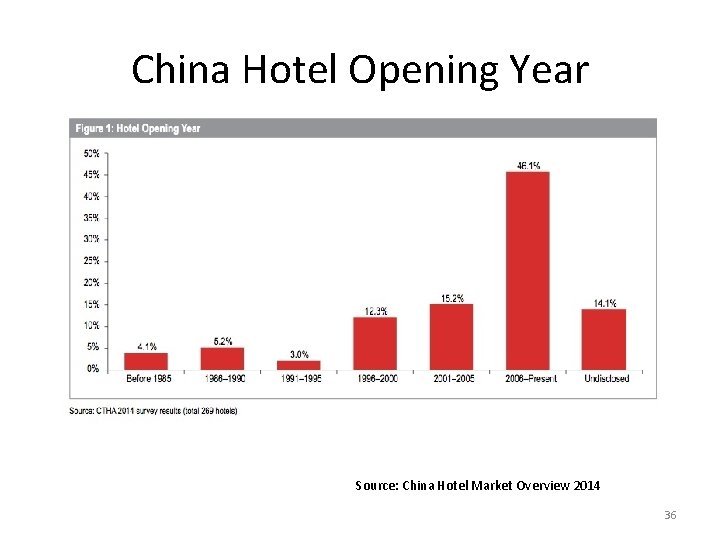
China Hotel Opening Year Source: China Hotel Market Overview 2014 36
China Hotel Market Outlook • • • In 2013, the ADR of sampled hotels was RMB 400, 2. 4%, below that of 2012. A substantial pipeline of new hotel supply continues to weigh down on hotel performance and the growth rate of inbound tourism has declined on a slower economic environment. Overall occupancy of surveyed hotels decreased from 63. 0% in 2012 to 60. 0% in 2013. Source: China Hotel Market Overview 2014 37
China Hotel Business Mix • • • Among the surveyed hotels, Corporate FIT travellers were still the leading segment in the business mix, making up 39. 2% in 2012 and slightly higher in 2013 (39. 8%). The long-stay segment accounted for 5. 3%. Other segments accounted for 6. 9%. With the decline in occupancy and Rev. PAR in 2013, the outlook for 2014 remained pessimistic based on hotels’ trading expectations and the large supply pipeline set to enter the market. Source: China Hotel Market Overview 2014 38
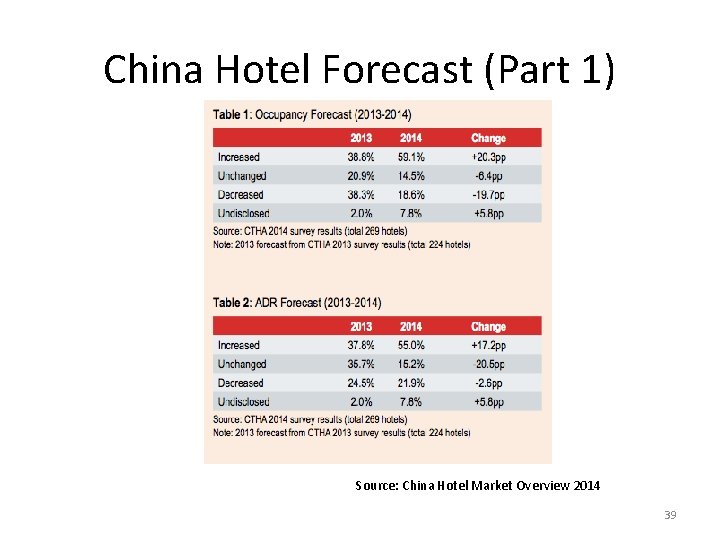
China Hotel Forecast (Part 1) Source: China Hotel Market Overview 2014 39
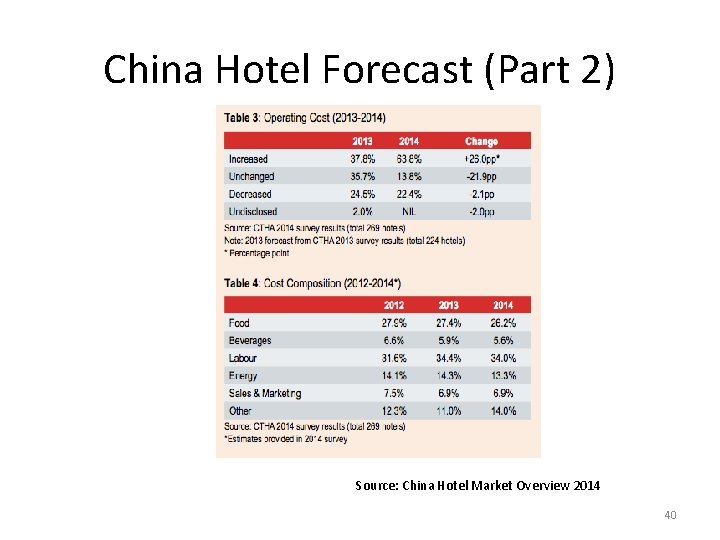
China Hotel Forecast (Part 2) Source: China Hotel Market Overview 2014 40
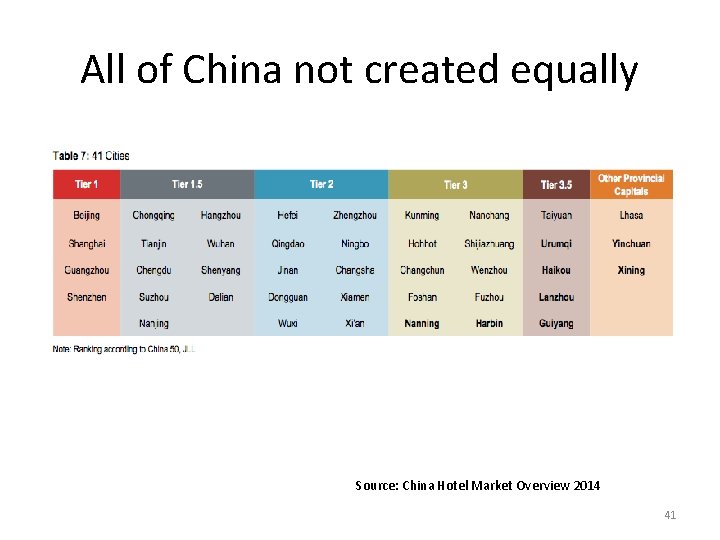
All of China not created equally Source: China Hotel Market Overview 2014 41
Economic Challenges Continue Source: China Hotel Market Overview 2014 42
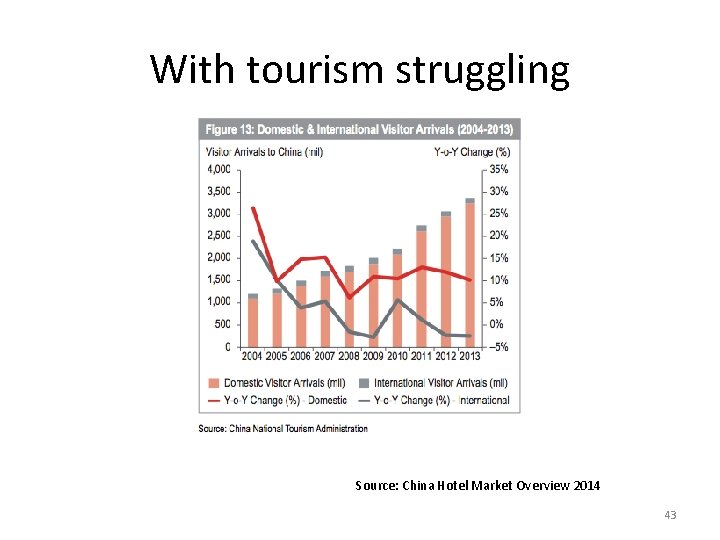
With tourism struggling Source: China Hotel Market Overview 2014 43
Foreign Direct Investment is changing Source: China Hotel Market Overview 2014 44
It’s always about China’s “future” • • • Mainland China’s hotel transformation occurred during the 1980 s, probably best demonstrated by the well-known Jianguo Hotel. Fast forward to 2008, the Aman at the Summer Palace, developed and built by the Beijing Tourism Group in collaboration with Aman Resorts, also made a major impact. Hotel developers in the Mainland continue to outdo each other with the most ambitious, luxurious and aesthetically pleasing projects imaginable. Source: China Hotel Market Overview 2014 45
China-tization • • • International hotel chains are adapting their services to suit unique Chinese preferences. Hotel operator Accor has focused on Mainland China as it re-engineered its Grand Mercure brand to tailor to the needs of the wealthy Chinese traveller. Uses different, specialized characters in Chinese, too. (美爵) Intercontinental hotels has developed a new luxury hotel concept designed specifically for Chinese guests. 华邑(Hualuxe)酒店 In the competitive international hotel market a “one size fits all” approach doesn’t work any more. Source: China Hotel Market Overview 2014 46
Actions by International Competitors (Part 1) • • • Accor, the largest international hotel operator in Asia-Pacific, today revealed that it now operates over 100, 000 rooms in the region, with the opening of ibis Hong Kong Central and Sheung Wan. According to the research, six in ten travellers in Asia prefer international economy hotel brands to domestic brands and assign different “personalities” to them. Why? International brands were considered “stylish, highclass, reliable, attractive and energetic” compared to domestic brands, which tended to be viewed as “down-to-earth, practical, approachable, and considerate. ” Source: Accor surpasses 100, 000 rooms in Asia- Pacific press release 9/11/12 47
Actions by International Competitors (Part 2) • • • Over the last two decades companies such as Hyatt, Starwood, Hilton, Inter. Continental Hotels Group, Marriott, Kempinski, and Four Seasons have successfully challenged the long established reign in the Chinese luxury segment previously held by Peninsula and Shangri-la. In recent years, China has played host to premier global events like the 2008 Olympics in Beijing and the 2010 World Expo in Shanghai. Few industries, if any, have benefited more from growing interest in all things China than the tourism industry Source: Why China? A study of why foreign hotel companies are rushing to develop new luxury hotels in 48 China
Actions by International Competitors (Part 3) • • • First wave: Inter. Continental Hotels Group (IHG) entered China in the mid 1980’s. They were the first U. S. based multinational hotel group (MHG) to focus on growth in China. Second wave: Seeking to mimic the early success of IHG, companies such as Marriott, Hilton and Starwood partnered with private, public and state-owned enterprises to expand their operations to China It is apparent that most foreign hotel companies are opting to bring their top-end brands to China and build luxury properties rather than mid-range and budget hotels. This is due to the higher margins gained from operating luxury properties in China over other categories. Source: Why China? A study of why foreign hotel companies are rushing to develop new luxury hotels in 49 China
Top 10 Revenue Generating Hotels Source: Why China? A study of why foreign hotel companies are rushing to develop new luxury hotels in 50 China
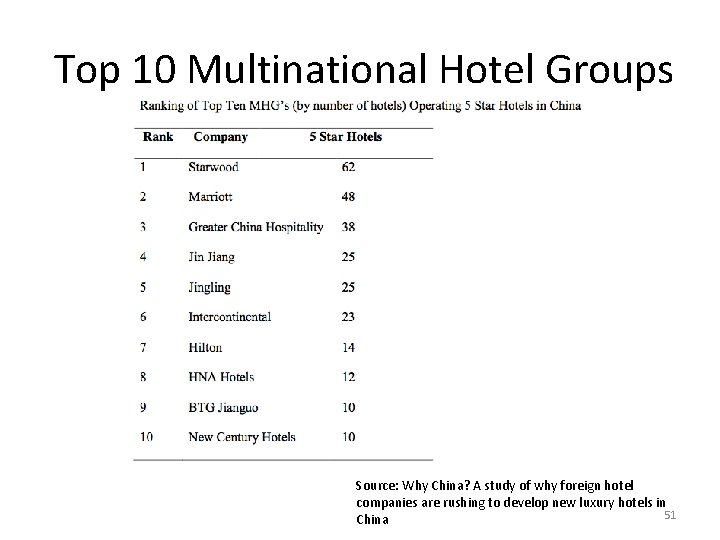
Top 10 Multinational Hotel Groups Source: Why China? A study of why foreign hotel companies are rushing to develop new luxury hotels in 51 China
If it’s so easy… why not everyone? • • • Issues of wage inflation, supply concerns are all significant challenges to overcome. Obstacles in China: 1) Economic and political systems, 2) hotel ownership, 3) management capability and resources, and 4) competition between local and foreign chains. Additional hurdles: 1) Establishing a successful loyalty program, 2) navigating the unpredictable government environment, 3) understating the role of guanxi, 4) finding skilled labor and 5) dealing with high pollution levels. Source: Why China? A study of why foreign hotel companies are rushing to develop new luxury hotels in 52 China
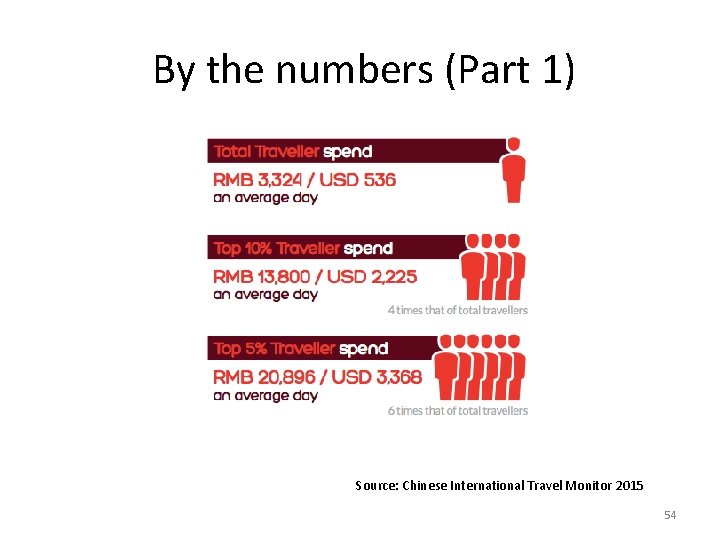
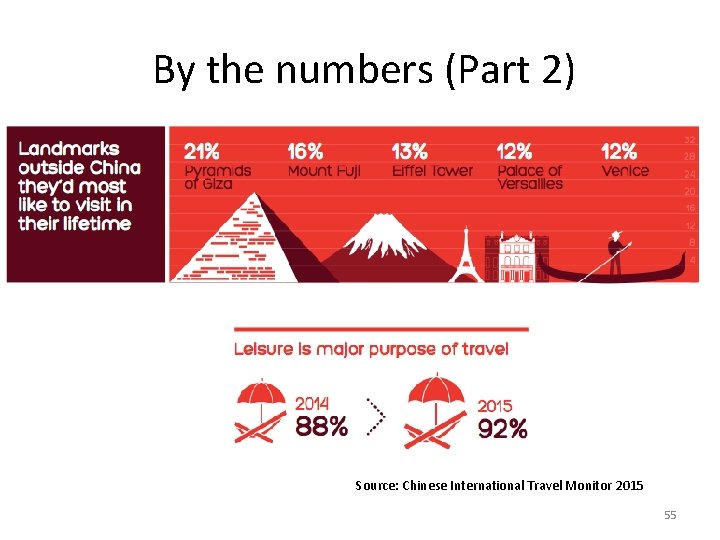
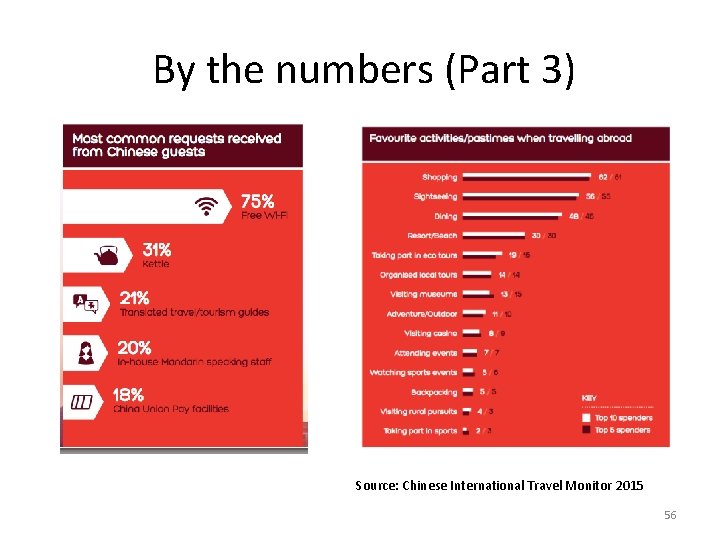
China Outbound is huge market • • Outbound Chinese travellers could number around 174 million in four years’ time, spending about US$264 billion annually. Note that “millennial” travellers, those Gen-Y people aged 18 to 35 who tend to like freer, unencumbered travel. The wealthiest top 10 percent of Chinese travellers, whose average daily outlay when travelling overseas of well over 13, 000 RMB (US$2, 000). Over half of all Chinese outbound travellers now use mobile phones to plan and book trips, up from just 17 percent in 2014. Source: Chinese International Travel Monitor 2015 53
By the numbers (Part 1) Source: Chinese International Travel Monitor 2015 54
By the numbers (Part 2) Source: Chinese International Travel Monitor 2015 55
By the numbers (Part 3) Source: Chinese International Travel Monitor 2015 56
Customization (Part 1) • • • Starwood’s design-led luxury lifestyle brand, W Hotels in Bangkok, is luring hip young Chinese travellers in the Asia Pacific region through its unique, local design concepts and initiatives aimed at global jetsetters. Services: Organizing a surprise wedding proposal, to making a reservation at the hottest bar in town, and providing favorite amenities in a guest’s room. Adaptations: Mandarin speakers, colorful flashing tuk-tuk lights on the ground floor, to oversized cushions in the shape of Thai boxing gloves in the guestrooms. Source: Chinese International Travel Monitor 2015 57
Customization (Part 2) • • • Inter. Continental Hotels Group (IHG) launched “Zhou Dao, ” ( 洲道)the company’s global program to welcome Chinese travellers with an intimate, home-away-from-home experience. Nearly 100 IHG hotels across the globe are already participating in the program, and by the end of 2015, this number is expected to more than double, to 250 hotels. IHG has also announced its strategic partnership with “Welcome Chinese, ” a new hospitality standard specifically dedicated to Chinese travellers and the only industry standard recognised by the China Tourism Academy, a subdivision of the China National Tourist Office. Source: Chinese International Travel Monitor 2015 58
Customization (Part 3) • • • Four Seasons announced in June 2015 a smart device app, to allow its hotel guests to get things done on the go: bookings, concierge and room service needs such as pre-ordering your breakfast. In the coming months, the Four Seasons app will be released in Simplified Chinese. The brand already has significant presence in popular Chinese social networks Weibo and We. Chat. Source: Chinese International Travel Monitor 2015 59
Customization (Part 4) • • • China is the largest source of inbound travellers to South Korea, ahead of, in order, Japan, the USA, Taiwan, Hong Kong and the Philippines. Airlines have been scrambling to meet the booming demand. New routes from Yangyang International Airport to 10 Chinese cities were launched last year. Government assistance: It has launched a cable TV channel in Chinese featuring tourist attractions, sales, performances, concerts and events. Source: Chinese International Travel Monitor 2015 60
Customization (Part 5) • • • The statistics indicate that the number of Chinese visitors to France has doubled since 2009, with more upside expected. In the first two months of 2015, China tourist visa applications were up 65 percent. In May 2015, the largest group tour ever organized in France made headlines: more than 6, 400 tourists travelled to Paris and Nice in a single contingent. The Louvre and Palace of Versailles recently announced that it had opened accounts on Weibo and We. Chat. Source: Chinese International Travel Monitor 2015 61
Business and Education in China, Korea and Southeast Asia 好好学习 天天向上 "To many South Koreans… education is the last fortress through which everyone, regardless of their current status, can ascend to a higher social status. ” WSJ Nov 12, 2008 Source: Keith Gallinelli
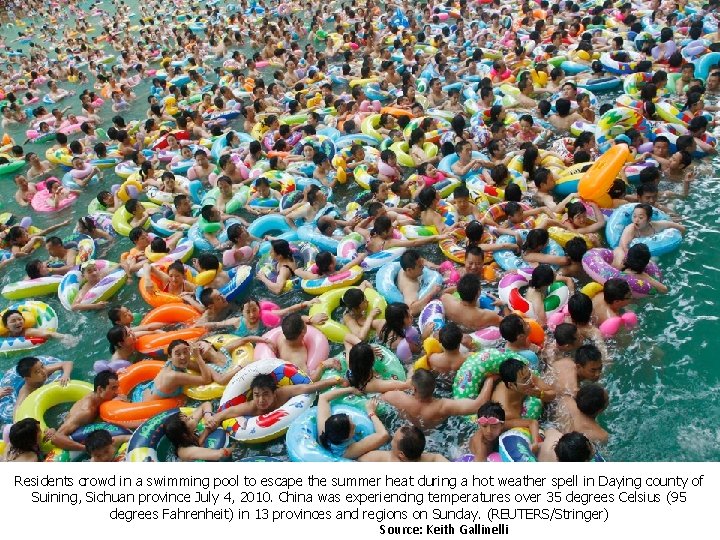
Residents crowd in a swimming pool to escape the summer heat during a hot weather spell in Daying county of Suining, Sichuan province July 4, 2010. China was experiencing temperatures over 35 degrees Celsius (95 degrees Fahrenheit) in 13 provinces and regions on Sunday. (REUTERS/Stringer) Source: Keith Gallinelli
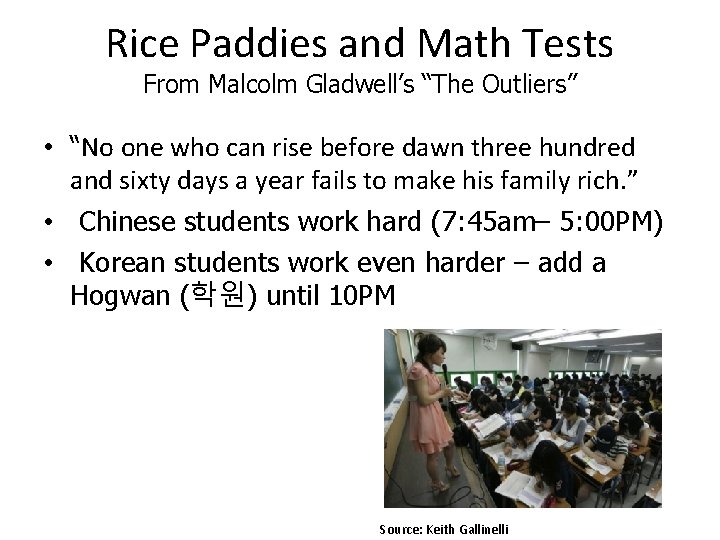
Rice Paddies and Math Tests From Malcolm Gladwell’s “The Outliers” • “No one who can rise before dawn three hundred and sixty days a year fails to make his family rich. ” • Chinese students work hard (7: 45 am– 5: 00 PM) • Korean students work even harder – add a Hogwan (학원) until 10 PM Source: Keith Gallinelli
Competition Stay in your home country and take the 高 考 Gao Kao, but… • 4 in 10 students don’t make the cut • 2 in 10 get their first choice of university • Korean students face the same problem, but even more competitive Source: Keith Gallinelli
Study Abroad Source: http: //www. iie. org/Services/Project-Atlas/United-States/International-Students-In. US Source: Keith Gallinelli
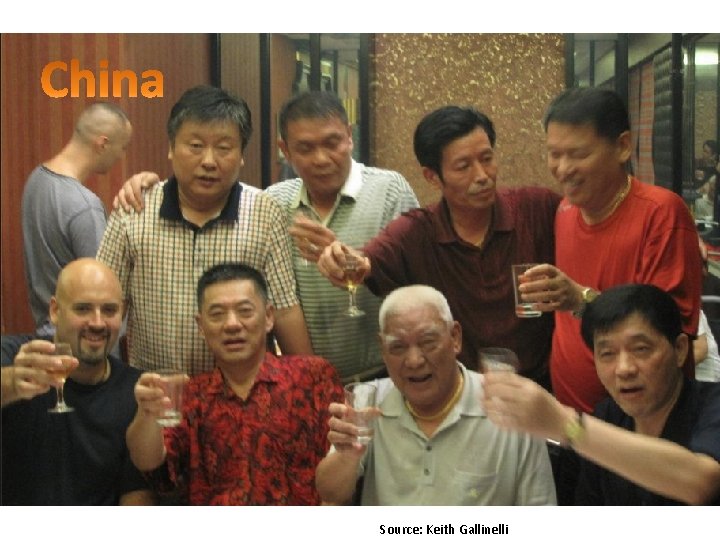
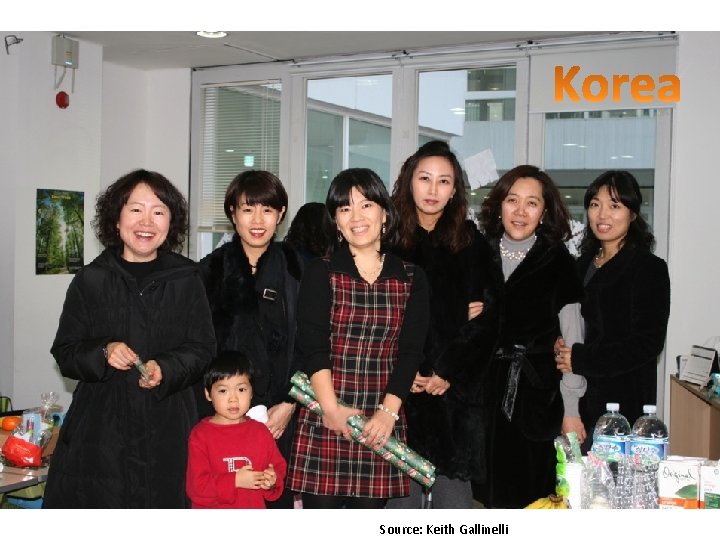
Doing business in Asia • • 关系Guanxi 老板The Lao Ban 회장님 Hui jang nim Doing things “right” way Source: Keith Gallinelli
Source: Keith Gallinelli
Source: Keith Gallinelli
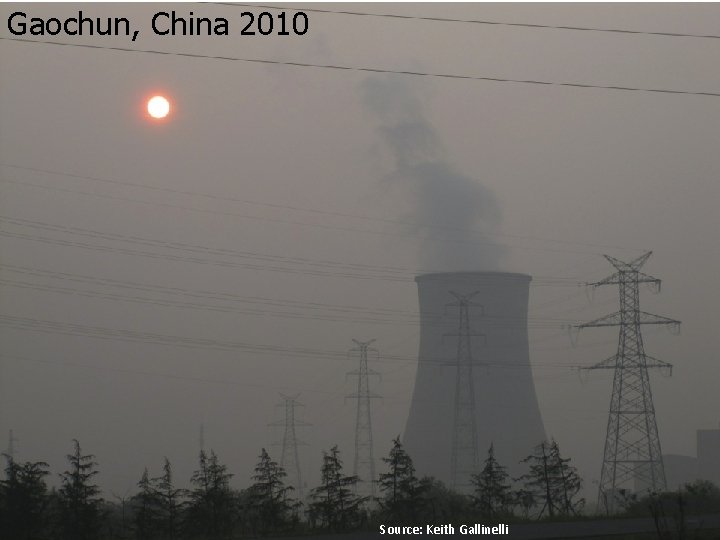
Gaochun, China 2010 Source: Keith Gallinelli
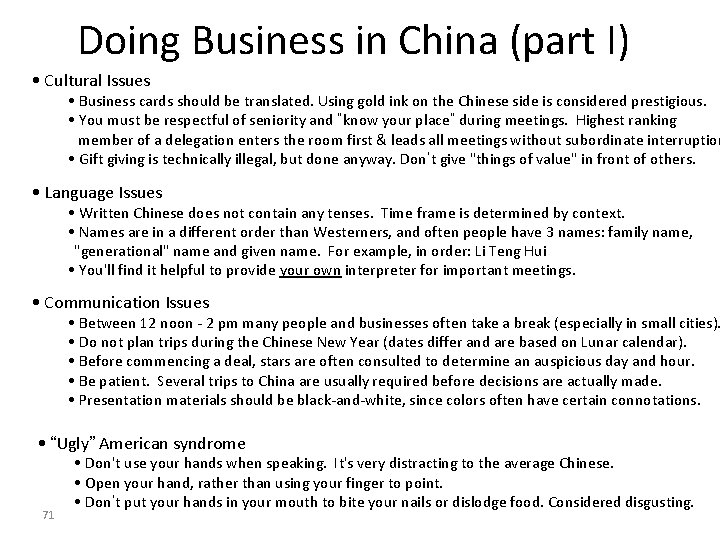
Doing Business in China (part I) • Cultural Issues • Business cards should be translated. Using gold ink on the Chinese side is considered prestigious. • You must be respectful of seniority and “know your place” during meetings. Highest ranking member of a delegation enters the room first & leads all meetings without subordinate interruption • Gift giving is technically illegal, but done anyway. Don’t give "things of value" in front of others. • Language Issues • Written Chinese does not contain any tenses. Time frame is determined by context. • Names are in a different order than Westerners, and often people have 3 names: family name, "generational" name and given name. For example, in order: Li Teng Hui • You'll find it helpful to provide your own interpreter for important meetings. • Communication Issues • Between 12 noon - 2 pm many people and businesses often take a break (especially in small cities). • Do not plan trips during the Chinese New Year (dates differ and are based on Lunar calendar). • Before commencing a deal, stars are often consulted to determine an auspicious day and hour. • Be patient. Several trips to China are usually required before decisions are actually made. • Presentation materials should be black-and-white, since colors often have certain connotations. • “Ugly” American syndrome 71 • Don't use your hands when speaking. It's very distracting to the average Chinese. • Open your hand, rather than using your finger to point. • Don’t put your hands in your mouth to bite your nails or dislodge food. Considered disgusting.
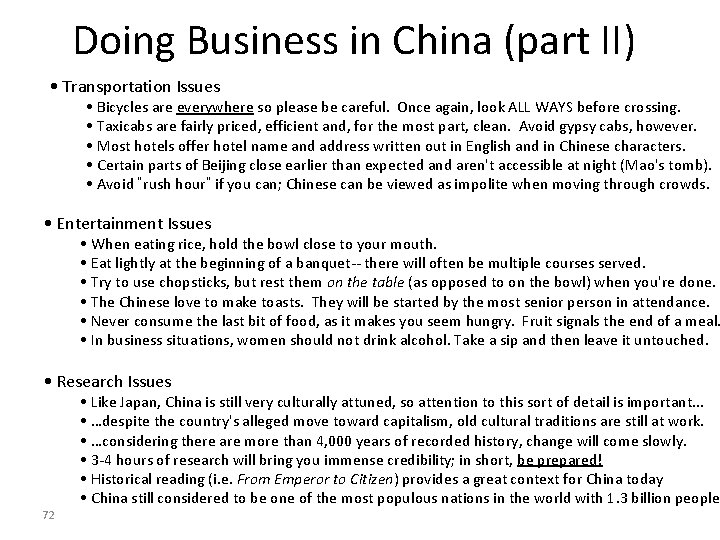
Doing Business in China (part II) • Transportation Issues • Bicycles are everywhere so please be careful. Once again, look ALL WAYS before crossing. • Taxicabs are fairly priced, efficient and, for the most part, clean. Avoid gypsy cabs, however. • Most hotels offer hotel name and address written out in English and in Chinese characters. • Certain parts of Beijing close earlier than expected and aren't accessible at night (Mao's tomb). • Avoid “rush hour” if you can; Chinese can be viewed as impolite when moving through crowds. • Entertainment Issues • When eating rice, hold the bowl close to your mouth. • Eat lightly at the beginning of a banquet-- there will often be multiple courses served. • Try to use chopsticks, but rest them on the table (as opposed to on the bowl) when you're done. • The Chinese love to make toasts. They will be started by the most senior person in attendance. • Never consume the last bit of food, as it makes you seem hungry. Fruit signals the end of a meal. • In business situations, women should not drink alcohol. Take a sip and then leave it untouched. • Research Issues 72 • Like Japan, China is still very culturally attuned, so attention to this sort of detail is important. . . • …despite the country's alleged move toward capitalism, old cultural traditions are still at work. • …considering there are more than 4, 000 years of recorded history, change will come slowly. • 3 -4 hours of research will bring you immense credibility; in short, be prepared! • Historical reading (i. e. From Emperor to Citizen) provides a great context for China today • China still considered to be one of the most populous nations in the world with 1. 3 billion people!
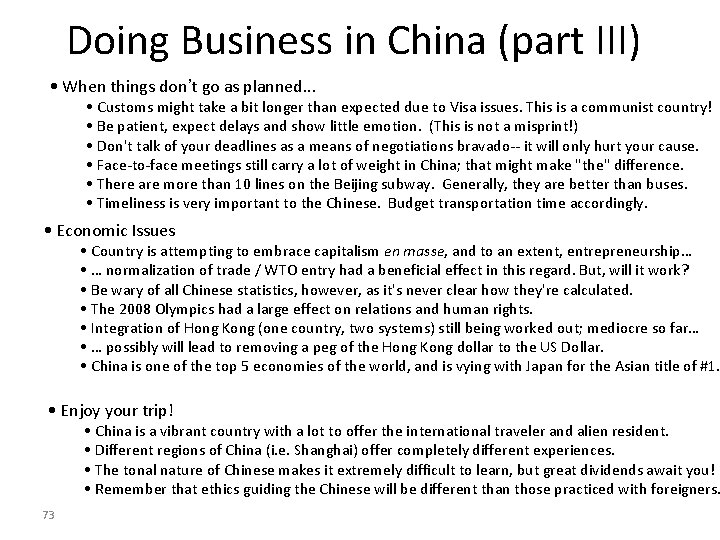
Doing Business in China (part III) • When things don’t go as planned. . . • Customs might take a bit longer than expected due to Visa issues. This is a communist country! • Be patient, expect delays and show little emotion. (This is not a misprint!) • Don't talk of your deadlines as a means of negotiations bravado-- it will only hurt your cause. • Face-to-face meetings still carry a lot of weight in China; that might make "the" difference. • There are more than 10 lines on the Beijing subway. Generally, they are better than buses. • Timeliness is very important to the Chinese. Budget transportation time accordingly. • Economic Issues • Country is attempting to embrace capitalism en masse, and to an extent, entrepreneurship… • … normalization of trade / WTO entry had a beneficial effect in this regard. But, will it work? • Be wary of all Chinese statistics, however, as it's never clear how they're calculated. • The 2008 Olympics had a large effect on relations and human rights. • Integration of Hong Kong (one country, two systems) still being worked out; mediocre so far… • … possibly will lead to removing a peg of the Hong Kong dollar to the US Dollar. • China is one of the top 5 economies of the world, and is vying with Japan for the Asian title of #1. • Enjoy your trip! • China is a vibrant country with a lot to offer the international traveler and alien resident. • Different regions of China (i. e. Shanghai) offer completely different experiences. • The tonal nature of Chinese makes it extremely difficult to learn, but great dividends await you! • Remember that ethics guiding the Chinese will be different than those practiced with foreigners. 73
Session #3 The Japan Market 74
Japan Market 75
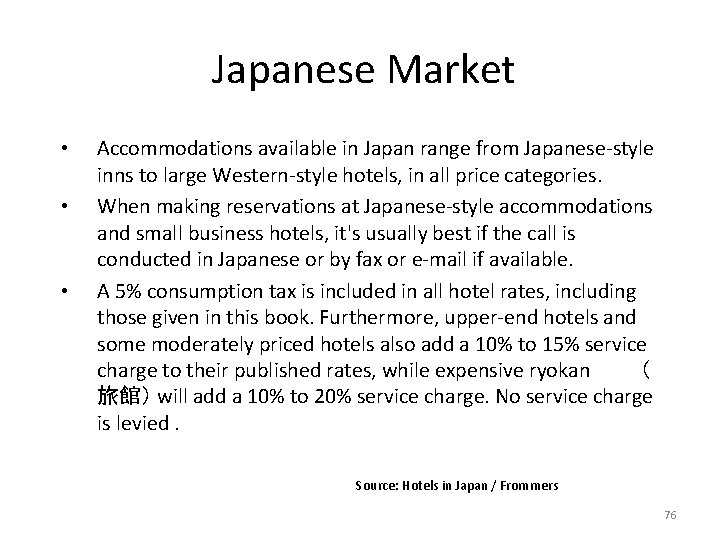
Japanese Market • • • Accommodations available in Japan range from Japanese-style inns to large Western-style hotels, in all price categories. When making reservations at Japanese-style accommodations and small business hotels, it's usually best if the call is conducted in Japanese or by fax or e-mail if available. A 5% consumption tax is included in all hotel rates, including those given in this book. Furthermore, upper-end hotels and some moderately priced hotels also add a 10% to 15% service charge to their published rates, while expensive ryokan ( 旅館) will add a 10% to 20% service charge. No service charge is levied. Source: Hotels in Japan / Frommers 76
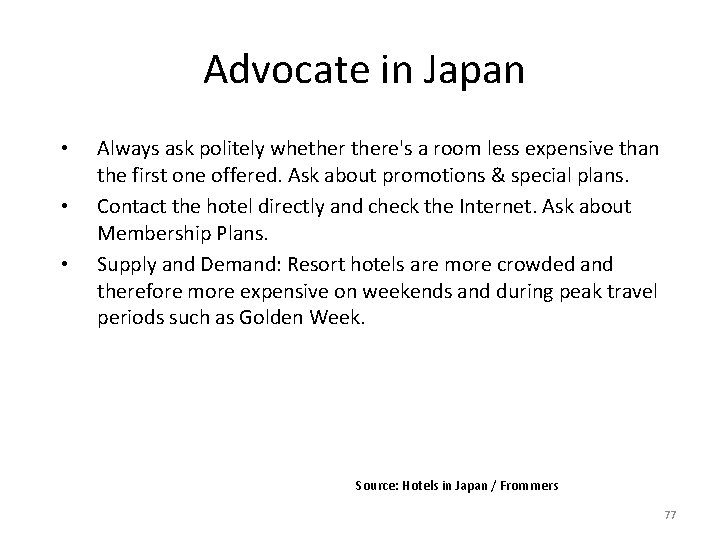
Advocate in Japan • • • Always ask politely whethere's a room less expensive than the first one offered. Ask about promotions & special plans. Contact the hotel directly and check the Internet. Ask about Membership Plans. Supply and Demand: Resort hotels are more crowded and therefore more expensive on weekends and during peak travel periods such as Golden Week. Source: Hotels in Japan / Frommers 77
Japan: All About Service (Part 1) • • • Always ask politely whethere's a room less expensive than the first one offered. Ask about promotions & special plans. Contact the hotel directly and check the Internet. Ask about Membership Plans. Supply and Demand: Resort hotels are more crowded and therefore more expensive on weekends and during peak travel periods such as Golden Week. Source: How Japan Has Perfected Hospitality Culture 78
Japan: All About Service (Part 2) • • Sincerity vs. Cultural norms: A 1960 s stewardess ( jacket, skirt, gloves, pumps, jaunty hat) in a department store welcomes you with a series of bows and spoken greetings that continue, without pause, as she pushes the call button. Service is so polished and comprehensive that even the most basic transactions can take on a ceremonious air. Just as important, you don't pay extra for that care. There is no tipping in Japan. Although Japanese hospitality, or what we call omotenashi ( お持て成し) has developed a reputation outside of Japan as being a benchmark for exceptional service, it can be very difficult to define. Source: How Japan Has Perfected Hospitality Culture 79
Japan: All About Service (Part 3) • • “The staff reopened the bar—even though it was well after last call—because it was my birthday. “How did they know? ” What I experienced at the Park Hyatt Tokyo was an example of omoiyari (思いやり): The active sensitivity to other people. No staff sighs during work and there is no extensive chatting between co-workers. “When he bowed and wished me well with what seemed like heartfelt sincerity, he was being professional. ” Source: How Japan Has Perfected Hospitality Culture 80
Recent Trends (Part 1) • • • The rising investment also reflects growing interest in Japan’s broader, long-dormant real-estate sector as Prime Minister Shinzo Abe’s policies have weakened the yen and loosened lending conditions, while unlocking the nation’s potential as a tourist destination. Investment in Japanese hotels by value last year rose to ¥ 297 billion ($2. 5 billion), the most since 2007, according to Real Capital Analytics Inc. , a U. S. -based data and research provider. That’s less than half the total seen in 2007, but around nine times the post- crisis low of ¥ 32. 3 billion in 2009. Tourism in Japan is growing rapidly. A record 13. 4 million foreign tourists visited the country last year, an increase of nearly a third from a year earlier. Source: Japan Tourism Boom Draws Hotel Investors 81
Recent Trends (Part 2) • • • Japan is far from a global tourism hot spot. It ranked only 27 th worldwide in foreign visitors in 2013, according to the United Nations World Tourism Organization. English isn’t as commonly spoken in Tokyo as in other major Asian cities such as Singapore and Hong Kong, and those in the industry say it doesn’t offer enough tourist- friendly budget transportation options. Still, many investors see great potential. Hotel properties in Japan offer relatively high returns. In 2013, they generated total returns—income plus capital gains—of 8. 1%, compared with 7. 1% in the U. S. and 6. 1% in Singapore. Source: Japan Tourism Boom Draws Hotel Investors 82
Recent Trends (Part 3) • • • Revenue per available rooms, the industry’s key performance metric, grew roughly 10% each year over the past three years in local currency terms, more than in other key markets such as the U. S. , U. K. Australia, and Singapore. Japanese hotels don’t charge as much as rivals in other major economies. The average daily rate in 2014 was $123, compared with $236 in Singapore and $220 in France. Japanese banks are eager to lend money because government bonds, their traditional investments, are offering paltry yields due to the Bank of Japan’s asset-purchase program. Source: Japan Tourism Boom Draws Hotel Investors 83
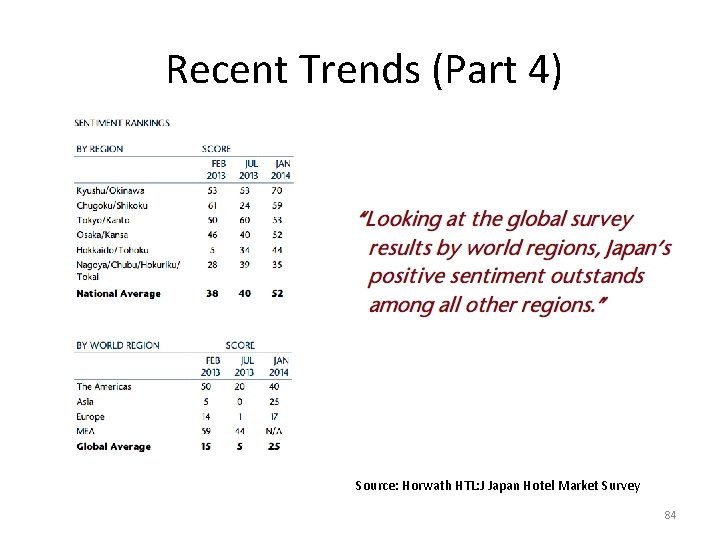
Recent Trends (Part 4) Source: Horwath HTL: J Japan Hotel Market Survey 84
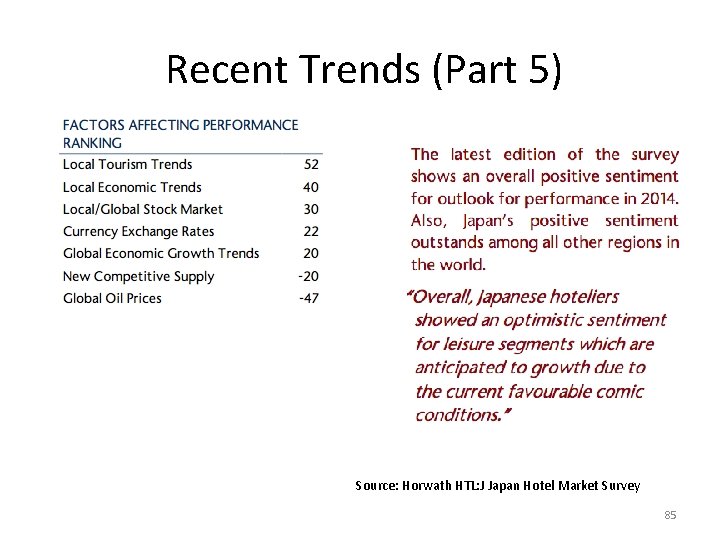
Recent Trends (Part 5) Source: Horwath HTL: J Japan Hotel Market Survey 85
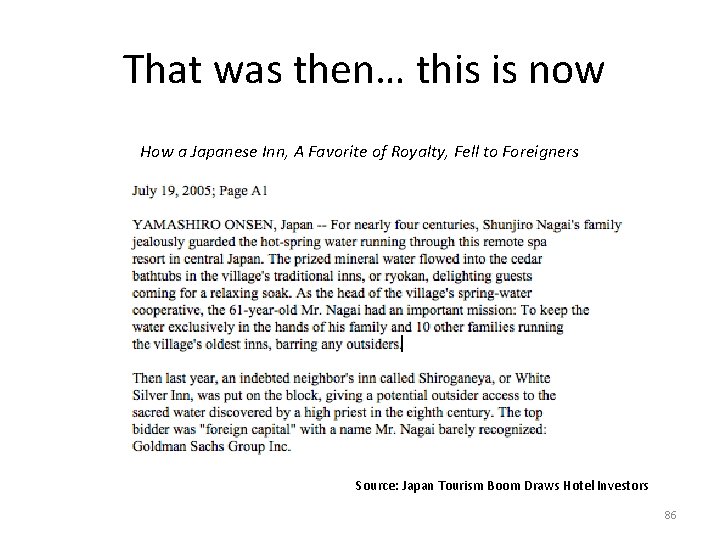
That was then… this is now How a Japanese Inn, A Favorite of Royalty, Fell to Foreigners Source: Japan Tourism Boom Draws Hotel Investors 86
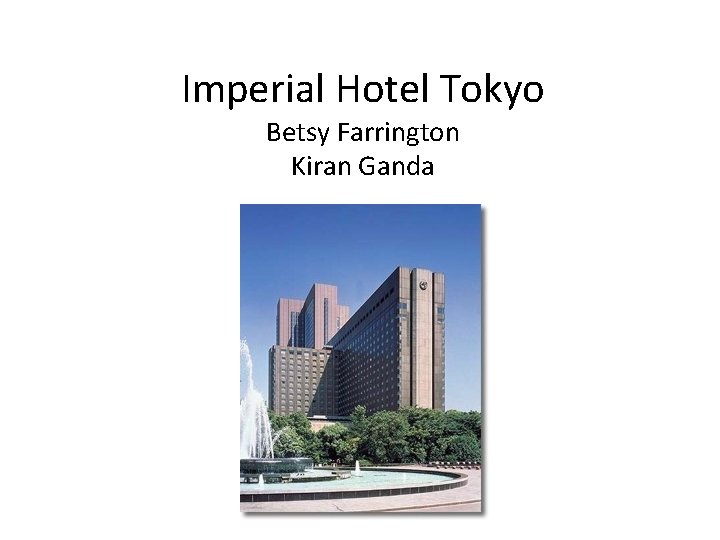
Imperial Hotel Tokyo Betsy Farrington Kiran Ganda
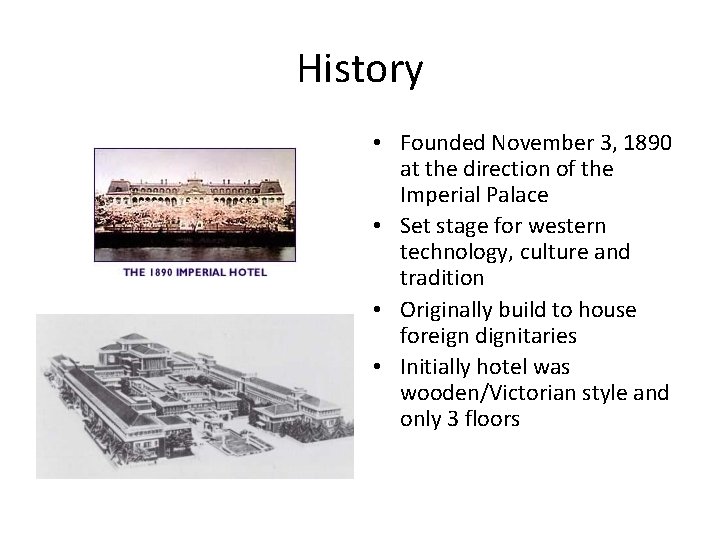
History • Founded November 3, 1890 at the direction of the Imperial Palace • Set stage for western technology, culture and tradition • Originally build to house foreign dignitaries • Initially hotel was wooden/Victorian style and only 3 floors
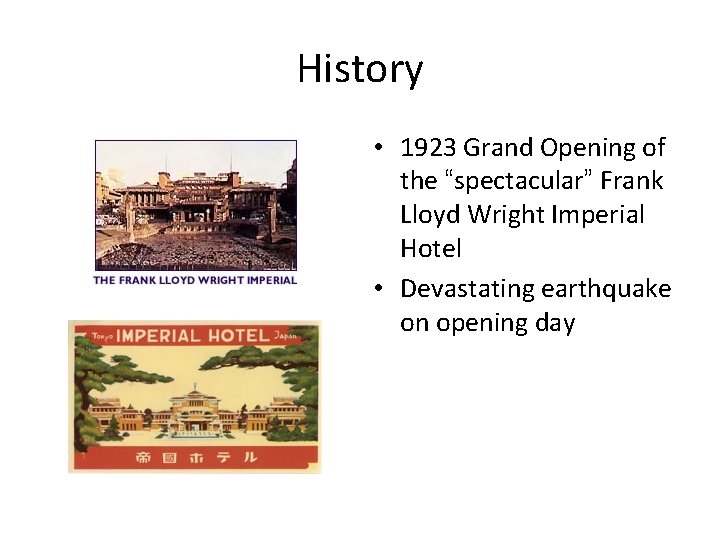
History • 1923 Grand Opening of the “spectacular” Frank Lloyd Wright Imperial Hotel • Devastating earthquake on opening day
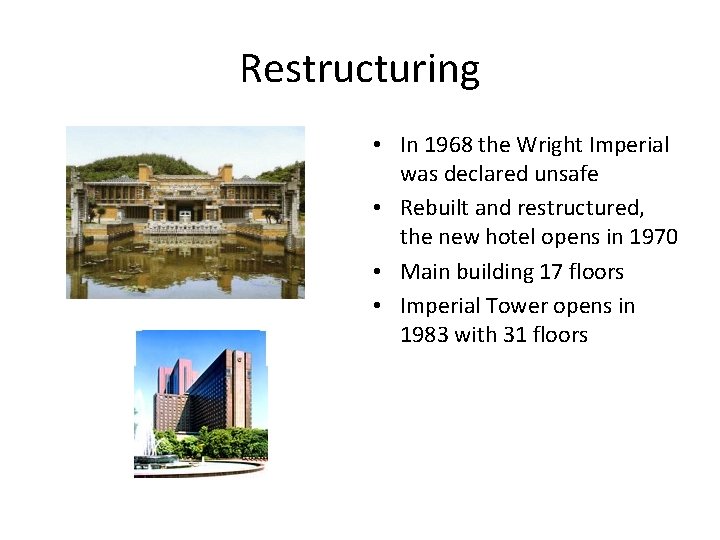
Restructuring • In 1968 the Wright Imperial was declared unsafe • Rebuilt and restructured, the new hotel opens in 1970 • Main building 17 floors • Imperial Tower opens in 1983 with 31 floors
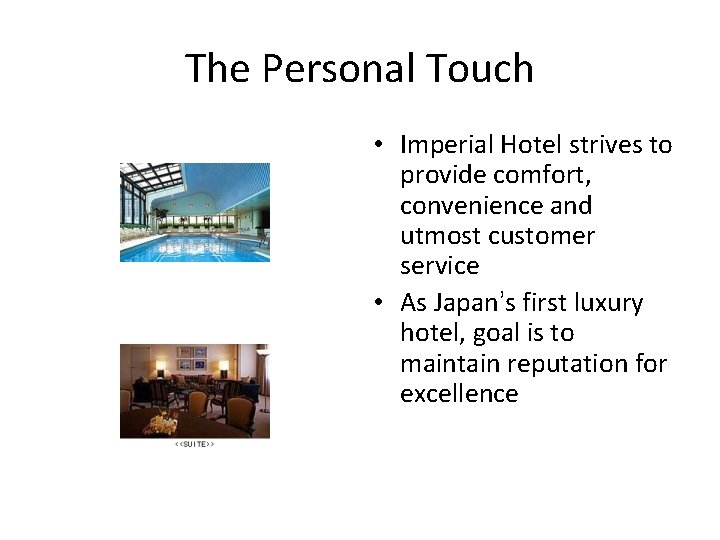
The Personal Touch • Imperial Hotel strives to provide comfort, convenience and utmost customer service • As Japan’s first luxury hotel, goal is to maintain reputation for excellence
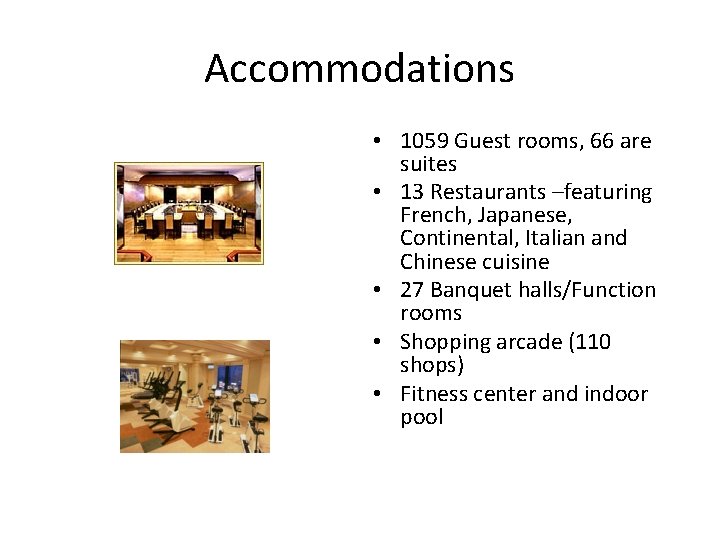
Accommodations • 1059 Guest rooms, 66 are suites • 13 Restaurants –featuring French, Japanese, Continental, Italian and Chinese cuisine • 27 Banquet halls/Function rooms • Shopping arcade (110 shops) • Fitness center and indoor pool
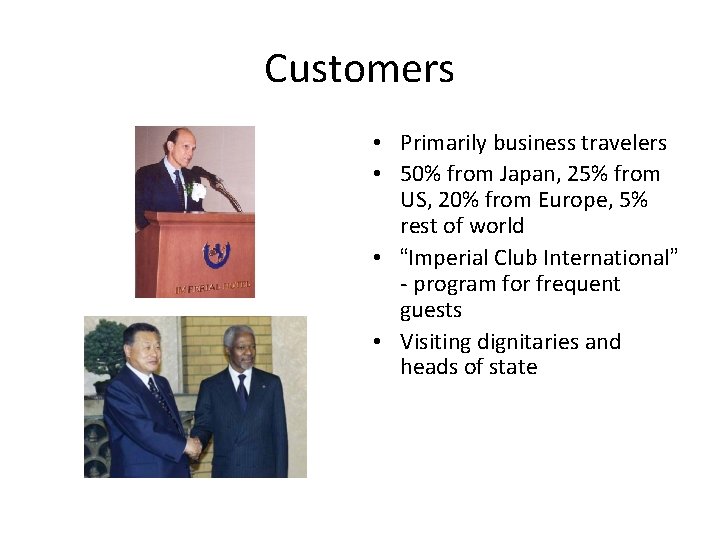
Customers • Primarily business travelers • 50% from Japan, 25% from US, 20% from Europe, 5% rest of world • “Imperial Club International” - program for frequent guests • Visiting dignitaries and heads of state
Core Competency - Technology • Executive Service Center launched in 1974 • First Japanese hotel to move into the high technology age • Amenities include: meeting space, secretarial support, computer services, interpreter/translation services, printing and fax • Recently installed high speed internet connections in all rooms
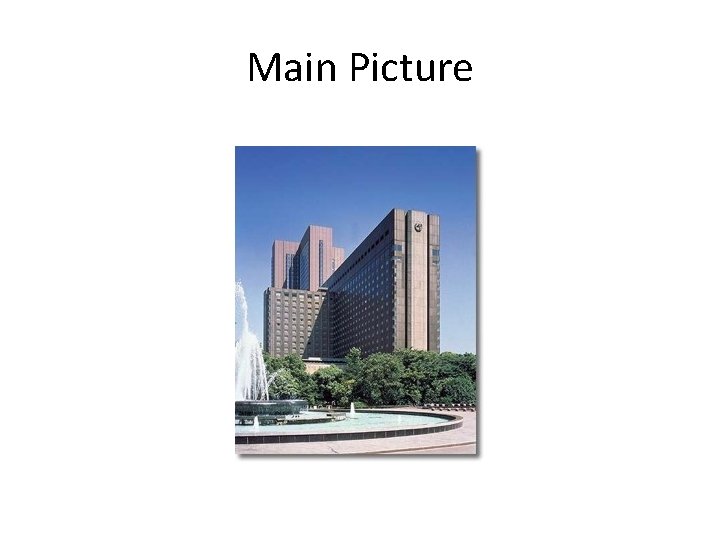
Main Picture
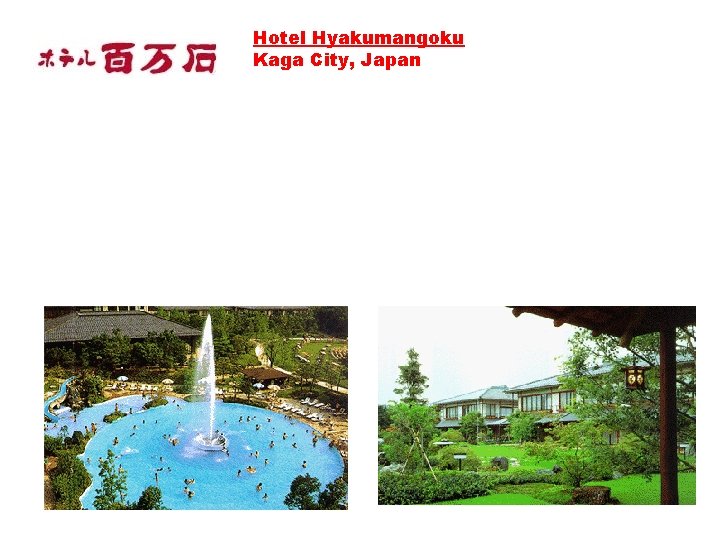
Hotel Hyakumangoku Kaga City, Japan
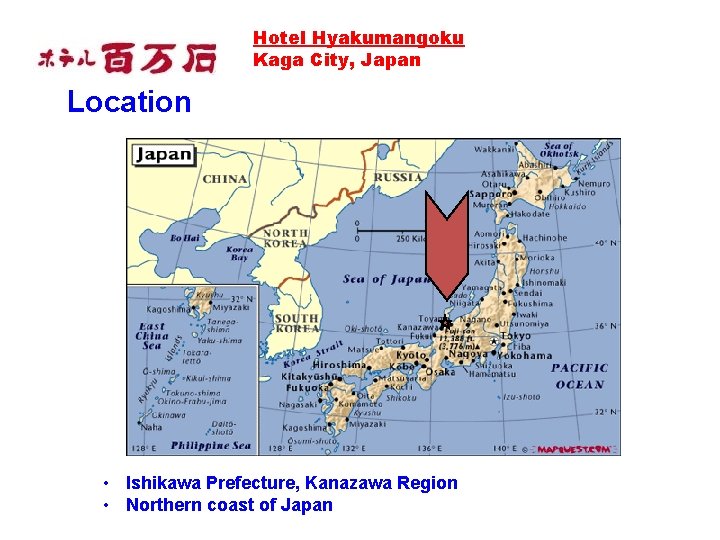
Hotel Hyakumangoku Kaga City, Japan Location • Ishikawa Prefecture, Kanazawa Region • Northern coast of Japan
Hotel Hyakumangoku Kaga City, Japan Hotel Hyakumangoku • 226 guest rooms • Two styles of room • Traditional Japanese (184 rooms) • European Twins (42) • Hotel and grounds are 16. 3 acres • Various amenities
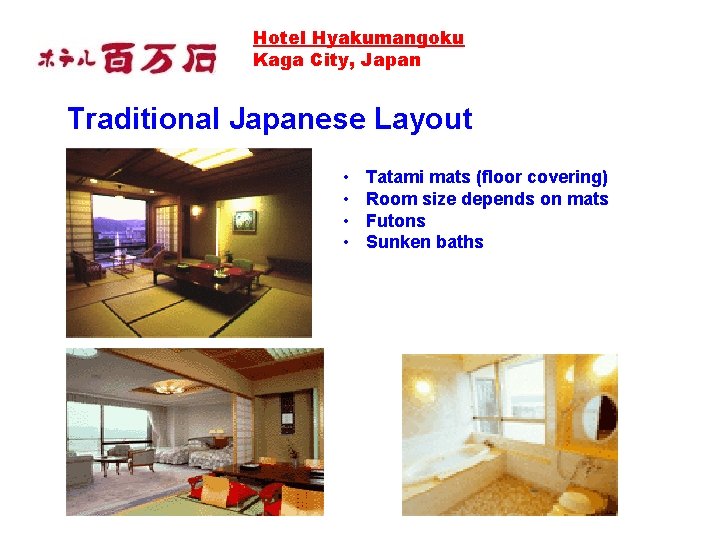
Hotel Hyakumangoku Kaga City, Japan Traditional Japanese Layout • • Tatami mats (floor covering) Room size depends on mats Futons Sunken baths
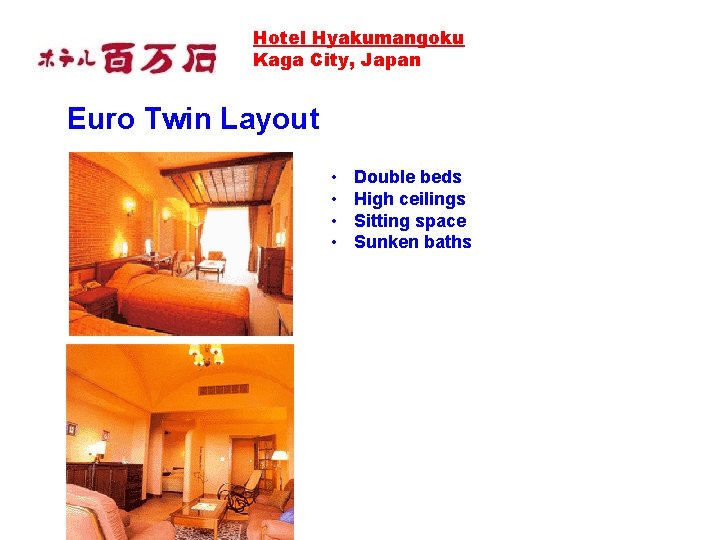
Hotel Hyakumangoku Kaga City, Japan Euro Twin Layout • • Double beds High ceilings Sitting space Sunken baths
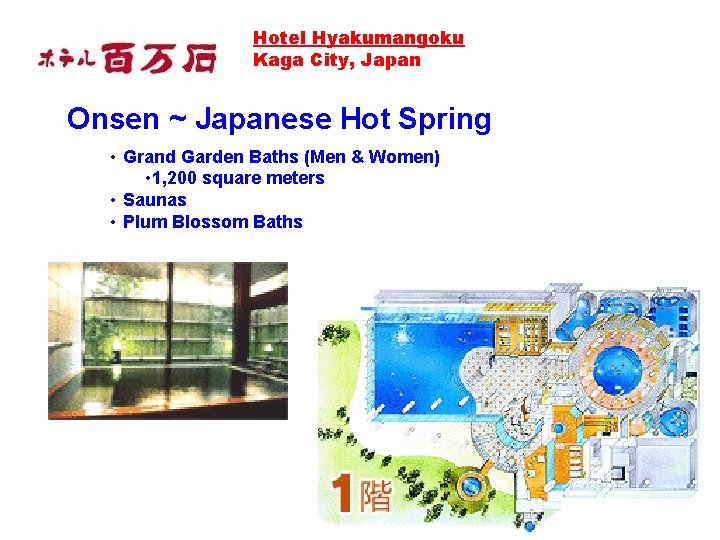
Hotel Hyakumangoku Kaga City, Japan Onsen ~ Japanese Hot Spring • Grand Garden Baths (Men & Women) • 1, 200 square meters • Saunas • Plum Blossom Baths
Hotel Hyakumangoku Kaga City, Japan Onsen ~ Japanese Hot Spring • Onsen • Hot springs vary (big/small/indoor/out/natural/man-made) • 1000 year old custom • Relaxation and beneficial properties to thermal springs • Hot water, mineral water, water vapor and gases • 770 F + • Onnaburo – women’s bath • Otokoburo – men’s bath • Japanese chronicles of Fudoki • “Bathing once, the visitor is made fair of face and figure; bathing twice, all diseases are healed. ”
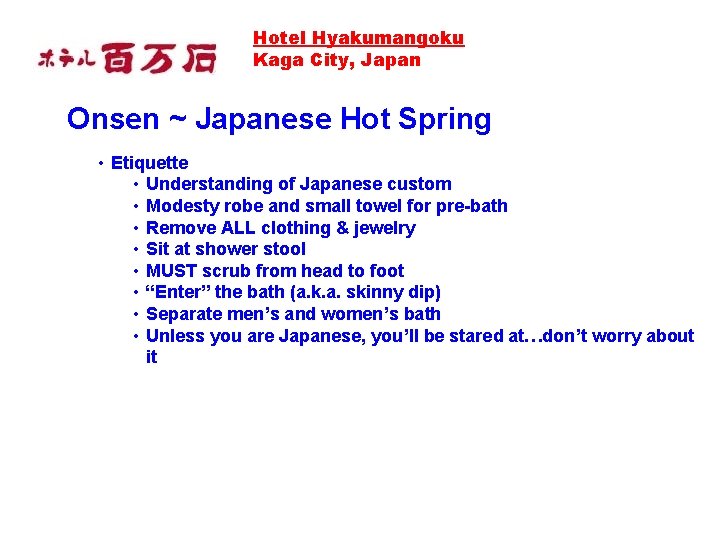
Hotel Hyakumangoku Kaga City, Japan Onsen ~ Japanese Hot Spring • Etiquette • Understanding of Japanese custom • Modesty robe and small towel for pre-bath • Remove ALL clothing & jewelry • Sit at shower stool • MUST scrub from head to foot • “Enter” the bath (a. k. a. skinny dip) • Separate men’s and women’s bath • Unless you are Japanese, you’ll be stared at…don’t worry about it
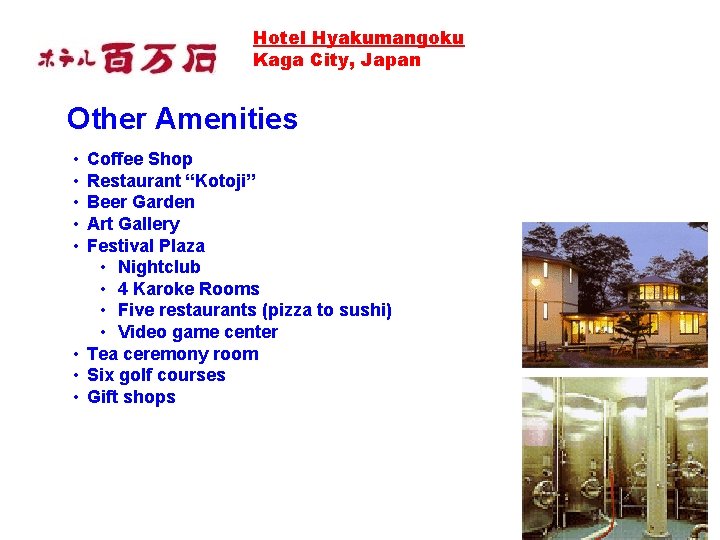
Hotel Hyakumangoku Kaga City, Japan Other Amenities • • • Coffee Shop Restaurant “Kotoji” Beer Garden Art Gallery Festival Plaza • Nightclub • 4 Karoke Rooms • Five restaurants (pizza to sushi) • Video game center • Tea ceremony room • Six golf courses • Gift shops
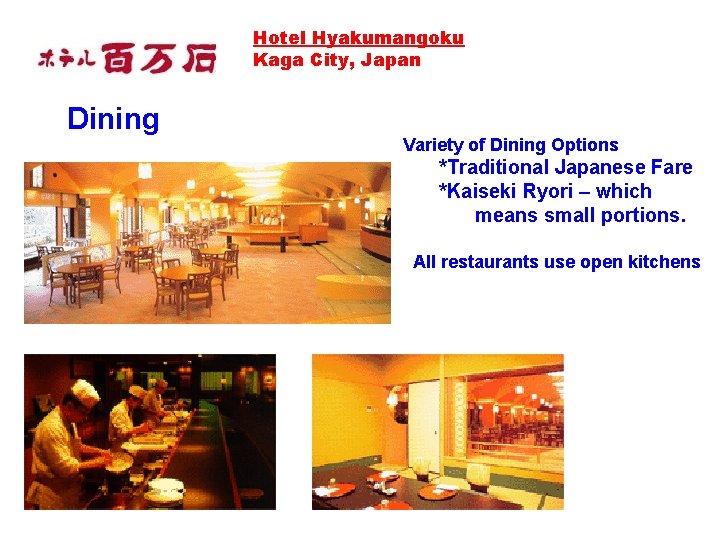
Hotel Hyakumangoku Kaga City, Japan Dining Variety of Dining Options *Traditional Japanese Fare *Kaiseki Ryori – which means small portions. All restaurants use open kitchens
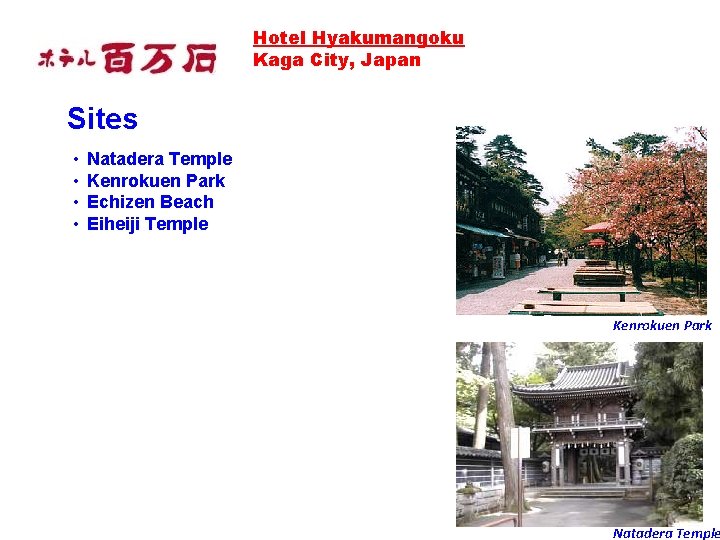
Hotel Hyakumangoku Kaga City, Japan Sites • • Natadera Temple Kenrokuen Park Echizen Beach Eiheiji Temple Kenrokuen Park Natadera Temple
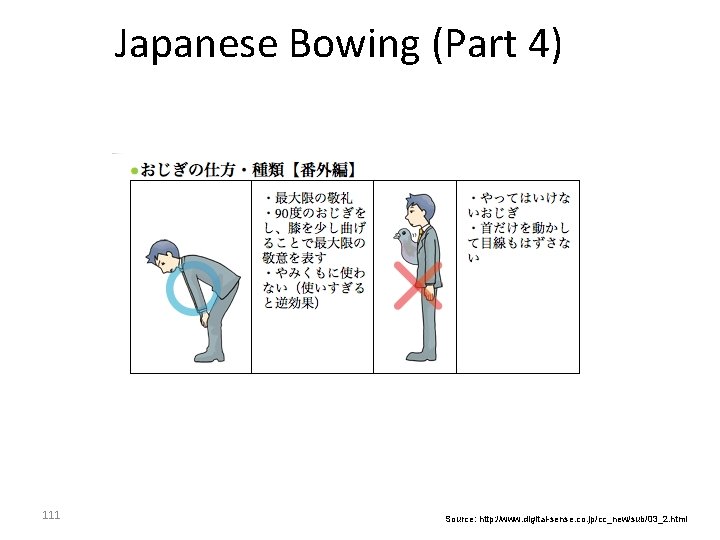
Japanese Training & Bowing 107 Picture source: http: //www. imperialhotel. co. jp/index_j. html All material in presentation accessed June / 2009 Other sources: Personal knowledge and experience
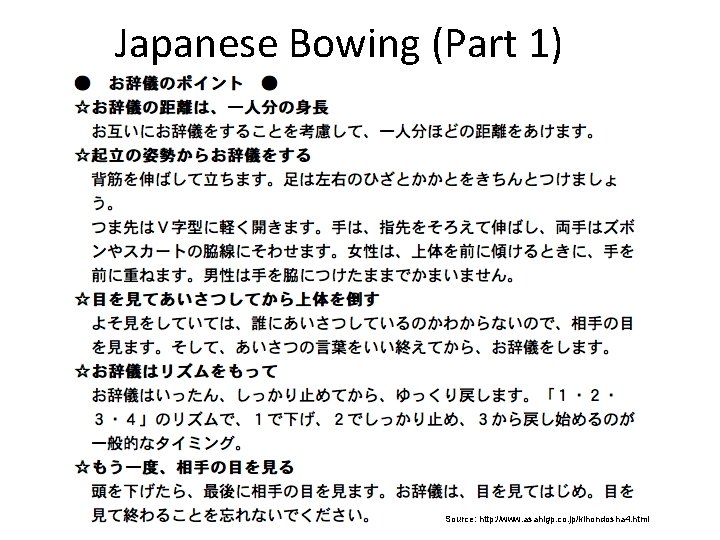
Japanese Bowing (Part 1) Source: http: //www. asahigp. co. jp/kihondosha 4. html
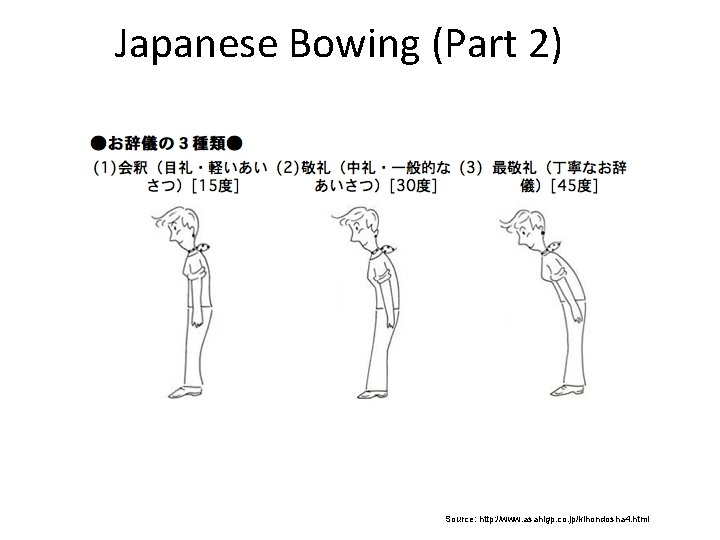
Japanese Bowing (Part 2) Source: http: //www. asahigp. co. jp/kihondosha 4. html
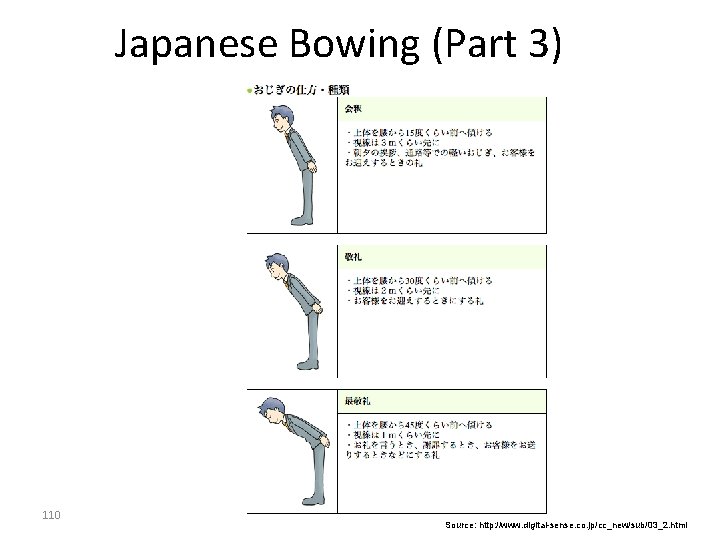
Japanese Bowing (Part 3) 110 Source: http: //www. digital-sense. co. jp/cc_new/sub/03_2. html
Japanese Bowing (Part 4) 111 Source: http: //www. digital-sense. co. jp/cc_new/sub/03_2. html
Japanese Bowing (Part 5) Source: http: //www. asahigp. co. jp/kihondosha 4. html
Doing Business in Japan (part I) • Cultural Issues • Business cards must be in Japanese; always leave them face-up, & on the table during meetings. • You must be respective of seniority and “know your place” during meetings. • You walk a fine line between “going with the flow, ” and pursuing your own agenda. • Language Issues • Japanese never come out and really say “no. ” It’s implied in many different ways. • Visitors should try to speak in as much Japanese as they can… study on the plane! • Japanese understand more English than they let on; be mindful of this! • Communication Issues • Japanese are always eerily focused on the “big picture. ” Be careful of acquiescing to each request. • Japanese departments have different agendas-- don’t be surprised if you’re focusing on two unrelated issues in the same negotiation. Use this to your advantage, if you can. • Be flawless in your responsiveness. This will place you in excellent stead with your contacts. • Your average contacts aren’t usually creative-- don’t expect too much of this from the relationship • The Japanese are “flawless” at repetition-- use this to your advantage, as well, if you can. • “Ugly” American syndrome 113 • In no other country is this so pronounced as it is in Japan. Remember: when in Rome. . . • You won’t win by trying something “new” this one time--- it vary rarely works and can cost you a significant amount of “face. ”
Doing Business in Japan (part II) • Transportation Issues • Bring comfortable shoes and expect to do a lot of walking. This is NOT a taxicab city. • The train system is very efficient-- trains always arrive and depart completely on schedule. • Trains only run until 12 -1 am in the morning; be aware of this, or it could be a costly mistake. • Don’t eat in trains, buses or taxis as it’s considered to be rude (drinking is usually OK). • Cellphone use inside trains and restaurants is now being regulated (even for data transfers). • Avoid (morning) “rush hour” if you can; it’s at least 4 x worse than the MBTA. • Entertainment Issues • Never pour your own drinks in the early rounds, as this detracts from group solidarity. • Don’t refuse any food that’s given to you; take at least one bite, or one sip. Be polite. • Women should not consume more than 1 -2 full drinks (i. e. beer/wine) during any one evening. • Japanese love to go to at least 2 places, perhaps 3, when entertaining clients; budget accordingly. • Don’t be “put off” by odd remarks; average English speaking ability is mediocre. • Don’t be “put off” by long periods of silence… it’s a cultural norm. • Research Issues • Most of the material “in the books” is correct, especially outside of Tokyo. Don’t “blow it off, ” believing that the “young” generation is changing the country. • 2 -3 hours of research will bring you immense credibility; invest 4 -6 hours if you have the time • Demonstrate your new found knowledge to your hosts- they’ll be genuinely be impressed. • Don’t think “you have them where you want” them when your hosts treat you extremely kindly. This, too, is cultural. 114
Doing Business in Japan (part III) • When things don’t go as planned. . . • Don’t display your frustration in public; you appear weak, and “very American. ” • Insist on a meeting with the top leader; but definitely do your homework beforehand. The Japanese are experts at preparation, detail and consistency. You should be, too! • Face-to-face meetings still carry a lot of weight in Japan; make the long trip, if you can. • Most of your hosts will want to meet at least one time on each person’s “turf”to meet everyone. • Budget your time to “close the deal” accordingly. Even in 2003, Japan is big on consensus. • Economic Issues • Lifetime employment is slowly eroding based on the protracted recession in the country. • Entrepreneurship is beginning to make an entrance, especially in hi-tech, albeit slowly. • Interest rates are currently at. 25% & the economy is still hurting. Prices beginning to deflate. • Disposable income spending is at an all time low, and is a good proxy for consumer confidence. • Dollar-Yen exchange rate is relatively favorable these days, in favor of the US (approx. Y 120/$1) • Despite the recession, prices are still 2 -3 x higher than the US. But remember to view them in the context of yen-denominated salaries. • Enjoy your trip! • Japan is a FABULOUS country with a lot to offer the international traveler and alien resident. • Some of my best friends are Japanese; it is truly a country filled with quality, educated people. • Try to get out of Tokyo and other large cities; the countryside offers some spectacular views. • If you need any professional or personal advice before your trip, please contact me! 115
Session #4 The Thai Market 116
Thai Market 117
Thailand Hotel Market Outlook (Part 1) • • After a successful year for tourism in 2013, Thailand experienced a 6. 7 percent decrease in visitor arrivals and a 4. 9 percent decrease in tourism receipts. This slump in tourism receipts is attributed to the anti-government protests during the peak tourism season, from November 2013 to February 2014. As of September 2014, approximately 101 hotels, comprising about 18 000 rooms, were introduced into the market. These new hotels were mainly located in Bangkok with 32 percent of new rooms, and Phuket with 22 percent of new rooms. Source: Horwath: 2015 THAILAND Hotel Industry Survey of Operations 118
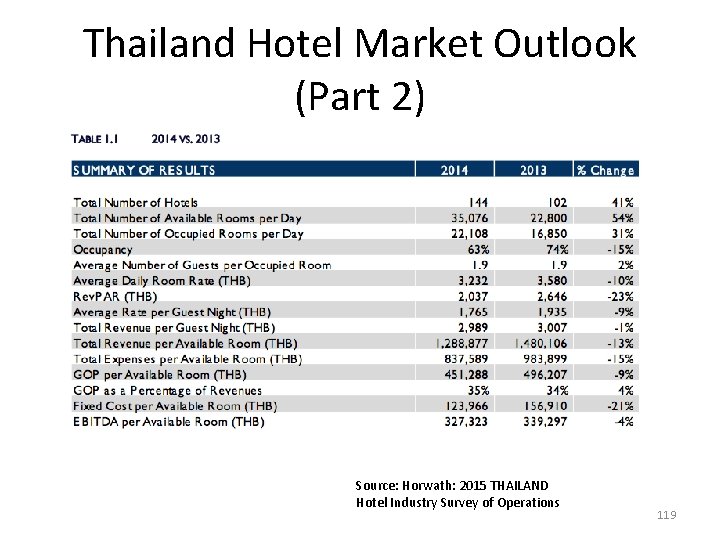
Thailand Hotel Market Outlook (Part 2) Source: Horwath: 2015 THAILAND Hotel Industry Survey of Operations 119
Thailand Hotel Market Outlook (Part 3) • • • As an overall average, rooms revenue constituted 61 percent of total revenue. This proportion was kept relatively low due to the high proportion of resort properties in the sample. Average labor cost per employee does not increase proportionately with average rate. This allows high end hotels to achieve a much better expense ratio than hotels of lower positioning in the rooms department. Overall, utilities on a per available room remained the same from 2013, yet on a per occupied room basis, they were up. This suggests that the hotel was consuming more energy, fuel and water per guest with fewer guests in the hotel. With higher overall occupancies, hotels could benefit from economies of scale. Source: Horwath: 2015 THAILAND Hotel Industry Survey of Operations 120
Thailand Hotel Market Outlook (Part 4) • • • Bangkok, 27 January, 2016 – Thailand’s hospitality industry reached new highs in 2015, enjoying its best year in over two decades, according to research revealed exclusively by leading research institute STR Global at Thailand Tourism Forum 2016, held on 25 January, 2016 at the Inter. Continental Bangkok. Thailand closed the year with an overall occupancy of 73. 4 per cent, an increase of 13. 6 per cent over 2014, as arrivals soared to near the 30 million mark, driven by the demand from the mainland China market. “Thailand will remain the preferred travel destination for ASEAN and all Asian markets for years and we wish to continue to grow and be part of that. ” Source: 2015 named the best year in two decades for Thai hospitality industry 121
Thailand Hotel Market Outlook (Part 5) • • • Domestic demand was concentrated in the low-tier hotels in Bangkok; however, it was quite evenly distributed across hotels in Phuket. People are more likely to spend on a holiday beach getaway than on a Business city trip. Greater Phuket and Koh Samui remain the resort destinations of choice for European travellers, due to their international reputation. When people think about “Thai Hospitality”, they may think: lots of cheap, luxury hotels, and a thriving tourist culture. Source: Horwath: 2015 THAILAND, Hotel Industry Survey of Operations, Thai Hospitality: Its Reputation 122 and Culture
Thailand Culture (Part 1) • • • Another frequent reputation of the industry is that of the prostitution activity, and its link to hospitality. It may be difficult for an international hotel to quickly find local resources in China that can operate with acceptable service quality for a standard, three-star hotel [in Thailand]. We are dealing with a culture that has a foundation for hospitality and service that is capable of meeting the demands of the international travelers. This presents good grounds for continued growth. Source: Thai Hospitality: Its Reputation and Culture 123
Thailand Culture (Part 2) • • • Another frequent reputation of the industry is that of the prostitution activity, and its link to hospitality. It may be difficult for an international hotel to quickly find local resources in China that can operate with acceptable service quality for a standard, three-star hotel [in Thailand]. We are dealing with a culture that has a foundation for hospitality and service that is capable of meeting the demands of the international travelers. This presents good grounds for continued growth. Source: Thai Hospitality: Its Reputation and Culture 124
Thailand Culture (Part 3) • • There are 26 provinces that make up Central and Eastern Thailand, and Bangkok is one of them. Geographically, this is Thailand’s heartland. The North is the birthplace of the earliest Thai civilization and has many sites of archaeological and cultural interest. Northern people are famous for their courtesy and hospitality, and the region is also noted for its variety of cultural traditions. Northeast: A vast plateau covering nearly one third of the country. South: It is a rich land in terms of the abundance of its natural resources. Source: Travel Info: About Thailand 125
Thailand Culture (Part 4) • • On a worldwide scale Bangkok and the rest of Thailand is safer than most tourist destinations. The overall Buddhist beliefs and the deeply held Thai traditional influences are rich and are one of the main reasons that tourists who are looking for a unique travel experience flock here each year. Price for value has always been, and should continue to be, an asset whether at the luxury, deluxe, moderate or economy tiers of the hospitality industry. Thailand is the land of smiles – An overwhelming majority of the population is kind and helpful. Source: Opportunities and Challenges in the Hospitality Industry 126
That was then… this is now • • Mandarin Oriental, Bangkok is a five-star hotel in Bangkok owned in part and managed by Mandarin Oriental Hotel Group. Located on the banks of the Chao Phraya River, the original structure was the first hotel built in Thailand when it opened as The Oriental in 1876. In September 2008, the hotel formally changed its name from The Oriental, Bangkok to Mandarin Oriental, Bangkok. The hotel was the first hotel in Thailand. Named “Best City Hotel in Asia” and one of the “Top 20 Hotels Worldwide” (Travel + Leisure's annual World Best Awards 2009). Source: Japan Tourism Boom Draws Hotel Investors 127
Doing Business in Thailand (part I) • Cultural Issues • Thailand is only Asian country never to have been a European colony. • From the 13 th to the 20 th century, known as Siam, and hence the Kingdom of Siam. Name officially changed to Thailand in 1939. • The name Thai means “free. ” • Language Issues • Official language is Thai, which is linguistically related to Chinese, and is a tonal language. • The “Wai” is the most common greeting amongst men and women. If you offer the gesture to someone they will immediately reciprocate, and vice-versa. • Your hosts will be very impressed if you can learn a few Thai words or phrases. But remember that sentence structures, particularly the endings, vary between men and women. • Communication Issues • Most appointments are from 8: 30 - 5: 00 pm Monday through Friday. • Thai’s have great respect for rank, authority and titles, so any business related requests will have to go through several layers of management and bureaucracy before getting approved. • Try to get business cards translated into Thai on the reverse side. • “Ugly” American syndrome 128 • Never touch children (or anyone) on the head. Neither point your foot nor cross your legs. • Despite the high temperatures, proper attire is required at temples or the Royal Palace. • When introduced to a Monk, never touch them. Please do not ask for, or take their picture.
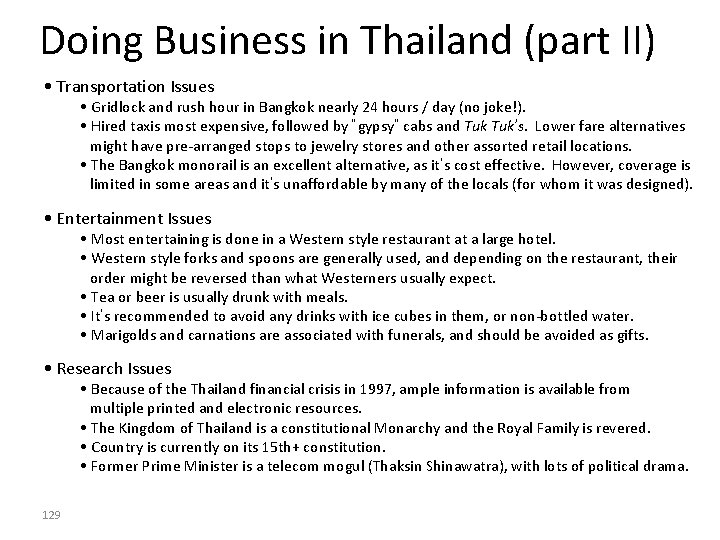
Doing Business in Thailand (part II) • Transportation Issues • Gridlock and rush hour in Bangkok nearly 24 hours / day (no joke!). • Hired taxis most expensive, followed by “gypsy” cabs and Tuk’s. Lower fare alternatives might have pre-arranged stops to jewelry stores and other assorted retail locations. • The Bangkok monorail is an excellent alternative, as it’s cost effective. However, coverage is limited in some areas and it’s unaffordable by many of the locals (for whom it was designed). • Entertainment Issues • Most entertaining is done in a Western style restaurant at a large hotel. • Western style forks and spoons are generally used, and depending on the restaurant, their order might be reversed than what Westerners usually expect. • Tea or beer is usually drunk with meals. • It’s recommended to avoid any drinks with ice cubes in them, or non-bottled water. • Marigolds and carnations are associated with funerals, and should be avoided as gifts. • Research Issues • Because of the Thailand financial crisis in 1997, ample information is available from multiple printed and electronic resources. • The Kingdom of Thailand is a constitutional Monarchy and the Royal Family is revered. • Country is currently on its 15 th+ constitution. • Former Prime Minister is a telecom mogul (Thaksin Shinawatra), with lots of political drama. 129
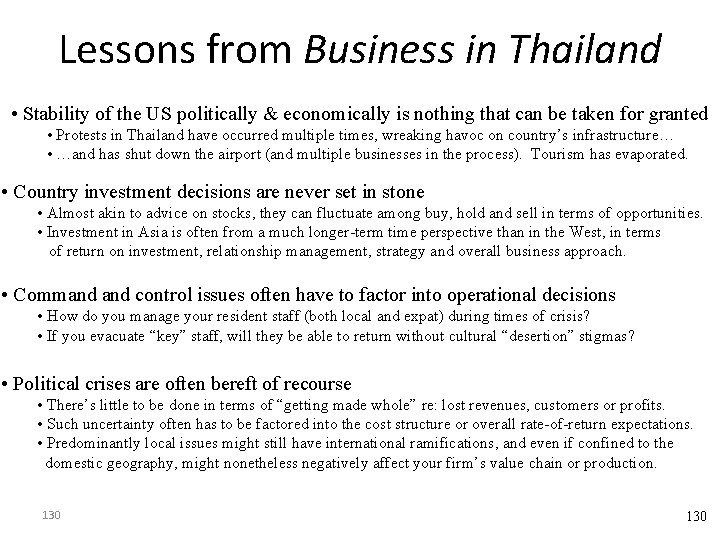
Lessons from Business in Thailand • Stability of the US politically & economically is nothing that can be taken for granted • Protests in Thailand have occurred multiple times, wreaking havoc on country’s infrastructure… • …and has shut down the airport (and multiple businesses in the process). Tourism has evaporated. • Country investment decisions are never set in stone • Almost akin to advice on stocks, they can fluctuate among buy, hold and sell in terms of opportunities. • Investment in Asia is often from a much longer-term time perspective than in the West, in terms of return on investment, relationship management, strategy and overall business approach. • Command control issues often have to factor into operational decisions • How do you manage your resident staff (both local and expat) during times of crisis? • If you evacuate “key” staff, will they be able to return without cultural “desertion” stigmas? • Political crises are often bereft of recourse • There’s little to be done in terms of “getting made whole” re: lost revenues, customers or profits. • Such uncertainty often has to be factored into the cost structure or overall rate-of-return expectations. • Predominantly local issues might still have international ramifications, and even if confined to the domestic geography, might nonetheless negatively affect your firm’s value chain or production. 130
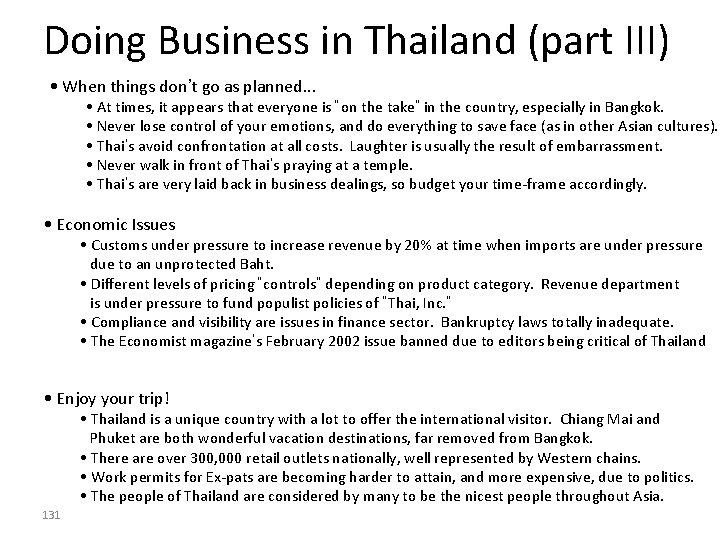
Doing Business in Thailand (part III) • When things don’t go as planned. . . • At times, it appears that everyone is “on the take” in the country, especially in Bangkok. • Never lose control of your emotions, and do everything to save face (as in other Asian cultures). • Thai’s avoid confrontation at all costs. Laughter is usually the result of embarrassment. • Never walk in front of Thai’s praying at a temple. • Thai’s are very laid back in business dealings, so budget your time-frame accordingly. • Economic Issues • Customs under pressure to increase revenue by 20% at time when imports are under pressure due to an unprotected Baht. • Different levels of pricing “controls” depending on product category. Revenue department is under pressure to fund populist policies of “Thai, Inc. ” • Compliance and visibility are issues in finance sector. Bankruptcy laws totally inadequate. • The Economist magazine’s February 2002 issue banned due to editors being critical of Thailand • Enjoy your trip! • Thailand is a unique country with a lot to offer the international visitor. Chiang Mai and Phuket are both wonderful vacation destinations, far removed from Bangkok. • There are over 300, 000 retail outlets nationally, well represented by Western chains. • Work permits for Ex-pats are becoming harder to attain, and more expensive, due to politics. • The people of Thailand are considered by many to be the nicest people throughout Asia. 131
Session #5 The Delivery Nation Case Study 132
The Delivery Nation Case Study 133
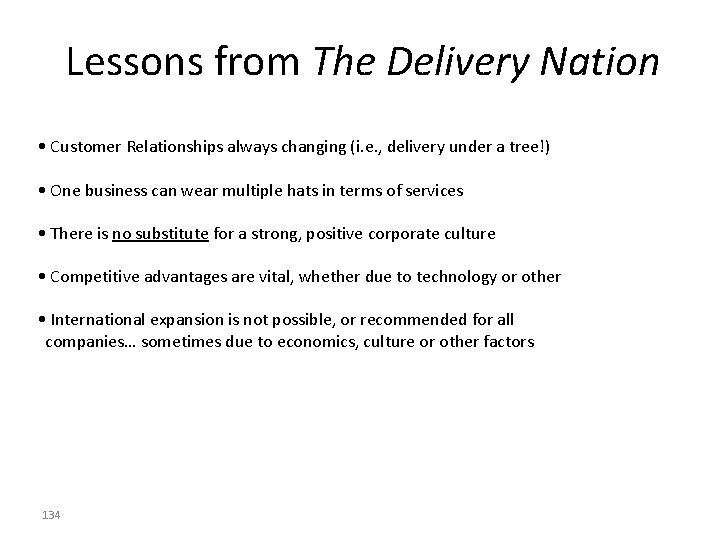
Lessons from The Delivery Nation • Customer Relationships always changing (i. e. , delivery under a tree!) • One business can wear multiple hats in terms of services • There is no substitute for a strong, positive corporate culture • Competitive advantages are vital, whether due to technology or other • International expansion is not possible, or recommended for all companies… sometimes due to economics, culture or other factors 134
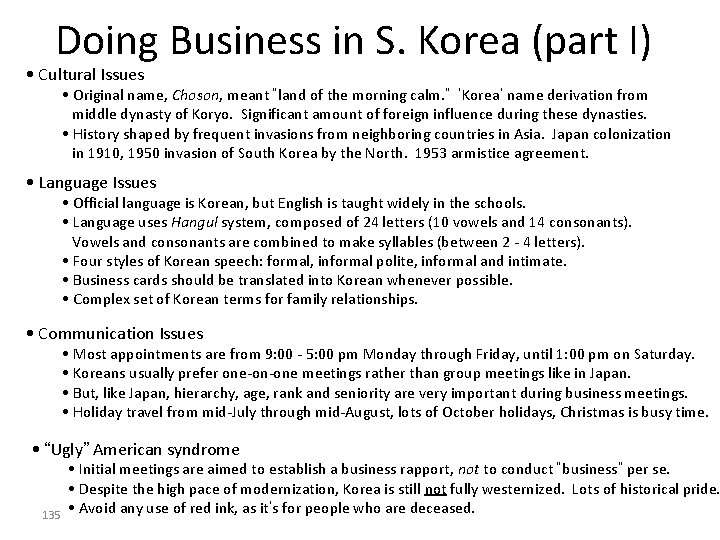
Doing Business in S. Korea (part I) • Cultural Issues • Original name, Choson, meant “land of the morning calm. ” ‘Korea’ name derivation from middle dynasty of Koryo. Significant amount of foreign influence during these dynasties. • History shaped by frequent invasions from neighboring countries in Asia. Japan colonization in 1910, 1950 invasion of South Korea by the North. 1953 armistice agreement. • Language Issues • Official language is Korean, but English is taught widely in the schools. • Language uses Hangul system, composed of 24 letters (10 vowels and 14 consonants). Vowels and consonants are combined to make syllables (between 2 - 4 letters). • Four styles of Korean speech: formal, informal polite, informal and intimate. • Business cards should be translated into Korean whenever possible. • Complex set of Korean terms for family relationships. • Communication Issues • Most appointments are from 9: 00 - 5: 00 pm Monday through Friday, until 1: 00 pm on Saturday. • Koreans usually prefer one-on-one meetings rather than group meetings like in Japan. • But, like Japan, hierarchy, age, rank and seniority are very important during business meetings. • Holiday travel from mid-July through mid-August, lots of October holidays, Christmas is busy time. • “Ugly” American syndrome 135 • Initial meetings are aimed to establish a business rapport, not to conduct “business” per se. • Despite the high pace of modernization, Korea is still not fully westernized. Lots of historical pride. • Avoid any use of red ink, as it’s for people who are deceased.
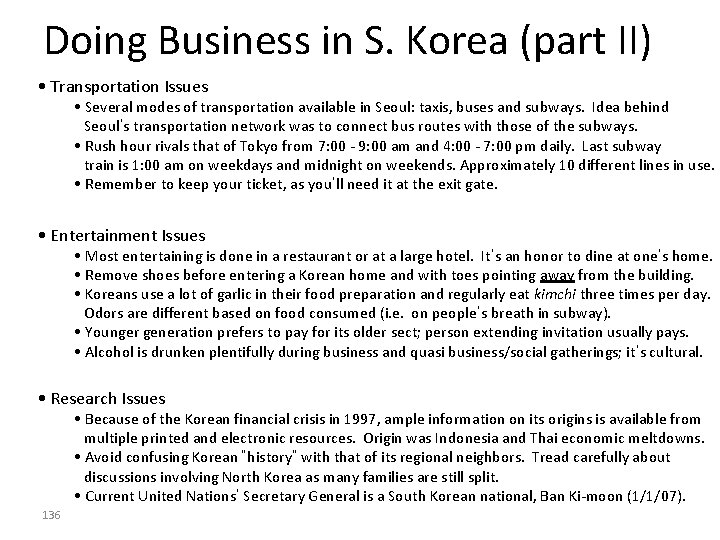
Doing Business in S. Korea (part II) • Transportation Issues • Several modes of transportation available in Seoul: taxis, buses and subways. Idea behind Seoul’s transportation network was to connect bus routes with those of the subways. • Rush hour rivals that of Tokyo from 7: 00 - 9: 00 am and 4: 00 - 7: 00 pm daily. Last subway train is 1: 00 am on weekdays and midnight on weekends. Approximately 10 different lines in use. • Remember to keep your ticket, as you’ll need it at the exit gate. • Entertainment Issues • Most entertaining is done in a restaurant or at a large hotel. It’s an honor to dine at one’s home. • Remove shoes before entering a Korean home and with toes pointing away from the building. • Koreans use a lot of garlic in their food preparation and regularly eat kimchi three times per day. Odors are different based on food consumed (i. e. on people’s breath in subway). • Younger generation prefers to pay for its older sect; person extending invitation usually pays. • Alcohol is drunken plentifully during business and quasi business/social gatherings; it’s cultural. • Research Issues • Because of the Korean financial crisis in 1997, ample information on its origins is available from multiple printed and electronic resources. Origin was Indonesia and Thai economic meltdowns. • Avoid confusing Korean “history” with that of its regional neighbors. Tread carefully about discussions involving North Korea as many families are still split. • Current United Nations’ Secretary General is a South Korean national, Ban Ki-moon (1/1/07). 136
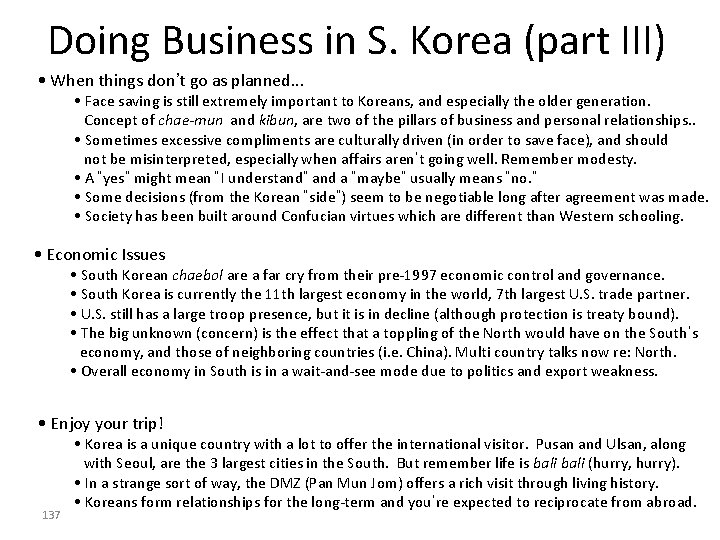
Doing Business in S. Korea (part III) • When things don’t go as planned. . . • Face saving is still extremely important to Koreans, and especially the older generation. Concept of chae-mun and kibun, are two of the pillars of business and personal relationships. . • Sometimes excessive compliments are culturally driven (in order to save face), and should not be misinterpreted, especially when affairs aren’t going well. Remember modesty. • A “yes” might mean “I understand” and a “maybe” usually means “no. ” • Some decisions (from the Korean “side”) seem to be negotiable long after agreement was made. • Society has been built around Confucian virtues which are different than Western schooling. • Economic Issues • South Korean chaebol are a far cry from their pre-1997 economic control and governance. • South Korea is currently the 11 th largest economy in the world, 7 th largest U. S. trade partner. • U. S. still has a large troop presence, but it is in decline (although protection is treaty bound). • The big unknown (concern) is the effect that a toppling of the North would have on the South’s economy, and those of neighboring countries (i. e. China). Multi country talks now re: North. • Overall economy in South is in a wait-and-see mode due to politics and export weakness. • Enjoy your trip! 137 • Korea is a unique country with a lot to offer the international visitor. Pusan and Ulsan, along with Seoul, are the 3 largest cities in the South. But remember life is bali (hurry, hurry). • In a strange sort of way, the DMZ (Pan Mun Jom) offers a rich visit through living history. • Koreans form relationships for the long-term and you’re expected to reciprocate from abroad.
Session #6 Beijing Sammies Case Study 138
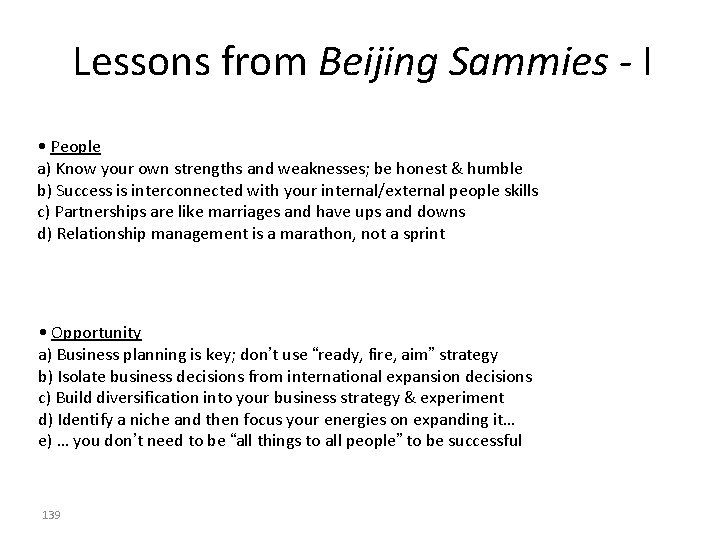
Lessons from Beijing Sammies - I • People a) Know your own strengths and weaknesses; be honest & humble b) Success is interconnected with your internal/external people skills c) Partnerships are like marriages and have ups and downs d) Relationship management is a marathon, not a sprint • Opportunity a) Business planning is key; don’t use “ready, fire, aim” strategy b) Isolate business decisions from international expansion decisions c) Build diversification into your business strategy & experiment d) Identify a niche and then focus your energies on expanding it… e) … you don’t need to be “all things to all people” to be successful 139
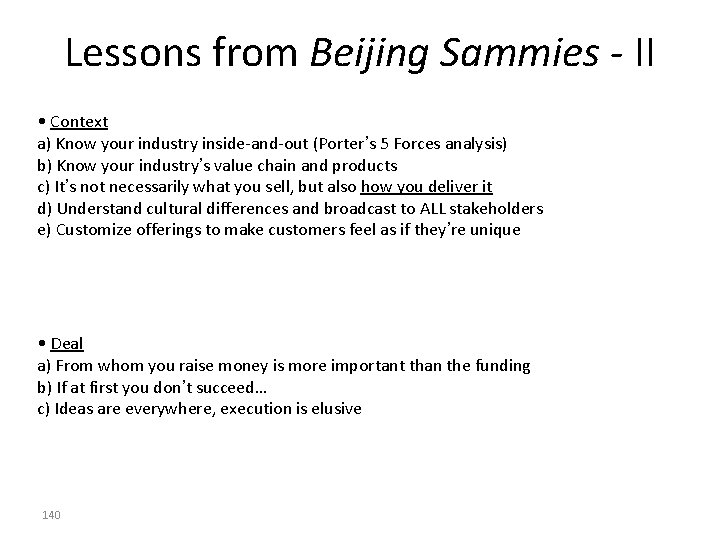
Lessons from Beijing Sammies - II • Context a) Know your industry inside-and-out (Porter’s 5 Forces analysis) b) Know your industry’s value chain and products c) It’s not necessarily what you sell, but also how you deliver it d) Understand cultural differences and broadcast to ALL stakeholders e) Customize offerings to make customers feel as if they’re unique • Deal a) From whom you raise money is more important than the funding b) If at first you don’t succeed… c) Ideas are everywhere, execution is elusive 140
Beijing Sammies Optional 141
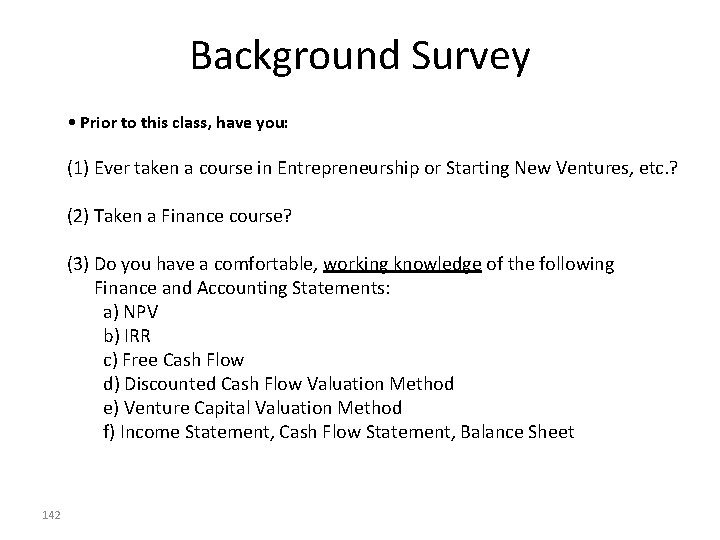
Background Survey • Prior to this class, have you: (1) Ever taken a course in Entrepreneurship or Starting New Ventures, etc. ? (2) Taken a Finance course? (3) Do you have a comfortable, working knowledge of the following Finance and Accounting Statements: a) NPV b) IRR c) Free Cash Flow d) Discounted Cash Flow Valuation Method e) Venture Capital Valuation Method f) Income Statement, Cash Flow Statement, Balance Sheet 142
A Comment on Finance • Integral part of company analysis (i. e. building blocks of bridge) • Important to learn the basics and then proceed from there • This is difficult material, especially if you don’t like numbers • This is NOT a finance course, but you have to know the basics. . . • Please contact me if you want to read up on finance & valuations 143
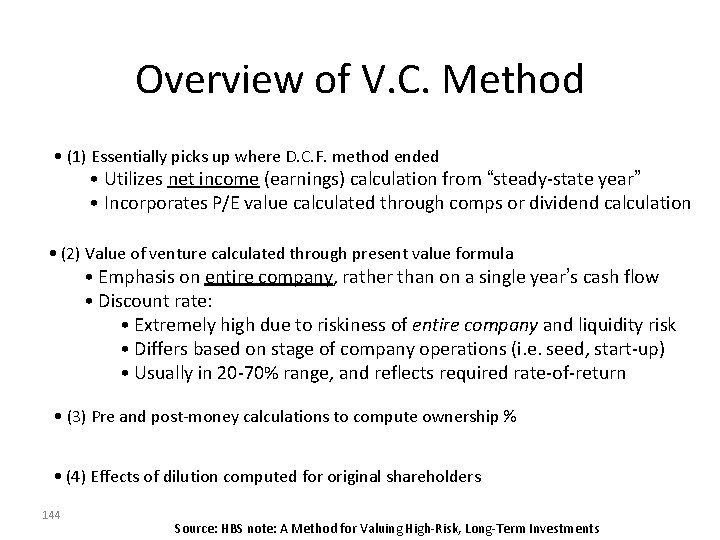
Overview of V. C. Method • (1) Essentially picks up where D. C. F. method ended • Utilizes net income (earnings) calculation from “steady-state year” • Incorporates P/E value calculated through comps or dividend calculation • (2) Value of venture calculated through present value formula • Emphasis on entire company, rather than on a single year’s cash flow • Discount rate: • Extremely high due to riskiness of entire company and liquidity risk • Differs based on stage of company operations (i. e. seed, start-up) • Usually in 20 -70% range, and reflects required rate-of-return • (3) Pre and post-money calculations to compute ownership % • (4) Effects of dilution computed for original shareholders 144 Source: HBS note: A Method for Valuing High-Risk, Long-Term Investments
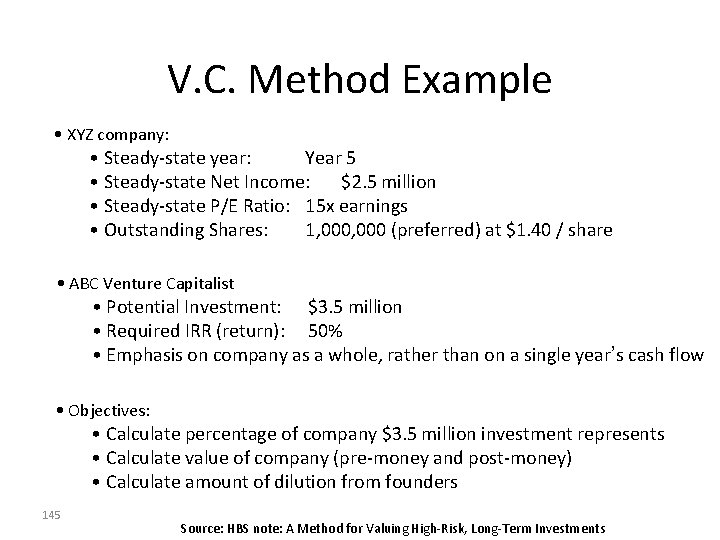
V. C. Method Example • XYZ company: • Steady-state year: Year 5 • Steady-state Net Income: $2. 5 million • Steady-state P/E Ratio: 15 x earnings • Outstanding Shares: 1, 000 (preferred) at $1. 40 / share • ABC Venture Capitalist • Potential Investment: $3. 5 million • Required IRR (return): 50% • Emphasis on company as a whole, rather than on a single year’s cash flow • Objectives: • Calculate percentage of company $3. 5 million investment represents • Calculate value of company (pre-money and post-money) • Calculate amount of dilution from founders 145 Source: HBS note: A Method for Valuing High-Risk, Long-Term Investments
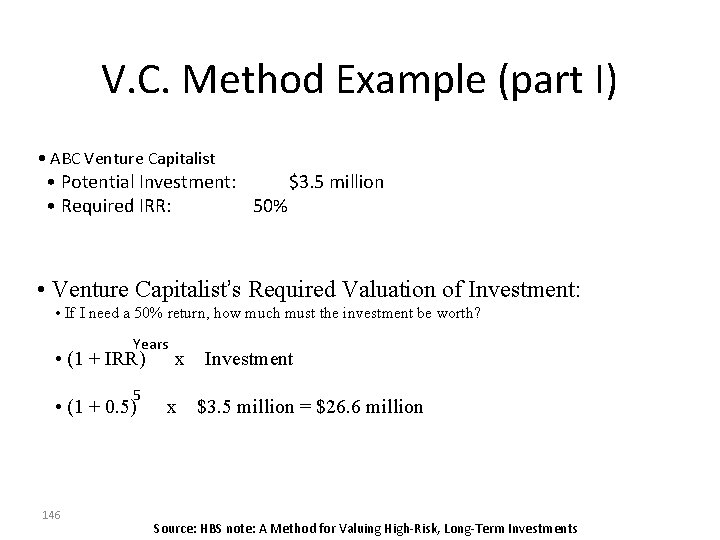
V. C. Method Example (part I) • ABC Venture Capitalist • Potential Investment: $3. 5 million • Required IRR: 50% • Venture Capitalist’s Required Valuation of Investment: • If I need a 50% return, how much must the investment be worth? Years • (1 + IRR) 5 • (1 + 0. 5) 146 x x Investment $3. 5 million = $26. 6 million Source: HBS note: A Method for Valuing High-Risk, Long-Term Investments
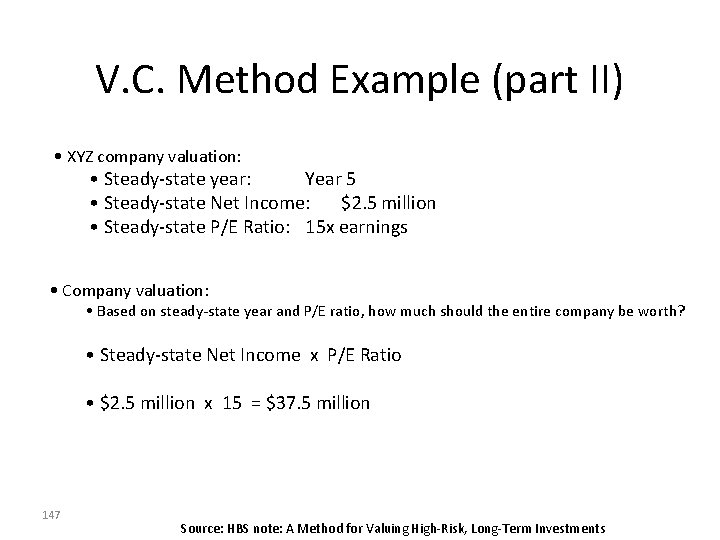
V. C. Method Example (part II) • XYZ company valuation: • Steady-state year: Year 5 • Steady-state Net Income: $2. 5 million • Steady-state P/E Ratio: 15 x earnings • Company valuation: • Based on steady-state year and P/E ratio, how much should the entire company be worth? • Steady-state Net Income x P/E Ratio • $2. 5 million x 15 = $37. 5 million 147 Source: HBS note: A Method for Valuing High-Risk, Long-Term Investments
V. C. Method Example (part III) • V. C. Ownership Calculation: • What percentage of the company will I be buying? How much does it represent? • Required investment / Company valuation • $26. 6 million / $37. 5 million = 70. 9% ownership • New Shares issued: • How many shares must be issued now, in addition to the 1 million currently outstanding? • Total New Shares Sold = % Ownership / (1 - % Ownership) • 70. 9% / (1 - 70. 9%) = 2, 436, 426 • Cost per Share = $3. 5 million investment / 2, 436, 426 shares = $1. 44 / sh • Increase from $1. 40 / share when company was founded with 1 million shares 148
V. C. Method Example (part IV) • Post-money calculation: • How much is the company “worth” today after I invest my money? • Investment / Ownership Acquired • $3. 5 million / 70. 9% = $4. 9 million post-money valuation • Pre-money valuation: • How much is the company “worth’ today, before I invest my money? • Post-money valuation - Investment • $4. 9 million - $3. 5 million = $1. 4 million pre-money valuation 149 Source: HBS note: A Method for Valuing High-Risk, Long-Term Investments
Beijing Sammies Valuation- part I • Objectives: a) Perform basic analysis to determine how well Beijing Sammies must perform each year for you to receive an adequate rate-of-return on your investment. b) Make a preliminary investment decision. 150
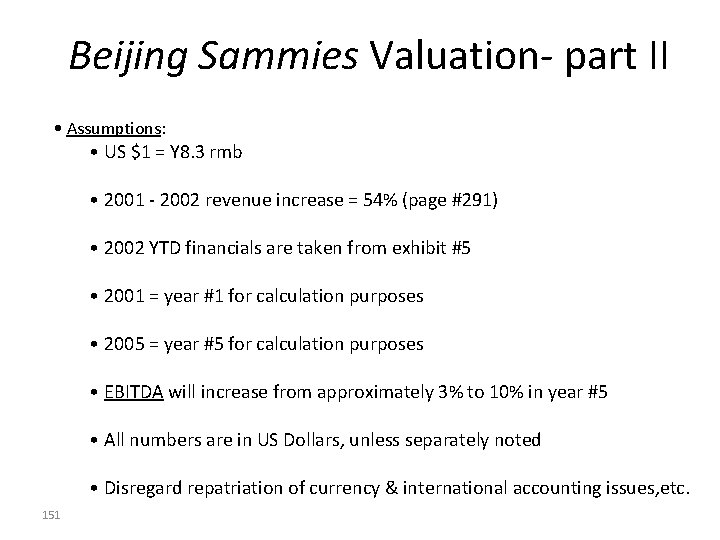
Beijing Sammies Valuation- part II • Assumptions: • US $1 = Y 8. 3 rmb • 2001 - 2002 revenue increase = 54% (page #291) • 2002 YTD financials are taken from exhibit #5 • 2001 = year #1 for calculation purposes • 2005 = year #5 for calculation purposes • EBITDA will increase from approximately 3% to 10% in year #5 • All numbers are in US Dollars, unless separately noted • Disregard repatriation of currency & international accounting issues, etc. 151
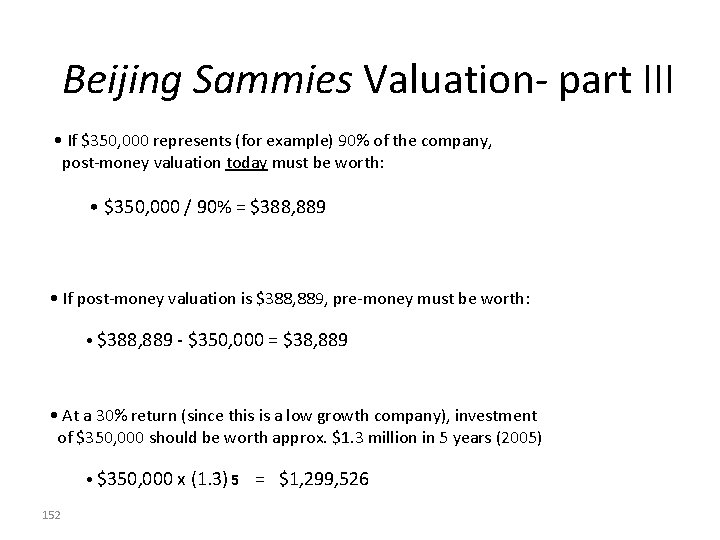
Beijing Sammies Valuation- part III • If $350, 000 represents (for example) 90% of the company, post-money valuation today must be worth: • $350, 000 / 90% = $388, 889 • If post-money valuation is $388, 889, pre-money must be worth: • $388, 889 - $350, 000 = $38, 889 • At a 30% return (since this is a low growth company), investment of $350, 000 should be worth approx. $1. 3 million in 5 years (2005) • $350, 000 x (1. 3) 5 152 = $1, 299, 526
Beijing Sammies Valuation- part IV • If $350, 000 represents 90% of the company, reverse engineered value of the entire company 5 years from now must be: • $1, 299, 526 / 90% = $1, 443, 918 • Assume that $1, 443, 918 is only 5 x EBITDA, since this is a low growth company. EBITDA in year 5 (2005) must be: • $1, 443, 918 / 5 = $288, 784 • Assume company will have 10% profit margin 3 years from now. (2005). Imputed sales must therefore be: • $288, 784 153 / 10% = $2, 887, 840
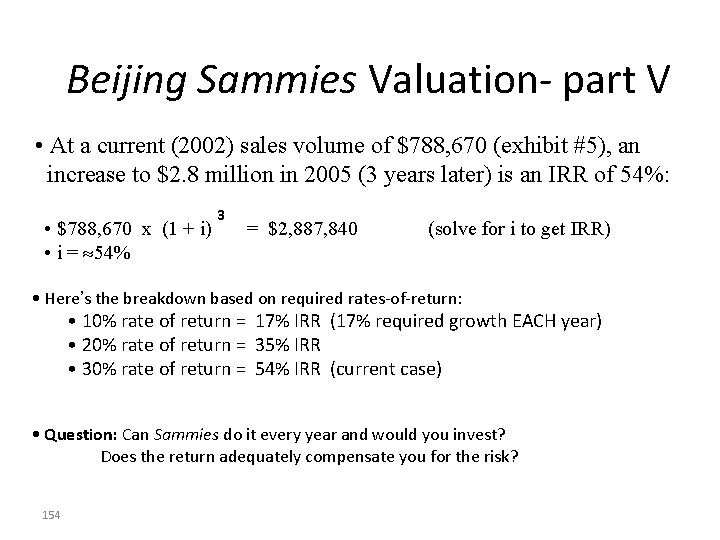
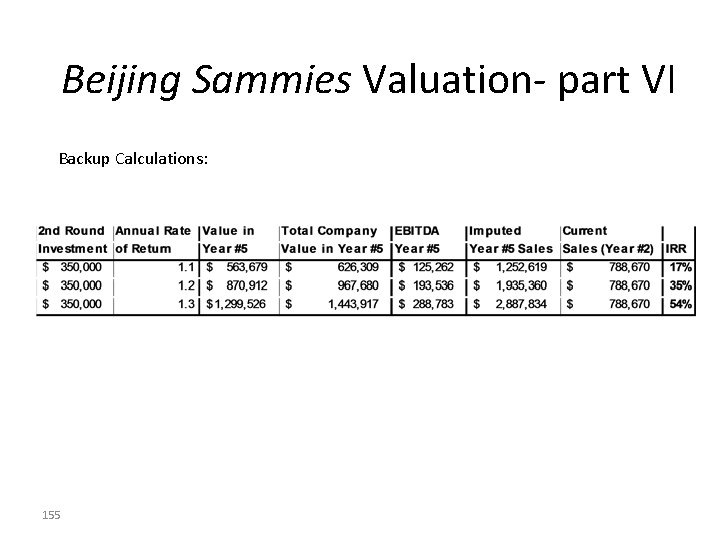
Beijing Sammies Valuation- part V • At a current (2002) sales volume of $788, 670 (exhibit #5), an increase to $2. 8 million in 2005 (3 years later) is an IRR of 54%: • $788, 670 x (1 + i) • i = 54% 3 = $2, 887, 840 (solve for i to get IRR) • Here’s the breakdown based on required rates-of-return: • 10% rate of return = 17% IRR (17% required growth EACH year) • 20% rate of return = 35% IRR • 30% rate of return = 54% IRR (current case) • Question: Can Sammies do it every year and would you invest? Does the return adequately compensate you for the risk? 154
Beijing Sammies Valuation- part VI Backup Calculations: 155
Session #7 • Group Presentation Planning Workshop 156
Group Presentation Planning Workshop
Session #8 • Group Presentations • Course Review and Concluding Remarks 158
Group Presentations (all teams)
Course Review and Concluding Remarks
Global Business Strategy Industries are global when there are significant advantages to integrating activities across country markets Global industries emerge in clusters Global vs. Transnational vs. Multi-domestic An approach to doing business A new way of managing people 161
About a “population of material” Academia can’t model every possible business permutation The “real world” doesn’t come with exhibits, case discussion “lessons, ” and the ability to e-mail questions to the “instructor. . . ” However, the “real world” is a function of pattern recognition… The mindset you develop, the approach through which you think through issues, and your analytical talents are some of the most important “tools” you’ll acquire in your business studies …and the real world does come with assistants to “do” the work! 162
…and the practice Some of your actual considerations in the “course of life”: • People • Opportunity • External Context • Deal • Int’l Risk Factors • Government- • Analysis- 163 performing services, providing resources investment of resources & rate of return macroeconomic factors, interest rates, etc. implicit & explicit contractual relationships what are they, and how can I manage them? ally, friend, foe or other? how does the industry make money, and how can my firm survive?
Pattern Recognition History does repeat itself and the more things change. . . Increasing the probability that things will go well Knowing what you know, and what you don’t know Learning the difference between doing it perfectly on paper, versus truly making your business a successful, ongoing entity in reality 164
The Importance of Context (reality? ) The world is changing…panic on Wall Street, international terrorism, worldwide recession and China in the WTO Global, as well as domestic competition, is eroding margins worldwide Entrepreneurship has now become a truly international concept Strong links are being developed between large and small companies 165 Source: HBS Entrepreneurial Finance Final Lecture, Fall 1995
What were my goals for this course? Concepts (defining global industries and crafting strategy, etc. ) Knowledge (value chain, business models, etc. ) Skills (analysis, real-world application, etc. ) Attitude (learning the art of the possible, etc. ) 166 Source: HBS Entrepreneurial Finance Final Lecture, Fall 1995
Crafting Strategy in Global Industries There's no substitute for local market knowledge International expansion takes twice as long & costs three times as much Retain competent legal, accounting and regulatory counsel in each country/region Utilize scenario analysis in forecasting price changes & other metrics Currency fluctuations can greatly affect earnings, but not cash flow! Competitor analysis is a good way to realistically assess the landscape 167
Managing Multinational Companies Managed conflict can be healthy for companies A CEO's strategy role differs based on the company and industry External industry forces might (involuntarily) also affect the same role Strategy and theory is important, but cash is king worldwide! There's a difference between having responsibility and authority Know thy politics. . . Good business strategy is often a matter of wisely managing people and communications 168
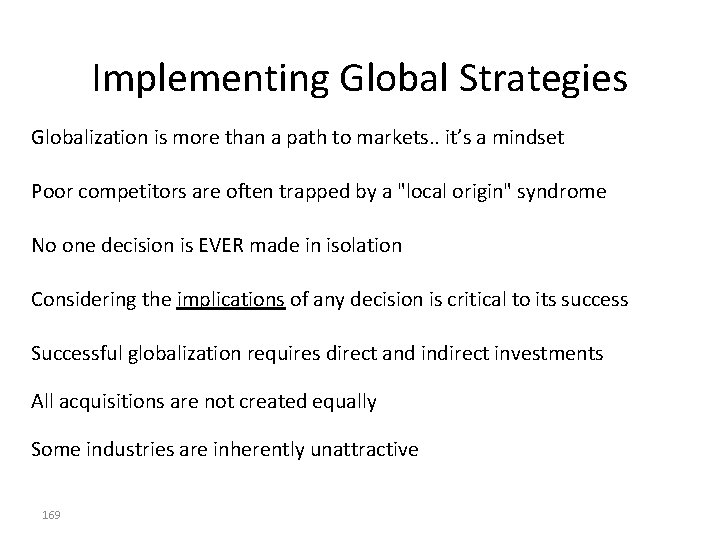
Implementing Global Strategies Globalization is more than a path to markets. . it’s a mindset Poor competitors are often trapped by a "local origin" syndrome No one decision is EVER made in isolation Considering the implications of any decision is critical to its success Successful globalization requires direct and indirect investments All acquisitions are not created equally Some industries are inherently unattractive 169
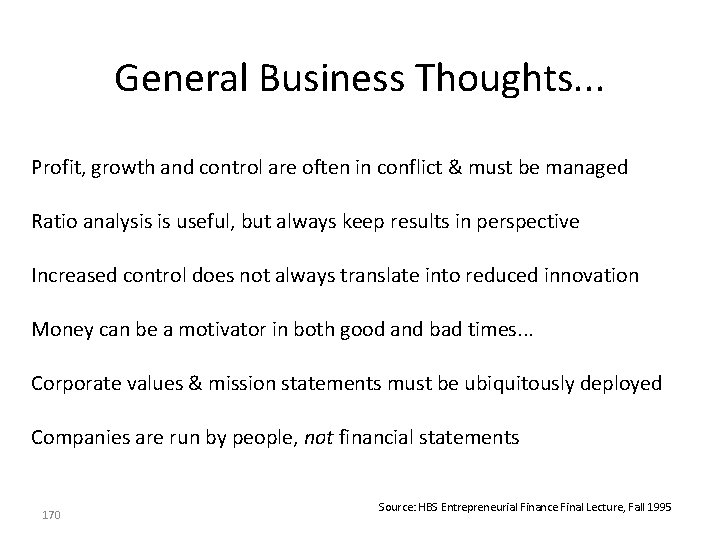
General Business Thoughts. . . Profit, growth and control are often in conflict & must be managed Ratio analysis is useful, but always keep results in perspective Increased control does not always translate into reduced innovation Money can be a motivator in both good and bad times. . . Corporate values & mission statements must be ubiquitously deployed Companies are run by people, not financial statements 170 Source: HBS Entrepreneurial Finance Final Lecture, Fall 1995
THINK! 171 Source: HBS Entrepreneurial Finance Final Lecture, Fall 1995, IBM
Thank you! Thank you for a wonderful week… I, too, learned a lot. Please keep in touch, and best of luck with everything! 172