
Welcome DSCs Invited Guests Snapshot of Todays events
- Slides: 38
Welcome DSCs & Invited Guests
Snapshot of Todays events • • • Emerging issues & what’s new New prescription Glass program Minors in Labs Guidelines Fume Hood Safety networking Vendor presentations and NETWORKING Respiratory Protection 3 D Printing – Additive Manufacturing DSC to DSC Sharing successes and challenges Centrifuge Safety Introduction to Bio. RAFT Brainstorming session for 2019 ideas
Resources in your retreat binder 1. 2. 3. 4. 5. 6. 7. Research Safety Organization Chart & Contact Information DSC Guidelines & Contact List Minors in Labs Bio. Raft Reproductive Health Hazard Guidelines Respiratory Protection | 3 D Print | Shop Safety Fact Sheets 8. Sponsor Vendor Information 9. 2019 Evaluation Form / 2018 Review
Office of Research Safety http: //www. clemson. edu/research/safety/ Easy to Work With Technically Competent Service Oriented “We are committed to continuous improvement and exceptional customer service for our students, faculty and staff both on campus and across the state” Email: researchsafety@Clemson. edu
2019 -2020 • • • Bio. RAFT Service brochure Website Fact sheets Fire Simulator/hands on training • TA safety training • First aid • Safety training • Safety for student clubs • Field Safety • Lab Safety Manual • Makerspace/3 D printing • 2 new positions
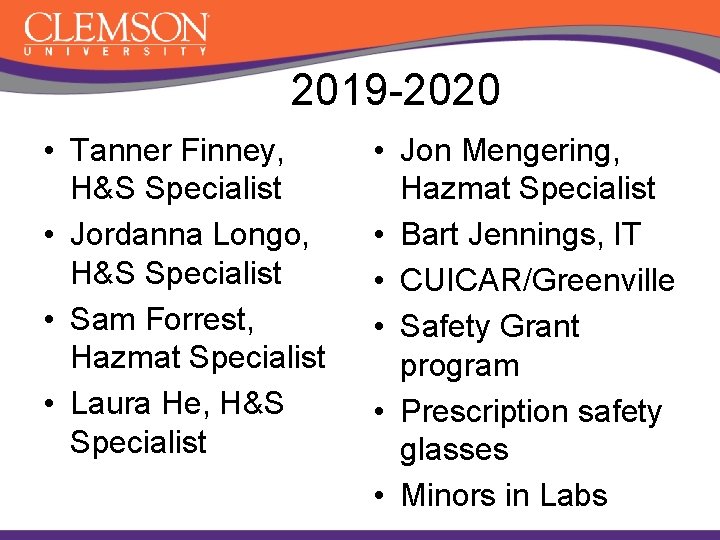
2019 -2020 • Tanner Finney, H&S Specialist • Jordanna Longo, H&S Specialist • Sam Forrest, Hazmat Specialist • Laura He, H&S Specialist • Jon Mengering, Hazmat Specialist • Bart Jennings, IT • CUICAR/Greenville • Safety Grant program • Prescription safety glasses • Minors in Labs
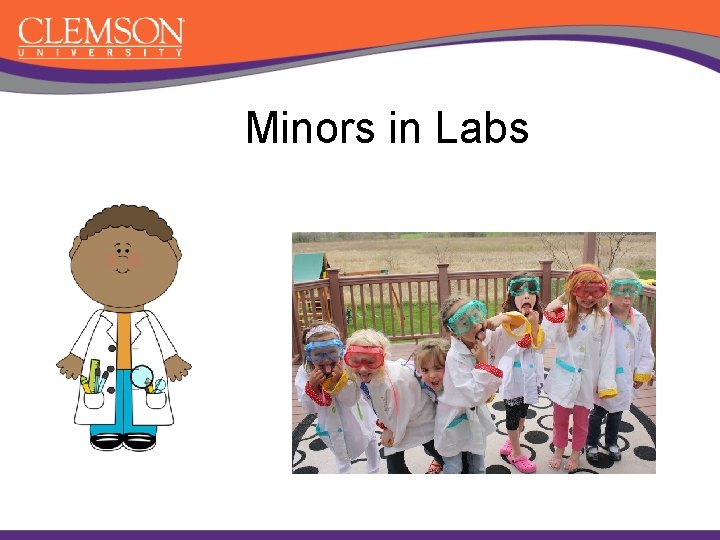
Minors in Labs
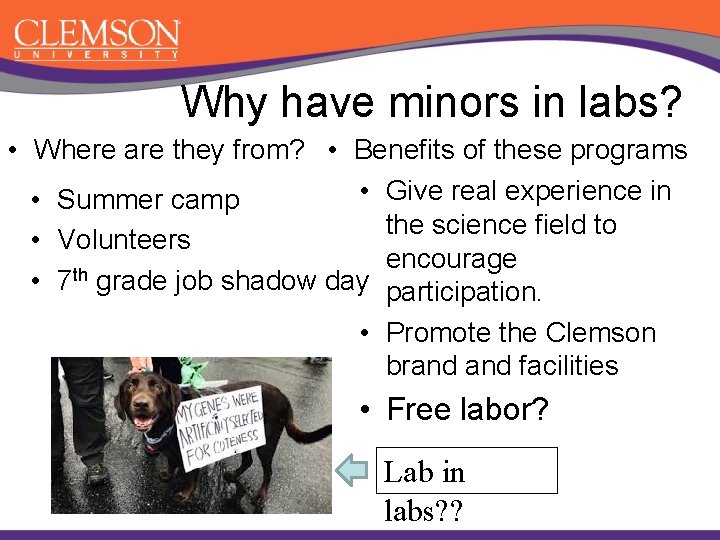
Why have minors in labs? • Where are they from? • Benefits of these programs • Give real experience in • Summer camp the science field to • Volunteers encourage • 7 th grade job shadow day participation. • Promote the Clemson brand facilities • Free labor? Lab in labs? ?
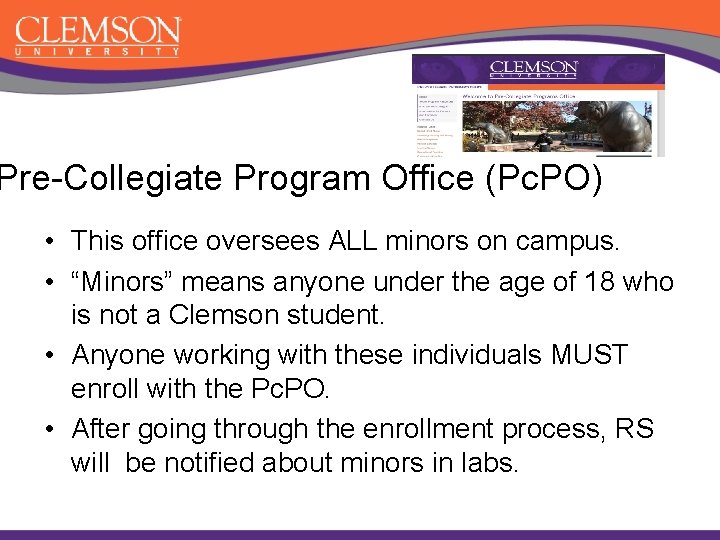
Pre-Collegiate Program Office (Pc. PO) • This office oversees ALL minors on campus. • “Minors” means anyone under the age of 18 who is not a Clemson student. • Anyone working with these individuals MUST enroll with the Pc. PO. • After going through the enrollment process, RS will be notified about minors in labs.
For these minors • Same requirements as anyone else in labs: – Training: could specialized trainings to these groups – Sign CHP acknowledgment page – PPE provided and worn – Added to IBC/AUP – Minors should never be left alone and the “rule of three” should be followed.
Minors in Labs Guidance Document • Provided in your packet. • Applies to ages 14 -17 • Prohibits certain types of work (explosives, acutely toxic chemicals, etc. ) • Allows for work with other hazards with additional oversight (carcinogens, radiation, BSL-2 labs) • Encourages communication with Research Safety
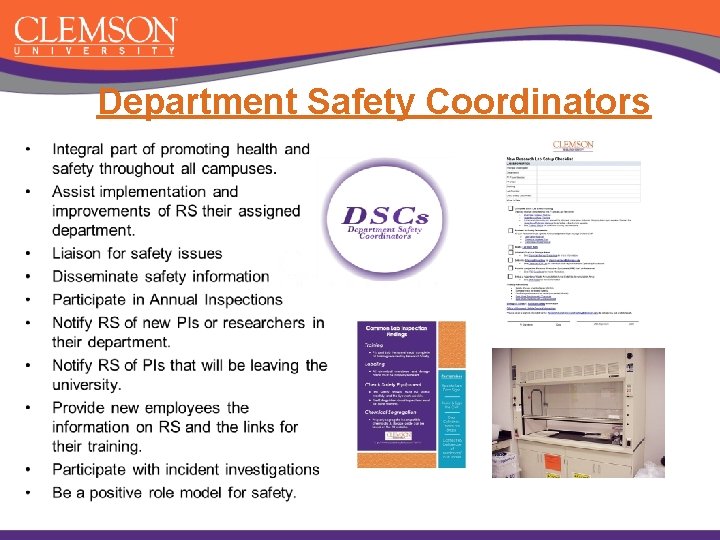
Department Safety Coordinators
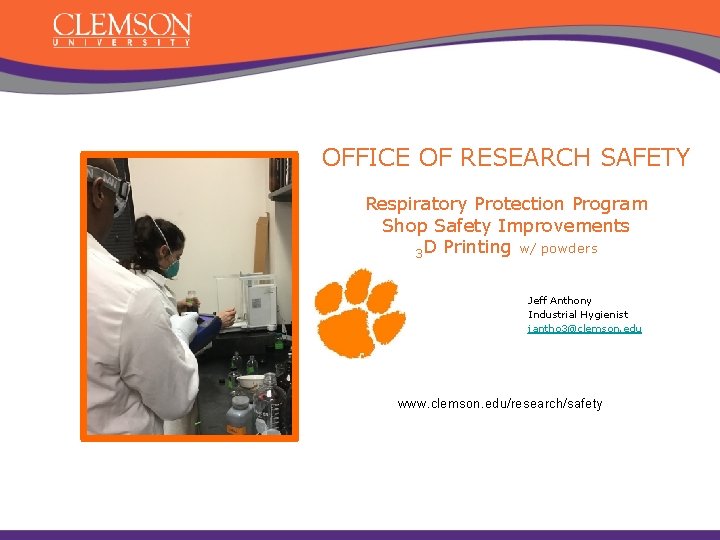
OFFICE OF RESEARCH SAFETY Respiratory Protection Program Shop Safety Improvements 3 D Printing w/ powders Jeff Anthony Industrial Hygienist jantho 3@clemson. edu www. clemson. edu/research/safety
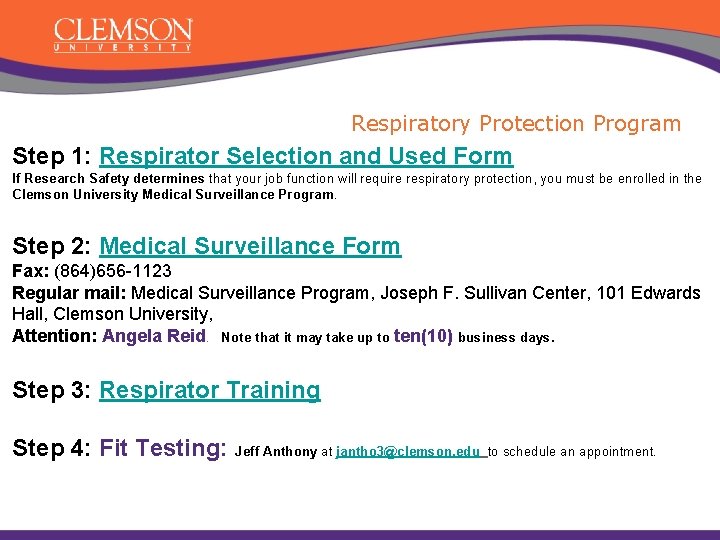
Respiratory Protection Program Step 1: Respirator Selection and Used Form If Research Safety determines that your job function will require respiratory protection, you must be enrolled in the Clemson University Medical Surveillance Program. Step 2: Medical Surveillance Form Fax: (864)656 -1123 Regular mail: Medical Surveillance Program, Joseph F. Sullivan Center, 101 Edwards Hall, Clemson University, Attention: Angela Reid. Note that it may take up to ten(10) business days. Step 3: Respirator Training Step 4: Fit Testing: Jeff Anthony at jantho 3@clemson. edu to schedule an appointment.
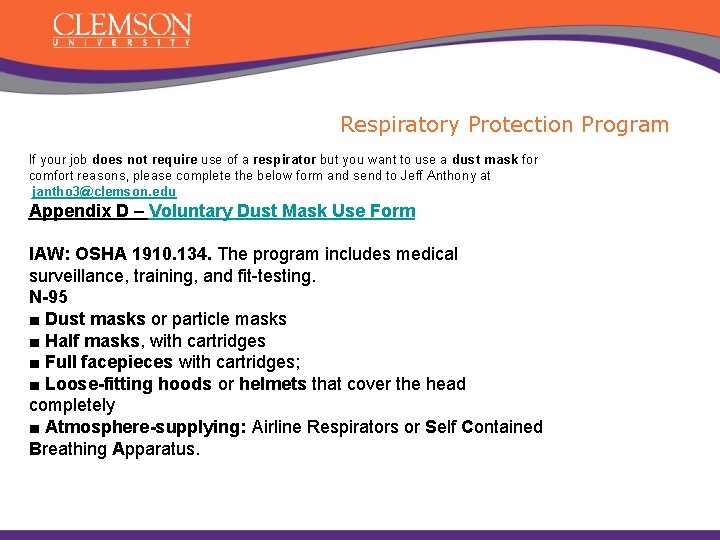
Respiratory Protection Program If your job does not require use of a respirator but you want to use a dust mask for comfort reasons, please complete the below form and send to Jeff Anthony at jantho 3@clemson. edu Appendix D – Voluntary Dust Mask Use Form IAW: OSHA 1910. 134. The program includes medical surveillance, training, and fit-testing. N-95 ■ Dust masks or particle masks ■ Half masks, with cartridges ■ Full facepieces with cartridges; ■ Loose-fitting hoods or helmets that cover the head completely ■ Atmosphere-supplying: Airline Respirators or Self Contained Breathing Apparatus.
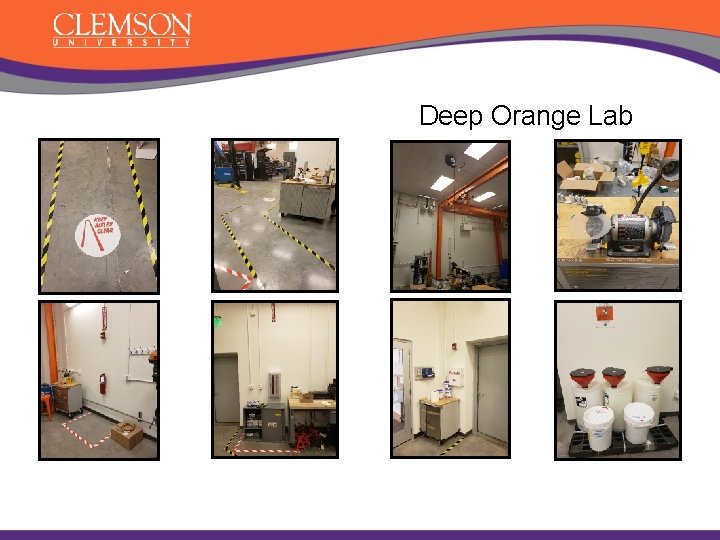
Deep Orange Lab
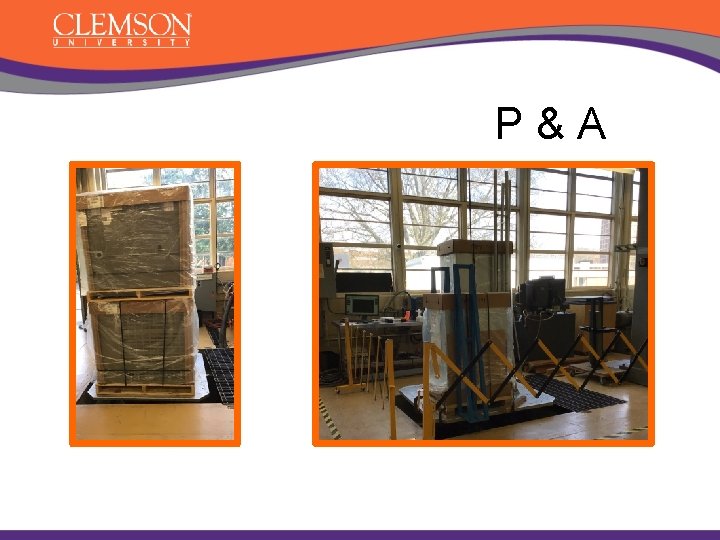
P & A
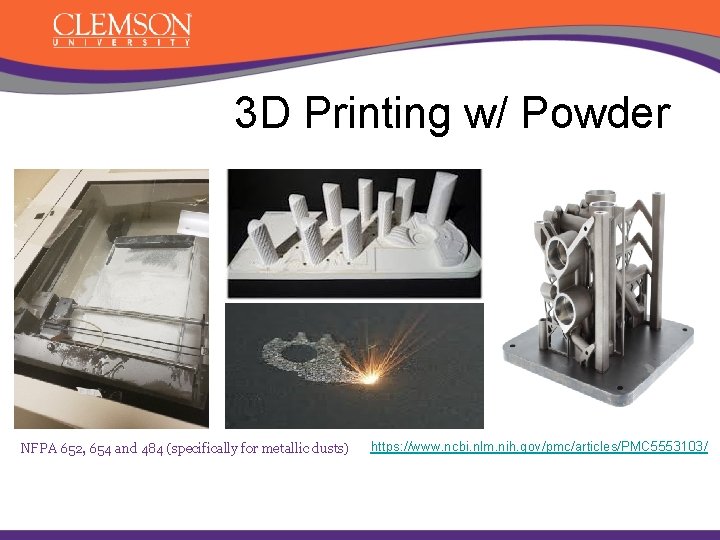
3 D Printing w/ Powder NFPA 652, 654 and 484 (specifically for metallic dusts) https: //www. ncbi. nlm. nih. gov/pmc/articles/PMC 5553103/
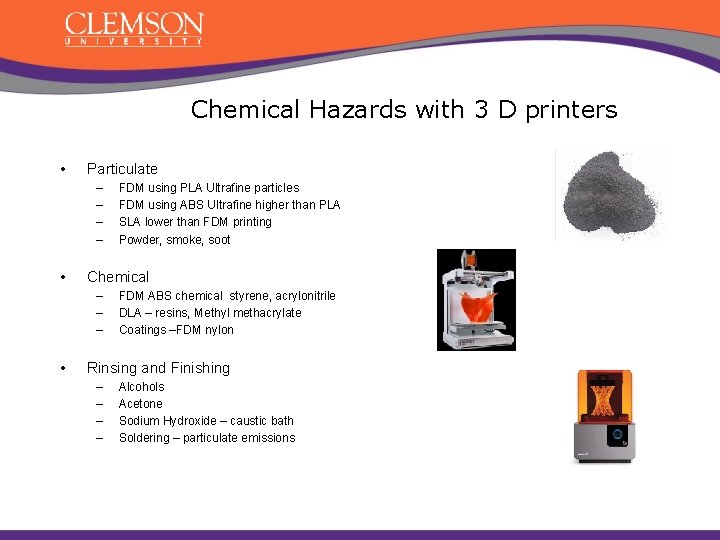
Chemical Hazards with 3 D printers • Particulate – – • Chemical – – – • FDM using PLA Ultrafine particles FDM using ABS Ultrafine higher than PLA SLA lower than FDM printing Powder, smoke, soot FDM ABS chemical styrene, acrylonitrile DLA – resins, Methyl methacrylate Coatings –FDM nylon Rinsing and Finishing – – Alcohols Acetone Sodium Hydroxide – caustic bath Soldering – particulate emissions
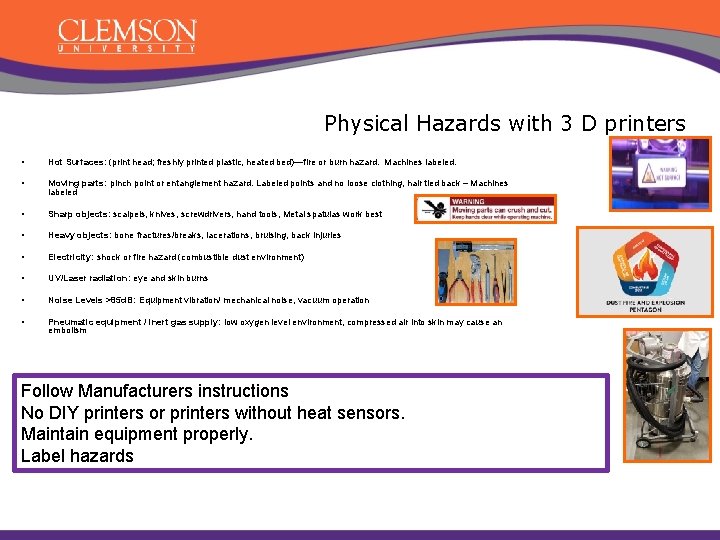
Physical Hazards with 3 D printers • Hot Surfaces: (print head; freshly printed plastic, heated bed)—fire or burn hazard. Machines labeled. • Moving parts: pinch point or entanglement hazard. Labeled points and no loose clothing, hair tied back – Machines labeled • Sharp objects: scalpels, knives, screwdrivers, hand tools, Metal spatulas work best • Heavy objects: bone fractures/breaks, lacerations, bruising, back injuries • Electricity: shock or fire hazard (combustible dust environment) • UV/Laser radiation: eye and skin burns • Noise Levels >85 d. B: Equipment vibration/ mechanical noise, vacuum operation • Pneumatic equipment / inert gas supply: low oxygen level environment, compressed air into skin may cause an embolism Follow Manufacturers instructions No DIY printers or printers without heat sensors. Maintain equipment properly. Label hazards
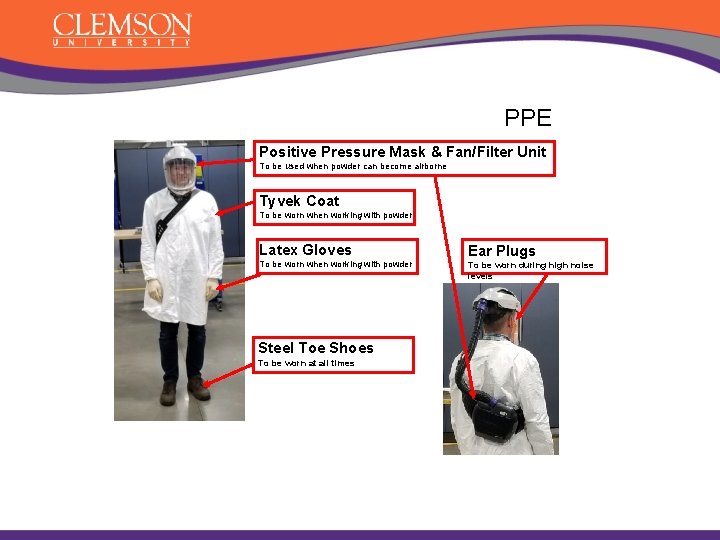
PPE Positive Pressure Mask & Fan/Filter Unit To be used when powder can become airborne Tyvek Coat To be worn when working with powder Latex Gloves Ear Plugs To be worn when working with powder To be worn during high noise levels Steel Toe Shoes To be worn at all times
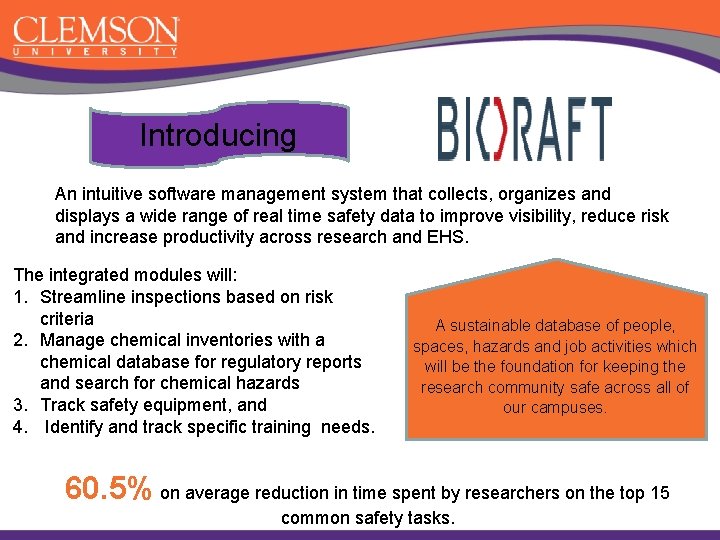
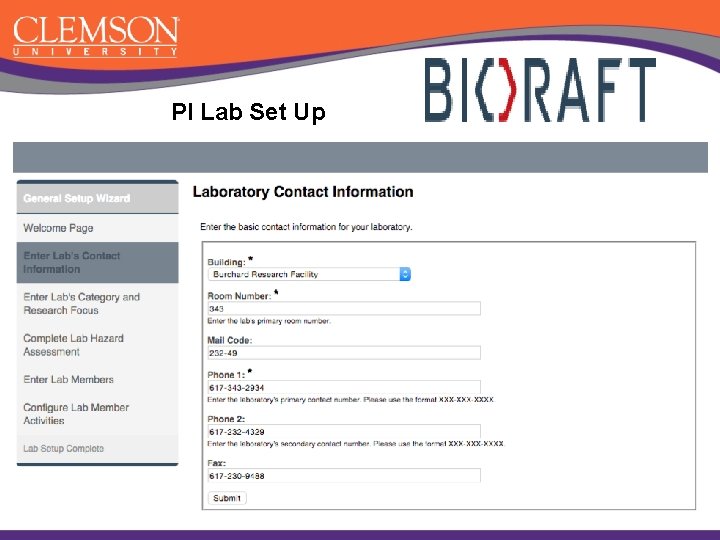
Introducing An intuitive software management system that collects, organizes and displays a wide range of real time safety data to improve visibility, reduce risk and increase productivity across research and EHS. The integrated modules will: 1. Streamline inspections based on risk criteria 2. Manage chemical inventories with a chemical database for regulatory reports and search for chemical hazards 3. Track safety equipment, and 4. Identify and track specific training needs. A sustainable database of people, spaces, hazards and job activities which will be the foundation for keeping the research community safe across all of our campuses. 60. 5% on average reduction in time spent by researchers on the top 15 common safety tasks.
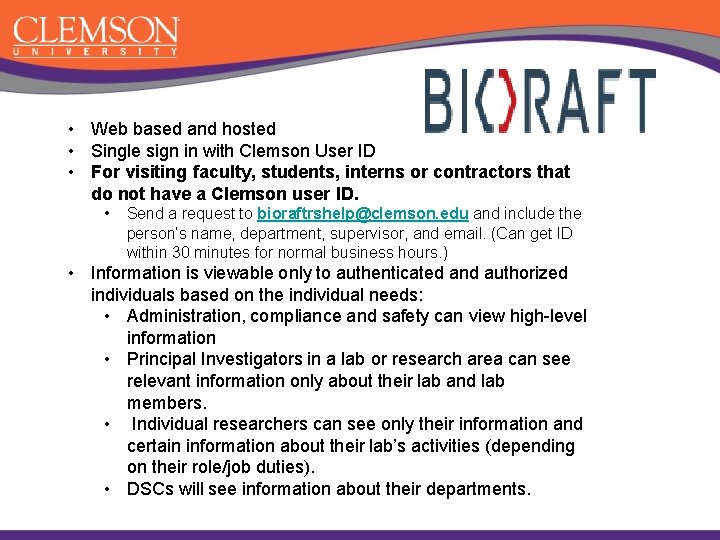
• Web based and hosted • Single sign in with Clemson User ID • For visiting faculty, students, interns or contractors that do not have a Clemson user ID. • Send a request to bioraftrshelp@clemson. edu and include the person’s name, department, supervisor, and email. (Can get ID within 30 minutes for normal business hours. ) • Information is viewable only to authenticated and authorized individuals based on the individual needs: • Administration, compliance and safety can view high-level information • Principal Investigators in a lab or research area can see relevant information only about their lab and lab members. • Individual researchers can see only their information and certain information about their lab’s activities (depending on their role/job duties). • DSCs will see information about their departments.
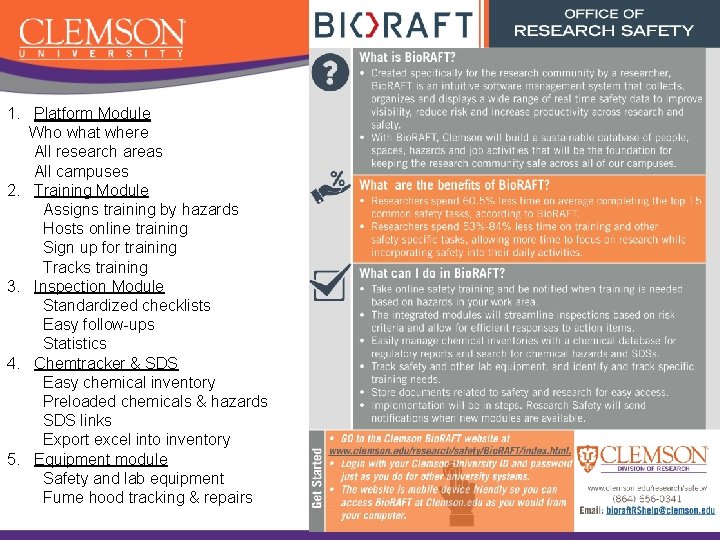
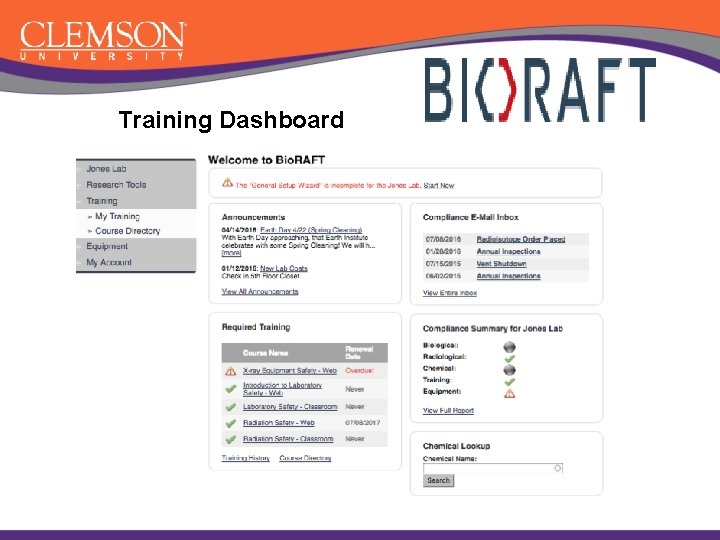
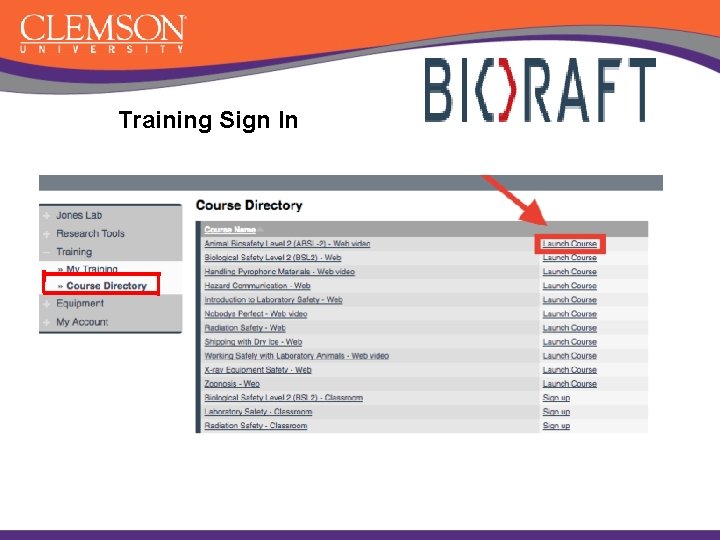
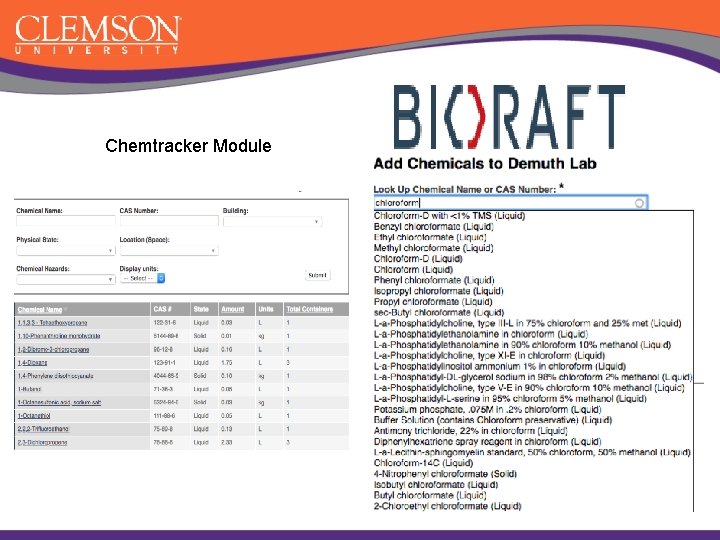
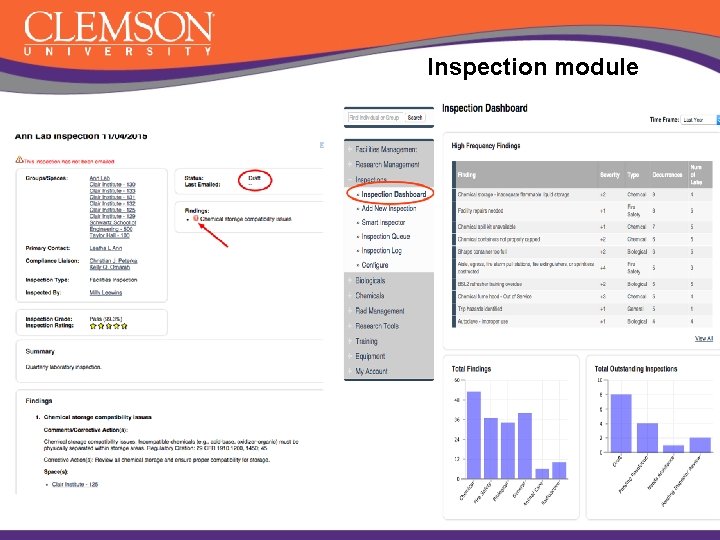
1. Platform Module Who what where All research areas All campuses 2. Training Module Assigns training by hazards Hosts online training Sign up for training Tracks training 3. Inspection Module Standardized checklists Easy follow-ups Statistics 4. Chemtracker & SDS Easy chemical inventory Preloaded chemicals & hazards SDS links Export excel into inventory 5. Equipment module Safety and lab equipment Fume hood tracking & repairs
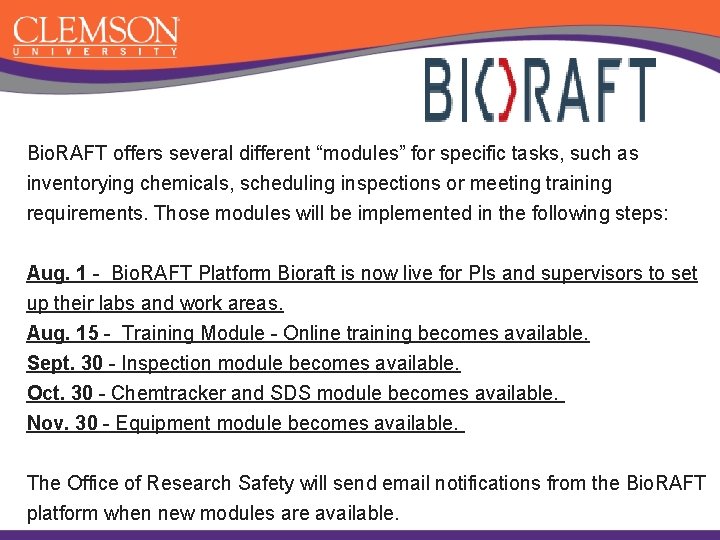
Bio. RAFT offers several different “modules” for specific tasks, such as inventorying chemicals, scheduling inspections or meeting training requirements. Those modules will be implemented in the following steps: Aug. 1 - Bio. RAFT Platform Bioraft is now live for PIs and supervisors to set up their labs and work areas. Aug. 15 - Training Module - Online training becomes available. Sept. 30 - Inspection module becomes available. Oct. 30 - Chemtracker and SDS module becomes available. Nov. 30 - Equipment module becomes available. The Office of Research Safety will send email notifications from the Bio. RAFT platform when new modules are available.
PI Lab Set Up
Training Dashboard
Training Sign In
Chemtracker Module
Inspection module
DEMONSTRATION
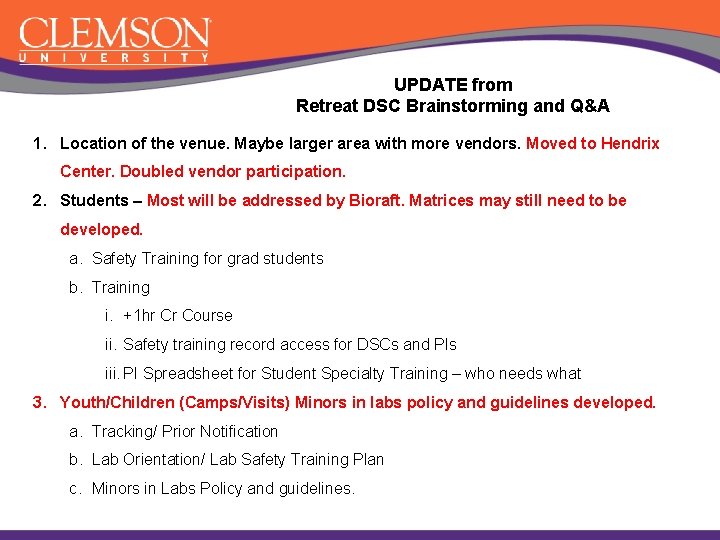
UPDATE from Retreat DSC Brainstorming and Q&A 1. Location of the venue. Maybe larger area with more vendors. Moved to Hendrix Center. Doubled vendor participation. 2. Students – Most will be addressed by Bioraft. Matrices may still need to be developed. a. Safety Training for grad students b. Training i. +1 hr Cr Course ii. Safety training record access for DSCs and PIs iii. PI Spreadsheet for Student Specialty Training – who needs what 3. Youth/Children (Camps/Visits) Minors in labs policy and guidelines developed. a. Tracking/ Prior Notification b. Lab Orientation/ Lab Safety Training Plan c. Minors in Labs Policy and guidelines.
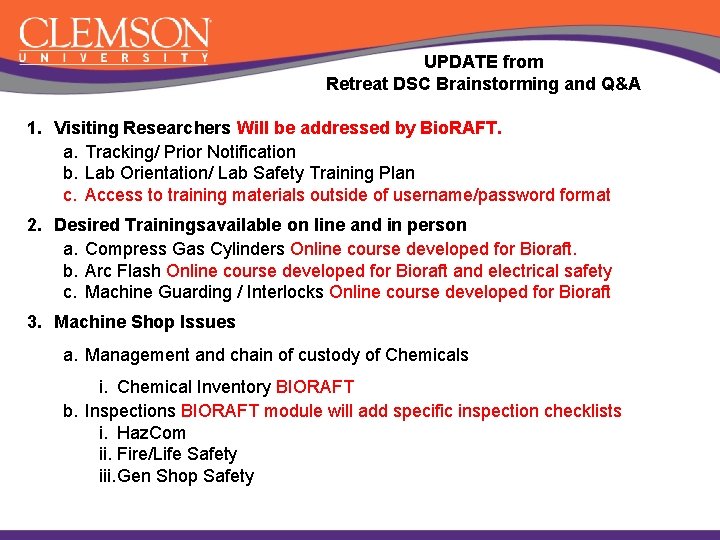
UPDATE from Retreat DSC Brainstorming and Q&A 1. Visiting Researchers Will be addressed by Bio. RAFT. a. Tracking/ Prior Notification b. Lab Orientation/ Lab Safety Training Plan c. Access to training materials outside of username/password format 2. Desired Trainingsavailable on line and in person a. Compress Gas Cylinders Online course developed for Bioraft. b. Arc Flash Online course developed for Bioraft and electrical safety c. Machine Guarding / Interlocks Online course developed for Bioraft 3. Machine Shop Issues a. Management and chain of custody of Chemicals i. Chemical Inventory BIORAFT b. Inspections BIORAFT module will add specific inspection checklists i. Haz. Com ii. Fire/Life Safety iii. Gen Shop Safety
Questions? Office of Research Safety http: //www. clemson. edu/research/safety/ Email: researchsafety@Clemson. edu “We are committed to innovation and exceptional customer service for our students, faculty and staff both on campus and across the state”
THANK YOU FOR ALL YOU DO TO PROMOTE A POSITIVE SAFETY CULTURE!