
Welcome Discrete Mathematics for Computer Science Comp Sci
- Slides: 43
Welcome! Discrete Mathematics for Computer Science Comp. Sci 102 D 106 LSRC M, W 1: 15 -2: 30 Professor: Jeffrey Forbes Comp. Sci 102 1. 1
Frequently Asked Questions l l What are the prerequisites? Ø CPS 6 but CPS 100 preferred Ø Math 31 & 32 How does this course fit into the curricula? Ø Useful foundation for courses like Compsci 130 and 140 Ø Solid grounding in mathematical foundations Ø Replaces requirement of Math 135 (probability), Math 124 (Combinatorics) and Math 187 (Logic) What is recitation? Is it required? Ø Recitation is a more hands-on section where you will do problems and discuss solutions. Your work there will be graded. How do keep up to date? Ø Read web page regularly http: //www. cs. duke. edu/courses/spring 05/cps 102 Ø Read discussion forum regularly http: //www. cs. duke. edu/php. BB 2/index. php? c=37 Comp. Sci 102 Ø Read your email 1. 2
Course goals l l What we want to teach Ø Precise, reliable, powerful thinking Ø The ability to state and prove nontrivial facts, in particular about programs Ø Mathematical foundations and ideas useful throughout CS Ø Correctly read, represent and analyze various types of discrete structures using standard notations. What areas Ø Propositions and Proofs Ø Induction Ø Basics of Counting Ø Arithmetic Algorithms Ø Probability Ø Structures Comp. Sci 102 1. 3
So, what’s this class about? What are “discrete structures” anyway? • “Discrete” ( “discreet”!) - Composed of distinct, separable parts. (Opposite of continuous. ) discrete: continuous : : digital: analog • “Structures” - Objects built up from simpler objects according to some definite pattern. • “Discrete Mathematics” - The study of discrete, mathematical objects and structures. Comp. Sci 102 © Michael Frank 1. 4
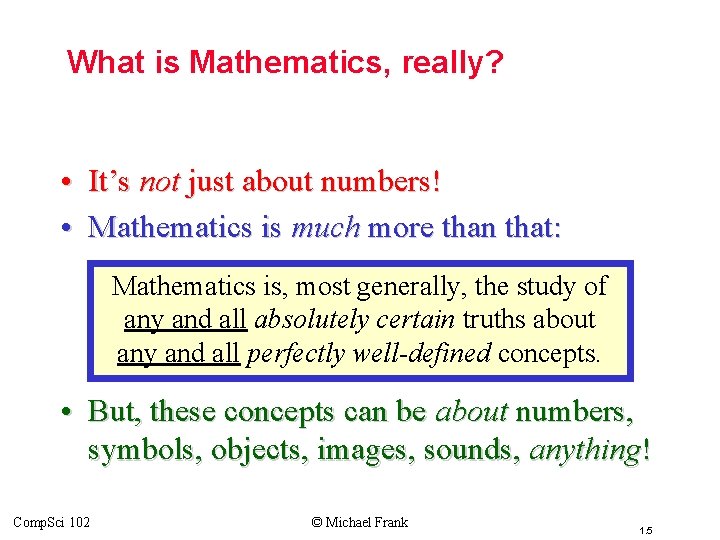
What is Mathematics, really? • It’s not just about numbers! • Mathematics is much more than that: Mathematics is, most generally, the study of any and all absolutely certain truths about any and all perfectly well-defined concepts. • But, these concepts can be about numbers, symbols, objects, images, sounds, anything! Comp. Sci 102 © Michael Frank 1. 5
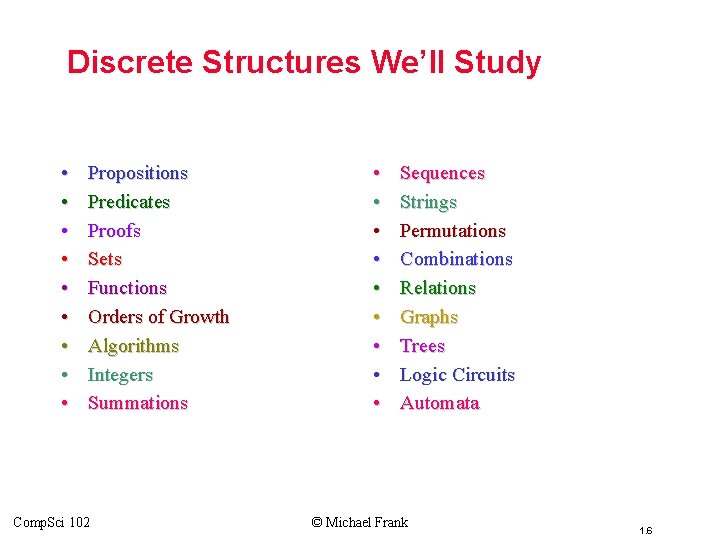
Discrete Structures We’ll Study • • • Propositions Predicates Proofs Sets Functions Orders of Growth Algorithms Integers Summations Comp. Sci 102 • • • Sequences Strings Permutations Combinations Relations Graphs Trees Logic Circuits Automata © Michael Frank 1. 6
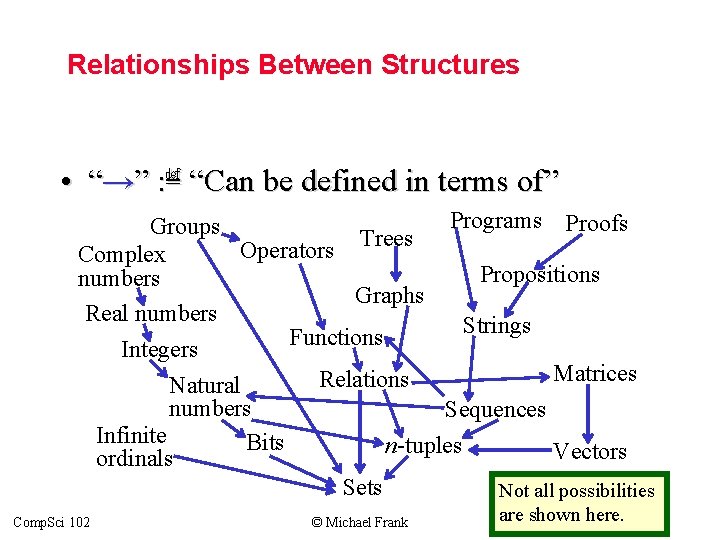
Relationships Between Structures • “→” : ≝ “Can be defined in terms of” Programs Proofs Groups Trees Operators Complex Propositions numbers Graphs Real numbers Strings Functions Integers Matrices Relations Natural numbers Sequences Infinite Bits n-tuples Vectors ordinals Sets Not all possibilities Comp. Sci 102 © Michael Frank are shown here. 1. 7
Some Notations We’ll Learn Comp. Sci 102 © Michael Frank 1. 8
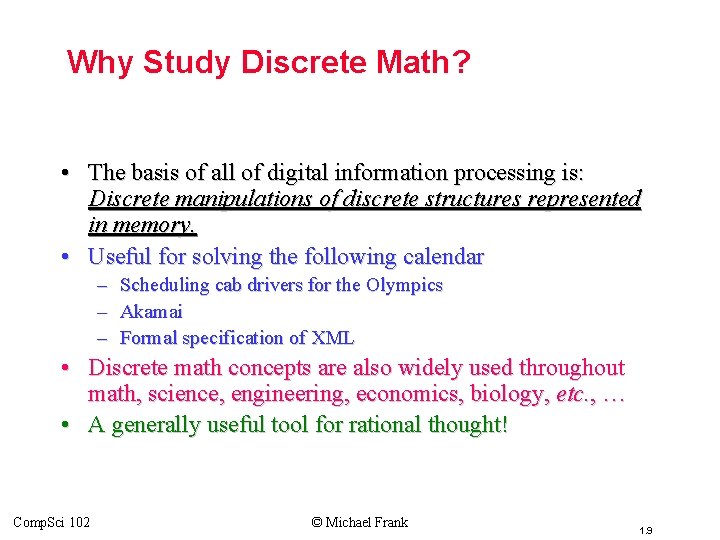
Why Study Discrete Math? • The basis of all of digital information processing is: Discrete manipulations of discrete structures represented in memory. • Useful for solving the following calendar – – – Scheduling cab drivers for the Olympics Akamai Formal specification of XML • Discrete math concepts are also widely used throughout math, science, engineering, economics, biology, etc. , … • A generally useful tool for rational thought! Comp. Sci 102 © Michael Frank 1. 9
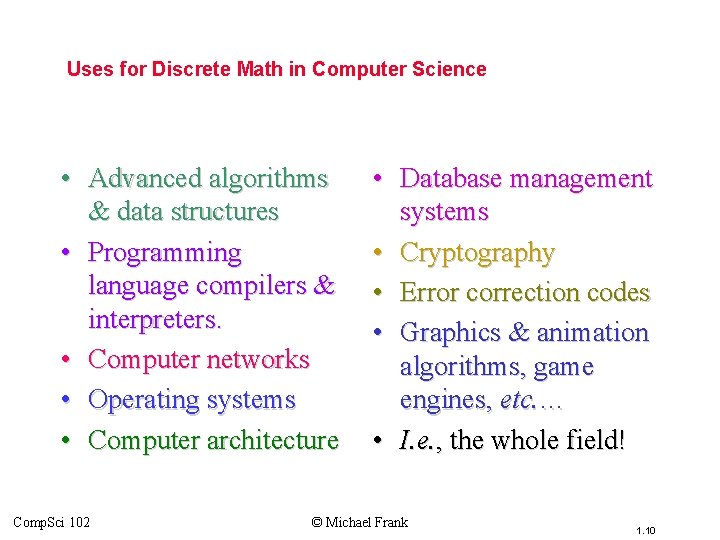
Uses for Discrete Math in Computer Science • Advanced algorithms & data structures • Programming language compilers & interpreters. • Computer networks • Operating systems • Computer architecture Comp. Sci 102 • Database management systems • Cryptography • Error correction codes • Graphics & animation algorithms, game engines, etc. … • I. e. , the whole field! © Michael Frank 1. 10
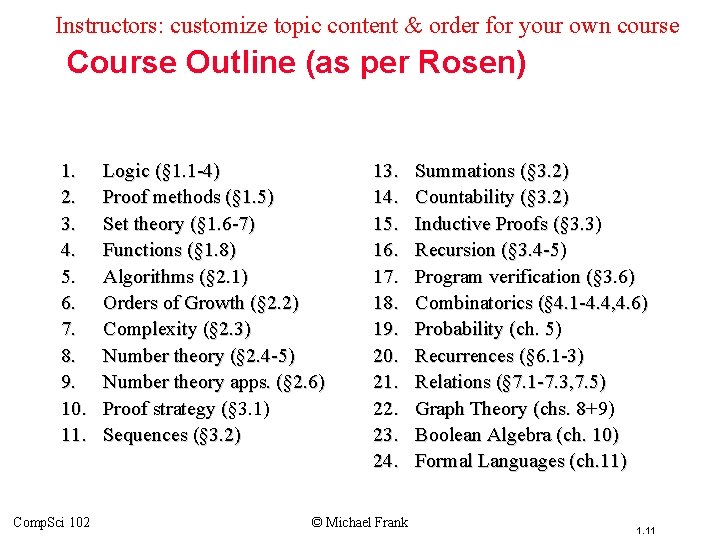
Instructors: customize topic content & order for your own course Course Outline (as per Rosen) 1. 2. 3. 4. 5. 6. 7. 8. 9. 10. 11. Comp. Sci 102 Logic (§ 1. 1 -4) Proof methods (§ 1. 5) Set theory (§ 1. 6 -7) Functions (§ 1. 8) Algorithms (§ 2. 1) Orders of Growth (§ 2. 2) Complexity (§ 2. 3) Number theory (§ 2. 4 -5) Number theory apps. (§ 2. 6) Proof strategy (§ 3. 1) Sequences (§ 3. 2) 13. 14. 15. 16. 17. 18. 19. 20. 21. 22. 23. 24. © Michael Frank Summations (§ 3. 2) Countability (§ 3. 2) Inductive Proofs (§ 3. 3) Recursion (§ 3. 4 -5) Program verification (§ 3. 6) Combinatorics (§ 4. 1 -4. 4, 4. 6) Probability (ch. 5) Recurrences (§ 6. 1 -3) Relations (§ 7. 1 -7. 3, 7. 5) Graph Theory (chs. 8+9) Boolean Algebra (ch. 10) Formal Languages (ch. 11) 1. 11
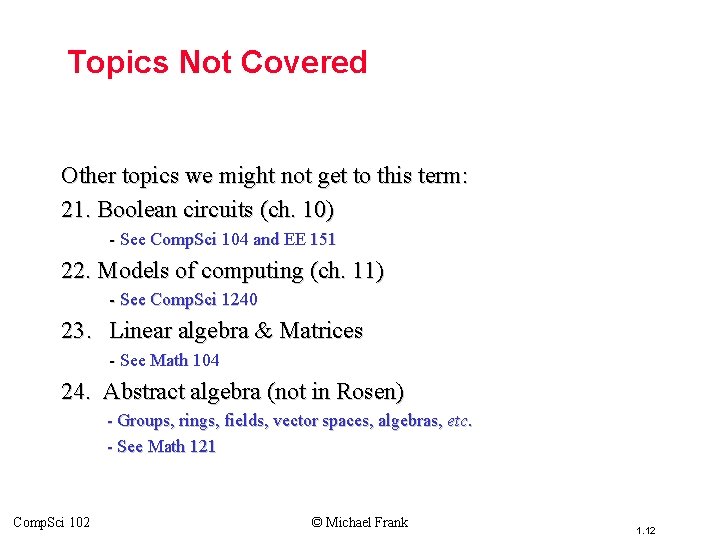
Topics Not Covered Other topics we might not get to this term: 21. Boolean circuits (ch. 10) - See Comp. Sci 104 and EE 151 22. Models of computing (ch. 11) - See Comp. Sci 1240 23. Linear algebra & Matrices - See Math 104 24. Abstract algebra (not in Rosen) - Groups, rings, fields, vector spaces, algebras, etc. - See Math 121 Comp. Sci 102 © Michael Frank 1. 12
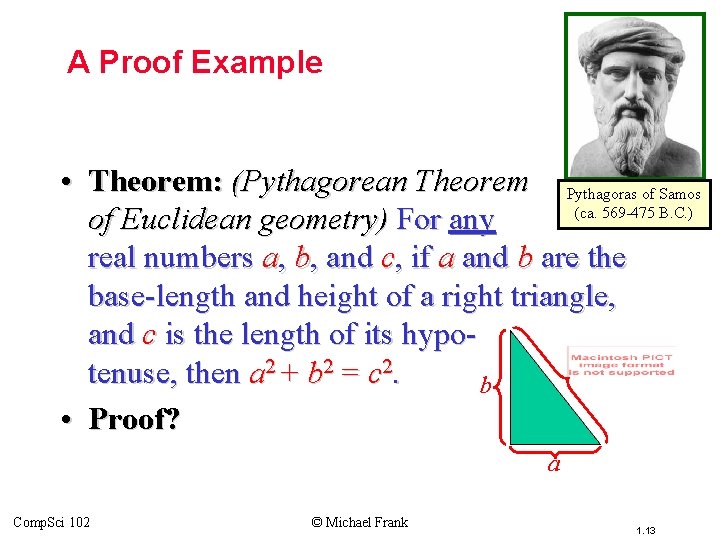
A Proof Example • Theorem: (Pythagorean Theorem Pythagoras of Samos (ca. 569 -475 B. C. ) of Euclidean geometry) For any real numbers a, b, and c, if a and b are the base-length and height of a right triangle, and c is the length of its hypotenuse, then a 2 + b 2 = c 2. b • Proof? a Comp. Sci 102 © Michael Frank 1. 13
Propositions • Statement that is either true or false • Examples – ``This encryption system cannot be broken'' – ``My program works efficiently in all cases'' – ``There are no circumstances under which I would lie to Congress'' – ``It is inconceivable that our legal system would execute an innocent person'’ • A theorem is a proposition that is guaranteed by a proof Comp. Sci 102 © Michael Frank 1. 14
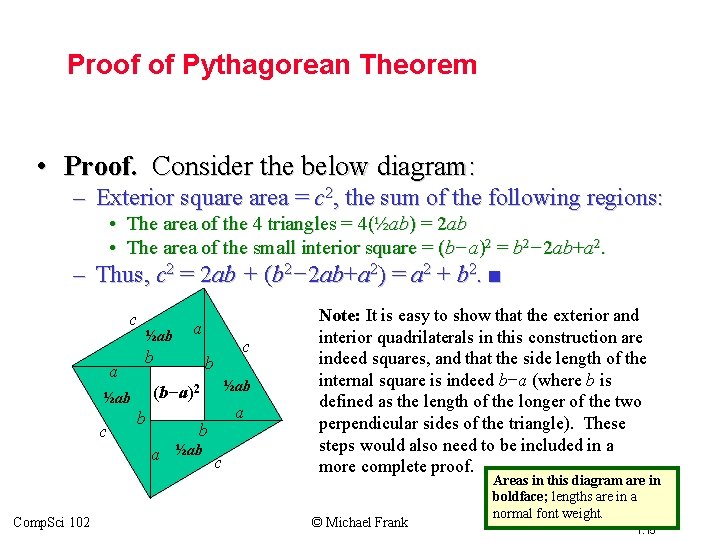
Proof of Pythagorean Theorem • Proof. Consider the below diagram: – Exterior square area = c 2, the sum of the following regions: • The area of the 4 triangles = 4(½ab) = 2 ab • The area of the small interior square = (b−a)2 = b 2− 2 ab+a 2. – Thus, c 2 = 2 ab + (b 2− 2 ab+a 2) = a 2 + b 2. ■ c a ½ab b Comp. Sci 102 b (b−a)2 ½ab c a b b a ½ab c c ½ab a Note: It is easy to show that the exterior and interior quadrilaterals in this construction are indeed squares, and that the side length of the internal square is indeed b−a (where b is defined as the length of the longer of the two perpendicular sides of the triangle). These steps would also need to be included in a more complete proof. © Michael Frank Areas in this diagram are in boldface; lengths are in a normal font weight. 1. 15
Finally: Have Fun! Comp. Sci 102 © Michael Frank 1. 16
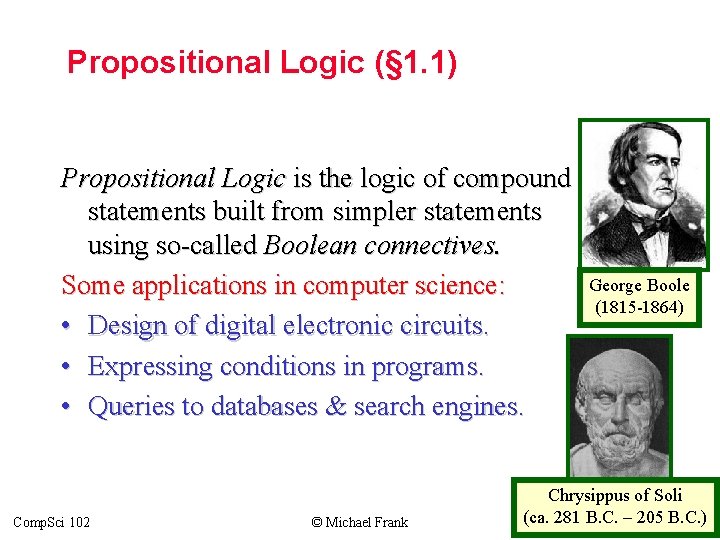
Topic #1 – Propositional Logic (§ 1. 1) Propositional Logic is the logic of compound statements built from simpler statements using so-called Boolean connectives. Some applications in computer science: • Design of digital electronic circuits. • Expressing conditions in programs. • Queries to databases & search engines. Comp. Sci 102 © Michael Frank George Boole (1815 -1864) Chrysippus of Soli (ca. 281 B. C. – 205 B. C. ) 1. 17
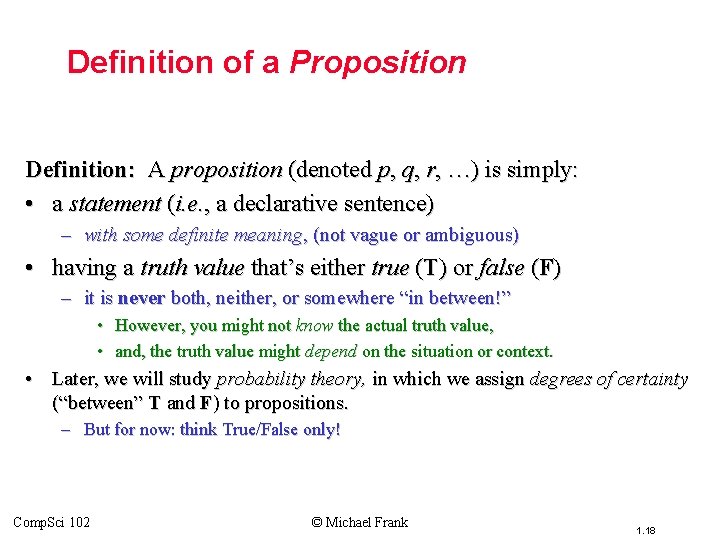
Topic #1 – Propositional Logic Definition of a Proposition Definition: A proposition (denoted p, q, r, …) is simply: • a statement (i. e. , a declarative sentence) – with some definite meaning, (not vague or ambiguous) • having a truth value that’s either true (T) or false (F) – it is never both, neither, or somewhere “in between!” • However, you might not know the actual truth value, • and, the truth value might depend on the situation or context. • Later, we will study probability theory, in which we assign degrees of certainty (“between” T and F) to propositions. – But for now: think True/False only! Comp. Sci 102 © Michael Frank 1. 18
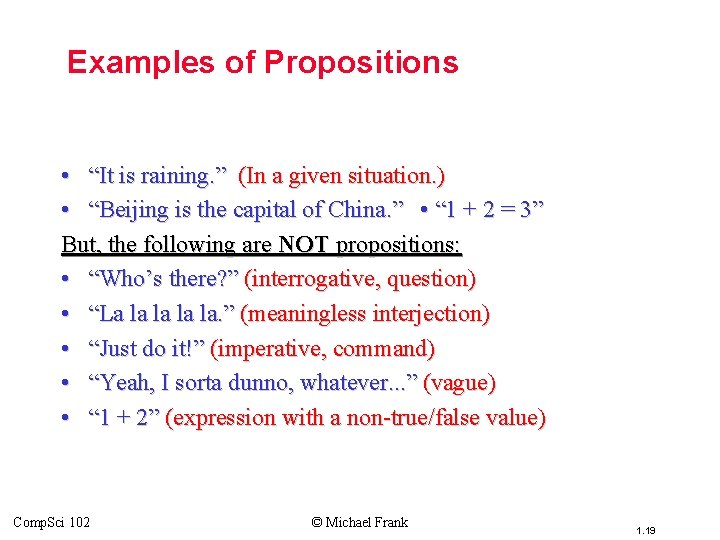
Topic #1 – Propositional Logic Examples of Propositions • “It is raining. ” (In a given situation. ) • “Beijing is the capital of China. ” • “ 1 + 2 = 3” But, the following are NOT propositions: • “Who’s there? ” (interrogative, question) • “La la la. ” (meaningless interjection) • “Just do it!” (imperative, command) • “Yeah, I sorta dunno, whatever. . . ” (vague) • “ 1 + 2” (expression with a non-true/false value) Comp. Sci 102 © Michael Frank 1. 19
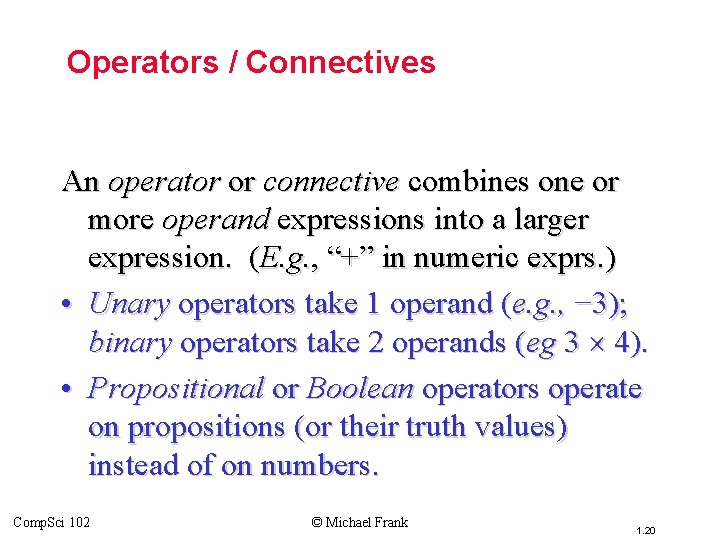
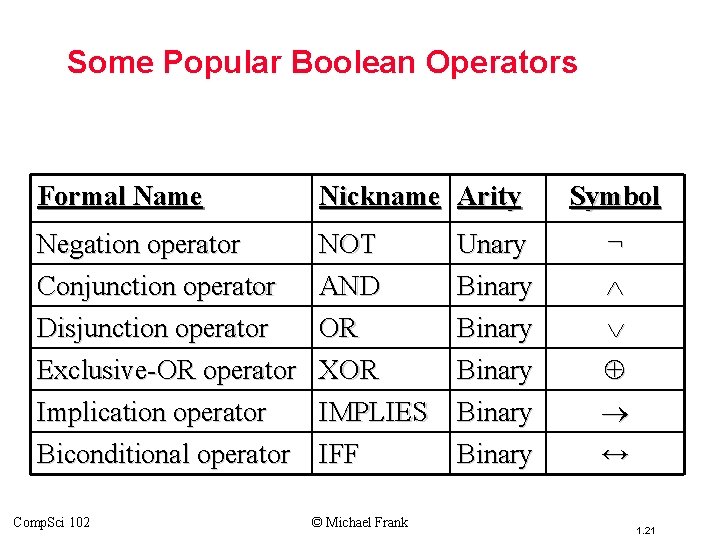
Topic #1. 0 – Propositional Logic: Operators / Connectives An operator or connective combines one or more operand expressions into a larger expression. (E. g. , “+” in numeric exprs. ) • Unary operators take 1 operand (e. g. , − 3); binary operators take 2 operands (eg 3 4). • Propositional or Boolean operators operate on propositions (or their truth values) instead of on numbers. Comp. Sci 102 © Michael Frank 1. 20
Topic #1. 0 – Propositional Logic: Operators Some Popular Boolean Operators Formal Name Nickname Arity Negation operator Conjunction operator NOT AND Unary Binary ¬ Disjunction operator Exclusive-OR operator Implication operator Biconditional operator OR XOR IMPLIES IFF Binary ↔ Comp. Sci 102 © Michael Frank Symbol 1. 21
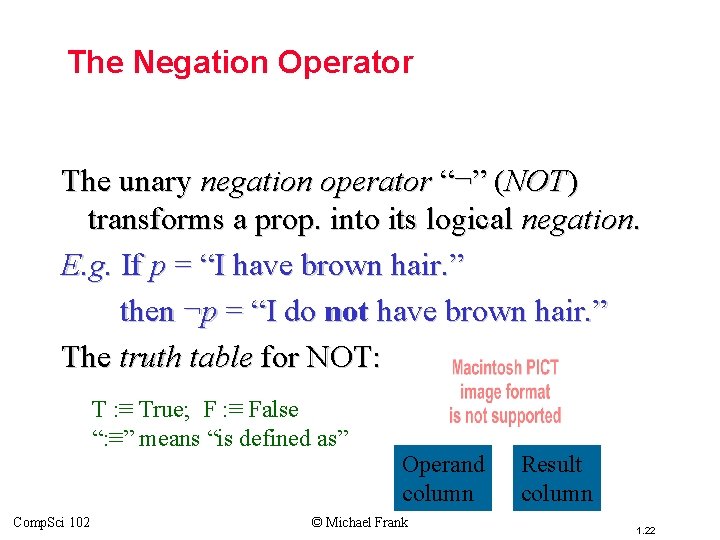
Topic #1. 0 – Propositional Logic: Operators The Negation Operator The unary negation operator “¬” (NOT) transforms a prop. into its logical negation. E. g. If p = “I have brown hair. ” then ¬p = “I do not have brown hair. ” The truth table for NOT: T : ≡ True; F : ≡ False “: ≡” means “is defined as” Comp. Sci 102 Operand column © Michael Frank Result column 1. 22
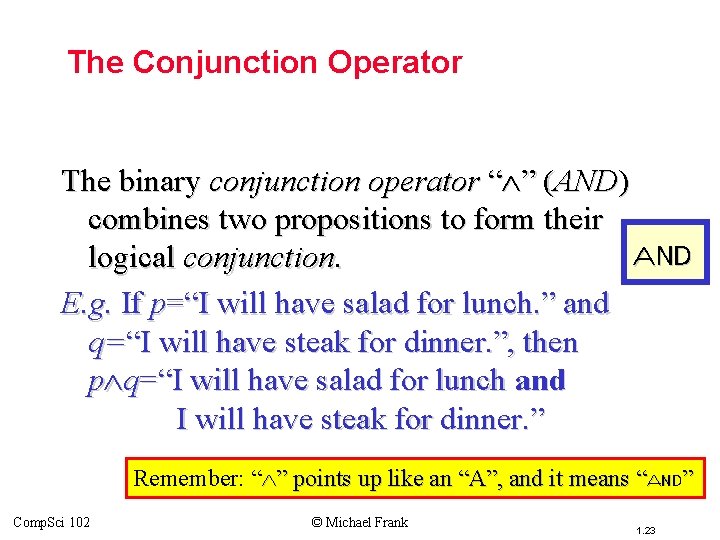
Topic #1. 0 – Propositional Logic: Operators The Conjunction Operator The binary conjunction operator “ ” (AND) combines two propositions to form their ND logical conjunction. E. g. If p=“I will have salad for lunch. ” and q=“I will have steak for dinner. ”, then p q=“I will have salad for lunch and I will have steak for dinner. ” Remember: “ ” points up like an “A”, and it means “ ND” Comp. Sci 102 © Michael Frank 1. 23
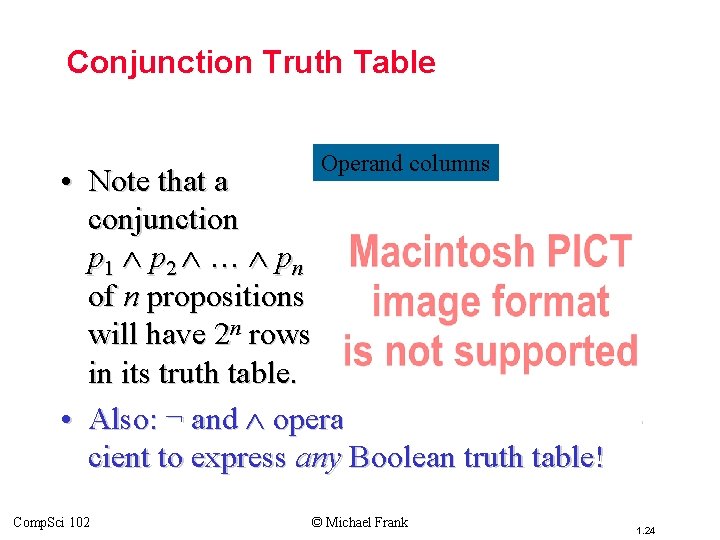
Topic #1. 0 – Propositional Logic: Operators Conjunction Truth Table Operand columns • Note that a conjunction p 1 p 2 … pn of n propositions will have 2 n rows in its truth table. • Also: ¬ and operations together are sufficient to express any Boolean truth table! Comp. Sci 102 © Michael Frank 1. 24
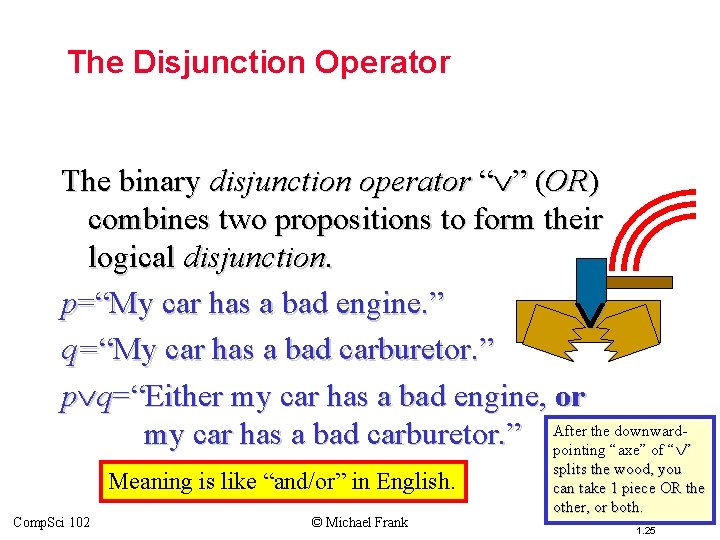
Topic #1. 0 – Propositional Logic: Operators The Disjunction Operator The binary disjunction operator “ ” (OR) combines two propositions to form their logical disjunction. p=“My car has a bad engine. ” q=“My car has a bad carburetor. ” p q=“Either my car has a bad engine, or the downwardmy car has a bad carburetor. ” After pointing “axe” of “ ” Meaning is like “and/or” in English. Comp. Sci 102 © Michael Frank splits the wood, you can take 1 piece OR the other, or both. 1. 25
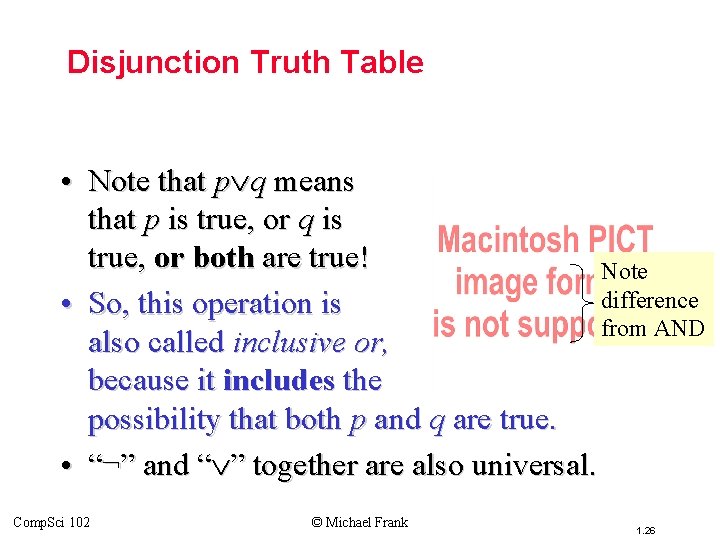
Topic #1. 0 – Propositional Logic: Operators Disjunction Truth Table • Note that p q means that p is true, or q is true, or both are true! Note difference • So, this operation is from AND also called inclusive or, because it includes the possibility that both p and q are true. • “¬” and “ ” together are also universal. Comp. Sci 102 © Michael Frank 1. 26
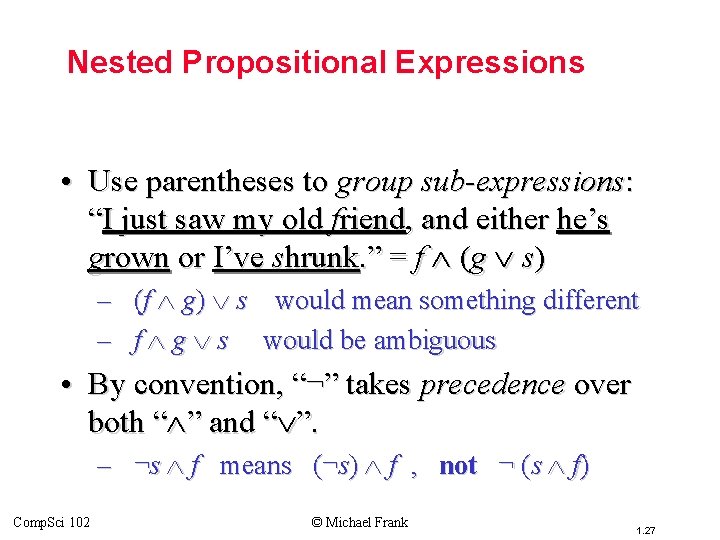
Topic #1. 0 – Propositional Logic: Operators Nested Propositional Expressions • Use parentheses to group sub-expressions: “I just saw my old friend, and either he’s grown or I’ve shrunk. ” = f (g s) – (f g) s would mean something different – f g s would be ambiguous • By convention, “¬” takes precedence over both “ ” and “ ”. – ¬s f means (¬s) f , not ¬ (s f) Comp. Sci 102 © Michael Frank 1. 27
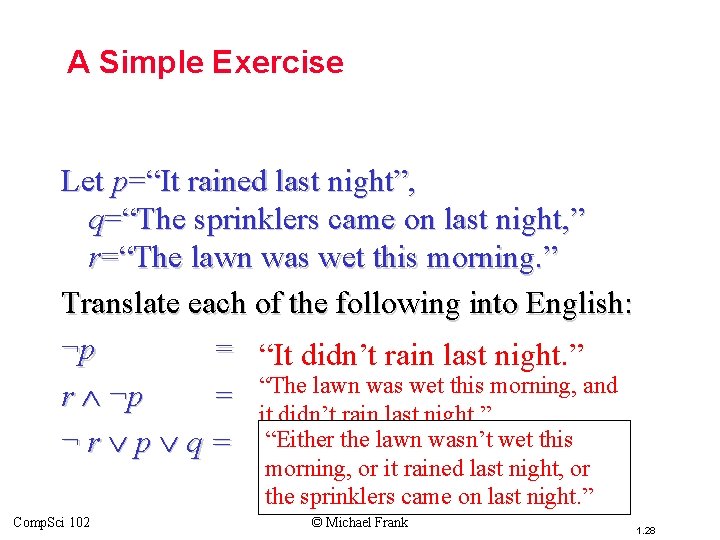
Topic #1. 0 – Propositional Logic: Operators A Simple Exercise Let p=“It rained last night”, q=“The sprinklers came on last night, ” r=“The lawn was wet this morning. ” Translate each of the following into English: ¬p = “It didn’t rain last night. ” r ¬p = “The lawn was wet this morning, and it didn’t rain last night. ” ¬ r p q = “Either the lawn wasn’t wet this morning, or it rained last night, or the sprinklers came on last night. ” Comp. Sci 102 © Michael Frank 1. 28
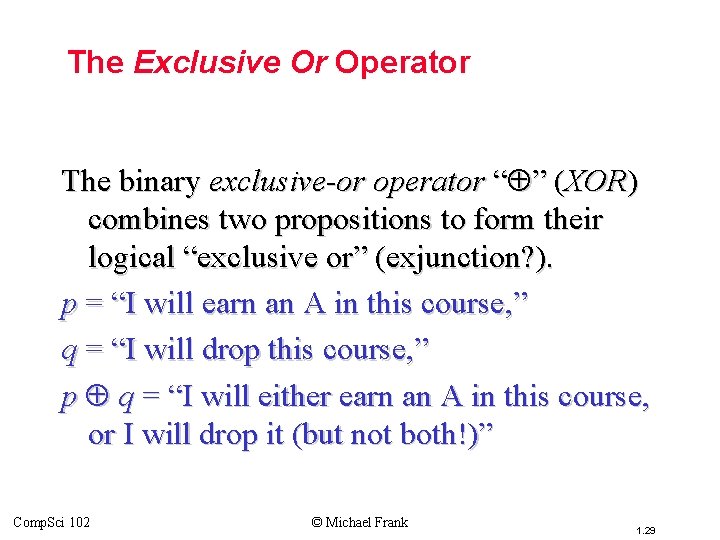
Topic #1. 0 – Propositional Logic: Operators The Exclusive Or Operator The binary exclusive-or operator “ ” (XOR) combines two propositions to form their logical “exclusive or” (exjunction? ). p = “I will earn an A in this course, ” q = “I will drop this course, ” p q = “I will either earn an A in this course, or I will drop it (but not both!)” Comp. Sci 102 © Michael Frank 1. 29
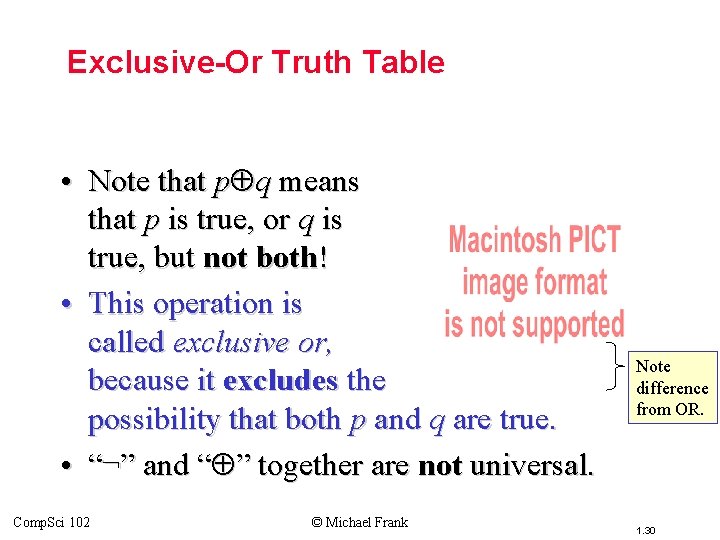
Topic #1. 0 – Propositional Logic: Operators Exclusive-Or Truth Table • Note that p q means that p is true, or q is true, but not both! • This operation is called exclusive or, because it excludes the possibility that both p and q are true. • “¬” and “ ” together are not universal. Comp. Sci 102 © Michael Frank Note difference from OR. 1. 30
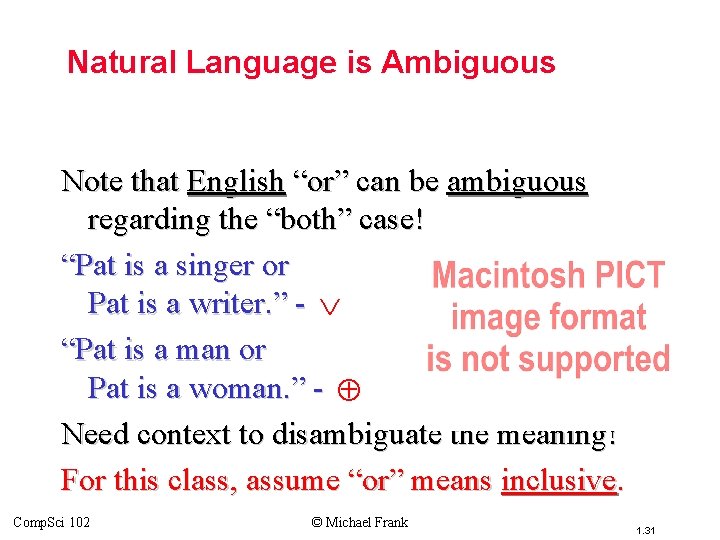
Topic #1. 0 – Propositional Logic: Operators Natural Language is Ambiguous Note that English “or” can be ambiguous regarding the “both” case! “Pat is a singer or Pat is a writer. ” - “Pat is a man or Pat is a woman. ” - Need context to disambiguate the meaning! For this class, assume “or” means inclusive. Comp. Sci 102 © Michael Frank 1. 31
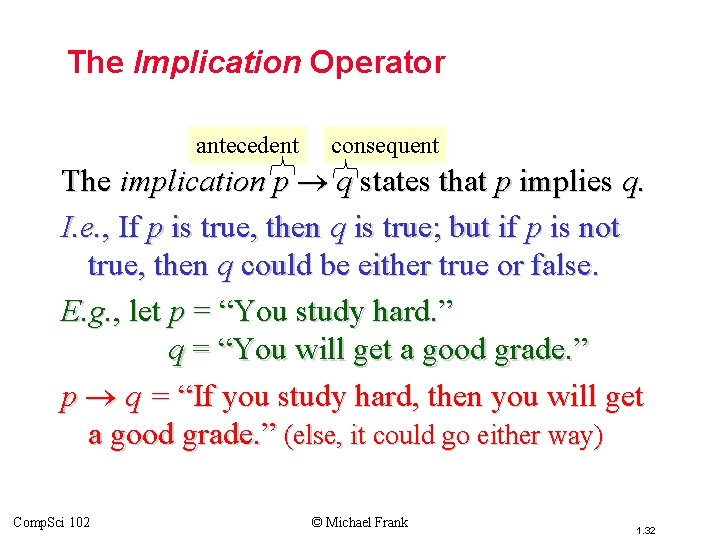
Topic #1. 0 – Propositional Logic: Operators The Implication Operator antecedent consequent The implication p q states that p implies q. I. e. , If p is true, then q is true; but if p is not true, then q could be either true or false. E. g. , let p = “You study hard. ” q = “You will get a good grade. ” p q = “If you study hard, then you will get a good grade. ” (else, it could go either way) Comp. Sci 102 © Michael Frank 1. 32
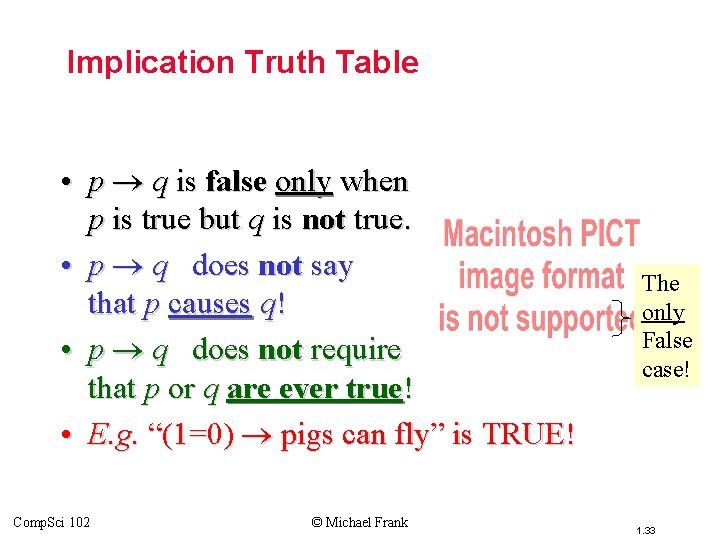
Topic #1. 0 – Propositional Logic: Operators Implication Truth Table • p q is false only when p is true but q is not true. • p q does not say that p causes q! • p q does not require that p or q are ever true! • E. g. “(1=0) pigs can fly” is TRUE! Comp. Sci 102 © Michael Frank The only False case! 1. 33
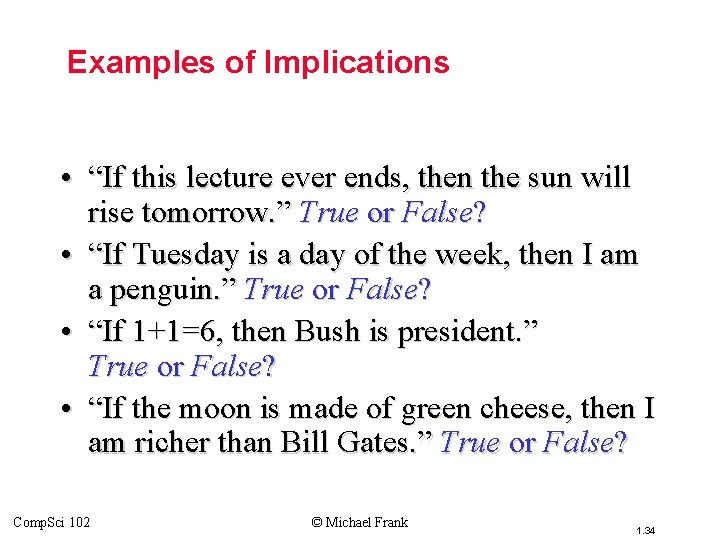
Topic #1. 0 – Propositional Logic: Operators Examples of Implications • “If this lecture ever ends, then the sun will rise tomorrow. ” True or False? • “If Tuesday is a day of the week, then I am a penguin. ” True or False? • “If 1+1=6, then Bush is president. ” True or False? • “If the moon is made of green cheese, then I am richer than Bill Gates. ” True or False? Comp. Sci 102 © Michael Frank 1. 34
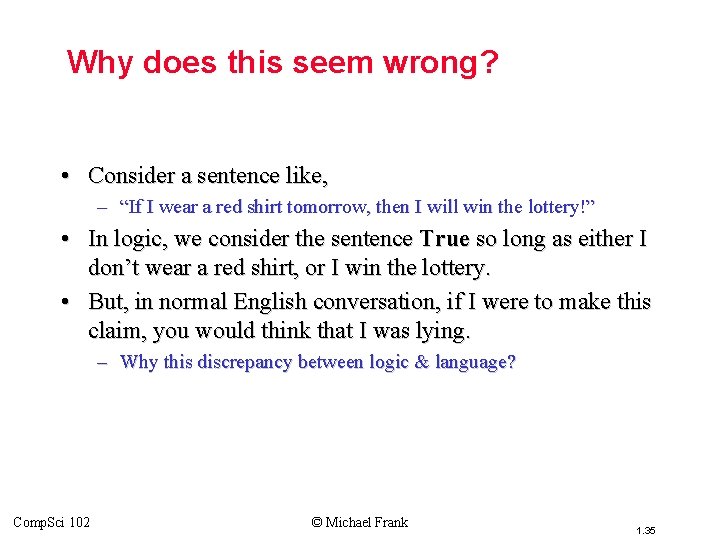
Why does this seem wrong? • Consider a sentence like, – “If I wear a red shirt tomorrow, then I will win the lottery!” • In logic, we consider the sentence True so long as either I don’t wear a red shirt, or I win the lottery. • But, in normal English conversation, if I were to make this claim, you would think that I was lying. – Why this discrepancy between logic & language? Comp. Sci 102 © Michael Frank 1. 35
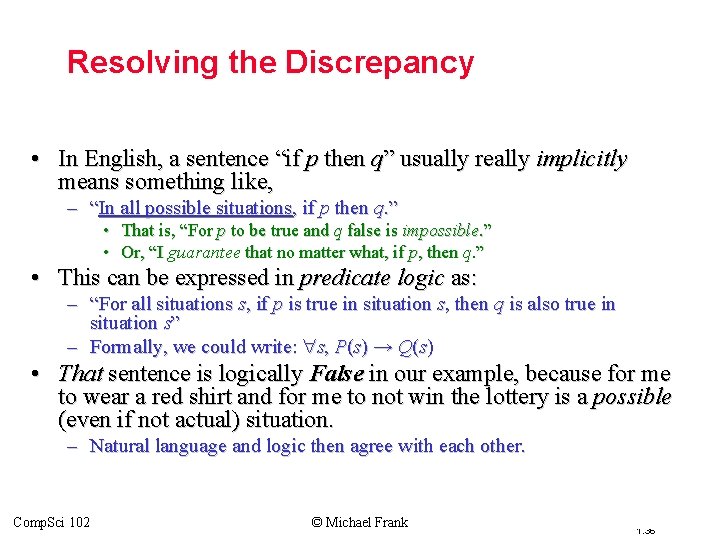
Resolving the Discrepancy • In English, a sentence “if p then q” usually really implicitly means something like, – “In all possible situations, if p then q. ” • That is, “For p to be true and q false is impossible. ” • Or, “I guarantee that no matter what, if p, then q. ” • This can be expressed in predicate logic as: – “For all situations s, if p is true in situation s, then q is also true in situation s” – Formally, we could write: s, P(s) → Q(s) • That sentence is logically False in our example, because for me to wear a red shirt and for me to not win the lottery is a possible (even if not actual) situation. – Natural language and logic then agree with each other. Comp. Sci 102 © Michael Frank 1. 36
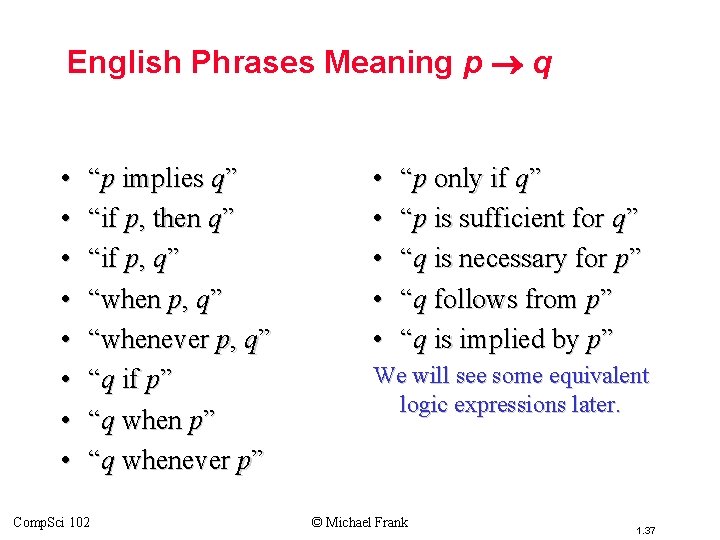
Topic #1. 0 – Propositional Logic: Operators English Phrases Meaning p q • • “p implies q” “if p, then q” “if p, q” “whenever p, q” “q if p” “q whenever p” Comp. Sci 102 • • • “p only if q” “p is sufficient for q” “q is necessary for p” “q follows from p” “q is implied by p” We will see some equivalent logic expressions later. © Michael Frank 1. 37
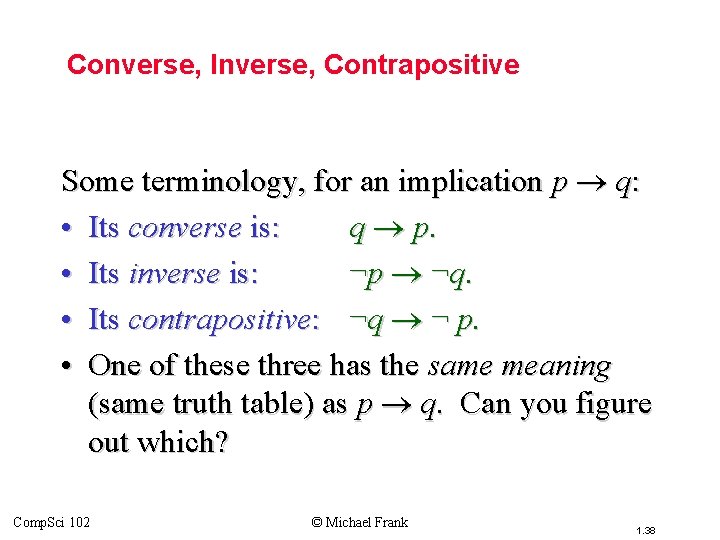
Topic #1. 0 – Propositional Logic: Operators Converse, Inverse, Contrapositive Some terminology, for an implication p q: • Its converse is: q p. • Its inverse is: ¬p ¬q. • Its contrapositive: ¬q ¬ p. • One of these three has the same meaning (same truth table) as p q. Can you figure out which? Comp. Sci 102 © Michael Frank 1. 38
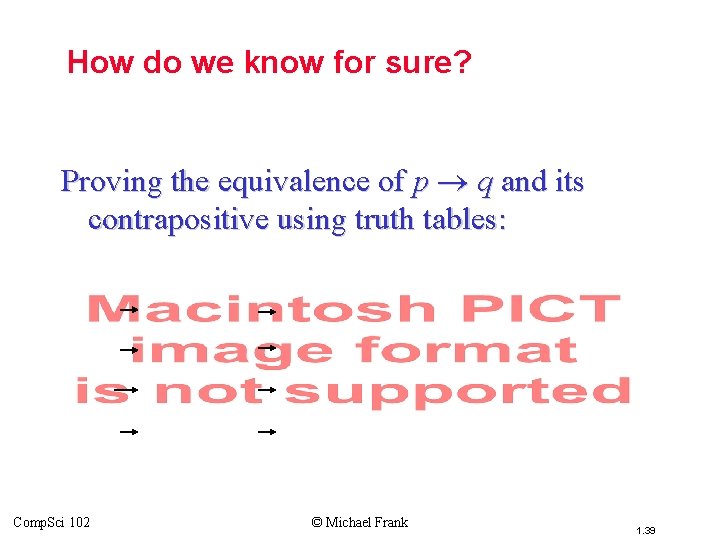
Topic #1. 0 – Propositional Logic: Operators How do we know for sure? Proving the equivalence of p q and its contrapositive using truth tables: Comp. Sci 102 © Michael Frank 1. 39
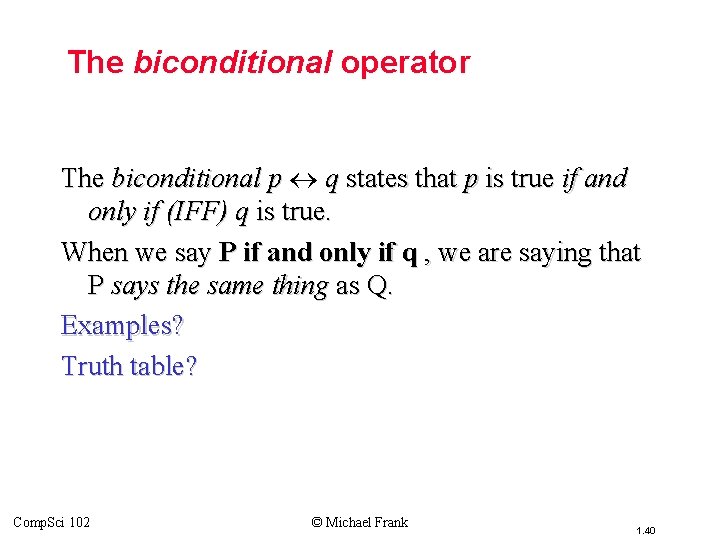
Topic #1. 0 – Propositional Logic: Operators The biconditional operator The biconditional p q states that p is true if and only if (IFF) q is true. When we say P if and only if q , we are saying that P says the same thing as Q. Examples? Truth table? Comp. Sci 102 © Michael Frank 1. 40
Topic #1. 0 – Propositional Logic: Operators Biconditional Truth Table • p q means that p and q have the same truth value. • Note this truth table is the exact opposite of ’s! Thus, p q means ¬(p q) • p q does not imply that p and q are true, or that either of them causes the other, or that they have a common cause. Comp. Sci 102 © Michael Frank 1. 41
Topic #1. 0 – Propositional Logic: Operators Boolean Operations Summary • We have seen 1 unary operator (out of the 4 possible) and 5 binary operators (out of the 16 possible). Their truth tables are below. Comp. Sci 102 © Michael Frank 1. 42
Topic #1. 0 – Propositional Logic: Operators Some Alternative Notations Comp. Sci 102 © Michael Frank 1. 43