
WELCOME Data Analytics Industry Day VADM Brian Brown
WELCOME Data Analytics Industry Day
VADM Brian Brown Commander, Naval Information Forces

Our Strategic Environment National Security Strategy National Defense Strategy Navy Strategy Distributed Maritime Operations • Maritime Era of Great Power Competition – China and Russia • Must still contend with Iran, North Korea, Violent Extremists • Technology and Pace of Technology – Stressing Info Environs • Dynamic Spectrum of Conflict Urgency to deliver the Navy the Nation Needs Lethal, Agile, Ready United States Fleet Forces

Information Warfare in Distributed Maritime Ops A key component of the Distributed Maritime Operations concept, Navy Information Warfare delivers lethality and decisive warfare advantage through assured command control, battlespace awareness, and integrated fires. Integration Assured C 2 Integrated Fires DMO Distribution Maneuver Battlespace Awareness United States Fleet Forces 4

IW Capabilities Across Warfare Areas IW capabilities are part of every kill chain across all domains (even Mother Nature’s) Information Warfare Antisubmarine Warfare rks Human Influenced Battlespace Awareness Physical Strike IW Capability Pillars Information Architecture Assured C 2 Information Content Battlespace Awareness Information Effects Integrated Fires United States Fleet Forces Mine Warfare S p e ctru m Netwo s Ballistic Missile Defense mm Sp Co ace Ops Safety Air Defense Expeditionary Warfare IFC Antisurface Warfare IW “owns” IW “impacts” 5

IW TYCOM United States Fleet Forces
C 5 I Campaign Plan Metrics Mr. Rich Voter C 5 I Wholeness Campaign Plan Lead, NAVIFOR
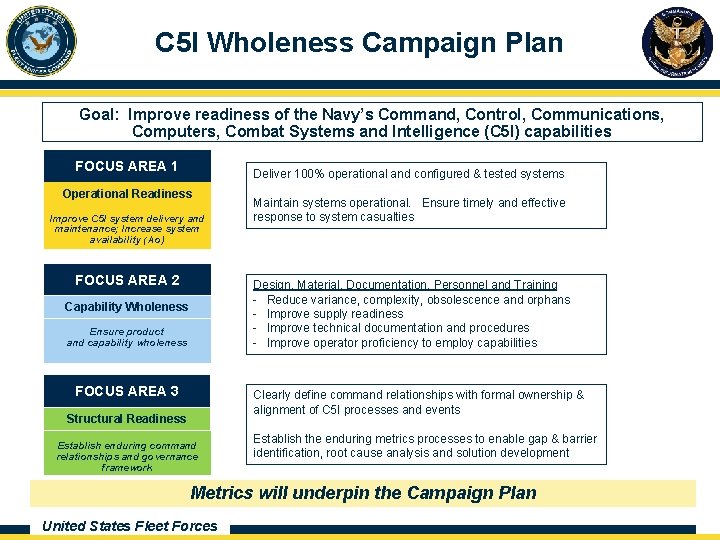
C 5 I Wholeness Campaign Plan Goal: Improve readiness of the Navy’s Command, Control, Communications, Computers, Combat Systems and Intelligence (C 5 I) capabilities FOCUS AREA 1 Deliver 100% operational and configured & tested systems Operational Readiness Improve C 5 I system delivery and maintenance; Increase system availability (Ao) FOCUS AREA 2 Maintain systems operational. Ensure timely and effective response to system casualties Design, Material, Documentation, Personnel and Training - Reduce variance, complexity, obsolescence and orphans - Improve supply readiness - Improve technical documentation and procedures - Improve operator proficiency to employ capabilities Capability Wholeness Ensure product and capability wholeness FOCUS AREA 3 Clearly define command relationships with formal ownership & alignment of C 5 I processes and events Structural Readiness Establish enduring command relationships and governance framework Establish the enduring metrics processes to enable gap & barrier identification, root cause analysis and solution development Metrics will underpin the Campaign Plan United States Fleet Forces
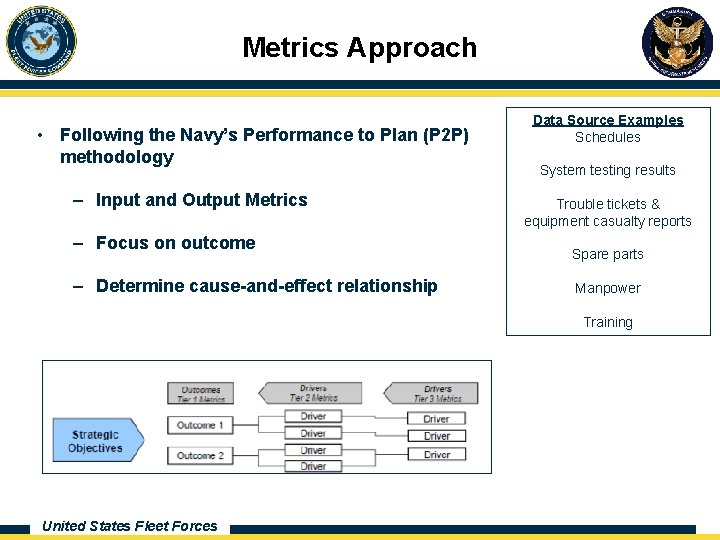
Metrics Approach • Following the Navy’s Performance to Plan (P 2 P) methodology ‒ Input and Output Metrics ‒ Focus on outcome ‒ Determine cause-and-effect relationship Data Source Examples Schedules System testing results Trouble tickets & equipment casualty reports Spare parts Manpower Training United States Fleet Forces
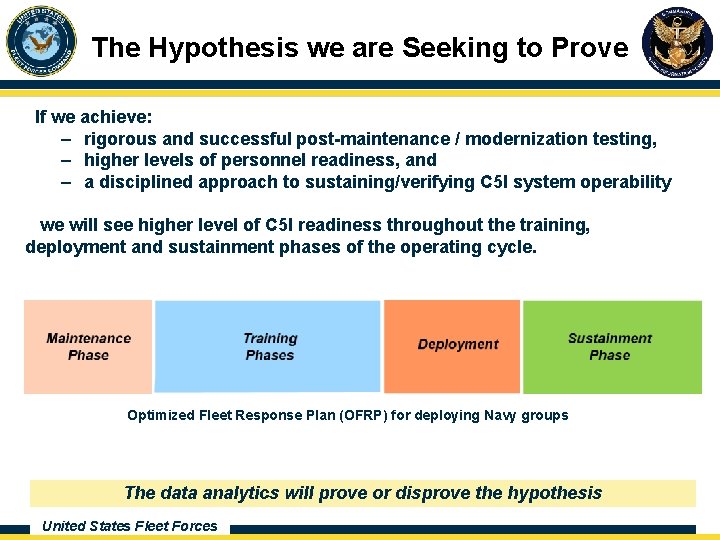
The Hypothesis we are Seeking to Prove If we achieve: ‒ rigorous and successful post-maintenance / modernization testing, ‒ higher levels of personnel readiness, and ‒ a disciplined approach to sustaining/verifying C 5 I system operability we will see higher level of C 5 I readiness throughout the training, deployment and sustainment phases of the operating cycle. Optimized Fleet Response Plan (OFRP) for deploying Navy groups The data analytics will prove or disprove the hypothesis United States Fleet Forces

Data Analytic Challenges • Authoritative data sources • Data access • Data quality • Seeking MOEs and not just MOPs • Achieving sufficient fidelity to understand cause-and-effect • Ensuring a well understood baseline before looking for correlation United States Fleet Forces
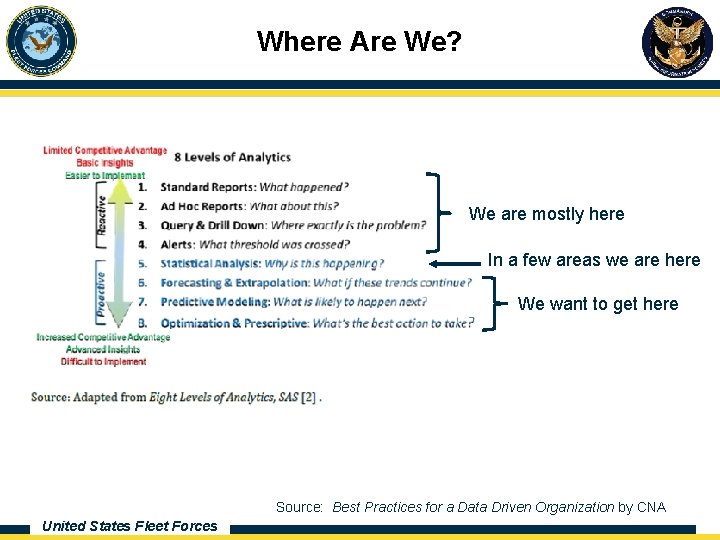
Where Are We? We are mostly here In a few areas we are here We want to get here Source: Best Practices for a Data Driven Organization by CNA United States Fleet Forces
Keynote ~ RAVEN CAPT Al Lopez Program Manager Naval Information Warfare Systems Command
FLEET READINESS DIRECTORATE “Readiness & Analytics Visualization Environment” (RAVEN) 13 August 2019 Presented to: Data Analytics Industry Day Presented by: CAPT Al Lopez Program Manager, Fleet Readiness Directorate & APEO Readiness DISTRIBUTION STATEMENT A: Approved for public release. Distribution is unlimited (08 AUGUST 2019)
A Personal Data Discovery
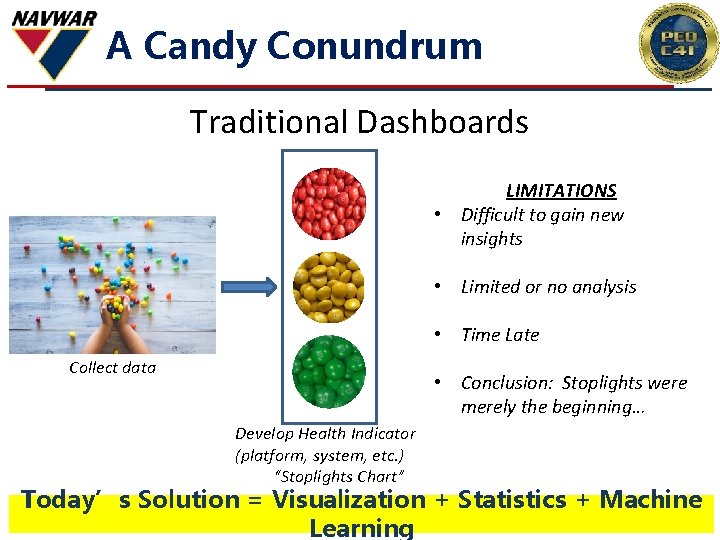
A Candy Conundrum Traditional Dashboards LIMITATIONS • Difficult to gain new insights • Limited or no analysis • Time Late Collect data • Conclusion: Stoplights were merely the beginning… Develop Health Indicator (platform, system, etc. ) “Stoplights Chart” Today’s Solution = Visualization + Statistics + Machine Learning
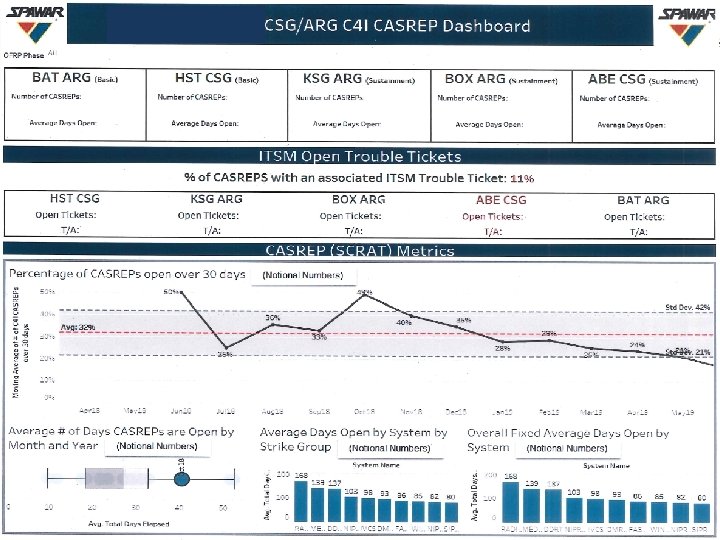
Some Questions To Answer How do we anticipate (and prevent) CASREP spikes based on historical averages by OFRP events? How do Manning and Training trends correlate with readiness and CASREPs? Which trends are occurring across data sources that might point to a bigger issue? Is there a recurrent source of issues to the Fleet?
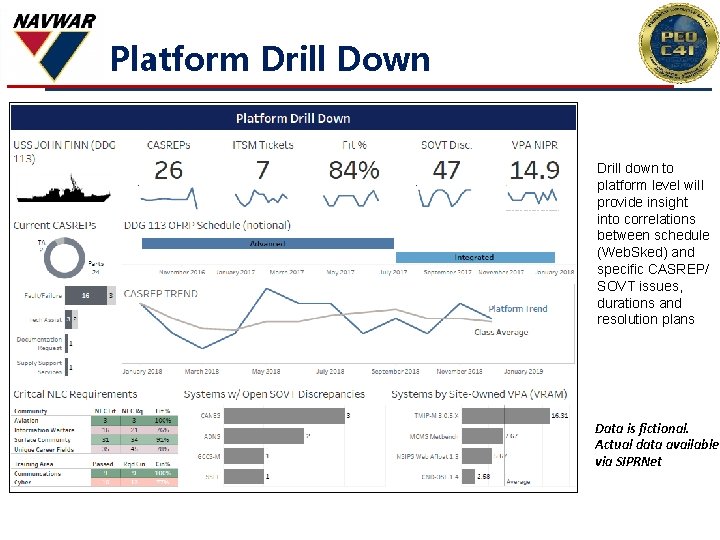
Platform Drill Down Drill down to platform level will provide insight into correlations between schedule (Web. Sked) and specific CASREP/ SOVT issues, durations and resolution plans Data is fictional. Actual data available via SIPRNet Statement D: Distribution authorized to Do. D and U. S. Do. D contractors only. Other requests shall be referred to COMSPAWAR or the cognizant SPAWAR code.
Statement D: Distribution authorized to Do. D and U. S. Do. D contractors only. Other requests shall be referred to COMSPAWAR or the cognizant SPAWAR code.
What is RAVEN. . Getting left of the Readiness problem…using data we already have • Automating real time data feeds from ~30 sources • Facilitates analysis, visualization and data provisioning • Identifies problem areas and trends to enable data -driven decision-making and proactive measures Statement D: Distribution authorized to Do. D and U. S. Do. D contractors only. Other requests shall be referred to COMSPAWAR or the cognizant SPAWAR code.
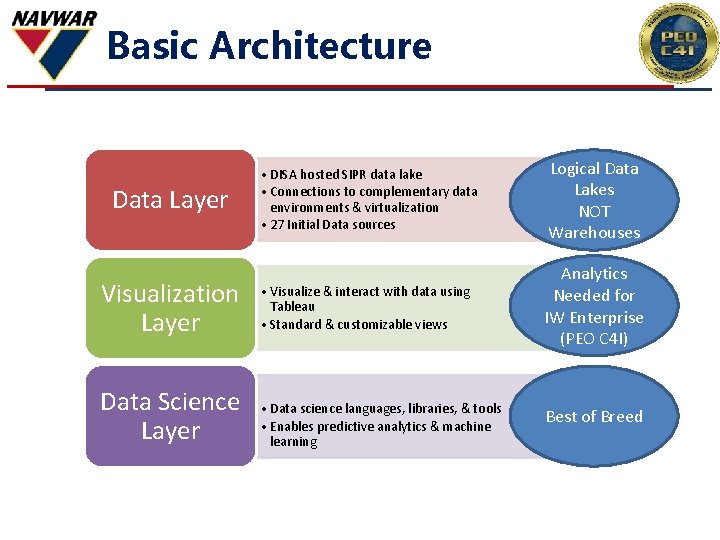
Basic Architecture • DISA hosted SIPR data lake • Connections to complementary data environments & virtualization • 27 Initial Data sources Logical Data Lakes NOT Warehouses Visualization Layer • Visualize & interact with data using Tableau • Standard & customizable views Analytics Needed for IW Enterprise (PEO C 4 I) Data Science Layer • Data science languages, libraries, & tools • Enables predictive analytics & machine learning Data Layer Best of Breed
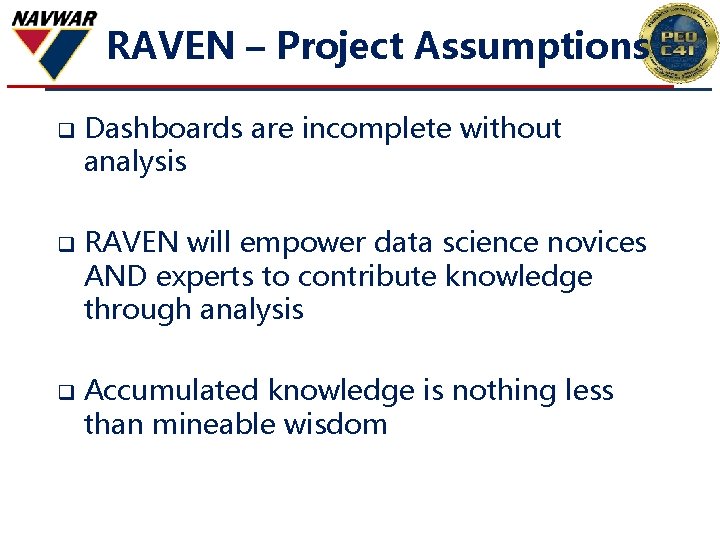
RAVEN – Project Assumptions Dashboards are incomplete without analysis RAVEN will empower data science novices AND experts to contribute knowledge through analysis Accumulated knowledge is nothing less than mineable wisdom
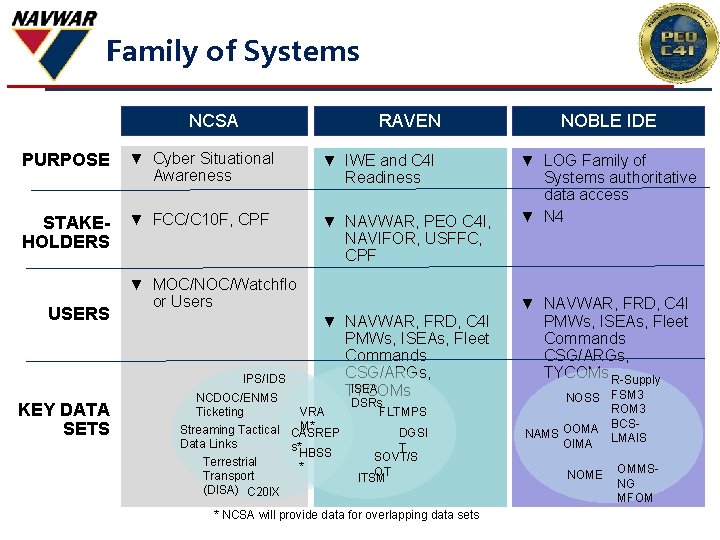
Family of Systems NCSA RAVEN PURPOSE ▼ Cyber Situational STAKEHOLDERS ▼ FCC/C 10 F, CPF Awareness ▼ IWE and C 4 I Readiness ▼ NAVWAR, PEO C 4 I, NOBLE IDE ▼ LOG Family of Systems authoritative data access ▼ N 4 NAVIFOR, USFFC, CPF ▼ MOC/NOC/Watchflo USERS or Users ▼ NAVWAR, FRD, C 4 I IPS/IDS KEY DATA SETS PMWs, ISEAs, Fleet Commands CSG/ARGs, ISEA TYCOMs NCDOC/ENMS DSRs VRA Ticketing FLTMPS M* Streaming Tactical CASREP DGSI Data Links s*HBSS T SOVT/S Terrestrial * OT Transport ITSM (DISA) C 20 IX * NCSA will provide data for overlapping data sets ▼ NAVWAR, FRD, C 4 I PMWs, ISEAs, Fleet Commands CSG/ARGs, TYCOMs R-Supply NOSS FSM 3 ROM 3 BCSNAMS OOMA LMAIS OIMA NOME OMMSNG MFOM
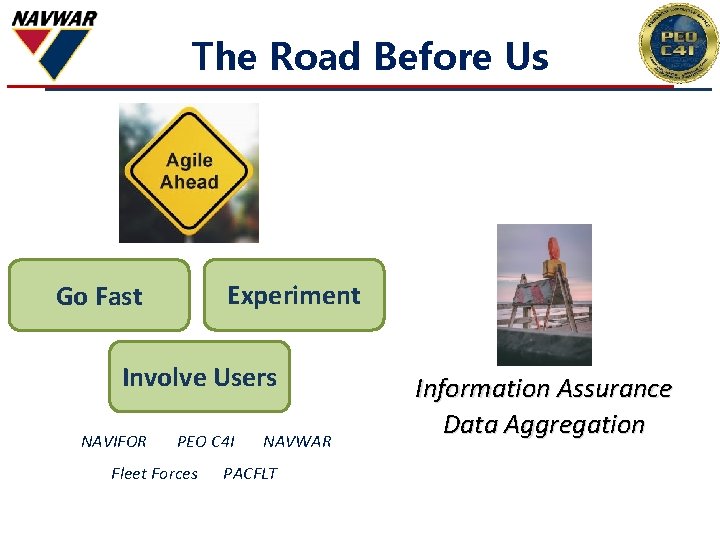
The Road Before Us Experiment Go Fast Involve Users NAVIFOR PEO C 4 I Fleet Forces NAVWAR PACFLT Information Assurance Data Aggregation
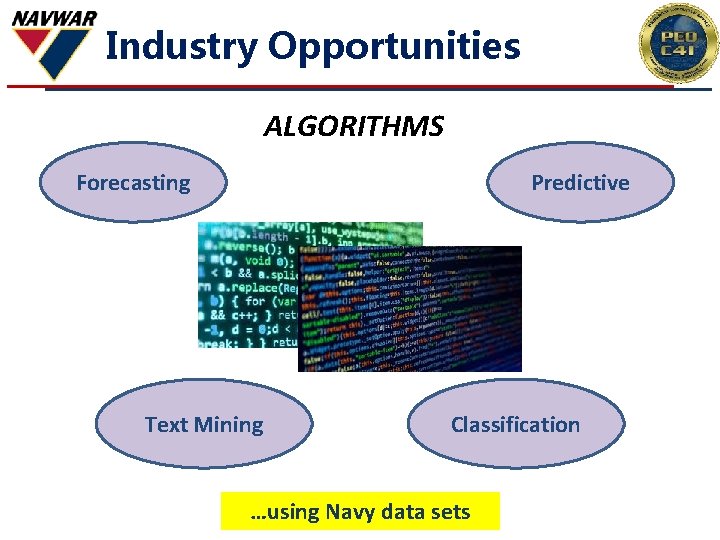
Industry Opportunities ALGORITHMS Forecasting Predictive Text Mining Classification …using Navy data sets
- Slides: 25