
WELCOME Class B Com Part1 Subject Financial Accounting

WELCOME Class: B. Com – Part-1 Subject: Financial Accounting TOPIC: DOUBLE ENTRY SYSTEM Prepared By Dr. SHAHID IQBAL Guest Faculty, Marwari College, Darbhanga, Mobile No. and Whatsup No. : 7004160257 Email ID: shahidlnmu@gmail. com 1
Meaning of Double-Entry System The double entry system of accounting means that for every business transaction, amounts must be recorded in a minimum of two accounts. The double-entry system also requires that for all transactions, the amounts entered as debits must be equal to the amounts entered as credits. �Example of a Double-Entry System To illustrate double entry, let's assume that a company borrows $10, 000 from its bank. The company's Cash account must be increased by $10, 000 and a liability account must be increased by $10, 000. To increase an asset, a debit entry is required. To increase a liability, a credit entry is required. Hence, the account Cash will be debited for $10, 000 and the liability Loans Payable will be credited for $10, 000. 2
Characteristics or Features or Fundamental Principles of Double Entry System The double-entry system is a scientific, self-sufficient and reliable system of accounting. Following some widely accepted characteristics or principles account is kept under this system. As a result in one side arithmetical accuracy of the transaction is ensured and on the other side ascertainment of the financial position of the business is easily possible. Characteristics of double-entry system are stated below; �Two parties: Every transaction involves two parties – debit and credit. According to the main principles of this system, every debit of some amount creates corresponding credit or every credit creates the corresponding debit for the same amount. �Giver and receiver: Every transaction must have one giver and one receiver. 3
� Exchange of equal amount: The amount of money of a transaction the party gives is equal to the amount the party receives. �Separate entity: Under this system business is treated as a separate entity from the owner. Here the business is considered as a separate entity. �Dual aspects: Every transaction is divided into two aspects. The left side of the transaction debit and the right side is credit. �Results: Under double entry system totality of debit is equal to the totality of credit. In it ascertainment of the result is easy. �Complete accounting system: Double entry system is a scientific and complete accounting system 4
Classification of Accounts: Based on Traditional Approach Types of Accounts: �Personal Accounts: - These accounts related to natural persons, artificial persons and representative persons. For examples. Natural-Ram� s A/c, Artificial- Ram & Co. A/c, Representative. Outstanding Salary A/c. �Real Accounts: - These accounts related to the tangible or intangible real assets. For examples- Tangible- Land A/c, Intangible- Goodwill A/c. �Nominal Accounts: - These accounts related to expenses, losses, profits & gains. For example- Expenses- Purchases A/c, Loss- Loss by fire A/c, Profits & Gains- Sales A/c, Discount received A/c. 5
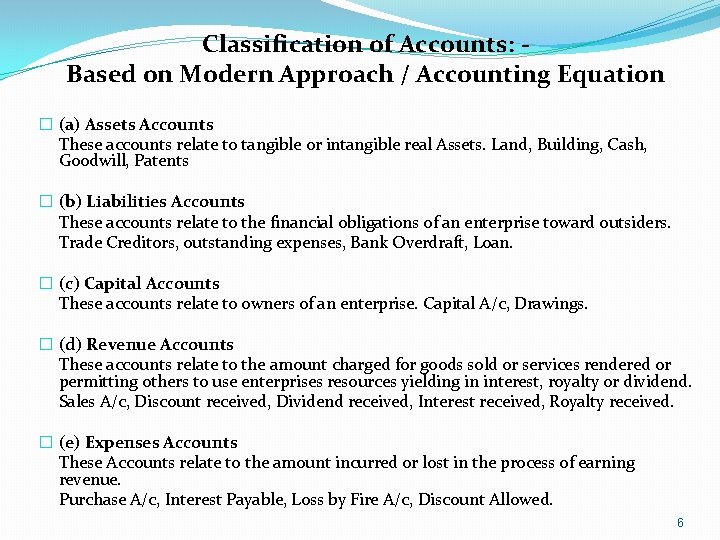
Classification of Accounts: Based on Modern Approach / Accounting Equation � (a) Assets Accounts These accounts relate to tangible or intangible real Assets. Land, Building, Cash, Goodwill, Patents � (b) Liabilities Accounts These accounts relate to the financial obligations of an enterprise toward outsiders. Trade Creditors, outstanding expenses, Bank Overdraft, Loan. � (c) Capital Accounts These accounts relate to owners of an enterprise. Capital A/c, Drawings. � (d) Revenue Accounts These accounts relate to the amount charged for goods sold or services rendered or permitting others to use enterprises resources yielding in interest, royalty or dividend. Sales A/c, Discount received, Dividend received, Interest received, Royalty received. � (e) Expenses Accounts These Accounts relate to the amount incurred or lost in the process of earning revenue. Purchase A/c, Interest Payable, Loss by Fire A/c, Discount Allowed. 6
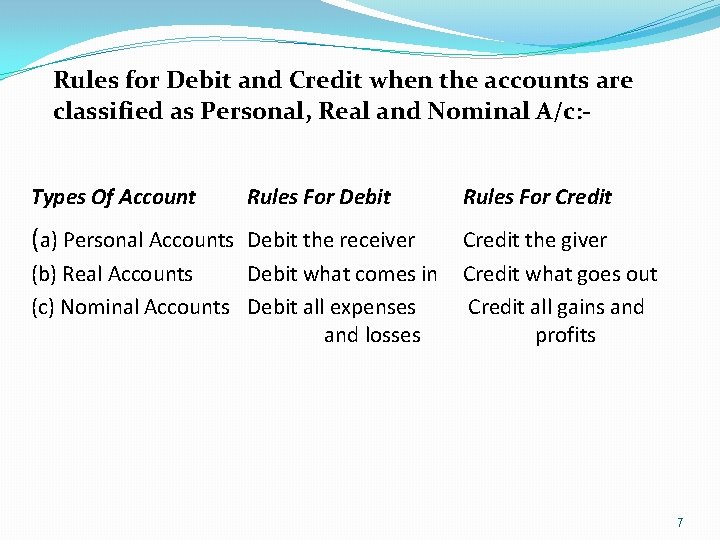
Rules for Debit and Credit when the accounts are classified as Personal, Real and Nominal A/c: Types Of Account Rules For Debit (a) Personal Accounts Debit the receiver (b) Real Accounts Debit what comes in (c) Nominal Accounts Debit all expenses and losses Rules For Credit the giver Credit what goes out Credit all gains and profits 7
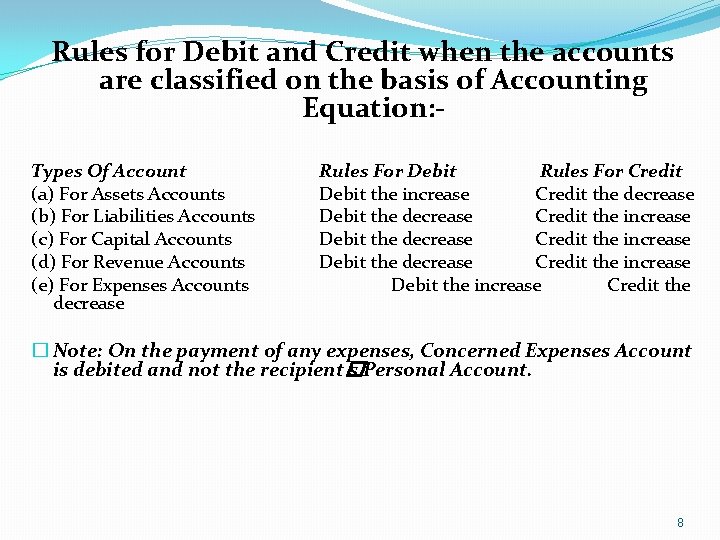
Rules for Debit and Credit when the accounts are classified on the basis of Accounting Equation: Types Of Account (a) For Assets Accounts (b) For Liabilities Accounts (c) For Capital Accounts (d) For Revenue Accounts (e) For Expenses Accounts decrease Rules For Debit Rules For Credit Debit the increase Credit the decrease Debit the decrease Credit the increase Debit the increase Credit the � Note: On the payment of any expenses, Concerned Expenses Account is debited and not the recipient� s Personal Account. 8

Thank You 9
- Slides: 9