
WELCOME CLASS B COM PART1 SUBJECT FINANCIAL ACCOUNTING
WELCOME CLASS: B. COM – PART-1 SUBJECT: FINANCIAL ACCOUNTING TOPIC: BALANCE SHEET Prepared By Dr. SHAHID IQBAL Guest Faculty Marwari College, Darbhanga, Mobile No. and Whatsup No. : 7004160257 Email ID: shahidlnmu@gmail. com 1
MEANING OF BALANCE SHEET: After preparing the Profit & Loss A/c, the next step is to prepare a Balance Sheet. A Balance Sheet is a statement of assets and liabilities of an enterprise at a given date. It is called a Balance Sheet because it is a sheet of balances of those ledger accounts which have not been closed till the preparation of Trading and Profit & Loss A/c. The purpose behind to prepare the Balance Sheet is to know the nature and value of assets of a business and to ascertain the nature and amount of liabilities of a business and to find out the financial solvency of an enterprise. A enterprise is considered to be a solvent if its assets exceed is external liabilities. 2
FEATURES / CHARACTERISTICS OF BALANCE SHEET: � � The characteristics of a Balance sheet are summarized as under: A Balance Sheet is only a statement and not an account. It has no debit side or credit side. The headings of two sides are ‘Assets’ and ‘Liabilities’. A Balance Sheet is prepared at a particular point of time and not for a particular period. The information contained in a Balance Sheet is true only at that particular point of time at which it is prepared. A Balance Sheet is a summary of balances of those ledger accounts which have not been closed by transfer to the Trading and Profit & Loss A/c. A Balance Sheet shows the nature and value of assets and the nature and amount of liabilities at a given date. 3
ITEMS OF BALANCE SHEET: - In India the right hand side of Balance Sheet is called the ‘Assets’ side and the left hand side is called the ‘Liabilities’ side. The debit balance of those ledger accounts which have not been closed till the preparation of Trading and Profit & Loss A/c are shown on the Assets side of the Balance Sheet. Items to be shown on the Assets side of Balance Sheet: a) Fixed Assets: Fixed Assets refers to those assets which are held for the purposes of providing or producing goods or services and those which are not for resale in the normal course of the business. Fixed Assets may be classified as ‘Tangible Assets’ and ‘Intangible Assets’. Tangible Assets refers to those which can be touched and seen e. g. Land & Building, Furniture & Fixtures, Plant & Machinary. Intangible Assets refers to those which can not be seen and touched e. g. Goodwill, Trade Marks, and Patents. Note: Fixed Assets normally valued at cost less depreciation. b) Investments: Investment represents an expenditure on assets to earn interest, dividend, income or other benefit e. g. Shares, Debentures, and Bonds. c) Current Assets: Current Assets are those which are held in (1) Cash e. g. cash in hand cash at bank (2) for their conversion into cash e. g. stock of finished goods, debtors, Bills Receivable, Accrued Income. Note: Current Assets are usually valued at cost or market price whichever less on the basis of conservatism principle is. 4
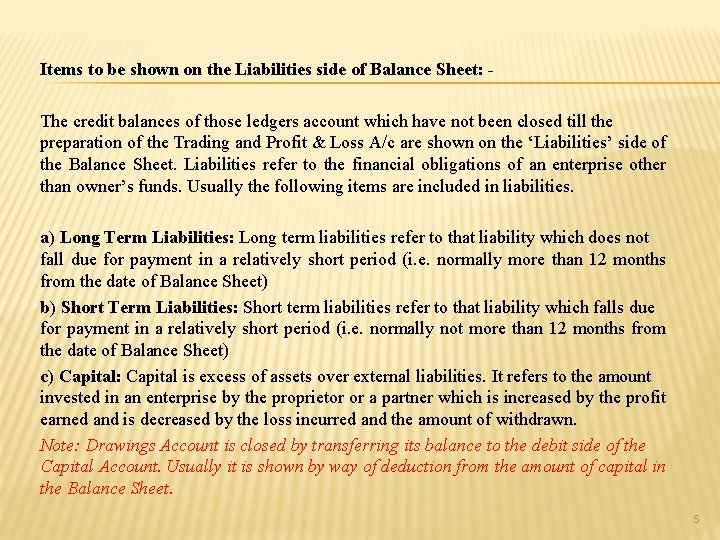
Items to be shown on the Liabilities side of Balance Sheet: - The credit balances of those ledgers account which have not been closed till the preparation of the Trading and Profit & Loss A/c are shown on the ‘Liabilities’ side of the Balance Sheet. Liabilities refer to the financial obligations of an enterprise other than owner’s funds. Usually the following items are included in liabilities. a) Long Term Liabilities: Long term liabilities refer to that liability which does not fall due for payment in a relatively short period (i. e. normally more than 12 months from the date of Balance Sheet) b) Short Term Liabilities: Short term liabilities refer to that liability which falls due for payment in a relatively short period (i. e. normally not more than 12 months from the date of Balance Sheet) c) Capital: Capital is excess of assets over external liabilities. It refers to the amount invested in an enterprise by the proprietor or a partner which is increased by the profit earned and is decreased by the loss incurred and the amount of withdrawn. Note: Drawings Account is closed by transferring its balance to the debit side of the Capital Account. Usually it is shown by way of deduction from the amount of capital in the Balance Sheet. 5
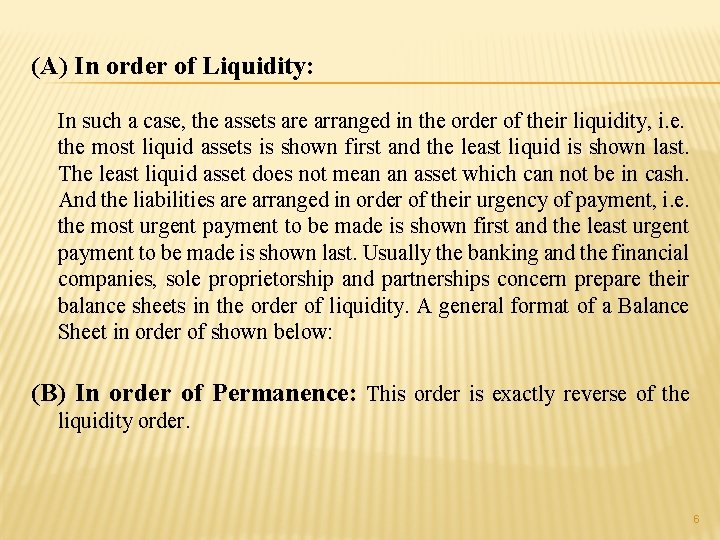
(A) In order of Liquidity: In such a case, the assets are arranged in the order of their liquidity, i. e. the most liquid assets is shown first and the least liquid is shown last. The least liquid asset does not mean an asset which can not be in cash. And the liabilities are arranged in order of their urgency of payment, i. e. the most urgent payment to be made is shown first and the least urgent payment to be made is shown last. Usually the banking and the financial companies, sole proprietorship and partnerships concern prepare their balance sheets in the order of liquidity. A general format of a Balance Sheet in order of shown below: (B) In order of Permanence: This order is exactly reverse of the liquidity order. 6

(A) Format of Balance Sheet : In order of Liquidity: FORMAT OF BALANCE SHEET As on …………………. . Liabilities Current Liabilities: Bank Overdraft Bills Payable Outstanding Expenses Sundry Creditors Income Received in Advance Long Term Liabilities: Loan Capital: Opening Balance xxx Add: Net Profit xxx (Less: Net Loss) xxx Less Drawings xxx Amount Rs xxx xxx xxx Assets Current Assets: Cash in Hand Cash at Bank Bills Receivable Sundry Debtors Prepaid Expenses Accrued Expenses Closing Stock Investments: Fixed Assets: Furniture and Fixture Plant and Machinary Building Land Goodwill Amount Rs. 7
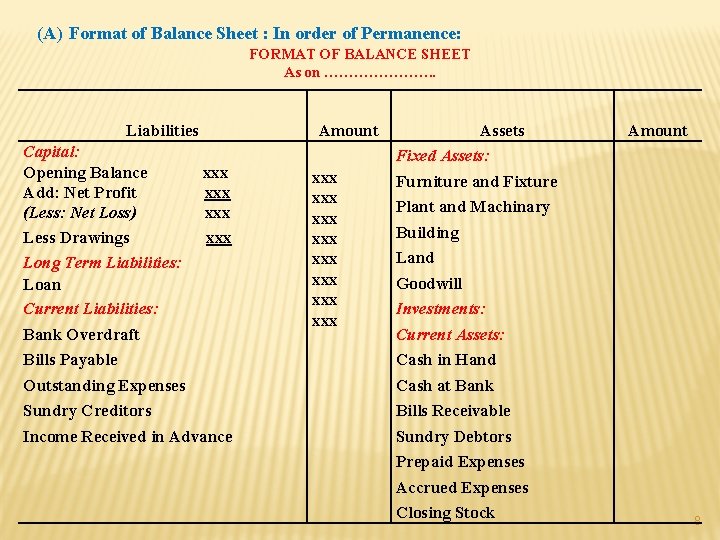
(A) Format of Balance Sheet : In order of Permanence: FORMAT OF BALANCE SHEET As on …………………. . Liabilities Capital: Opening Balance xxx Add: Net Profit xxx (Less: Net Loss) xxx Less Drawings xxx Long Term Liabilities: Loan Current Liabilities: Bank Overdraft Bills Payable Outstanding Expenses Sundry Creditors Income Received in Advance Amount xxx xxx Assets Fixed Assets: Furniture and Fixture Plant and Machinary Building Land Goodwill Investments: Current Assets: Cash in Hand Cash at Bank Bills Receivable Sundry Debtors Prepaid Expenses Accrued Expenses Closing Stock Amount 8
THANK YOU 9
- Slides: 9