
WELCOME Chen 1 Simulation of MIMO Capacity Limits
- Slides: 32
WELCOME Chen 1
Simulation of MIMO Capacity Limits Professor: Patric Östergård Supervisor: Kalle Ruttik Communications Labortory 2
Agenda 1. Introduction to Multiple-In Multiple-Out(MIMO) 2. MIMO Multiple Access Channel(MAC) 3. Water-filling algorithm(WF) 4. MIMO Broadcast Channel(BC) 5. Zero-forcing method(ZF) 6. Simulation results 7. Conclusion 3
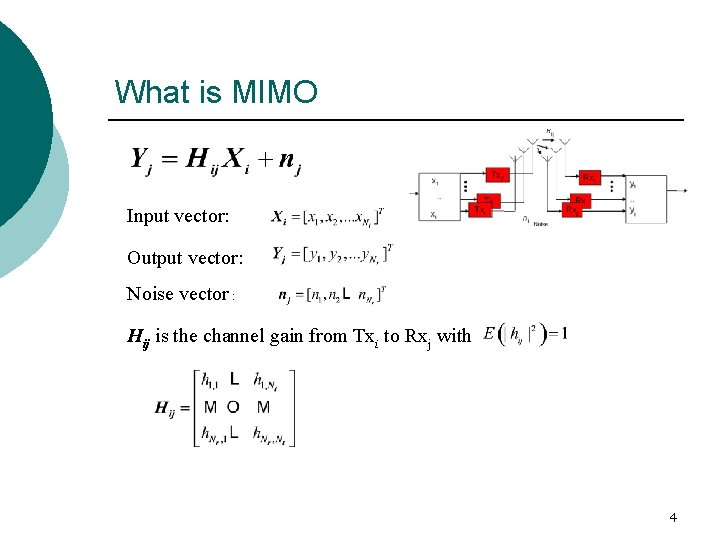
What is MIMO Input vector: Output vector: Noise vector : Hij is the channel gain from Txi to Rxj with 4
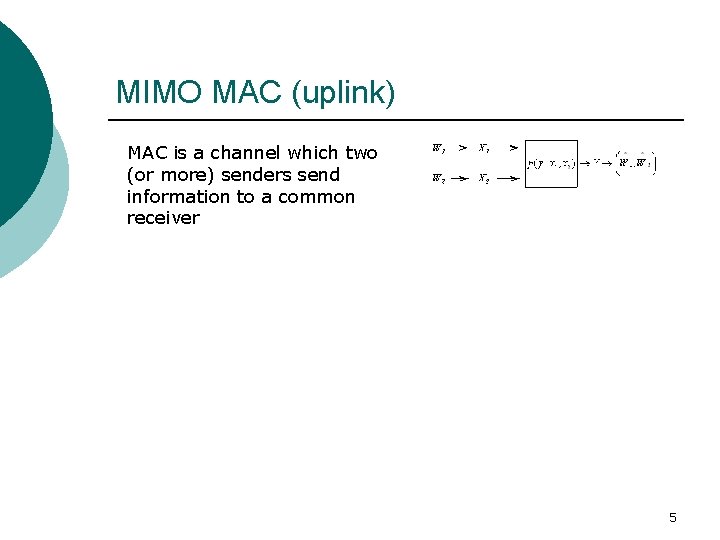
MIMO MAC (uplink) MAC is a channel which two (or more) senders send information to a common receiver 5
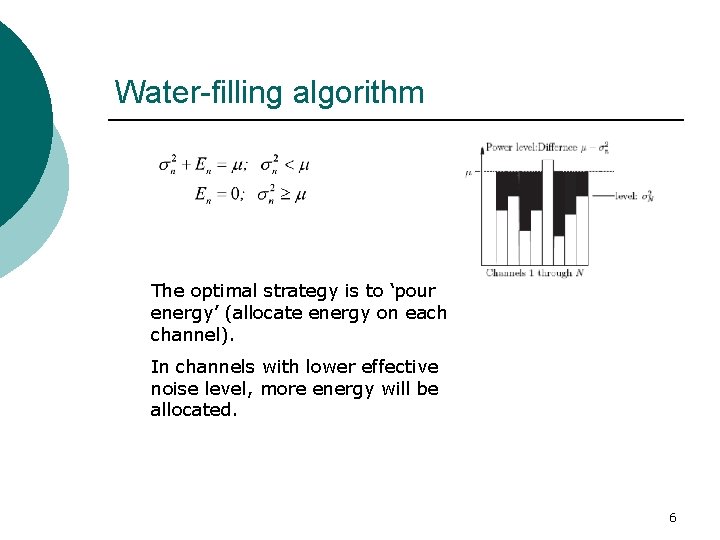
Water-filling algorithm The optimal strategy is to ‘pour energy’ (allocate energy on each channel). In channels with lower effective noise level, more energy will be allocated. 6
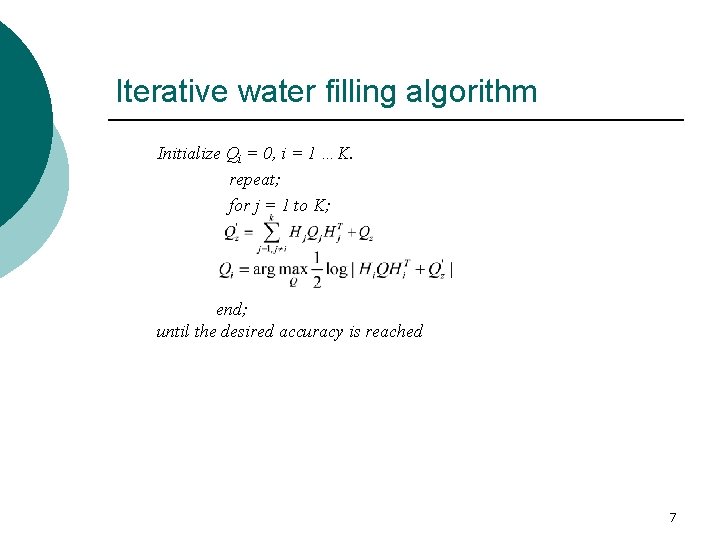
Iterative water filling algorithm Initialize Qi = 0, i = 1 …K. repeat; for j = 1 to K; end; until the desired accuracy is reached 7
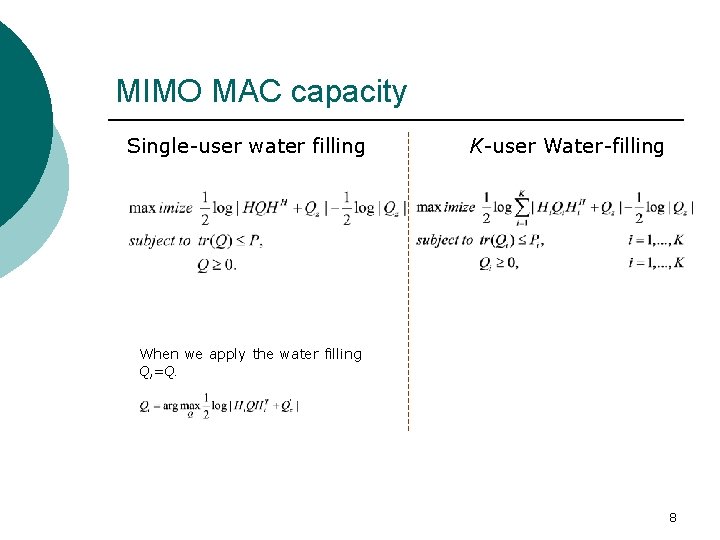
MIMO MAC capacity Single-user water filling K-user Water-filling When we apply the water filling Qi=Q. 8
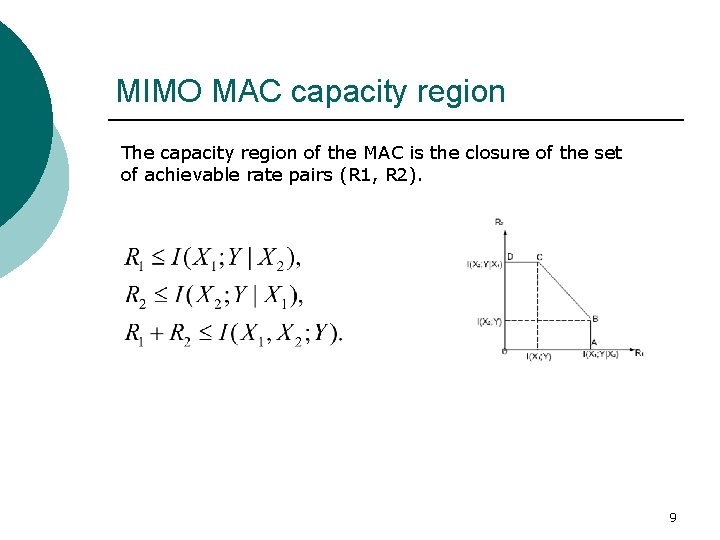
MIMO MAC capacity region The capacity region of the MAC is the closure of the set of achievable rate pairs (R 1, R 2). 9
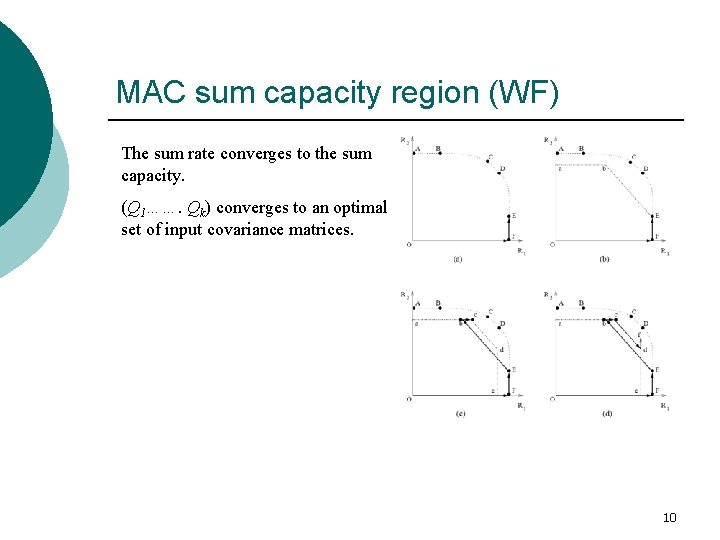
MAC sum capacity region (WF) The sum rate converges to the sum capacity. (Q 1……. Qk) converges to an optimal set of input covariance matrices. 10
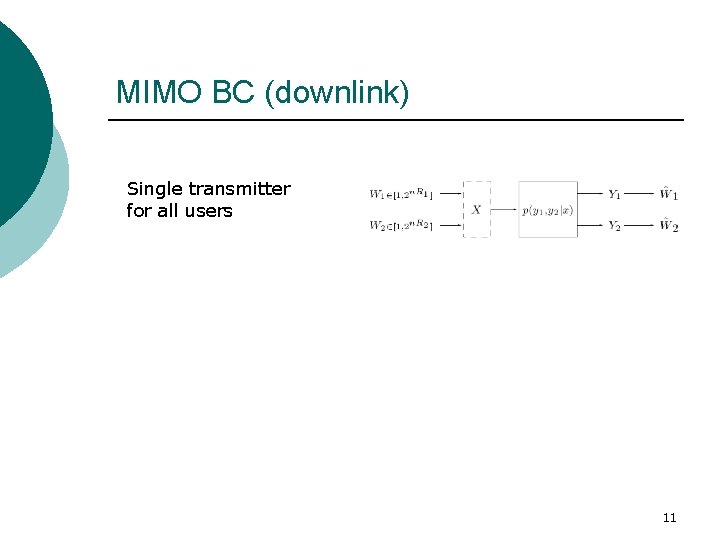
MIMO BC (downlink) Single transmitter for all users 11
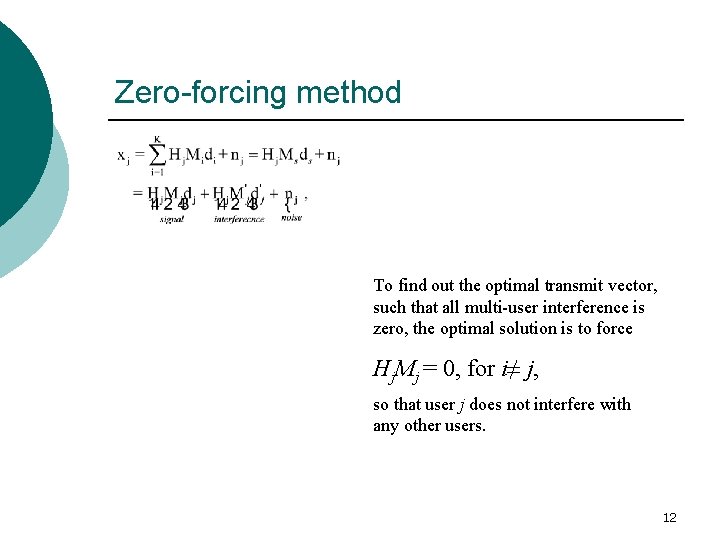
Zero-forcing method To find out the optimal transmit vector, such that all multi-user interference is zero, the optimal solution is to force Hj. Mj = 0, for i≠ j, so that user j does not interfere with any other users. 12
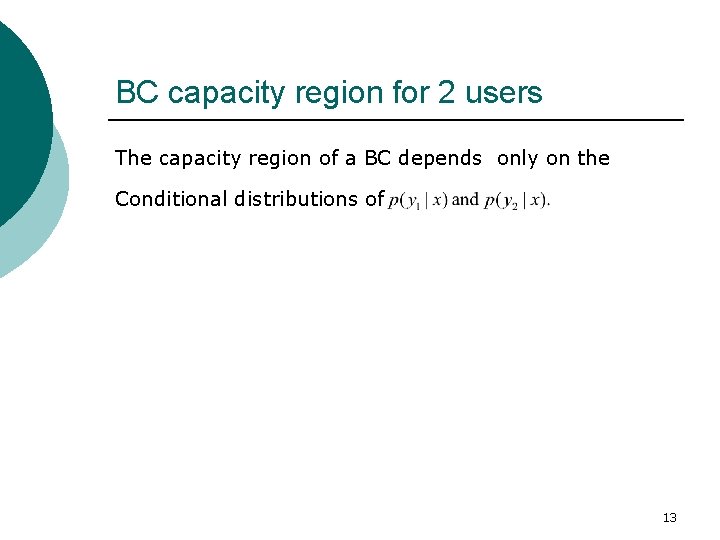
BC capacity region for 2 users The capacity region of a BC depends only on the Conditional distributions of 13
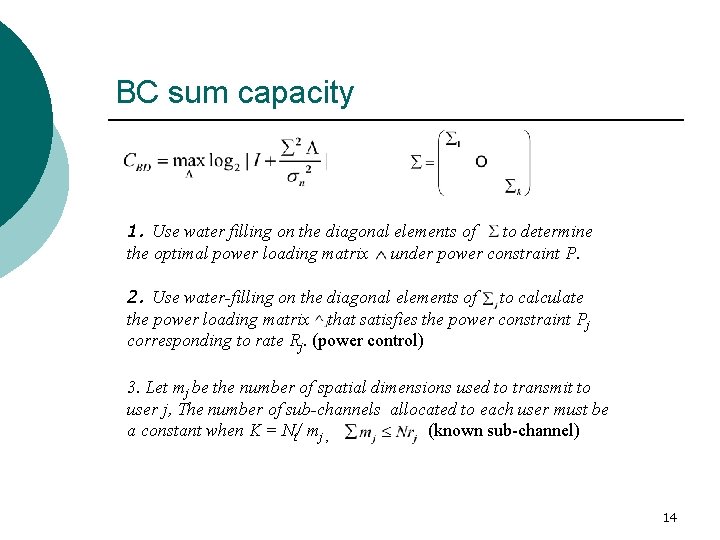
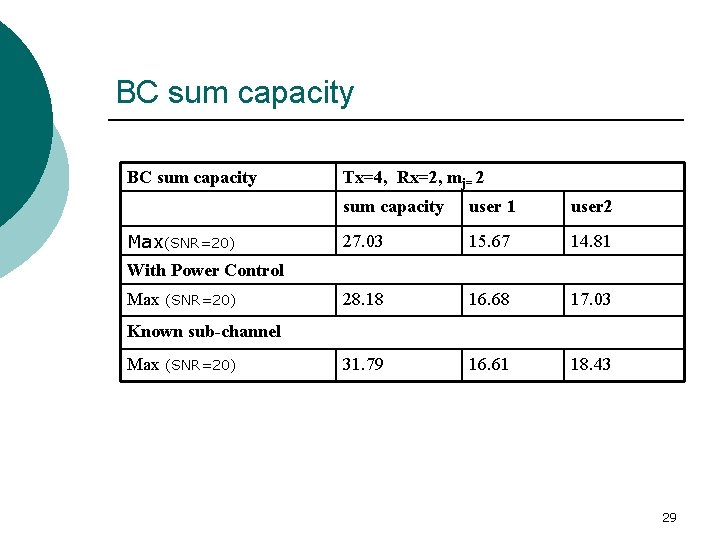
BC sum capacity 1. Use water filling on the diagonal elements of to determine the optimal power loading matrix under power constraint P. 2. Use water-filling on the diagonal elements of to calculate the power loading matrix that satisfies the power constraint Pj corresponding to rate Rj. (power control) 3. Let mj be the number of spatial dimensions used to transmit to user j, The number of sub-channels allocated to each user must be a constant when K = Nt/ mj , (known sub-channel) 14
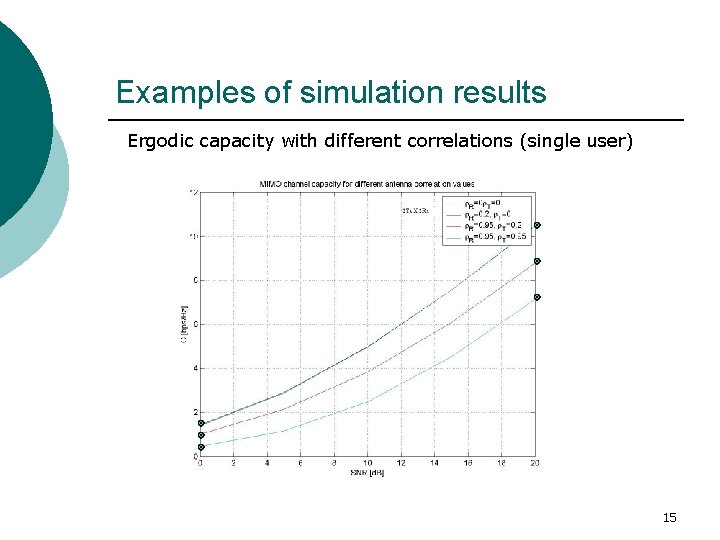
Examples of simulation results Ergodic capacity with different correlations (single user) 15
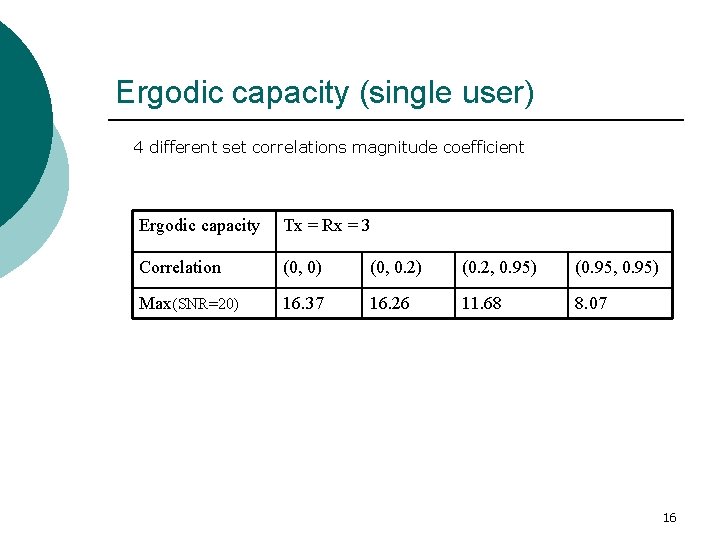
Ergodic capacity (single user) 4 different set correlations magnitude coefficient Ergodic capacity Tx = Rx = 3 Correlation (0, 0) (0, 0. 2) (0. 2, 0. 95) (0. 95, 0. 95) Max(SNR=20) 16. 37 16. 26 11. 68 8. 07 16
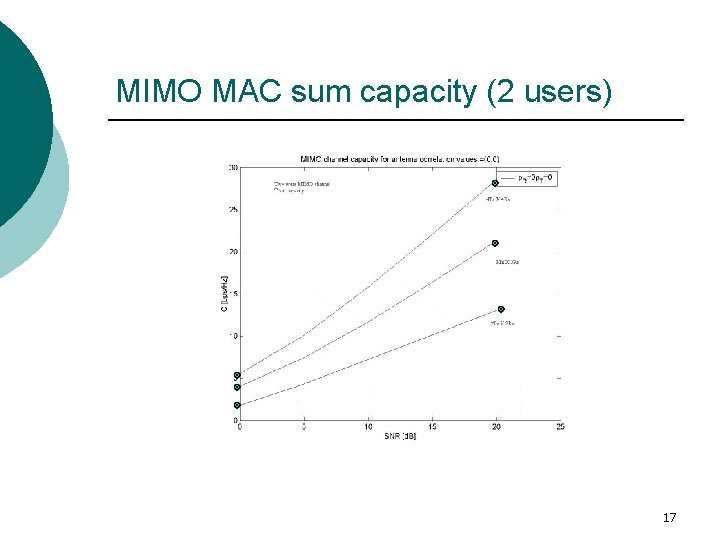
MIMO MAC sum capacity (2 users) 17
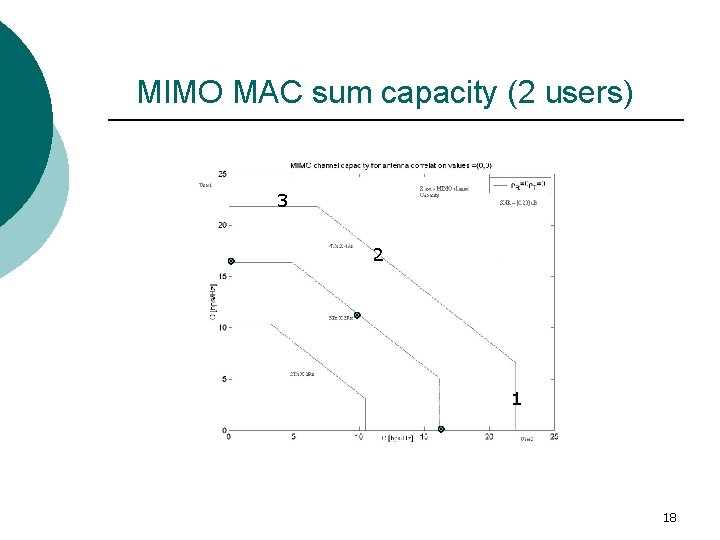
MIMO MAC sum capacity (2 users) 3 2 1 18
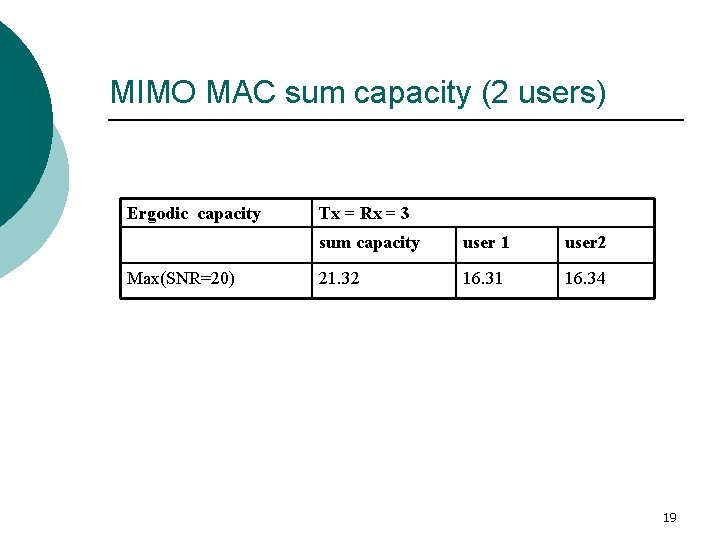
MIMO MAC sum capacity (2 users) Ergodic capacity Max(SNR=20) Tx = Rx = 3 sum capacity user 1 user 2 21. 32 16. 31 16. 34 19
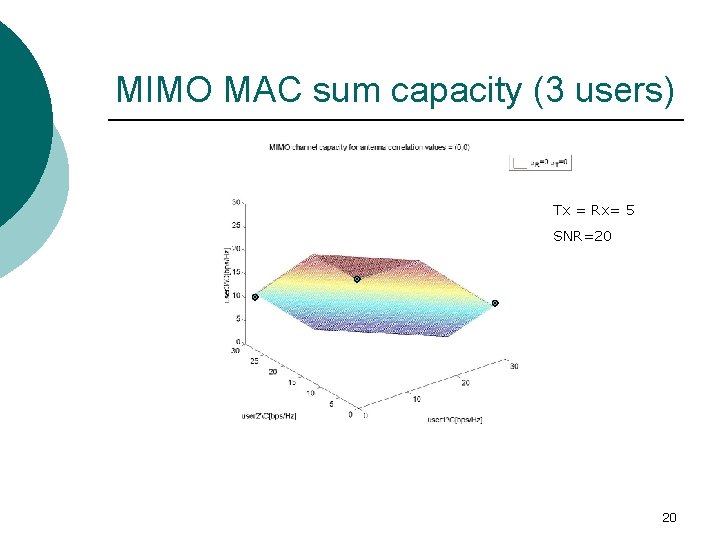
MIMO MAC sum capacity (3 users) Tx = Rx= 5 SNR=20 20
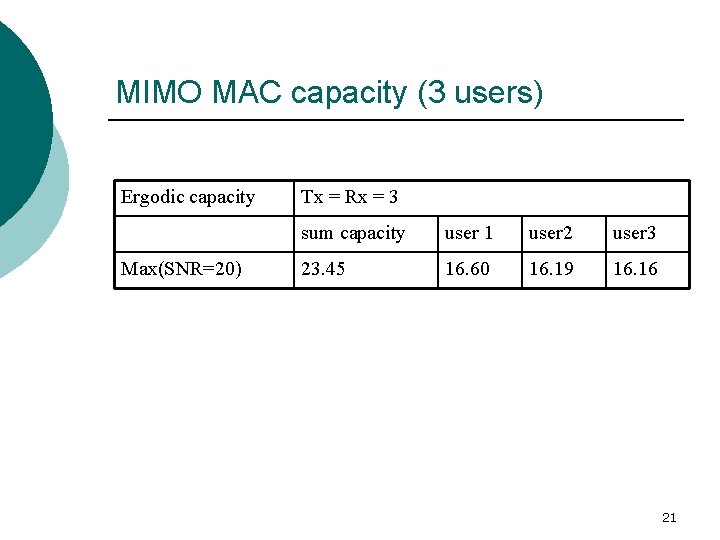
MIMO MAC capacity (3 users) Ergodic capacity Max(SNR=20) Tx = Rx = 3 sum capacity user 1 user 2 user 3 23. 45 16. 60 16. 19 16. 16 21
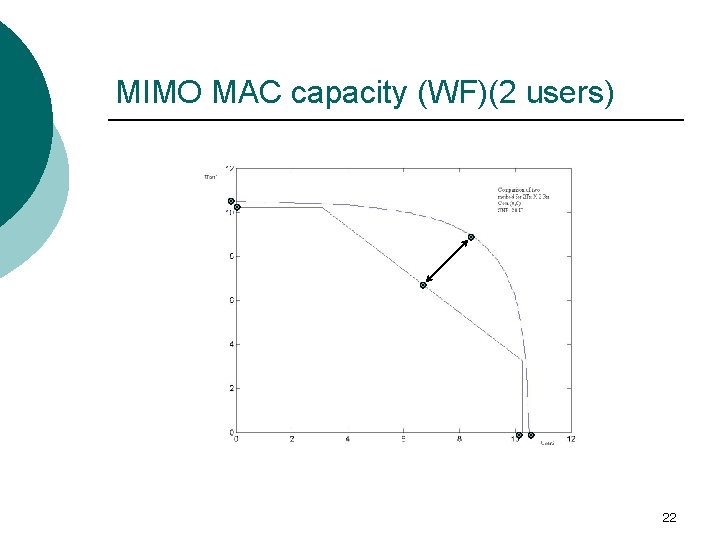
MIMO MAC capacity (WF)(2 users) 22
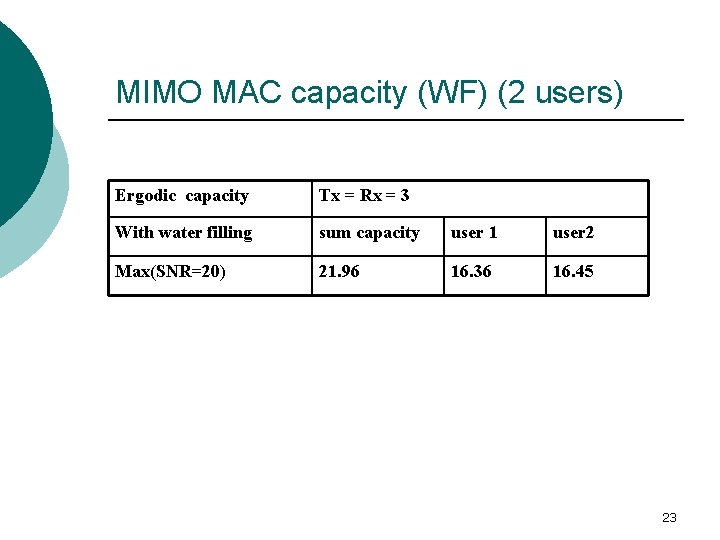
MIMO MAC capacity (WF) (2 users) Ergodic capacity Tx = Rx = 3 With water filling sum capacity user 1 user 2 Max(SNR=20) 21. 96 16. 36 16. 45 23
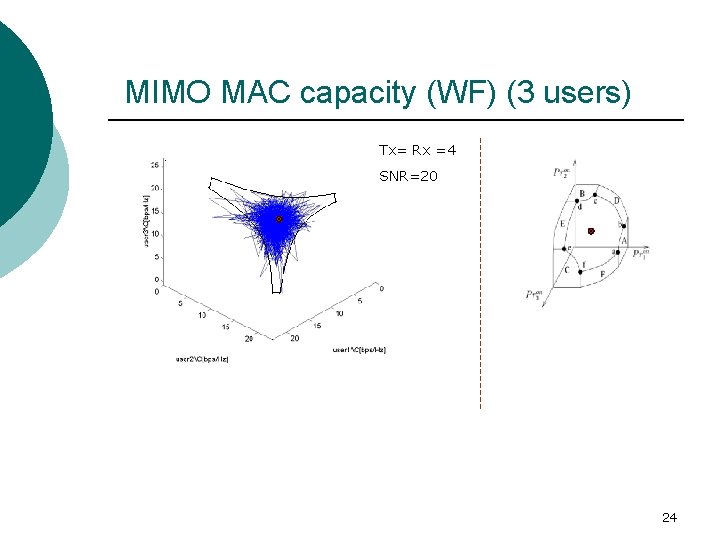
MIMO MAC capacity (WF) (3 users) Tx= Rx =4 SNR=20 24
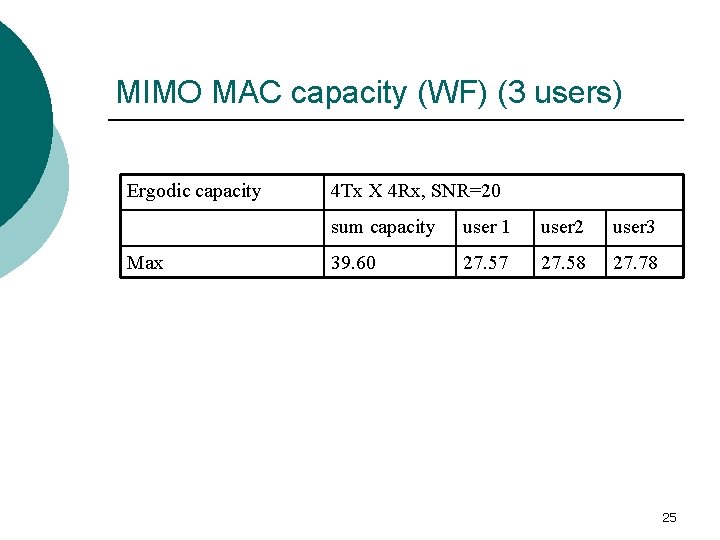
MIMO MAC capacity (WF) (3 users) Ergodic capacity Max 4 Tx X 4 Rx, SNR=20 sum capacity user 1 user 2 user 3 39. 60 27. 57 27. 58 27. 78 25
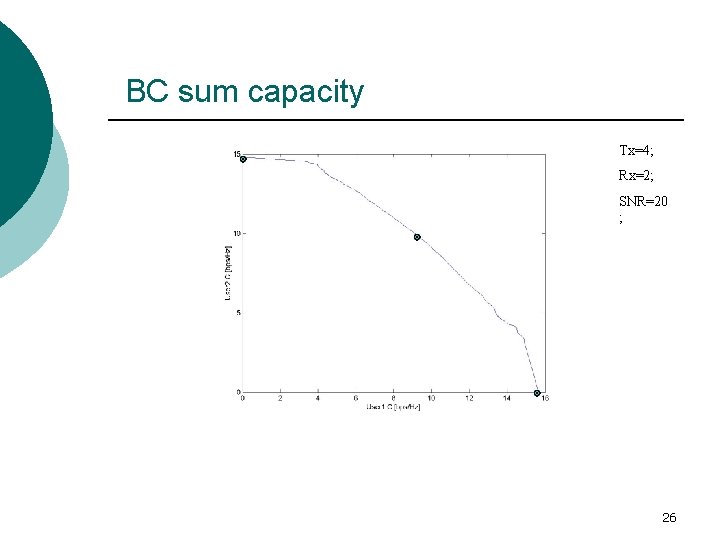
BC sum capacity Tx=4; Rx=2; SNR=20 ; 26
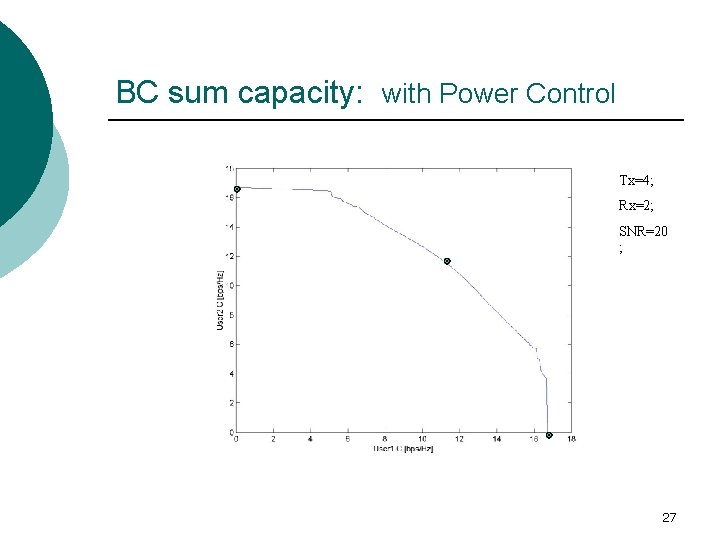
BC sum capacity: with Power Control Tx=4; Rx=2; SNR=20 ; 27
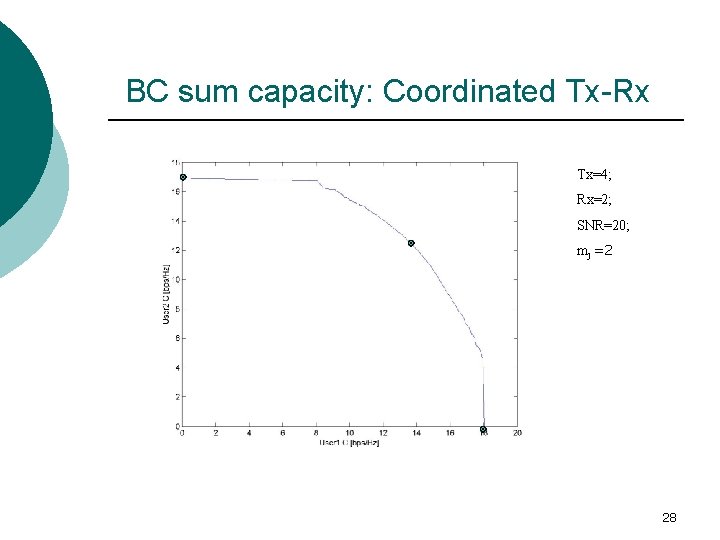
BC sum capacity: Coordinated Tx-Rx Tx=4; Rx=2; SNR=20; mj =2 28
BC sum capacity Max(SNR=20) Tx=4, Rx=2, mj= 2 sum capacity user 1 user 2 27. 03 15. 67 14. 81 28. 18 16. 68 17. 03 31. 79 16. 61 18. 43 With Power Control Max (SNR=20) Known sub-channel Max (SNR=20) 29
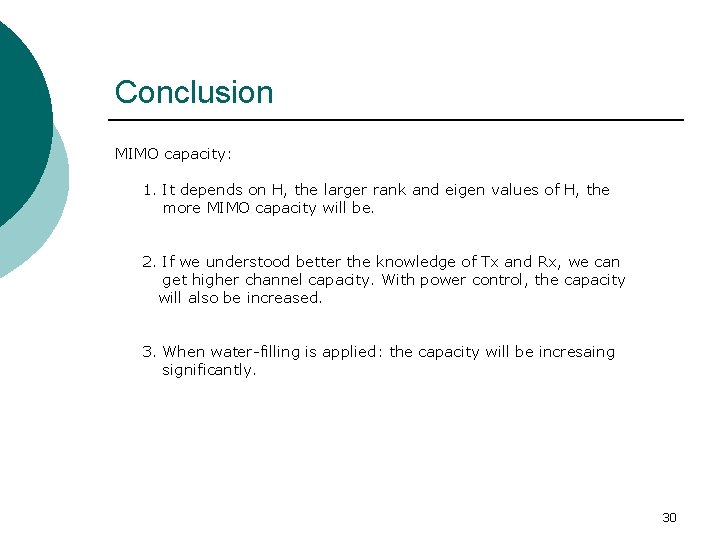
Conclusion MIMO capacity: 1. It depends on H, the larger rank and eigen values of H, the more MIMO capacity will be. 2. If we understood better the knowledge of Tx and Rx, we can get higher channel capacity. With power control, the capacity will also be increased. 3. When water-filling is applied: the capacity will be incresaing significantly. 30
Main references 1. T. M. Cover, “Elements if information theory”, 1991. 2. W. Yu, “Iterative water-filling for Gaussian vector multiple access channels”, 2004. 3. Quentin H. Spencer, “Zero-forcing methods for downlink spatial multiplexing”, 2004. 31
THANK YOU! Any questions? 32