
Welcome Break out group with Premila Veerasamy GELC
Welcome! Break out group with Premila Veerasamy. GELC
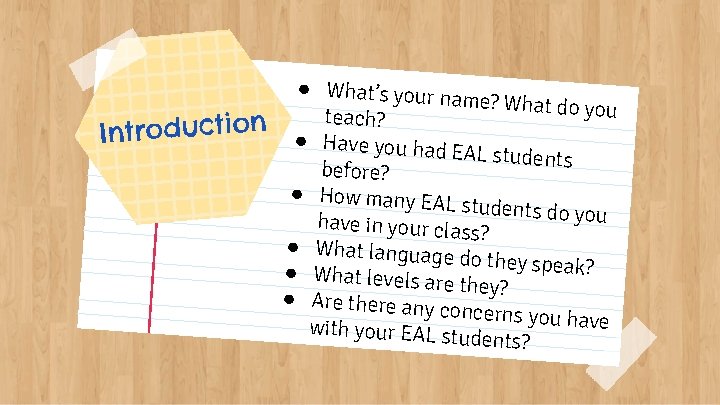
Introduction ● What’s your n ame? What do yo u teach? ● Have you had EAL students before? ● How many EA L students do you have in your clas s? ● What languag e do they speak? ● What levels a re they? ● Are there any concerns you ha ve with your EAL stu dents?
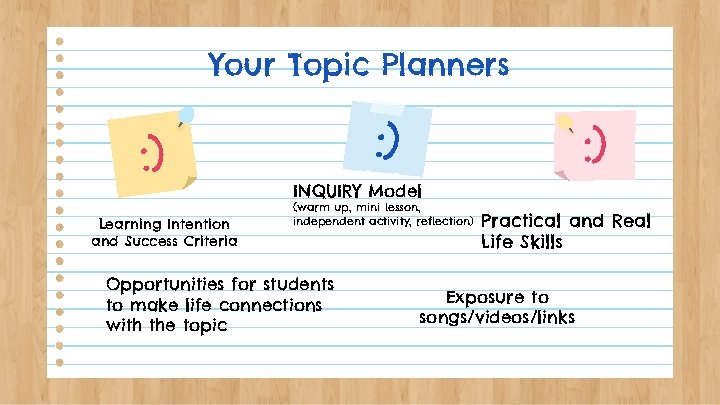
Your Topic Planners : ) Learning Intention and Success Criteria : ) INQUIRY Model (warm up, mini lesson, independent activity, reflection) Opportunities for students to make life connections with the topic Practical and Real Life Skills Exposure to songs/videos/links
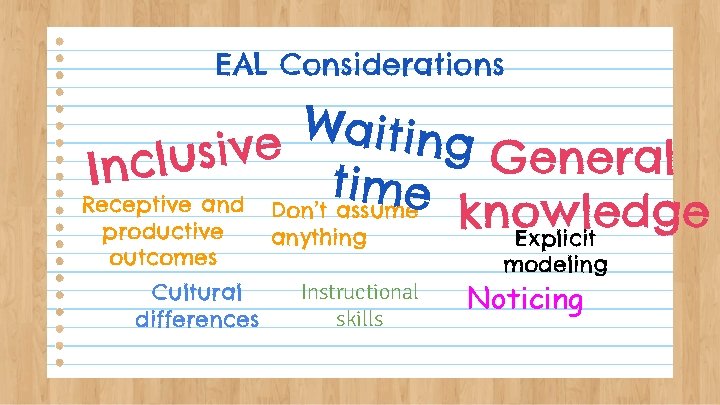
EAL Considerations Waiting e v i s u General l Inc t i me Receptive and Don’t assume knowledge productive anything Explicit outcomes Cultural differences modeling Instructional skills Noticing
? EAL methodologies and strategies Consider these strategies and methodologies for yo ur p.
Comprehensible input The need to explain key vocabulary. The vocabulary requires explicit teaching from the teacher. This will not only benefit EAL learners but all other students in the class. When teaching key vocabulary, include the following: ● Word ● Definition ● Visual ● Example of word in a sentence ● Word in first language ● Self connection to word
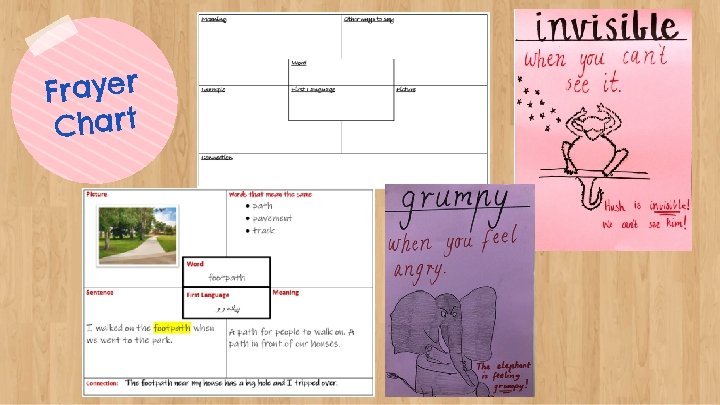
Frayer Chart
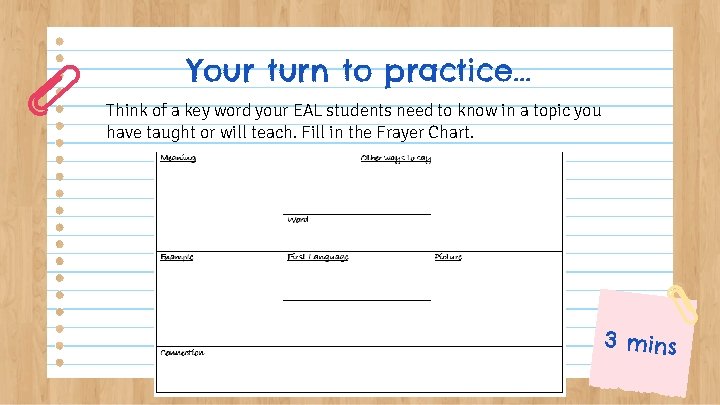
Your turn to practice. . . Think of a key word your EAL students need to know in a topic you have taught or will teach. Fill in the Frayer Chart. 3 mins
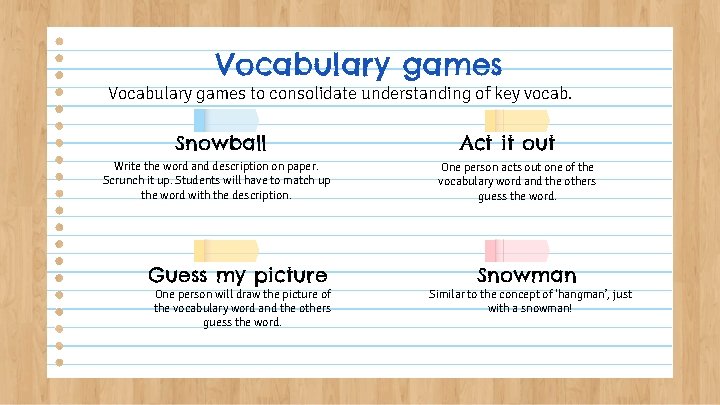
Vocabulary games to consolidate understanding of key vocab. Snowball Write the word and description on paper. Scrunch it up. Students will have to match up the word with the description. Guess my picture One person will draw the picture of the vocabulary word and the others guess the word. Act it out One person acts out one of the vocabulary word and the others guess the word. Snowman Similar to the concept of ‘hangman’, just with a snowman!
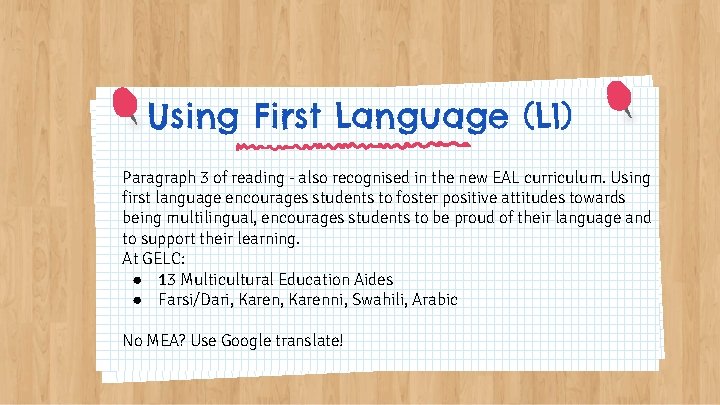
Using First Language (L 1) Paragraph 3 of reading - also recognised in the new EAL curriculum. Using first language encourages students to foster positive attitudes towards being multilingual, encourages students to be proud of their language and to support their learning. At GELC: ● 13 Multicultural Education Aides ● Farsi/Dari, Karenni, Swahili, Arabic No MEA? Use Google translate!
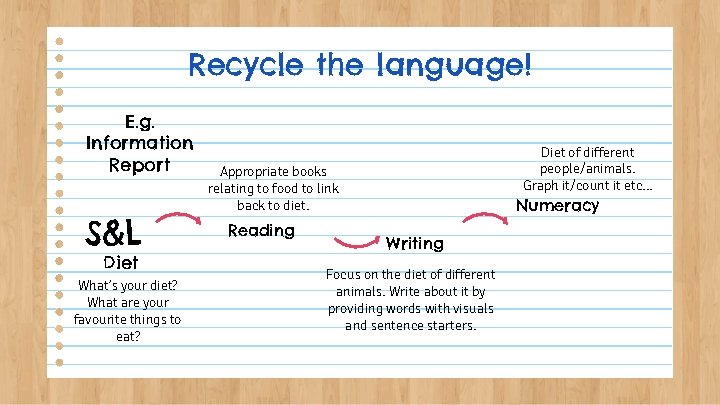
Recycle the language! E. g. Information Report S&L Diet What’s your diet? What are your favourite things to eat? Diet of different people/animals. Graph it/count it etc. . . Appropriate books relating to food to link back to diet. Reading Numeracy Writing Focus on the diet of different animals. Write about it by providing words with visuals and sentence starters.
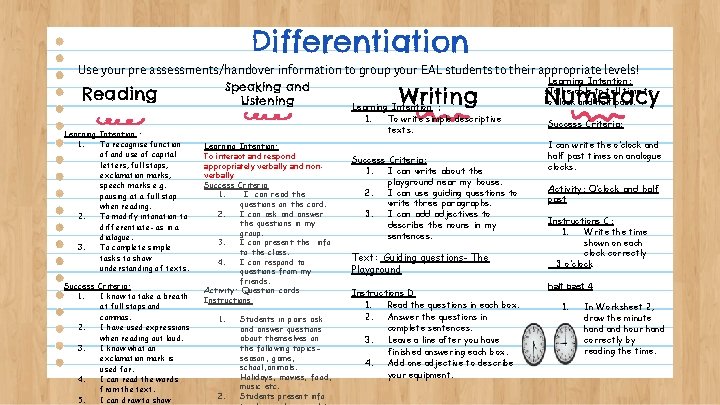
Differentiation Use your pre assessments/handover information to group your EAL students to their appropriate levels! Reading Learning Intention : 1. To recognise function of and use of capital letters, full stops, exclamation marks, speech marks e. g. pausing at a full stop when reading. 2. To modify intonation to differentiate- as in a dialogue. 3. To complete simple tasks to show understanding of texts. Success Criteria: 1. I know to take a breath at full stops and commas. 2. I have used expressions when reading out loud. 3. I know what an exclamation mark is used for. 4. I can read the words from the text. 5. I can draw to show Speaking and Listening Learning Intention: To interact and respond appropriately verbally and nonverbally Success Criteria 1. I can read the questions on the card. 2. I can ask and answer the questions in my group. 3. I can present the info to the class. 4. I can respond to questions from my friends. Activity: Question cards Instructions 1. 2. Students in pairs ask and answer questions about themselves on the following topicsseason, game, school, animals. Holidays, movies, food, music etc. Students present info Writing Learning Intention : 1. To write simple descriptive texts. Success Criteria: 1. I can write about the playground near my house. 2. I can use guiding questions to write three paragraphs. 3. I can add adjectives to describe the nouns in my sentences. Text: Guiding questions- The Playground Instructions D 1. Read the questions in each box. 2. Answer the questions in complete sentences. 3. Leave a line after you have finished answering each box. 4. Add one adjective to describe your equipment. Learning Intention: To be able to tell time to o’clock and half past. Numeracy Success Criteria: I can write the o’clock and half past times on analogue clocks. Activity: O’clock and half past Instructions C: 1. Write the time shown on each clock correctly 3 o’clock half past 4 1. In Worksheet 2, draw the minute hand hour hand correctly by reading the time.
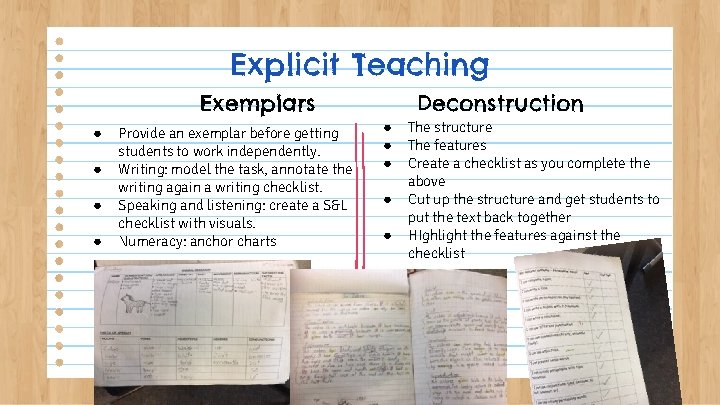
Explicit Teaching Exemplars ● ● Provide an exemplar before getting students to work independently. Writing: model the task, annotate the writing again a writing checklist. Speaking and listening: create a S&L checklist with visuals. Numeracy: anchor charts Deconstruction ● ● ● The structure The features Create a checklist as you complete the above Cut up the structure and get students to put the text back together HIghlight the features against the checklist
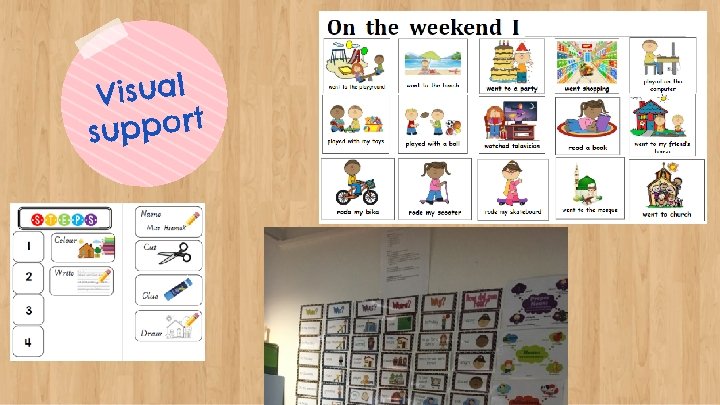
Visual support
Other useful strategies ● Word Wall ● Concrete objects ● Role Plays / Act it out ● ● ● ● Videos Margin Questions picture, questions, spot the difference Dictogloss Checklists Graphic Organisers Nominalisation
Concrete objects! Powerful tool to teach students to construct rich understanding of what they’re learning. ● Excursions /Incursions ● Real -life examples ● Authentic materials
Do you have any questions or wonderings? Thank you! If you would like a c opy of this presentation, please email me at: Premila. Veerasamy @education. vic. gov. au
Useful websites Annotated work samples, exemplars of units of work, assessment materials and advice http: //teal. global 2. vic. edu. au/ New EAL curriculum explanation https: //fuse. education. vic. gov. au/Resource/Landing. Page? Object. Id=c 4416 a 9 f-b 669 -434 d-b 3 fc-dee 403637559 Dictagloss https: //fuse. education. vic. gov. au/Resource/Landing. Page? Object. Id=5 eba 24 ea-52 a 3 -44 d 5 -9 a 8 b-d 3 d 5947 fe 20 c&Search. Scope=All EAL advice from DET https: //www. education. vic. gov. au/school/teachers/support/diversity/eal/Pages/default. aspx literacy in maths and science for EAL students https: //www. education. vic. gov. au/Documents/school/teachers/teachingresources/diversity/EAL-interactive-resource-Sep-2019. pdf Literacy and maths teaching tool kit https: //fuse. education. vic. gov. au/Resource. Package/Landing. Page? object. Id=aa 83097 a-0 ddb-4 ed 0 -b 913 -6 ca 9250 e 0633&Search. Scope=Teacher
- Slides: 18