
Welcome Back to Science A science Review What

Welcome Back to Science A science Review
What is Science? An organized way of studying things and finding answers to questions and solving problems
Types of Science • Physical Science: Any of the sciences, such as physics, chemistry, astronomy, and geology, that analyze the nature and properties of energy and nonliving matter. • Life Science: Any of several branches of science, such as biology, medicine, anthropology, or ecology, that deal with living organisms and their organization, life processes, and relationships to each other and their environment. Also called bioscience. • Earth Science: Any of several essentially geologic sciences that are concerned with the origin, structure, and physical phenomena of the earth.
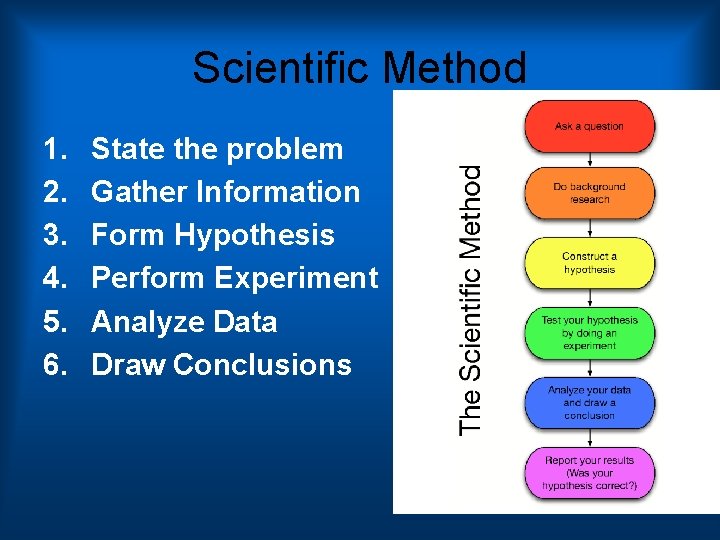
Scientific Method 1. 2. 3. 4. 5. 6. State the problem Gather Information Form Hypothesis Perform Experiment Analyze Data Draw Conclusions
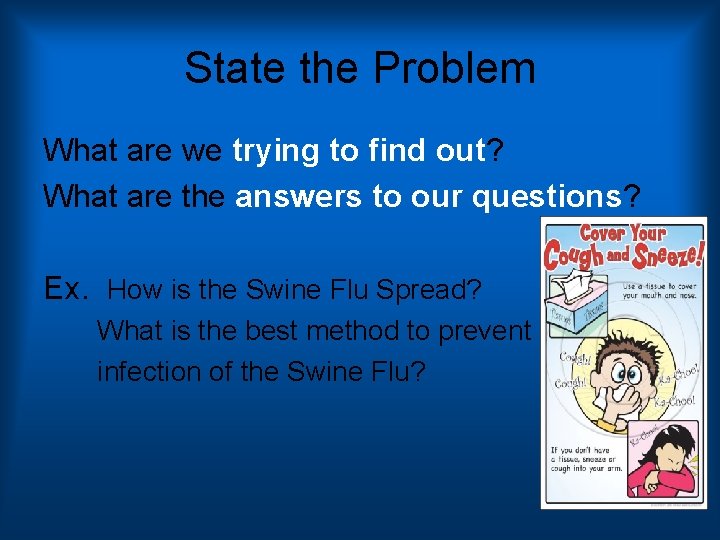
State the Problem What are we trying to find out? What are the answers to our questions? Ex. How is the Swine Flu Spread? What is the best method to prevent infection of the Swine Flu?
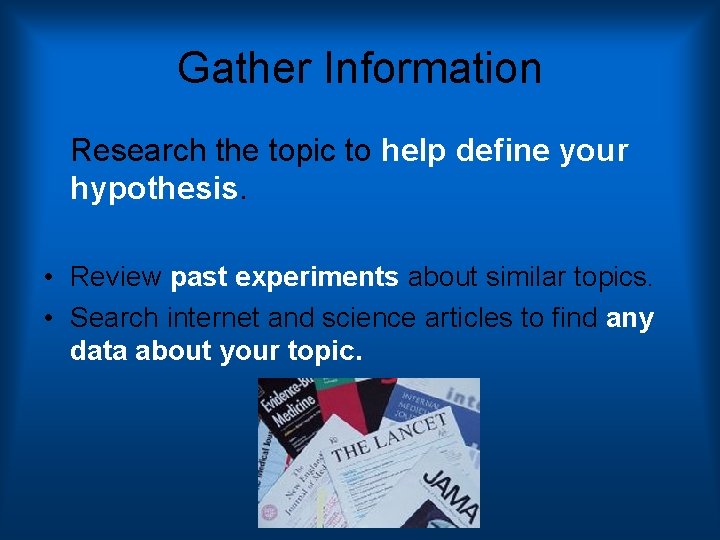
Gather Information Research the topic to help define your hypothesis. • Review past experiments about similar topics. • Search internet and science articles to find any data about your topic.
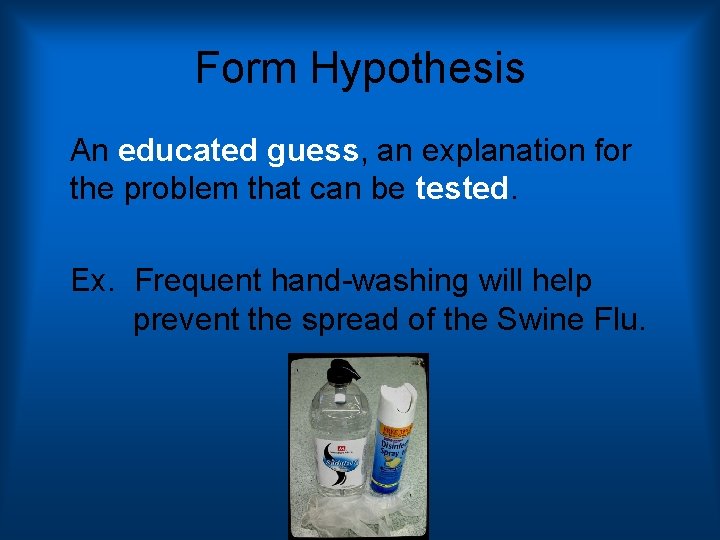
Form Hypothesis An educated guess, an explanation for the problem that can be tested. Ex. Frequent hand-washing will help prevent the spread of the Swine Flu.
Perform Experiment • Use specific steps so the experiment can be repeated • There should be a control in your experiment. • There should be only ONE variable. Control: factor in an experiment that stays the same Variable: factor in an experiment that changes
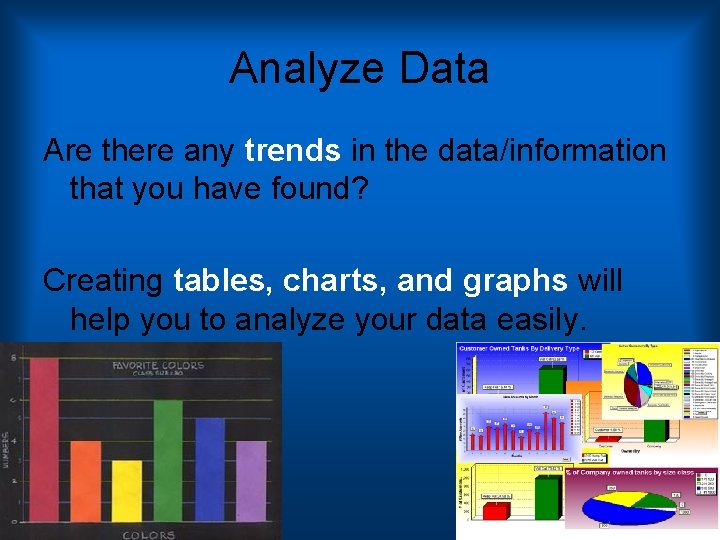
Analyze Data Are there any trends in the data/information that you have found? Creating tables, charts, and graphs will help you to analyze your data easily.
Draw Conclusions A logical answer based on the data and observations At that point, you can accept or reject the hypothesis This can also often lead to more questions and experimentation
Theories and Laws Theory: Explanation of things or events on scientific knowledge that is a result of many observations and repeated experimentation. Theories are created after many experiments continue to support the hypothesis.
Theories and Laws: Statement about how things work in nature. Laws are true most of the time. They are less likely to change than theories. Laws explain what happens, but not why things happen.
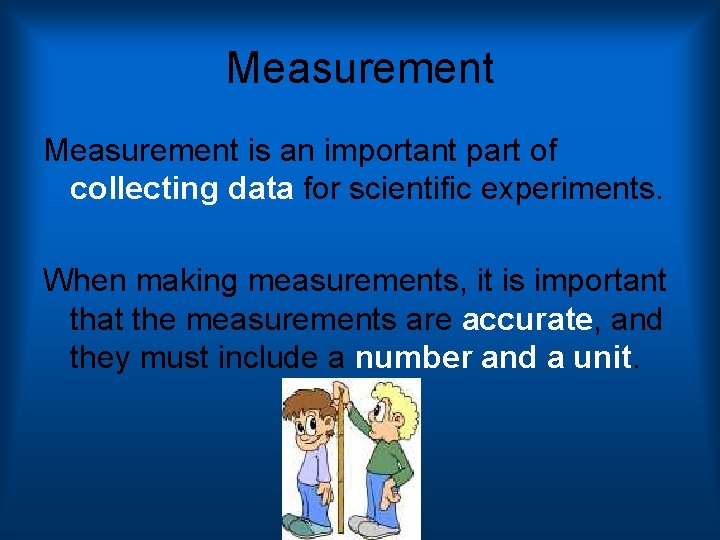
Measurement is an important part of collecting data for scientific experiments. When making measurements, it is important that the measurements are accurate, and they must include a number and a unit.
Examples of Measurement • • • Mass: amount of matter an object contains Weight: gravitational force on an object Volume: amount of space an object occupies Length: how long something is Temperature: amount of heat something contains • Time: the duration from the beginning to end of an event • Density: how much mass is in a given volume
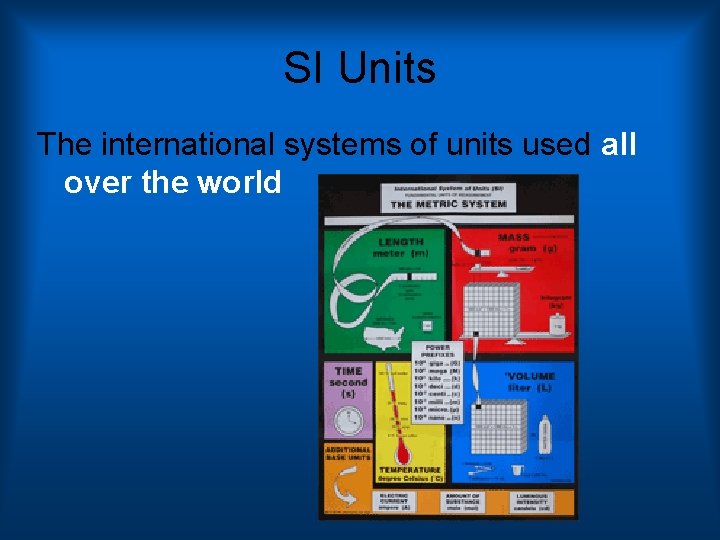
SI Units The international systems of units used all over the world
Examples of Measurement • • Mass: grams (g), kilograms (kg) Weight: Newtons (N) Volume: milliliters (m. L), liter (L), Length: meter (m), centimeter (cm), kilometer (km) • Temperature: degrees Celsius (C) • Time: seconds (s) • Density: grams/milliliter (g/m. L)
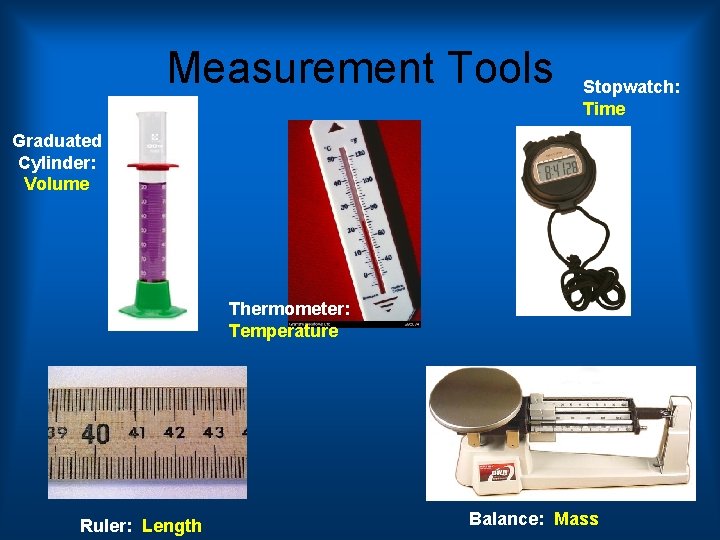
Measurement Tools Stopwatch: Time Graduated Cylinder: Volume Thermometer: Temperature Ruler: Length Balance: Mass
Safety There are important rules to follow while working in a science lab. Here a few important ones to remember: 1. 2. 3. 4. Wear safety goggles when necessary. Wash hands after handling lab materials. No running in the lab. Always read lab instructions completely.
Review Question #1 • What are three types of science we will talk about? • Physical, Earth, Life
Review Question #2 • List the six steps of the scientific method in order. • State the problem, gather information, form hypothesis, perform experiment, analyze data, draw conclusions.
Review Question #3 • Which step of the scientific method is the following? If you do not wash your hands you will get a cold. • Hypothesis
Review Question #4 • A control and variable are part of which step of the scientific method? • Perform Experiment
Review Question #5 • _____ explains what happens, but not why things happen. • A Law
Review Question #6 • What are two SI Units for volume? • milliliters (m. L), liters (L)
Review Question #7 • What measurement tool is used to measure volume? Mass? • Graduated Cylinder • Balance
- Slides: 25