
Welcome Back to School Night for Mathematics in
Welcome! Back to School Night for Mathematics in Context®
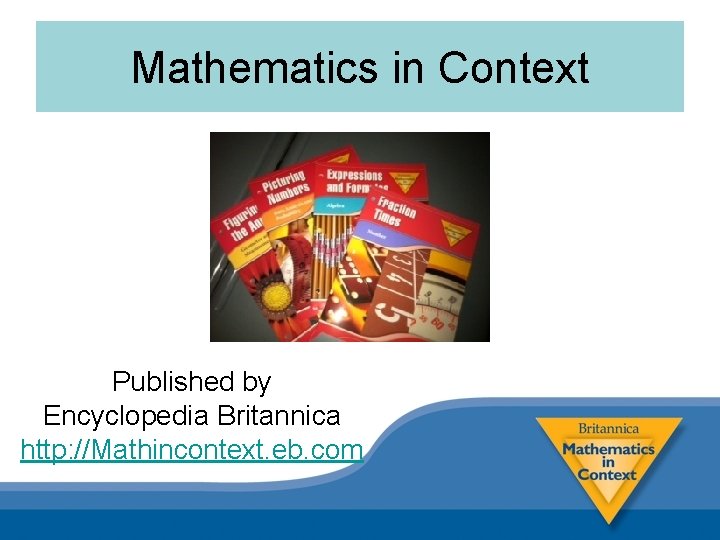
Mathematics in Context Published by Encyclopedia Britannica http: //Mathincontext. eb. com
Benefits of Mi. C • Mi. C builds on students’ existing knowledge. • Mi. C uses real world context to develop math concepts. • Mi. C uses mathematical models to support learning (charts, graphs, etc). • Mi. C integrates and intertwines learning strands.
Student Learning in Mi. C • Students build on their knowledge of math. • Learning “makes sense” to students as they formalize the mathematics. • Multiple strategies and representations cater to students’ individual learning styles. • Real world contexts motivate students and support learning of complex mathematics.
The Texts • Nine modules at each grade level focus on the strands of mathematics- Numbers, Algebra, Measurement and Geometry, and Data and Probability. • Individual modules are paperback and fit into a binder. • Check Your Work review problems are at the end of each section with solutions in the back of the book.
Assessment • Students are assessed informally by the teacher as they work to find solutions to the problems. • Quizzes and tests are given for each unit. • Homework will be assigned nightly – most times the homework will be an extension of what was covered in class – not just “extra” work!
Students in Mi. C classrooms… • Explore mathematical relationships. • Develop and explain their own reasoning and strategies for solving problems. • Use problem-solving tools appropriately. • Listen to, understand, and value each other’s strategies.
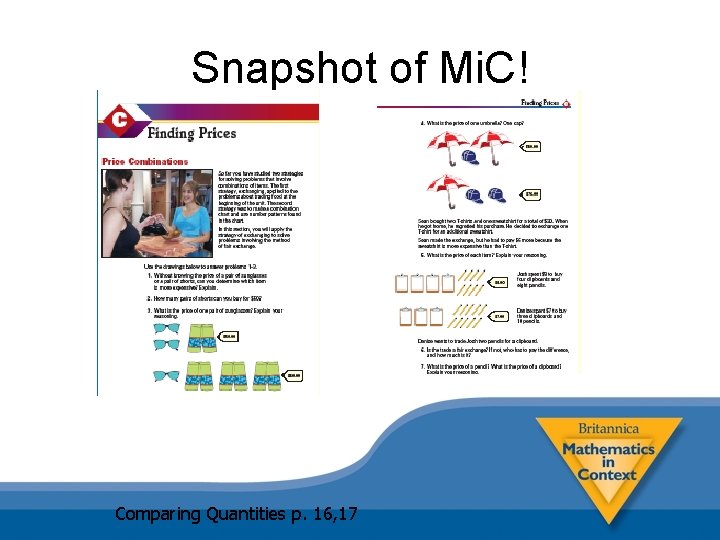
Snapshot of Mi. C! Comparing Quantities p. 16, 17
Web Page • Britannica Mathematics in Context
Helping your student at home • Read the problem: this is the first step toward a solution. • Ask questions: Do you understand what the problem is asking? How did you do this in class? Do you have all of the information that you need? • Review: the pages before the problem for clues to the solution or process.
Helping at home (cont’d) • Look at the section summary; this provides a review of the section. • Look at class notes for samples done in class. • Reread the entire section and work through the problems with your student.
Teacher Web Page • Mrs. Millerhttp: //www. pdsd. org/181520368 490800/site/default. asp
Preparing for Tests and Quizzes • Review each section summary and rework the problems if necessary. • Check for vocabulary and understanding of the words, symbols. • Read over class notes and homework.
Encourage Success! • Talk about math class! • Make sure all assignments are completed on time. • Ask your student to explain what s/he is doing! • Let your positive attitude become your child’s positive attitude!
Thank you for coming out tonight!
- Slides: 15