
Welcome back Lesson 1 Updates What is new

Welcome back Lesson 1

Updates What is new this year… • New teacher – Jane Thomas • Spelling books: for any new words that you are unfamiliar with • Track your learning both in class and at home (replace homework cards) • Slight change to the information packs (now includes information and activities) What is the same…. §Homework due in the beginning of the week: Monday §Wearing of lanyards §Sdcpsychology. weebly. com
A 2 content Biopsychology Approaches (humanistic/psychopathology) Schizophrenia Research methods: every last lesson of the week After Christmas Gender Forensic/Aggression Issue and debate: every last lesson of the week
th Homework: due in w/c 18 September Brain scanning techniques. You will be given one of the four brain scanning techniques. Your task is to create a poster (example) on the technique. The poster must include: § What the technique is (description) § How the technique is used (description) § 2 strengths of the technique § 2 weaknesses of the technique Do not just use the information provided in your biopsychology pack

VESPA Focus on Vision Do you know what you want to achieve? Why are you studying A-Levels? What grades do you want to achieve in your a-Levels? What careers are you interested in?

Localisation of function in the brain Lesson 1
Learning aims and objectives Localisation of the brain §Explain what is meant by localisation of function §Describe one study investigating localisation of function §Evaluate the extent to which brain functions are localised Plasticity and functional recovery Define what is meant by plasticity Outline and evaluate research into plasticity of the brain You could have an essay for these topics
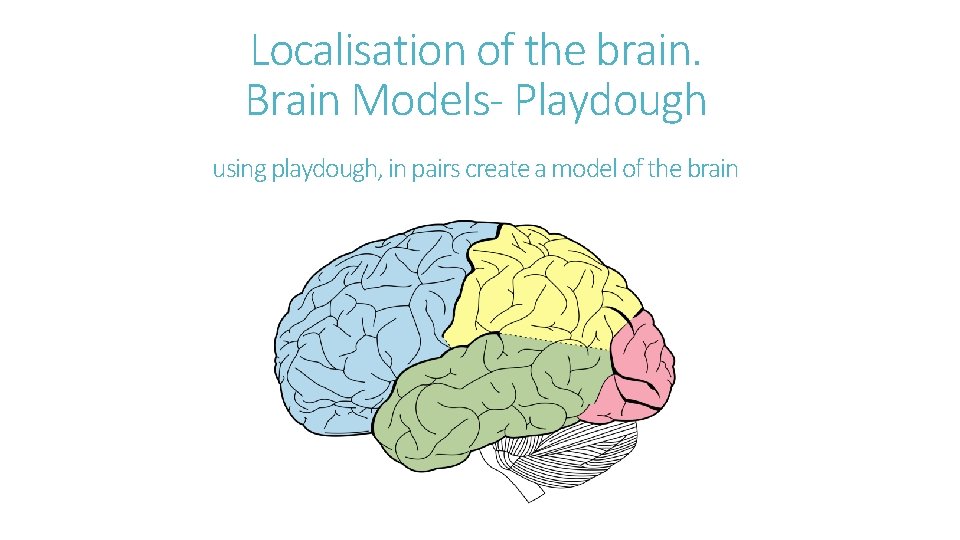
Localisation of the brain. Brain Models- Playdough using playdough, in pairs create a model of the brain
What do you already know about the brain? How many hemispheres is the brain split in to? 2 Some of our physical and psychological functions are controlled or dominated by a particular hemisphere: Left hemisphere. Language processing Right hemisphere Recognising emotions, spatial relationships Hemispheric lateralisation: The lateralisation of brain function is the tendency for some neural functions or cognitive processes to be more dominant in one hemisphere than the other
The cerebral cortex, is split in to 4 lobes Can you name the lobes? Frontal lobe Parietal lobe Occipital lobe Temporal lobe Can you correctly label where they are on your model? Task: go on to 3 D brain. Find out the function of each lobe and jot it on to your labels.
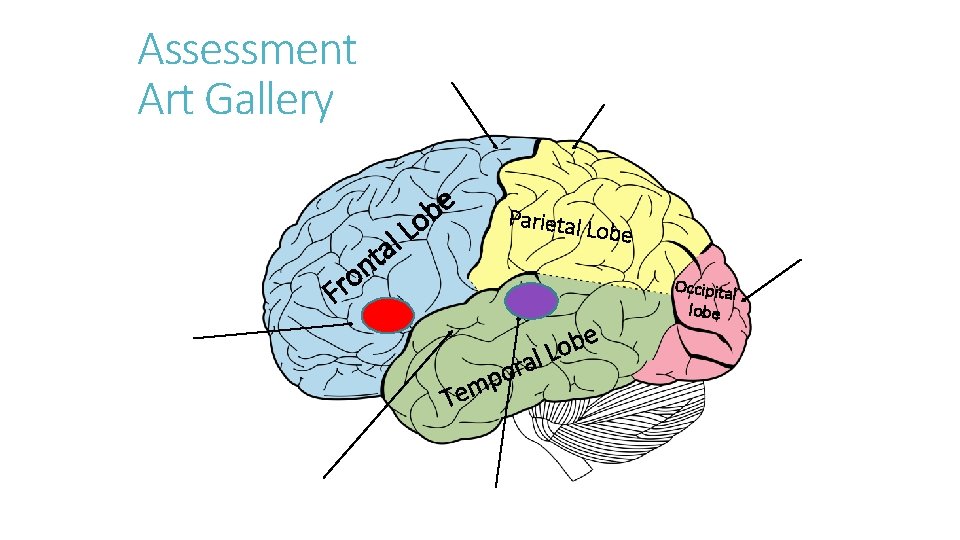
Assessment Art Gallery t n o r F e b o L l a Parietal L obe Tem a r o p e b o l. L Occipital lobe
Each lobe contain specific areas which control specific functions Motor cortex (complex movement) Somatosensory area (sensory information e. g. perceiving touch) Visual area (visual perception/sent information from the eye) Wernicke’s area (understanding speech (comprehension) Auditory area (receives and transmits information about what the sound is and location) Broca’s area (speech production)
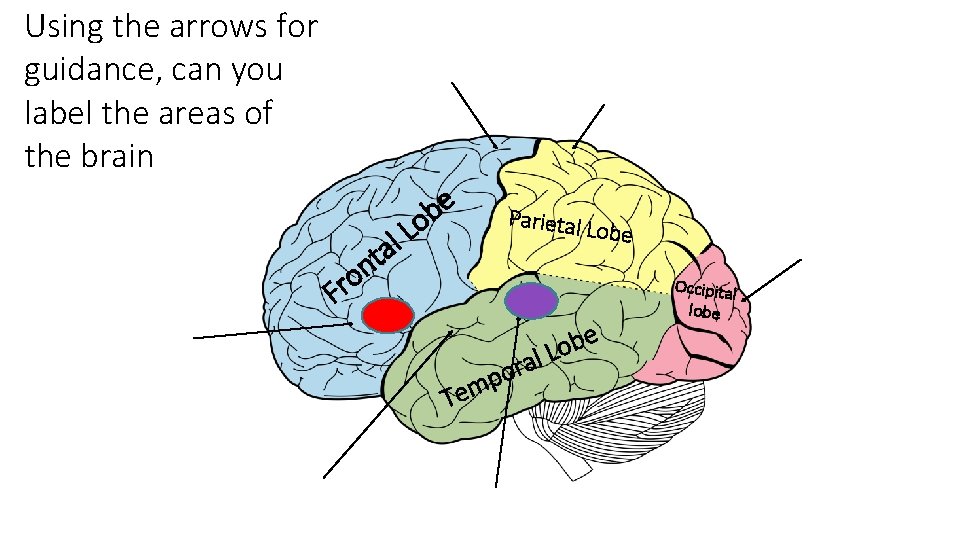
Using the arrows for guidance, can you label the areas of the brain t n o r F e b o L l a Parietal L obe Tem a r o p e b o l. L Occipital lobe
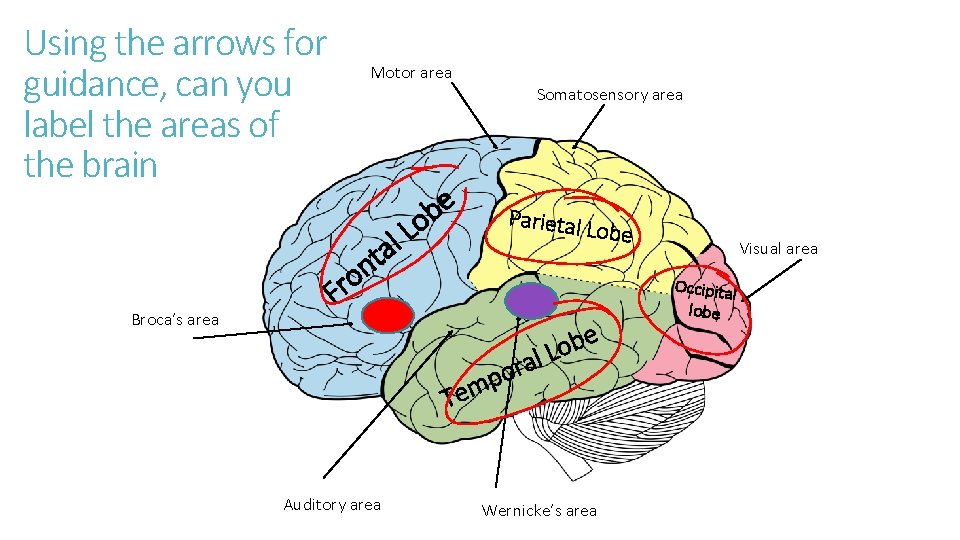
Using the arrows for guidance, can you label the areas of the brain Broca’s area Motor area Somatosensory area t n o r F e b o Parietal L L l a obe e b o l. L a r o p Tem Auditory area Wernicke’s area Visual area Occipital lobe
Task On your table is a more detailed description of the functions of each area. Match the description with the area. Once completed, label your brain diagram (including hemisphere, lobes and areas) and add the additional information on the function of each area.
Question Is the brain localised or multifunctional throughout? “Clive Wearing had impaired semantic memory but his procedural memory was unaffected” “The Case of Phineas Gage recovered as the rest of his brain compensated for the damage. ” “Lashley (1950) conducted work on rat’s brains and did not find a specific area for memory” “Evidence from individual case studies demonstrate specific deficits such as loss of speech function”
Lets vote 1. Localisation 2. Multifunctional (Holistic) 3. Not sure Convert these into a fraction and percentage What graph(s) could I use? Why might this data not be valid? How could I improve the validity or reliability of this data?
Evaluation What do we need to consider first when evaluating theory? Supporting Evidence
Evaluation Decide whether the evidence supports the brain as being localised or multifunctional
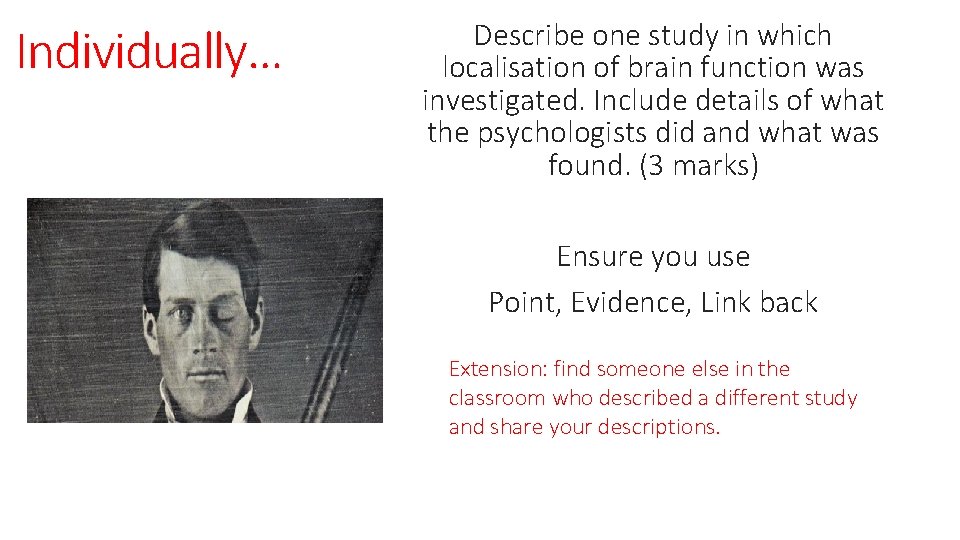
Individually… Describe one study in which localisation of brain function was investigated. Include details of what the psychologists did and what was found. (3 marks) Ensure you use Point, Evidence, Link back Extension: find someone else in the classroom who described a different study and share your descriptions.
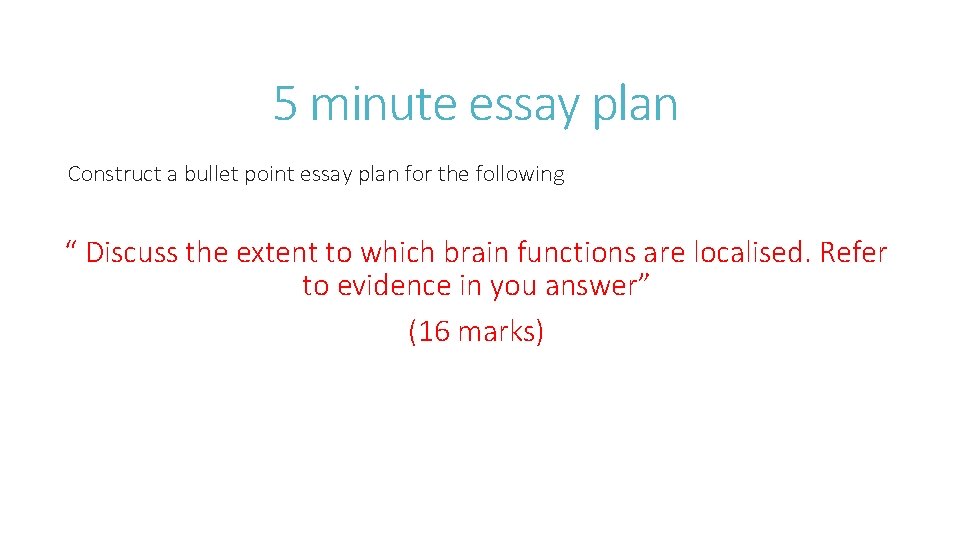
5 minute essay plan Construct a bullet point essay plan for the following “ Discuss the extent to which brain functions are localised. Refer to evidence in you answer” (16 marks)
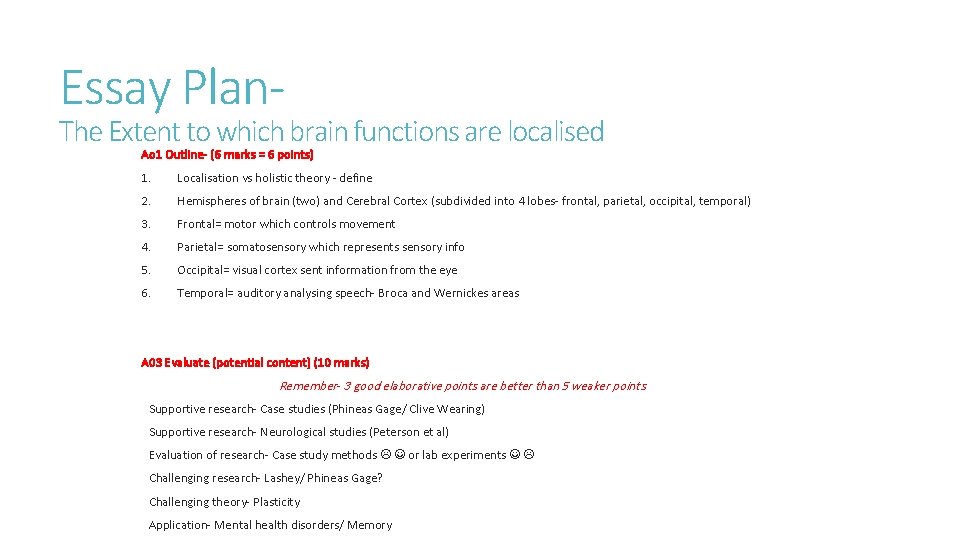
Essay Plan- The Extent to which brain functions are localised Ao 1 Outline- (6 marks = 6 points) 1. Localisation vs holistic theory - define 2. Hemispheres of brain (two) and Cerebral Cortex (subdivided into 4 lobes- frontal, parietal, occipital, temporal) 3. Frontal= motor which controls movement 4. Parietal= somatosensory which represents sensory info 5. Occipital= visual cortex sent information from the eye 6. Temporal= auditory analysing speech- Broca and Wernickes areas A 03 Evaluate (potential content) (10 marks) Remember- 3 good elaborative points are better than 5 weaker points Supportive research- Case studies (Phineas Gage/ Clive Wearing) Supportive research- Neurological studies (Peterson et al) Evaluation of research- Case study methods or lab experiments Challenging research- Lashey/ Phineas Gage? Challenging theory- Plasticity Application- Mental health disorders/ Memory
- Slides: 22