
Welcome Back From Spring Break Brief Review Forecasting
Welcome Back From Spring Break • Brief Review – Forecasting for 3 weeks – Simulation • Motivation for building simulation models • Steps for developing simulation models • Stochastic variables and why they are included in models • What financial simulation model is used for • Parametric Distributions (N, U, Bernoulli) • Test Results – Mean – Std Dev
Materials for Lecture 9 • Chapter 6 • Chapter 16 Sections 3. 2 - 3. 7. 3, 4. 0, • Lecture 10 Demo Distributions. xlsx • Lecture 10 Empirical Distributions. xlsx
Empirical Probability Distribution • These are Non-Parametric Distributions – Discrete Uniform – Empirical – GRKS – Triangle • Parametric Distributions – Fixed form, such as Uniform, Normal, Beta, Gamma, etc. and are estimated by UPES
Discrete Uniform Empirical • Discrete Uniform Empirical distribution used where only fixed values can occur – Each value has an equal probability of being drawn – No interpolation between observed values • Function might be used for things such as, – Discrete number of labors who show up to work – Number of steers on a truck – Simulating a fair die – Letter grades

Discrete Uniform Empirical Distribution PDF for DE(3, 4, 6, 7) CDF for DE(3, 4, 6, 7) 1. 75. 5. 25 3 4 6 7 X 0 3 4 6 7 X PDF and CDF for a Discrete Uniform Distribution. - Parameters for a DE(x 1, x 2, x 3, …, xn) based on history - Discrete Empirical means that each observed value of Xi, has an equal probability of being observed Row 1 2 3 4 5 A 10 12 20 15 13 B C =DEMPIRICAL (A 1: A 5)
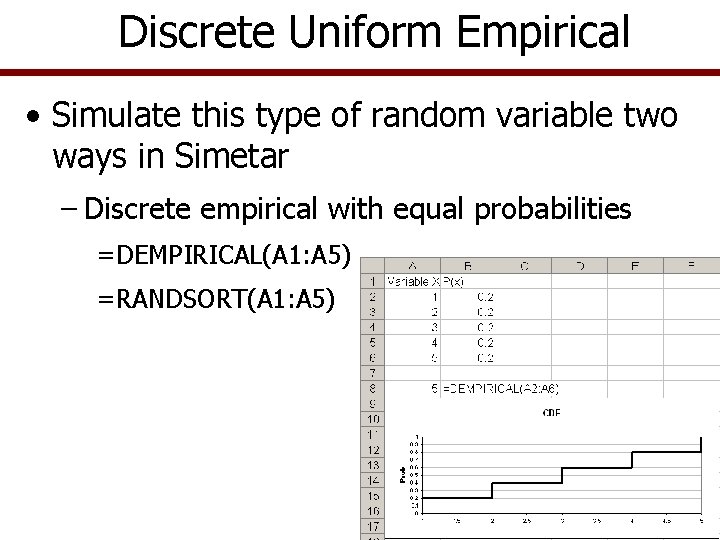
Discrete Uniform Empirical • Simulate this type of random variable two ways in Simetar – Discrete empirical with equal probabilities =DEMPIRICAL(A 1: A 5) =RANDSORT(A 1: A 5)
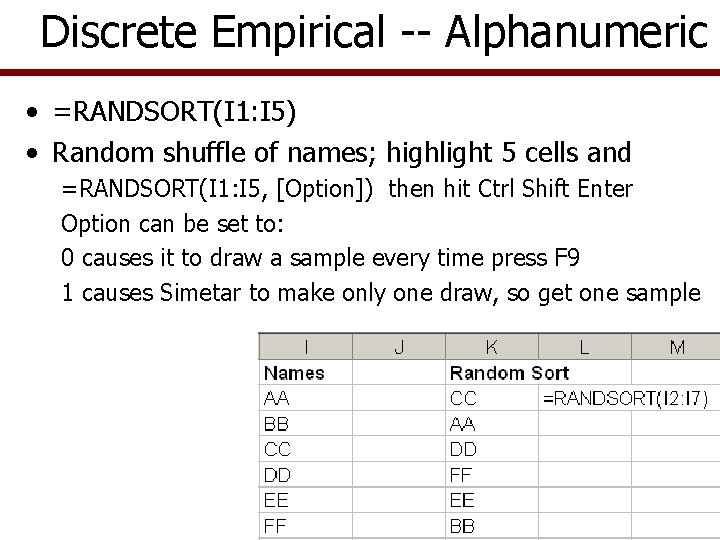
Discrete Empirical -- Alphanumeric • =RANDSORT(I 1: I 5) • Random shuffle of names; highlight 5 cells and =RANDSORT(I 1: I 5, [Option]) then hit Ctrl Shift Enter Option can be set to: 0 causes it to draw a sample every time press F 9 1 causes Simetar to make only one draw, so get one sample
Empirical Distribution • An empirical distribution is defined totally by the observations for the data, no distributional form is assumed • Parameters to simulate an empirical distribution – Forecasted values: means (Ῡ) or forecasts (Ŷ) – Calculate the deviation from the mean or forecast – Sort the deviations from the mean or forecast from low to high – Assign a cumulative probability to each data point (usually equal probability). • Cumulative probabilities go from zero to one – Assume the distribution is continuous, so interpolate between the observed points • Use the Inverse Transformula to simulate the distribution • This requires simulation of a USD for use in interpolation • Use Emp icon to estimate parameters
Using the Empirical Distribution • Empirical distribution should be used if – Random variable is continuous over its range, – You have < 20 observations for the variable, and/or – You cannot easily estimate parameters for the true PDF • Simulate crop yields as an Empirical distribution when you have only 10 historical values – In this situation we know: • Yield can be any positive value • We don’t have enough observations to test for normality • We know the 10 random values were observed with a probability of 1/10, or one observation each year
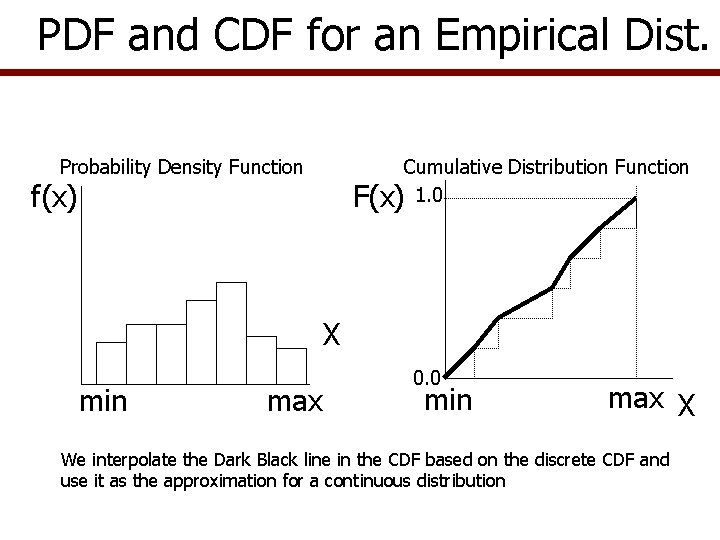
PDF and CDF for an Empirical Dist. Probability Density Function Cumulative Distribution Function F(x) 1. 0 f(x) X min max 0. 0 min max X We interpolate the Dark Black line in the CDF based on the discrete CDF and use it as the approximation for a continuous distribution
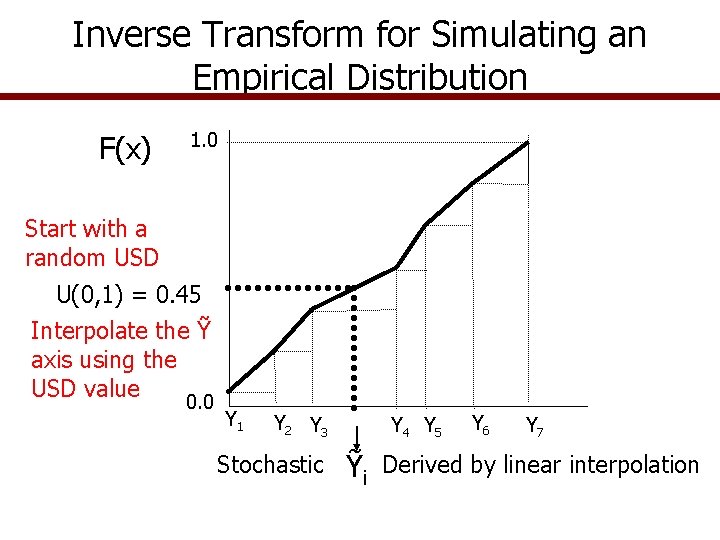
Inverse Transform for Simulating an Empirical Distribution F(x) 1. 0 Start with a random USD U(0, 1) = 0. 45 Interpolate the Ỹ axis using the USD value 0. 0 Y 1 Y 2 Y 3 Stochastic Y 4 Y 5 Ỹi Y 6 Y 7 Derived by linear interpolation
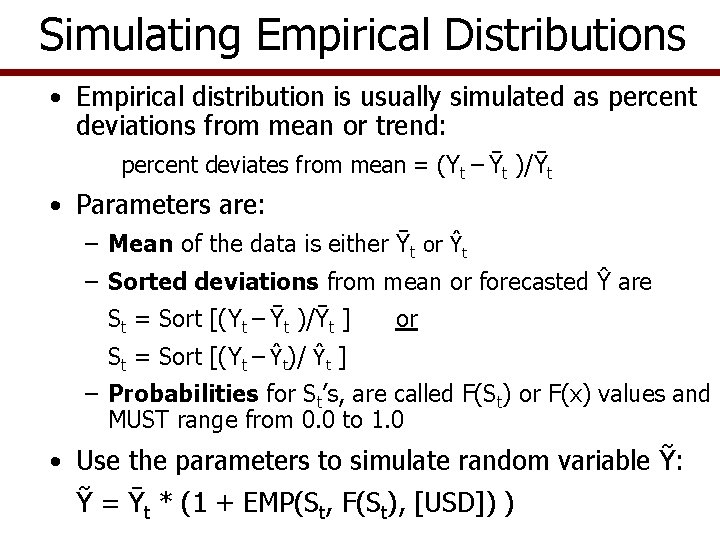
Simulating Empirical Distributions • Empirical distribution is usually simulated as percent deviations from mean or trend: percent deviates from mean = (Yt – Ῡt )/Ῡt • Parameters are: – Mean of the data is either Ῡt or Ŷt – Sorted deviations from mean or forecasted Ŷ are St = Sort [(Yt – Ῡt )/Ῡt ] or St = Sort [(Yt – Ŷt)/ Ŷt ] – Probabilities for St’s, are called F(St) or F(x) values and MUST range from 0. 0 to 1. 0 • Use the parameters to simulate random variable Ỹ: Ỹ = Ῡt * (1 + EMP(St, F(St), [USD]) )
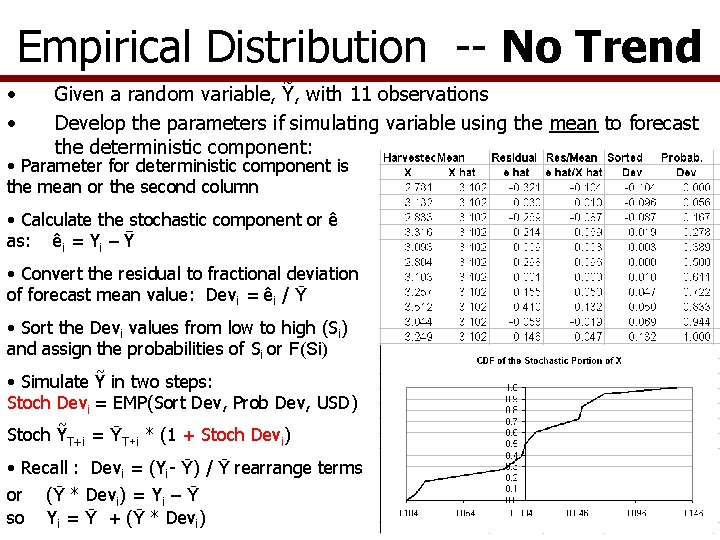
Empirical Distribution -- No Trend • • Given a random variable, Ỹ, with 11 observations Develop the parameters if simulating variable using the mean to forecast the deterministic component: • Parameter for deterministic component is the mean or the second column • Calculate the stochastic component or ê as: êi = Yi – Ῡ • Convert the residual to fractional deviation of forecast mean value: Devi = êi / Ῡ • Sort the Devi values from low to high (Si) and assign the probabilities of Si or F(Si) • Simulate Ỹ in two steps: Stoch Devi = EMP(Sort Dev, Prob Dev, USD) Stoch ỸT+i = ῩT+i * (1 + Stoch Devi) • Recall : Devi = (Yi- Ῡ) / Ῡ rearrange terms or so (Ῡ * Devi) = Yi – Ῡ Yi = Ῡ + (Ῡ * Devi)
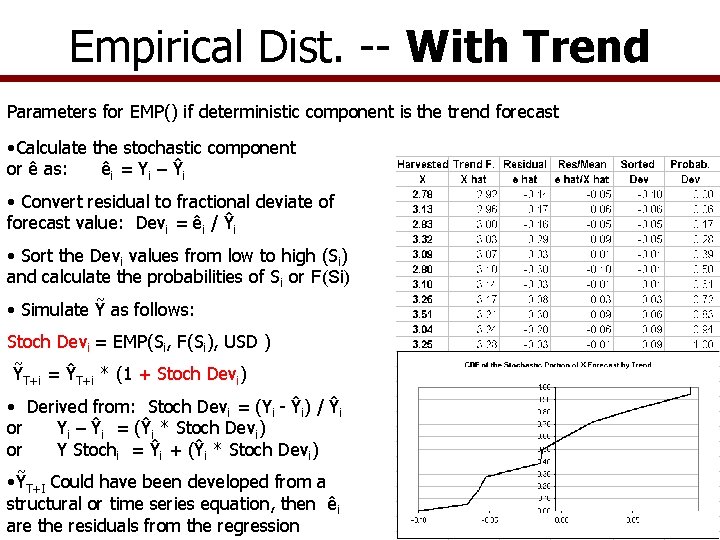
Empirical Dist. -- With Trend Parameters for EMP() if deterministic component is the trend forecast • Calculate the stochastic component or ê as: ê i = Yi – Ŷi • Convert residual to fractional deviate of forecast value: Devi = êi / Ŷi • Sort the Devi values from low to high (Si) and calculate the probabilities of Si or F(Si) • Simulate Ỹ as follows: Stoch Devi = EMP(Si, F(Si), USD ) ỸT+i = ŶT+i * (1 + Stoch Devi) • Derived from: Stoch Devi = (Yi - Ŷi) / Ŷi or Yi – Ŷi = (Ŷi * Stoch Devi) or Y Stochi = Ŷi + (Ŷi * Stoch Devi) • ỸT+I Could have been developed from a structural or time series equation, then êi are the residuals from the regression
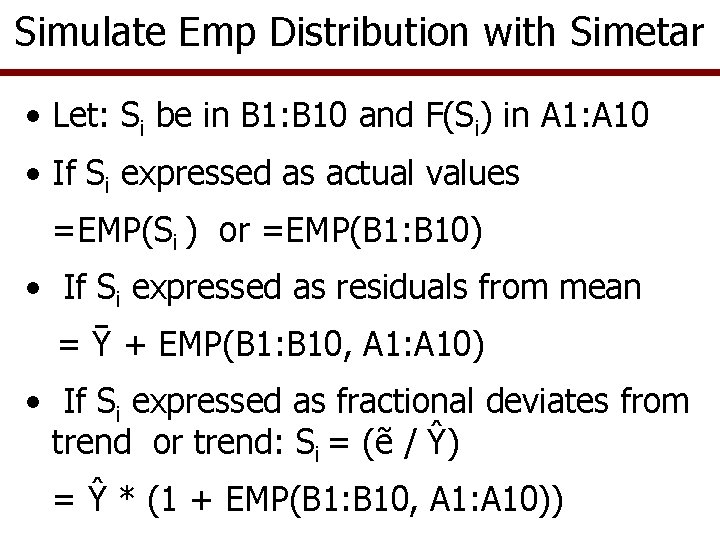
Simulate Emp Distribution with Simetar • Let: Si be in B 1: B 10 and F(Si) in A 1: A 10 • If Si expressed as actual values =EMP(Si ) or =EMP(B 1: B 10) • If Si expressed as residuals from mean = Ῡ + EMP(B 1: B 10, A 1: A 10) • If Si expressed as fractional deviates from trend or trend: Si = (ẽ / Ŷ) = Ŷ * (1 + EMP(B 1: B 10, A 1: A 10))
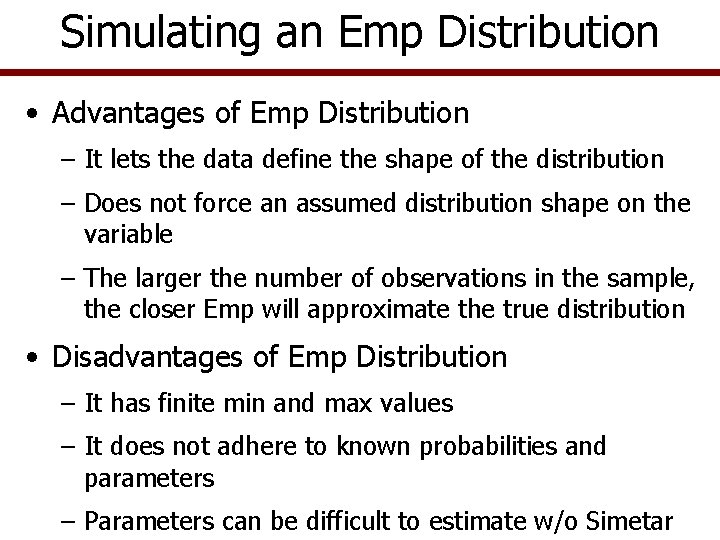
Simulating an Emp Distribution • Advantages of Emp Distribution – It lets the data define the shape of the distribution – Does not force an assumed distribution shape on the variable – The larger the number of observations in the sample, the closer Emp will approximate the true distribution • Disadvantages of Emp Distribution – It has finite min and max values – It does not adhere to known probabilities and parameters – Parameters can be difficult to estimate w/o Simetar
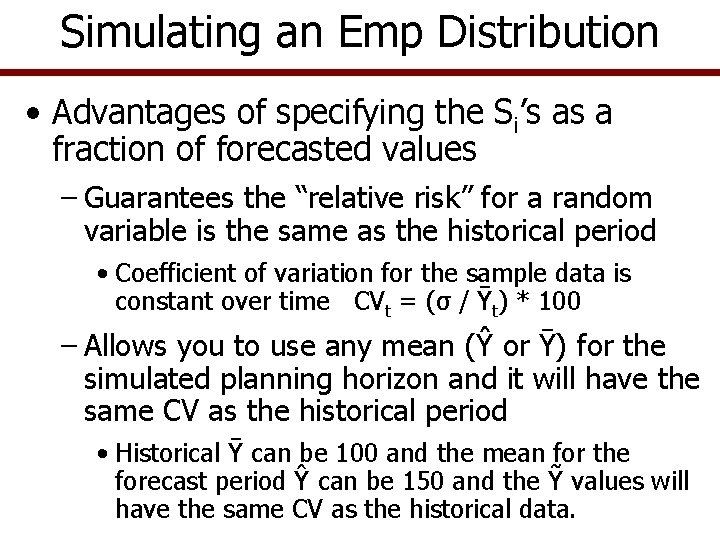
Simulating an Emp Distribution • Advantages of specifying the Si’s as a fraction of forecasted values – Guarantees the “relative risk” for a random variable is the same as the historical period • Coefficient of variation for the sample data is constant over time CVt = (σ / Ῡt) * 100 – Allows you to use any mean (Ŷ or Ῡ) for the simulated planning horizon and it will have the same CV as the historical period • Historical Ῡ can be 100 and the mean for the forecast period Ŷ can be 150 and the Ỹ values will have the same CV as the historical data.
- Slides: 17