
Welcome Back Business Communication Overview of Class Housekeeping

Welcome Back! Business Communication
Overview of Class + Housekeeping → Welcome Back, Collecting of Teaching Philosophy Statements, Practicum Reflections, Rita Piersen Video etc. (20) → Professional E-mails (90) → Closing (10) ---Announcements: Mid-Term – April 27 30% Teaching Philosophy, 30% Professional E-mail 40% Short Exam with Concepts/Vocab from the book
Video –

Practicum Reflection Questions What were your expectations for the Practicum? Was it the same or different than what you expected? What do you feel is the most important thing you learned? What do you feel like your strengths are as a teacher? Where do you feel like you want the most improvement? How do you feel like what Rita Piersen says in her talk is relevant to your Practicum experiences?
Student Facilitation Expectations Be respectful and attentive to your classmates presenting Take notes on new/unfamiliar vocabulary and concepts (can be fair game for the Mid-Term!)

Writing a Professional E-mail – Seven Important Aspects 1. ) Subject Line – Always have a subject line that clearly and simply shows the content of the message Example: Request for Deadline Extension 2. ) Simplified Sentences – Don't make your e-mail look overcrowded by using too many technical terms or long words. It is good to use complex and compound sentences but make sure they are easy to understand.
3. ) Think about who your reader is going to be Is it a colleague, client, or a boss? Should the e-mail be formal or informal? Informal – Thanks for emailing me on 15 th February. Formal – Thank you for your email dated 15 th February. Informal – Can you…? Formal – I was wondering if you could…. ? Some emails to colleagues can be informal if you have a long working relationship and know them well. This is the style that is closest to speech, so there are often everyday words and conversational expressions that can be used. The reader may also accept or overlook minor grammatical errors in informal emails. However, if the email is going to a client or senior colleague, bad grammar and an over-friendly writing style will most probably not be acceptable.
4. ) Be VERY careful of punctuation, grammar, capitalization, and spelling!!! While these can be tolerated in informal emails, they are very important in business emails as they are an important part of the image you create. Give yourself time to edit what you’ve written before you push that Send button.
5. ) Think about how direct or indirect you want to be. In some cultures, it is common practice to be very direct in email correspondence. However, this can cause a problem if you’re writing to someone in another country and in a language that is not your mother tongue. They might find your directness rude and possibly offensive. Direct – I need this in half an hour. Indirect and polite – Would it be possible to have this in half an hour? Direct – There will be a delay Indirect – I’m afraid there may be a slight delay. Direct – It’s a bad idea Indirect – To be honest, I’m not sure if that would be a good idea.
6. ) Be positive – Look at these words: helpful, good question, agreed, together, useful, I will do my best, mutual, opportunity. Now look at these: busy, crisis, failure, forget it, I can’t, it’s impossible, waste, hard. The words you use show your attitude to life, so choose your words wisely. 7. ) Get feedback – When writing a really important/high stakes e-mail, it never hurts to get feedback!
Structure/Parts of the E-mail 1. ) Subject Line 2. ) Greeting – Be polite, formal, and personal (Good afternoon, Mr. Jones) 3. ) First paragraph – Describe who you are and the purpose of the message. “My name is Rachel Kirk and I am a prospective student for the Graduate School of Education at University of Columbia. I was writing to get more information about the program. ” 4. ) Body – Main part of the message. Use short sentences and/or bullets. Extra space makes it easier to read. 5. ) Closing – Say thank you and include contact information. “Any information you could pass along would be greatly appreciated. ”
Good afternoon Dr. ____. I hope you are well. My name is Rachel Kirk and I am currently a prospective student for the Graduate School of Education at University of Columbia. I was writing to gain more information about the program. I am currently ____ (context). My research interests are _____. I was wondering if, given these interests, you think I would be a good fit for your program. Any information you could provide me with would be greatly appreciated. Thank you so much, Rachel Kirk (Job Title) (Contact Information)
Subject: professor! Professor! how are you? Do you remember me? ? I was a student who was taking advanced conversation class last year and got a job in Singapore. These days, too many things bother me a lot so I am trying to get a different job. I made a resume and cover letter. I am very shy to show you and it seems very ridiculous but I need your help. This resume is for the HR department. Actually I want to make it complete but my brain just stopped. give me some advice please. . Thank you sir!
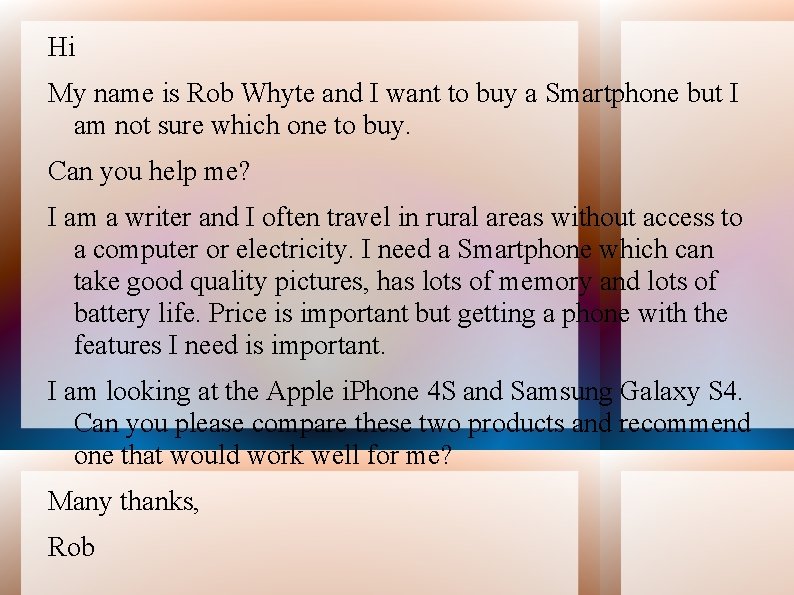
Hi My name is Rob Whyte and I want to buy a Smartphone but I am not sure which one to buy. Can you help me? I am a writer and I often travel in rural areas without access to a computer or electricity. I need a Smartphone which can take good quality pictures, has lots of memory and lots of battery life. Price is important but getting a phone with the features I need is important. I am looking at the Apple i. Phone 4 S and Samsung Galaxy S 4. Can you please compare these two products and recommend one that would work well for me? Many thanks, Rob
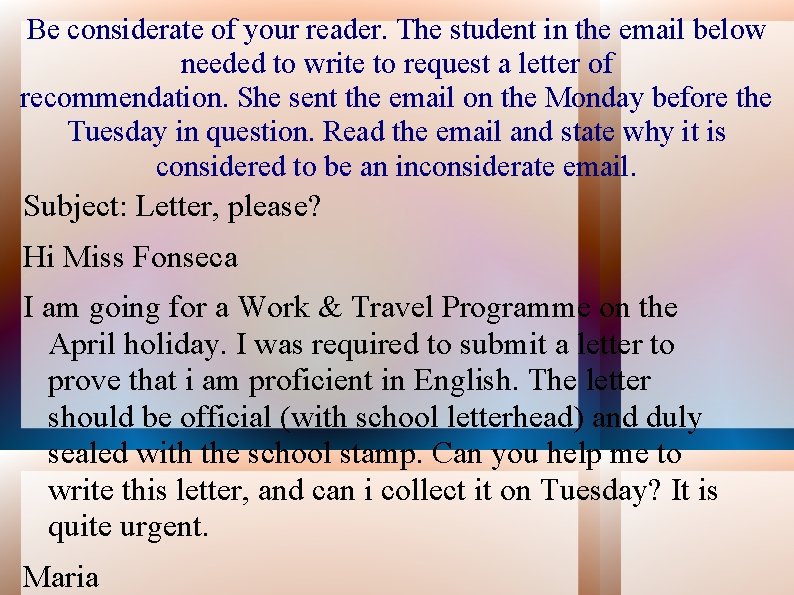
Be considerate of your reader. The student in the email below needed to write to request a letter of recommendation. She sent the email on the Monday before the Tuesday in question. Read the email and state why it is considered to be an inconsiderate email. Subject: Letter, please? Hi Miss Fonseca I am going for a Work & Travel Programme on the April holiday. I was required to submit a letter to prove that i am proficient in English. The letter should be official (with school letterhead) and duly sealed with the school stamp. Can you help me to write this letter, and can i collect it on Tuesday? It is quite urgent. Maria
Formal Versus Informal Language Complete Part 1 on the E-mail packet The left is informal/neutral. The right side is formal. Match the phrases or words with their equivalent.
Beginnings and Endings Complete Exercises A & B on the worksheet
Writing Professional E-mail Practice Choose one formal e-mail topic and one informal email topic from the list on the last page. Write the two e-mails (on paper or on your phone). When you are finished, exchange the e-mails you have written with a partner. Give each other feedback on how to make it better (writing, grammar, formatting, etc. )
Write an email applying for a job Structure of a job application e-mail: → Greeting and introduction → Reason for writing → Your background and experience → The job itself, and why you would like to do it → Refer to your CV → Final comments

- Slides: 22