
Welcome Back AGENDA Lecture Status Power Trust PrimarySecondary
Welcome Back!

AGENDA – Lecture • • • Status Power Trust Primary/Secondary Tension Improving group communication – Presentation Techniques – Group work

Status • Status is an individual’s importance to the group • High Status • Low Status • Status Achievers • Status Seekers
High Status • Shown more deference – Are listened to – Asked for advice – Rewarded with greater share of goods • Bigger car/office/salary – More recognition for contributions – Talk more often • to other high status members • total group – leadership role • highest status =leader – More influence than low status members

Low Status • Direct conversation to high status, not low status group members. • Communicate more positive messages to high status members • Whiners: victim mentality • Comments ignored • Communicate more irrelevant information

Power Bases • Legitimate Power – Those elected/chosen • Referent Power – Those we allow to have power because we admire them • Expert Power – Those with knowledge/experience • Reward Power – Those able to reward other’s performance (grades) • Coercive Power – Those able to use threats/blackmail
Power/Status and Gender • Do men and women have different power bases in our society? • How does culture impact the issue of power/status and gender?
Trust • Trust must be earned • Trust develops when you can predict how another will behave under certain circumstances-and they do as expected • Trust is always a gamble • Previous experiences in small group settings will influence how you are able to trust others to do tasks as agreed
Self Disclosure • The deliberate communication of information about yourself to others. • Should be appropriate for the time, setting and people in the group • It is a function of an ongoing relationship • It is reciprocal
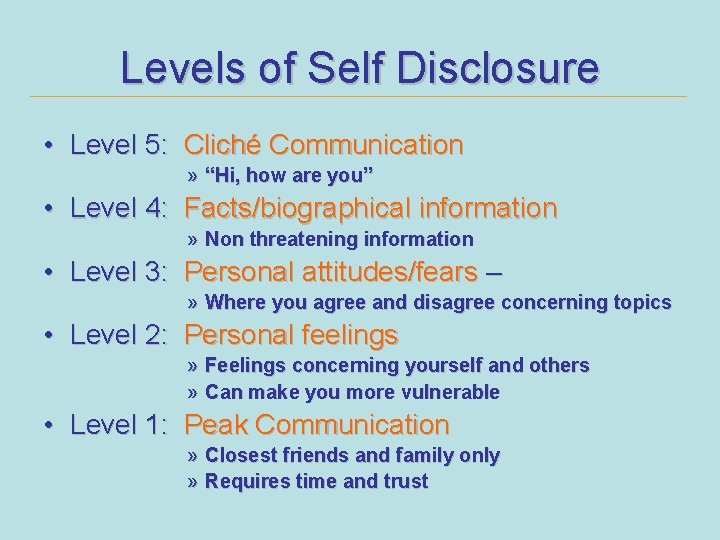
Levels of Self Disclosure • Level 5: Cliché Communication » “Hi, how are you” • Level 4: Facts/biographical information » Non threatening information • Level 3: Personal attitudes/fears – » Where you agree and disagree concerning topics • Level 2: Personal feelings » Feelings concerning yourself and others » Can make you more vulnerable • Level 1: Peak Communication » Closest friends and family only » Requires time and trust
Primary Tension • The social unease and stiffness that accompanies getting acquainted. • Speaking is more soft and extremely polite • Long pauses are common
Secondary Tension • Usually establishes group norms, or patterns of behavior that occur without discussion • Arises from the differences of opinion that occur naturally in the small group process – Personality differences – Disagreements – Power struggles
Improve Group/Team Communication n Establish a cooperative climate n Be ready to perform needed roles n Encourage continual improvement
Presentation Techniques • Remember: this is a performance – Each participant is “on stage” even when another member is presenting their portion of the presentation – Be aware of both your verbal and non verbal communication • • Eye contact: Look at everyone (not spot on wall/out door) Avoid touching your body in any way Avoid speech fillers” “um” Grammar – Introduce members – Transition between speakers
Presentation Techniques • Index cards NOT paper notes • Visual aids must be easily seen/read by all audience members – DO NOT PASS VISUAL AROUND ROOM – Professional style is key • NO LAST MINUTE, HURRY UP AND GET IT DONE OBJECTS/MATERIALS • KISS (keep it simple…Simon)
Group work • Divide into groups as assigned • Finish preparation for Group Assignment I • Be prepared to present your group’s findings Tuesday (22 nd).

End of Presentation
- Slides: 17