
Welcome ASL 3 and 4 Lecture Day From

- Slides: 26
Welcome! ASL 3 and 4 - Lecture Day
From last year’s classifier PPT
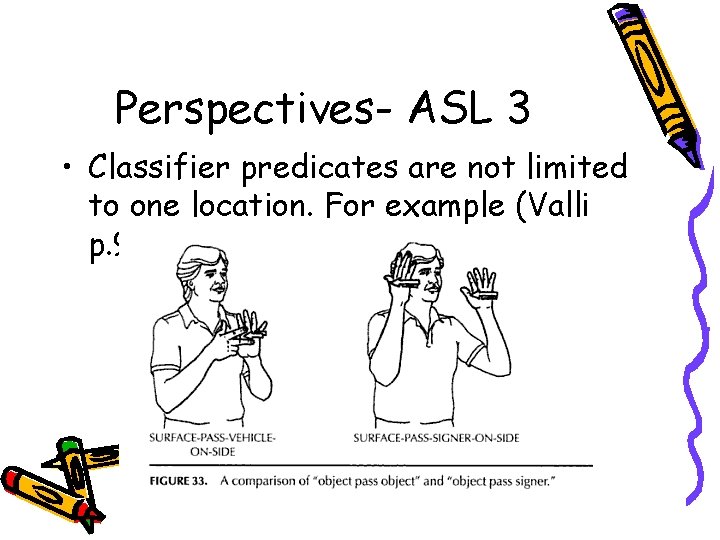
Perspectives- ASL 3 • Classifier predicates are not limited to one location. For example (Valli p. 90):
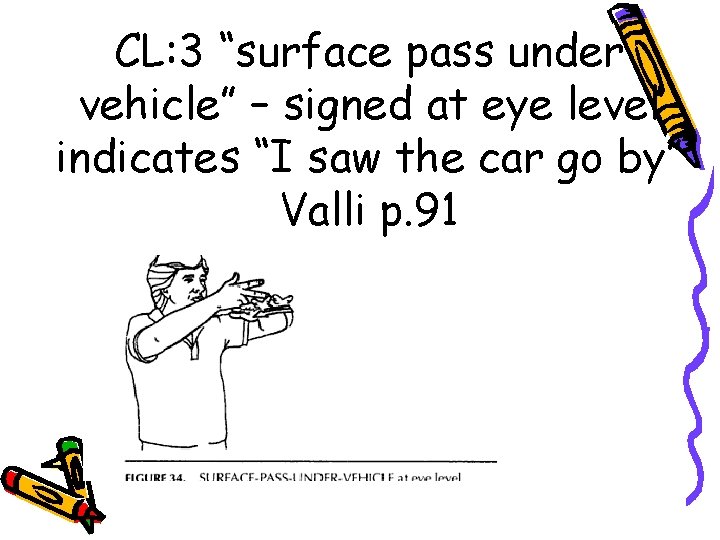
CL: 3 “surface pass under vehicle” – signed at eye level indicates “I saw the car go by” Valli p. 91
ASL 3 • Classifiers are bound morphemesthey have no meaning on their own, but must be used in conjunction with their noun • ASL 3: locatives- “lock” in place • Classifier movement can show several types of meaning • Eg. Two ways of showing cars in a row: cl cl cl , or sweeping (concept of more than one)
Test Question: • 12. Classifiers are: • A. bound morphemes • B. free morphemes • 13. True or false: • Perspective is important in ASL classifier predicates, and can show whether the signer is viewing the predicate or not.
Classifiers- examples • http: //www. lifeprint. com/asl 101/page s-signs/c/classifiers. htm • Test sheet by Monday to view, practice. Classifier test Wednesday? As you are ready.
Misc. Grammar: • • Noun verb pairs- reduplication Minimal Pairs- ASL vs. English Language acquisition vs. learning (acquisition naturally occurs, learning is in a class setting, trying to present real-world opportunities but limited • Socialize and find real-world opportunities
Blocking Environmental Interference • = Tuning out sounds around you • The trick: learning when to ignore sound vs. pay attention to it • Difference in a conversation vs. interpreting
Time Lag • The amount of time from when the person spoke to when you interpret their signs • The greater the time lag in ASL interpreting, the more accurate the interpretation- to a point • Issues: the longer the time lag, the more likely you are to forget information • Skilled interpreters develop this over time
Advanced ASL Levels of Discourse in Linguistics and ASL examples
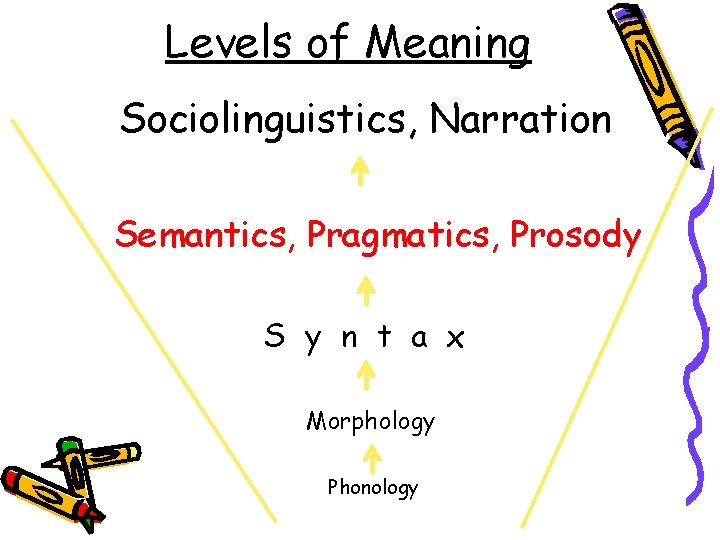
Levels of Meaning Sociolinguistics, Narration Semantics, Pragmatics, Prosody S y n t a x Morphology Phonology
Phonology • Phonology: Organization of speech sounds in a particular language (same sounds, different sound inventories); organization of parts of signs in signed languages • Phonetics: The study of speech sounds or parts of signs – Articulatory (production) – Acoustic (transmission) – Auditory (perception)
Phonology • The study of how languages organize the smallest parts of words or signs • A phoneme represents the distinctive unit that if changed will create a minimal pair (ASL minimal pair e. g. HOME vs. DEAF) • Phonetics is the study of how the signs (or sounds) are realized during communication (ASL e. g. -STUDENT)
Phonology vs. Morphology • Phonology studies the smallest contrastive parts of language (e. g. in ASL: holds, movements). • The parts of language studied in phonology do not have meaning in isolation. English e. g. letters: s-i-t-s; ASL e. g. handshape (flat: o) • Morphology is the study of the smallest meaningful units in language, and how language uses these units to build signs (or words). • Morpheme: the smallest meaningful unit in a language
Morphology • Morpheme: the smallest unit of meaning in a language • E. g. happily- English: = happy + ly (often “happily” =NMS attached to sign) • E. g. ASL= HAPPY + NMS • ASL: “careless” from NMS (tongue) • English: present progressive -ing
Morphemes • Free Morphemes • Bound Morphemes
Free Morphemes • Morphemes that can occur as independent units, that can occur by themselves • English e. g. cat, sit • ASL e. g. CAT, LOUSY
Bound Morphemes • Morphemes that must occur with other morphemes, that cannot occur as independent units • English e. g. plural -s- ‘cats’ and third person -s- ‘sits’ • ASL e. g. the 3 handshape: THREEWEEKS and THREE-MONTHS
Syntax • Syntax: rules for making sentences, based on grammar- word order, etc. Note on Language Assessment/Usage: • Competence: what you know about a language, including its syntax • Performance: how you use the language (errors, etc. )
Sentences • Sentences in language are infinite • Finite (limited) set of rules for making sentences • Language users know these rules, whether conscious or unconscious
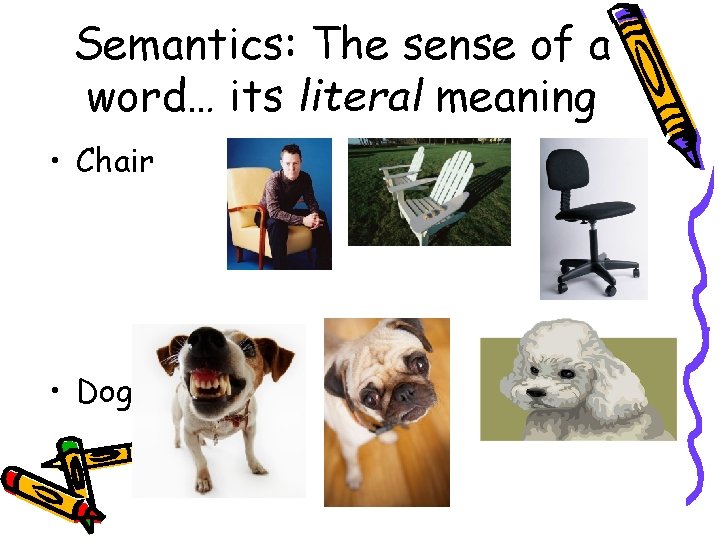
Semantics • The literal meaning of a sign/word • A chair is a chair… or is it? • Perception influences semantics
Semantics: The sense of a word… its literal meaning • Chair • Dog
Pragmatics • Communicating more than what is literally stated or signed • Adds to the semantic meaning • Depends on the speaker/signer, addressee, and context • Many L 2 learners struggle with this; details are often not taught in classes
The end--- • Tests this six weeks: • 1. Friday (tomorrow) – medical signs, sentences A-D • 2. Classifier test • 3. Written test • 4. 1 on 1 conversation- as you are ready (after we practice all parts) • Final Exam information: written test (MC/TF), signed portion (video, ), 1 on 1 conversation