
Welcome Agile Software Quality Management Attributes testing Better
Welcome Agile Software Quality Management Attributes testing Better quality, less risk (c) 2019 Ian E. Savage
Agile Software Quality Management My goal is to bring the QA and Agile communities closer for the benefit of both. Success criteria / Metric: Some of you will try ASQM… …and share your results with #PNSQC and #AONW. (c) 2019 Ian E. Savage
ASQM Part 1 ASQM defined. Operational definition of “quality” ASQM test matrices ASQM test/risk matrices (c) 2019 Ian E. Savage
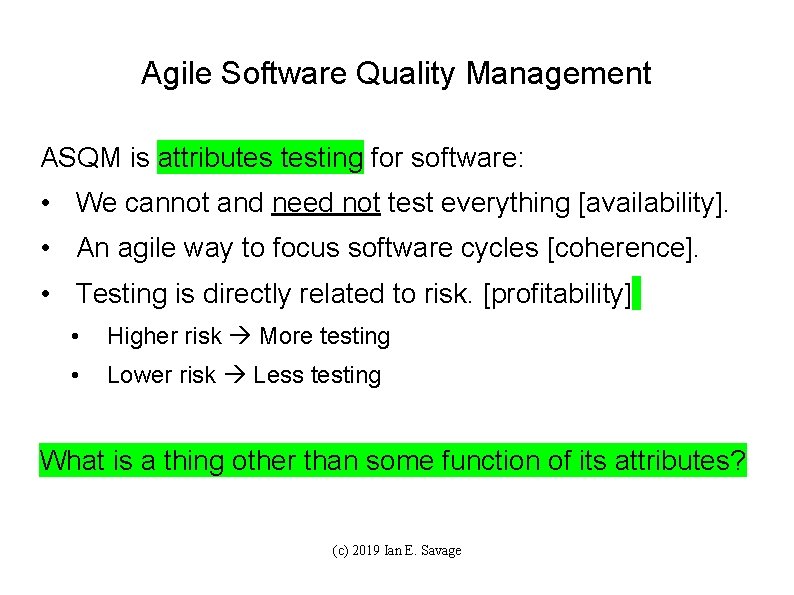
Agile Software Quality Management ASQM is attributes testing for software: • We cannot and need not test everything [availability]. • An agile way to focus software cycles [coherence]. • Testing is directly related to risk. [profitability] • Higher risk More testing • Lower risk Less testing What is a thing other than some function of its attributes? (c) 2019 Ian E. Savage
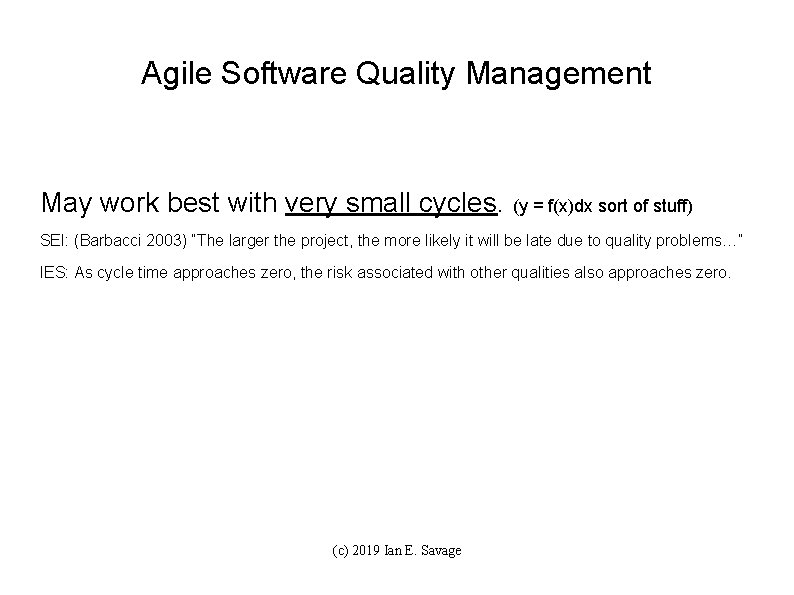
Agile Software Quality Management May work best with very small cycles. (y = f(x)dx sort of stuff) SEI: (Barbacci 2003) “The larger the project, the more likely it will be late due to quality problems…” IES: As cycle time approaches zero, the risk associated with other qualities also approaches zero. (c) 2019 Ian E. Savage
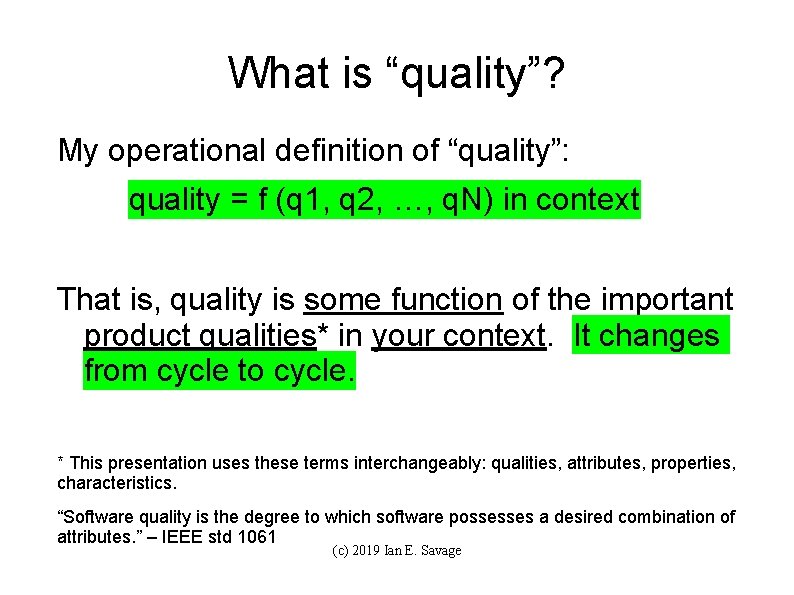
What is “quality”? My operational definition of “quality”: quality = f (q 1, q 2, …, q. N) in context That is, quality is some function of the important product qualities* in your context. It changes from cycle to cycle. * This presentation uses these terms interchangeably: qualities, attributes, properties, characteristics. “Software quality is the degree to which software possesses a desired combination of attributes. ” – IEEE std 1061 (c) 2019 Ian E. Savage
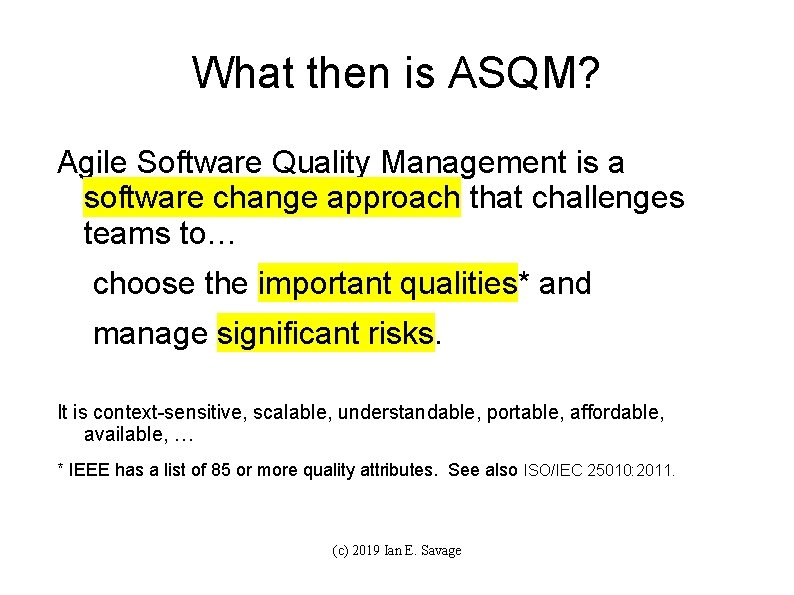
What then is ASQM? Agile Software Quality Management is a software change approach that challenges teams to… choose the important qualities* and manage significant risks. It is context-sensitive, scalable, understandable, portable, affordable, available, … * IEEE has a list of 85 or more quality attributes. See also ISO/IEC 25010: 2011. (c) 2019 Ian E. Savage
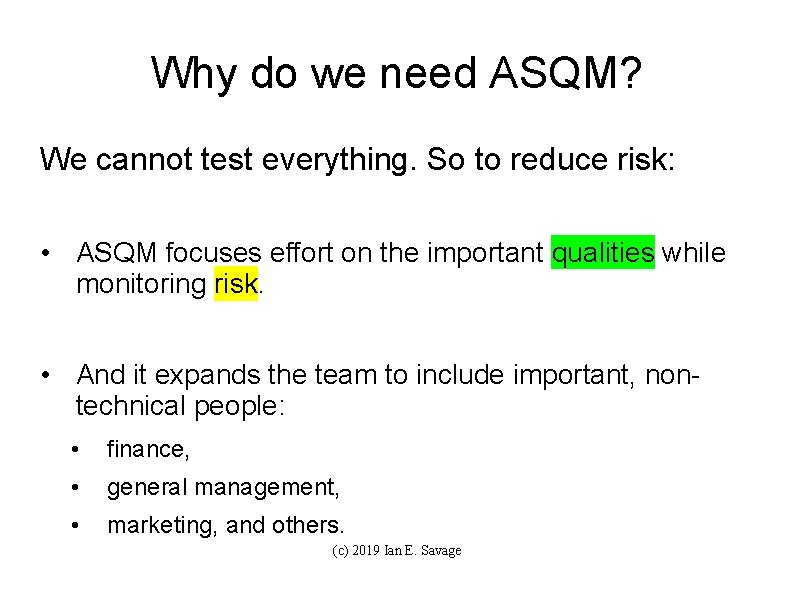
Why do we need ASQM? We cannot test everything. So to reduce risk: • ASQM focuses effort on the important qualities while monitoring risk. • And it expands the team to include important, nontechnical people: • finance, • general management, • marketing, and others. (c) 2019 Ian E. Savage
Why do we need ASQM? POP QUIZ Why should a Finance person be on the software team? (c) 2019 Ian E. Savage
How do we use ASQM? At the beginning of a cycle, the team: 1. Selects salient quality attribute(s) 2. Lists associated questions and answers 3. Ranks important risks 4. Plans for monitoring those risks (c) 2019 Ian E. Savage
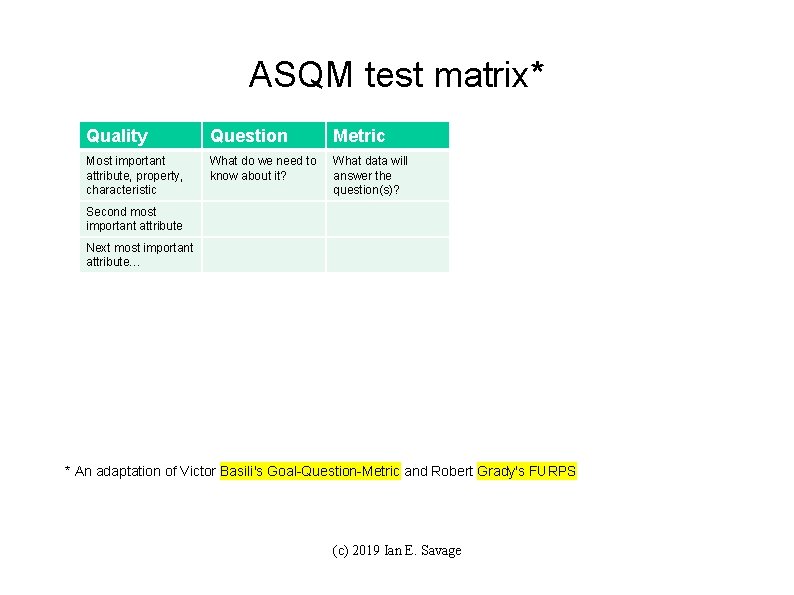
ASQM test matrix* Quality Question Metric Most important attribute, property, characteristic What do we need to know about it? What data will answer the question(s)? Second most important attribute Next most important attribute… * An adaptation of Victor Basili's Goal-Question-Metric and Robert Grady's FURPS (c) 2019 Ian E. Savage
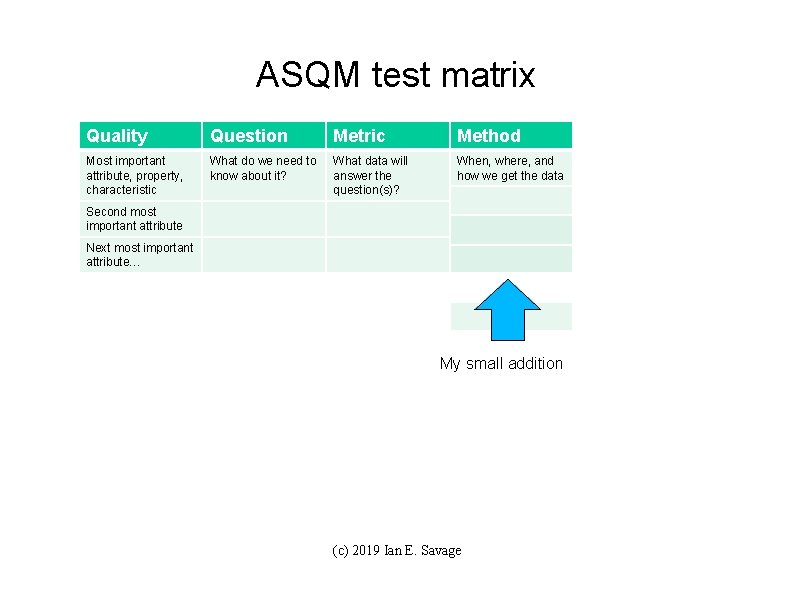
ASQM test matrix Quality Question Metric Method Most important attribute, property, characteristic What do we need to know about it? What data will answer the question(s)? When, where, and how we get the data Second most important attribute Next most important attribute… My small addition (c) 2019 Ian E. Savage
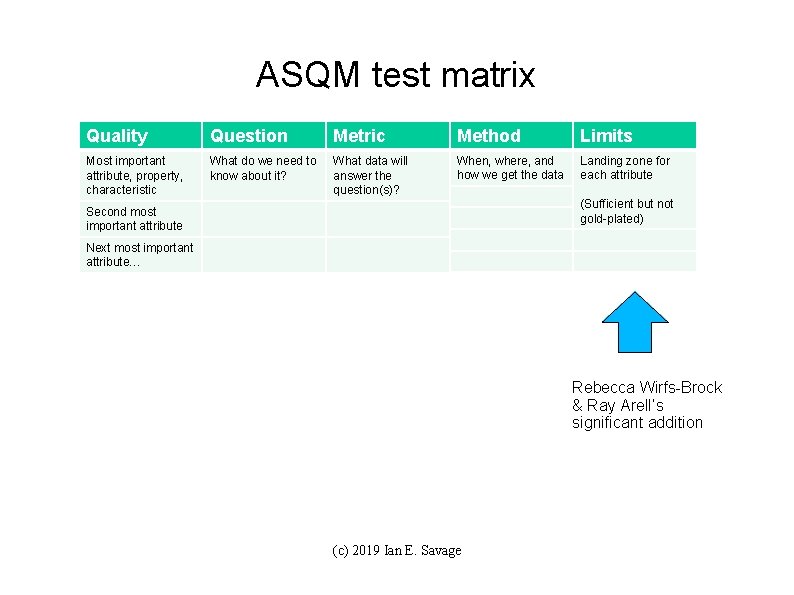
ASQM test matrix Quality Question Metric Method Limits Most important attribute, property, characteristic What do we need to know about it? What data will answer the question(s)? When, where, and how we get the data Landing zone for each attribute (Sufficient but not gold-plated) Second most important attribute Next most important attribute… Rebecca Wirfs-Brock & Ray Arell’s significant addition (c) 2019 Ian E. Savage
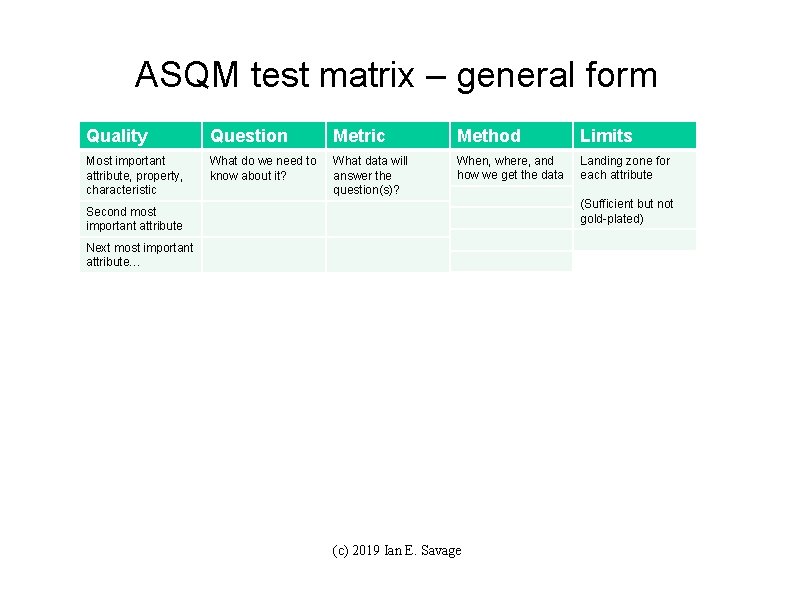
ASQM test matrix – general form Quality Question Metric Method Limits Most important attribute, property, characteristic What do we need to know about it? What data will answer the question(s)? When, where, and how we get the data Landing zone for each attribute (Sufficient but not gold-plated) Second most important attribute Next most important attribute… (c) 2019 Ian E. Savage
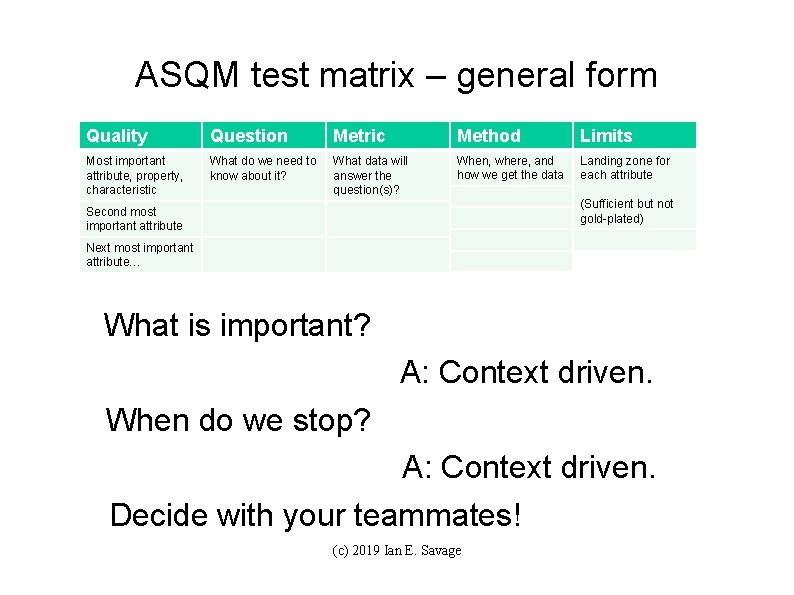
ASQM test matrix – general form Quality Question Metric Method Limits Most important attribute, property, characteristic What do we need to know about it? What data will answer the question(s)? When, where, and how we get the data Landing zone for each attribute (Sufficient but not gold-plated) Second most important attribute Next most important attribute… What is important? A: Context driven. When do we stop? A: Context driven. Decide with your teammates! (c) 2019 Ian E. Savage
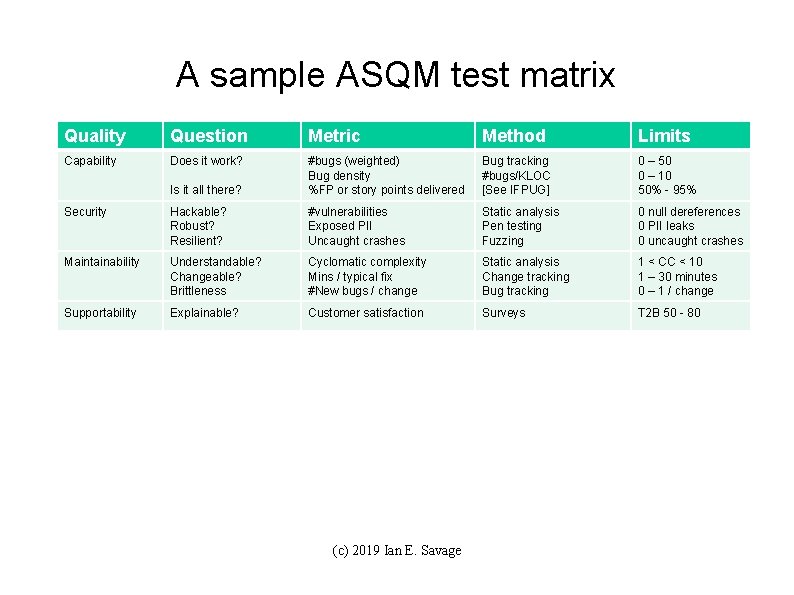
A sample ASQM test matrix Quality Question Metric Method Limits Capability Does it work? Is it all there? #bugs (weighted) Bug density %FP or story points delivered Bug tracking #bugs/KLOC [See IFPUG] 0 – 50 0 – 10 50% - 95% Security Hackable? Robust? Resilient? #vulnerabilities Exposed PII Uncaught crashes Static analysis Pen testing Fuzzing 0 null dereferences 0 PII leaks 0 uncaught crashes Maintainability Understandable? Changeable? Brittleness Cyclomatic complexity Mins / typical fix #New bugs / change Static analysis Change tracking Bug tracking 1 < CC < 10 1 – 30 minutes 0 – 1 / change Supportability Explainable? Customer satisfaction Surveys T 2 B 50 - 80 (c) 2019 Ian E. Savage
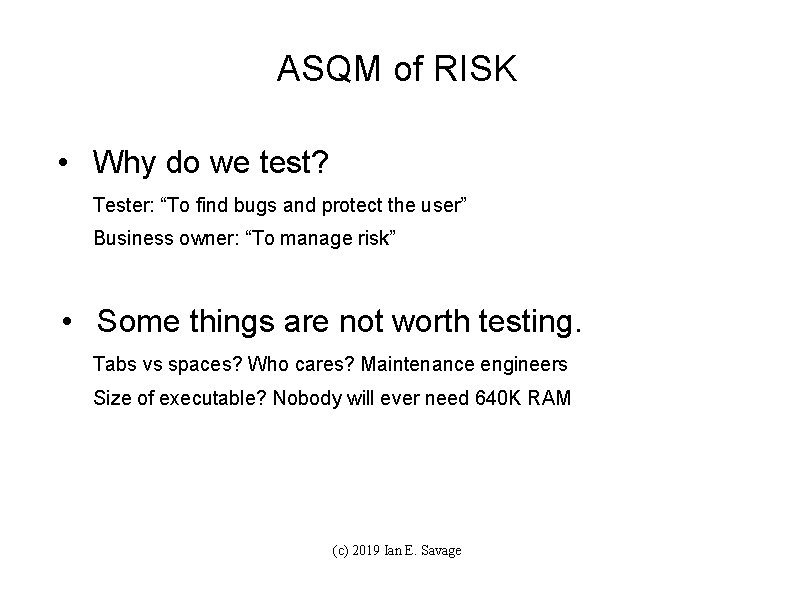
ASQM of RISK • Why do we test? Tester: “To find bugs and protect the user” Business owner: “To manage risk” • Some things are not worth testing. Tabs vs spaces? Who cares? Maintenance engineers Size of executable? Nobody will ever need 640 K RAM (c) 2019 Ian E. Savage
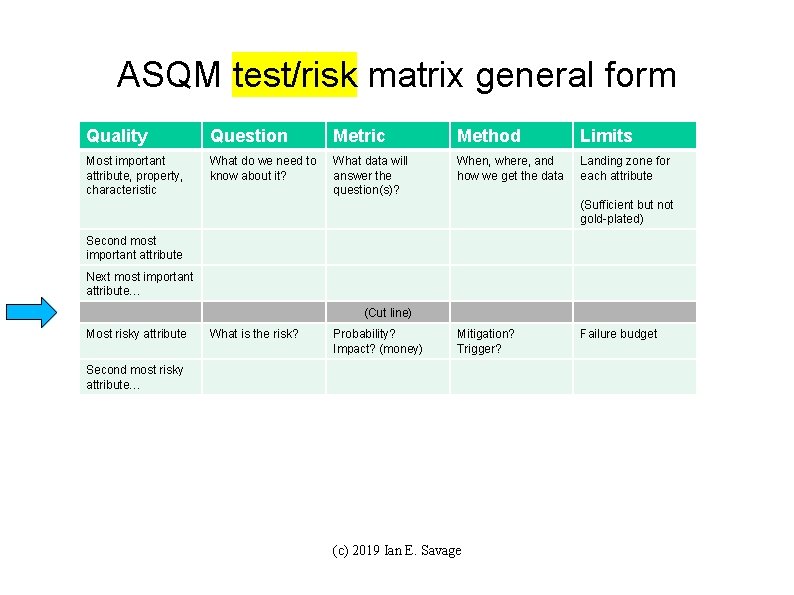
ASQM test/risk matrix general form Quality Question Metric Method Limits Most important attribute, property, characteristic What do we need to know about it? What data will answer the question(s)? When, where, and how we get the data Landing zone for each attribute (Sufficient but not gold-plated) Second most important attribute Next most important attribute… (Cut line) Most risky attribute What is the risk? Probability? Impact? (money) Mitigation? Trigger? Second most risky attribute… (c) 2019 Ian E. Savage Failure budget
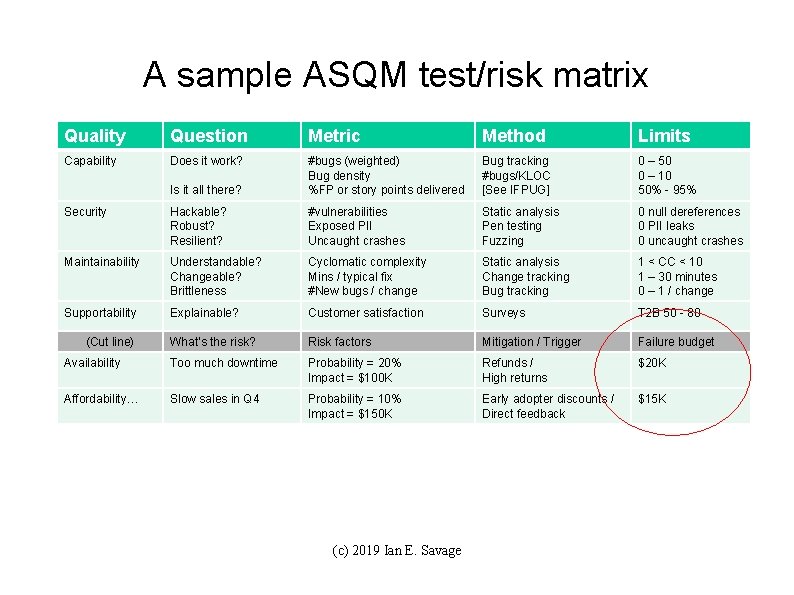
A sample ASQM test/risk matrix Quality Question Metric Method Limits Capability Does it work? Is it all there? #bugs (weighted) Bug density %FP or story points delivered Bug tracking #bugs/KLOC [See IFPUG] 0 – 50 0 – 10 50% - 95% Security Hackable? Robust? Resilient? #vulnerabilities Exposed PII Uncaught crashes Static analysis Pen testing Fuzzing 0 null dereferences 0 PII leaks 0 uncaught crashes Maintainability Understandable? Changeable? Brittleness Cyclomatic complexity Mins / typical fix #New bugs / change Static analysis Change tracking Bug tracking 1 < CC < 10 1 – 30 minutes 0 – 1 / change Supportability Explainable? Customer satisfaction Surveys T 2 B 50 - 80 What’s the risk? Risk factors Mitigation / Trigger Failure budget Availability Too much downtime Probability = 20% Impact = $100 K Refunds / High returns $20 K Affordability… Slow sales in Q 4 Probability = 10% Impact = $150 K Early adopter discounts / Direct feedback $15 K (Cut line) (c) 2019 Ian E. Savage
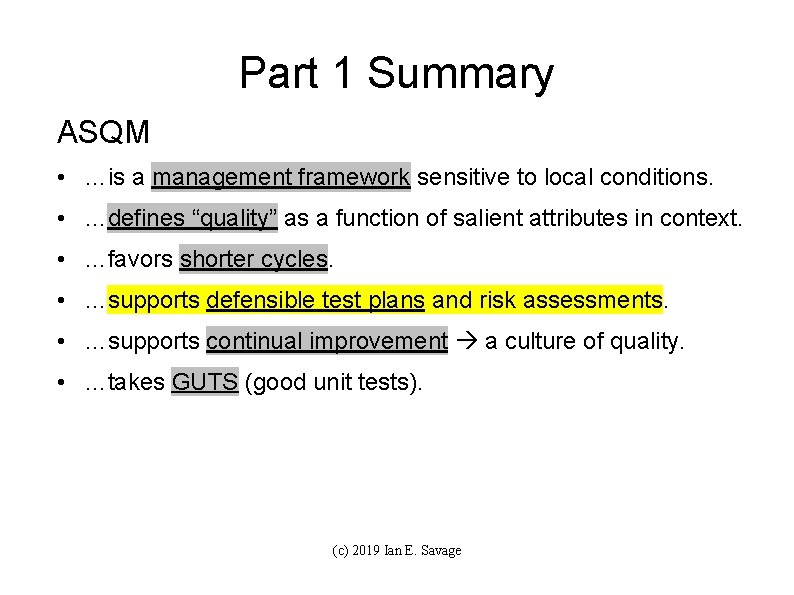
Part 1 Summary ASQM • …is a management framework sensitive to local conditions. • …defines “quality” as a function of salient attributes in context. • …favors shorter cycles. • …supports defensible test plans and risk assessments. • …supports continual improvement a culture of quality. • …takes GUTS (good unit tests). (c) 2019 Ian E. Savage
ASQM Part 2 Iron Triangle demise: Project constraints are product variables, too. (c) 2019 Ian E. Savage
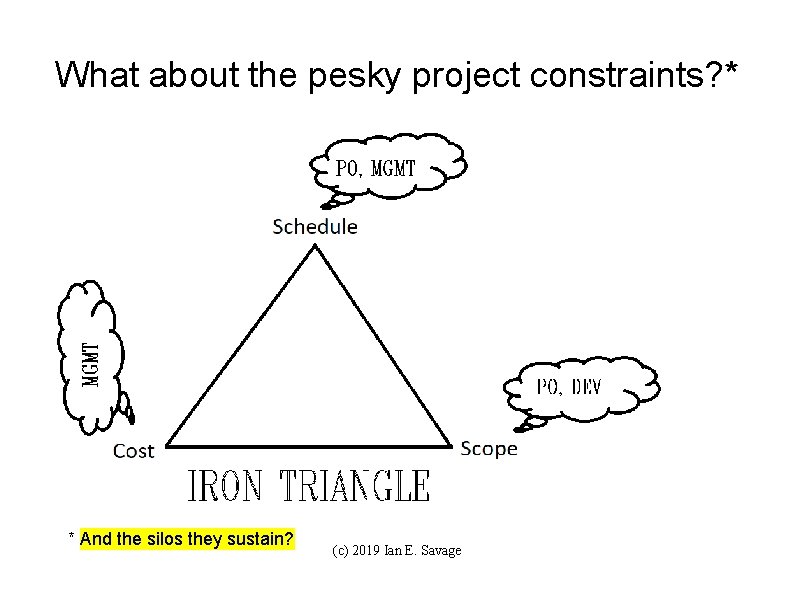
What about the pesky project constraints? * * And the silos they sustain? (c) 2019 Ian E. Savage
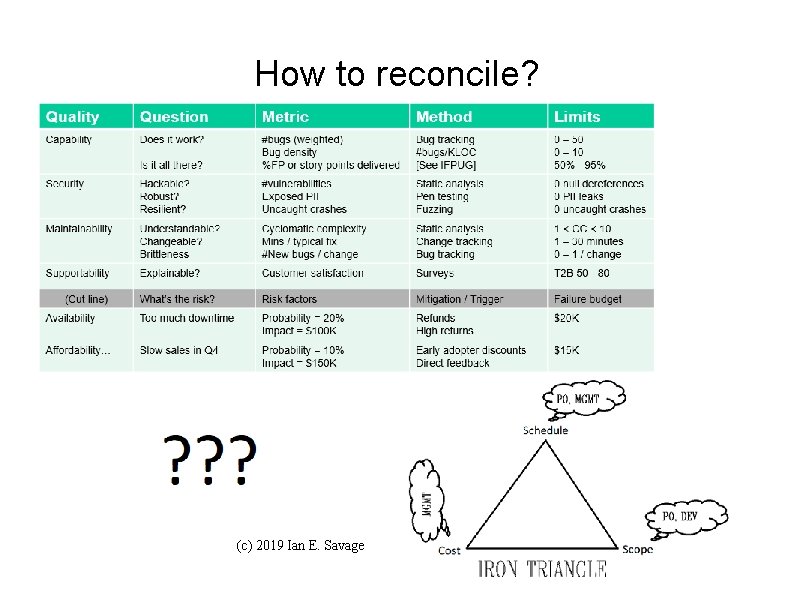
How to reconcile? (c) 2019 Ian E. Savage
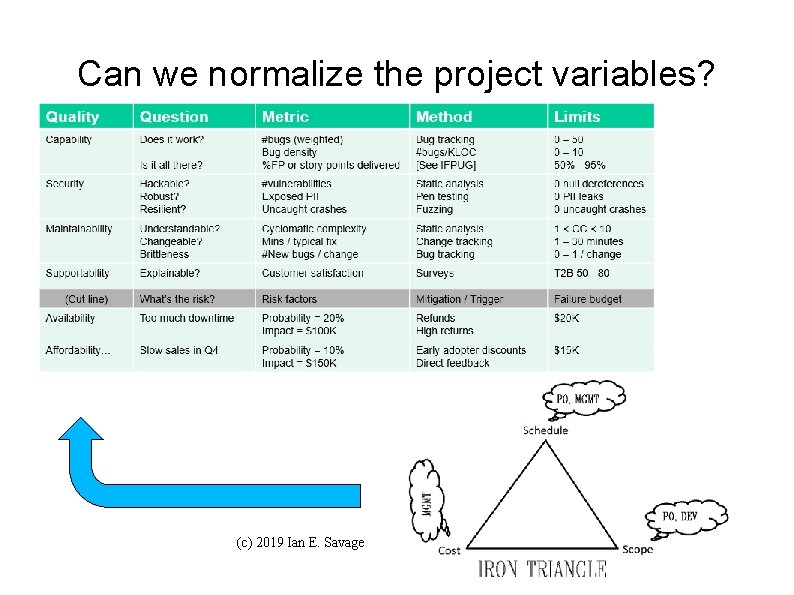
Can we normalize the project variables? (c) 2019 Ian E. Savage
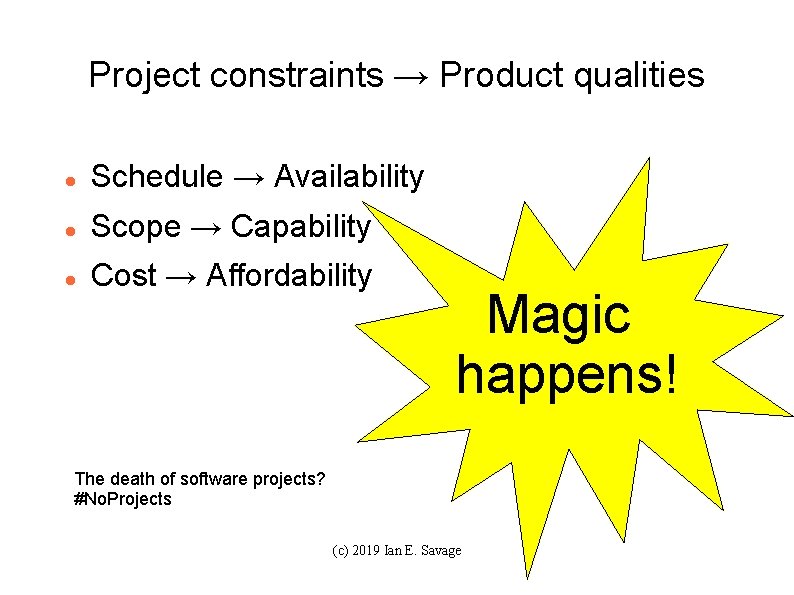
Project constraints → Product qualities Schedule → Availability Scope → Capability Cost → Affordability Magic happens! The death of software projects? #No. Projects (c) 2019 Ian E. Savage
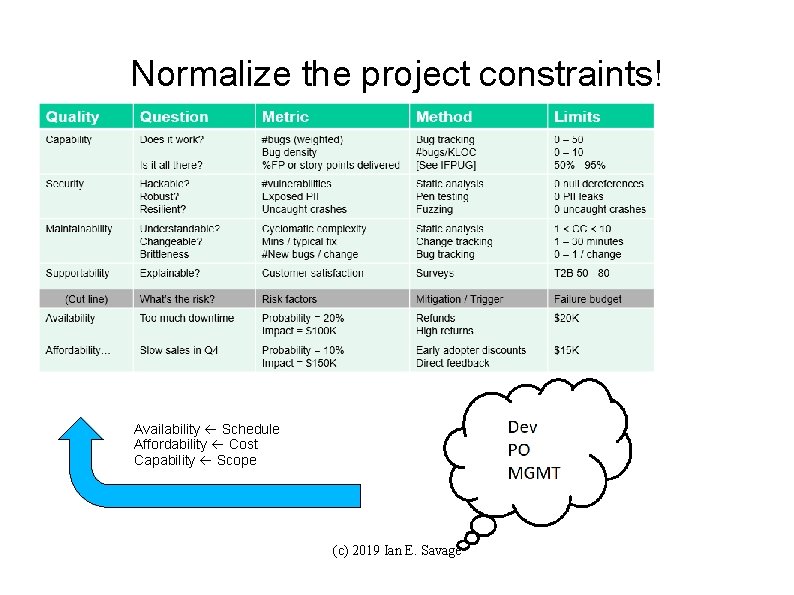
Normalize the project constraints! Availability Schedule Affordability Cost Capability Scope (c) 2019 Ian E. Savage
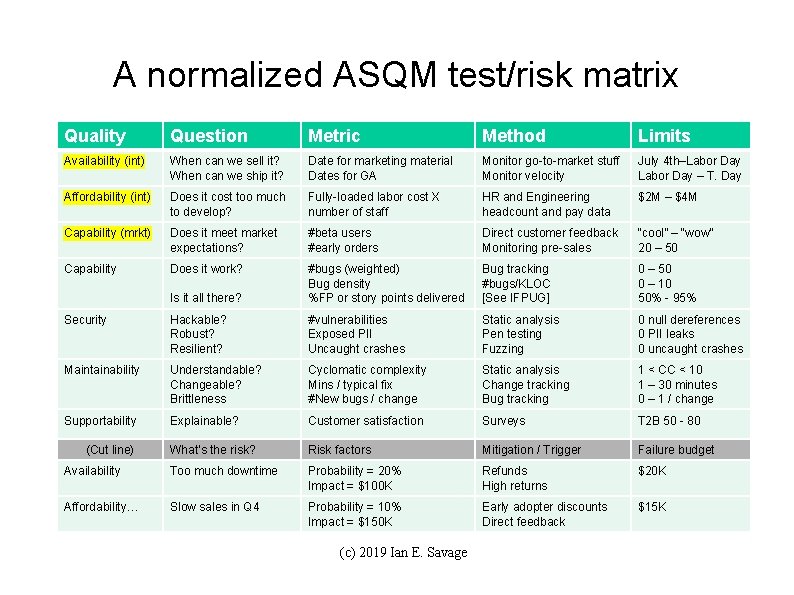
A normalized ASQM test/risk matrix Quality Question Metric Method Limits Availability (int) When can we sell it? When can we ship it? Date for marketing material Dates for GA Monitor go-to-market stuff Monitor velocity July 4 th–Labor Day – T. Day Affordability (int) Does it cost too much to develop? Fully-loaded labor cost X number of staff HR and Engineering headcount and pay data $2 M – $4 M Capability (mrkt) Does it meet market expectations? #beta users #early orders Direct customer feedback Monitoring pre-sales “cool” – “wow” 20 – 50 Capability Does it work? Is it all there? #bugs (weighted) Bug density %FP or story points delivered Bug tracking #bugs/KLOC [See IFPUG] 0 – 50 0 – 10 50% - 95% Security Hackable? Robust? Resilient? #vulnerabilities Exposed PII Uncaught crashes Static analysis Pen testing Fuzzing 0 null dereferences 0 PII leaks 0 uncaught crashes Maintainability Understandable? Changeable? Brittleness Cyclomatic complexity Mins / typical fix #New bugs / change Static analysis Change tracking Bug tracking 1 < CC < 10 1 – 30 minutes 0 – 1 / change Supportability Explainable? Customer satisfaction Surveys T 2 B 50 - 80 What’s the risk? Risk factors Mitigation / Trigger Failure budget Availability Too much downtime Probability = 20% Impact = $100 K Refunds High returns $20 K Affordability… Slow sales in Q 4 Probability = 10% Impact = $150 K Early adopter discounts Direct feedback $15 K (Cut line) (c) 2019 Ian E. Savage
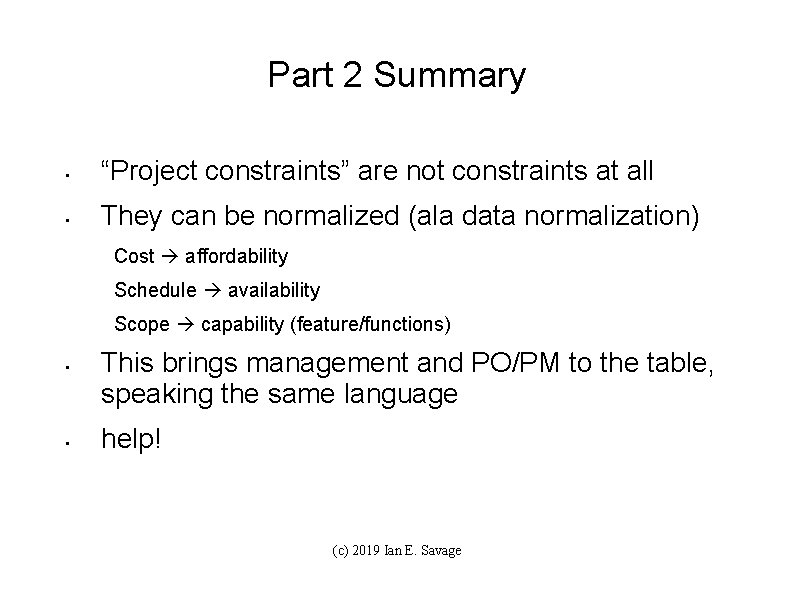
Part 2 Summary • “Project constraints” are not constraints at all • They can be normalized (ala data normalization) Cost affordability Schedule availability Scope capability (feature/functions) • • This brings management and PO/PM to the table, speaking the same language help! (c) 2019 Ian E. Savage
ASQM Part 3 Flow stuff: Smaller increments are better (c) 2019 Ian E. Savage
Scaling goes both ways SAFe® is one way to scale up Well-defined interfaces for multi-team projects Many implementation details What happens when we scale down? Fewer things change, less code churn Better communication between humans At a certain point, the work begins to flow evenly Fewer work-in-progress items Fewer queues (c) 2019 Ian E. Savage
Tale of Three Teams Project B. I. G. Lots of specialization, lots of changes SAFe® implementation in progress Project Middling Smaller team, smaller scope Scrum Flow / Mob programming Driver, navigator, mobber, anthropologist (c) 2019 Ian E. Savage
Tale of Three Teams Project B. I. G. Specialization: Lots Change / Churn Product: Lots Personnel: Lots Structure Project managers, architects, devs, sales, … CSRs Proscribed and static Outcomes: Poor / Mixed (c) 2019 Ian E. Savage
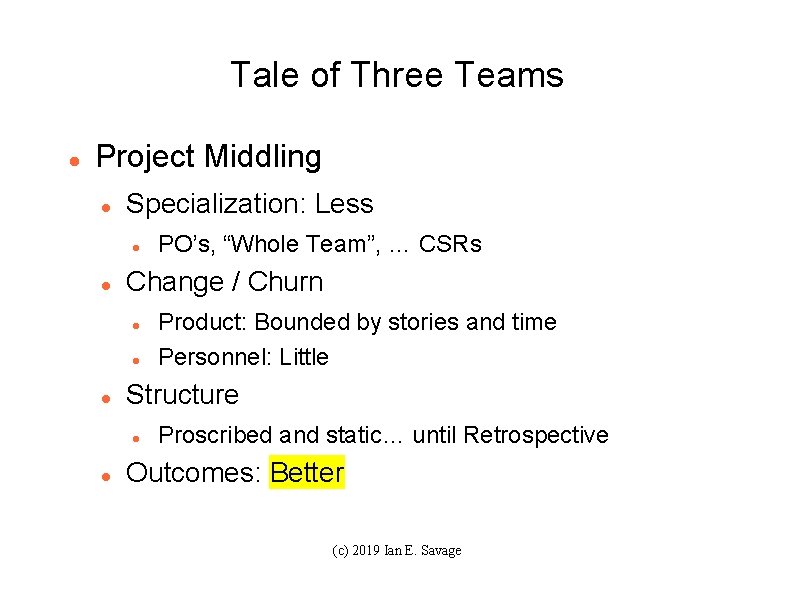
Tale of Three Teams Project Middling Specialization: Less Change / Churn Product: Bounded by stories and time Personnel: Little Structure PO’s, “Whole Team”, … CSRs Proscribed and static… until Retrospective Outcomes: Better (c) 2019 Ian E. Savage
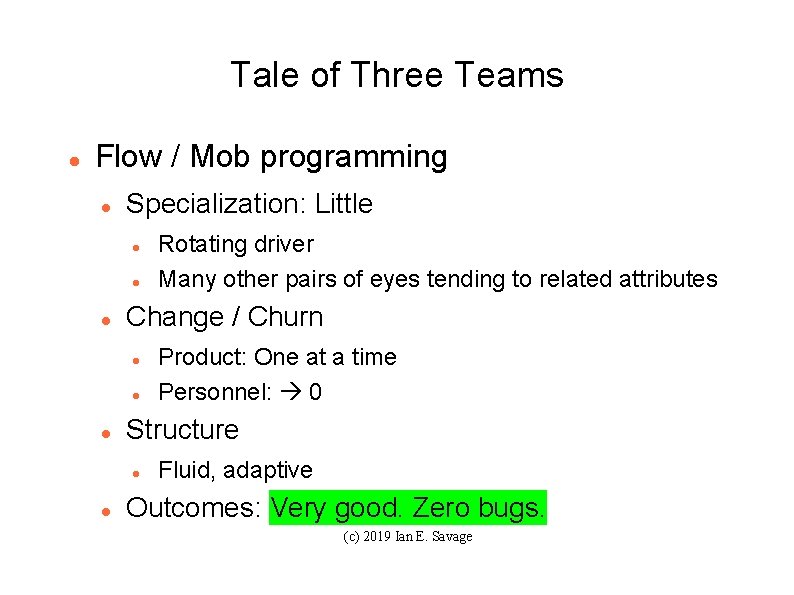
Tale of Three Teams Flow / Mob programming Specialization: Little Change / Churn Product: One at a time Personnel: 0 Structure Rotating driver Many other pairs of eyes tending to related attributes Fluid, adaptive Outcomes: Very good. Zero bugs. (c) 2019 Ian E. Savage
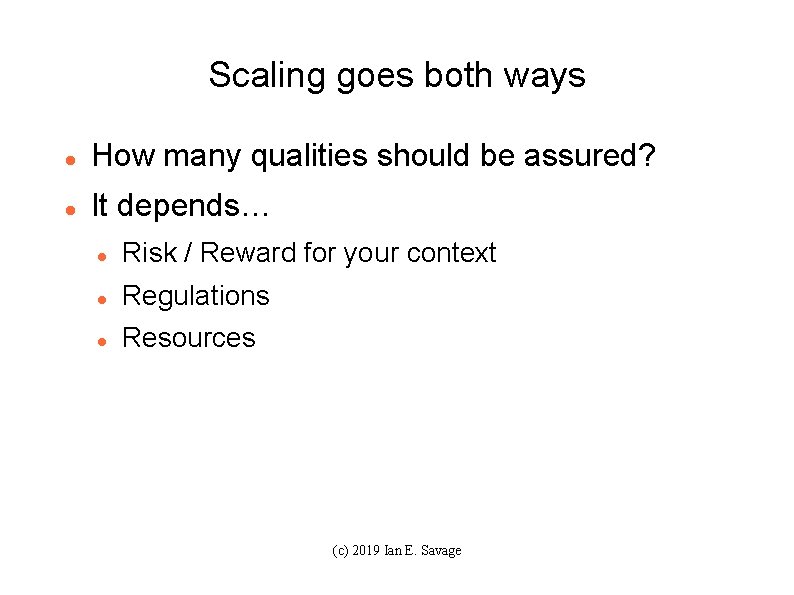
Scaling goes both ways How many qualities should be assured? It depends… Risk / Reward for your context Regulations Resources (c) 2019 Ian E. Savage
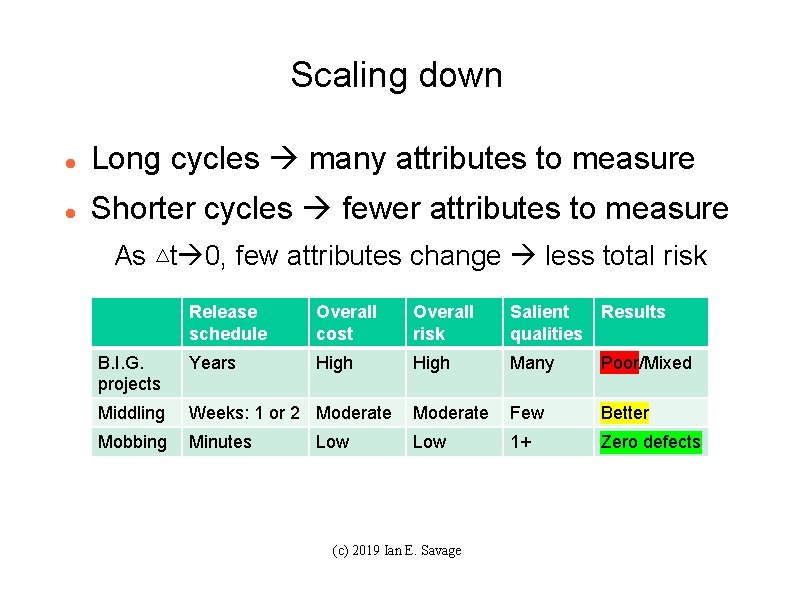
Scaling down Long cycles many attributes to measure Shorter cycles fewer attributes to measure As t 0, few attributes change less total risk Release schedule Overall cost Overall risk Salient Results qualities B. I. G. projects Years High Many Poor/Mixed Middling Weeks: 1 or 2 Moderate Few Better Mobbing Minutes Low 1+ Zero defects Low (c) 2019 Ian E. Savage
Other advantages of short cycles Fewer attributes to qualify faster delivery Big upfront planning not needed, less idle time Direct management involvement is possible Teams are more productive and happier Issues are seen and handled in real time Few large-scale, intractable problems (c) 2019 Ian E. Savage
Quality tradeoffs then become common: “It’s fast and feature-rich, but I cannot afford it. ” [performance, capability, affordability] “It still works, but we cannot change the source code. ” [reliability, maintainability] “If we add more features, our users will love it, but the buyers will revolt. ” [usability, marketability] (c) 2019 Ian E. Savage
ASQM recasts quality With ASQM, quality planning… precedes coding and drives engineering with just enough formality and shifts focus away from mere functionality. With ASQM risk management. . . you explore and actively manage your risks your highest priority qualities get measured your lower priority qualities get monitored Help! (c) 2019 Ian E. Savage
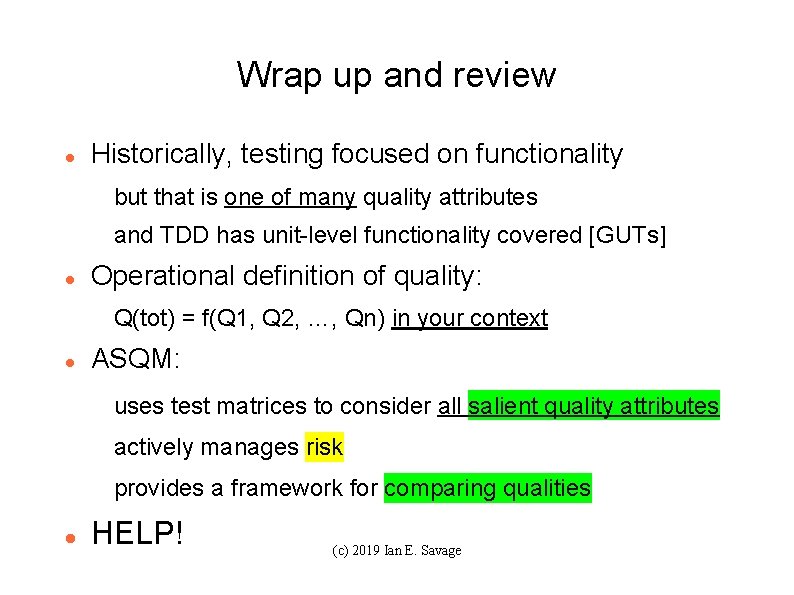
Wrap up and review Historically, testing focused on functionality but that is one of many quality attributes and TDD has unit-level functionality covered [GUTs] Operational definition of quality: Q(tot) = f(Q 1, Q 2, …, Qn) in your context ASQM: uses test matrices to consider all salient quality attributes actively manages risk provides a framework for comparing qualities HELP! (c) 2019 Ian E. Savage
That’s all folks. IESavage@yahoo. com IESavage 0000@gmail. com (c) 2019 Ian E. Savage
- Slides: 41