
Wel Come DE BROGLIE HYPOTHESIS B Sc III

Wel - Come
DE BROGLIE HYPOTHESIS B. Sc. III, Paper XV ( V Semester) By Dr. Shitre A. R. Head, Department of Physics, Yashwantrao Chavan Mahavidyalaya, Tuljapur.
Nature of a particle • A particle is specified by mass m, velocity v, momentum p, and energy E • A particle occupies a definite position in space. In order for that it must be small
Light • Interference and Diffraction experiments showed the wave nature of light • Blackbody radiation and Photoelectric effect can be explained only by considering light as a stream of particles
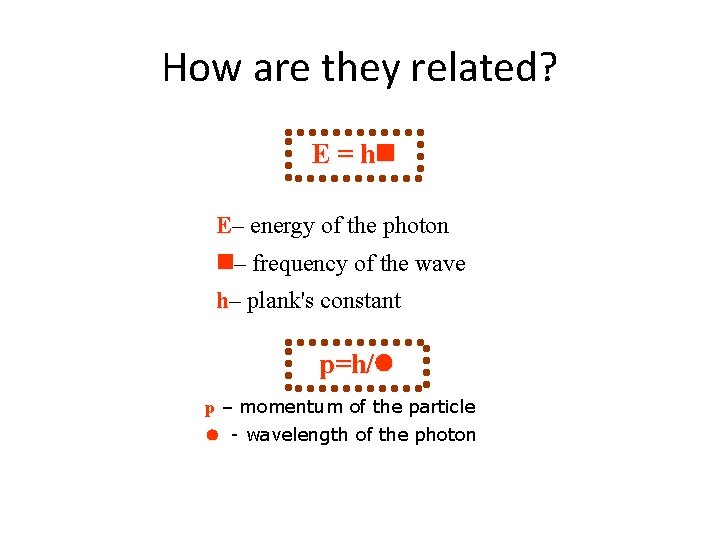
How are they related? E = h E– energy of the photon – frequency of the wave h– plank's constant p=h/ p – momentum of the particle - wavelength of the photon
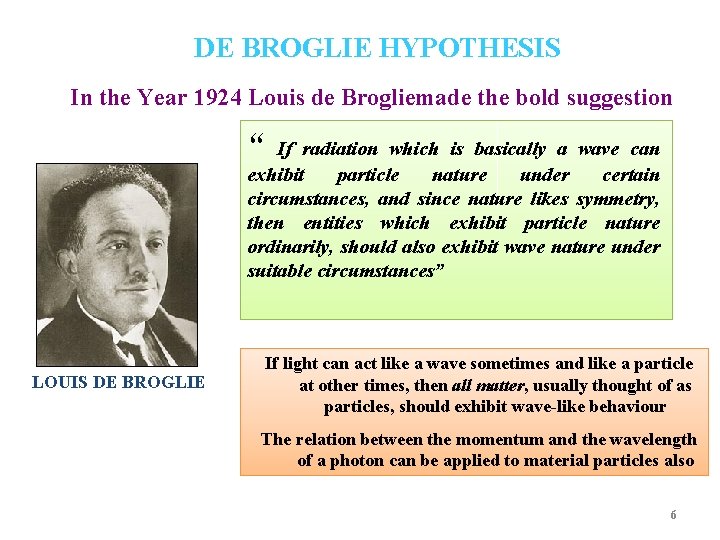
DE BROGLIE HYPOTHESIS In the Year 1924 Louis de Brogliemade the bold suggestion “ If radiation which is basically a wave can exhibit particle nature under certain circumstances, and since nature likes symmetry, then entities which exhibit particle nature ordinarily, should also exhibit wave nature under suitable circumstances” LOUIS DE BROGLIE If light can act like a wave sometimes and like a particle at other times, then all matter, matter usually thought of as particles, should exhibit wave-like behaviour The relation between the momentum and the wavelength of a photon can be applied to material particles also 6
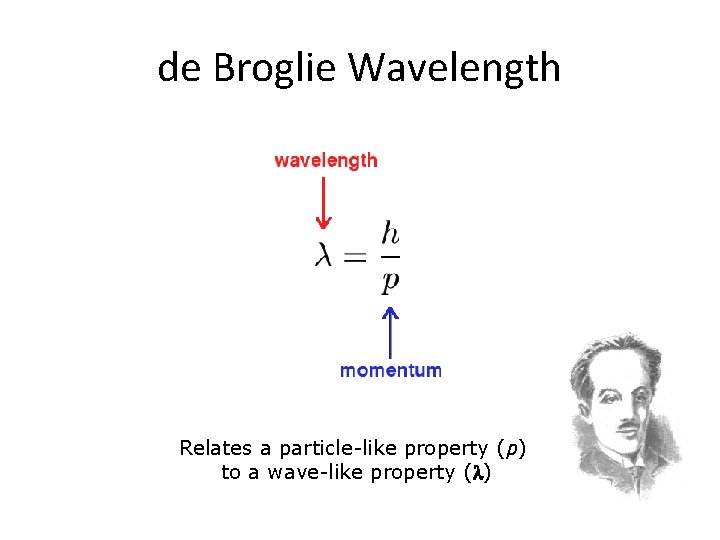
de Broglie Wavelength Relates a particle-like property (p) to a wave-like property (l)
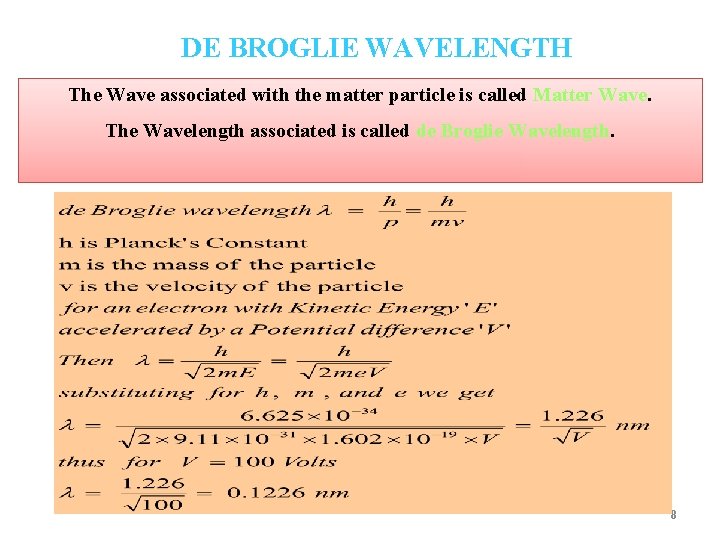
DE BROGLIE WAVELENGTH The Wave associated with the matter particle is called Matter Wave. The Wavelength associated is called de Broglie Wavelength. 8
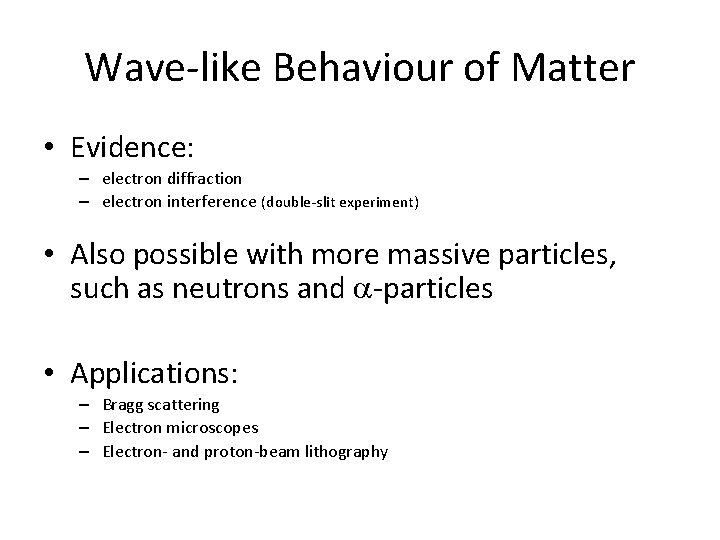
Wave-like Behaviour of Matter • Evidence: – electron diffraction – electron interference (double-slit experiment) • Also possible with more massive particles, such as neutrons and a-particles • Applications: – Bragg scattering – Electron microscopes – Electron- and proton-beam lithography
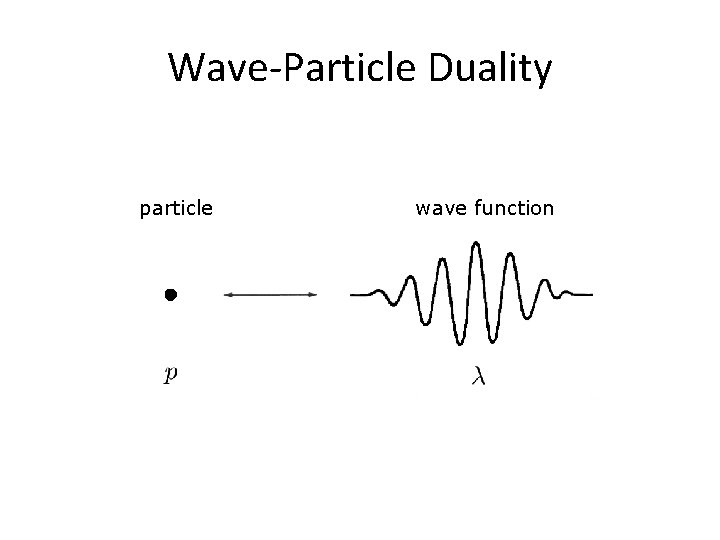
Wave-Particle Duality particle wave function

- Slides: 11