
Weinstein and Fantini Humanistic Model Gerald Weinstein and
- Slides: 12
Weinstein and Fantini: Humanistic Model Gerald Weinstein and Mario Fantini (1970) link socio-psychological factors with cognition so learners can deal with their problems and concerns. For this reason, these authors consider their model a “curriculum of affect. ” In viewing the model, some readers might consider it part of the behavioral, managerial, or administrative approach, but the model shifts from a deductive organization of curriculum to an inductive orientation from traditional content to relevant content.
Basic features of this model: • This is a curriculum of affect. • Emphasized on the human focus. • Objectives should address student’s concern, both personal and interpersonal. • Humanitarian curriculum provides space to develop student’s self-concepts and mature image of themselves as a citizen and a member of a human family. • This model highly emphasized on ‘I’ mean individual or individuals in curriculum.
• This model also recognized ‘education’ is the fully individualized process and expression of feelings of an individual. • The curriculum content organization are students concerns. Student are the heart of any instruction. • The curriculum developer are well accustomed about the individual process. • Curriculum content should be focused on the local needs and aspiration of the people.
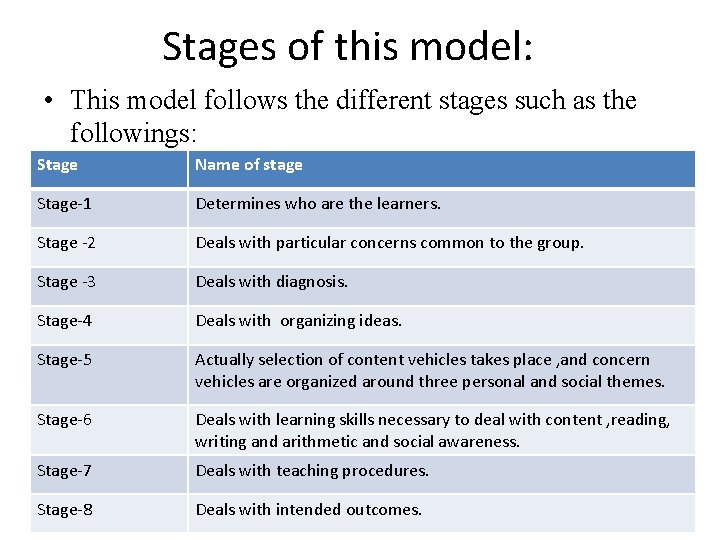
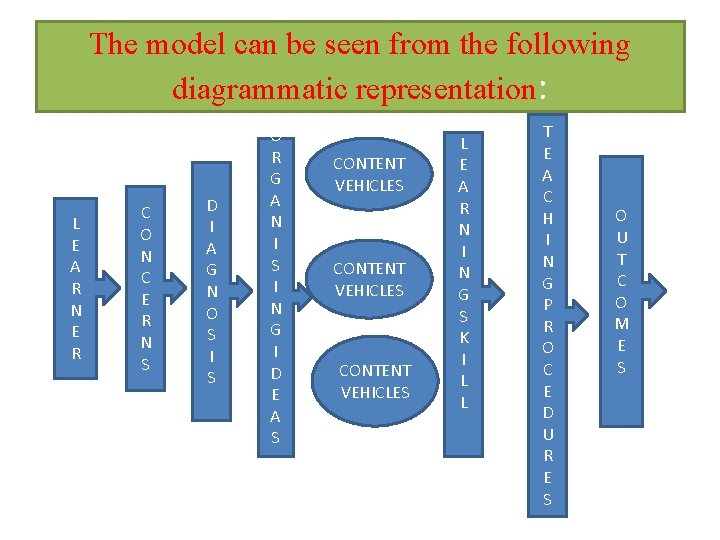
Stages of this model: • This model follows the different stages such as the followings: Stage Name of stage Stage-1 Determines who are the learners. Stage -2 Deals with particular concerns common to the group. Stage -3 Deals with diagnosis. Stage-4 Deals with organizing ideas. Stage-5 Actually selection of content vehicles takes place , and concern vehicles are organized around three personal and social themes. Stage-6 Deals with learning skills necessary to deal with content , reading, writing and arithmetic and social awareness. Stage-7 Deals with teaching procedures. Stage-8 Deals with intended outcomes.
The model can be seen from the following diagrammatic representation: L E A R N E R C O N C E R N S D I A G N O S I S O R G A N I S I N G I D E A S CONTENT VEHICLES L E A R N I N G S K I L L T E A C H I N G P R O C E D U R E S O U T C O M E S
• The first step is to identify the learners, their age, grade level, and common cultural and ethnic characteristics. Weinstein and Fantini are concerned with the group, as opposed to individuals, because most students are taught in groups. Therefore, knowledge of common characteristics and interests is considered prerequisite to differentiating and diagnosing individual problems.
• In the second step, the school determines the learners’ concerns and assesses the reasons for these concerns. Student concerns include the needs and interests of the learners, self-concepts, and self-image. Because concerns center on broad and persistent issues, they give the curriculum some consistency over time. • The third step, deals with diagnosis, the teacher attempts to develop strategies for instruction to meet learners’ concerns. Emphasis is on how students can gain greater control over their lives and feel more at ease with themselves. • In the fourth step, deals with organizing ideas. The teacher should select themes and topics around learners’ concerns rather than on the demands of subject matter. The concepts and skills to be taught should help the learners cope with their concerns.
• Fifth step, The content is organized around three major principles, or what Weinstein and Fantini call vehicles: life experiences of the learners, attitudes and feelings of the learners, and the social context in which they live. These three types of content influence the concepts, skills, and values that are taught in the classroom, and they form the basis for the “curriculum of affect. ”
• Sixth step: Deals with learning skills. According to the authors, learning skills include the basic skill of learning how to learn which in turn increases learners’ coping activity and power over their environment. Learning skills also help students deal with the content vehicles and problem solving in different subject areas. Self-awareness skills and personal skills are recommended, too, to help students deal with their own feelings and how they relate to other people.
• Seven Step: Teaching procedures are developed for learning skills, content vehicles, and organizing ideas. Teaching procedures should match the learning styles on their common characteristics and concerns (the first two steps). • In the last step, (8 step) the teacher evaluates the outcomes of the curriculum: cognitive and affective objectives. This evaluation component is similar to the evaluation components of deductive models. It deals with the intended outcomes. Here the interest and likes are asked: • A) Are the content vehicles achieved? • B) Are the learner’s skills and teaching procudire effective? • C) How can the curriculum be improved?
Conclusion • This model is based on the belief that teachers generate new content, new ideas and teaching techniques by keeping the learner central to the whole process. They can assess the relevance of the existing curriculum, content and the instructional methods employed. Based on the assessment the curriculum is modified to meet the learner needs.
References • • • Fred C. Lunenburg(2011) Curriculum Development: Inductive Models, Beauchamp, G. A. (1981). Curriculum theory (4 th ed. ). Itasca, IL: Peacock. Durkin, M. C. (1993). Thinking through class discussion: The Hilda Taba approach. Lancaster, PA: Technomic. Eisner, E. W. (1991). Should America have a national curriculum? Educational Leadership, 49, 76 -81. Oliva, P. F. (2009). Developing the curriculum (7 th ed. ). Boston, MA: Allyn & Bacon. Saylor, J. G. , Alexander, W. M. , & Lewis, A. J. (1981). Curriculum planning for better teaching and learning (4 th ed. ). New York, NY: Holt, Rinehart & Winston. Taba, H. (1962). Curriculum development: theory and practice. New York, NY: Harcourt, Brace & World. Taba, H. (1971). Teacher’s handbook for elementary social studies. Reading, MA: Addison-Wesley. Tyler, R. W. (1949). Basic principles of curriculum and instruction. Chicago, IL: University of Chicago Press. Walker, D. F. (1971). A naturalistic model for curriculum development. School Review, 80(1), 51 -67. Weinstein, G. , & Fantini, M. D. (1970). Toward humanistic education. New York, NY: Praeger.