
Weighted Average Cost of Capital WACC What is


- Slides: 27
Weighted Average Cost of Capital (WACC)
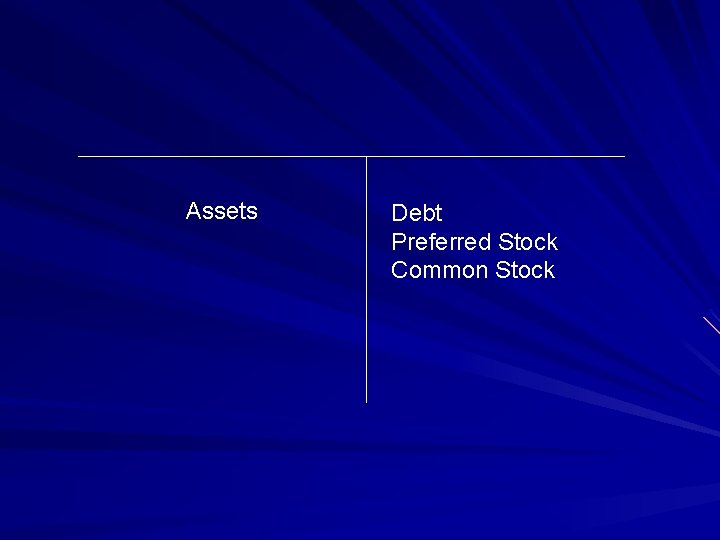
What is WACC? WACC is the cost of capital for a business that raises capital from more than one source Public companies raise money by selling – – – Debt Preferred stock Common Stock WACC reflects the overall mix of securities in the capital structure
Assets Debt Preferred Stock Common Stock
Use of WACC is used as a discount rate for evaluating investment projects It is the ‘r’ for NPV calculations WACC reflects the risk of the entire company WACC is only appropriate to use when the project is of the same risk as the entire company
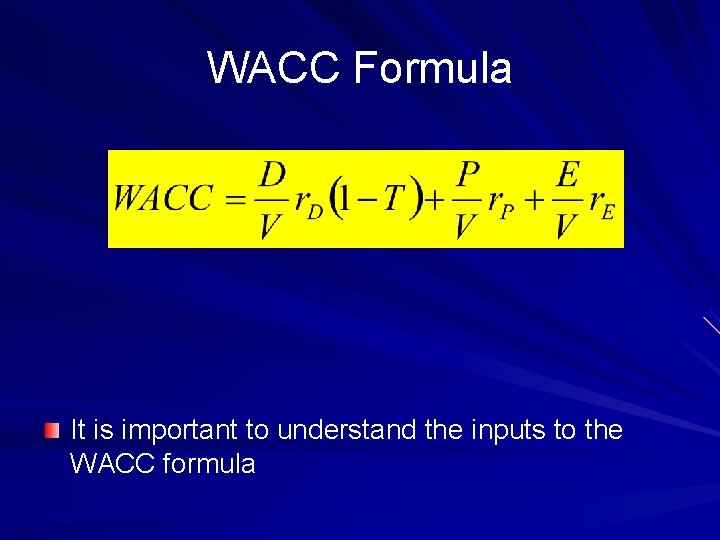
WACC Formula It is important to understand the inputs to the WACC formula
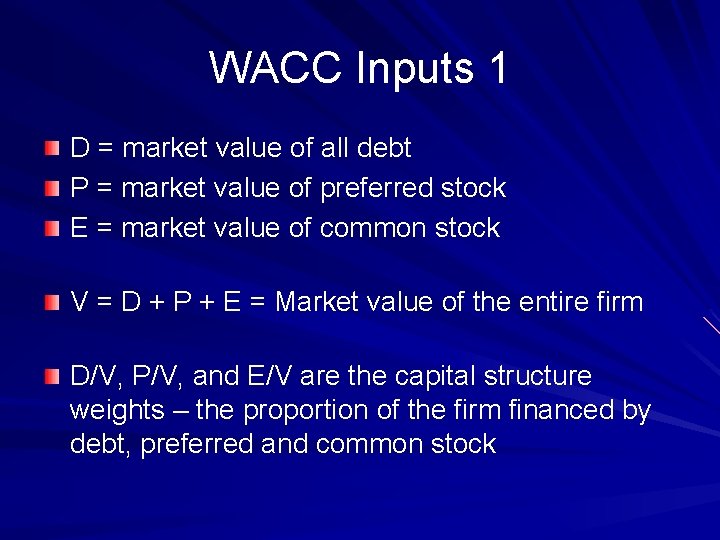
WACC Inputs 1 D = market value of all debt P = market value of preferred stock E = market value of common stock V = D + P + E = Market value of the entire firm D/V, P/V, and E/V are the capital structure weights – the proportion of the firm financed by debt, preferred and common stock
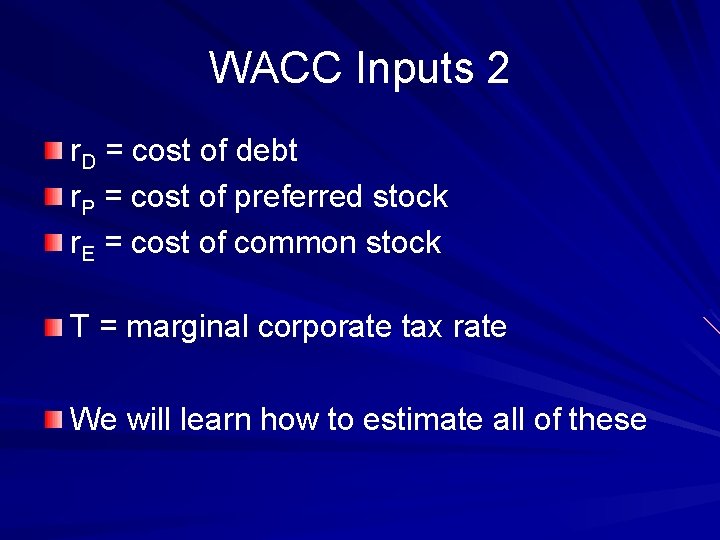
WACC Inputs 2 r. D = cost of debt r. P = cost of preferred stock r. E = cost of common stock T = marginal corporate tax rate We will learn how to estimate all of these
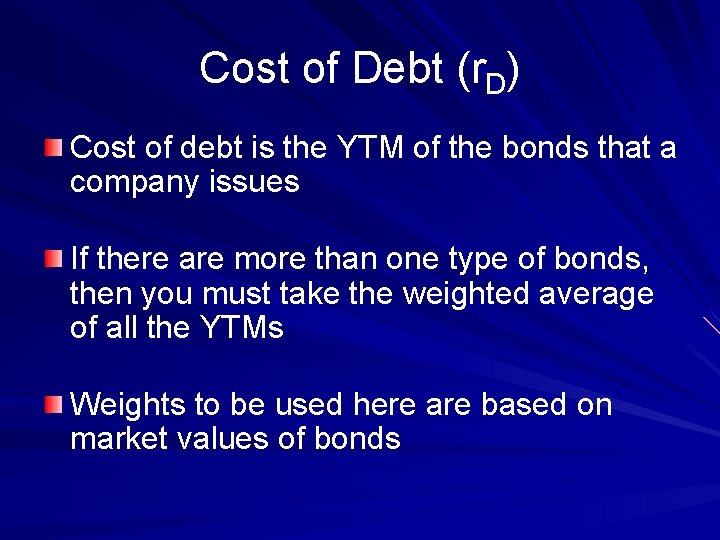
Cost of Debt (r. D) Cost of debt is the YTM of the bonds that a company issues If there are more than one type of bonds, then you must take the weighted average of all the YTMs Weights to be used here are based on market values of bonds
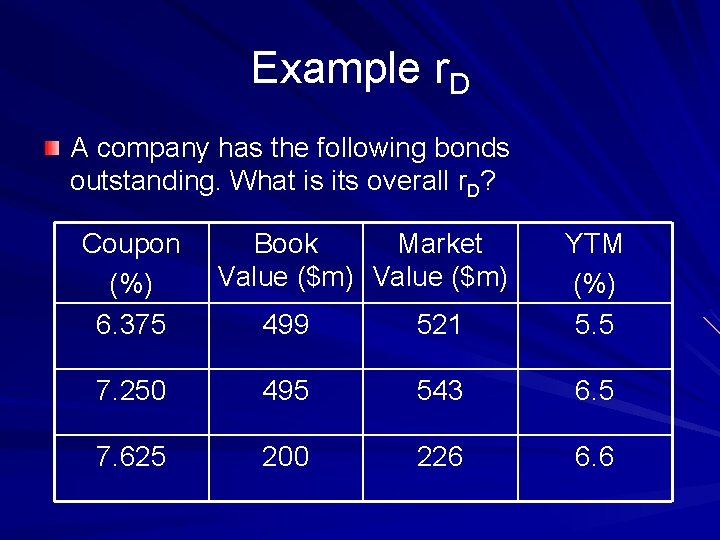
Example r. D A company has the following bonds outstanding. What is its overall r. D? Coupon (%) 6. 375 Book Market Value ($m) 499 521 YTM (%) 5. 5 7. 250 495 543 6. 5 7. 625 200 226 6. 6
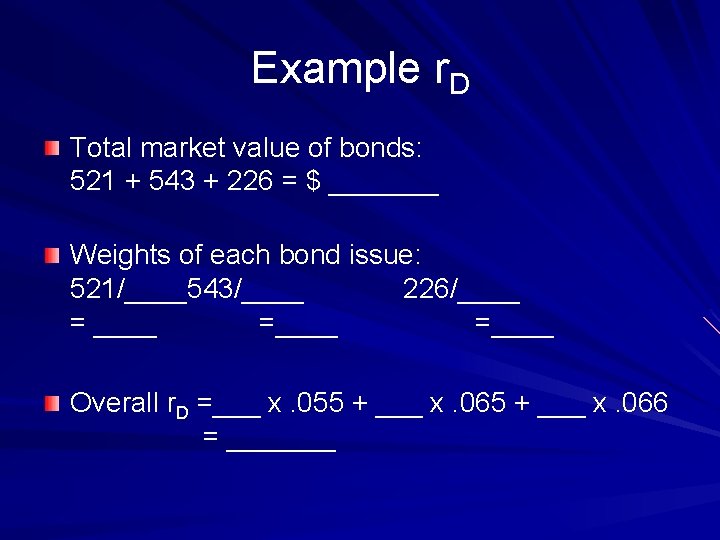
Example r. D Total market value of bonds: 521 + 543 + 226 = $ _______ Weights of each bond issue: 521/____543/____ 226/____ =____ Overall r. D =___ x. 055 + ___ x. 066 = _______
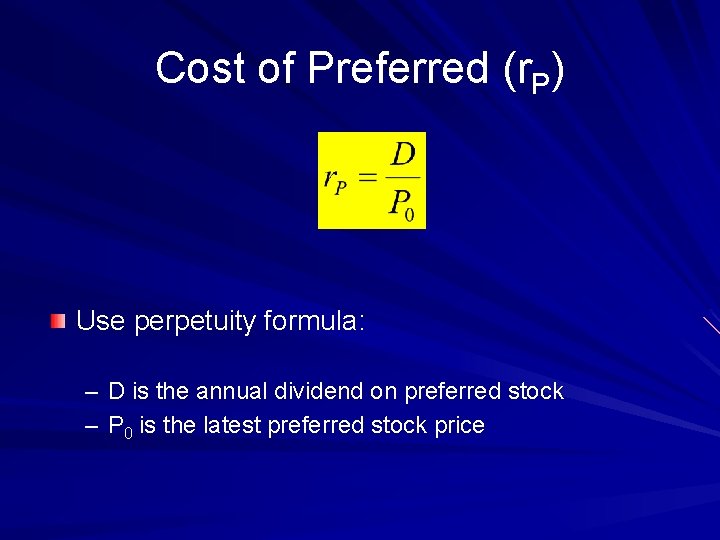
Cost of Preferred (r. P) Use perpetuity formula: – D is the annual dividend on preferred stock – P 0 is the latest preferred stock price
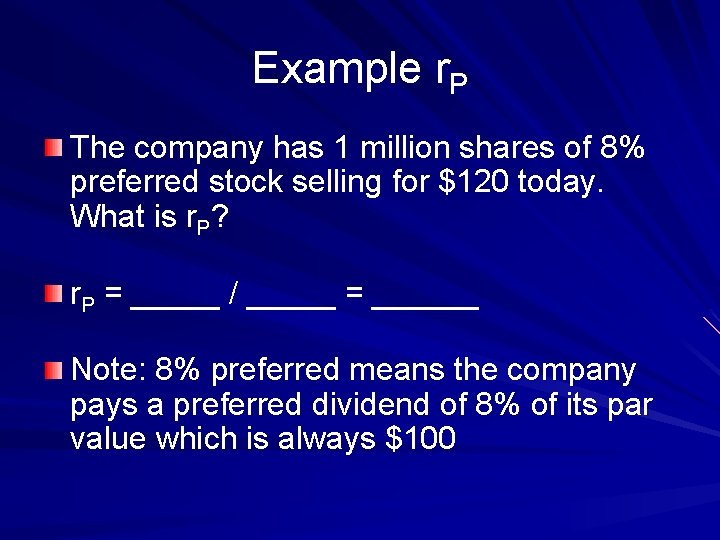
Example r. P The company has 1 million shares of 8% preferred stock selling for $120 today. What is r. P? r. P = _____ / _____ = ______ Note: 8% preferred means the company pays a preferred dividend of 8% of its par value which is always $100
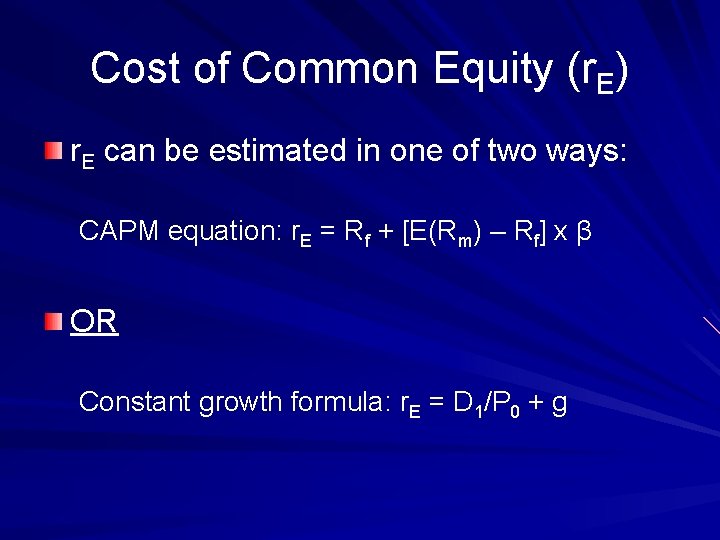
Cost of Common Equity (r. E) r. E can be estimated in one of two ways: CAPM equation: r. E = Rf + [E(Rm) – Rf] x β OR Constant growth formula: r. E = D 1/P 0 + g
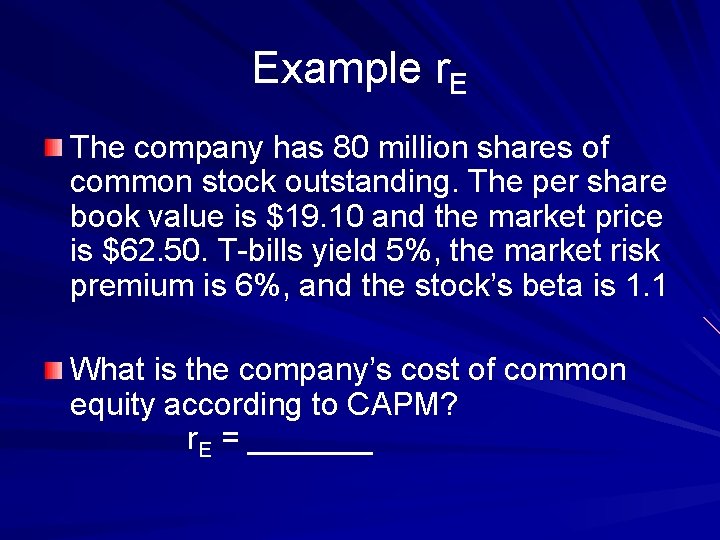
Example r. E The company has 80 million shares of common stock outstanding. The per share book value is $19. 10 and the market price is $62. 50. T-bills yield 5%, the market risk premium is 6%, and the stock’s beta is 1. 1 What is the company’s cost of common equity according to CAPM? r. E = _______
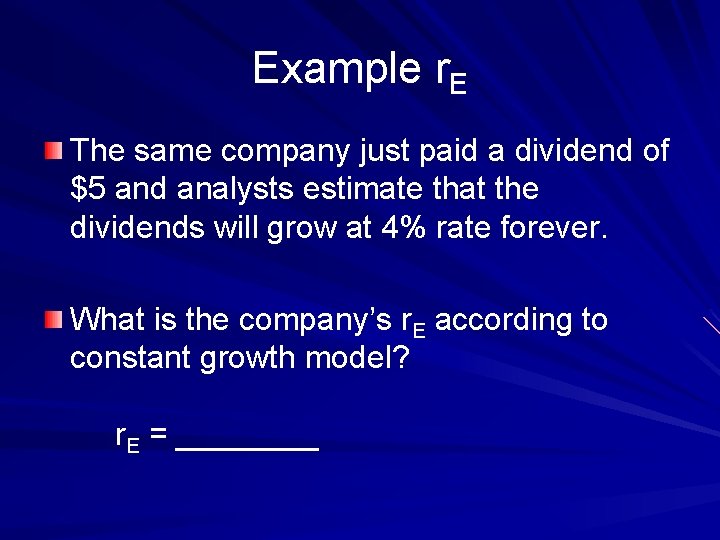
Example r. E The same company just paid a dividend of $5 and analysts estimate that the dividends will grow at 4% rate forever. What is the company’s r. E according to constant growth model? r. E = ____
Note on r. E Most companies do not have dividends growing at a constant rate forever It is better to use CAPM equation to estimate the cost of common equity You must use one of the two methods to estimate r. E Use caution when using constant growth method
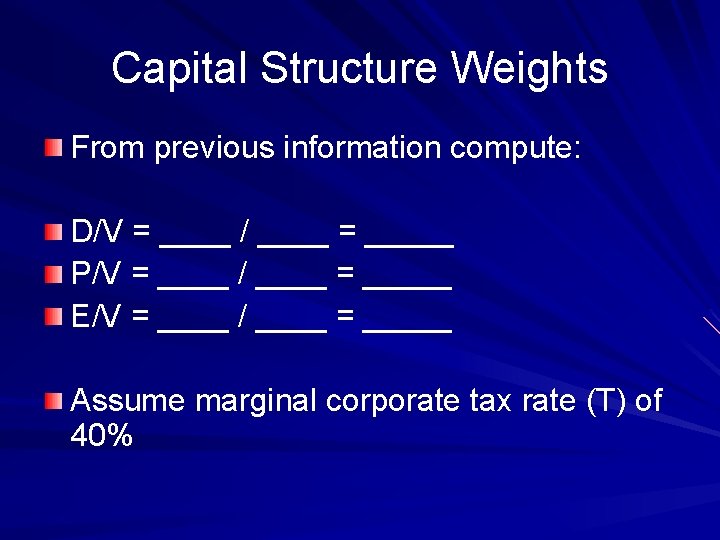
Capital Structure Weights From previous information compute: D/V = ____ / ____ = _____ P/V = ____ / ____ = _____ E/V = ____ / ____ = _____ Assume marginal corporate tax rate (T) of 40%
Putting it together… From previous information, what is the company’s WACC? Answer: WACC = ______
Things to remember All the inputs to WACC formula must be based on market values Sometimes market value of bond is difficult to obtain – In this case you may use book value as an approximation Stock prices are easy to obtain – never use book values!
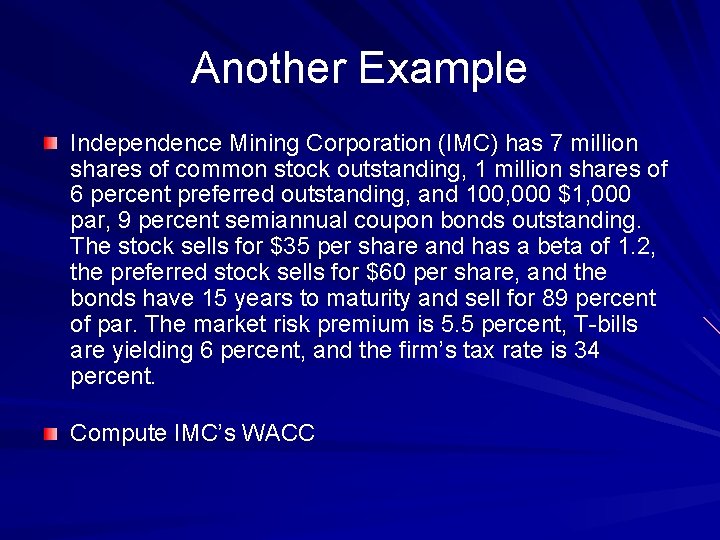
Another Example Independence Mining Corporation (IMC) has 7 million shares of common stock outstanding, 1 million shares of 6 percent preferred outstanding, and 100, 000 $1, 000 par, 9 percent semiannual coupon bonds outstanding. The stock sells for $35 per share and has a beta of 1. 2, the preferred stock sells for $60 per share, and the bonds have 15 years to maturity and sell for 89 percent of par. The market risk premium is 5. 5 percent, T-bills are yielding 6 percent, and the firm’s tax rate is 34 percent. Compute IMC’s WACC
Example continued If IMC is evaluating a mining expansion project that is as risky as the firm’s typical project, what rate should they use to discount the project’s cash flows? If IMC is thinking of going into shipping business, can it use the current WACC to discount the shipping project’s cash flows?
Caution on using WACC If a firm is considering a project that is substantially different in risk than the firms current operations it CANNOT use the WACC to evaluate this new project It must estimate WACC of other companies that are in the same line of business as the new project
The bottom line in finance In any discounting of cash flows ALWAYS USE A DISCOUNT RATE (r, in the denominator) THAT REFLECTS THE RISK OF THE CASH FLOWS (in the numerator)
Recap We started with TVM We always compare cash flows occuring at different times at the same point in time – compare apples with apples Value of ANY asset is simply the PV of ALL future cash flows For TVM you need cash flows and ‘r’
Recap Cash flows for different assets have different names: – For Stocks: cash flows are dividends – For Bonds: cash flows are interest/principal – For Projects: cash flows are project cash flows Cash flows often need to be estimated
Recap ‘r’ (in general, interest rate or discount rate) has different names for different assets: – For Stocks: required rate of return – For Bonds: yield – For Projects: cost of capital ‘r’ always depends on the riskiness of cash flows – according to CAPM, risk is measured by beta
What is finance? Understanding risk and return is a major part of finance Most of what we do in finance always comes back to understanding this simple tradeoff