
Weight Management Chapter 12 Learning Objectives Explain how
Weight Management Chapter 12
Learning Objectives �Explain how you gain or lose weight, and discuss at least two factors that play a role in the development of obesity. �Define overweight and obesity, and determine how much you should weigh. �Recognize risks of being obese. �Describe how to use the following components of a weight loss program to lose weight: eating plan, exercise, behavior and attitude modification, and support.
Introduction to Weight Management �Overweight and obesity are among the most pressing challenges in the United States. �In 2010, 18 percent of children ages 6 to 19 were obese. In the 1970 s, only 4 to 6 percent were obese. �More than double the number of adults were obese in 2010 when compared to the 1970 s.
What Is Kcalorie Balance? �Kcalorie balance refers to the relationship between the kcalories you take in from food and beverages and the kcalories you use through physical activity and your basal metabolism. �If kcalories consumed = kcalories used, then you maintain the same body weight. ◦ If you eat fewer kcalories than you use, then you lose weight. ◦ If you eat more kcalories than you use, then you gain weight.
Factors that play a role in obesity: �Behavioral—choices you make in eating and exercise �Cultural �Socioeconomic �Genetics �Other diseases/conditions � ◦ ◦ Environmental Increase in portion sizes Limited access to healthy affordable foods Lack of safe places to be active Greater availability of high kcalorie foods
How Much Should I Weigh? �Body Mass Index ◦ A measure of weight relative to height. ◦ A reasonably reliable indicator of total body fat— which is related to the risk of disease and death. Obese: BMI of 30 or greater Overweight: BMI of 25 to 29. 9 Ideal: BMI of 19 -24
How Much Should I Weigh? �Because BMI doesn’t tell you how much of your excess weight is fat, a physician will also measure your waist circumference. ◦ Women—desirable to keep waist below 35 inches ◦ Men—desirable to keep waist below 40 inches �Excessive abdominal fat is more healththreatening than fat in the hips or thighs. ◦ Because vital organs reside in the abdominal area, excess weight and pressure strains the heart, blood vessels and organs
Body Fat % �Body fat is usually measured through calipers and are related to the skin fold thickness �Since most fat resides under the skin, this is a better indicator then BMI or waist circumference ◦ For men—desirable percentage of body fat is under 25% �(22% if under 40 years of age) ◦ For women—desirable percentage of body fat is under 35% �(32% if under 40 years of age)
How Obesity Affects Your Health �An ◦ ◦ ◦ ◦ obese individual is at increased risk for: Type 2 diabetes High blood cholesterol levels High blood pressure Losing weight often Heart disease decreases blood pressure Stroke and cholesterol levels. Certain types of cancer Liver and gallbladder disease Sleep apnea
How to Lose Weight �You need to eat and drink fewer kcalories and/or burn more kcalories in physical activity. �Set a realistics weight loss goal—from ½ to 1 pound/week. �To lose 1 pound/week, you will need to cut back about 500 kcalories/day. �Even modest weight loss can produce health benefits—lower cholesterol, blood pressure, etc.
Eating Tips �No foods should be forbidden because that only makes them more attractive. �To cut kcalories without feeling hungry, you need to replace some higher kcalorie foods with foods that are lower in kcalories and fat and will fill you up—choose foods with lots of water and fiber such as fruits, vegetables, broth-based soups, whole grains, and legumes.
Eating Tips �Also eat smaller portions. �Pay more attention to how hungry you are rather than how much food is on the plate. �Don’t skip breakfast! �Low-fat and fat-free foods are not necessarily low in kcalories. �Avoid fried foods.
Eating Tips �Choose your carbohydrates carefully—pick fruits, vegetables, whole grains, and dairy. Fiber in these foods will help you feel full. Limit foods with added sugars and primarily white flour. �No foods can burn fat. �Drink plenty of fluids. �Watch out for empty kcalories in alcoholic beverages and mixers, as well as fancy coffee drinks.
Exercise �When losing weight, more physical activity increases the number of kcalories you body uses for energy—you burn more kcalories during the activity and also for a few hours after vigorous prolonged activity. �Dieters who exercise tend to lose more fat and retain more muscle. They are also more likely to follow their diet plans and keep the weight off.
Benefits of Exercise �Reduces high blood pressure �Reduces risk for type 2 diabetes, heart attack, stroke, and several forms of cancer �Reduces arthritis pain �Reduces risk for osteoporosis and falls �Reduces symptoms of depression and anxiety �Improves psychological well-being �Increases stamina and resistance to fatigue
How much exercise do you need to do? �To maintain your weight— 2½ hours of moderate intensity or 75 minutes of vigorous intensity each week �To lose weight— 250 to 300 minutes/week of moderate-intensity The optimal fitness routine includes aerobic training, strength-training, and stretching activities.
Exercise Moderate Intensity � Hiking � Yard work � Dancing � Golf (walking and carrying clubs) � Biking less than 10 mph � Walking 3. 5 mph � Weight training � Stretching Vigorous Intensity � Running � Biking over 10 mph � Swimming � Aerobics � Walking 4 mph � Heavy yard work � Weight lifting � Basketball (vigorous)
Modifying Eating Behaviors � Only let yourself eat in 1 or 2 places, such as at the kitchen or dining room table—don’t eat in bed, in front of TV, etc. � Plan regular meals and snack. � Eat slowly. � Take smaller bites—savor each bite. � Use a smaller plate—don’t clean your plate. � Reward yourself for positive steps—but don’t use food! � Pick something that is desirable and timely
Hot Topic: Weight Loss Myths �Fad diets are not the best way to lose weight and keep it off. ◦ Most fad diets are based on a loss of water weight �Starches are not necessarily fattening—many foods high in starch, such as whole grain bread, are low in fat and kcalories. �Reduced kcalorie diets result in weight loss regardless of whether they are low in carbohydrate, fat, or protein.
Hot Topic: Weight Loss Myths � No food can burn fat. � A low-fat or fat-free food may be lower in kcalories than the same size portion of the full-fat product, but many contain just as many kcalories. � Fast foods can be part of a healthy weight-loss program. ◦ Provided that it isnt consumed too often � Skipping breakfast does not help you lose weight. ◦ In fact, it does the opposite � In small amounts, nuts can be part of a healthy weightloss program.
Nutrition for All Ages Chapter 13
Learning Objectives Describe how to ensure enjoyable mealtimes with young children and teach them good eating habits. � Plan menus for preschool and school-age children and identify the nutrients that children are most likely to be lacking, their food sources, and why they are important. � Identify three nutrients that are very important for adolescents and why they are important. � Plan menus for adolescents. � Describe factors that influence the nutritional status of older adults, and identify nutrients of concern for older adults, their food sources, and why they are important. � Plan menus for healthy older adults. � Describe signs and treatment of eating disorders and who is most likely to have an eating disorder. � Plan nutritious menus for athletes. �
A healthy diet for almost any age includes the following: �High in healthy carbs such as fruits, veggies, whole grains, legumes, soy �Low in refined carbohydrates (sugar and white flour) �More good fats such as vegetable oils—very low in saturated fats and trans fats �Emphasize lean proteins—with little or no red meat
Problem Nutrients for Children � Fiber—fruits, veggies, whole grains, beans and peas, nuts (not found in meat, poultry, fish, dairy or eggs) � Iron ◦ Lack of iron causes fatigue and affects behavior, mood, and attention span ◦ Sources: lean meat, whole grain and enriched breads and cereals, eggs, legumes � Calcium and vitamin D ◦ Both are found in milk. ◦ Needed to build bones and teeth. ◦ Children from 2 to 3 need 2 cups/day. ◦ Children from 4 to 8 need 2½ cups/day. ◦ Encourage low-fat and fat-free milk.
Growth Spurts and Food Jags �Growth spurts are times when requirements for kcalories and nutrients are greatly increased due to rapid growth. �Appetite improves during growth spurts—at other times, the child’s appetite is often low. �Food jags—a habit of young children in which they eat mostly one food (such as hotdogs) for a period of time. Preschoolers can be fussy eaters and take the pleasure out of mealtime.
School-age Children �Better eaters than preschoolers. �They generally have better appetites and will eat a wider range of foods. �Breakfast is a very important meals for schoolage (and all) children—breakfast helps students perform at school.
What can parents do to encourage kids to eat healthy foods and exercise? �Be a good role model. �Have nutritious food choices readily available at home. �Make sure the kids get breakfast. �Have regular family meals as much as possible. �Limit television and media use—encourage physical activity Children need at least 60 minutes of moderate intensity activity most days of the week, preferably daily.
Nutrition and Menu Planning for Adolescents � Adolescence—period from 11 to 21 years of age. ◦ Starts about 10 or 11 for girls and 12 or 13 for boys. ◦ The growth spurt is intense for 2 to 2½ years and then there a few more years of growth at a slower pace. � Males now put on twice as much muscle as females do and females gain proportionately more fat. ◦ Adolescent males need more kcalories, protein, magnesium, and zinc for muscle and bone development ◦ Females need increased iron due to the start of menstruation.
Nutrition for Adolescents �Females have to pack a lot of nutrients into their diet—which can really be hard if trying to lose weight. �Problem nutrients: ◦ Calcium and vitamin D (bones): milk/dairy ◦ Iron (growth – blood): lean meat, whole-grain and enriched breads and cereals, eggs, legumes ◦ Potassium: fruits, veggies, dairy, legumes, meat Adolescents need four glass or milk (or equivalent) daily.
Adolescent Eating �Adolescents make most of their own food choices—they eat more meals away from home, eat more ready-to-eat foods, skip more meals, and eat at irregular times. �The media has a powerful influence. �Adolescents are influenced by their body image. �Parents can continue to positively influence adolescents’ eating habits by being good role models, etc.
The Aging Process �Sensitivity to taste and smell declines. �Decreased thirst sensation. �Dental problems may affect ability to chew. �Movement of food through digestive tract slows and can cause constipation and heartburn. �BMR declines 8 to 10 percent from age 30 to 70 due to fat replacing some muscle. �Each organ system declines—heart (blood pressure increases), kidney, etc. �Loss of bones—osteoporosis is common.
Nutrition for Older Adults �Older adults need fewer kcalories—so there is less room in the diet for empty-kcalorie foods. �Nutrients of concern: ◦ Water—decreased thirst sensation ◦ Calcium—Need four servings from dairy ◦ Vitamin B 12—adults over 50 don’t absorb well unless it is the type found in fortified foods and supplements ◦ Vitamin D—out in the sun less and less is made even when in the sun Fiber and potassium can also be problem nutrients.
Eating Disorders �Eating disorders are psychological disorders that cause serious disturbances to your everyday diet, such as eating extremely small amounts of food or severely overeating. �Severe distress or concern about body weight or shape often characterizes an eating disorder. �Stringent dieting to achieve an “ideal” figure can play a role, as well as troubled relationships, perfectionism, and low self-esteem.
Types of Eating Disorders �Anorexia nervosa ◦ Intentional starving of oneself �Bulimia nervosa ◦ Episodes of binging and purging �Binge-eating disorder ◦ Compulsive overeating Treatment is tailored to the individual, and may include psychotherapy, medical care, nutritional counseling, and medications.
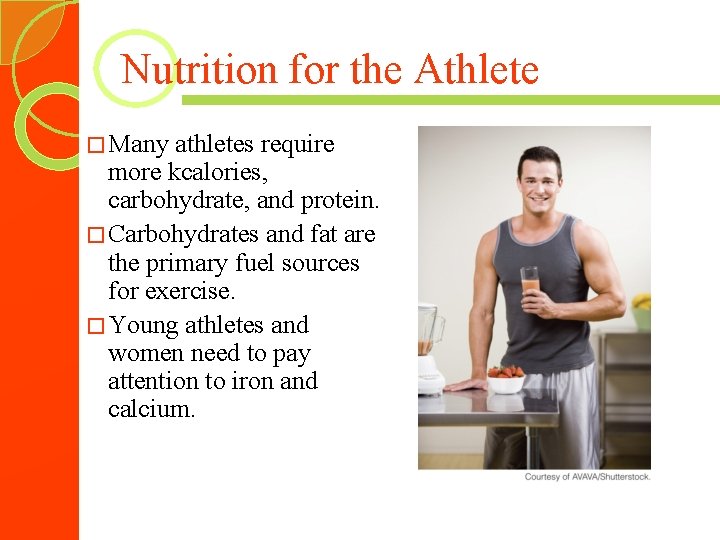
Nutrition for the Athlete � Many athletes require more kcalories, carbohydrate, and protein. � Carbohydrates and fat are the primary fuel sources for exercise. � Young athletes and women need to pay attention to iron and calcium.
Sports Drinks �Sports drinks contain a dilute mixture of carbohydrate and electrolytes. �Most contain about 50 kcal/cup with about 3 to 4 teaspoons of carbohydrate and small amounts of sodium (lost in sweat) and potassium. �Sports drinks are primarily designed to be used during exercise lasting 60 minutes or more.
Hot Topic: Fighting Childhood Obesity �America’s children and youth are less active, consume more fat and sweetened beverages, and eat fewer healthy foods, especially fruits and vegetables, than children of previous generations. �More children and adolescents are obese than ever before. �Contributing factors include genetic, behavioral, and environmental factors.
Environmental Factors � High sugar drinks and less healthy foods on school campuses (K-12). � Lack of daily, quality physical activity in all schools. � No safe and appealing place in many communities to play/be active. � Advertising of less healthy foods. � Limited access to healthy, affordable foods. � Greater availability of high energy dense foods. � Increasing portion sizes. � Lack of breastfeeding support. � Television and media.
- Slides: 38