
Weight Bias in Health Care Implications for Patients
Weight Bias in Health Care Implications for Patients, Providers, and Public Health Rebecca M. Puhl, Ph. D Director of Research
Rudd Center for Food Policy & Obesity Non-profit research and public policy organization Seek to improve the world’s diet, prevent obesity, and reduce weight stigma Establish creative connections between science and public policy, develop targeted research, encourage frank dialogue among key constituents Multidisciplinary team Strategic Science
Objectives Sources of weight bias How bias affects physical & emotional health Whether bias affects quality of care Implications for providers and researchers

What is Weight Bias? Negative attitudes affecting interactions Stereotypes leading to: stigma rejection prejudice discrimination Verbal, physical, and relational forms Subtle and overt expressions
How is Bias Measured? Self-Report Surveys Experimental Research
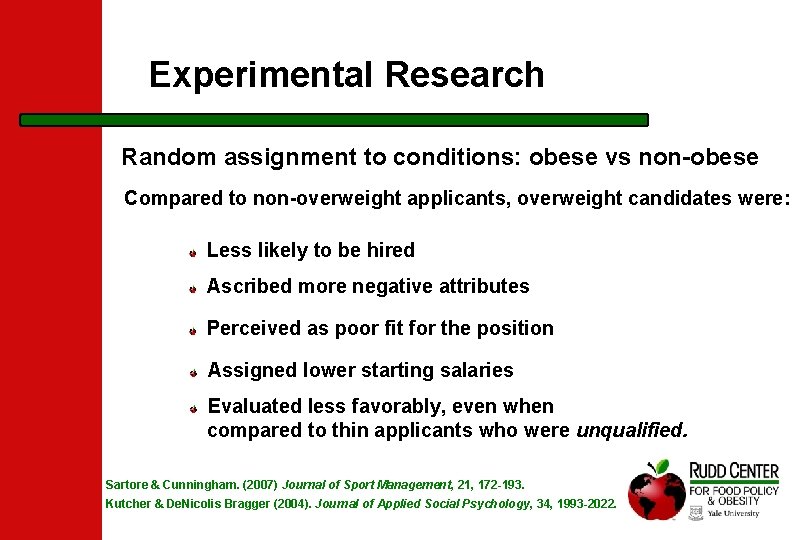
Experimental Research Random assignment to conditions: obese vs non-obese Compared to non-overweight applicants, overweight candidates were: Less likely to be hired Ascribed more negative attributes Perceived as poor fit for the position Assigned lower starting salaries Evaluated less favorably, even when compared to thin applicants who were unqualified. Sartore & Cunningham. (2007) Journal of Sport Management, 21, 172 -193. Kutcher & De. Nicolis Bragger (2004). Journal of Applied Social Psychology, 34, 1993 -2022.
How is Bias Measured? Self-Report Surveys Experimental Research Population Studies
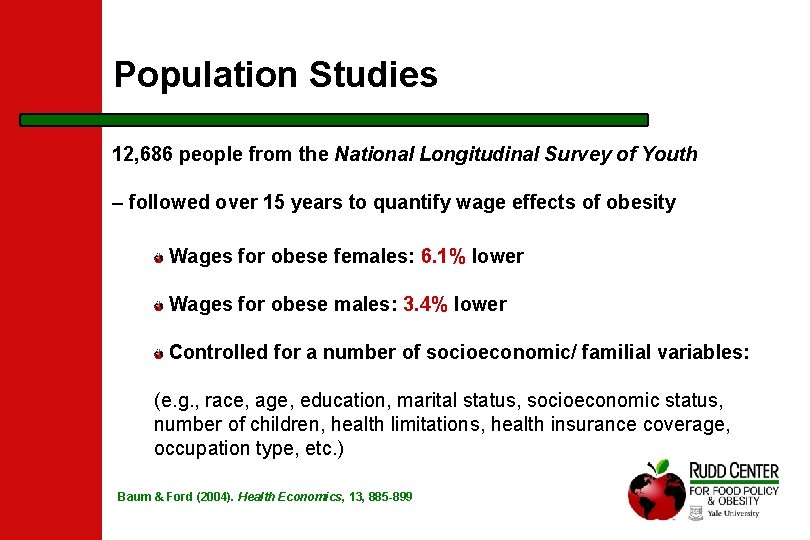
Population Studies 12, 686 people from the National Longitudinal Survey of Youth – followed over 15 years to quantify wage effects of obesity Wages for obese females: 6. 1% lower Wages for obese males: 3. 4% lower Controlled for a number of socioeconomic/ familial variables: (e. g. , race, age, education, marital status, socioeconomic status, number of children, health limitations, health insurance coverage, occupation type, etc. ) Baum & Ford (2004). Health Economics, 13, 885 -899
How is Bias Measured? Self-Report Surveys Experimental Research Population Studies Implicit Association Test https: //implicit. harvard. edu/implicit/demo/index. jsp
Why Care? Fosters blame and intolerance Hurts quality of life for adults and children Poses serious consequences for health
Prevalence of Weight Discrimination 2, 290 American Adults, 25 -74 years old Nationally representative sample (MIDUS) Experiences of discrimination due to multiple characteristics Institutional and interpersonal forms of bias
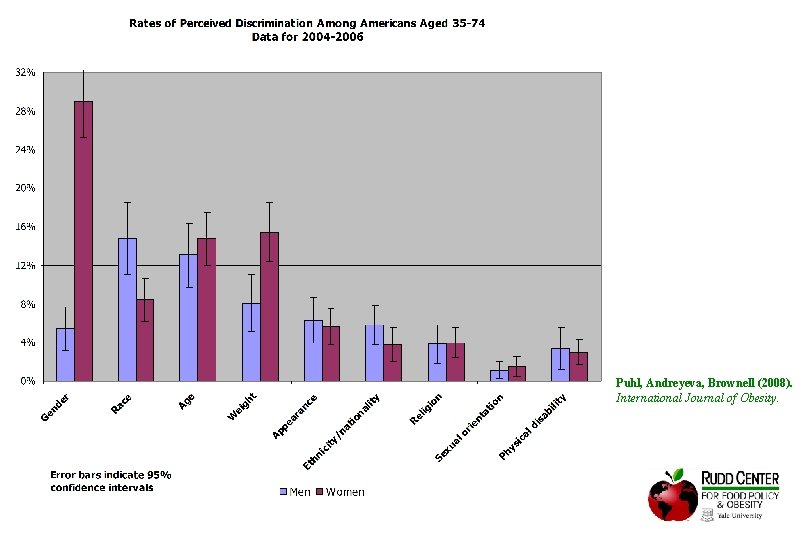
Puhl, Andreyeva, Brownell (2008). International Journal of Obesity.
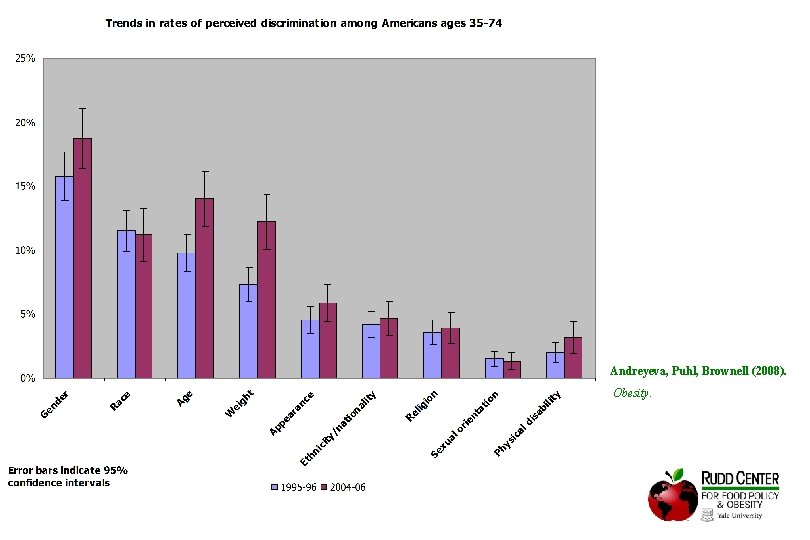
Andreyeva, Puhl, Brownell (2008). Obesity.
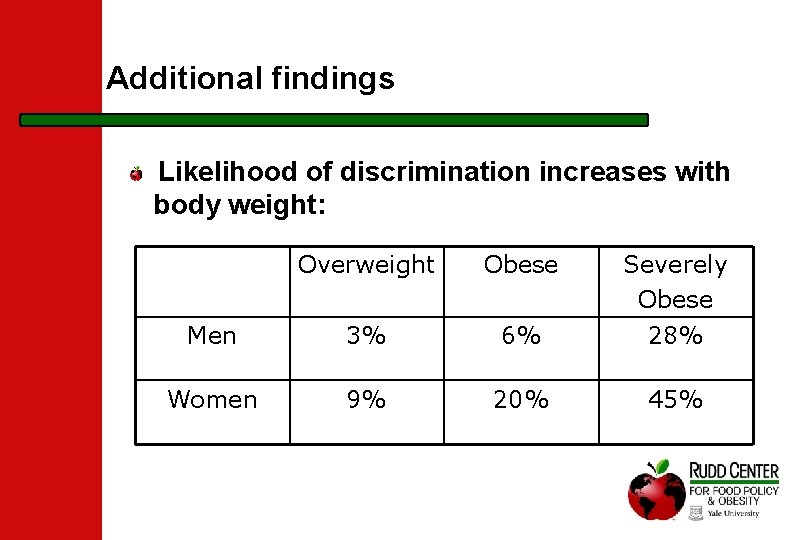
Additional findings Likelihood of discrimination increases with body weight: Overweight Obese Severely Obese Men 3% 6% 28% Women 9% 20% 45%
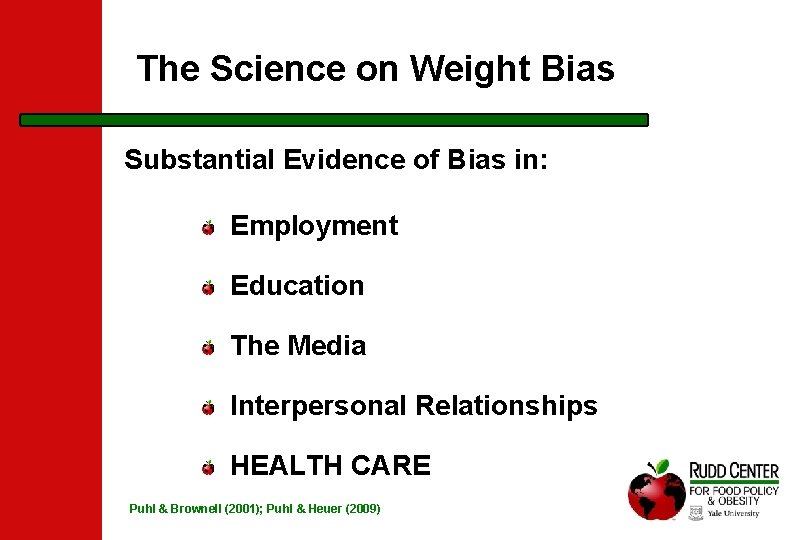
The Science on Weight Bias Substantial Evidence of Bias in: Employment Education The Media Interpersonal Relationships HEALTH CARE Puhl & Brownell (2001); Puhl & Heuer (2009)
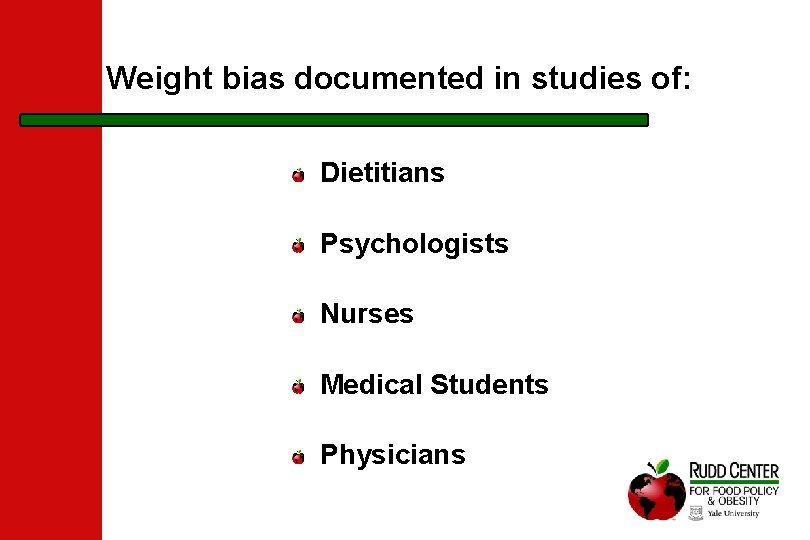
Weight bias documented in studies of: Dietitians Psychologists Nurses Medical Students Physicians
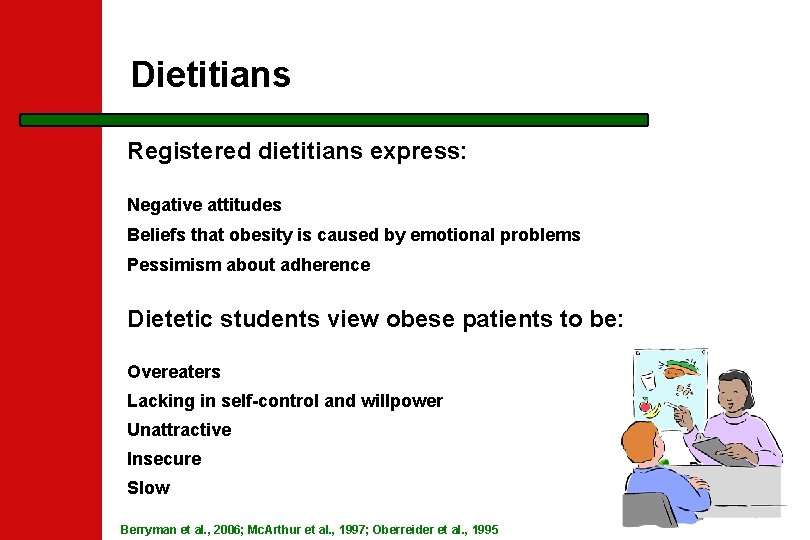
Dietitians Registered dietitians express: Negative attitudes Beliefs that obesity is caused by emotional problems Pessimism about adherence Dietetic students view obese patients to be: Overeaters Lacking in self-control and willpower Unattractive Insecure Slow Berryman et al. , 2006; Mc. Arthur et al. , 1997; Oberreider et al. , 1995
Influence of Patient Weight on Treatment Perceptions Methods: Evaluated mock health profiles that vary only by weight characteristics & gender (wt, BMI, %BF) 182 Dietetics students randomly assigned to view one of four patient profiles Asked about treatment perceptions and attitudes toward obese patients Puhl, Wharton, & Heuer (2009)
Findings Obese patients viewed as less likely to comply with treatment recommendations Obese patients’ diet quality and health status rated poorer than non-obese patients, despite identical nutritional and health information acro weight categories Puhl, Wharton, & Heuer (2009)
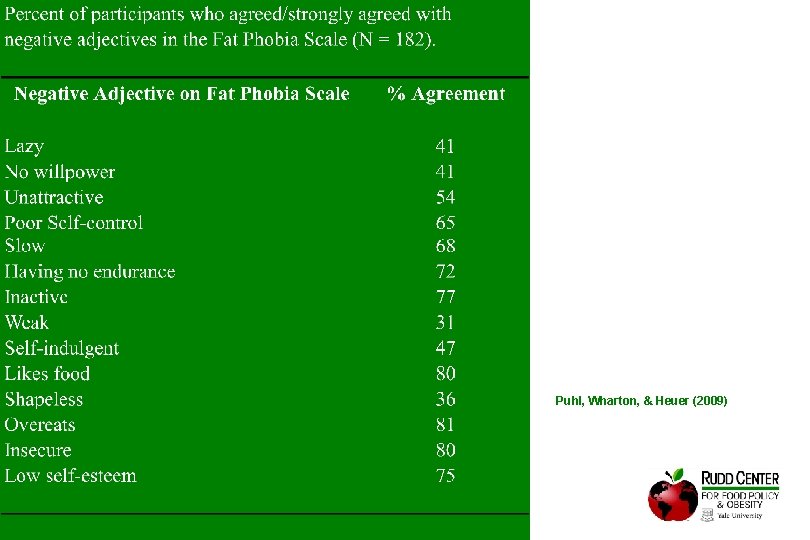
Puhl, Wharton, & Heuer (2009)
Psychologists Ascribe to obese patients… ü more pathology ü more severe symptoms ü more negative attributes ü worse prognosis Davis-Coelho, Waltz, & Davis-Coelho, 2000; Hassel, Amici, Thurston, & Gorsuch, 2001
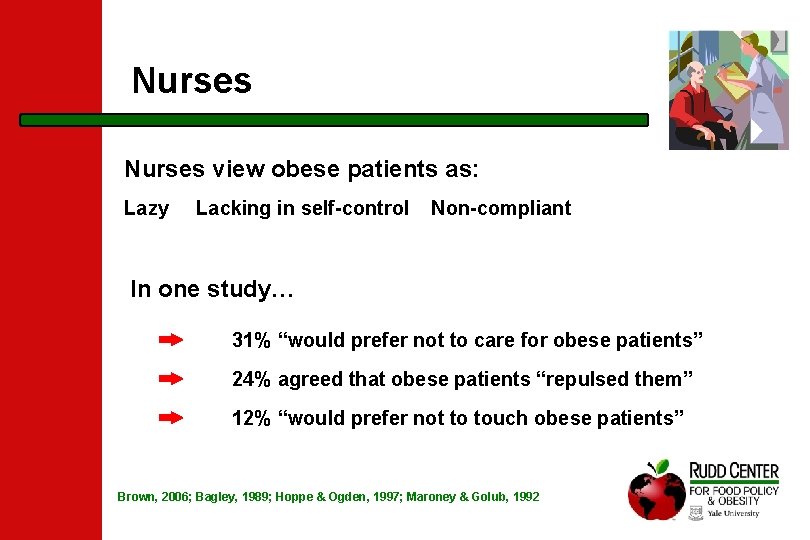
Nurses view obese patients as: Lazy Lacking in self-control Non-compliant In one study… 31% “would prefer not to care for obese patients” 24% agreed that obese patients “repulsed them” 12% “would prefer not to touch obese patients” Brown, 2006; Bagley, 1989; Hoppe & Ogden, 1997; Maroney & Golub, 1992
Medical Students Believe obese patients to be… ü ü ü poor in self-control less likely to adhere sloppy awkward unsuccessful unpleasant Blumberg & Mellis, 1980; Keane, 1990; Wigton & Mc. Gaghie, 2001
Medical Students reported that directing derogatory humor toward obese patients is acceptable, but that patients with cancer are “off limits” as targets for humor…. Except if the cancer patient is obese: Interviewer: “So cancer trumps everything else? What if there were a morbidly obese cancer patient? ” Students: “We would still make fun of them for being obese” Wear et al. , 2006
Medical Students Experimental research: Randomly assigned to view videos of confederate obese or average weight patients, visiting a physician for the first time. Students rated obese patients as: - less likely to make lifestyle changes - less responsive to counseling - less compliant with treatment Wigton & Mc. Gaghie, 2001
Physicians view obese patients as: non compliant lazy lacking in self-control awkward weak-willed sloppy unsuccessful unintelligent dishonest Campbell et al. , 2000; Fogelman et al. , 2002; Foster, 2003; Hebl & Xu, 2001; Kristeller & Hoerr, 1997; Price et al. , 1987
Physicians Experimental Research: Randomly assigned to view 1/6 patient vignettes that differed only by BMI and gender. Physicians rated heavier patients to be: - less self-disciplined - less compliant - more annoying As patient BMI increased, physicians reported: - liking their jobs less having less patience less desire to help the patient seeing obese patients was a waste of their time. Hebl & Xu, 2001
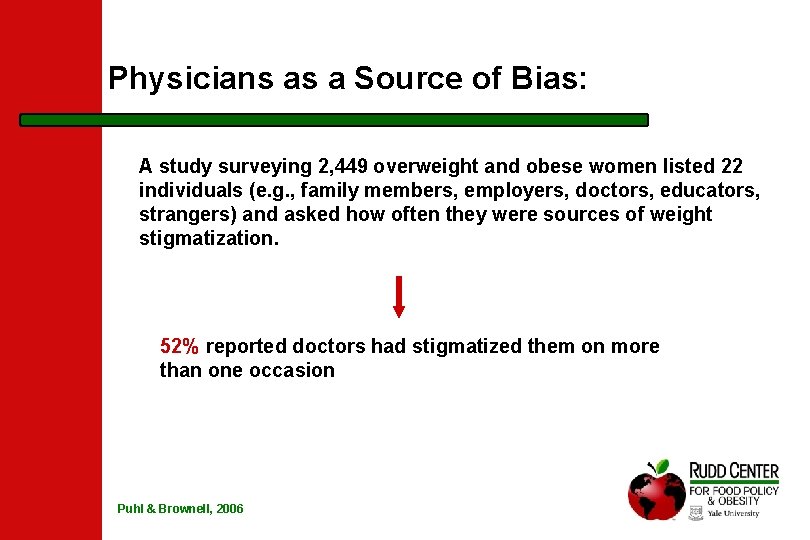
Physicians as a Source of Bias: A study surveying 2, 449 overweight and obese women listed 22 individuals (e. g. , family members, employers, doctors, educators, strangers) and asked how often they were sources of weight stigmatization. 52% reported doctors had stigmatized them on more than one occasion Puhl & Brownell, 2006
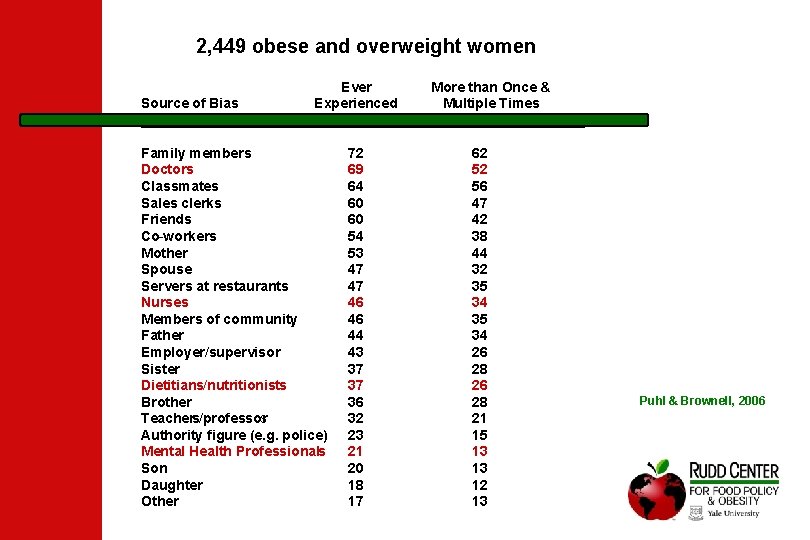
2, 449 obese and overweight women Ever More than Once & Source of Bias Experienced Multiple Times _____________________________ Family members Doctors Classmates Sales clerks Friends Co-workers Mother Spouse Servers at restaurants Nurses Members of community Father Employer/supervisor Sister Dietitians/nutritionists Brother Teachers/professor s Authority figure (e. g. police) Mental Health Professionals Son Daughter Other 72 69 64 60 60 54 53 47 47 46 46 44 43 37 37 36 32 23 21 20 18 17 62 52 56 47 42 38 44 32 35 34 26 28 21 15 13 13 12 13 Puhl & Brownell, 2006
Reactions of Patients Feel berated & disrespected by providers Upset by comments about their weight from doctors Perceive that they will not be taken seriously Report that their weight is blamed for all problems Reluctant to address weight concerns Parents of obese children feel blamed and dismissed Anderson & Wadden, 2004; Bertakis & Azari, 2005; Brown et al. , 2006; Edmunds, 2005
Patient Examples “I think the worst was my family doctor who made a habit of shrugging off my health concerns…The last time I went to him with a problem, he said, "You just need to learn to push yourself away from the table. " It later turned out that not only was I going through menopause, but my thyroid was barely working. ” “I asked a gynecologist for help with low libido. His response “Lose weight so your husband is interested. That will solve your problem". I changed doctors after that! And I've told everyone I know to stay away from that doctor. ” “I became very frustrated when a doctor disregarded what I was telling him because he had already made up his mind that obesity was at the root of all my problems. ” “Once when I was going to have surgery, I had to be taken to the basement of the hospital to be weighed on the freight scales. I've never forgotten the humiliation. ”
Is Care Affected? Physician interactions with obese patients: less time spent in appointments less discussion with patients more assignment of negative symptoms reluctance to perform certain screenings less intervention Bacquier et al. , 2005; Bertakis & Azari, 2005; Campbell et al. , 2000; Galuska et al. , 1999; Hebl & Xu, 2001; Kristeller & Hoerr, 1997; Price et al. , 1987
Impact on Care Obese patients are less likely to obtain… Preventive health services & exams Cancer screens, pelvic exams, mammograms and are more likely to… Cancel appointments Delay appointments Adams et al. , 1993; Drury & Louis, 2002; Fontaine et al. , 1998; Olson et al. , 1994, Ostbye et al. , 2005; Wee et al. , 2000; 2005.
Bias Contributes to Delay of Care Study of 498 women: Obese women delayed preventive services despite high access Women attributed their decisions to: Disrespect from providers Embarrassment of being weighed Negative provider attitudes Medical equipment too small Unsolicited advice to lose weight Amy et al. , 2006
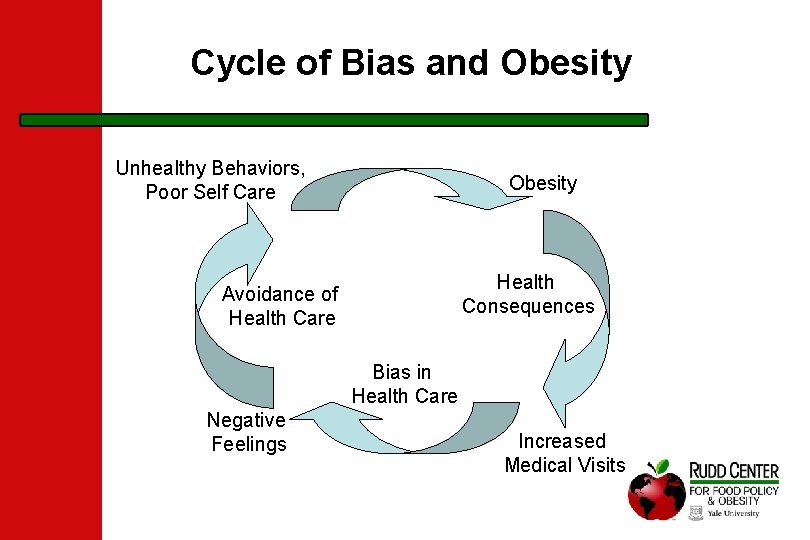
Cycle of Bias and Obesity Unhealthy Behaviors, Poor Self Care Obesity Health Consequences Avoidance of Health Care Bias in Health Care Negative Feelings Increased Medical Visits
The Personal Consequences of Weight Bias Psychological Social and Economic Medical
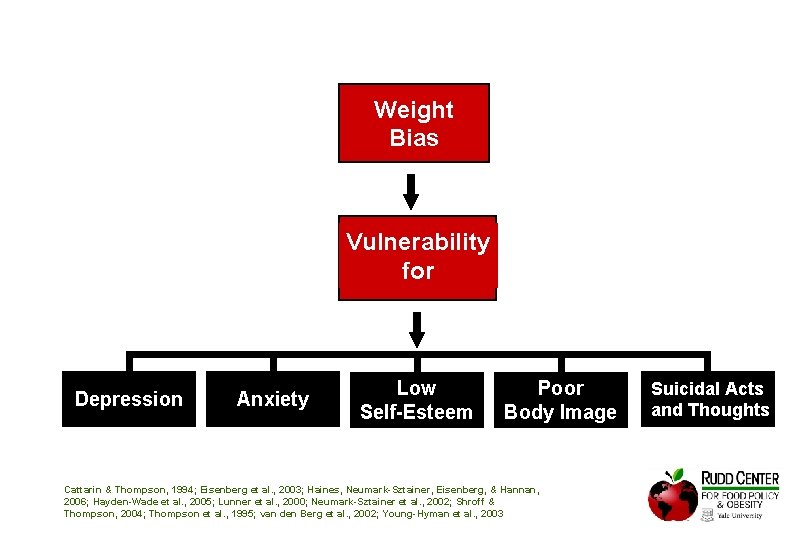
Weight Bias Vulnerability for Depression Anxiety Low Self-Esteem Poor Body Image Cattarin & Thompson, 1994; Eisenberg et al. , 2003; Haines, Neumark-Sztainer, Eisenberg, & Hannan, 2006; Hayden-Wade et al. , 2005; Lunner et al. , 2000; Neumark-Sztainer et al. , 2002; Shroff & Thompson, 2004; Thompson et al. , 1995; van den Berg et al. , 2002; Young-Hyman et al. , 2003 Suicidal Acts and Thoughts
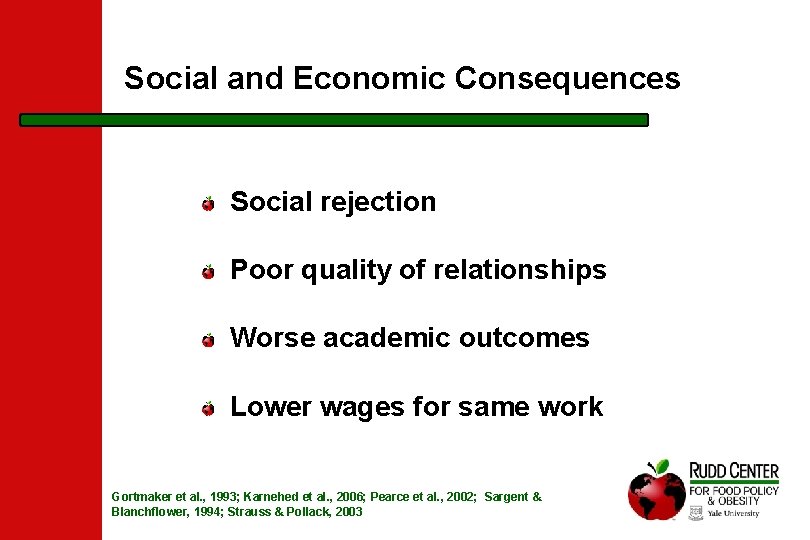
Social and Economic Consequences Social rejection Poor quality of relationships Worse academic outcomes Lower wages for same work Gortmaker et al. , 1993; Karnehed et al. , 2006; Pearce et al. , 2002; Sargent & Blanchflower, 1994; Strauss & Pollack, 2003
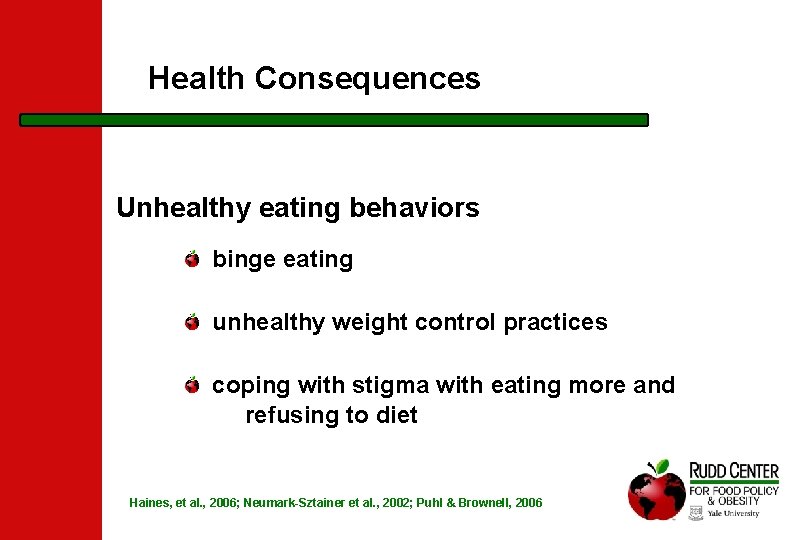
Health Consequences Unhealthy eating behaviors binge eating unhealthy weight control practices coping with stigma with eating more and refusing to diet Haines, et al. , 2006; Neumark-Sztainer et al. , 2002; Puhl & Brownell, 2006
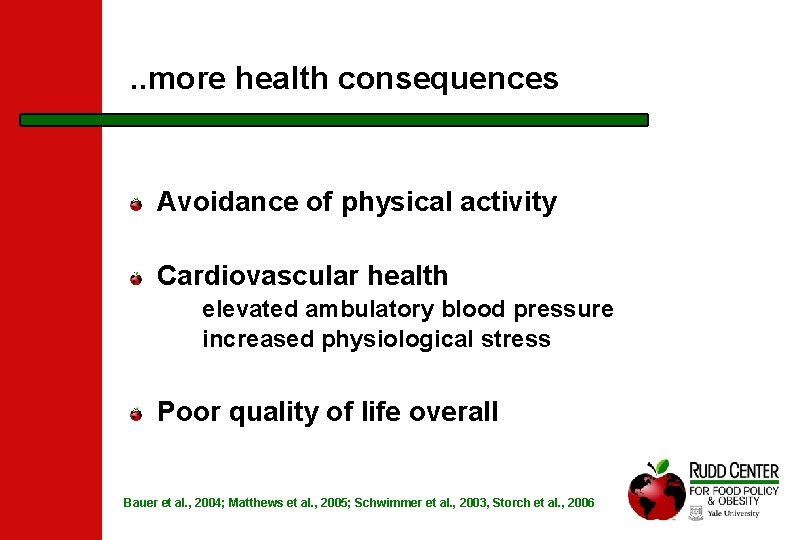
. . more health consequences Avoidance of physical activity Cardiovascular health elevated ambulatory blood pressure increased physiological stress Poor quality of life overall Bauer et al. , 2004; Matthews et al. , 2005; Schwimmer et al. , 2003, Storch et al. , 2006
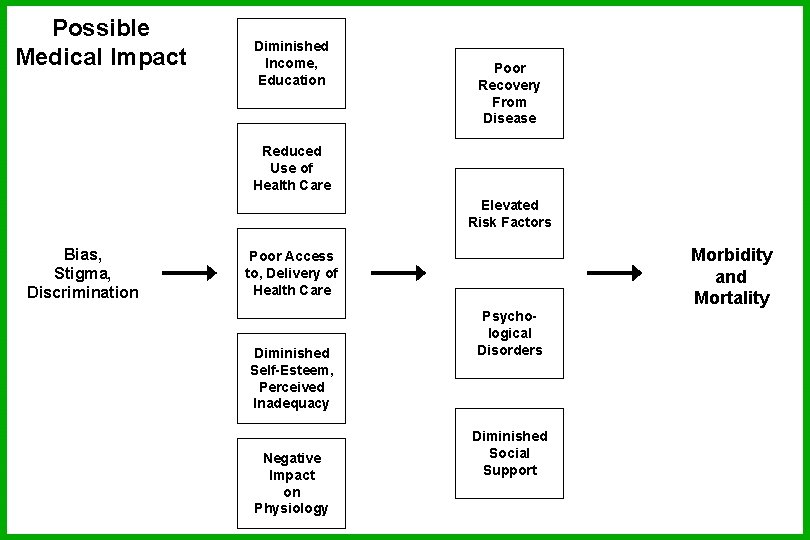
Possible Medical Impact Diminished Income, Education Poor Recovery From Disease Reduced Use of Health Care Elevated Risk Factors Bias, Stigma, Discrimination Morbidity and Mortality Poor Access to, Delivery of Health Care Diminished Self-Esteem, Perceived Inadequacy Negative Impact on Physiology Psychological Disorders Diminished Social Support
Addressing Stigma in Obesity Intervention Incorporate anti-stigma messages Shift focus from appearance to health behaviors Implement policies to prohibit weightbased victimization Move beyond “education” to comprehensive strategies Institute of Medicine. Preventing Childhood Obesity, 2005; Society for Nutrition Education, 2003.
Broader impact on public health Weight bias – absent in public health discourse Stigma can affect policy responses to obesity Government/Legislation - Ignore societal/environmental contributors - Protect the food industry - Emphasize personal responsibility/blame
Impact on public health. . Personal Responsibility in Food Consumption Act: “This bill is about selfresponsibility. If you eat too much, you get fat. It is your fault. Don’t try to blame somebody else” In 2008, a Mississippi State House Bill was proposed to prohibit restaurants from serving food to any person who is obese. 151 Cong. Rec. H 8927 (statement of Rep. Chabot).
How Do We Reduce Weight Bias?
Origins of Weight Bias Societal/media portrayals of obesity Cultural values of thinness Attributions about causes of obesity
TV/Film Portrayals of Obesity Content Analyses of Today’s Media: African Americans heavier than Caucasians Few obese characters on television Obese characters in stereotypical roles Male characters 3 x more likely to engage in weight-stigmatization commentary Fewer positive social interactions, romantic and sexual relationships Greenberg et al. , 2003; Himes & Thompson, 2007; Harrison, 2000

Postcards / Greeting Cards

Cultural Influences Societal Values of Thinness The myth of the infinitely malleable body Dieting/beauty industry: “If you only work hard enough”
Attributions about Obesity Onset is controllable Condition is reversible “if an obese person works hard enough, he or she can lose weight”
Causal Attributions of Obesity Children and adults are less likely to express weight bias if they perceive the cause of obesity to be external factors… And more likely to express bias if they perceive obesity to be caused by factors within personal control. Crandall, 1994; Crandall & Moriarty, 1995; Crandall et al. , 2001; De. Jong, 1993
Education about Causes of Obesity Educate participants about the biological, genetic, and external causes of obesity Does this work? Several studies improved attitudes Several studies did not change attitudes Anesbury & Tiggemann, 2000; Bell & Morgan, 2000; Crandall, 1994; Puhl et al. , 2005
Other Strategies Evoke Empathy Address Normative Attitudes Use Multiple Stigma-Reduction Methods Gapinski et al. , 2001; Hague & White, 2005; Puhl et al. , 2005; Teachman et al. , 2001; Wiese et al. , 1992
Multiple Component Interventions N = 95 Kinesiology students, 6 -week intervention Components: Didactic lectures, group discussions, hands-on learning projects, writing assignments Lecture content: awareness of weight bias, challenging perspectives that blame the individual, redefining professional practice/weight loss ideals to emphasize healthy lifestyles Rukavina & Rowell. A service learning based intervention to change attitudes toward obese individuals in kinesiology pre-professionals. Social Psychology of Education. 2008; 11: 95 -112.
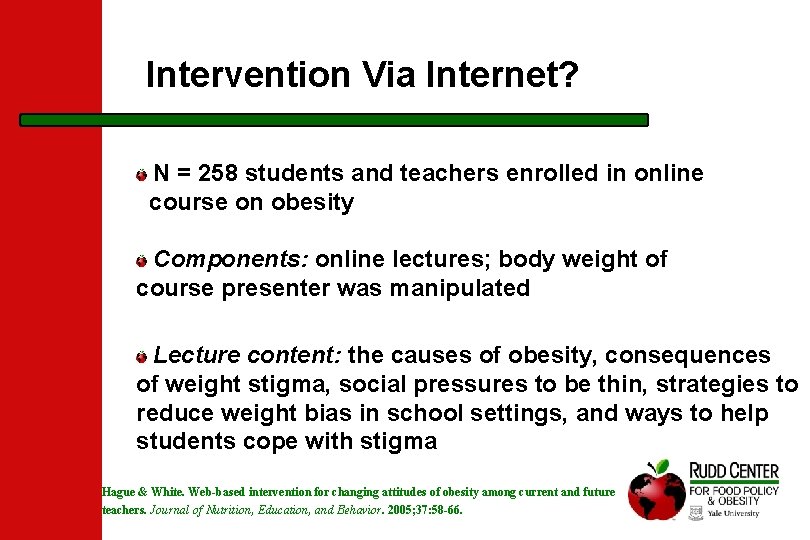
Intervention Via Internet? N = 258 students and teachers enrolled in online course on obesity Components: online lectures; body weight of course presenter was manipulated Lecture content: the causes of obesity, consequences of weight stigma, social pressures to be thin, strategies to reduce weight bias in school settings, and ways to help students cope with stigma Hague & White. Web-based intervention for changing attitudes of obesity among current and future teachers. Journal of Nutrition, Education, and Behavior. 2005; 37: 58 -66.
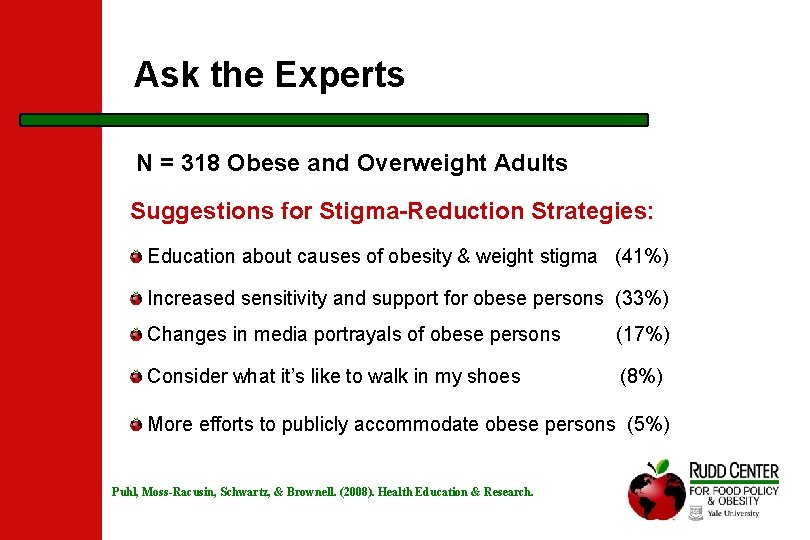
Ask the Experts N = 318 Obese and Overweight Adults Suggestions for Stigma-Reduction Strategies: Education about causes of obesity & weight stigma (41%) Increased sensitivity and support for obese persons (33%) Changes in media portrayals of obese persons (17%) Consider what it’s like to walk in my shoes (8%) More efforts to publicly accommodate obese persons (5%) Puhl, Moss-Racusin, Schwartz, & Brownell. (2008). Health Education & Research.
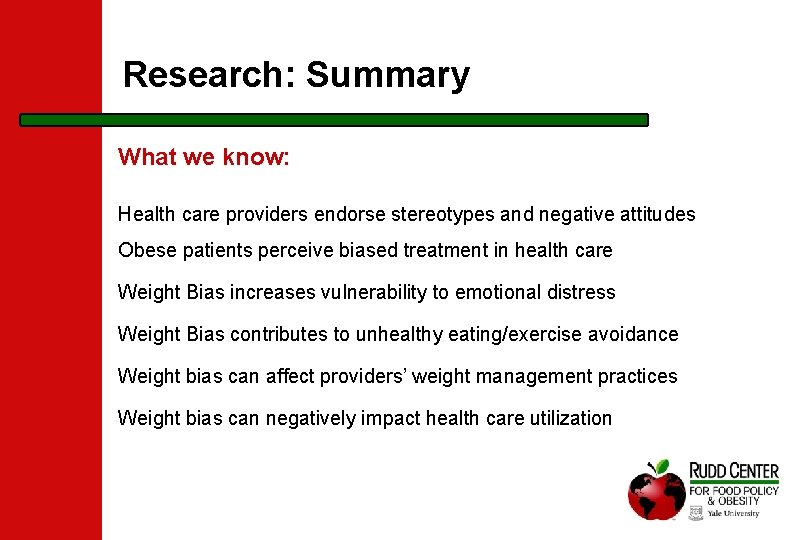
Research: Summary What we know: Health care providers endorse stereotypes and negative attitudes Obese patients perceive biased treatment in health care Weight Bias increases vulnerability to emotional distress Weight Bias contributes to unhealthy eating/exercise avoidance Weight bias can affect providers’ weight management practices Weight bias can negatively impact health care utilization
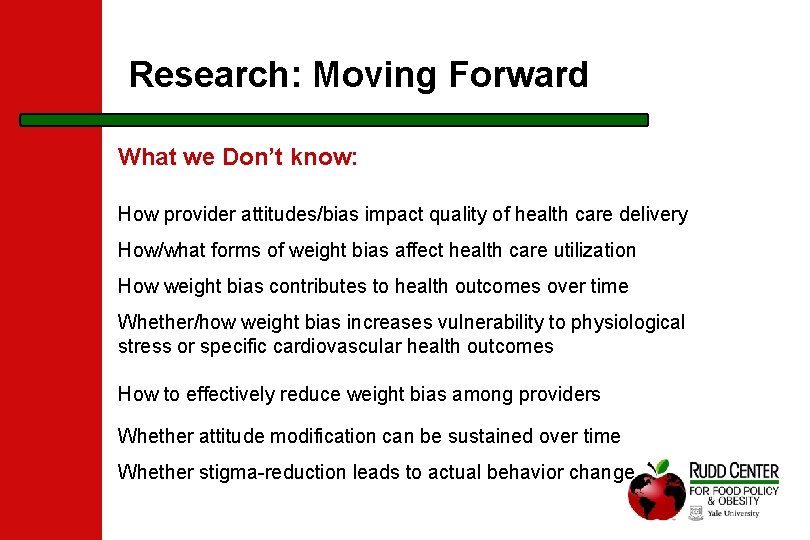
Research: Moving Forward What we Don’t know: How provider attitudes/bias impact quality of health care delivery How/what forms of weight bias affect health care utilization How weight bias contributes to health outcomes over time Whether/how weight bias increases vulnerability to physiological stress or specific cardiovascular health outcomes How to effectively reduce weight bias among providers Whether attitude modification can be sustained over time Whether stigma-reduction leads to actual behavior change

What Health Care Providers Can Do Integrate sensitivity into practice: 1) Consider patients’ previous negative experiences 2) Recognize that being overweight is a product of many factors 3) Explore all causes of presenting problems, not just weight 4) Recognize that many patients have tried to lose weight repeatedly 5) Emphasize importance of behavior changes rather than weight 6) Acknowledge the difficulty of making lifestyle changes 7) Recognize that small weight losses can improve health
Identify Your Attitudes Do I make assumptions based on weight regarding character, intelligence, professional success, health status, or lifestyle behaviors? Am I comfortable working with people of all shapes and sizes? Do I give appropriate feedback to encourage healthful behavior change? Am I sensitive to the needs and concerns of obese individuals? Do I treat the individual or only the condition?
Sensitive Weighing Procedures Does the patient need to be weighed? Ask patients for permission to weigh Use sensitive communication Weigh in private location Record weight silently, free of judgment/commentary
Creating a Supportive Environment Examine the physical office setting: Appropriate medical equipment Weight-friendly waiting room Appropriate examination room
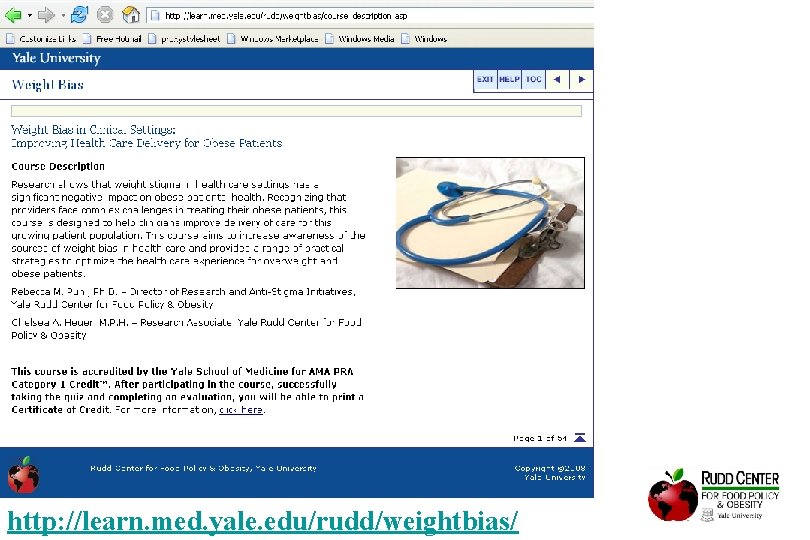
http: //learn. med. yale. edu/rudd/weightbias/
Supplement Issue in Obesity Expanding scientific interest in studying weight bias -Intervention strategies to reduce bias -Impact of weight bias and physical health -Impact of weight bias and emotional well-being -Improving measurement of weight bias -Prevalence of weight bias -Cross cultural comparisons of bias -Methods to improve sensitive care toward obese patients -Weight bias in family relationships November, 2008
Additional Resources Yale Rudd Center www. Yale. Rudd. Center. org Weight Bias Resources for Providers http: //www. yaleruddcenter. org/what/bias/toolkit/index. html “Weight Bias: Nature, Consequences, and Remedies” Guilford Press, 2005
- Slides: 67