
Weight Annealing Heuristics for Solving Bin Packing Problems
Weight Annealing Heuristics for Solving Bin Packing Problems Kok-Hua Loh University of Maryland Bruce Golden University of Maryland Edward Wasil American University INFORMS Annual Meeting October 5, 2006 0
Outline of Presentation § Introduction § Concept of Weight Annealing § One-Dimensional Bin Packing Problem § Two-Dimensional Bin Packing Problem § Conclusions 1
Weight Annealing Concept § Assigning different weights to different parts of a combinatorial problem to guide computational effort to poorly solved regions. Ø Ninio and Schneider (2005) Ø Elidan et al. (2002) § Allowing both uphill and downhill moves to escape from a poor local optimum. § Tracking changes in the objective function value, as well as how well every region is being solved. § Applied to the Traveling Salesman Problem. (Ninio and Schneider 2005) Ø Weight annealing led to mostly better results than simulated annealing. 2
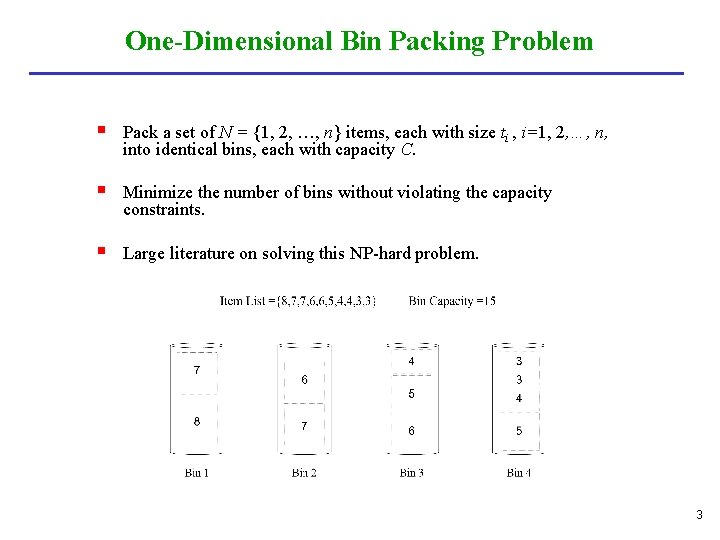
One-Dimensional Bin Packing Problem § Pack a set of N = {1, 2, …, n} items, each with size ti , i=1, 2, …, n, into identical bins, each with capacity C. § Minimize the number of bins without violating the capacity constraints. § Large literature on solving this NP-hard problem. 3
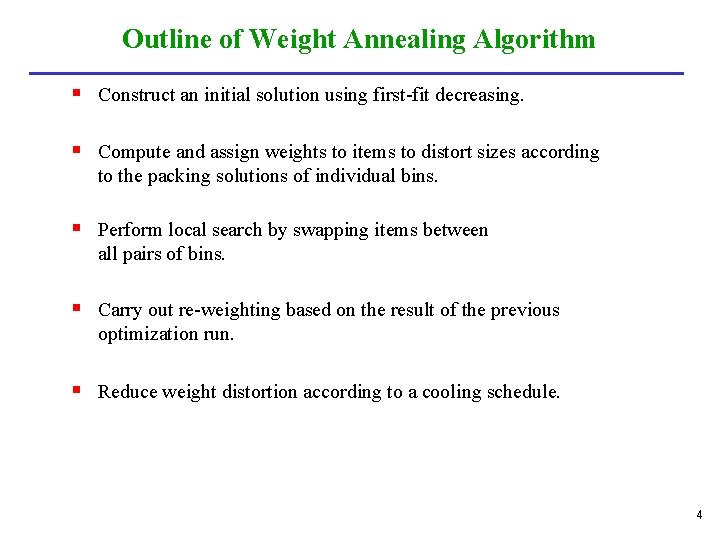
Outline of Weight Annealing Algorithm § Construct an initial solution using first-fit decreasing. § Compute and assign weights to items to distort sizes according to the packing solutions of individual bins. § Perform local search by swapping items between all pairs of bins. § Carry out re-weighting based on the result of the previous optimization run. § Reduce weight distortion according to a cooling schedule. 4
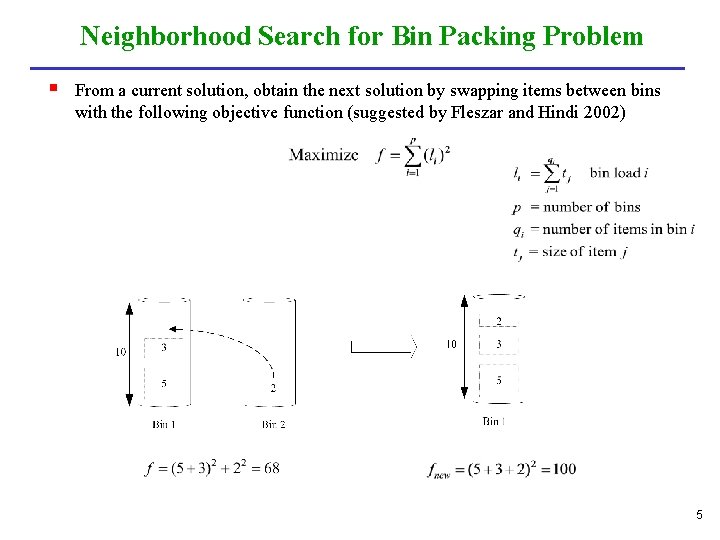
Neighborhood Search for Bin Packing Problem § From a current solution, obtain the next solution by swapping items between bins with the following objective function (suggested by Fleszar and Hindi 2002) 5
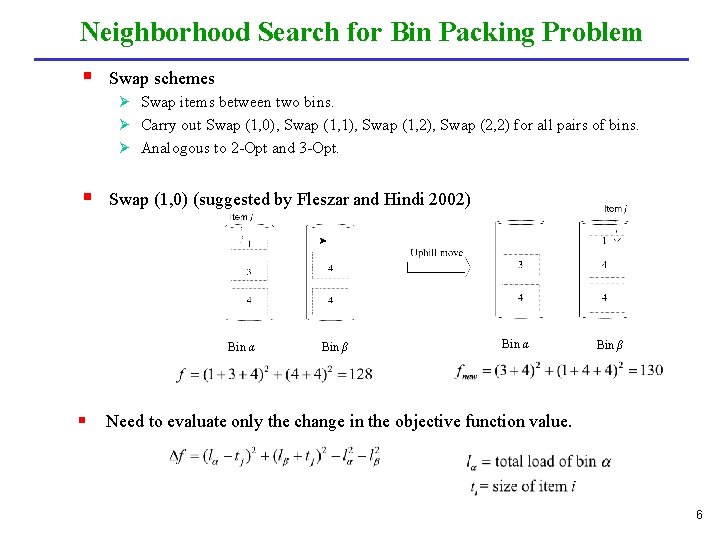
Neighborhood Search for Bin Packing Problem § Swap schemes Ø Swap items between two bins. Ø Carry out Swap (1, 0), Swap (1, 1), Swap (1, 2), Swap (2, 2) for all pairs of bins. Ø Analogous to 2 -Opt and 3 -Opt. § Swap (1, 0) (suggested by Fleszar and Hindi 2002) Bin α Bin β § Need to evaluate only the change in the objective function value. 6
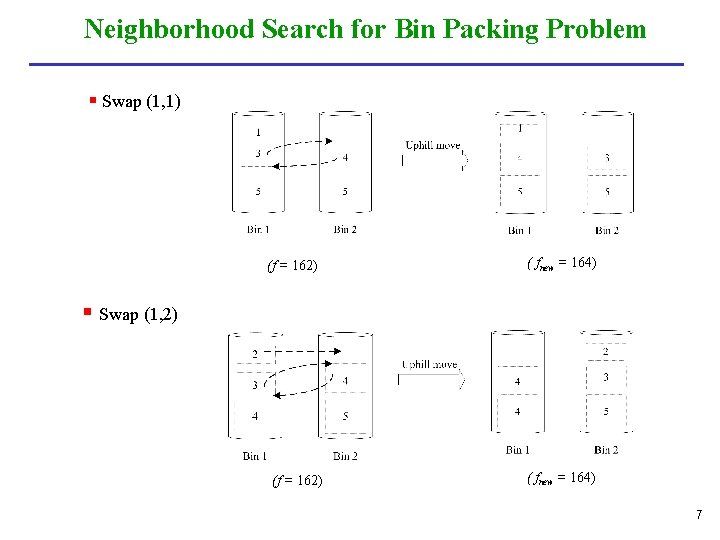
Neighborhood Search for Bin Packing Problem § Swap (1, 1) (f = 162) ( fnew = 164) § Swap (1, 2) (f = 162) ( fnew = 164) 7
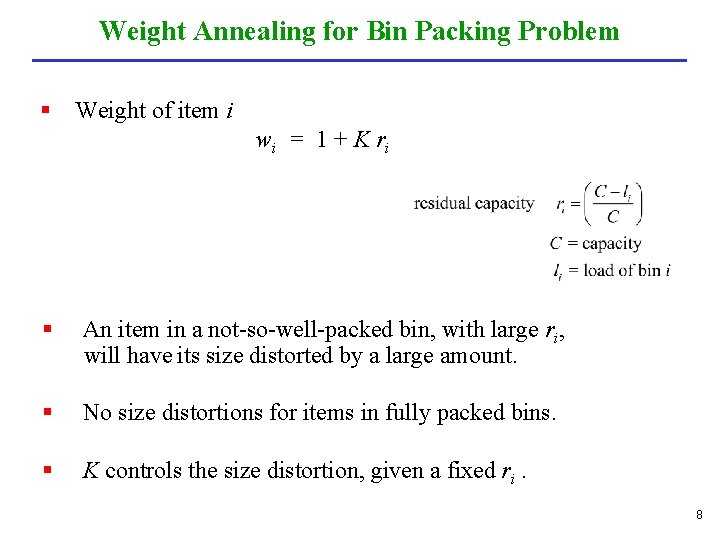
Weight Annealing for Bin Packing Problem § Weight of item i w i = 1 + K ri § An item in a not-so-well-packed bin, with large ri, will have its size distorted by a large amount. § No size distortions for items in fully packed bins. § K controls the size distortion, given a fixed ri. 8

Weight Annealing for Bin Packing Problem § Weight annealing allows downhill moves in a maximization problem. § Example C = 200, K= 0. 5, Transformed space f = 70126. 3 Transformed space f new = 70132. 2 Original space f = 63325 Original space f new = 63125 Ø Transformed space - uphill move Ø Original space - downhill move 9
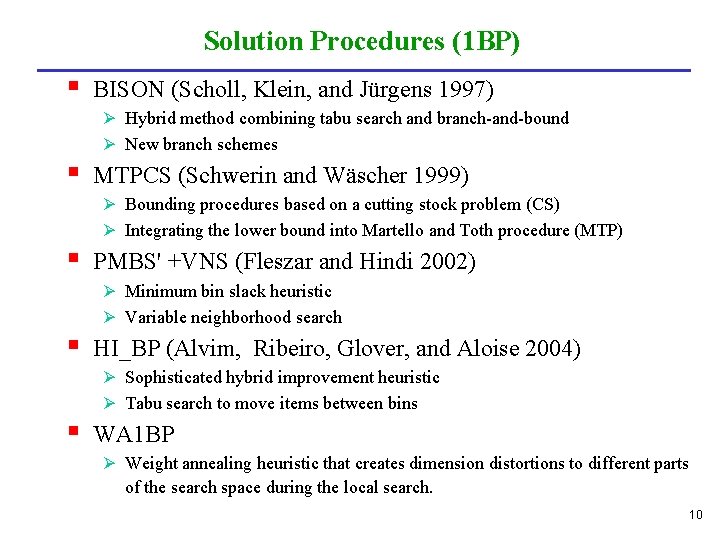
Solution Procedures (1 BP) § BISON (Scholl, Klein, and Jürgens 1997) Ø Hybrid method combining tabu search and branch-and-bound Ø New branch schemes § MTPCS (Schwerin and Wäscher 1999) Ø Bounding procedures based on a cutting stock problem (CS) Ø Integrating the lower bound into Martello and Toth procedure (MTP) § PMBS' +VNS (Fleszar and Hindi 2002) Ø Minimum bin slack heuristic Ø Variable neighborhood search § HI_BP (Alvim, Ribeiro, Glover, and Aloise 2004) Ø Sophisticated hybrid improvement heuristic Ø Tabu search to move items between bins § WA 1 BP Ø Weight annealing heuristic that creates dimension distortions to different parts of the search space during the local search. 10
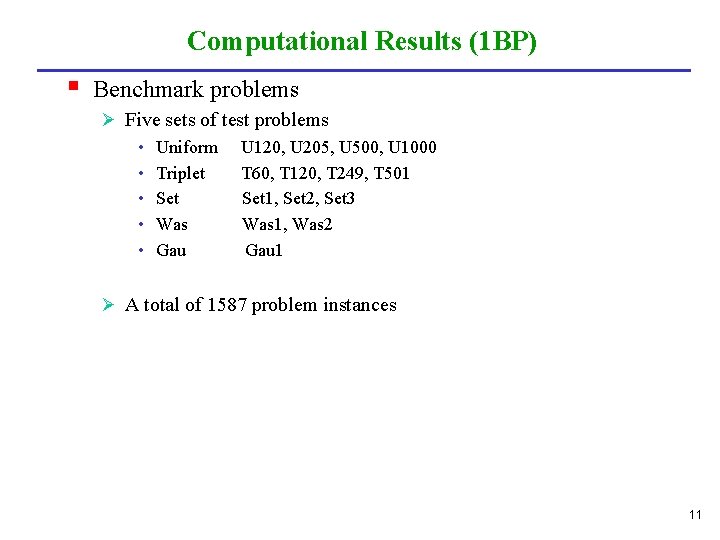
Computational Results (1 BP) § Benchmark problems Ø Five sets of test problems • Uniform U 120, U 205, U 500, U 1000 • Triplet T 60, T 120, T 249, T 501 • Set 1, Set 2, Set 3 • Was 1, Was 2 • Gau 1 Ø A total of 1587 problem instances 11
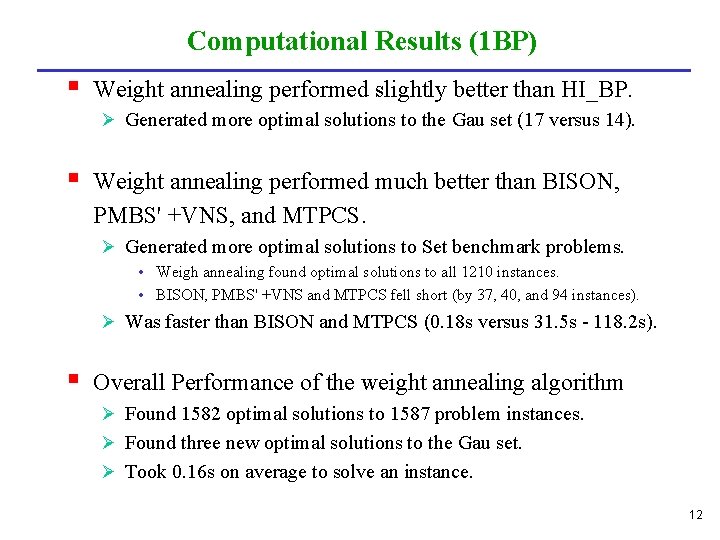
Computational Results (1 BP) § Weight annealing performed slightly better than HI_BP. Ø Generated more optimal solutions to the Gau set (17 versus 14). § Weight annealing performed much better than BISON, PMBS' +VNS, and MTPCS. Ø Generated more optimal solutions to Set benchmark problems. • Weigh annealing found optimal solutions to all 1210 instances. • BISON, PMBS' +VNS and MTPCS fell short (by 37, 40, and 94 instances). Ø Was faster than BISON and MTPCS (0. 18 s versus 31. 5 s - 118. 2 s). § Overall Performance of the weight annealing algorithm Ø Found 1582 optimal solutions to 1587 problem instances. Ø Found three new optimal solutions to the Gau set. Ø Took 0. 16 s on average to solve an instance. 12
Two-Dimensional Bin Packing Problems Problem statement § Allocate, without overlapping, n rectangular items to identical rectangular bins. § Pack items such that the edges of bins and items are parallel to each other. § Minimize the total number of rectangular bins (NP-hard). Classifications § Guillotine Cutting Ø 2 BP|O|G Ø 2 BP|R|G § Free Cutting Ø 2 BP|O|F Ø 2 BP|R|F Fixed Orientation (O), Guillotine Cutting (G) Allowable 90° Rotation (R), Guillotine Cutting (G) Fixed Orientation (O), Free Cutting (F) Allowable 90° Rotation (R), Free Cutting (F) 13
Two-Dimensional Bin Packing Problems (2 BP|O|G) Hybrid first-fit algorithm § Phase One (one-dimensional horizontal level packing) Ø Arrange the items in the order of non-increasing height. Ø Pack the items from left to right into levels, each level i with the same width W. Ø Pack an item (left justified) on the first level that can accommodate it; start a new level if no level can accommodate it. § Phase Two (one-dimensional vertical bin packing) Ø Arrange the levels in the order of non-increasing height hi; this is the height of the first item on the left. Ø Solve one-dimensional bin packing problems, each item i size hi, and bin size H. with 14
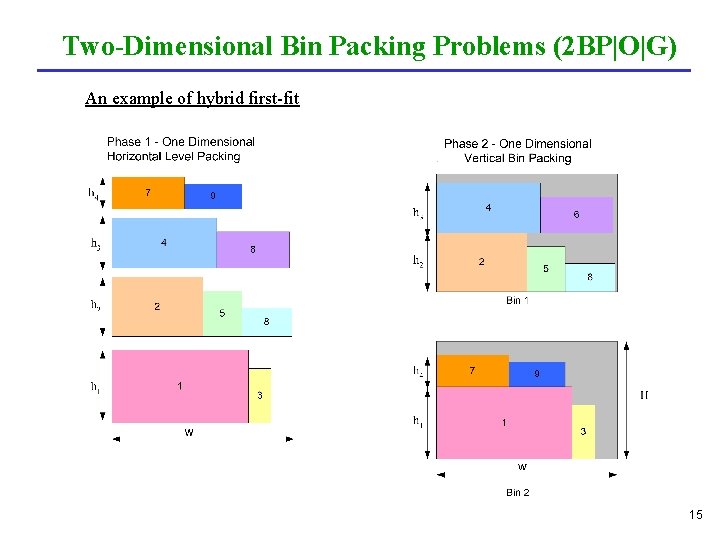
Two-Dimensional Bin Packing Problems (2 BP|O|G) An example of hybrid first-fit 15
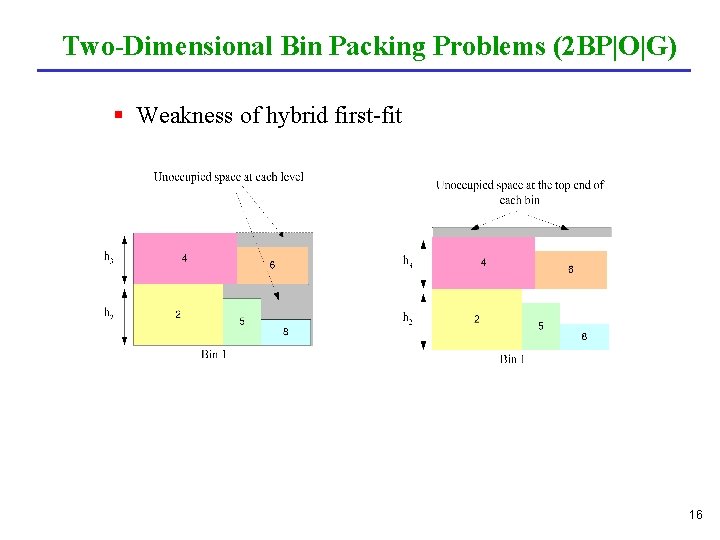
Two-Dimensional Bin Packing Problems (2 BP|O|G) § Weakness of hybrid first-fit 16
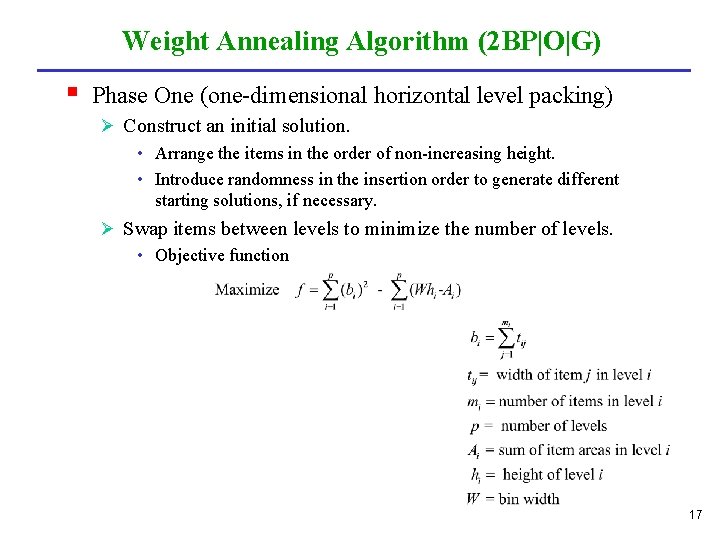
Weight Annealing Algorithm (2 BP|O|G) § Phase One (one-dimensional horizontal level packing) Ø Construct an initial solution. • Arrange the items in the order of non-increasing height. • Introduce randomness in the insertion order to generate different starting solutions, if necessary. Ø Swap items between levels to minimize the number of levels. • Objective function 17
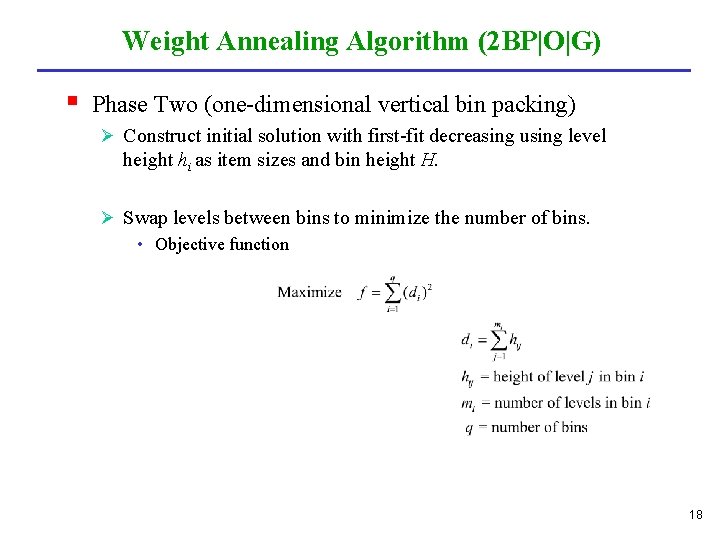
Weight Annealing Algorithm (2 BP|O|G) § Phase Two (one-dimensional vertical bin packing) Ø Construct initial solution with first-fit decreasing using level height hi as item sizes and bin height H. Ø Swap levels between bins to minimize the number of bins. • Objective function 18
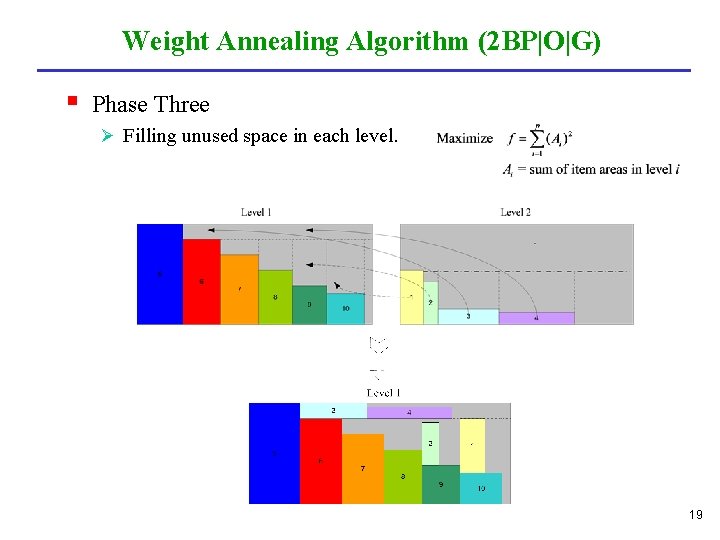
Weight Annealing Algorithm (2 BP|O|G) § Phase Three Ø Filling unused space in each level. 19
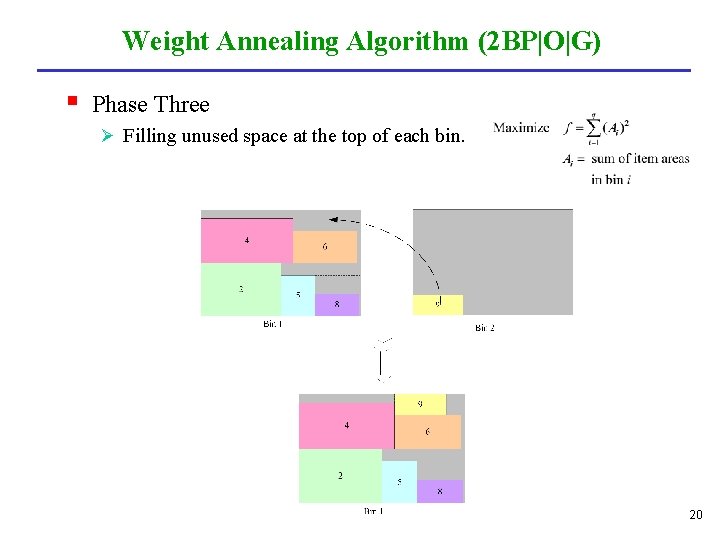
Weight Annealing Algorithm (2 BP|O|G) § Phase Three Ø Filling unused space at the top of each bin. 20
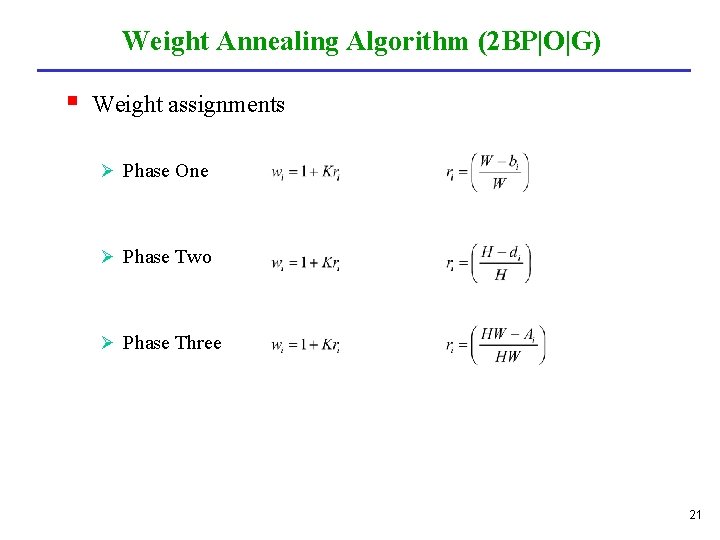
Weight Annealing Algorithm (2 BP|O|G) § Weight assignments Ø Phase One Ø Phase Two Ø Phase Three 21
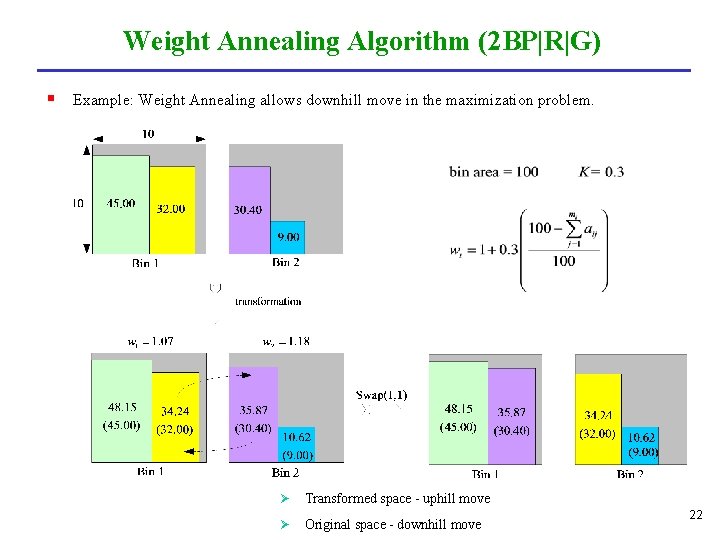
Weight Annealing Algorithm (2 BP|R|G) § Example: Weight Annealing allows downhill move in the maximization problem. Ø Transformed space - uphill move Ø Original space - downhill move 22
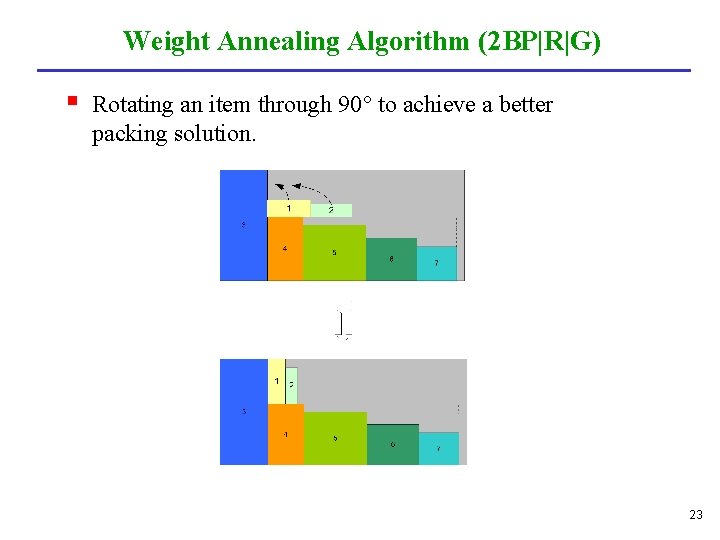
Weight Annealing Algorithm (2 BP|R|G) § Rotating an item through 90° to achieve a better packing solution. 23
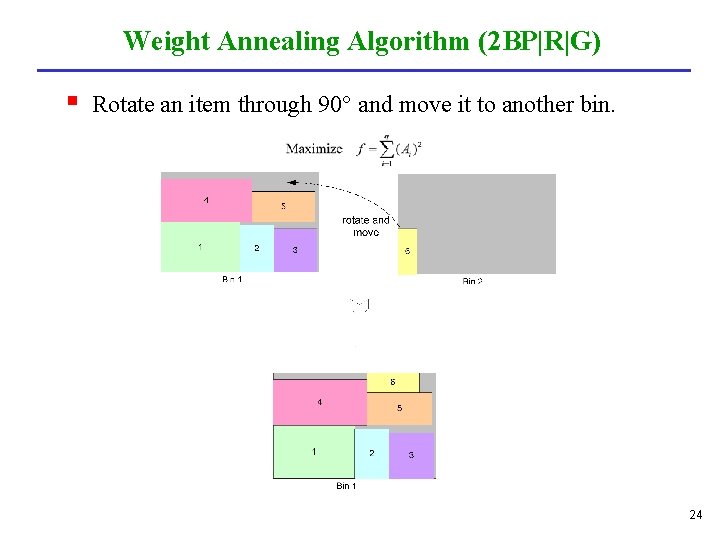
Weight Annealing Algorithm (2 BP|R|G) § Rotate an item through 90° and move it to another bin. 24
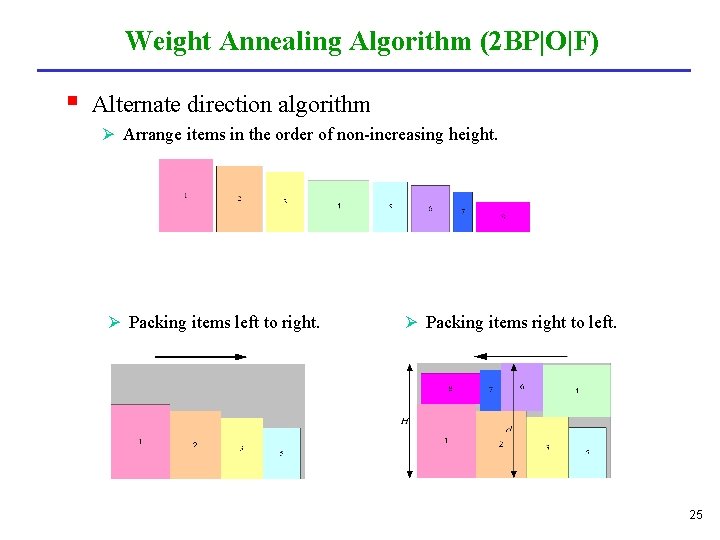
Weight Annealing Algorithm (2 BP|O|F) § Alternate direction algorithm Ø Arrange items in the order of non-increasing height. Ø Packing items left to right. Ø Packing items right to left. 25
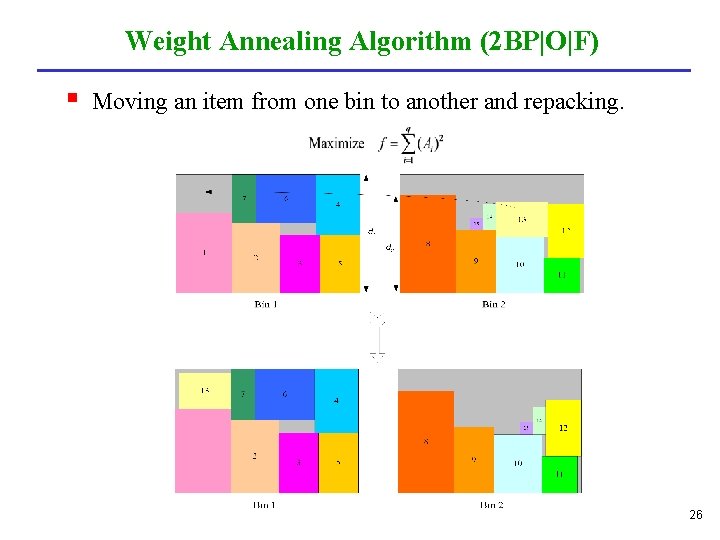
Weight Annealing Algorithm (2 BP|O|F) § Moving an item from one bin to another and repacking. 26
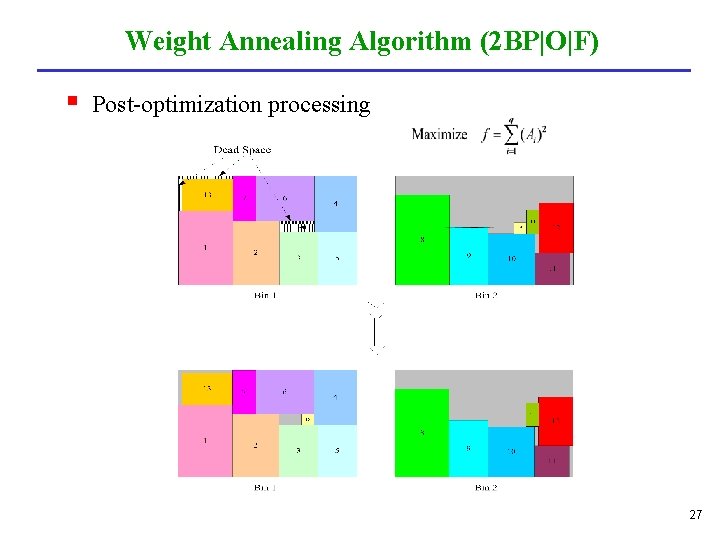
Weight Annealing Algorithm (2 BP|O|F) § Post-optimization processing 27
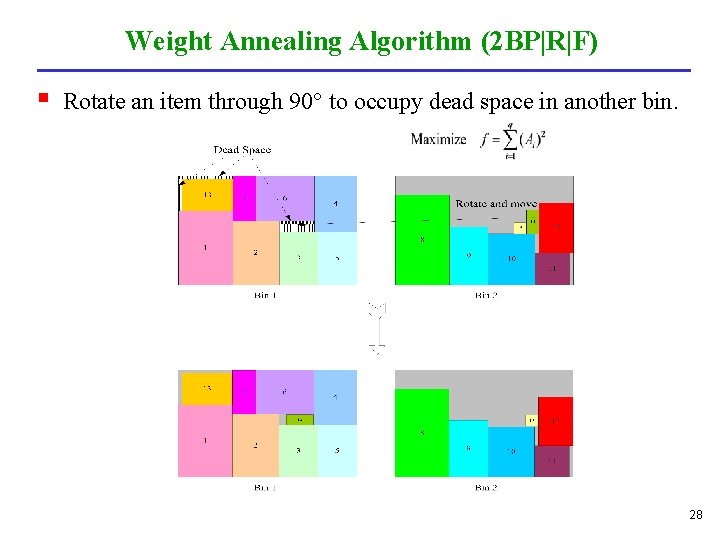
Weight Annealing Algorithm (2 BP|R|F) § Rotate an item through 90° to occupy dead space in another bin. 28
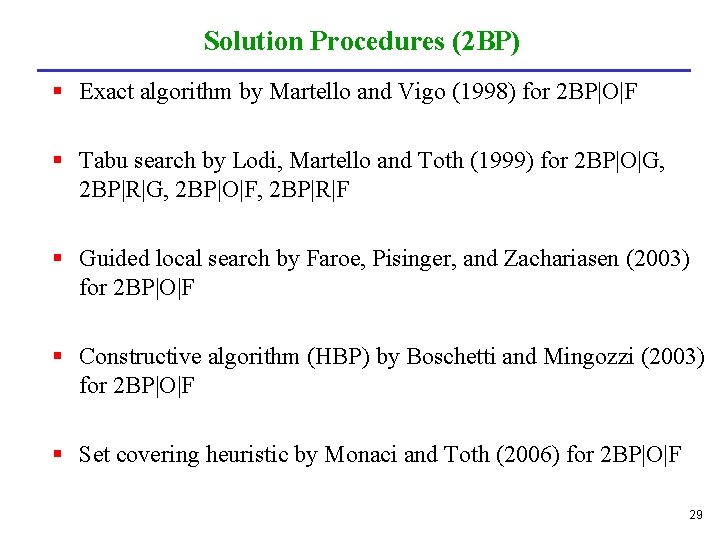
Solution Procedures (2 BP) § Exact algorithm by Martello and Vigo (1998) for 2 BP|O|F § Tabu search by Lodi, Martello and Toth (1999) for 2 BP|O|G, 2 BP|R|G, 2 BP|O|F, 2 BP|R|F § Guided local search by Faroe, Pisinger, and Zachariasen (2003) for 2 BP|O|F § Constructive algorithm (HBP) by Boschetti and Mingozzi (2003) for 2 BP|O|F § Set covering heuristic by Monaci and Toth (2006) for 2 BP|O|F 29
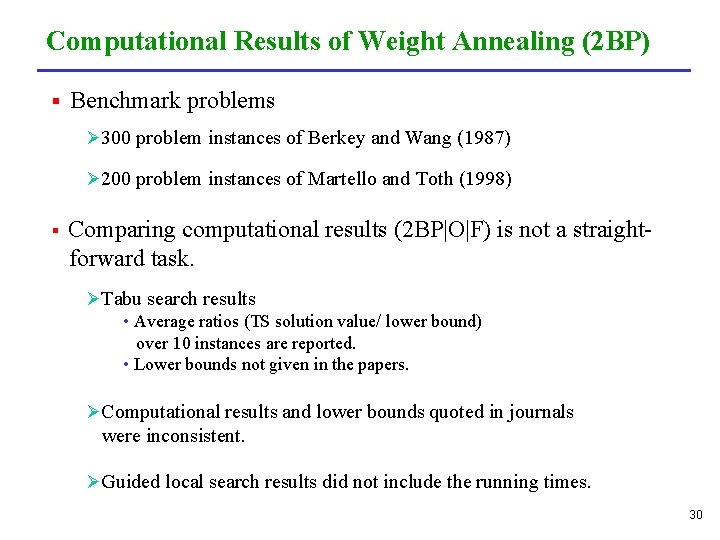
Computational Results of Weight Annealing (2 BP) § Benchmark problems Ø 300 problem instances of Berkey and Wang (1987) Ø 200 problem instances of Martello and Toth (1998) § Comparing computational results (2 BP|O|F) is not a straightforward task. ØTabu search results • Average ratios (TS solution value/ lower bound) over 10 instances are reported. • Lower bounds not given in the papers. ØComputational results and lower bounds quoted in journals were inconsistent. ØGuided local search results did not include the running times. 30
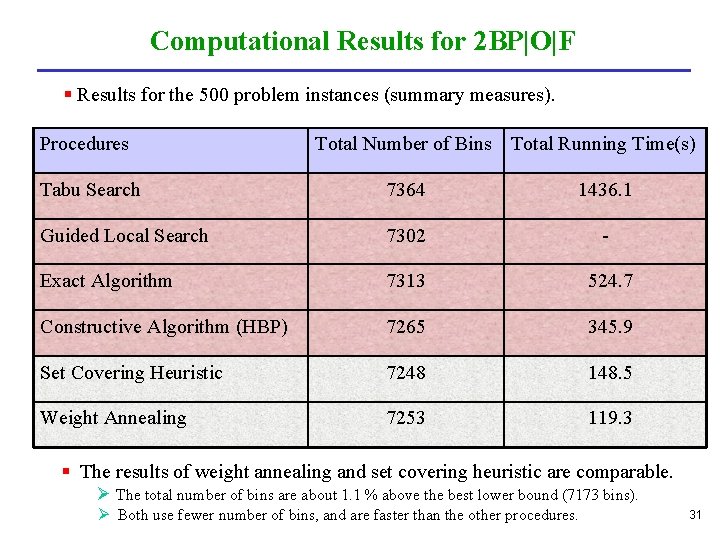
Computational Results for 2 BP|O|F § Results for the 500 problem instances (summary measures). Procedures Total Number of Bins Total Running Time(s) Tabu Search 7364 1436. 1 Guided Local Search 7302 - Exact Algorithm 7313 524. 7 Constructive Algorithm (HBP) 7265 345. 9 Set Covering Heuristic 7248 148. 5 Weight Annealing 7253 119. 3 § The results of weight annealing and set covering heuristic are comparable. Ø The total number of bins are about 1. 1 % above the best lower bound (7173 bins). Ø Both use fewer number of bins, and are faster than the other procedures. 31
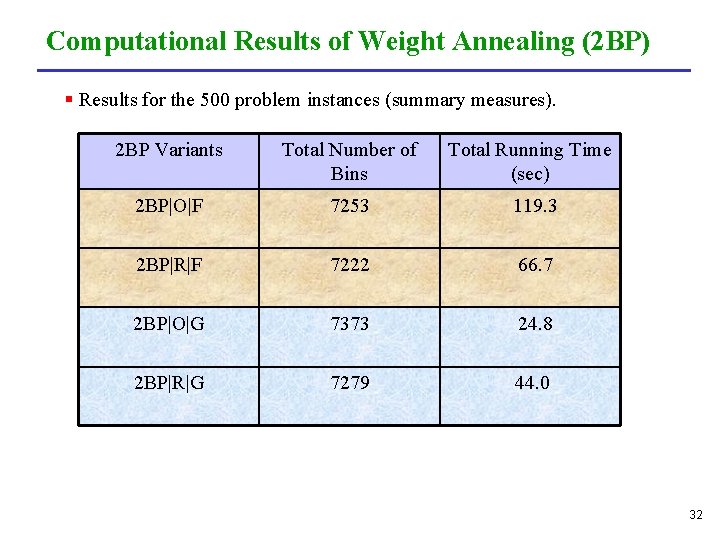
Computational Results of Weight Annealing (2 BP) § Results for the 500 problem instances (summary measures). 2 BP Variants Total Number of Bins Total Running Time (sec) 2 BP|O|F 7253 119. 3 2 BP|R|F 7222 66. 7 2 BP|O|G 7373 24. 8 2 BP|R|G 7279 44. 0 32
Conclusions § The application of weight annealing to bin packing problems is new. Ø One-dimensional bin packing problem Ø Two-dimensional bin packing problem (four versions) § Weight annealing algorithms produce high-quality solutions. § Weight annealing algorithms are fast and competitive. Ø Easy to understand Ø Simple to code Ø Small number of parameters 33
- Slides: 34