
Weekly planning grid Week beginning 19 5 20
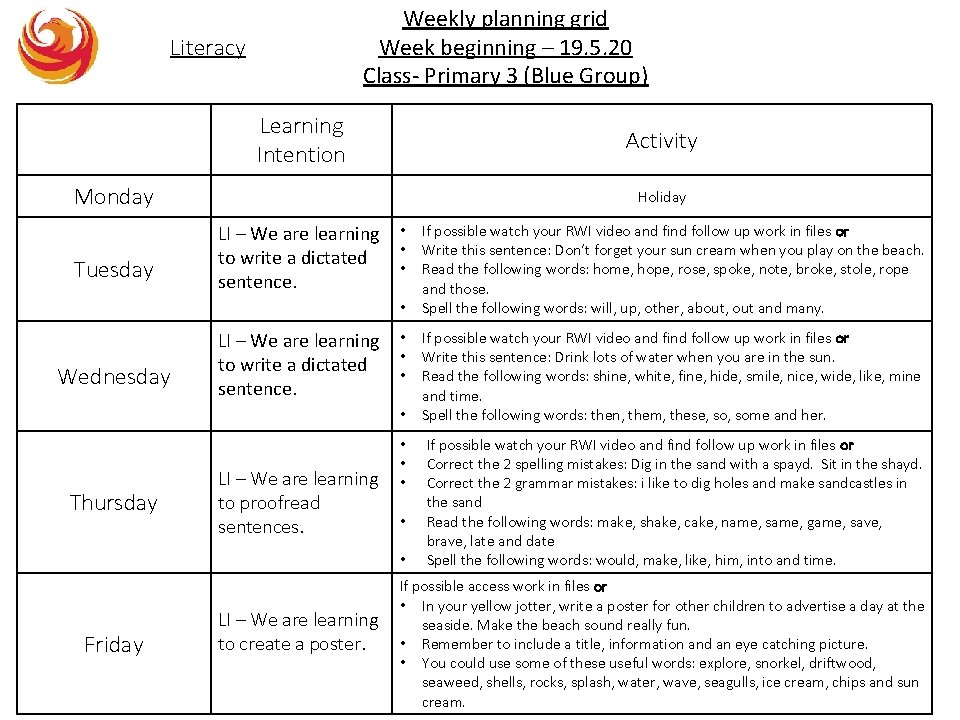
Weekly planning grid Week beginning – 19. 5. 20 Class- Primary 3 (Blue Group) Literacy Learning Intention Activity Monday Tuesday Holiday LI – We are learning • • to write a dictated • sentence. • Wednesday LI – We are learning • • to write a dictated • sentence. • Thursday LI – We are learning to proofread sentences. • • • Friday LI – We are learning to create a poster. If possible watch your RWI video and find follow up work in files or Write this sentence: Don’t forget your sun cream when you play on the beach. Read the following words: home, hope, rose, spoke, note, broke, stole, rope and those. Spell the following words: will, up, other, about, out and many. If possible watch your RWI video and find follow up work in files or Write this sentence: Drink lots of water when you are in the sun. Read the following words: shine, white, fine, hide, smile, nice, wide, like, mine and time. Spell the following words: then, them, these, some and her. If possible watch your RWI video and find follow up work in files or Correct the 2 spelling mistakes: Dig in the sand with a spayd. Sit in the shayd. Correct the 2 grammar mistakes: i like to dig holes and make sandcastles in the sand Read the following words: make, shake, cake, name, same, game, save, brave, late and date Spell the following words: would, make, like, him, into and time. If possible access work in files or • In your yellow jotter, write a poster for other children to advertise a day at the seaside. Make the beach sound really fun. • Remember to include a title, information and an eye catching picture. • You could use some of these useful words: explore, snorkel, driftwood, seaweed, shells, rocks, splash, water, wave, seagulls, ice cream, chips and sun cream.
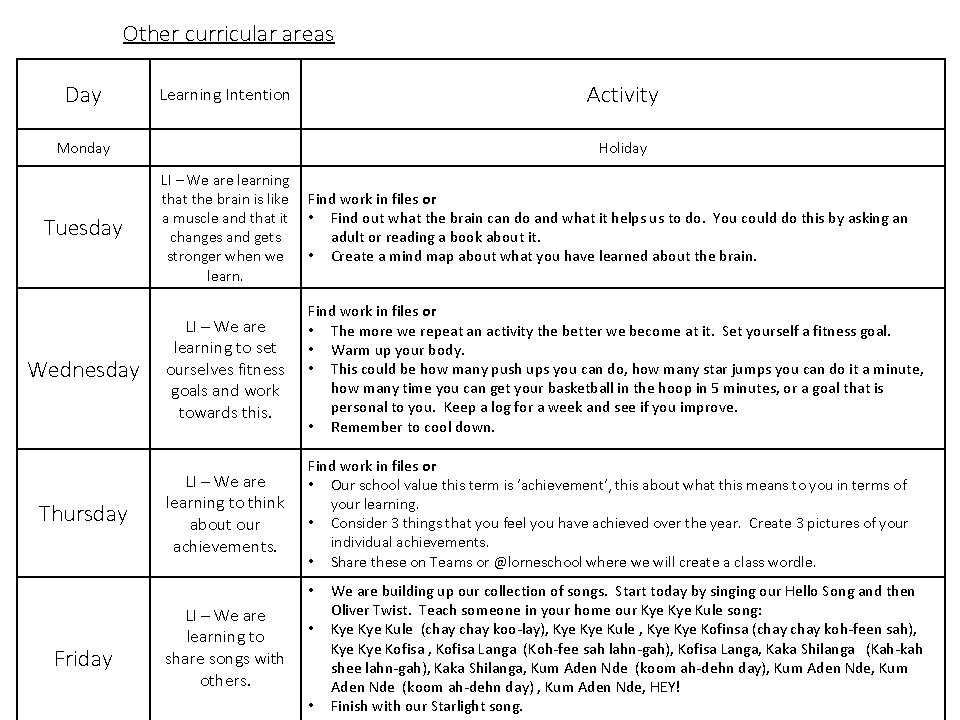
Other curricular areas Day Activity Learning Intention Monday Holiday Tuesday LI – We are learning that the brain is like a muscle and that it changes and gets stronger when we learn. Find work in files or • Find out what the brain can do and what it helps us to do. You could do this by asking an adult or reading a book about it. • Create a mind map about what you have learned about the brain. Wednesday LI – We are learning to set ourselves fitness goals and work towards this. Find work in files or • The more we repeat an activity the better we become at it. Set yourself a fitness goal. • Warm up your body. • This could be how many push ups you can do, how many star jumps you can do it a minute, how many time you can get your basketball in the hoop in 5 minutes, or a goal that is personal to you. Keep a log for a week and see if you improve. • Remember to cool down. LI – We are learning to think about our achievements. Find work in files or • Our school value this term is ‘achievement’, this about what this means to you in terms of your learning. • Consider 3 things that you feel you have achieved over the year. Create 3 pictures of your individual achievements. • Share these on Teams or @lorneschool where we will create a class wordle. Thursday • Friday LI – We are learning to share songs with others. • • We are building up our collection of songs. Start today by singing our Hello Song and then Oliver Twist. Teach someone in your home our Kye Kule song: Kye Kule (chay koo-lay), Kye Kule , Kye Kofinsa (chay koh-feen sah), Kye Kofisa , Kofisa Langa (Koh-fee sah lahn-gah), Kofisa Langa, Kaka Shilanga (Kah-kah shee lahn-gah), Kaka Shilanga, Kum Aden Nde (koom ah-dehn day), Kum Aden Nde (koom ah-dehn day) , Kum Aden Nde, HEY! Finish with our Starlight song.
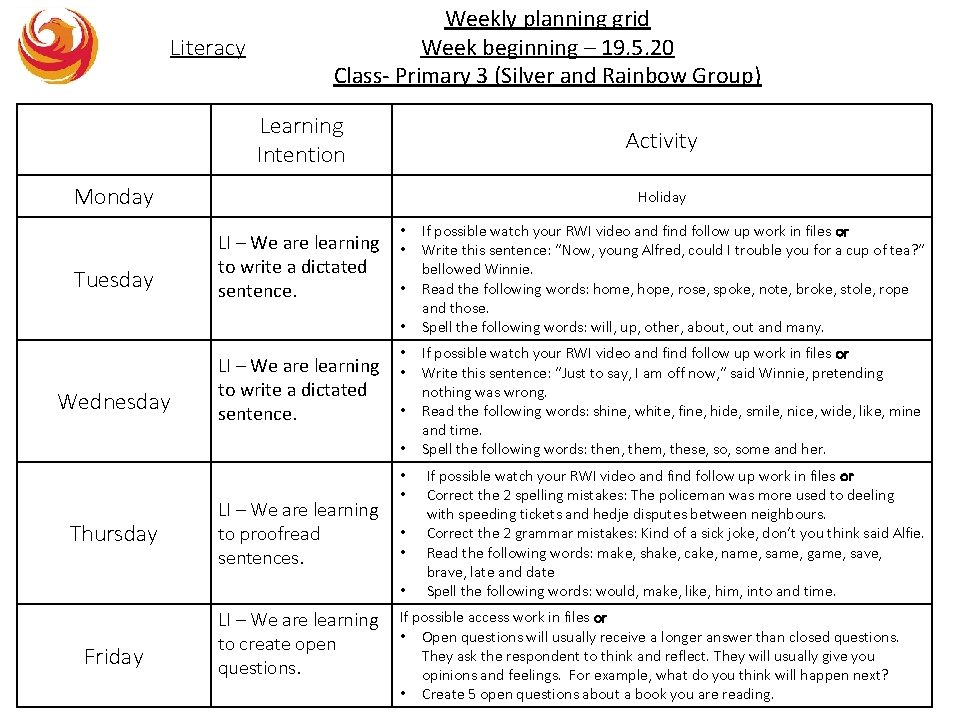
Literacy Weekly planning grid Week beginning – 19. 5. 20 Class- Primary 3 (Silver and Rainbow Group) Learning Intention Activity Monday Holiday • Tuesday LI – We are learning • to write a dictated • sentence. • • Wednesday LI – We are learning • to write a dictated • sentence. • Thursday LI – We are learning to proofread sentences. • • • Friday LI – We are learning to create open questions. If possible watch your RWI video and find follow up work in files or Write this sentence: “Now, young Alfred, could I trouble you for a cup of tea? ” bellowed Winnie. Read the following words: home, hope, rose, spoke, note, broke, stole, rope and those. Spell the following words: will, up, other, about, out and many. If possible watch your RWI video and find follow up work in files or Write this sentence: “Just to say, I am off now, ” said Winnie, pretending nothing was wrong. Read the following words: shine, white, fine, hide, smile, nice, wide, like, mine and time. Spell the following words: then, them, these, some and her. If possible watch your RWI video and find follow up work in files or Correct the 2 spelling mistakes: The policeman was more used to deeling with speeding tickets and hedje disputes between neighbours. Correct the 2 grammar mistakes: Kind of a sick joke, don’t you think said Alfie. Read the following words: make, shake, cake, name, same, game, save, brave, late and date Spell the following words: would, make, like, him, into and time. If possible access work in files or • Open questions will usually receive a longer answer than closed questions. They ask the respondent to think and reflect. They will usually give you opinions and feelings. For example, what do you think will happen next? • Create 5 open questions about a book you are reading.
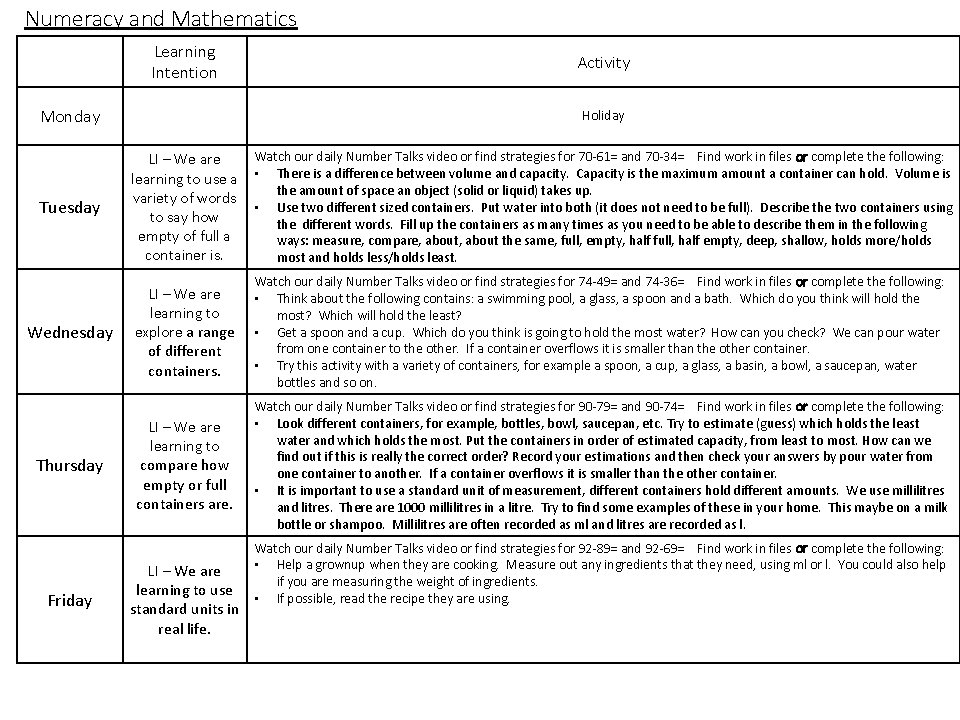
Numeracy and Mathematics Learning Intention Monday Activity Holiday Tuesday LI – We are learning to use a variety of words to say how empty of full a container is. Watch our daily Number Talks video or find strategies for 70 -61= and 70 -34= Find work in files or complete the following: • There is a difference between volume and capacity. Capacity is the maximum amount a container can hold. Volume is the amount of space an object (solid or liquid) takes up. • Use two different sized containers. Put water into both (it does not need to be full). Describe the two containers using the different words. Fill up the containers as many times as you need to be able to describe them in the following ways: measure, compare, about the same, full, empty, half full, half empty, deep, shallow, holds more/holds most and holds less/holds least. Wednesday LI – We are learning to explore a range of different containers. Watch our daily Number Talks video or find strategies for 74 -49= and 74 -36= Find work in files or complete the following: • Think about the following contains: a swimming pool, a glass, a spoon and a bath. Which do you think will hold the most? Which will hold the least? • Get a spoon and a cup. Which do you think is going to hold the most water? How can you check? We can pour water from one container to the other. If a container overflows it is smaller than the other container. • Try this activity with a variety of containers, for example a spoon, a cup, a glass, a basin, a bowl, a saucepan, water bottles and so on. LI – We are learning to compare how empty or full containers are. Watch our daily Number Talks video or find strategies for 90 -79= and 90 -74= Find work in files or complete the following: • Look different containers, for example, bottles, bowl, saucepan, etc. Try to estimate (guess) which holds the least water and which holds the most. Put the containers in order of estimated capacity, from least to most. How can we find out if this is really the correct order? Record your estimations and then check your answers by pour water from one container to another. If a container overflows it is smaller than the other container. • It is important to use a standard unit of measurement, different containers hold different amounts. We use millilitres and litres. There are 1000 millilitres in a litre. Try to find some examples of these in your home. This maybe on a milk bottle or shampoo. Millilitres are often recorded as ml and litres are recorded as l. Thursday Friday LI – We are learning to use standard units in real life. Watch our daily Number Talks video or find strategies for 92 -89= and 92 -69= Find work in files or complete the following: • Help a grownup when they are cooking. Measure out any ingredients that they need, using ml or l. You could also help if you are measuring the weight of ingredients. • If possible, read the recipe they are using.
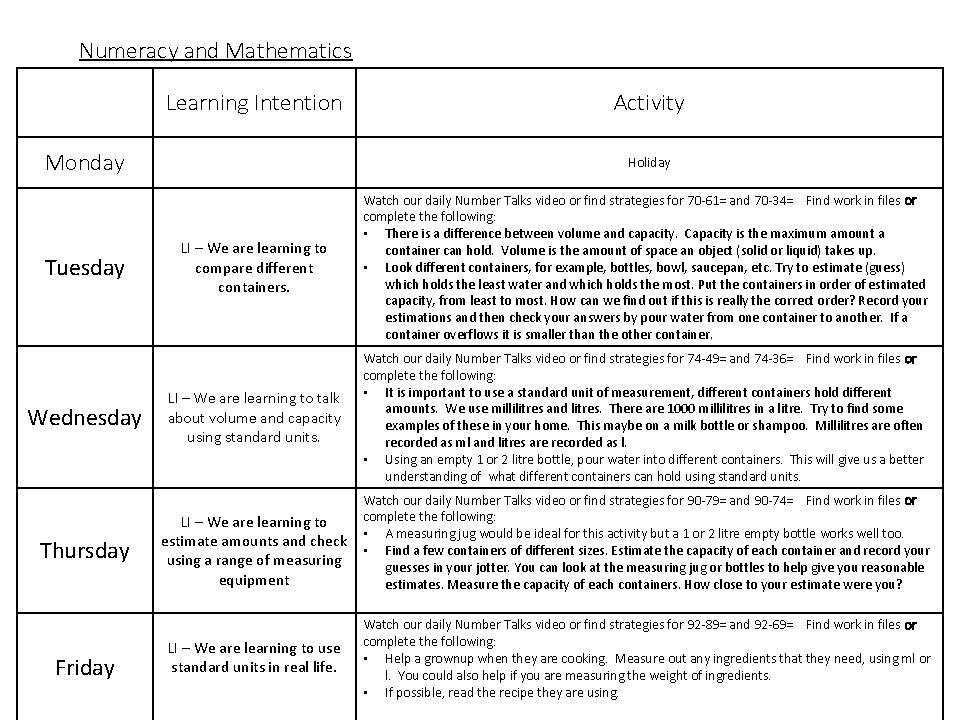
Numeracy and Mathematics Learning Intention Activity Monday Holiday Tuesday LI – We are learning to compare different containers. Watch our daily Number Talks video or find strategies for 70 -61= and 70 -34= Find work in files or complete the following: • There is a difference between volume and capacity. Capacity is the maximum amount a container can hold. Volume is the amount of space an object (solid or liquid) takes up. • Look different containers, for example, bottles, bowl, saucepan, etc. Try to estimate (guess) which holds the least water and which holds the most. Put the containers in order of estimated capacity, from least to most. How can we find out if this is really the correct order? Record your estimations and then check your answers by pour water from one container to another. If a container overflows it is smaller than the other container. LI – We are learning to talk about volume and capacity using standard units. Watch our daily Number Talks video or find strategies for 74 -49= and 74 -36= Find work in files or complete the following: • It is important to use a standard unit of measurement, different containers hold different amounts. We use millilitres and litres. There are 1000 millilitres in a litre. Try to find some examples of these in your home. This maybe on a milk bottle or shampoo. Millilitres are often recorded as ml and litres are recorded as l. • Using an empty 1 or 2 litre bottle, pour water into different containers. This will give us a better understanding of what different containers can hold using standard units. Wednesday Thursday Friday LI – We are learning to estimate amounts and check using a range of measuring equipment LI – We are learning to use standard units in real life. Watch our daily Number Talks video or find strategies for 90 -79= and 90 -74= Find work in files or complete the following: • A measuring jug would be ideal for this activity but a 1 or 2 litre empty bottle works well too. • Find a few containers of different sizes. Estimate the capacity of each container and record your guesses in your jotter. You can look at the measuring jug or bottles to help give you reasonable estimates. Measure the capacity of each containers. How close to your estimate were you? Watch our daily Number Talks video or find strategies for 92 -89= and 92 -69= Find work in files or complete the following: • Help a grownup when they are cooking. Measure out any ingredients that they need, using ml or l. You could also help if you are measuring the weight of ingredients. • If possible, read the recipe they are using.
- Slides: 5