
Weekend Discharge Team Facilitating Hospital Discharges 7 Days
- Slides: 1
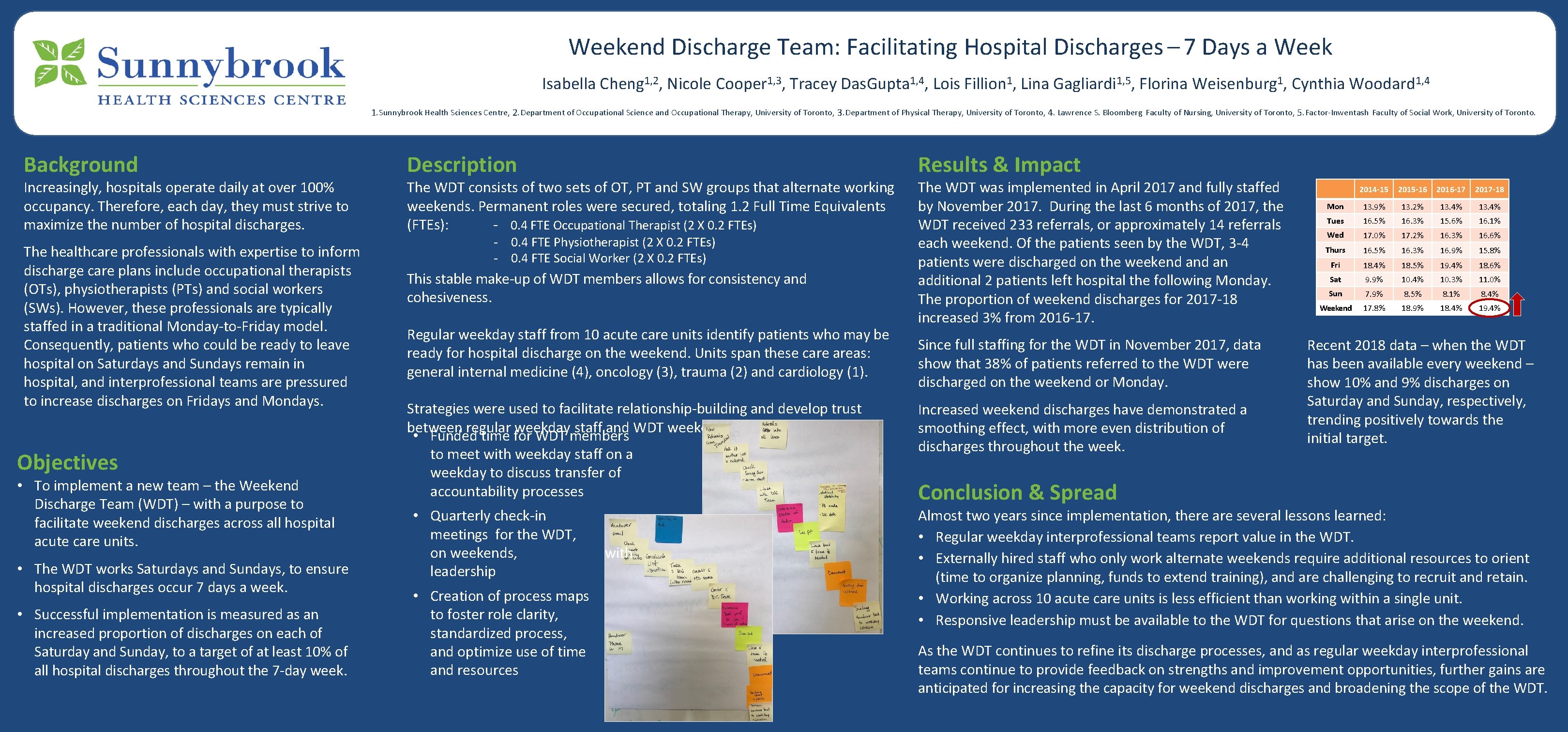
Weekend Discharge Team: Facilitating Hospital Discharges – 7 Days a Week Isabella Cheng 1, 2, Nicole Cooper 1, 3, Tracey Das. Gupta 1, 4, Lois Fillion 1, Lina Gagliardi 1, 5, Florina Weisenburg 1, Cynthia Woodard 1, 4 1. Sunnybrook Health Sciences Centre, 2. Department of Occupational Science and Occupational Therapy, University of Toronto, 3. Department of Physical Therapy, University of Toronto, 4. Lawrence S. Bloomberg Faculty of Nursing, University of Toronto, 5. Factor-Inwentash Faculty of Social Work, University of Toronto. Background Increasingly, hospitals operate daily at over 100% occupancy. Therefore, each day, they must strive to maximize the number of hospital discharges. The healthcare professionals with expertise to inform discharge care plans include occupational therapists (OTs), physiotherapists (PTs) and social workers (SWs). However, these professionals are typically staffed in a traditional Monday-to-Friday model. Consequently, patients who could be ready to leave hospital on Saturdays and Sundays remain in hospital, and interprofessional teams are pressured to increase discharges on Fridays and Mondays. Objectives • To implement a new team – the Weekend Discharge Team (WDT) – with a purpose to facilitate weekend discharges across all hospital acute care units. • The WDT works Saturdays and Sundays, to ensure hospital discharges occur 7 days a week. • Successful implementation is measured as an increased proportion of discharges on each of Saturday and Sunday, to a target of at least 10% of all hospital discharges throughout the 7 -day week. Description The WDT consists of two sets of OT, PT and SW groups that alternate working weekends. Permanent roles were secured, totaling 1. 2 Full Time Equivalents (FTEs): - 0. 4 FTE Occupational Therapist (2 X 0. 2 FTEs) - 0. 4 FTE Physiotherapist (2 X 0. 2 FTEs) - 0. 4 FTE Social Worker (2 X 0. 2 FTEs) This stable make-up of WDT members allows for consistency and cohesiveness. Regular weekday staff from 10 acute care units identify patients who may be ready for hospital discharge on the weekend. Units span these care areas: general internal medicine (4), oncology (3), trauma (2) and cardiology (1). Strategies were used to facilitate relationship-building and develop trust between regular weekday staff and WDT weekend-only staff: • Funded time for WDT members to meet with weekday staff on a weekday to discuss transfer of accountability processes • Quarterly check-in meetings for the WDT, on weekends, with leadership • Creation of process maps to foster role clarity, standardized process, and optimize use of time and resources Results & Impact The WDT was implemented in April 2017 and fully staffed by November 2017. During the last 6 months of 2017, the WDT received 233 referrals, or approximately 14 referrals each weekend. Of the patients seen by the WDT, 3 -4 patients were discharged on the weekend an additional 2 patients left hospital the following Monday. The proportion of weekend discharges for 2017 -18 increased 3% from 2016 -17. Since full staffing for the WDT in November 2017, data show that 38% of patients referred to the WDT were discharged on the weekend or Monday. Increased weekend discharges have demonstrated a smoothing effect, with more even distribution of discharges throughout the week. 2014 -15 2015 -16 2016 -17 2017 -18 Mon 13. 9% 13. 2% 13. 4% Tues 16. 5% 16. 3% 15. 6% 16. 1% Wed 17. 0% 17. 2% 16. 3% 16. 6% Thurs 16. 5% 16. 3% 16. 9% 15. 8% Fri 18. 4% 18. 5% 19. 4% 18. 6% Sat 9. 9% 10. 4% 10. 3% 11. 0% Sun 7. 9% 8. 5% 8. 1% 8. 4% Weekend 17. 8% 18. 9% 18. 4% 19. 4% Recent 2018 data – when the WDT has been available every weekend – show 10% and 9% discharges on Saturday and Sunday, respectively, trending positively towards the initial target. Conclusion & Spread Almost two years since implementation, there are several lessons learned: • Regular weekday interprofessional teams report value in the WDT. • Externally hired staff who only work alternate weekends require additional resources to orient (time to organize planning, funds to extend training), and are challenging to recruit and retain. • Working across 10 acute care units is less efficient than working within a single unit. • Responsive leadership must be available to the WDT for questions that arise on the weekend. As the WDT continues to refine its discharge processes, and as regular weekday interprofessional teams continue to provide feedback on strengths and improvement opportunities, further gains are anticipated for increasing the capacity for weekend discharges and broadening the scope of the WDT.