
Weekend Cabin Retreat Project Foundations and Foundation Plans

Weekend Cabin Retreat Project Foundations and Foundation Plans Sacramento City College EDT 300 - Foundation Plan Design 1
Objectives u Describe the procedure for staking out a house location. u List the major considerations when designing a footing for a residential foundation. u Analyze a typical floor plan to determine the appropriate foundation. 2 EDT 300 - Foundation Plan Design
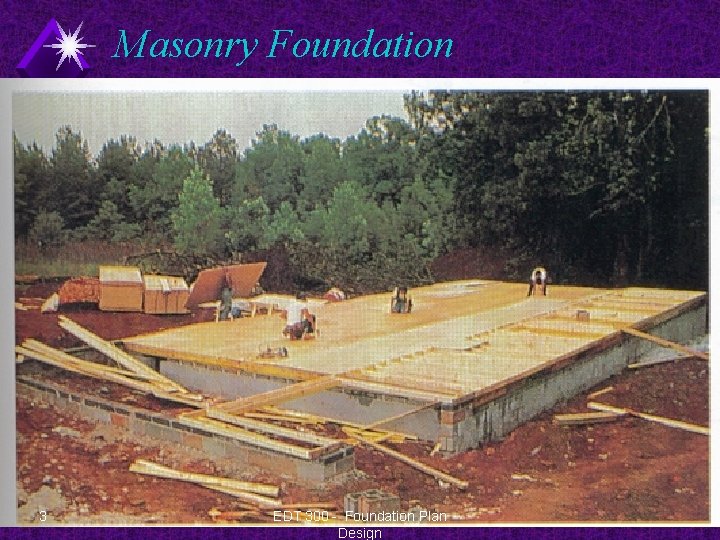
Masonry Foundation 3 EDT 300 - Foundation Plan Design
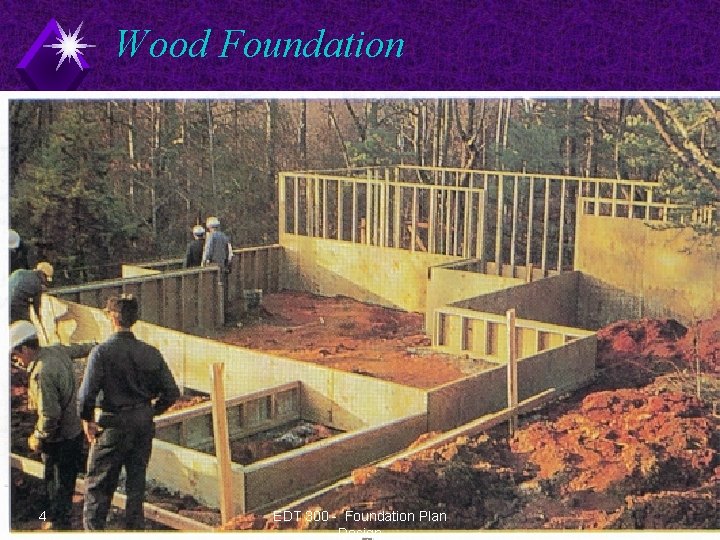
Wood Foundation 4 EDT 300 - Foundation Plan Design
Staking Out House Location u The plot plan provides the necessary dimensions required for staking out the location of the house on the lot. u Tools for staking out: u Measuring tape u Contractor's level u Transit (if required) 5 EDT 300 - Foundation Plan Design
Staking Out House Location u First Step u locate each corner by laying off the distances indicated on the plot plan. u Drive a stake into the ground at the location of each corner of the foundation to identify its position. 6 EDT 300 - Foundation Plan Design
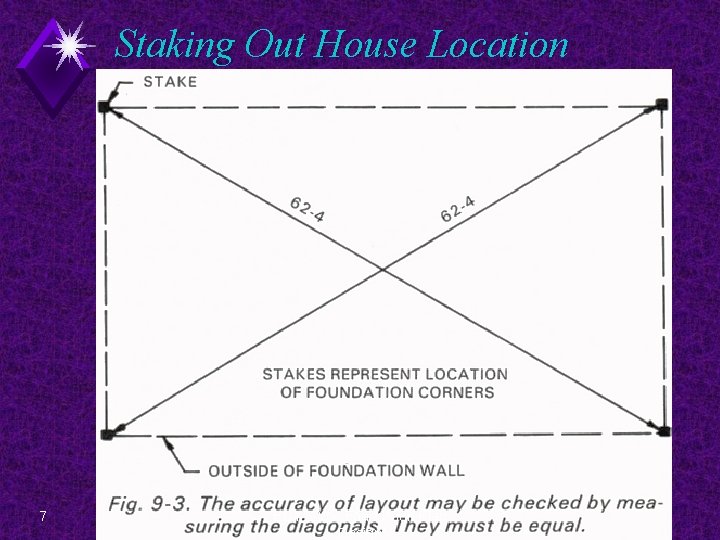
Staking Out House Location 7 EDT 300 - Foundation Plan Design
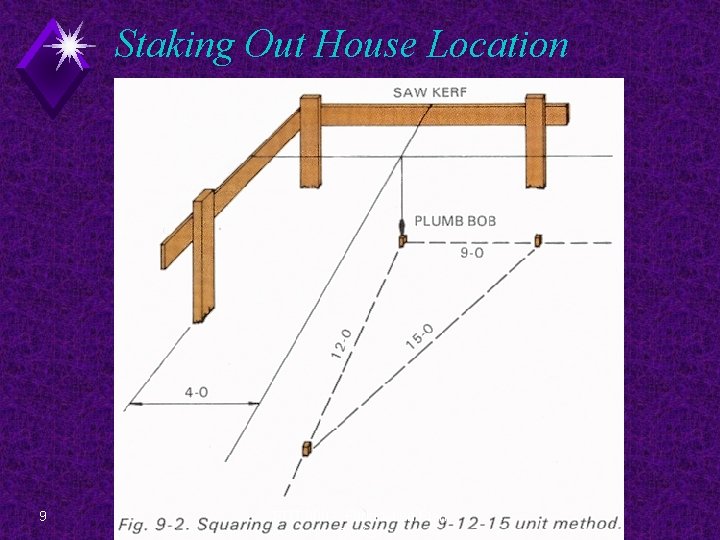
Staking Out House Location u Square corners may be laid out using the 9 -12 -15 unit method. u These proportions define a right triangle and establish a 90 angle corner. 8 EDT 300 - Foundation Plan Design
Staking Out House Location 9 EDT 300 - Foundation Plan Design
Staking Out House Location u Batter boards are used to retain the location of the foundation during excavation and construction. u Are constructed of 2 x 4 stakes driven into the ground about 4 feet outside the footing line. u A 1 x 6 board is nailed horizontally to the stakes so all are level and in the same horizontal plane. (They will have the same elevation. ) 10 EDT 300 - Foundation Plan Design
Staking Out House Location 11 EDT 300 - Foundation Plan Design
Staking Out House Location u. A strong cord is stretched across the boards at opposite ends of the building and located directly above the corner stakes. u A plumb bob is used for accurate placement of each stake. u This is done for each side of the building. u A saw kerf (cut) is usually made at the exact point on the horizontal batter board where the string is located. u This prevents movement of the string along the board. 12 EDT 300 - Foundation Plan Design
Staking Out House Location u After cuts are made in all eight batter boards, the outlines of the house will be located. u A control point is needed to determine the depth of excavation and foundation wall height. u The corner with the highest elevation is usually selected for this purpose. u The finished floor should be at least 8 inches above the grade. 13 EDT 300 - Foundation Plan Design
Excavation u In excavating for footings and foundation walls, the top soil is usually removed using a bulldozer or tractor with a blade. u This soil is saved for final grading. u A trencher or backhoe may be used to excavate for foundations when either slab construction or a crawl space is planned. 14 EDT 300 - Foundation Plan Design
Excavation u In excavating for a basement, basement a backhoe used. u Selection of excavating equipment is determined by the size of the excavation and type of soil. u Excavation for footings should extend down to a minimum of 6 in. into undisturbed earth. 15 EDT 300 - Foundation Plan Design
Excavation u It must also be at least 6 in. below the average maximum frost penetration depth. u Local codes usually specify the minimum footing depth for a given area. 16 EDT 300 - Foundation Plan Design
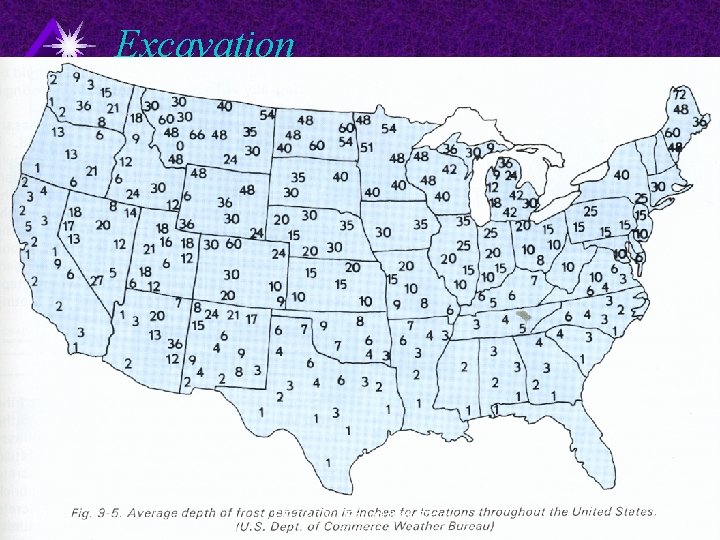
Excavation 17 EDT 300 - Foundation Plan Design
Excavation u No backfilling should be permitted under the proposed footings, because uneven settling of the house may occur. u Footings on rock. About 6 in. of the rock should be removed under the proposed footing and replaced with compacted sand to equalize settling. 18 EDT 300 - Foundation Plan Design
Excavation u Sites which have recently been filled and regraded: the footings should extend down to the original undisturbed earth. u Unless soil tests prove that the earth is sufficiently compacted to properly support the structure. 19 EDT 300 - Foundation Plan Design
Excavation u Excavation must be large enough to allow space to work when constructing the foundation wall and laying drain tile. u The steepness of the back slope will depend on the type of soil encountered. u Sandy soil is likely to cave-in and, requires a gentle back slope. u Clay may be nearly vertical. 20 EDT 300 - Foundation Plan Design
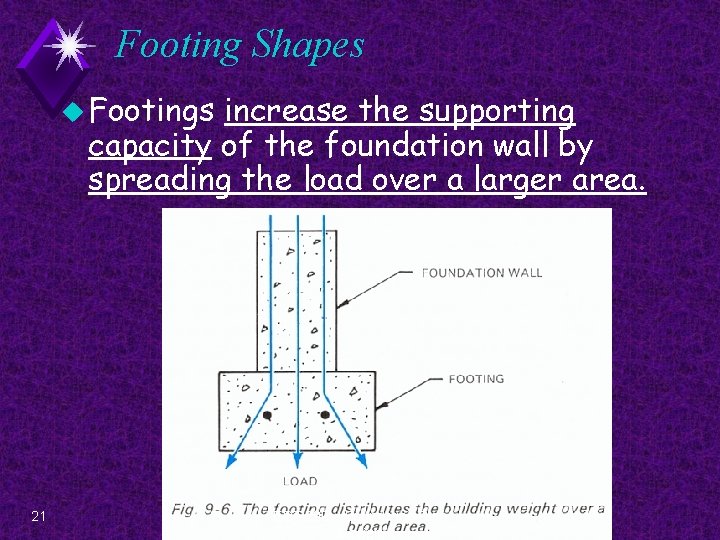
Footing Shapes u Footings increase the supporting capacity of the foundation wall by spreading the load over a larger area. 21 EDT 300 - Foundation Plan Design
Footing Shapes u If a foundation was built on rock, a footing would not be necessary. u Most houses are not built on such solid material and therefore need footings to support the heavy loads. u The size and type of footing should be u suitable for the weight of the building and u soil bearing capacity. 22 EDT 300 - Foundation Plan Design
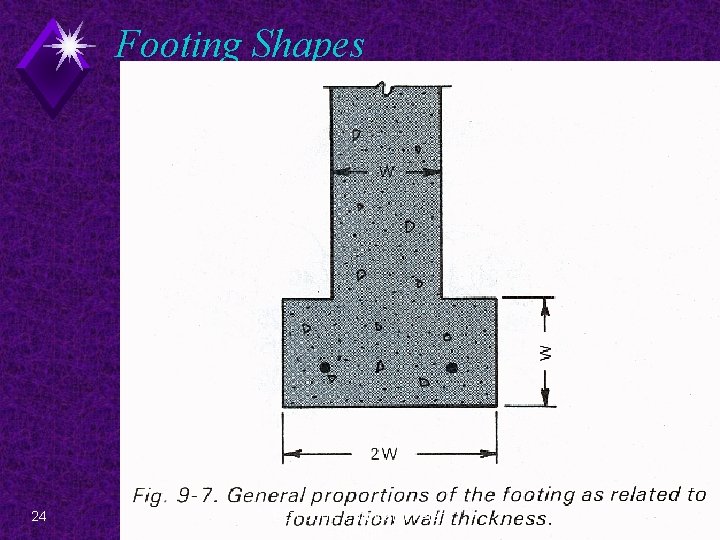
Footing Shapes u Footings for most residential structures are made of poured concrete. u The size of footing required is commonly determined by using the foundation wall thickness as a basis for its proportions. 23 EDT 300 - Foundation Plan Design
Footing Shapes 24 EDT 300 - Foundation Plan Design
Footing Shapes u This size footing is designed for most normal soil conditions ranging from sand to clay. 25 EDT 300 - Foundation Plan Design
Footing Shapes u Foundation walls should be centered along the footing. u The footing will project beyond each side of the foundation wall a distance equal to one-half the thickness of the foundation wall. u If the soil load bearing capacity is very poor, the size of footings should be increased and reinforced with steel. 26 EDT 300 - Foundation Plan Design
Footing Shapes u The footings must be large enough to minimize the effects of: u settlement of the structure. u unequal compressibility of the soil. u to reduce cracking. u The weight of most homes is greater on two of the four walls which causes unequal loading. 27 EDT 300 - Foundation Plan Design
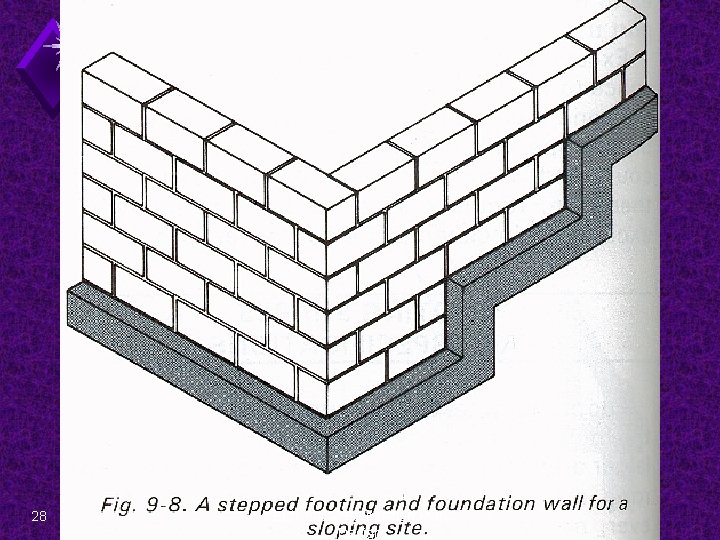
Footing Shapes 28 EDT 300 - Foundation Plan Design
Foundation Walls u Foundation walls extend from the first floor to the footing. u A foundation wall may also be a basement wall. 29 EDT 300 - Foundation Plan Design
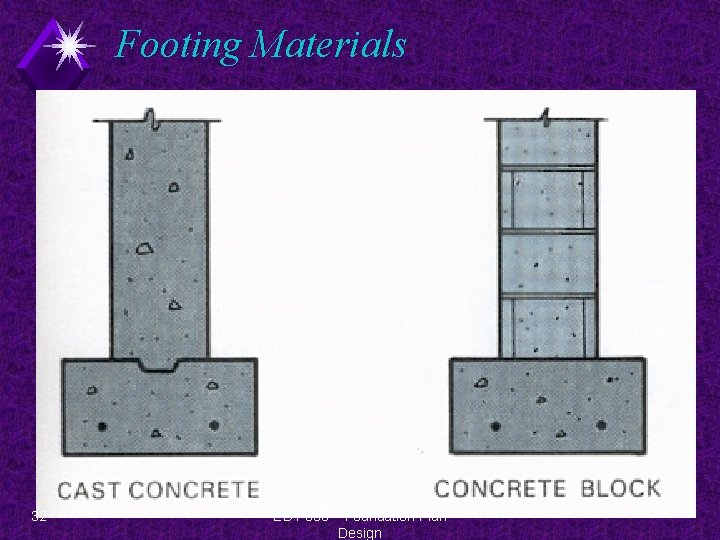
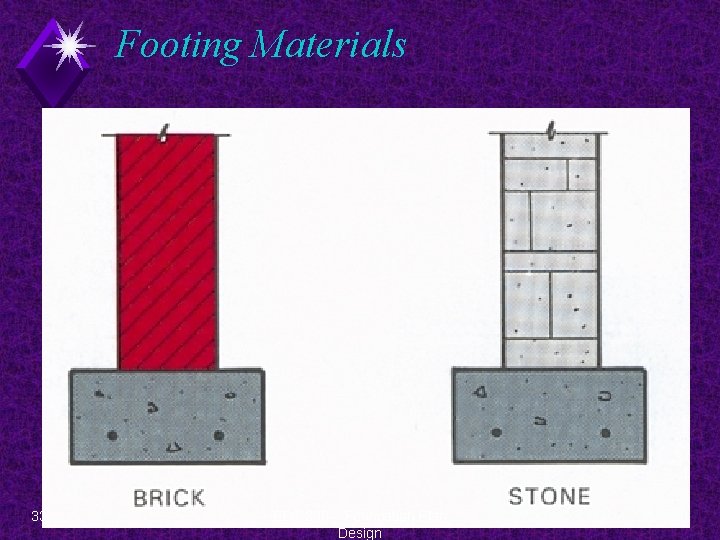
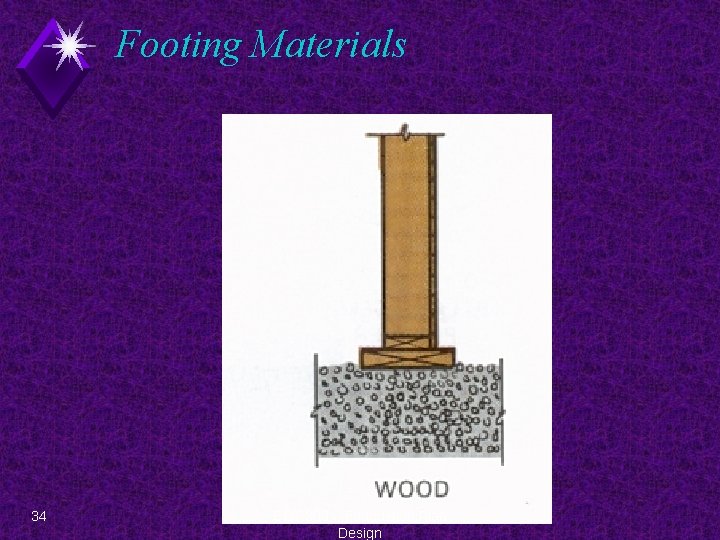
Foundation Walls u Materials used to build foundation walls include u cast (poured) concrete u concrete block u pressure-treated wood u stone or brick in rare instances 30 EDT 300 - Foundation Plan Design
Foundation Walls u Cast concrete and concrete block are widely used in residential structures. u Pressure-treated wood foundations are gaining acceptance for residential structures. u Brick is much more expensive than cast concrete, block, or wood, and is seldom used. u Stone was once used extensively, but is no longer of significance as a foundation material. 31 EDT 300 - Foundation Plan Design
Footing Materials 32 EDT 300 - Foundation Plan Design
Footing Materials 33 EDT 300 - Foundation Plan Design
Footing Materials 34 EDT 300 - Foundation Plan Design
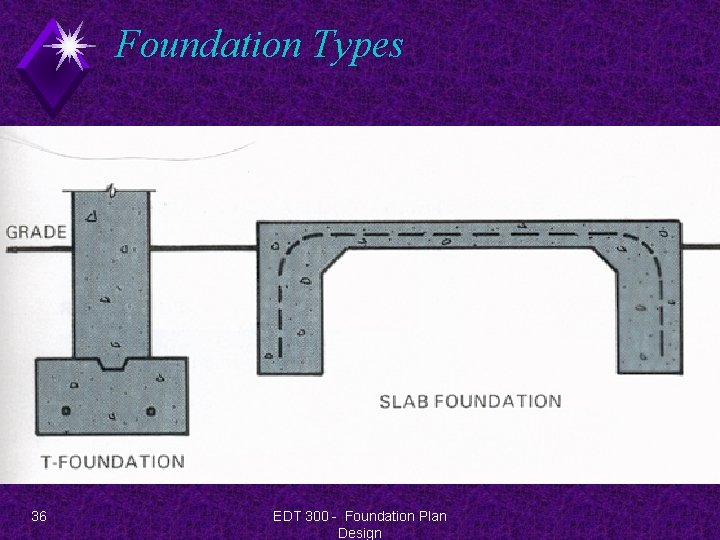
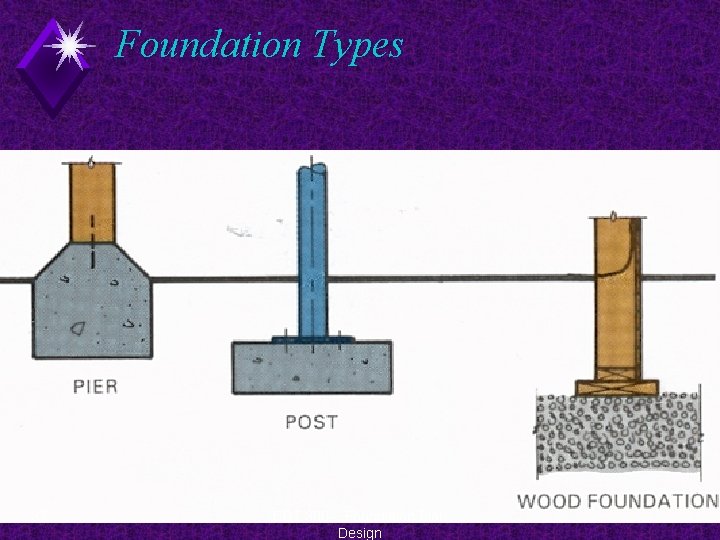
Foundation Walls u Foundation types: walls are of four basic u T-foundation u slab foundation u pier or post foundation u permanent wood foundation 35 EDT 300 - Foundation Plan Design
Foundation Types 36 EDT 300 - Foundation Plan Design
Foundation Types 37 EDT 300 - Foundation Plan Design
Foundation Walls u The type chosen for a particular situation will depend upon u the weight to be supported u load bearing capacity of the soil u location of the foundation in the building u climate u local codes u preferred building practice. u All should be considered when designing a foundation. 38 EDT 300 - Foundation Plan Design
T-Foundations u Most common foundation type u Looks like an inverted T. u The foundation and footing are usually two separate parts but may be cast as a single unit. 39 EDT 300 - Foundation Plan Design
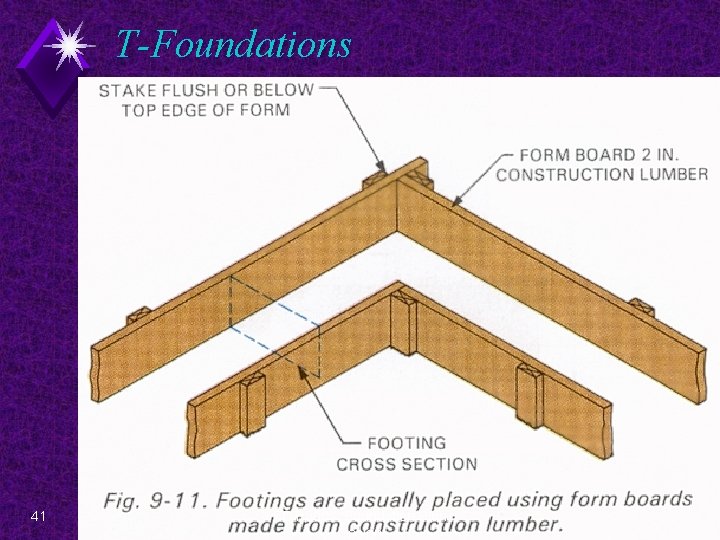
T-Foundations u Concrete for footings of a Tfoundation is usually placed in forms made from construction lumber. u The form boards are nailed to stakes once they are level. u Stakes prevent movement while the concrete is being cast. 40 EDT 300 - Foundation Plan Design
T-Foundations 41 EDT 300 - Foundation Plan Design
Slab Foundations u. A slab foundation is an extension of a slab floor. u It is placed at the same time the floor is cast and is not a separate unit. u It is sometimes called a thickened edge slab. 42 EDT 300 - Foundation Plan Design
Slab Foundations u The foundation wall should extend down below the frost line, as in the case of the T-foundation. u Use of steel reinforcing bars or mesh is recommended for the slab foundation to prevent cracking due to settling. 43 EDT 300 - Foundation Plan Design
Slab Foundations u Some of the primary advantages of the slab foundation u requires less time, expense, and labor to construct. u no separate footing is required, excavation is not as extensive as for the T-foundation. u Less time is required since the entire foundation and floor is placed in one operation. 44 EDT 300 - Foundation Plan Design
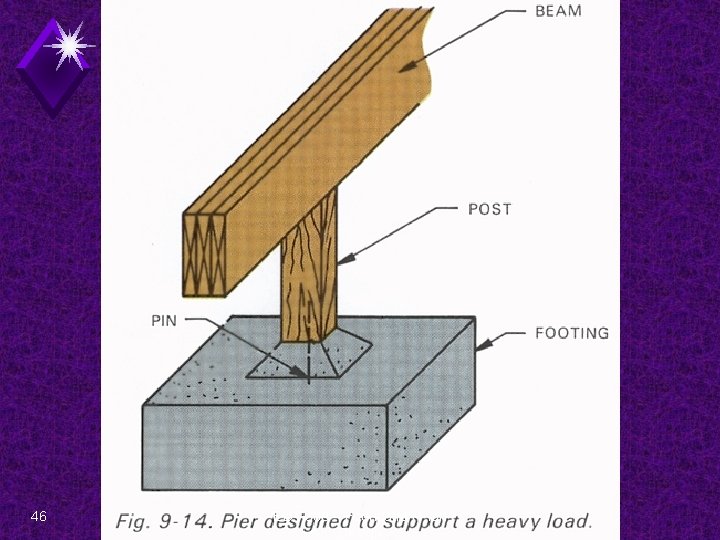
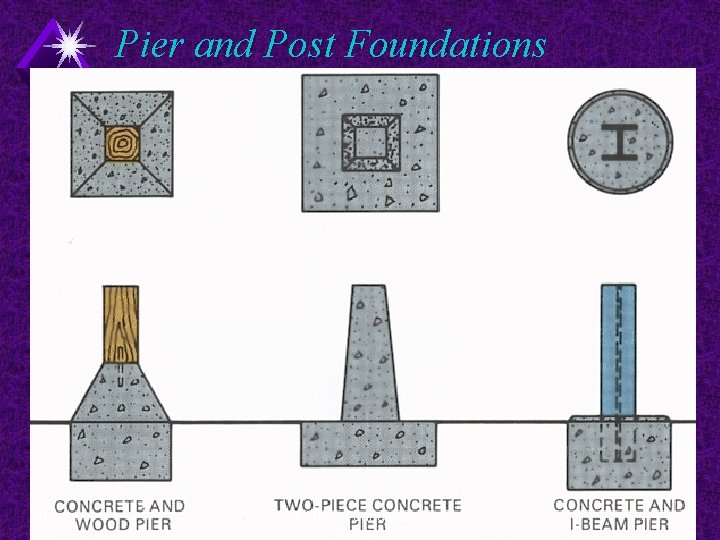
Pier and Post Foundations u Many situations in residential construction lend themselves to the use of piers, columns and posts. u Cheaper and just as satisfactory to use piers rather than the Tfoundation under parts of the building. u Example: a crawl space is planned and the distance is too great for a single span, the pier foundation is a logical choice, 45 EDT 300 - Foundation Plan Design
46 EDT 300 - Foundation Plan Design
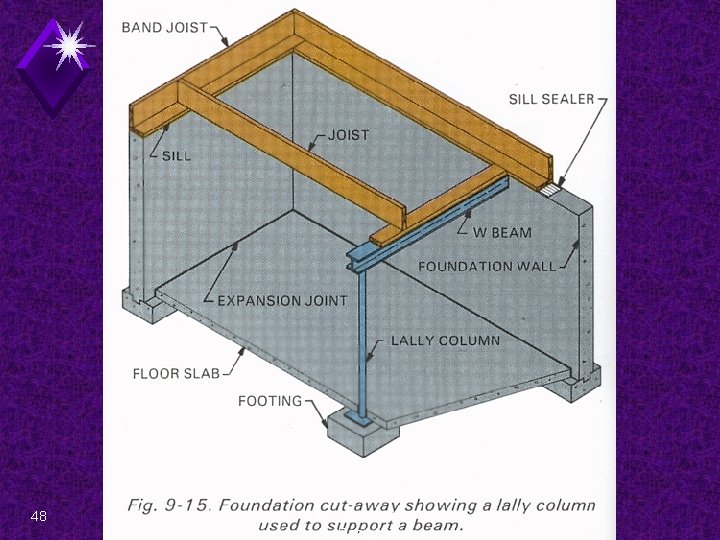
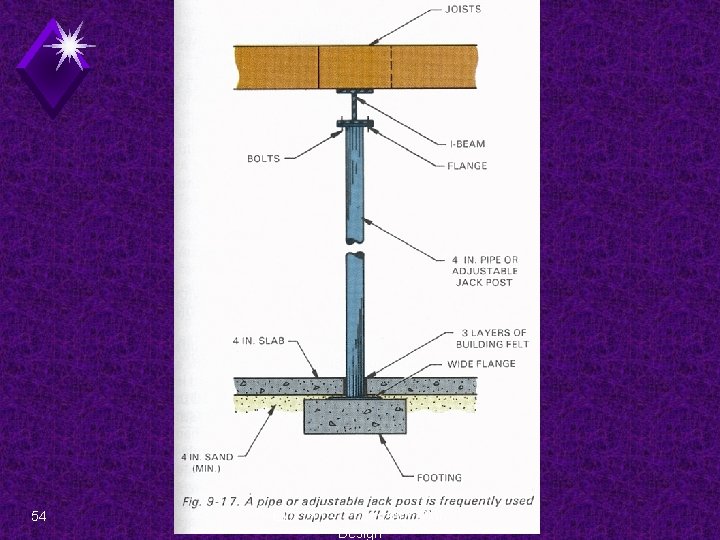
Pier and Post Foundations u Another common application: a basement or garage where the distance is too great to span with floor joists. u Lally columns are used to support a beam that in turn supports the joist. , rather than construct a bearing wall partition. 47 EDT 300 - Foundation Plan Design
48 EDT 300 - Foundation Plan Design
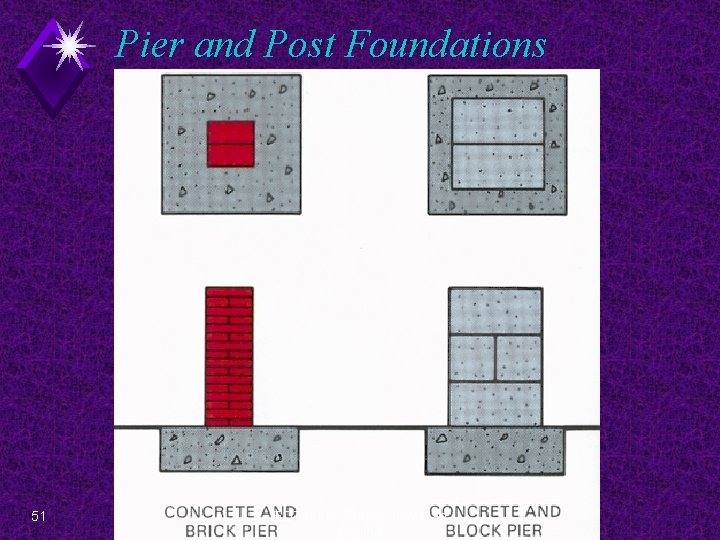
Pier and Post Foundations u Basic difference between a pier and column is the length. u Piers are usually much shorter and ordinarily located under the house. 49 EDT 300 - Foundation Plan Design
Pier and Post Foundations 50 EDT 300 - Foundation Plan Design
Pier and Post Foundations 51 EDT 300 - Foundation Plan Design
Pier and Post Foundations u The column is composed of two pieces; a footing and post. 52 EDT 300 - Foundation Plan Design
Pier and Post Foundations u The footing is usually square or rectangular u The post may be masonry, steel, or pressure-treated wood. 53 EDT 300 - Foundation Plan Design
54 EDT 300 - Foundation Plan Design
Wood Foundations u Wood foundations are known by several names: u the permanent wood foundation (PWF) u the all-weather wood foundation (AWWF) u the treated wood foundation. 55 EDT 300 - Foundation Plan Design
Wood Foundations u. A wood foundation is a below grade pressure-treated plywood-sheathed stud wall. u The wood foundation is attractive in climates where typical (concrete and masonry) foundation work stops in freezing or rainy weather. 56 EDT 300 - Foundation Plan Design

Wood Foundations u All wood parts are pressure-treated with chemical solutions that make the wood fibers useless as food for insects or fungus growth. 57 EDT 300 - Foundation Plan Design
Wood Foundations u The system is accepted by u the Federal Housing Administration (FHA) u the Department of Housing and Urban Development (HUD), u Farmers Home Administration (Fm. HA) u the major model building codes u It is rapidly gaining acceptance in state and local codes as well. 58 EDT 300 - Foundation Plan Design
Wood Foundations u The system may be used in full basement or crawl space construction u It is adaptable to most any site and light-frame building design. 59 EDT 300 - Foundation Plan Design
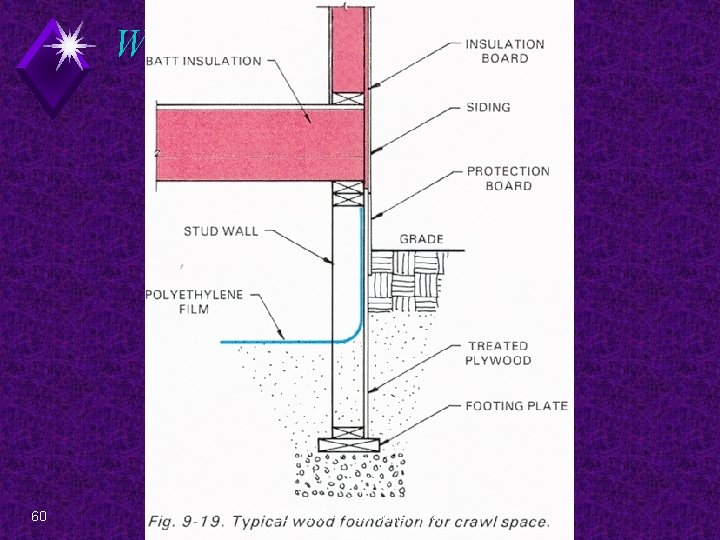
Wood Foundations 60 EDT 300 - Foundation Plan Design
Wood Foundations u Crawl spaces u. A trench is excavated to receive the footing and foundation wall. u The trench should be at least 12 in. deep regardless of the frost depth. u The depth of the excavation should be below the average maximum frost penetration depth. u 2 in. of sand or 6 in. of crushed stone or gravel are raked smooth in the bottom of the trench. u This provides a level base for the footing. 61 EDT 300 - Foundation Plan Design
Wood Foundations u The footing is generally 12” wide. u Local 62 codes may require wider footings. EDT 300 - Foundation Plan Design
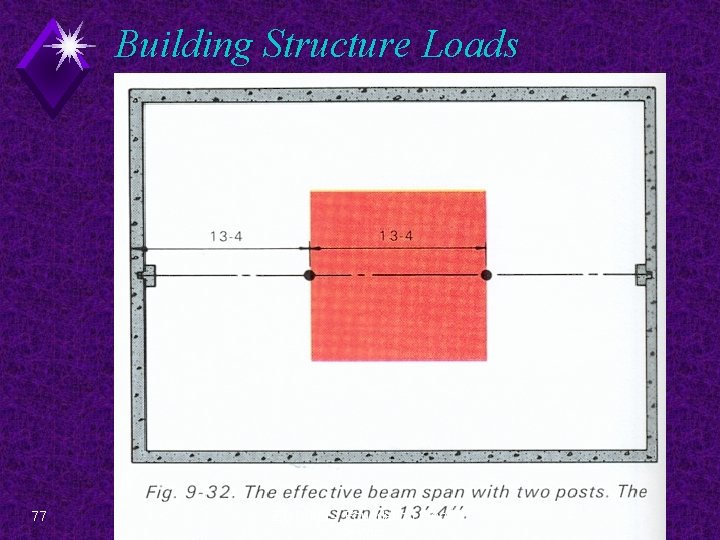
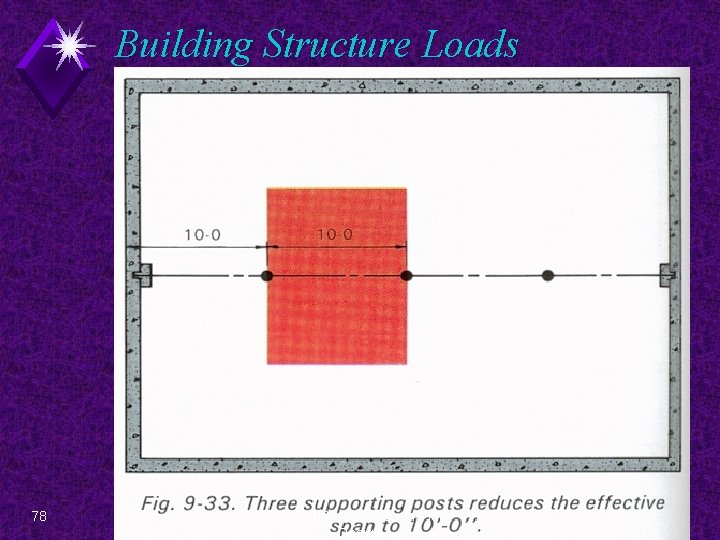
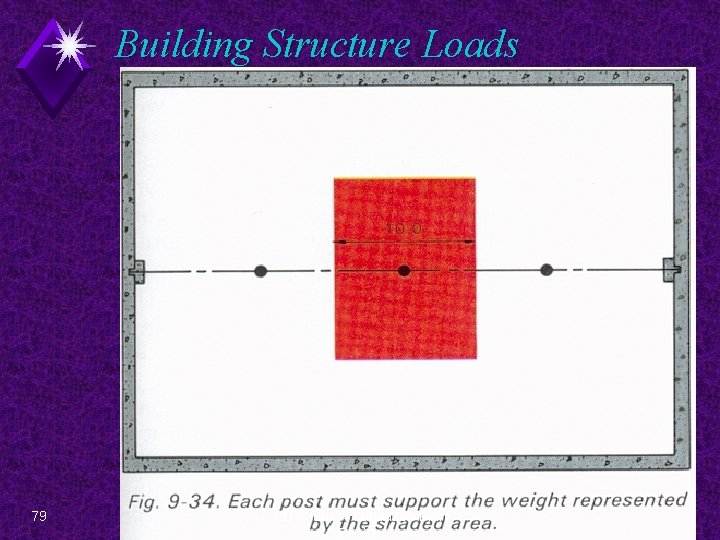
Beams and Girders u Most residences have spans too great to use unsupported floor joists. u A beam or girder is required to support the joists and prevent excessive sagging. u The beam is usually placed an equal distance from each outside wall or under a bearing wall. u A bearing wall is designed to support part of the load of the structure. 63 EDT 300 - Foundation Plan Design
Beams and Girders u Beams may be either wood or metal. u Wood beams are of two types builtup and solid. u Built-up beams u are used more frequently u easier to handle u more readily available u do not check to the extent of solid beams. u However, solid beams are generally stronger and more fire-resistant. 64 EDT 300 - Foundation Plan Design

Beams and Girders u Two types of steel beams are commonly used: S-beams and wideflange beams, 65 EDT 300 - Foundation Plan Design
Beams and Girders u The wide-flange beam u will support greater weight u is more stable than the standard S beam u it is more popular for residential construction. 66 EDT 300 - Foundation Plan Design
Beams and Girders u Calculation of the size beam needed is based on the weight of the structure. u Weights are designated either as live loads or dead loads. 67 EDT 300 - Foundation Plan Design
Beams and Girders u Live loads are those fixed or moving weights, which are not a structural part of the house. u Examples include: u furniture u occupants u snow on the roof u wind, etc. 68 EDT 300 - Foundation Plan Design
Beams and Girders u Dead loads are those static or fixed weights of the structure itself. u Examples of dead loads are the weights of: u roofing u foundation walls u siding u joists, 69 etc. EDT 300 - Foundation Plan Design
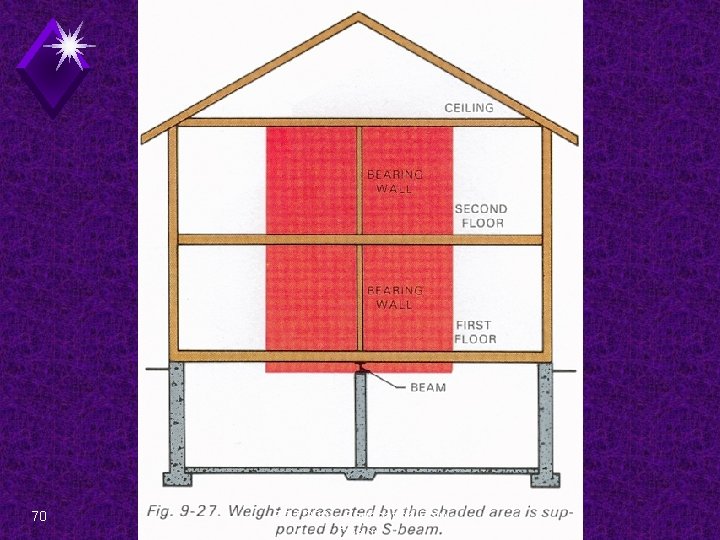
70 EDT 300 - Foundation Plan Design

71 EDT 300 - Foundation Plan Design
Building Structure Loads u First/Second Floor u Live load plus dead load = 50 pounds per square foot. u Ceiling u Live load plus dead load = 30 pounds per square foot. u Walls u Dead u Roof load = 10 pounds per square foot. u No load on the beam. Exterior walls generally support the roof. 72 EDT 300 - Foundation Plan Design
Building Structure Loads u Weight Calculations u The example used is for a two-story frame structure which is 28'-O" x 40'-O". u Width x length = Area of the house. u 28' x 40' = 1120 sq. ft. for each floor. u 8' x 40' = 320 sq. ft. of wall area for each wall. 73 EDT 300 - Foundation Plan Design
Building Structure Loads u Weight per sq. ft. x number of sq. ft. = total wt. u Weight 74 of first floor u (1120 sq. ft. x 50 lbs. /sq. ft. ) = 56, 000 lbs. u Weight of second floor u (1120 sq. ft. x 50 lbs. /sq. ft. ) = 56, 000 lbs. u Weight of ceiling u (1120 sq. ft. x 30 lbs. /sq. ft. ) = 33, 600 lbs. u Weight of roof on beam EDT 300 - Foundation Plan Design
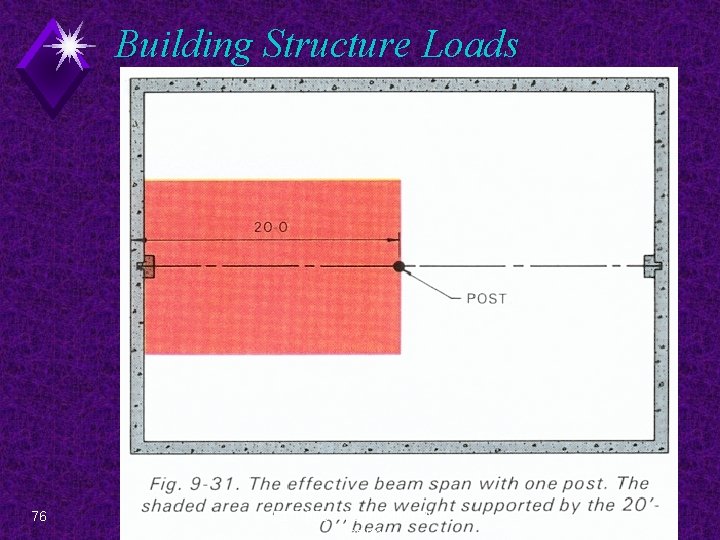
Building Structure Loads u One-half of the total weight bears on the center beam. u (1/2 x 145, 600 pounds) u Weight of first floor wall u (320 sq. ft. x 10 lbs. /sq. ft. ) u Weight of second floor wall u (320 sq. ft. x 10 lbs. /sq. ft. ) u Weight bearing on beam u One 75 “kip” is 1, 000 pounds EDT 300 - Foundation Plan Design = 72, 800 lbs. = 3, 200 lbs. = 79, 200 lbs.
Building Structure Loads 76 EDT 300 - Foundation Plan Design
Building Structure Loads 77 EDT 300 - Foundation Plan Design
Building Structure Loads 78 EDT 300 - Foundation Plan Design
Building Structure Loads 79 EDT 300 - Foundation Plan Design
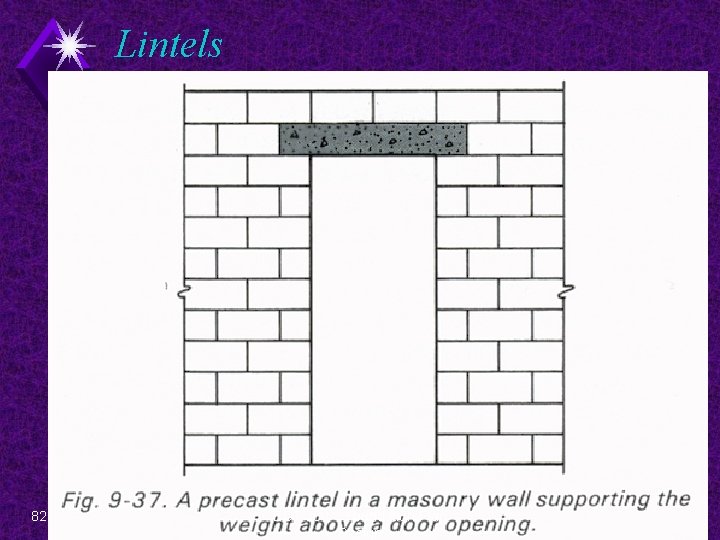
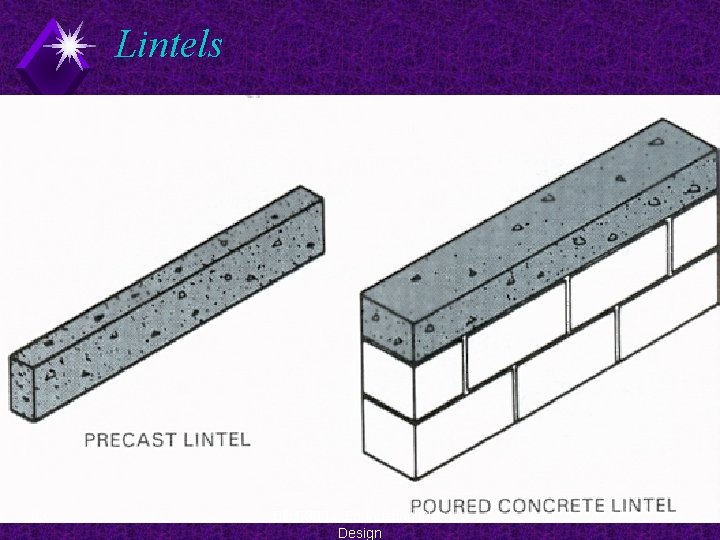
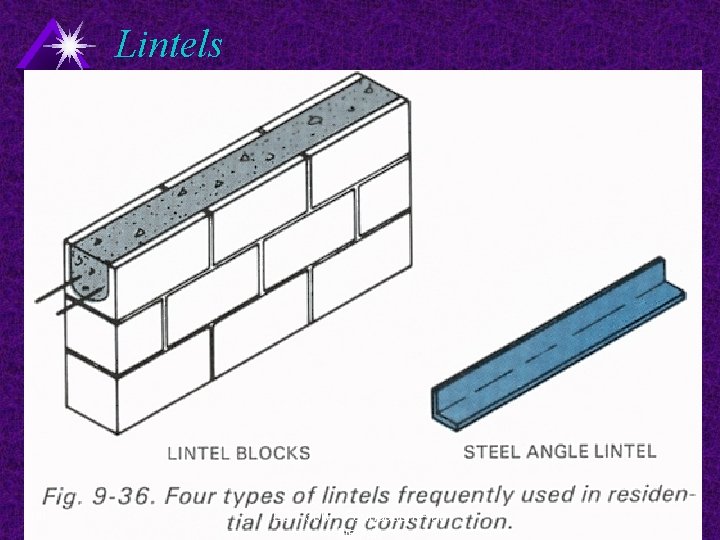
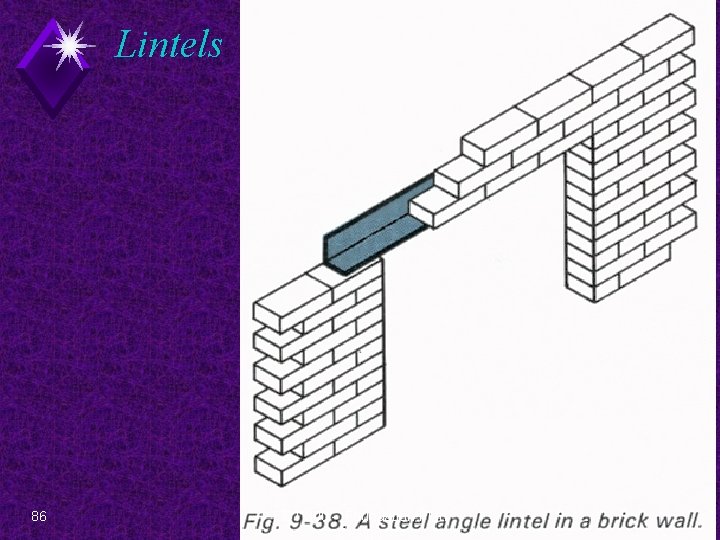
Lintels u. A lintel is a horizontal structural member that supports the load over an opening such as a door or window. u Lintels may be constructed of u precast concrete u cast-in-place concrete u lintel blocks u steel angle. 80 EDT 300 - Foundation Plan Design
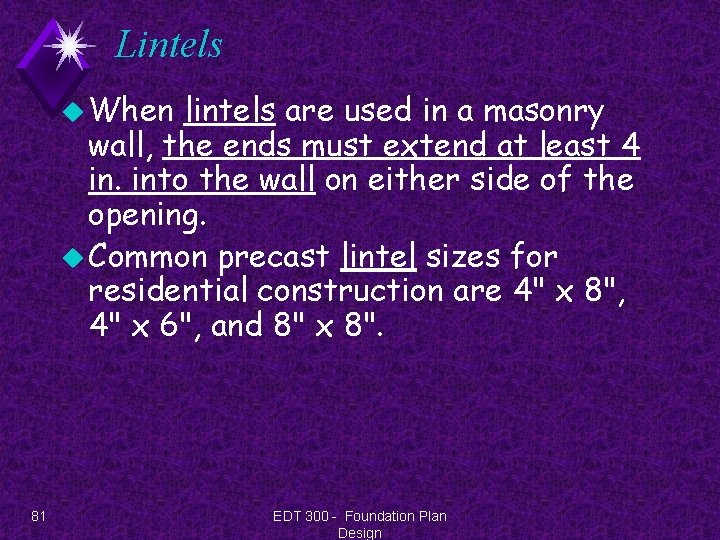
Lintels u When lintels are used in a masonry wall, the ends must extend at least 4 in. into the wall on either side of the opening. u Common precast lintel sizes for residential construction are 4" x 8", 4" x 6", and 8" x 8". 81 EDT 300 - Foundation Plan Design
Lintels 82 EDT 300 - Foundation Plan Design
Lintels 83 EDT 300 - Foundation Plan Design
Lintels 84 EDT 300 - Foundation Plan Design
Lintels u Lintels are also made of angle steel. u They are available as equal angles (both legs the same size) or as unequal angles. 85 EDT 300 - Foundation Plan Design
Lintels 86 EDT 300 - Foundation Plan Design
Lintels u Openings in cast concrete walls do not require lintels. 87 EDT 300 - Foundation Plan Design
Concrete and Masonry u Concrete is the result of combining cement, sand, aggregate (usually stone or gravel), and water. u Cement is composed of a mixture of lime, silica, alumina, iron components, and gypsum. u The proportions of the ingredients will vary with the requirements. 88 EDT 300 - Foundation Plan Design
Concrete and Masonry u Sidewalks, driveways, footings, and basement floors usually contain one part cement, three parts sand, and five parts aggregate. u Footings as well as concrete floors must have both a minimum compressive strength of 3, 000 psi and minimum cement content of 5 bags (470 lbs. ) per cubic yard. 89 EDT 300 - Foundation Plan Design
Concrete and Masonry u The amount of water used will most likely be 6 or 7 gallons for each bag of cement (normally 94 pounds per bag). u Concrete cures over a long period of time and should be kept moist for several days after it is placed. u Failure to do this reduces strength and may harm the exposed surface. 90 EDT 300 - Foundation Plan Design
Concrete and Masonry u Temperature also affects the setting time of concrete. u Cold weather slows down the process and concrete should not be allowed to freeze before it has set. 91 EDT 300 - Foundation Plan Design
Concrete and Masonry u Concrete is ordered by the cubic yard (27 cubic foot). u The consistency is generally specified by how many bags of cement are contained in each yard of mix. u A "five-bag mix" is considered minimum for most jobs. u A "six-bag mix" will produce a stronger product and should be used when high strength or reinforcing is required. 92 EDT 300 - Foundation Plan Design
Concrete and Masonry u When concrete is being placed, it commonly traps air pockets within the mixture. u These air pockets are worked out by vibrating or tamping. u This action helps to form a more dense material and removes weak spots due to air pockets. 93 EDT 300 - Foundation Plan Design
Concrete and Masonry u After the concrete has been placed, a screed is used to smooth the surface. u The screed is a long straightedge, usually a board, which is worked back and forth across the surface. u This action brings excess water to the surface and settles the aggregate. u Power screeds are a so available for large jobs. 94 EDT 300 - Foundation Plan Design
Concrete and Masonry u When screeding is finished, the surface is then worked over with a float. u A float is a short board about a foot long with a handle attached to one of the flat sides. 95 EDT 300 - Foundation Plan Design
Concrete and Masonry u The purpose of “floating” is: u (1) to embed the large aggregate just beneath the surface, u (2) to remove any slight imperfections, lumps, and voids to produce a flat surface, and u (3) to consolidate mortar at the surface in preparation for final steeltroweling. 96 EDT 300 - Foundation Plan Design
Concrete and Masonry u As the mixture reaches the proper consistency, the troweling process is started. u The trowel is rectangular and is used in a circular motion. u This troweling action further hardens the surface and develops a very smooth finish. u A slightly rough surface is made by a broom. 97 EDT 300 - Foundation Plan Design
Concrete and Masonry u When ordering concrete, one should figure only 25 cubic feet to the yard. u Some of the material will remain in the mixer, some will be spilled, and forms may sag. u Experience has shown that it is better to have a little more concrete than you need than to have too little. 98 EDT 300 - Foundation Plan Design
Concrete and Masonry u Large areas of concrete crack from expansion and contraction due to changes in temperature and moisture content. u Cracking may be minimized or controlled by contraction joints. u Contraction joints should be placed in line with interior columns, at changes in the width of the slab, or at maximum spacing of about 20 ft. 99 EDT 300 - Foundation Plan Design
Concrete and Masonry u Joints are formed by cutting grooves in the freshly placed concrete with a jointing tool. u They can be cut into the slab with a power saw after the concrete has hardened. u The depth of joints or grooves should be one-fourth the thickness of the slab. 100 EDT 300 - Foundation Plan Design
Concrete and Masonry u. A concrete slab is usually placed directly on firmly compacted sand 4 to 6 inches thick. u Dry sand should be dampened to prevent absorption of too much mixing water from the fresh concrete. 101 EDT 300 - Foundation Plan Design
Concrete and Masonry u The sand should be u thoroughly compacted to prevent settlement of the slab. u sloped toward the floor drains to ensure a uniform slab thickness. u Floor slabs usually have a minimum thickness of 4 inches. 102 EDT 300 - Foundation Plan Design
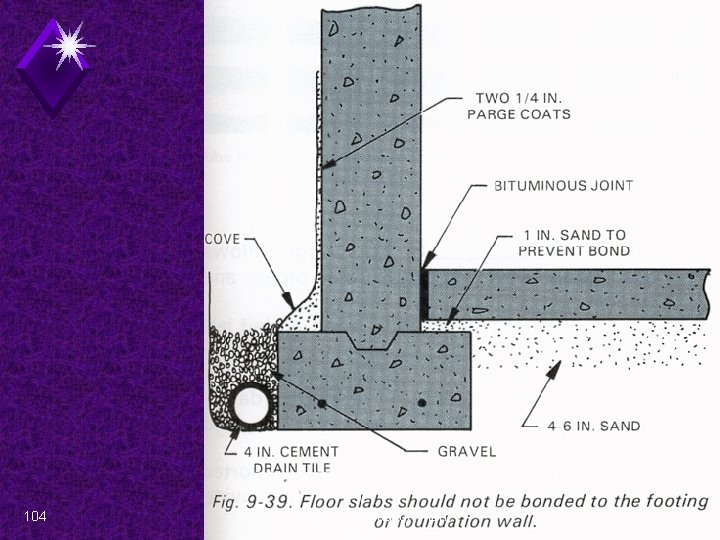
Concrete and Masonry u Floor slabs should not be bonded to footings or interior columns. u A sand cushion 1 in. thick may be used to separate the slab from the footing. u A sleeve of three thicknesses of building felt may be wrapped around columns to break the bond. 103 EDT 300 - Foundation Plan Design
104 EDT 300 - Foundation Plan Design
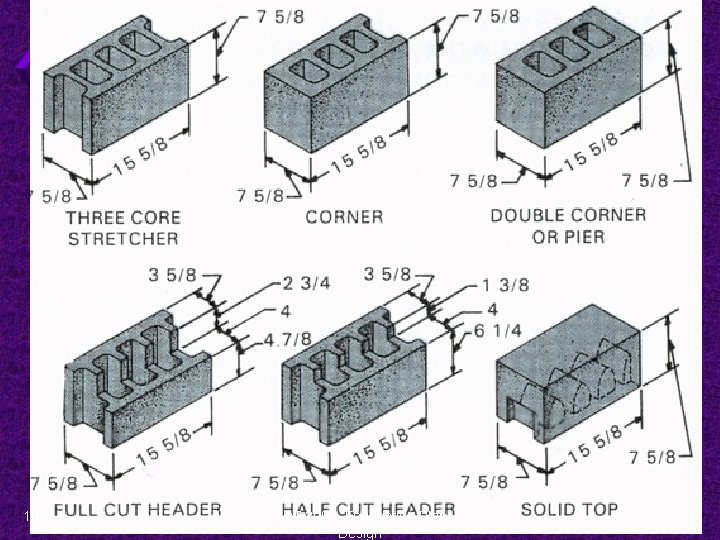
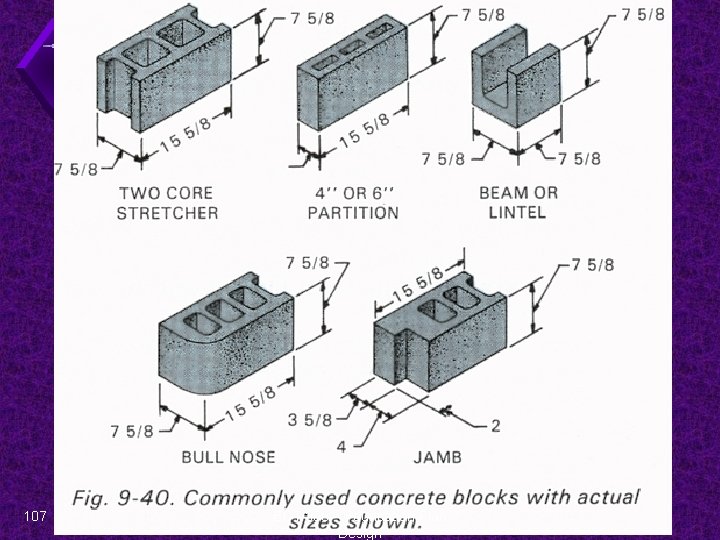
Concrete Blocks u Concrete blocks are used extensively in residential buildings for exterior and interior walls. u Concrete blocks are hollow concrete masonry units, usually 8" x 16" in dimension. u The actual size is 7 5/8" x 15 5/8". u These dimensions allow for a 3/8 in. mortar joint. 105 EDT 300 - Foundation Plan Design
Concrete Blocks 106 EDT 300 - Foundation Plan Design
Concrete Blocks 107 EDT 300 - Foundation Plan Design
Concrete Blocks u The distance from the center line of one, mortar joint to the center line of the next will be 8 or 16 inches. 108 EDT 300 - Foundation Plan Design
- Slides: 108