
Week 9 The Transition to Democracy 1974 1985
- Slides: 23
Week 9: The Transition to Democracy, 1974 -1985
Themes this week • Gradual “opening” (abertura) back to democracy • Impetus from within the military: moderates gain upper hand, gradual paving of way for democratic transition • BUT: at same time, bottom-up impetus: civil society movements: - Women’s movements; Black Movement; indigenous organising; land rights (MST) – next week - Liberation Theology (Catholic Church): this week * “Identity politics”: groups make citizenship demands on basis of particular issues or identities - But: many aims and practices also overlap - E. g. growth of PT often intersects with Liberation Theology movements
Last week… • Military coup 1964; initially moderates have upper hand • 1967 Costa e Silva takes over as president; 1968 “AI 5” (5 th institutional act); start of full-blown military dictatorship • Resistance ongoing in various forms… armed guerrillas • As well as violent suppression of resistance, military also maintains power through control of the MEDIA
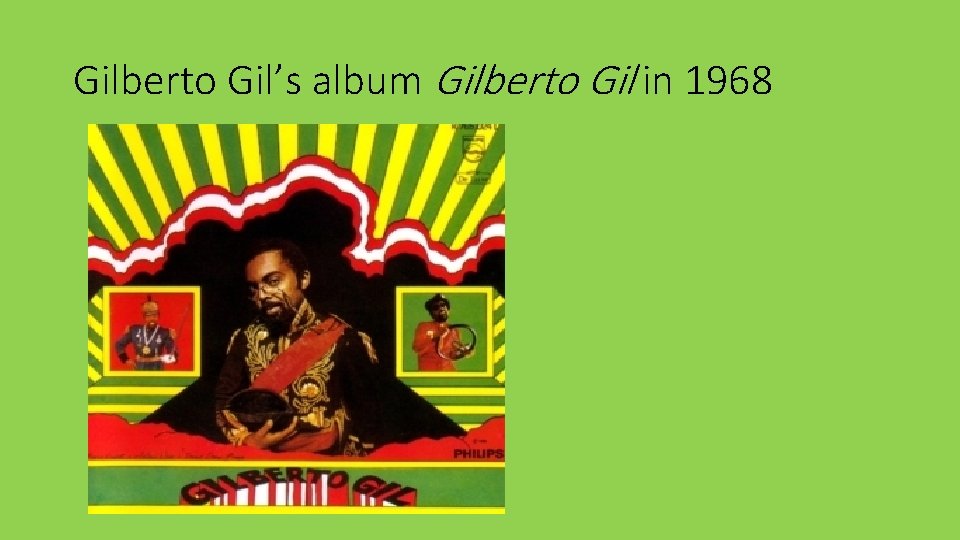
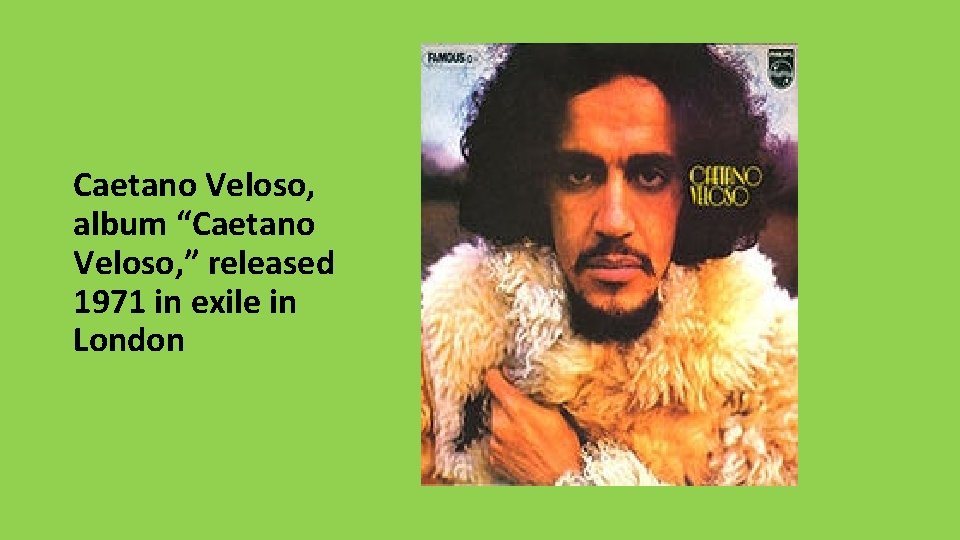
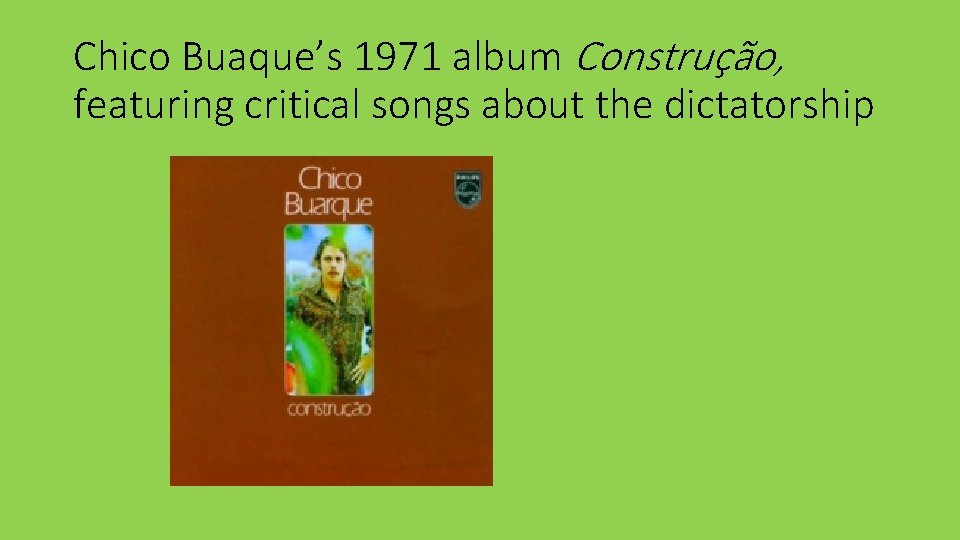
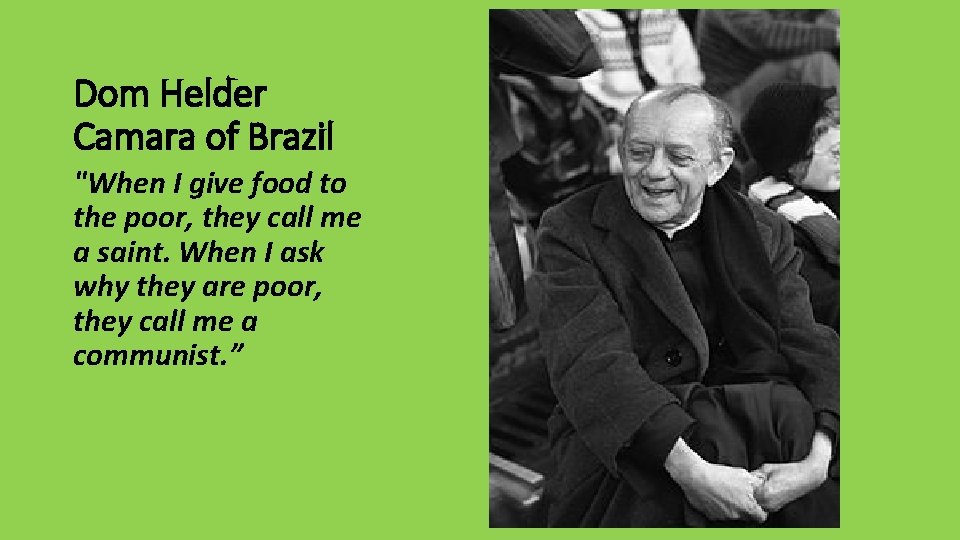
Culture as a tool for resistance? • Subtle criticism can evade censors (film, music) • Media not totally censored, e. g. radical bishop Dom Helder Camara gets 15 mins airtime per week; becomes basis for Liberation Theology • “Tropicalismo”: avant-garde cultural movement plus subtle/ creative lyrics criticising regime • Eventual exile of most tropicalismo musicians (Gilberto Gil, Caetano Veloso, and briefly Chico Buarque)
Gilberto Gil’s album Gilberto Gil in 1968
Caetano Veloso, album “Caetano Veloso, ” released 1971 in exile in London
Chico Buaque’s 1971 album Construção, featuring critical songs about the dictatorship
Other sources of opposition • General exile of Brazilians on the left from late ‘ 60 s: opposition thinking evolves in exile • Criticism of torture when used against middle class • US support for military, but with increasing reservations about human rights violations • Bar Association defends political prisoners • Catholic Church provides legitimate focal point
Recapping: the “economic miracle, ” 1968 -74 • Inflation down from 90% in 1964 to 27% in 1967 • 1968 -1974: 11% growth per year • Encouragement of major foreign investment (especially from US) • Infrastructure projects: Itaipu Dam, Transamazon Highway
A new economic reality from 1973… • Earlier “economic miracle” (1968 -74) gives way to… • Oil crises, 1973, 1979 • Initial decision for “debt-led growth” - disastrous • 1981 credit squeeze by US Federal Reserve • Brazil back in DEBT • 1980 s “lost decade” in Latin America • military rule loses economic justification
“Abertura”: the military road back to democracy • Impetus for democracy from moderates within military (“abertura”) • Ernesto Geisel assumes presidency, 1974 • New military generation less concerned with Cold War politics • Concern with Brazil’s “legalistic” image abroad • Government gradually lets go of “managed” majority in Congress • Amnesty law 1979; exiles start returning, but, prevents “truth and reconciliation” process in Brazil
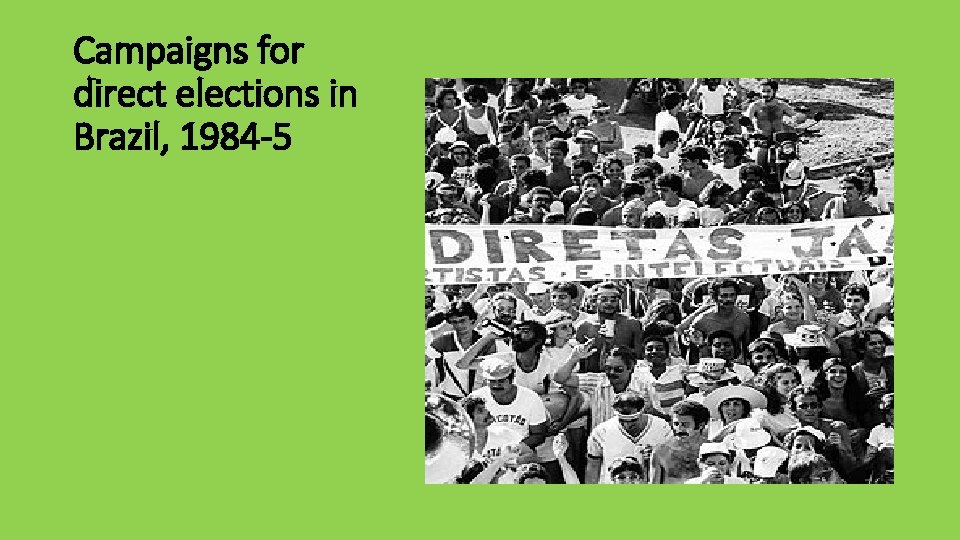
The role of civil society • Role of the Church as umbrella for dissent • Civil society movements: women, unions, indigenous, religious, Afro-Brazilian, human rights, gay & lesbian rights, environmental, land reform. . . • Growth of the PT (Partido dos Trabalhadores, Workers’ Party) through grass-roots and labour organising • Failed but influential campaign for direct presidential elections, 1985: support of Church, PMDB, massive public rallies in RJ/ SP
Campaigns for direct elections in Brazil, 1984 -5
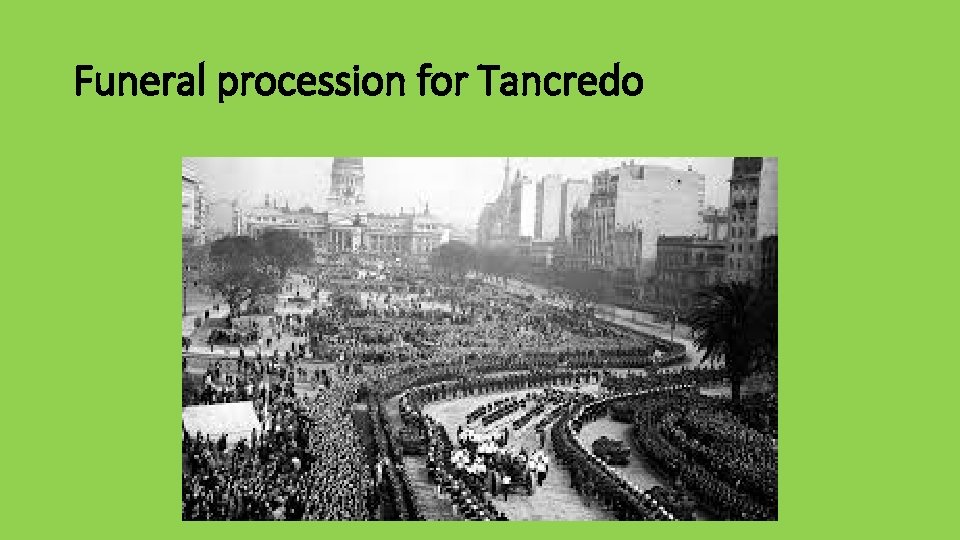
The election of Tancredo Neves, 1985 • 2 political parties, both military creations: - PDS (formerly ARENA) – pro-government - PMDB (opposition) supports Tancredo • One portion of PDS backs Trancredo majority in Congress achieved • Military agree to democratic transition • Massive excitement: first civilian president since Quadros • Death in mysterious circumstances; national mourning • Vice-president José Sarney (PDS) takes over
Funeral procession for Tancredo
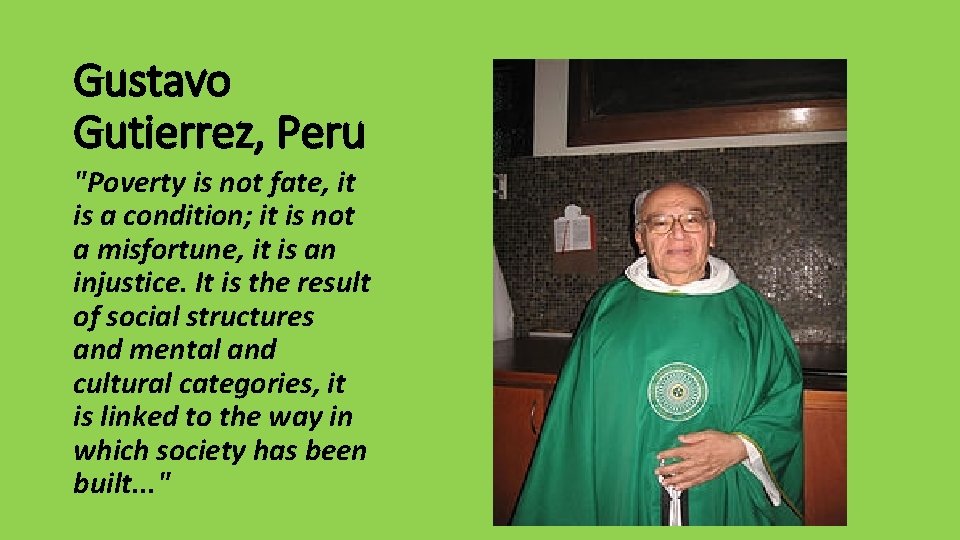
Liberation Theology • Theological reaction to poverty and inequality in Latin America (urbanisation, industrialisation…) • Intersects with changes in the Church led by the Vatican, but also with Latin American dependency theory and Marxism • Formulated by Peruvian bishop, Gustavo Gutiérrez, book Teología de la Liberación (1971) • Also influential in Brazil; Chile; El Salvador • Brings together social analysis with Christian belief
Context • Second Vatican Council (Vatican II) – 1962: conference of world’s cardinals. Aims to address: - Loss of members to PENTECOSTALISM - need for clearer global mission and presence - Advocates a “turning out towards the world” • Conference of Latin American Bishops in Medellín, Colombia (1968): importance of church’s work at the “base” of society • Conference of Latin American Bishops in Puebla (Mexico) 1979: “preferential option for the poor” formulated
Liberation Theology in practice • Bottom-up organizing; respect for and interest in the daily experiences of the poor • In Brazil alone, between late 1960 s and early 1980 s, there were 80, 000 to 100, 000 Ecclesiastical Base Communities; 1 -2 M participants • Bible study; practical and political messages; literacy • Interpretation of social injustice as a sin • Concern by God with HUMAN HISTORY and need for social justice on Earth not just in heaven
Dom Helder Camara of Brazil "When I give food to the poor, they call me a saint. When I ask why they are poor, they call me a communist. ”
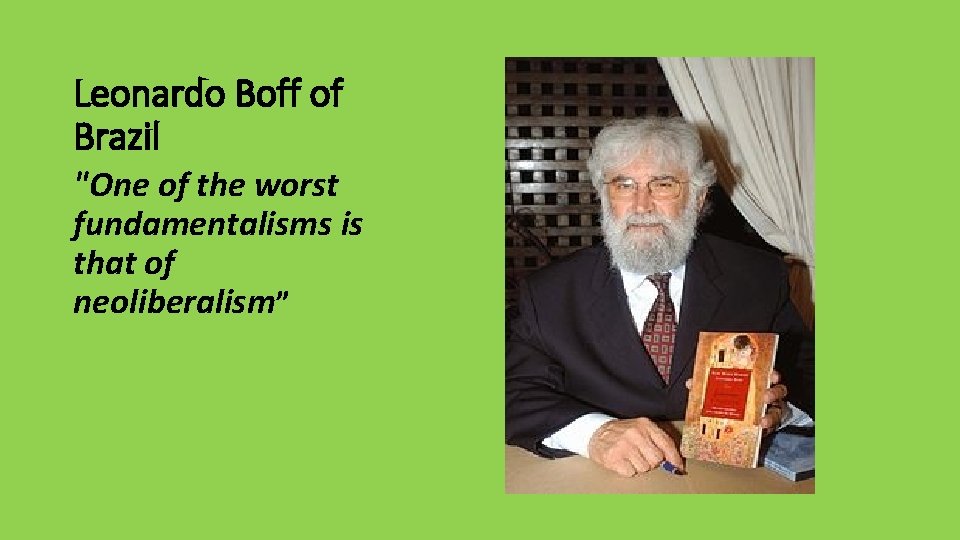
Leonardo Boff of Brazil "One of the worst fundamentalisms is that of neoliberalism”
Gustavo Gutierrez, Peru "Poverty is not fate, it is a condition; it is not a misfortune, it is an injustice. It is the result of social structures and mental and cultural categories, it is linked to the way in which society has been built. . . "
Readings • Kenneth Serbin, “Dom Helder Camara: The Father of the Church of the Poor, ” in Beattie, ed, The Human Tradition • Robin Nagle and Jill Nagle, Claiming the Virgin: The Broken Promise of Liberation Theology in Brazil (1997), Ch 1 • Rebecca Abers, Inventing local democracy: grassroots politics in Brazil (2000), Chapter 2, “Urban Politics and Neighbourhood Organizing in Brazil. ”
Questions • Why did Brazil move back to democracy by 1985? • Who drove the process of “opening” (abertura)? • What was the role of the Church and Liberation Theology? • What were the goals of Liberation Theology and how successfully were they implemented in Brazil in the 1970 s and 1980 s? • Did the transition to democracy bring new methods of grassroots political organising, or simply re-package older ones?