
Week 8 Lecture 8 Hypotheses about the origins
Week 8: Lecture 8: Hypotheses about the origins and elaboration of our genus • Review of Mid-Pleistocene evolutionary trends • The puzzle of Homo naledi • Neanderthals – Who were they and what do they have to do with our evolutionary history?
Return to the Pleistocene hominin fossil record • Review: When does the Pleistocene begin? – 2. 6 mya • How was the climate changing in Africa at this time? • How is this potentially relevant for human evolution? – What genus appears around this time? • How do they differ from australopithecine ancestor? – Consider this in terms of the earliest members of our genus and among organisms identified as H. ergaster or erectus
Homo erectus to Homo sapiens • Middle Pleistocene: ~780, 000 - 125, 000 ya • Transitional forms in Africa, Europe and Asia • Not H. erectus but not H. sapiens either – includes Homo antecessor, – Homo heidelbergensis, – Homo neanderthalensis & Denisovans, – and early Homo sapiens?
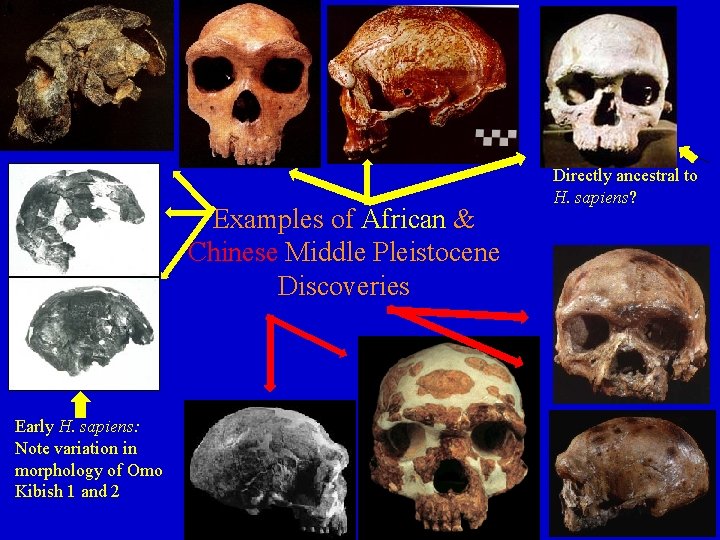
Examples of African & Chinese Middle Pleistocene Discoveries Early H. sapiens: Note variation in morphology of Omo Kibish 1 and 2 Directly ancestral to H. sapiens?
What was H. heidelbergensis? • A “Wastebasket Taxon” ? How much variation? • Larger crania than H. erectus but retain some similarities • European versions have some Neanderthal traits • African versions have some Homo sapiens traits • Asian mid-Pleistocene hominins sometimes included; more traits in common with African specimens • Some see it as last common ancestor to Neanderthals and Homo sapiens
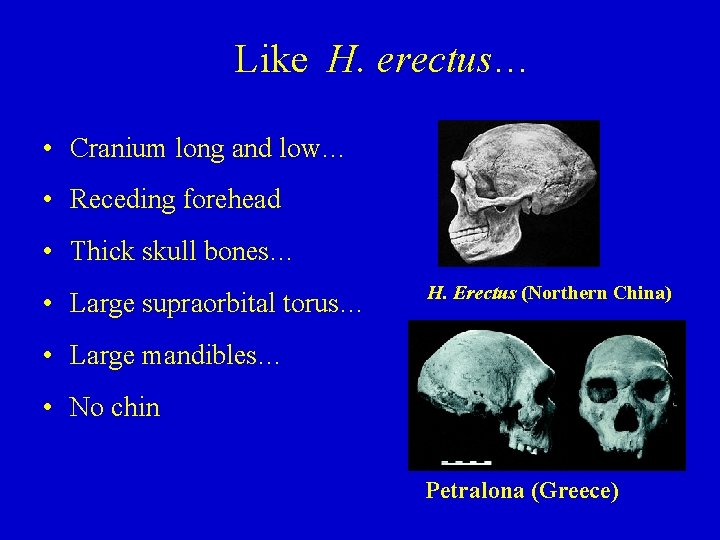
Like H. erectus… • Cranium long and low… • Receding forehead • Thick skull bones… • Large supraorbital torus… H. Erectus (Northern China) • Large mandibles… • No chin Petralona (Greece)
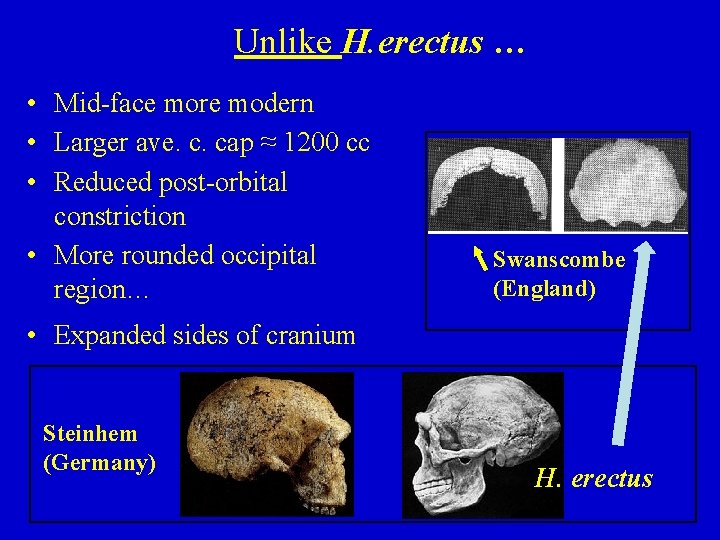
Unlike H. erectus … • Mid-face more modern • Larger ave. c. cap ≈ 1200 cc • Reduced post-orbital constriction • More rounded occipital region… Swanscombe (England) • Expanded sides of cranium Steinhem (Germany) H. erectus
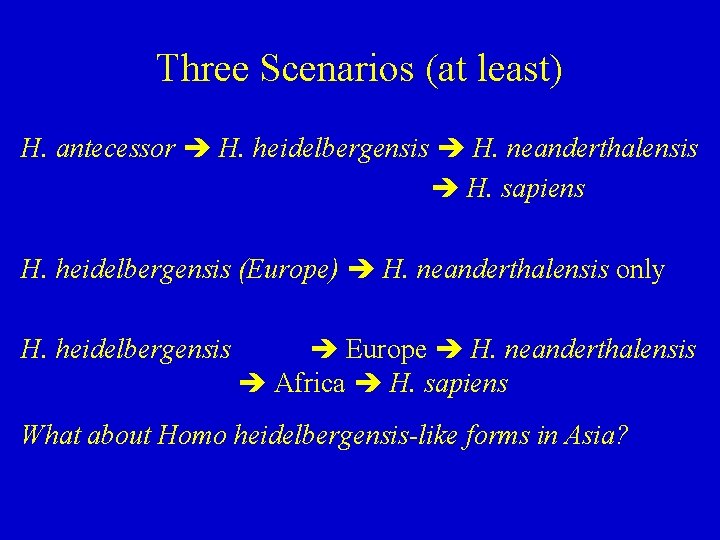
Three Scenarios (at least) H. antecessor H. heidelbergensis H. neanderthalensis H. sapiens H. heidelbergensis (Europe) H. neanderthalensis only H. heidelbergensis Europe H. neanderthalensis Africa H. sapiens What about Homo heidelbergensis-like forms in Asia?
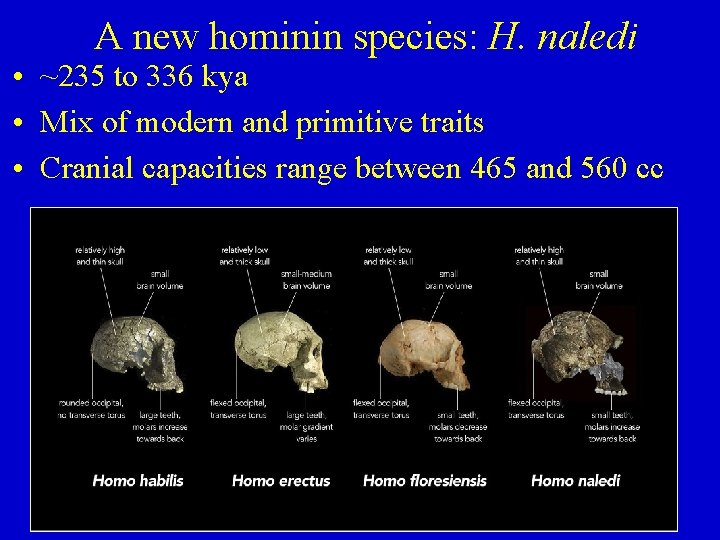
A new hominin species: H. naledi • ~235 to 336 kya • Mix of modern and primitive traits • Cranial capacities range between 465 and 560 cc
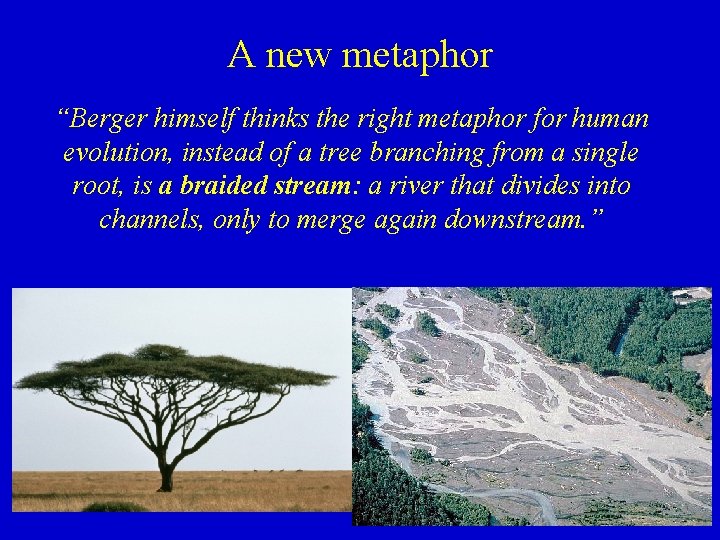
A new metaphor “Berger himself thinks the right metaphor for human evolution, instead of a tree branching from a single root, is a braided stream: a river that divides into channels, only to merge again downstream. ”
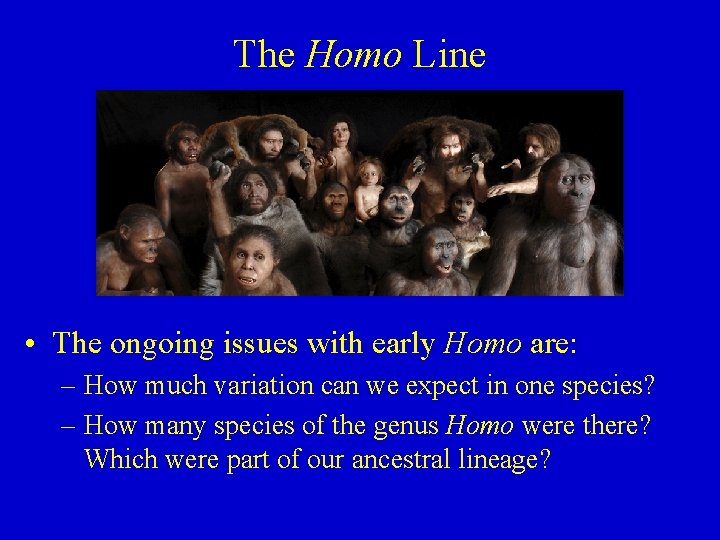
The Homo Line • The ongoing issues with early Homo are: – How much variation can we expect in one species? – How many species of the genus Homo were there? Which were part of our ancestral lineage?
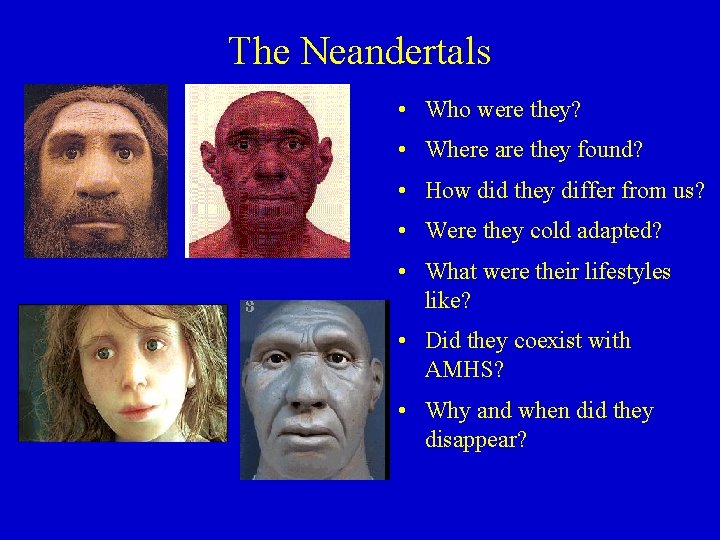
The Neandertals • Who were they? • Where are they found? • How did they differ from us? • Were they cold adapted? • What were their lifestyles like? • Did they coexist with AMHS? • Why and when did they disappear?
Neanderthals: Who, When and Where • Probably share a common ancestor with us about 500 kya • 130, 000 yrs ago: at beginning of last Interglacial • Last stand: 27, 000 yrs ago in Zafarraya, Spain • Westernmost: Close to Atlantic: Spain or Portugal • Easternmost: Altai mountains, Siberia • Northernmost: Wales (or Siberia) • Southernmost: Gibraltar or Southern Israel • Fossils of 275 individual known from > 70 sites
Earlier Major Ideas • Neandertals genetically isolated from AMH in W. Asia by Wurmian glaciation, evolved in Europe from H. heidelbergensis • Neandertals archaic group extinct without issue • Vs. • Evolutionary continuity – Neandertals widespread and contributed substantial DNA to modern Europeans • Probable scenario based upon recent evidence
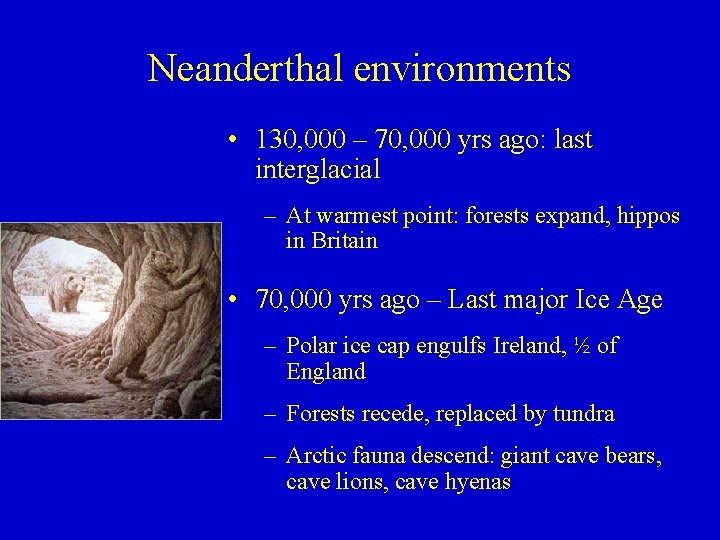
Neanderthal environments • 130, 000 – 70, 000 yrs ago: last interglacial – At warmest point: forests expand, hippos in Britain • 70, 000 yrs ago – Last major Ice Age – Polar ice cap engulfs Ireland, ½ of England – Forests recede, replaced by tundra – Arctic fauna descend: giant cave bears, cave lions, cave hyenas
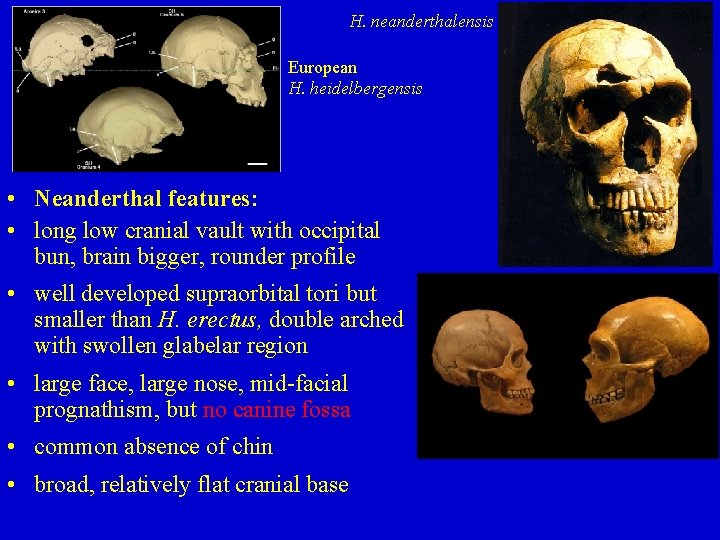
H. neanderthalensis European H. heidelbergensis • Neanderthal features: • long low cranial vault with occipital bun, brain bigger, rounder profile • well developed supraorbital tori but smaller than H. erectus, double arched with swollen glabelar region • large face, large nose, mid-facial prognathism, but no canine fossa • common absence of chin • broad, relatively flat cranial base
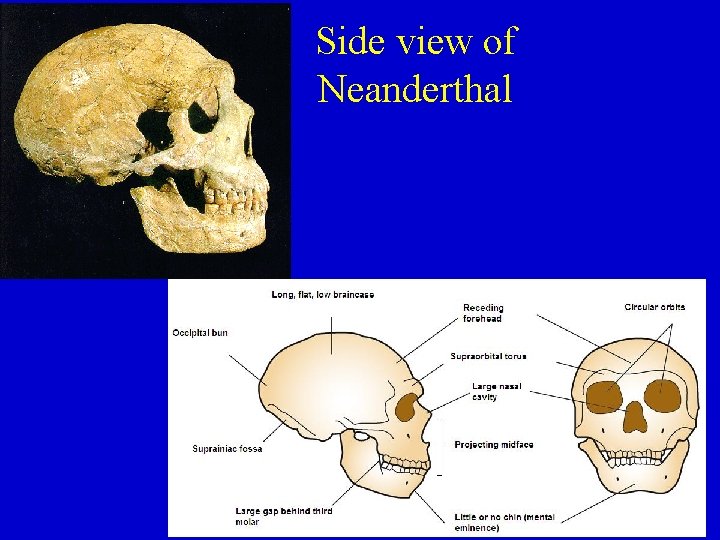
Side view of Neanderthal
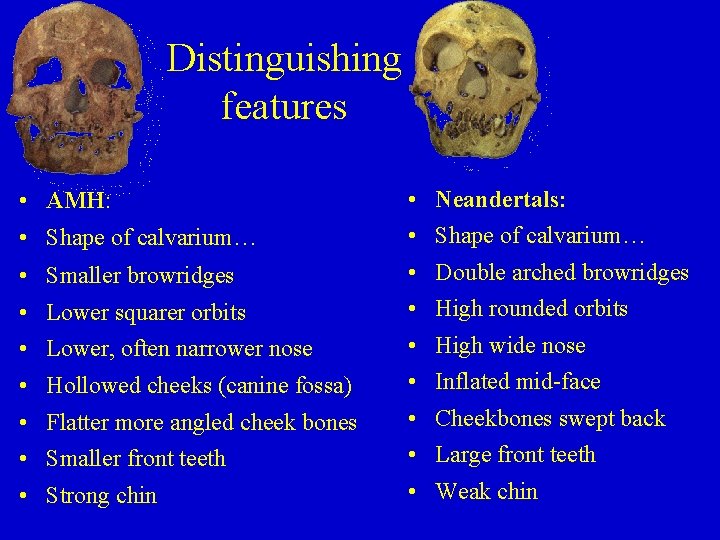
Distinguishing features • AMH: • Shape of calvarium… • Smaller browridges • Lower squarer orbits • Lower, often narrower nose • • Hollowed cheeks (canine fossa) Flatter more angled cheek bones Smaller front teeth Strong chin • • • Neandertals: Shape of calvarium… Double arched browridges High rounded orbits High wide nose Inflated mid-face Cheekbones swept back Large front teeth Weak chin
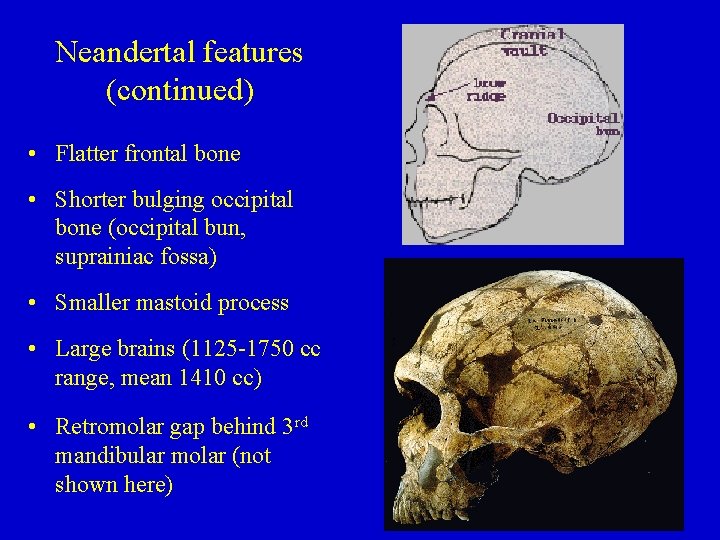
Neandertal features (continued) • Flatter frontal bone • Shorter bulging occipital bone (occipital bun, suprainiac fossa) • Smaller mastoid process • Large brains (1125 -1750 cc range, mean 1410 cc) • Retromolar gap behind 3 rd mandibular molar (not shown here)
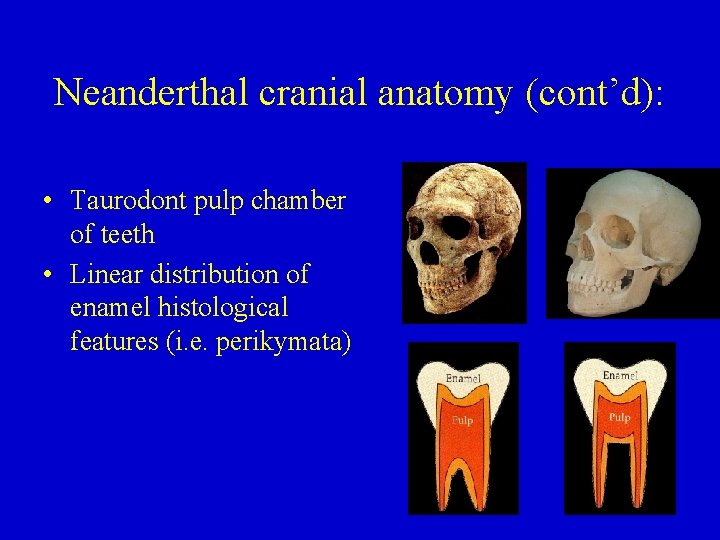
Neanderthal cranial anatomy (cont’d): • Taurodont pulp chamber of teeth • Linear distribution of enamel histological features (i. e. perikymata)
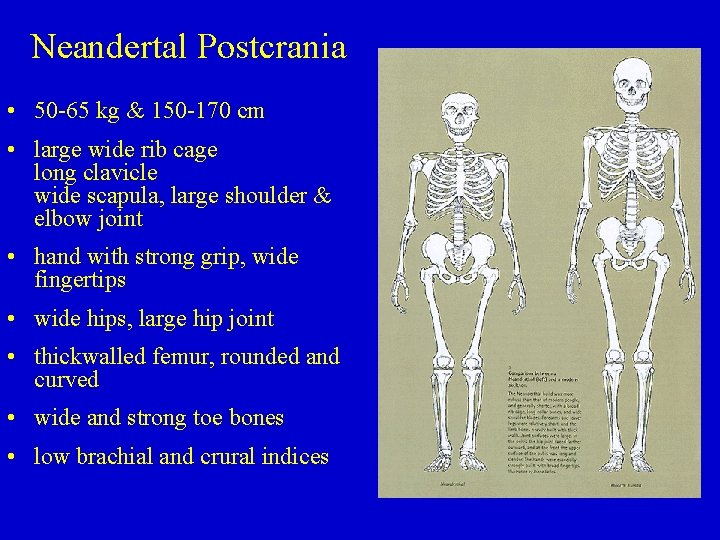
Neandertal Postcrania • 50 -65 kg & 150 -170 cm • large wide rib cage long clavicle wide scapula, large shoulder & elbow joint • hand with strong grip, wide fingertips • wide hips, large hip joint • thickwalled femur, rounded and curved • wide and strong toe bones • low brachial and crural indices
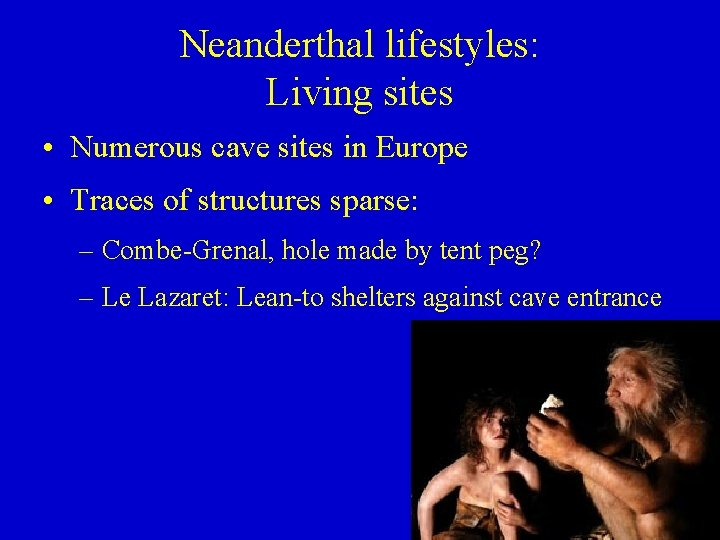
Neanderthal lifestyles: Living sites • Numerous cave sites in Europe • Traces of structures sparse: – Combe-Grenal, hole made by tent peg? – Le Lazaret: Lean-to shelters against cave entrance
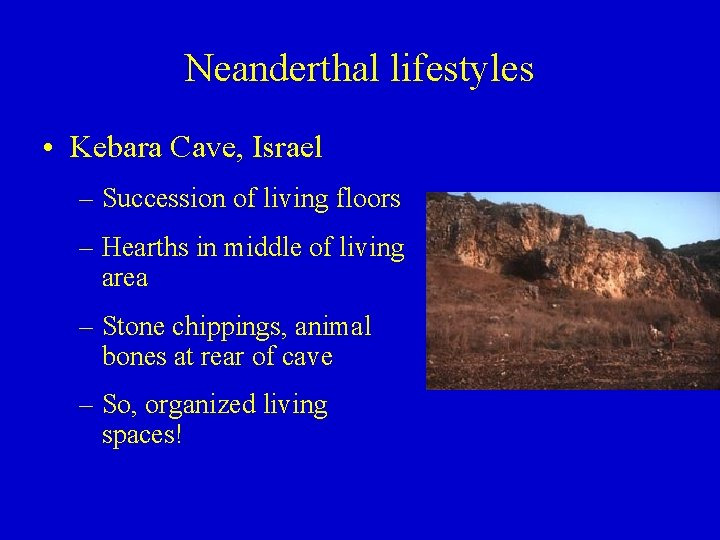
Neanderthal lifestyles • Kebara Cave, Israel – Succession of living floors – Hearths in middle of living area – Stone chippings, animal bones at rear of cave – So, organized living spaces!
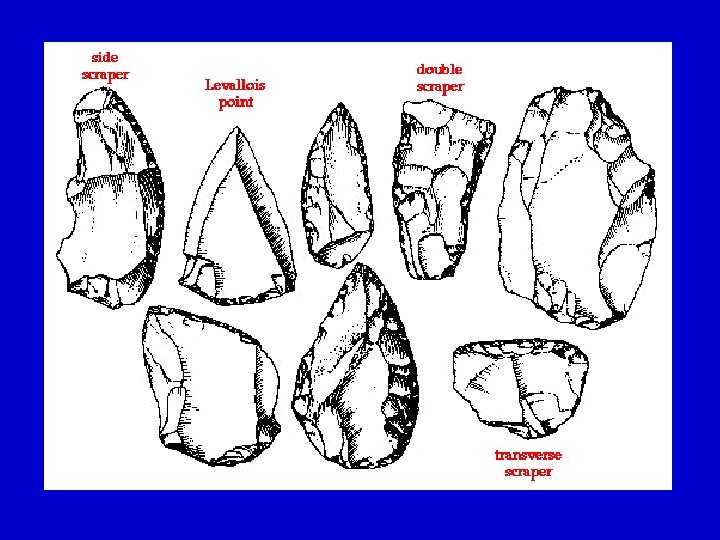
Neanderthal Technology • MOUSTERIAN (after Le Moustier) • nearby flint/chert: general absence of tools made from bone, ivory, antler • Flake tools made by Le. Vallois prepared core technique • Scrapers, points, a few blades • Functions of tools: microwear indicates woodworking, hideworking • Kebara: points hafted to wooden spears – Hunting deer, bison
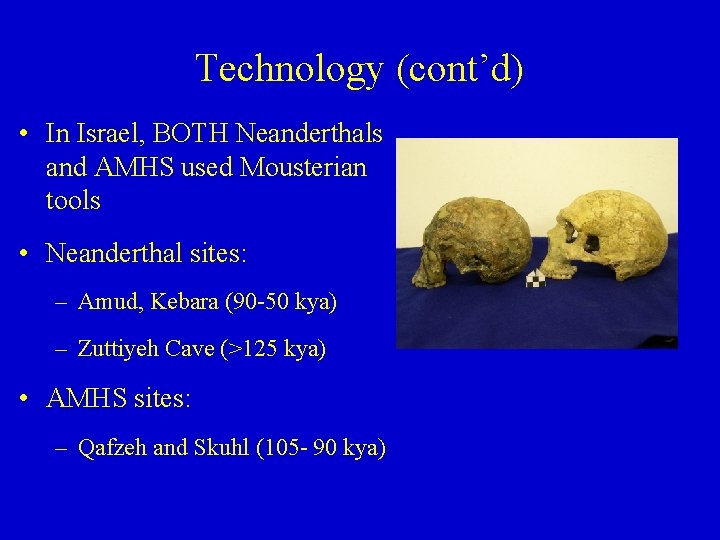
Technology (cont’d) • In Israel, BOTH Neanderthals and AMHS used Mousterian tools • Neanderthal sites: – Amud, Kebara (90 -50 kya) – Zuttiyeh Cave (>125 kya) • AMHS sites: – Qafzeh and Skuhl (105 - 90 kya)
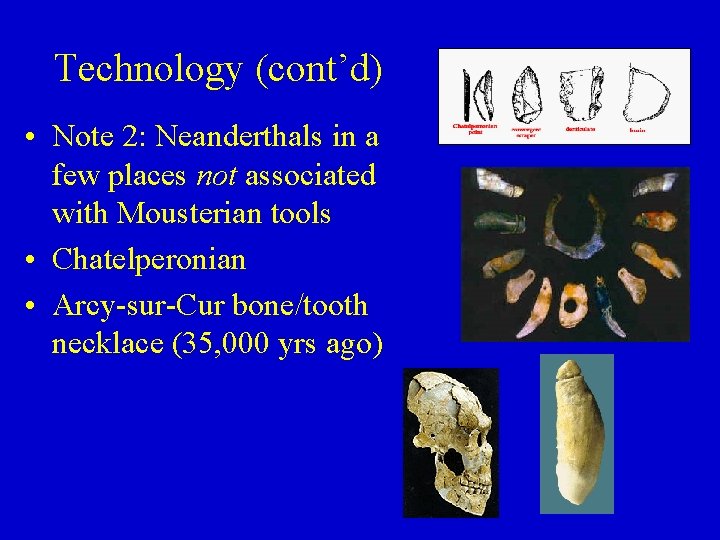
Technology (cont’d) • Note 2: Neanderthals in a few places not associated with Mousterian tools • Chatelperonian • Arcy-sur-Cur bone/tooth necklace (35, 000 yrs ago)
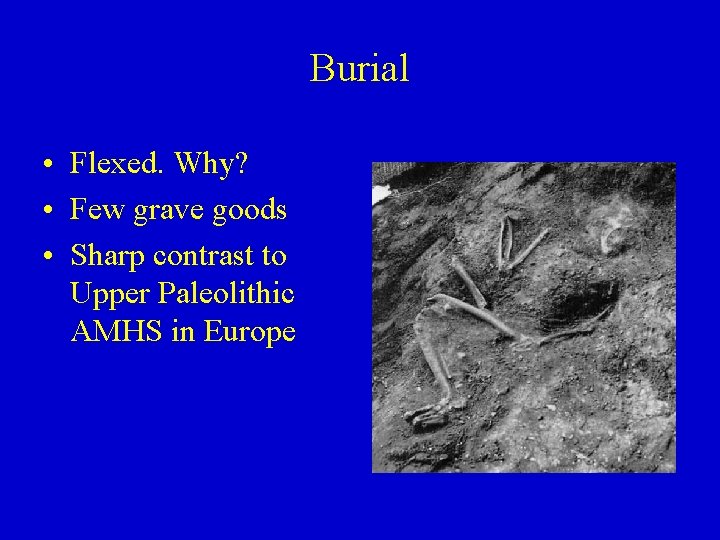
Burial • Flexed. Why? • Few grave goods • Sharp contrast to Upper Paleolithic AMHS in Europe
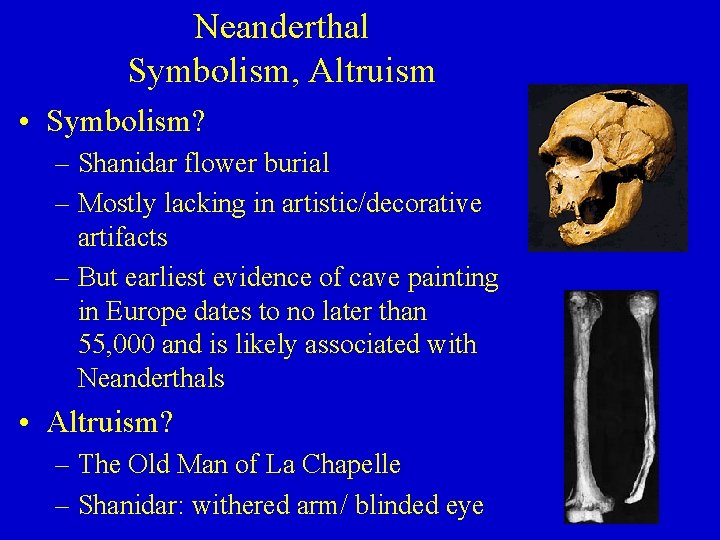
Neanderthal Symbolism, Altruism • Symbolism? – Shanidar flower burial – Mostly lacking in artistic/decorative artifacts – But earliest evidence of cave painting in Europe dates to no later than 55, 000 and is likely associated with Neanderthals • Altruism? – The Old Man of La Chapelle – Shanidar: withered arm/ blinded eye

- Slides: 30