
WEEK 7 QUALITATIVE RESEARCH METHODS Participant observation action
WEEK 7: QUALITATIVE RESEARCH METHODS Participant observation, action research and ethnography Dr Jillian Yeow
Reminder • Assignment due: December 12 th 2016 • Research proposal (3000 words) • A proposal outlining a specific research topic and a set of research questions for a piece of research you plan to conduct • Should contain: 1. Title 2. Abstract 3. Introduction 4. Research aims and objectives, research question(s) 5. Literature review 6. Research methodology and methods 7. Approach to analysis of findings (i. e. Data analysis) 8. Approach to writing up/ discussion 9. Managerial implications of your research/ any limitations 10. Ethical considerations 11. Conclusion and references 12. Research timetable/ schedule

Participant observation • • • Watching and engaging with people in their environments to collect (naturalistic) data about relevant behaviours, events and environments Dimensions might include: space, actors, activities, objects, motivation and goals, and feelings (Spradley, 1980) Different types: the complete participant, the participantas-observer, the observer-as-participant, the complete observer (Junker, 1960)
Why use participant observation? • Bernard (2006) says it can: • Open up the areas of inquiry to collect a wider range of data (insider privileges) • Reduces the problem of reactivity (A successful participant observer fits into the scene well enough to be ignored, even if he is doing abnormal things such as interviewing, taking pictures, recording video or audio, or taking notes) • Enables researchers to know what questions to ask (to use the right terms and “slang” if necessary) • Gain intuitive understanding of the meaning of your data (reduces validity error which can occur through gross misunderstanding of local knowledge) • Natural setting, observing “true” behaviour; “neutral”
5 Participant observation ‘If your research question(s) … are concerned with what people do, an obvious way in which to discover this is to watch them do it’ (Saunders et al. , 2012) PO involves the systematic observation, recording, description, analysis and interpretation of behavior Can involve the collection of both quantitative and qualitative data • • • PO contrasts with structured observation (quantitative strategy) PO = “immersion” in a context PO: central to ethnography / case-study designs • • § A continuum* of researcher: Involvement ------------------------- Detachment (participant) (observer) * possible movement along the continuum during the research
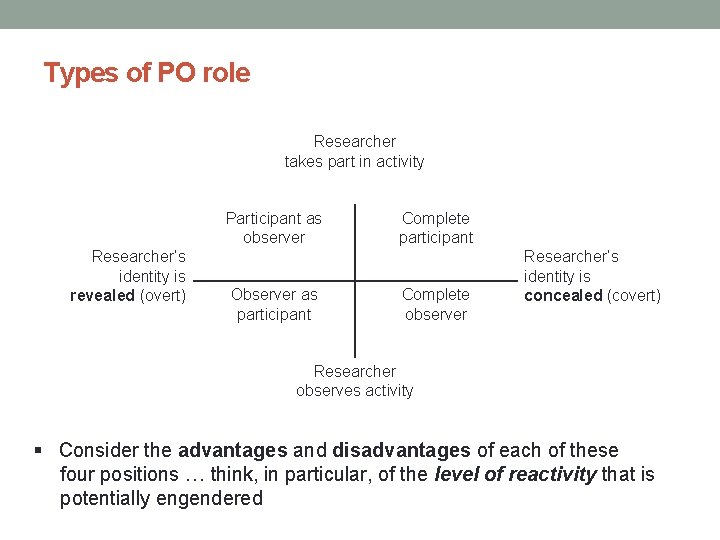
Types of PO role Researcher takes part in activity Participant as observer Researcher’s identity is revealed (overt) Observer as participant Complete observer Researcher’s identity is concealed (covert) Researcher observes activity § Consider the advantages and disadvantages of each of these four positions … think, in particular, of the level of reactivity that is potentially engendered
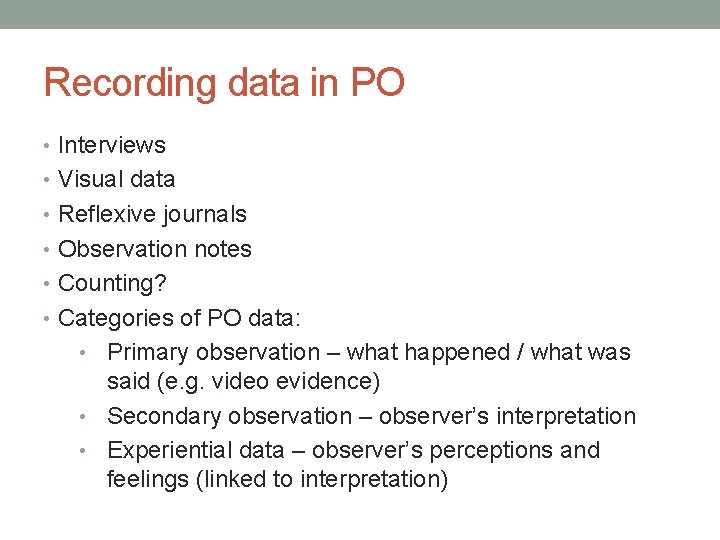
Recording data in PO • Interviews • Visual data • Reflexive journals • Observation notes • Counting? • Categories of PO data: • Primary observation – what happened / what was said (e. g. video evidence) • Secondary observation – observer’s interpretation • Experiential data – observer’s perceptions and feelings (linked to interpretation)
Limitations of PO • Role of the researcher • Liza Dalby’s (1983) famous study of geisha culture • female, fluent in Japanese, and willing to undergo at least some of the lengthy and rigorous training required to become a geisha. • status as a gaikokujin —a person not of Japanese ancestry— made her geisha experience somewhat different than that of someone of Japanese heritage. • Some would say her description is a compelling blend of outsider objectivity and insider knowledge, exemplifying both insider and outsider perspectives. Others doubt that any gaijin (the common, less respectful term for a non-Japanese) was ever allowed far enough inside geisha life to provide a “real” description of it. • Impact on analysis? • Role of the researcher/ level of participation • Ethical concerns? • Changing the “natural environment”? • Risks to the researcher?
Issues in PO Reactive effects • • • Observer effects • • bias – e. g. “going native” Time effects • • • people’s knowledge of being observed may make them behave less naturally/ in different ways The Hawthorne effect? is the setting being observed at a typical time? Reflect on how the first two issues might be resolved
Ethnography • Long-term and in-depth use of participant observation (and other qualitative methods); demographic information • Go into detail; one or very few cases • Research site important • Systematic and sustained engagement with a field • Emphasis on social phenomena rather than theory/ hypothesis testing • Degree of embeddedness • Example of Dalby’s study of geisha culture
Examples of ethnography in business and management research • Knox et al (2008) ‘Enacting Airports: Space, Movement and Modes of Ordering’, Organization, 15(6), pp. 869 -88. • Mc. Cann et al (2013) ‘Still Blue Collar after all these Years? An Ethnography of the Professionalization of Emergency Ambulance Work’, Journal of Management Studies, 50(5), pp. 750 -76
Action research • Change and intervention (for improvement/ solve a problem) • Researchers work with practitioners on a problem/ issue of concern • Tend to not make too many assumptions at the outset; alternative interpretations are likely to emerge • Often involves a team of researchers • Examples: • Implementation of a new information system • Understanding change management processes in the NHS
Issues in AR • Credibility • Competency • Validity of AR • Unique outcome; may not be replicable • Can you generalise? • Unintended consequences or change? • Experimental AR (cf. Lewin) • Inductive AR • Participatory AR • The reflexive researcher/ practitioner • Important aim of AR
THE ASSIGNMENT
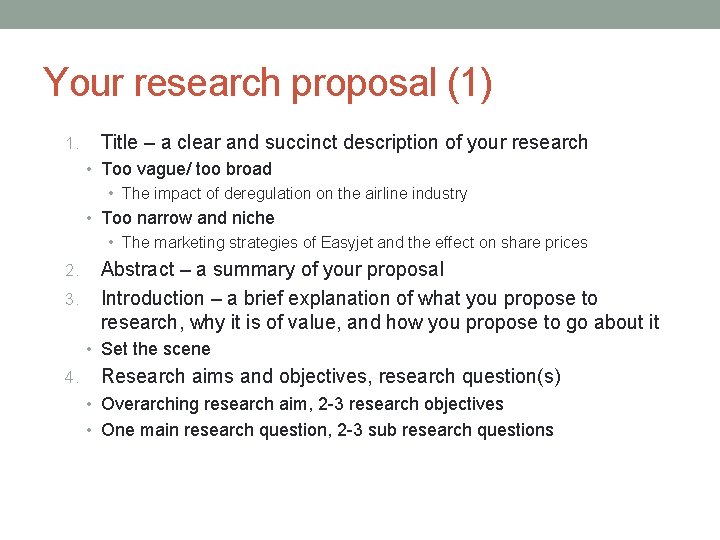
Your research proposal (1) 1. Title – a clear and succinct description of your research • Too vague/ too broad • The impact of deregulation on the airline industry • Too narrow and niche • The marketing strategies of Easyjet and the effect on share prices 2. 3. Abstract – a summary of your proposal Introduction – a brief explanation of what you propose to research, why it is of value, and how you propose to go about it • Set the scene 4. Research aims and objectives, research question(s) • Overarching research aim, 2 -3 research objectives • One main research question, 2 -3 sub research questions
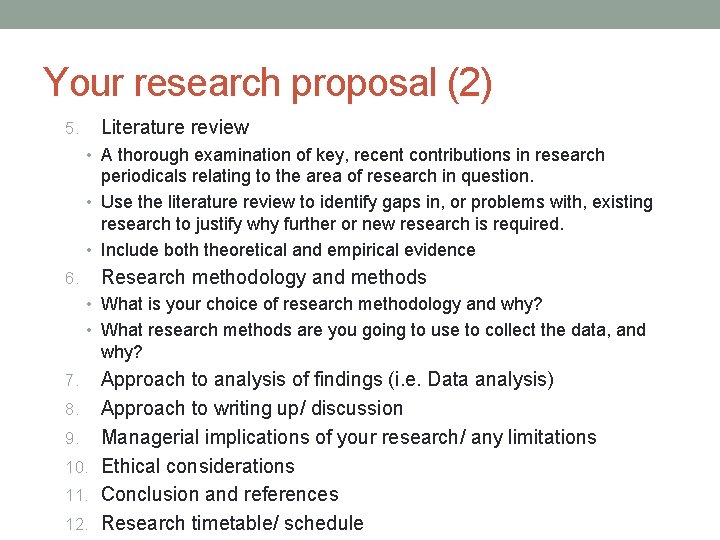
Your research proposal (2) 5. Literature review • A thorough examination of key, recent contributions in research periodicals relating to the area of research in question. • Use the literature review to identify gaps in, or problems with, existing research to justify why further or new research is required. • Include both theoretical and empirical evidence 6. Research methodology and methods • What is your choice of research methodology and why? • What research methods are you going to use to collect the data, and why? Approach to analysis of findings (i. e. Data analysis) 8. Approach to writing up/ discussion 9. Managerial implications of your research/ any limitations 10. Ethical considerations 11. Conclusion and references 12. Research timetable/ schedule 7.
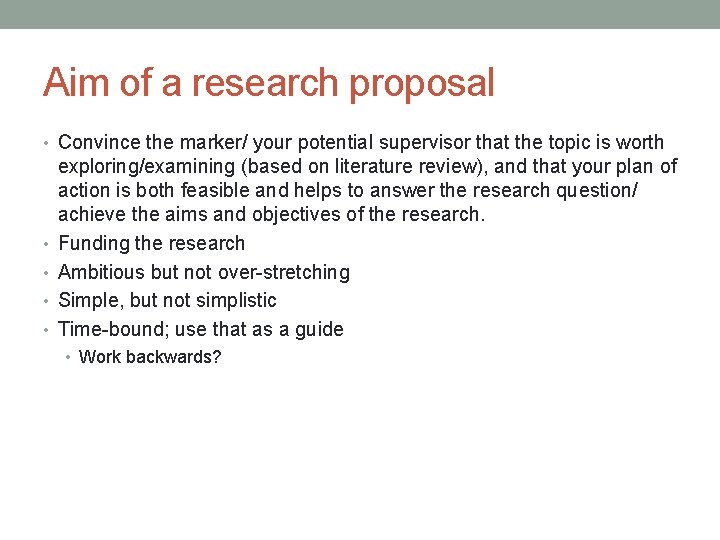
Aim of a research proposal • Convince the marker/ your potential supervisor that the topic is worth • • exploring/examining (based on literature review), and that your plan of action is both feasible and helps to answer the research question/ achieve the aims and objectives of the research. Funding the research Ambitious but not over-stretching Simple, but not simplistic Time-bound; use that as a guide • Work backwards?
Further reading • How to…. • Conduct a literature review (Hart, 1999) • Conduct qualitative/ quantitative/ mixed methods research • Write a research proposal • Carry out a dissertation
- Slides: 18