
Week 7 b ANNOUNCEMENTS Reader with reference material
Week 7 b ANNOUNCEMENTS • Reader with reference material from Howe & Sodini and from Rabaey et al available at Copy Central on Hearst Ave. near Euclid OUTLINE • Semiconductor materials • Properties of silicon • Doping Reading Howe & Sodini: Ch. 2. 1 -2. 4. 1 EECS 42, Spring 2005 Week 7 b, Slide 1 Prof. White
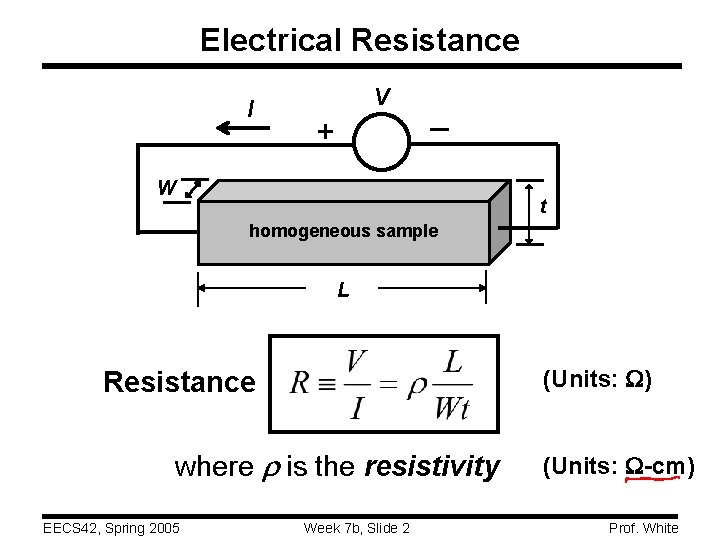
Electrical Resistance I V + _ W t homogeneous sample L (Units: W) Resistance where is the resistivity EECS 42, Spring 2005 Week 7 b, Slide 2 (Units: W-cm) Prof. White
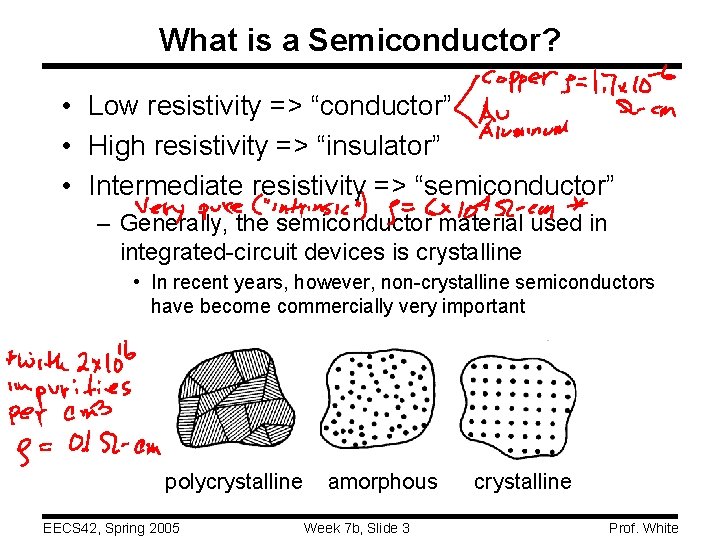
What is a Semiconductor? • Low resistivity => “conductor” • High resistivity => “insulator” • Intermediate resistivity => “semiconductor” – Generally, the semiconductor material used in integrated-circuit devices is crystalline • In recent years, however, non-crystalline semiconductors have become commercially very important polycrystalline EECS 42, Spring 2005 amorphous Week 7 b, Slide 3 crystalline Prof. White
EECS 42, Spring 2005 Week 7 b, Slide 4 Prof. White
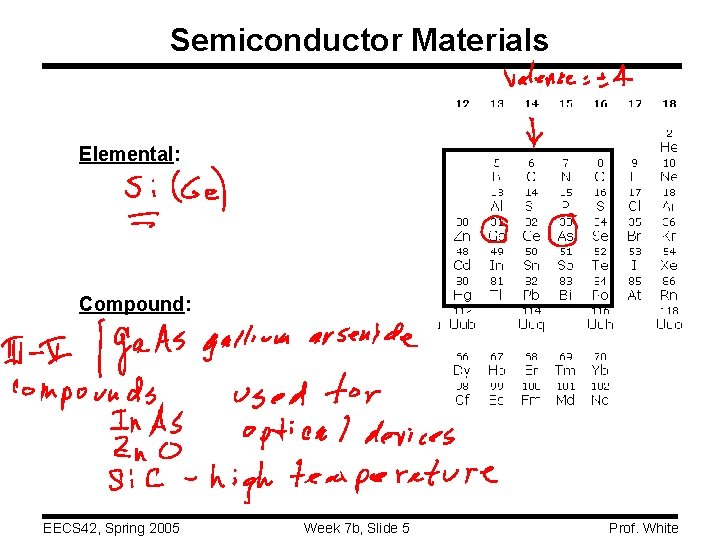
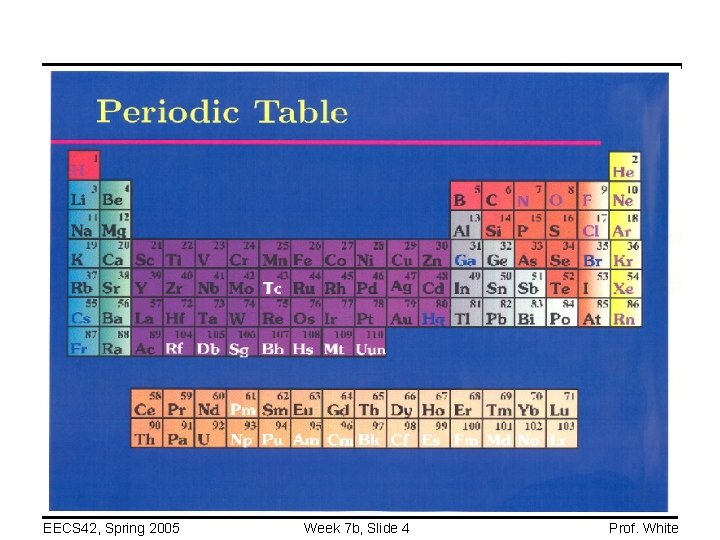
Semiconductor Materials Elemental: Compound: EECS 42, Spring 2005 Week 7 b, Slide 5 Prof. White
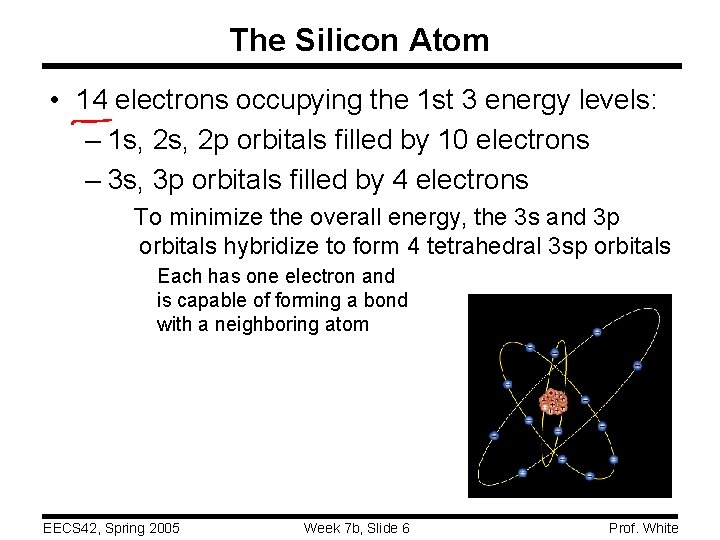
The Silicon Atom • 14 electrons occupying the 1 st 3 energy levels: – 1 s, 2 p orbitals filled by 10 electrons – 3 s, 3 p orbitals filled by 4 electrons To minimize the overall energy, the 3 s and 3 p orbitals hybridize to form 4 tetrahedral 3 sp orbitals Each has one electron and is capable of forming a bond with a neighboring atom EECS 42, Spring 2005 Week 7 b, Slide 6 Prof. White
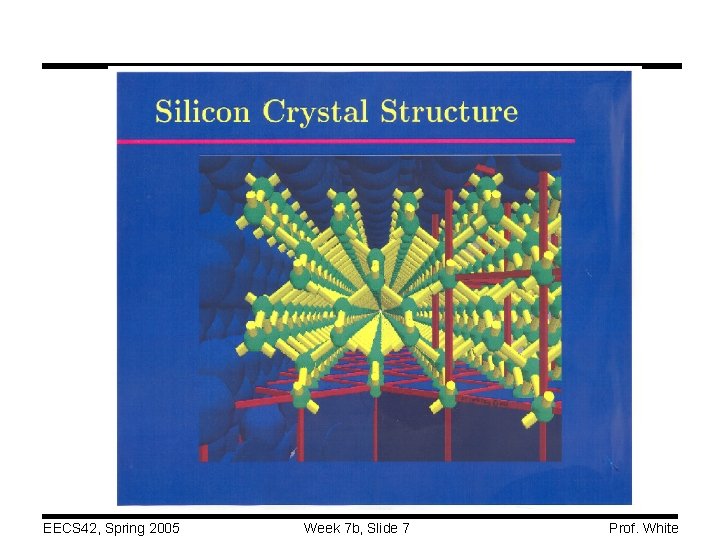
EECS 42, Spring 2005 Week 7 b, Slide 7 Prof. White
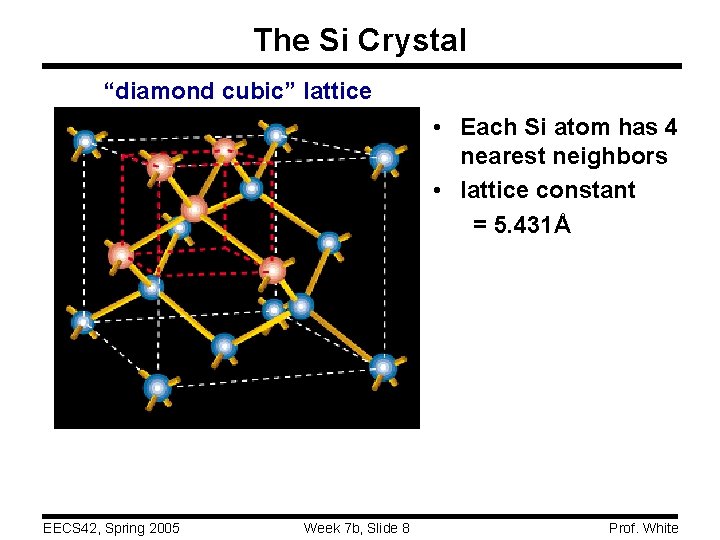
The Si Crystal “diamond cubic” lattice • Each Si atom has 4 nearest neighbors • lattice constant = 5. 431Å EECS 42, Spring 2005 Week 7 b, Slide 8 Prof. White
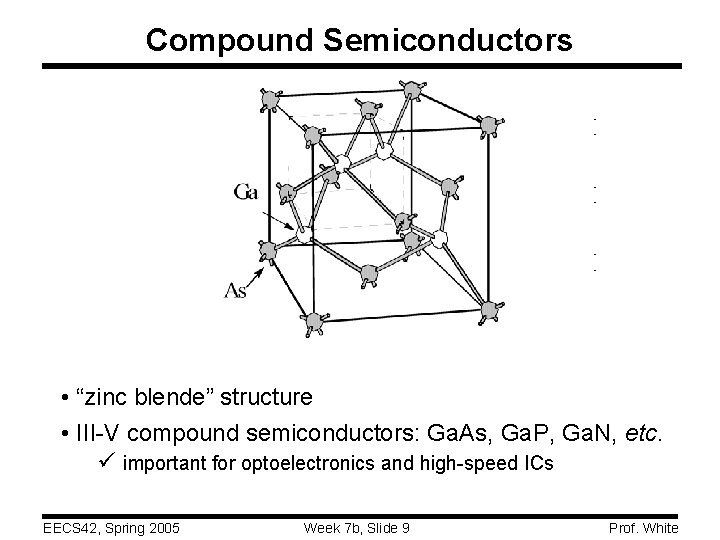
Compound Semiconductors • “zinc blende” structure • III-V compound semiconductors: Ga. As, Ga. P, Ga. N, etc. ü important for optoelectronics and high-speed ICs EECS 42, Spring 2005 Week 7 b, Slide 9 Prof. White
Electronic Properties of Si Silicon is a semiconductor material. Pure Si has relatively high resistivity at room temperature. There are 2 types of mobile charge-carriers in Si: Conduction electrons are negatively charged. Holes are positively charged. They are an “absence of electrons”. The concentration of conduction electrons & holes in a semiconductor can be affected in several ways: 1. 2. 3. 4. by adding special impurity atoms (dopants) by applying an electric field by changing the temperature by irradiation EECS 42, Spring 2005 Week 7 b, Slide 10 Prof. White
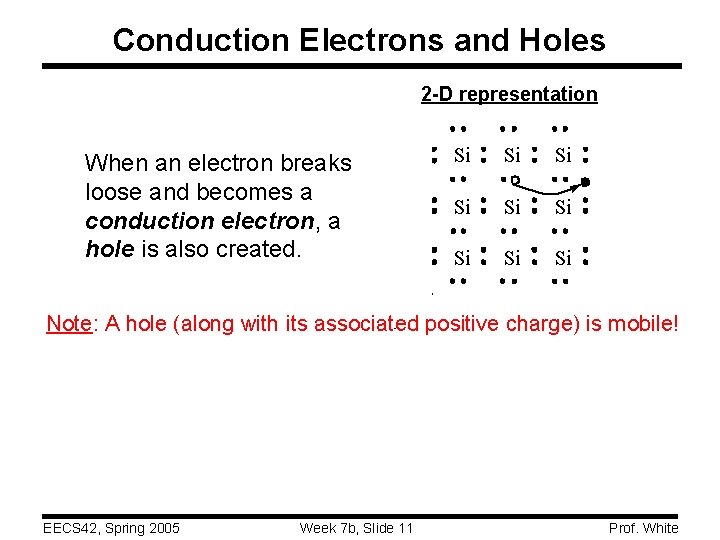
Conduction Electrons and Holes 2 -D representation When an electron breaks loose and becomes a conduction electron, a hole is also created. Si Si Si Note: A hole (along with its associated positive charge) is mobile! EECS 42, Spring 2005 Week 7 b, Slide 11 Prof. White
Definition of Parameters n = number of mobile electrons per cm 3 p = number of holes per cm 3 ni = intrinsic carrier concentration (#/cm 3) In a pure semiconductor, n = p = ni EECS 42, Spring 2005 Week 7 b, Slide 12 Prof. White
Generation • We have seen that conduction (mobile) electrons and holes can be created in pure (intrinsic) silicon by thermal generation. – Thermal generation rate increases exponentially with temperature T • Another type of generation process which can occur is optical generation – The energy absorbed from a photon frees an electron from covalent bond • In Si, the minimum energy required is 1. 1 e. V, which corresponds to ~1 mm wavelength (infrared region). 1 e. V = energy gained by an electron falling through 1 V potential = qe. V = 1. 6 x 10 -19 C x 1 V = 1. 6 x 10 -19 J. • Note that conduction electrons and holes are continuously generated, if T > 0 EECS 42, Spring 2005 Week 7 b, Slide 13 Prof. White
EECS 42, Spring 2005 Week 7 b, Slide 14 Prof. White
Recombination • When a conduction electron and hole meet, each one is eliminated, a process called “recombination”. The energy lost by the conduction electron (when it “falls” back into the covalent bond) can be released in two ways: 1. to the semiconductor lattice (vibrations) “thermal recombination” semiconductor is heated 2. to photon emission “optical recombination” light is emitted • Optical recombination is negligible in Si. It is significant in compound semiconductor materials, and is the basis for light-emitting diodes and laser diodes. EECS 42, Spring 2005 Week 7 b, Slide 15 Prof. White
Late News – Silicon Laser In October 2004 UCLA researchers reported making a (Raman*) laser in a silicon waveguide, and in February 2005 reported being able to modulate the optical output by simply using a silicon pn-junction diode to inject loss-producing electrons into the laser cavity. Expectation: use of optical radiation to output information from silicon chips (someday) • See photonics. com/dictionary web site for Raman effect description EECS 42, Spring 2005 Week 7 b, Slide 16 Prof. White
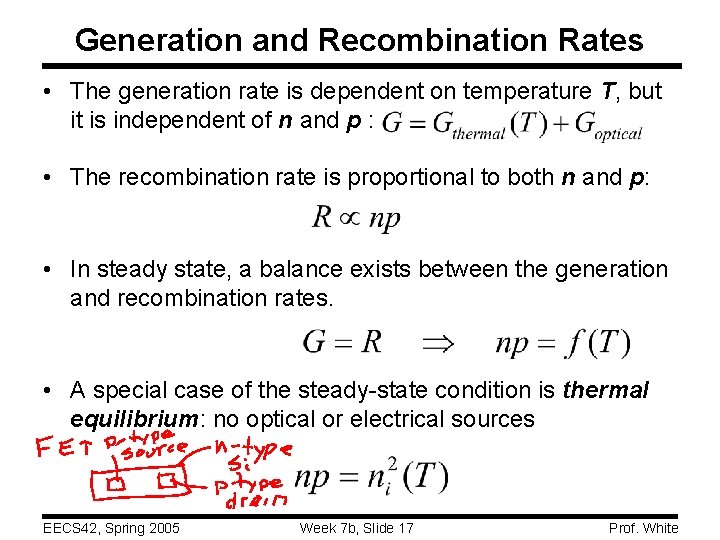
Generation and Recombination Rates • The generation rate is dependent on temperature T, but it is independent of n and p : • The recombination rate is proportional to both n and p: • In steady state, a balance exists between the generation and recombination rates. • A special case of the steady-state condition is thermal equilibrium: no optical or electrical sources EECS 42, Spring 2005 Week 7 b, Slide 17 Prof. White
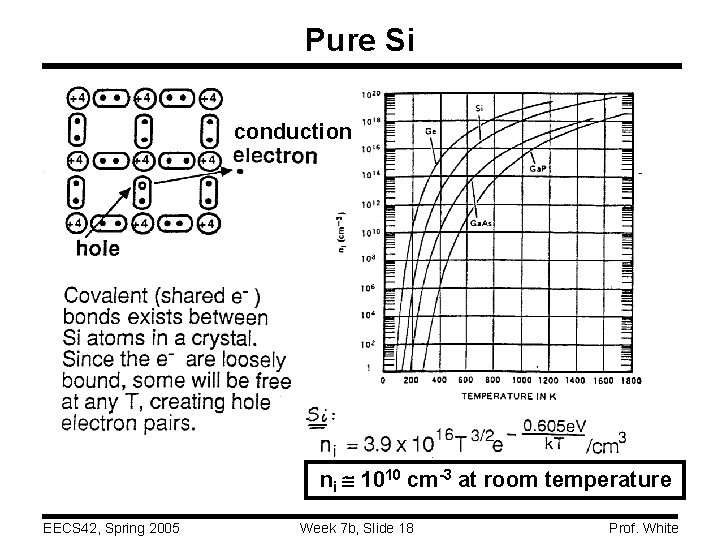
Pure Si conduction ni 1010 cm-3 at room temperature EECS 42, Spring 2005 Week 7 b, Slide 18 Prof. White
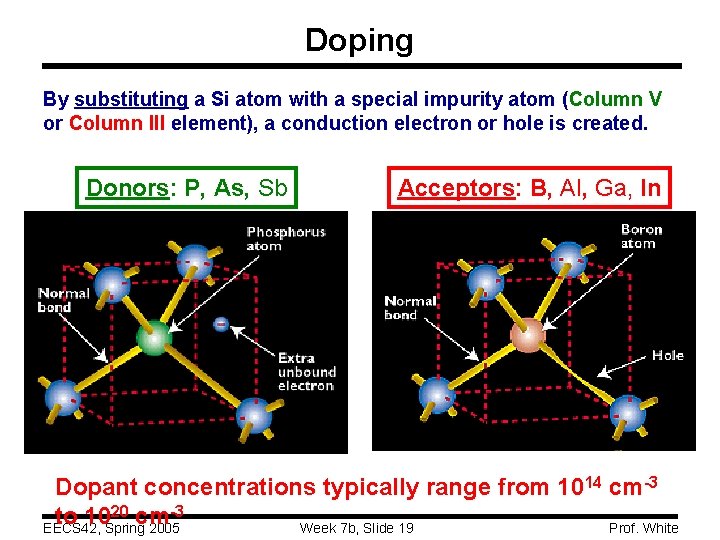
Doping By substituting a Si atom with a special impurity atom (Column V or Column III element), a conduction electron or hole is created. Donors: P, As, Sb Acceptors: B, Al, Ga, In Dopant concentrations typically range from 1014 cm-3 20 cm-3 to 10 EECS 42, Spring 2005 Prof. White Week 7 b, Slide 19
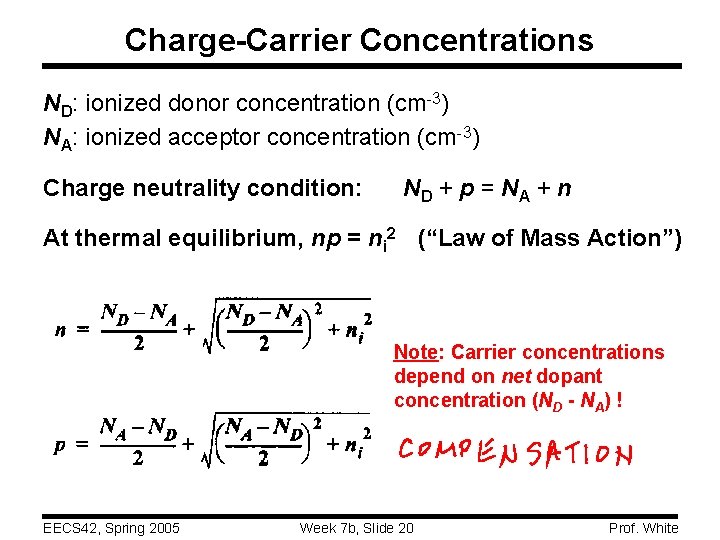
Charge-Carrier Concentrations ND: ionized donor concentration (cm-3) NA: ionized acceptor concentration (cm-3) Charge neutrality condition: ND + p = NA + n At thermal equilibrium, np = ni 2 (“Law of Mass Action”) Note: Carrier concentrations depend on net dopant concentration (ND - NA) ! EECS 42, Spring 2005 Week 7 b, Slide 20 Prof. White
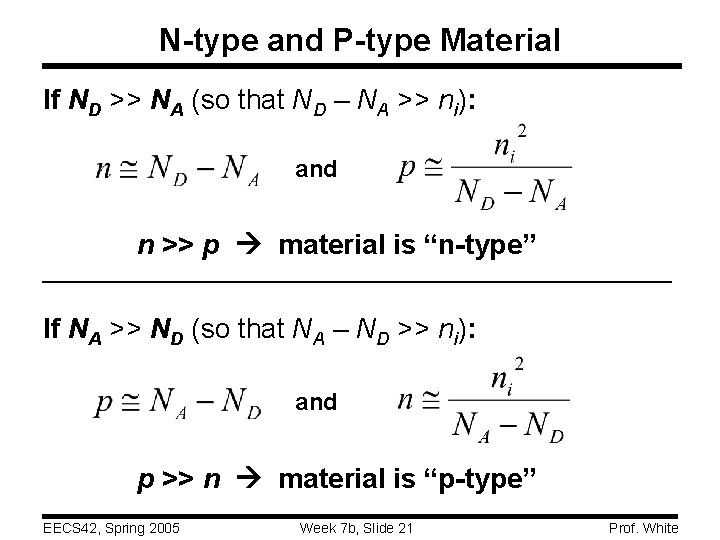
N-type and P-type Material If ND >> NA (so that ND – NA >> ni): and n >> p material is “n-type” If NA >> ND (so that NA – ND >> ni): and p >> n material is “p-type” EECS 42, Spring 2005 Week 7 b, Slide 21 Prof. White
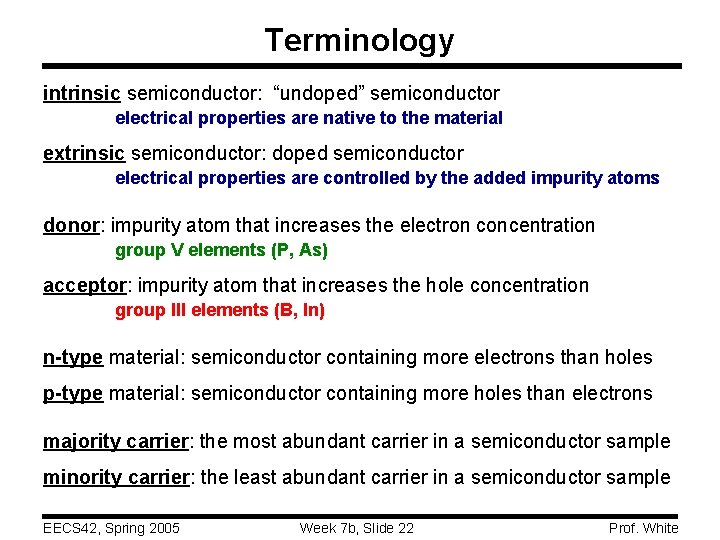
Terminology intrinsic semiconductor: “undoped” semiconductor electrical properties are native to the material extrinsic semiconductor: doped semiconductor electrical properties are controlled by the added impurity atoms donor: impurity atom that increases the electron concentration group V elements (P, As) acceptor: impurity atom that increases the hole concentration group III elements (B, In) n-type material: semiconductor containing more electrons than holes p-type material: semiconductor containing more holes than electrons majority carrier: the most abundant carrier in a semiconductor sample minority carrier: the least abundant carrier in a semiconductor sample EECS 42, Spring 2005 Week 7 b, Slide 22 Prof. White
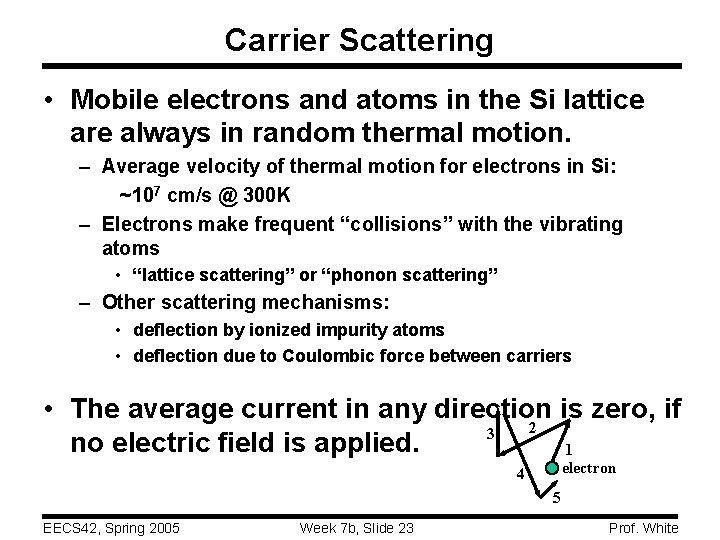
Carrier Scattering • Mobile electrons and atoms in the Si lattice are always in random thermal motion. – Average velocity of thermal motion for electrons in Si: ~107 cm/s @ 300 K – Electrons make frequent “collisions” with the vibrating atoms • “lattice scattering” or “phonon scattering” – Other scattering mechanisms: • deflection by ionized impurity atoms • deflection due to Coulombic force between carriers • The average current in any direction is zero, if 2 3 no electric field is applied. 1 electron 4 5 EECS 42, Spring 2005 Week 7 b, Slide 23 Prof. White
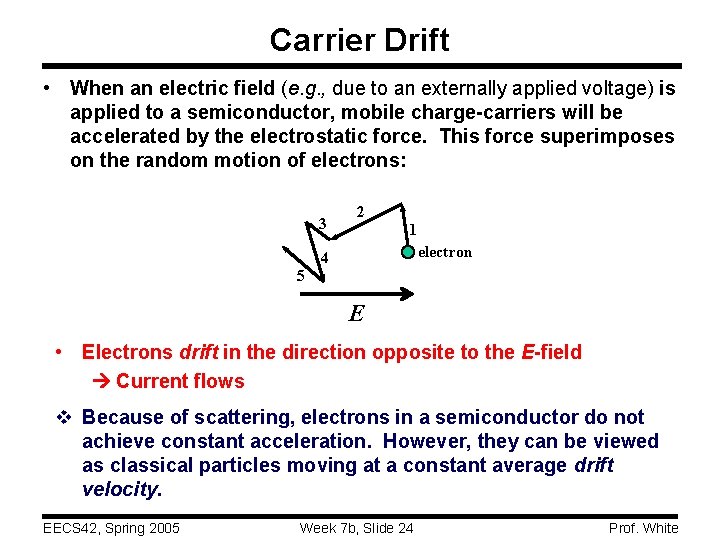
Carrier Drift • When an electric field (e. g. , due to an externally applied voltage) is applied to a semiconductor, mobile charge-carriers will be accelerated by the electrostatic force. This force superimposes on the random motion of electrons: 3 2 1 electron 4 5 E • Electrons drift in the direction opposite to the E-field Current flows v Because of scattering, electrons in a semiconductor do not achieve constant acceleration. However, they can be viewed as classical particles moving at a constant average drift velocity. EECS 42, Spring 2005 Week 7 b, Slide 24 Prof. White
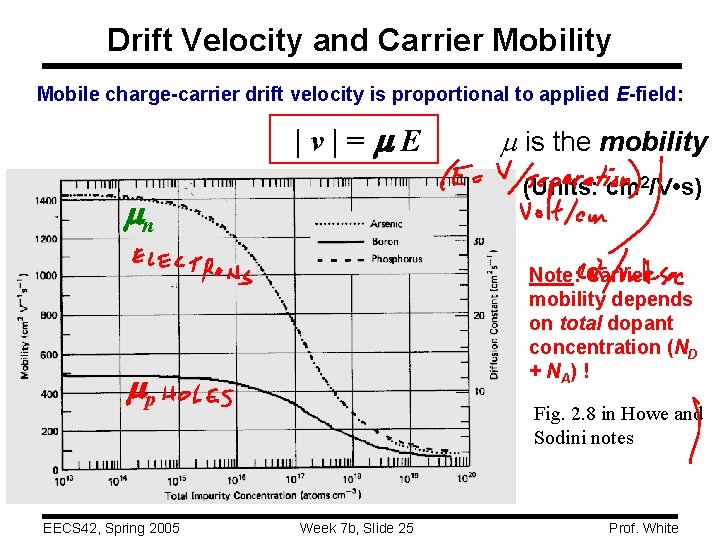
Drift Velocity and Carrier Mobility Mobile charge-carrier drift velocity is proportional to applied E-field: |v|= E (Units: cm 2/V • s) n Note: Carrier mobility depends on total dopant concentration (ND + NA) ! p EECS 42, Spring 2005 m is the mobility Fig. 2. 8 in Howe and Sodini notes Week 7 b, Slide 25 Prof. White
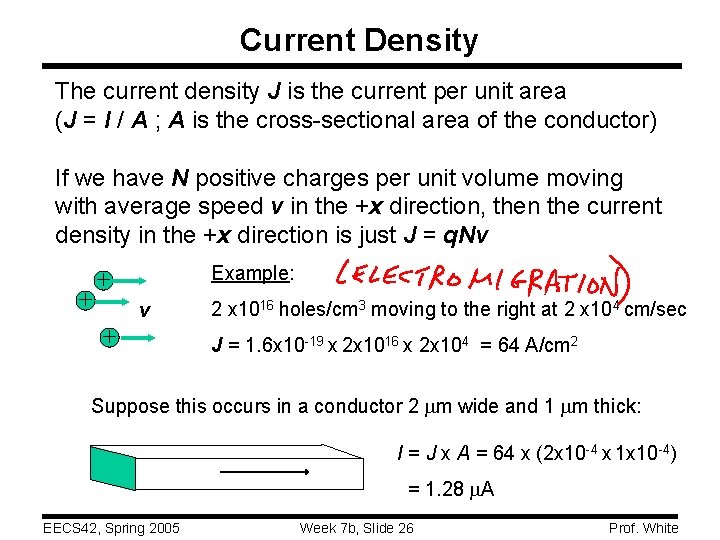
Current Density The current density J is the current per unit area (J = I / A ; A is the cross-sectional area of the conductor) If we have N positive charges per unit volume moving with average speed v in the +x direction, then the current density in the +x direction is just J = q. Nv + Example: + v + 2 x 10¹⁶ holes/cm 3 moving to the right at 2 x 104 cm/sec J = 1. 6 x 10 -19 x 2 x 1016 x 2 x 104 = 64 A/cm 2 Suppose this occurs in a conductor 2 mm wide and 1 mm thick: I = J x A = 64 x (2 x 10 -4 x 1 x 10 -4) = 1. 28 m. A EECS 42, Spring 2005 Week 7 b, Slide 26 Prof. White
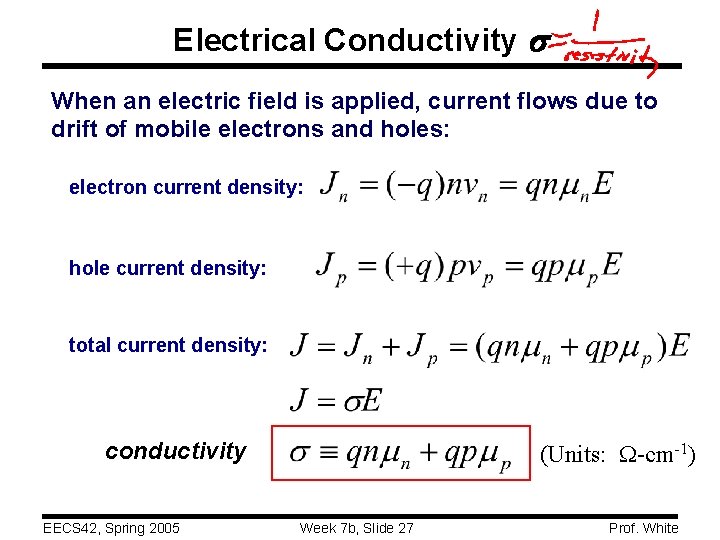
Electrical Conductivity s When an electric field is applied, current flows due to drift of mobile electrons and holes: electron current density: hole current density: total current density: conductivity EECS 42, Spring 2005 (Units: W-cm-1) Week 7 b, Slide 27 Prof. White
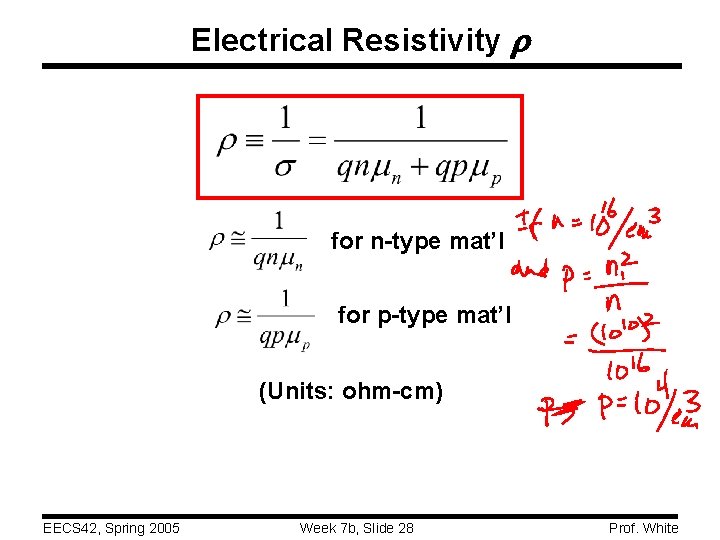
Electrical Resistivity for n-type mat’l for p-type mat’l (Units: ohm-cm) EECS 42, Spring 2005 Week 7 b, Slide 28 Prof. White
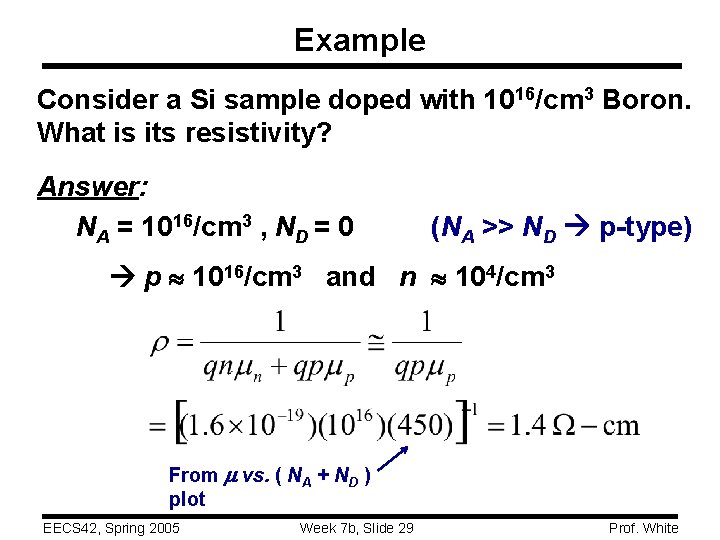
Example Consider a Si sample doped with 1016/cm 3 Boron. What is its resistivity? Answer: NA = 1016/cm 3 , ND = 0 (NA >> ND p-type) p 1016/cm 3 and n 104/cm 3 From vs. ( NA + ND ) plot EECS 42, Spring 2005 Week 7 b, Slide 29 Prof. White
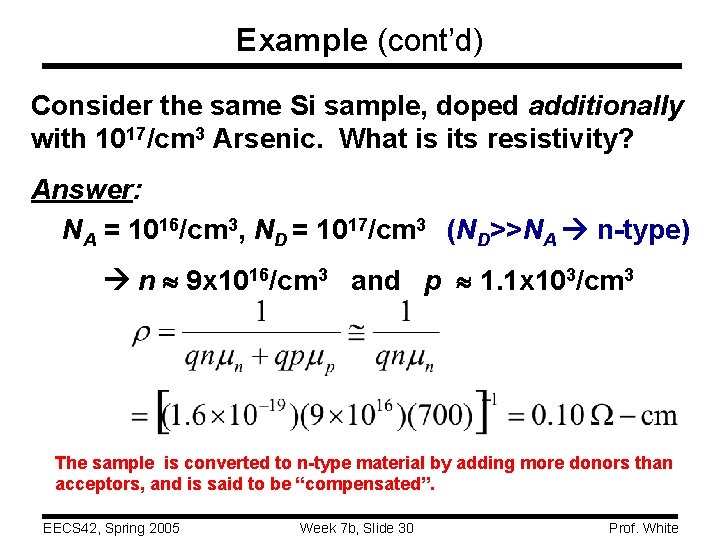
Example (cont’d) Consider the same Si sample, doped additionally with 1017/cm 3 Arsenic. What is its resistivity? Answer: NA = 1016/cm 3, ND = 1017/cm 3 (ND>>NA n-type) n 9 x 10¹⁶/cm 3 and p 1. 1 x 10³/cm 3 The sample is converted to n-type material by adding more donors than acceptors, and is said to be “compensated”. EECS 42, Spring 2005 Week 7 b, Slide 30 Prof. White
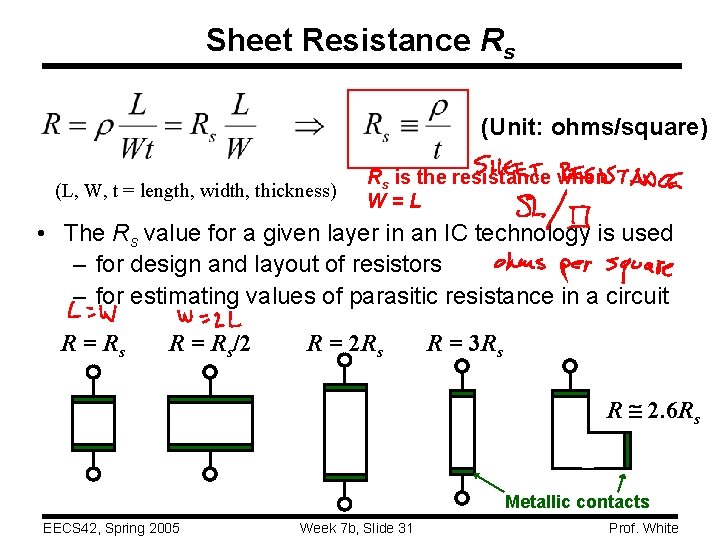
Sheet Resistance Rs (Unit: ohms/square) (L, W, t = length, width, thickness) Rs is the resistance when W=L • The Rs value for a given layer in an IC technology is used – for design and layout of resistors – for estimating values of parasitic resistance in a circuit R = Rs/2 R = 2 Rs R = 3 Rs R 2. 6 Rs Metallic contacts EECS 42, Spring 2005 Week 7 b, Slide 31 Prof. White
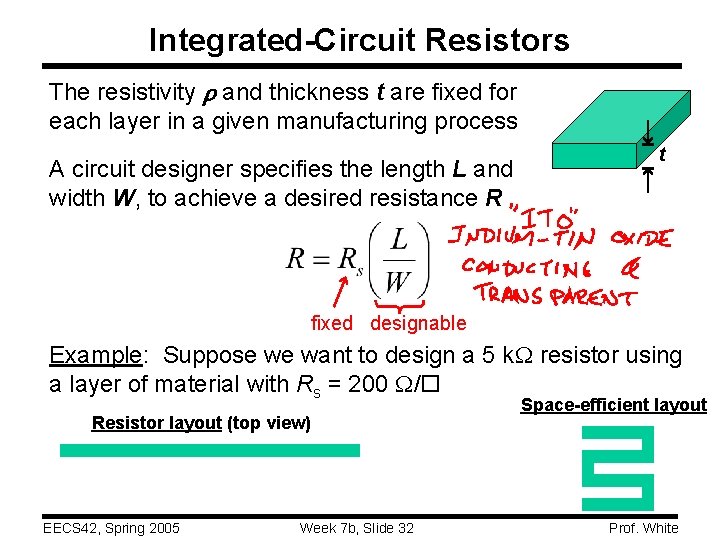
Integrated-Circuit Resistors The resistivity and thickness t are fixed for each layer in a given manufacturing process A circuit designer specifies the length L and width W, to achieve a desired resistance R t fixed designable Example: Suppose we want to design a 5 k. W resistor using a layer of material with Rs = 200 W/ Resistor layout (top view) EECS 42, Spring 2005 Week 7 b, Slide 32 Space-efficient layout Prof. White
Summary • Crystalline Si: – 4 valence electrons per atom – diamond lattice: each atom has 4 nearest neighbors – 5 x 10²² atoms/cm 3 • In a pure Si crystal, conduction electrons and holes are formed in pairs. – Holes can be considered as positively charged mobile particles which exist inside a semiconductor. – Both holes and electrons can conduct current. • Dopants in Si: – Reside on lattice sites (substituting for Si) – Group V elements contribute conduction electrons, and are called donors – Group III elements contribute holes, and are called acceptors EECS 42, Spring 2005 Week 7 b, Slide 33 Prof. White
- Slides: 33