
Week 7 2 The Laurent series and the
- Slides: 10
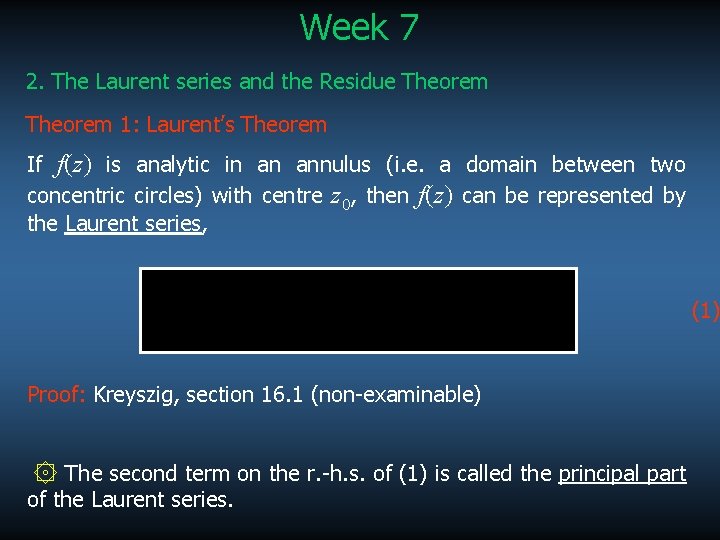
Week 7 2. The Laurent series and the Residue Theorem 1: Laurent’s Theorem If f(z) is analytic in an annulus (i. e. a domain between two concentric circles) with centre z 0, then f(z) can be represented by the Laurent series, (1) Proof: Kreyszig, section 16. 1 (non-examinable) ۞ The second term on the r. -h. s. of (1) is called the principal part of the Laurent series.
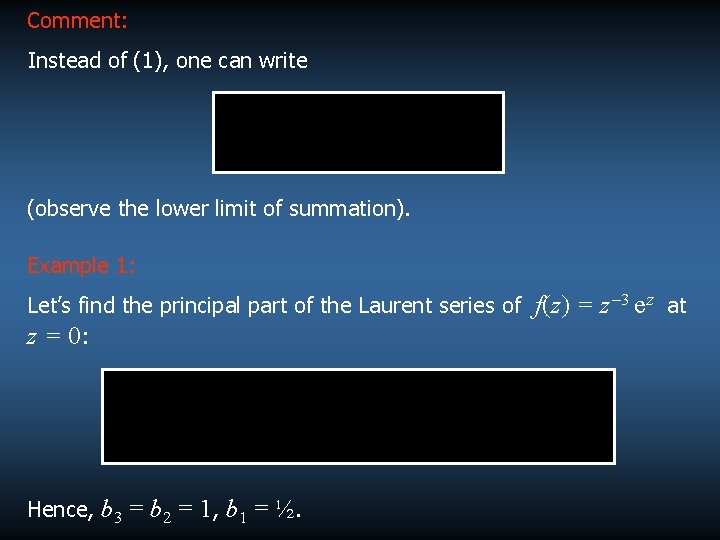
Comment: Instead of (1), one can write (observe the lower limit of summation). Example 1: Let’s find the principal part of the Laurent series of f(z) = z – 3 e z at z = 0: Hence, b 3 = b 2 = 1, b 1 = ½.
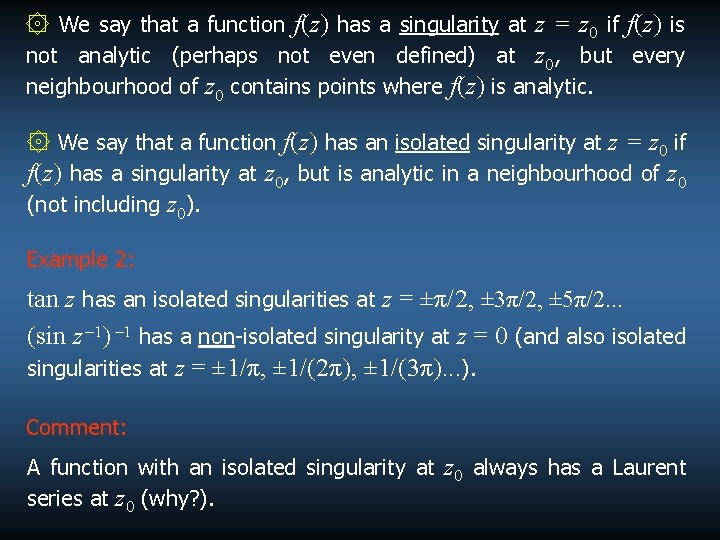
۞ We say that a function f(z) has a singularity at z = z 0 if f(z) is not analytic (perhaps not even defined) at z 0, but every neighbourhood of z 0 contains points where f(z) is analytic. ۞ We say that a function f(z) has an isolated singularity at z = z 0 if f(z) has a singularity at z 0, but is analytic in a neighbourhood of z 0 (not including z 0). Example 2: tan z has an isolated singularities at z = ±π/2, ± 3π/2, ± 5π/2. . . (sin z – 1) – 1 has a non-isolated singularity at z = 0 (and also isolated singularities at z = ± 1/π, ± 1/(2π), ± 1/(3π). . . ). Comment: A function with an isolated singularity at z 0 always has a Laurent series at z 0 (why? ).
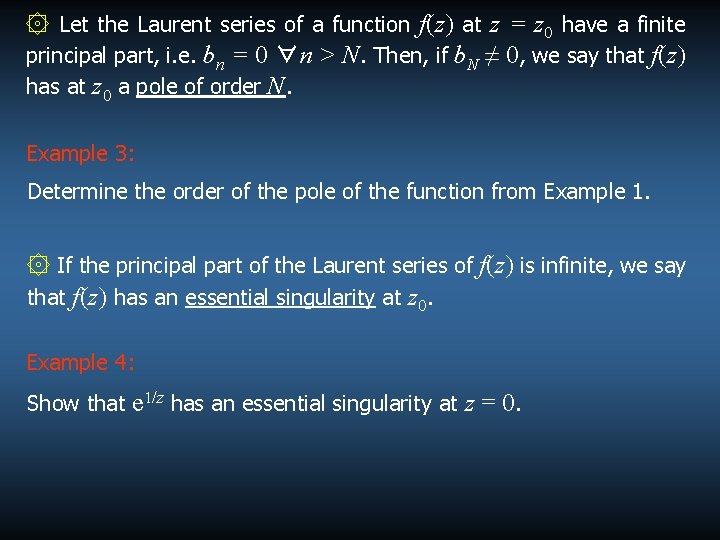
۞ Let the Laurent series of a function f(z) at z = z 0 have a finite principal part, i. e. bn = 0 ∀n > N. Then, if b. N ≠ 0, we say that f(z) has at z 0 a pole of order N. Example 3: Determine the order of the pole of the function from Example 1. ۞ If the principal part of the Laurent series of f(z) is infinite, we say that f(z) has an essential singularity at z 0. Example 4: Show that e 1/z has an essential singularity at z = 0.
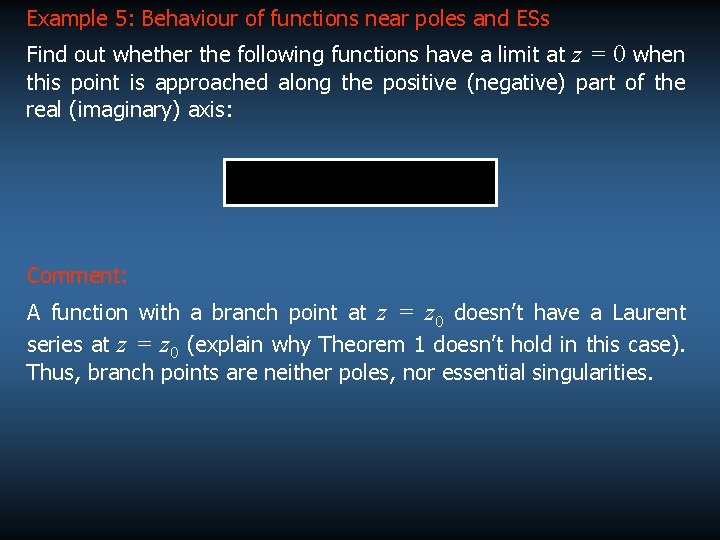
Example 5: Behaviour of functions near poles and ESs Find out whether the following functions have a limit at z = 0 when this point is approached along the positive (negative) part of the real (imaginary) axis: Comment: A function with a branch point at z = z 0 doesn’t have a Laurent series at z = z 0 (explain why Theorem 1 doesn’t hold in this case). Thus, branch points are neither poles, nor essential singularities.
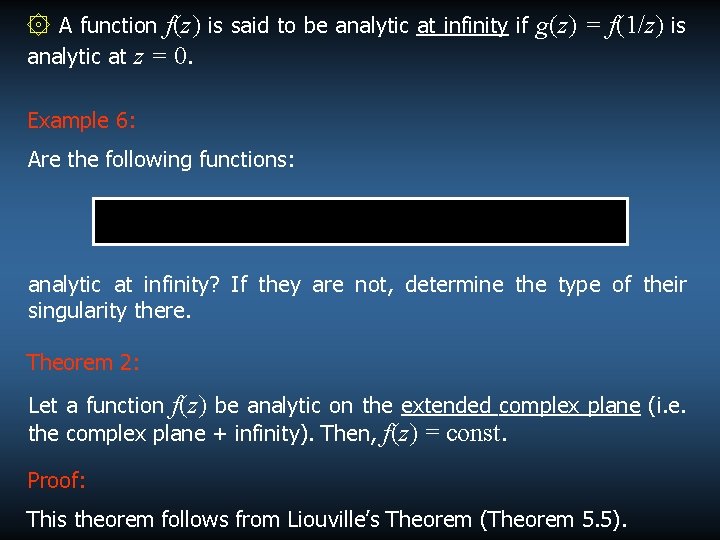
۞ A function f(z) is said to be analytic at infinity if g(z) = f(1/z) is analytic at z = 0. Example 6: Are the following functions: analytic at infinity? If they are not, determine the type of their singularity there. Theorem 2: Let a function f(z) be analytic on the extended complex plane (i. e. the complex plane + infinity). Then, f(z) = const. Proof: This theorem follows from Liouville’s Theorem (Theorem 5. 5).
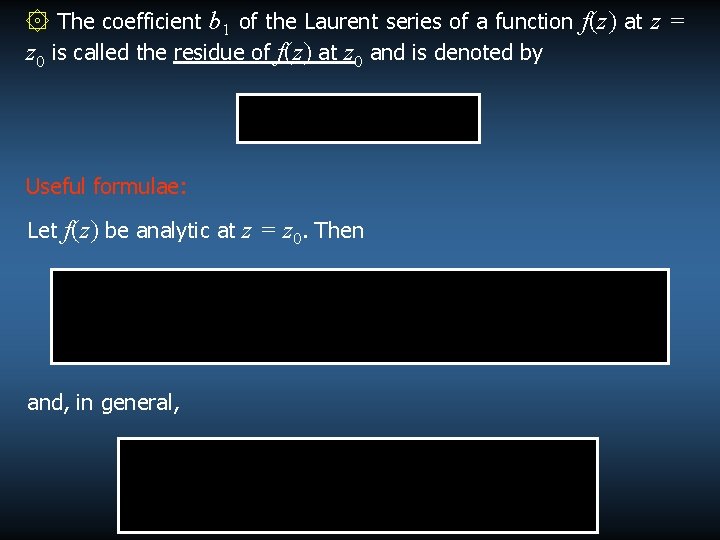
۞ The coefficient b 1 of the Laurent series of a function f(z) at z = z 0 is called the residue of f(z) at z 0 and is denoted by Useful formulae: Let f(z) be analytic at z = z 0. Then and, in general,
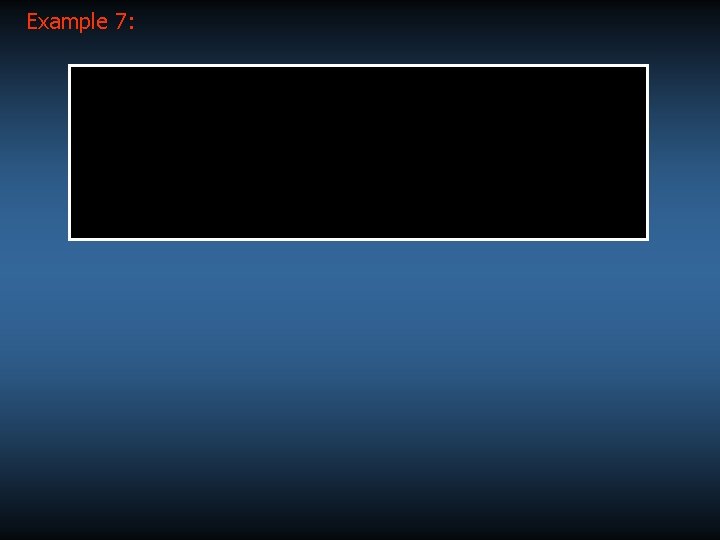
Example 7:
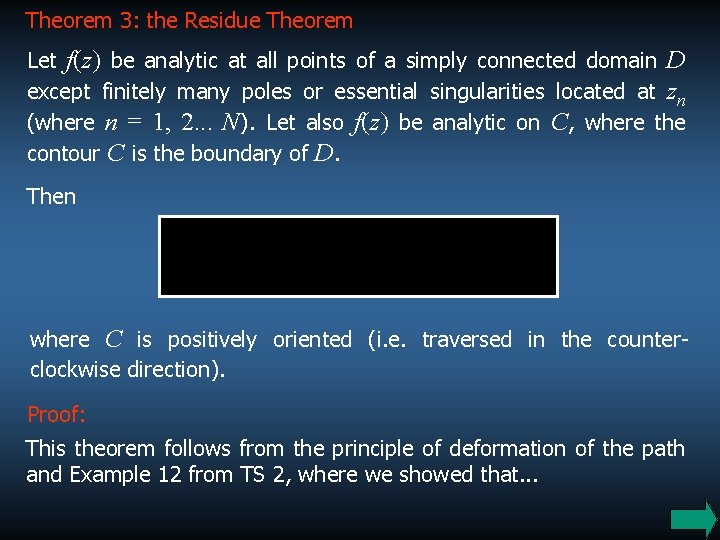
Theorem 3: the Residue Theorem Let f(z) be analytic at all points of a simply connected domain D except finitely many poles or essential singularities located at zn (where n = 1, 2. . . N). Let also f(z) be analytic on C, where the contour C is the boundary of D. Then where C is positively oriented (i. e. traversed in the counterclockwise direction). Proof: This theorem follows from the principle of deformation of the path and Example 12 from TS 2, where we showed that. . .
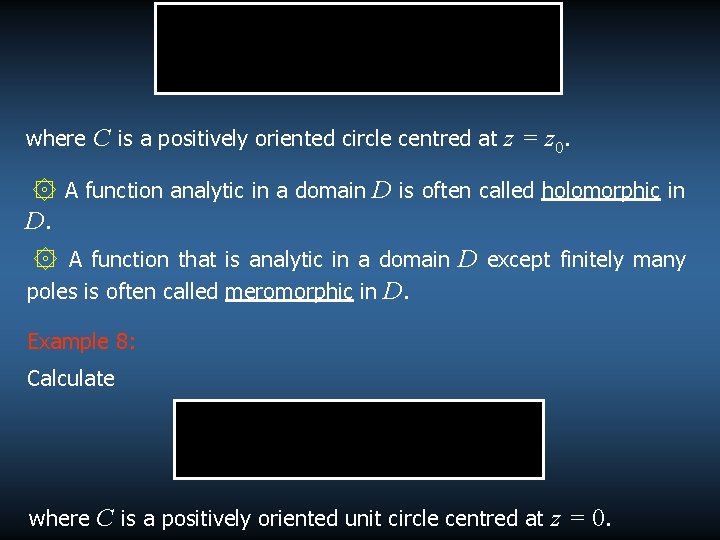
where C is a positively oriented circle centred at z = z 0. ۞ A function analytic in a domain D is often called holomorphic in D. ۞ A function that is analytic in a domain D except finitely many poles is often called meromorphic in D. Example 8: Calculate where C is a positively oriented unit circle centred at z = 0.