
Week 6 Doors and Windows Objectives This chapter
Week 6 Doors and Windows

Objectives • This chapter discusses doors and windows • Specifically discussed are types, sizes, plan and elevation symbols, construction details, residential schedules, and code requirements

Doors • Provide access, privacy, security, fire protection, and ventilation • Designers select doors to meet appearance, functionality, security, energy efficiency, and building code criteria • Made of wood, wood composites, steel, fiberglass composite, or mixtures • Steel doors can have wood veneers • Other choices: hollow core, solid core, flush, paneled, louvered, or fire-rated
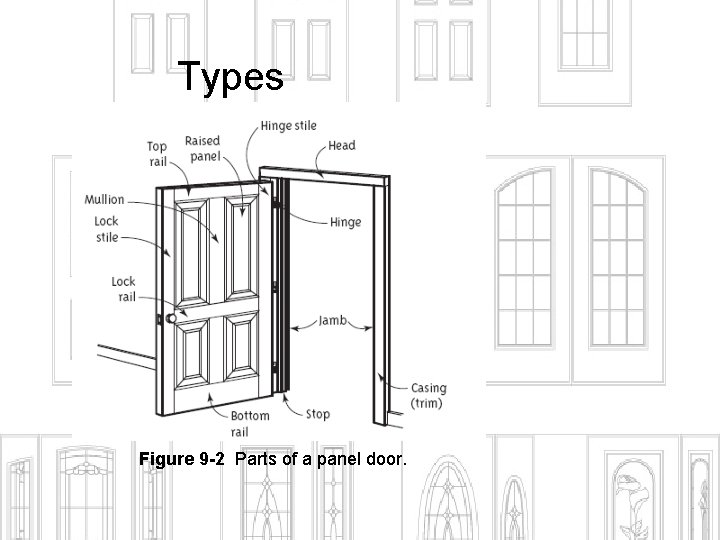
Types Figure 9 -2 Parts of a panel door.

Swing (Hinged) • Hinged on one side and swings in or out of the room Figure 9 -3 Exterior swing door with sidelights and transom window.
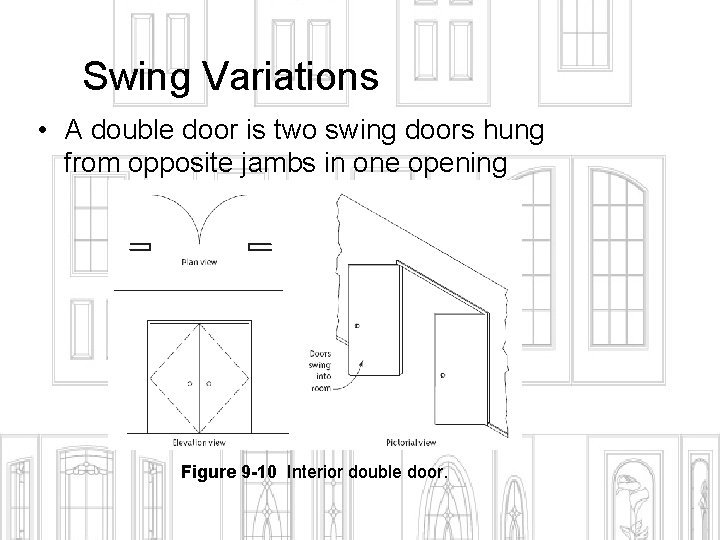
Swing Variations • A double door is two swing doors hung from opposite jambs in one opening Figure 9 -10 Interior double door.
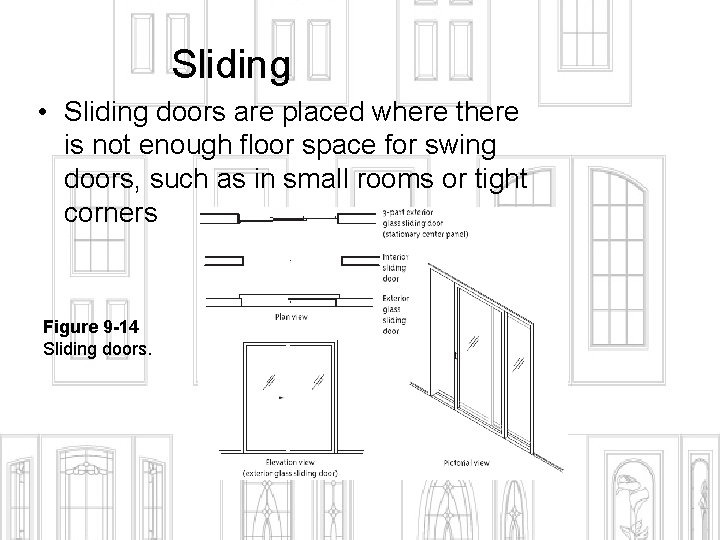
Sliding • Sliding doors are placed where there is not enough floor space for swing doors, such as in small rooms or tight corners Figure 9 -14 Sliding doors.
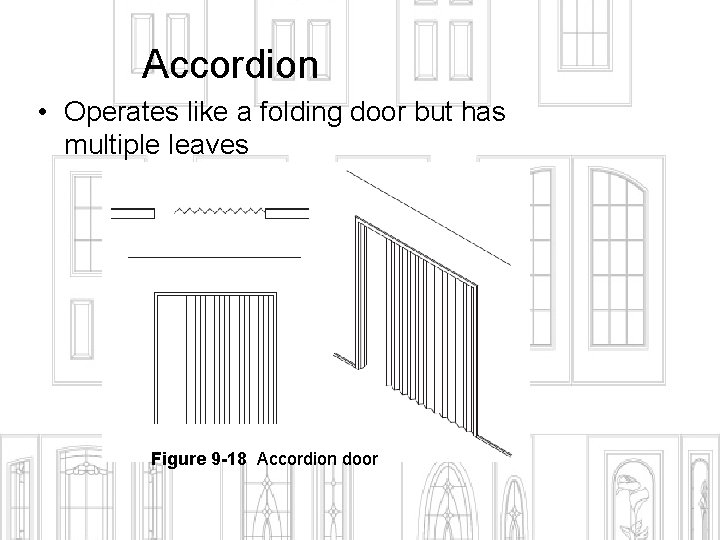
Accordion • Operates like a folding door but has multiple leaves Figure 9 -18 Accordion door
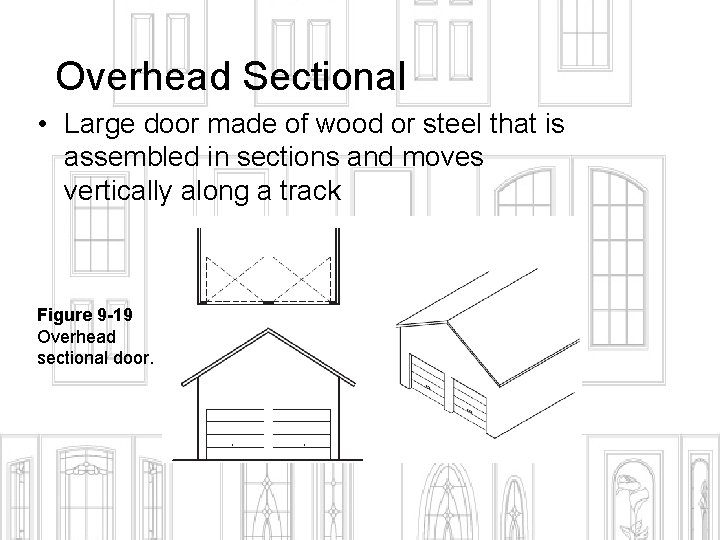
Overhead Sectional • Large door made of wood or steel that is assembled in sections and moves vertically along a track Figure 9 -19 Overhead sectional door.
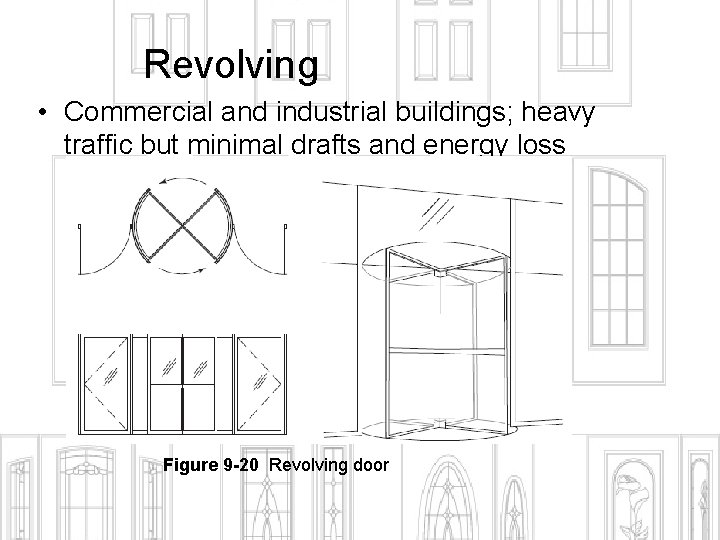
Revolving • Commercial and industrial buildings; heavy traffic but minimal drafts and energy loss Figure 9 -20 Revolving door
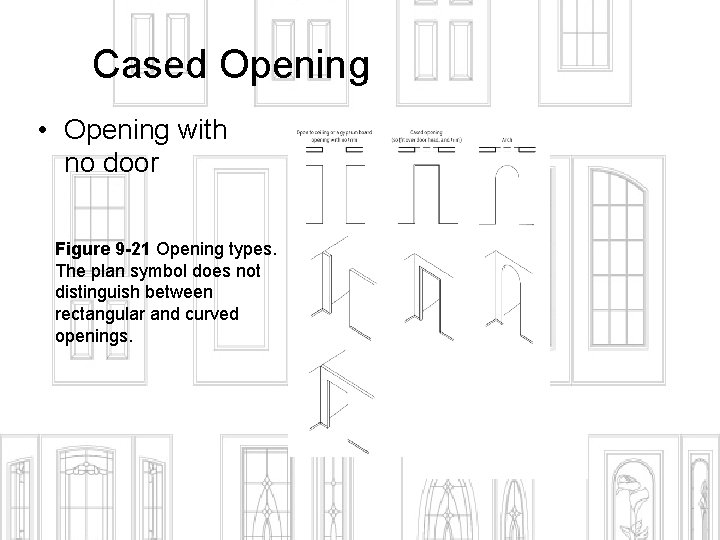
Cased Opening • Opening with no door Figure 9 -21 Opening types. The plan symbol does not distinguish between rectangular and curved openings.
Door Sizes • Common size is 6'-8" tall, 3'-0" wide and 1¾" thick • Wheelchair-accessible homes entry should have a 34" clearance around it • The rough opening, or hole in the wall, for an interior door is usually framed 3" higher than the door height and 2 ½" more than the door width to provide space for the frame
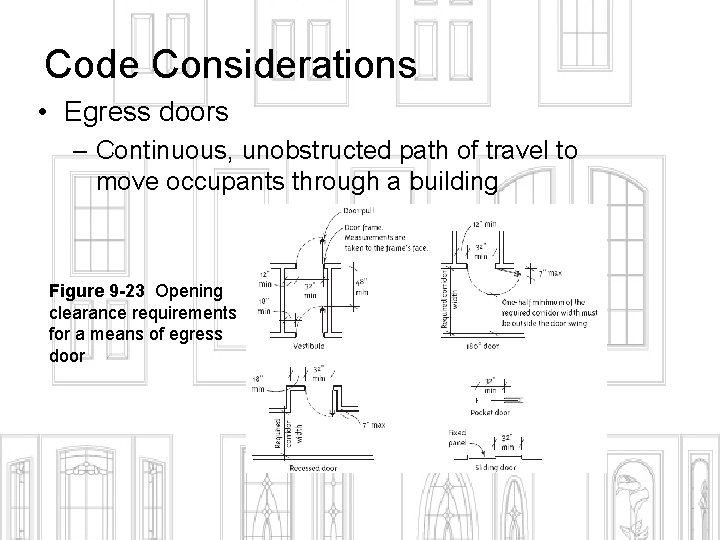
Code Considerations • Egress doors – Continuous, unobstructed path of travel to move occupants through a building Figure 9 -23 Opening clearance requirements for a means of egress door
Door Hardware • Anything that operates and holds a door in place – Hinges – Locks – Handles – Knobs – Exit devices – Bolts – Closers – Holders – Stops

Windows • Provide light, air, privacy, security, a view, and sometimes emergency egress • Fenestration: arrangement, proportioning, and design of windows and doors in a building • Sash: window glass plus the frame, two rails and two stiles – A trim, or casing, is placed around the sash – The sash may contain muntins
Glazing • Glazing, glass choices include: – Obscure – Single double- and triple-pane – Laminated – Tempered – Insulating – Low-emissive – Gas-filled – Impact – Art
Types • • • Double hung Fixed Slider Casement Awning • • • Hopper Jalousie Pivot Bay Bow Skylight
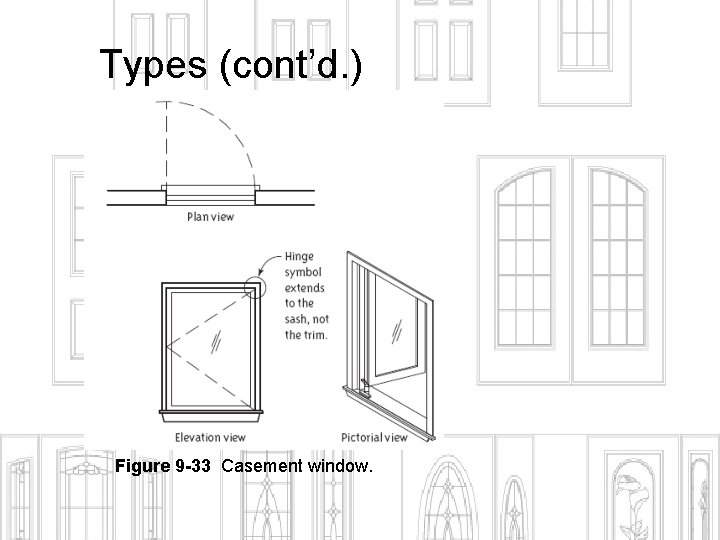
Types (cont’d. ) Figure 9 -33 Casement window.

Types (cont’d. ) Figure 9 -39 Jalousie window.
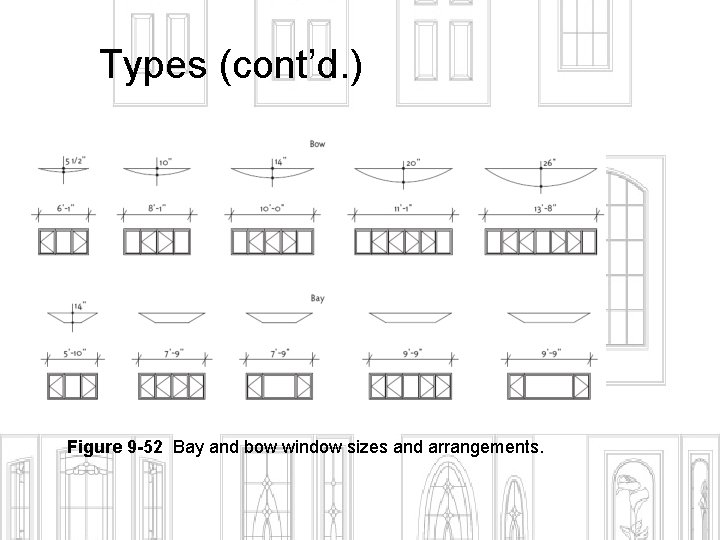
Types (cont’d. ) Figure 9 -52 Bay and bow window sizes and arrangements.
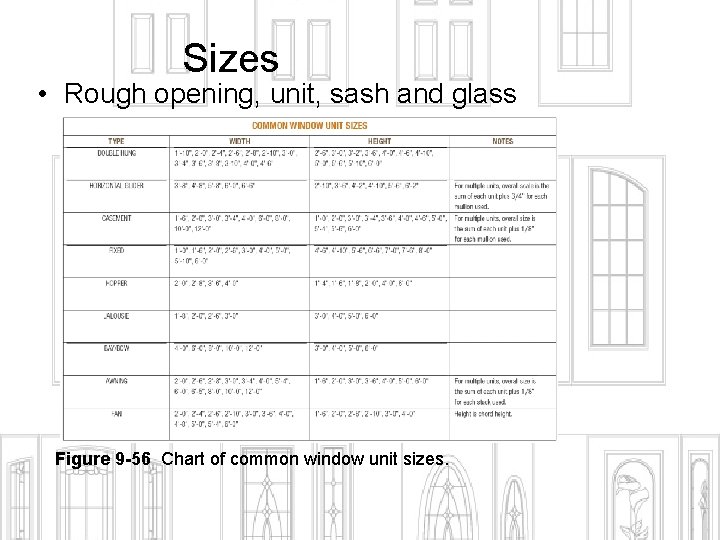
Sizes • Rough opening, unit, sash and glass Figure 9 -56 Chart of common window unit sizes.
Selection and Placement • Align the tops on multistory buildings • Glass area should be at least 20 percent of the room’s floor area • Ventilation windows should be at least 10 percent of the floor area • Placement on the south walls will bring in more light, but also will bring in more heat • Several small windows on multiple walls illuminate a room more evenly
Selection and Placement (cont’d. ) • Windows high on a wall provide more light penetration than windows placed low • Windows placed opposite each other attract cross-breezes • Like mirrors, large expanses of glass can make a room look larger • Design window openings to match standard window sizes • Place windows to reveal the best views

Door and Window Construction Details • The head is the top, the jambs are the sides and the sill is the bottom Figure 9 -65 Door framing. Figure 9 -66 Window framing.
Hardware • Screws, hinges, knobs, screens, and other hardware usually included in construction detail drawings • Finished floor surface on either side of an interior door must be the same elevation as the threshold • Threshold hardware strip must be beveled • Codes require exit door hardware to be easily used with one hand • Closers to make a door self-closing
Summary • Doors and windows are important building components that come in many types and sizes • Important to know the rudiments of their construction so you can draft them properly • Symbols and details tell the reader where they are located, what they look like, and how they operate
- Slides: 26